


The happiness of your life depends upon the quality of your thoughts, therefore guard accordingly; and take care that you entertain no notions unsuitable to virtue, and reasonable nature.
Marcus Aurelius Antoninus (121 AD – 180 AD)The motivation to rid one's mind of unwanted thoughts is an intuitive one. After all, unpleasant thoughts are accompanied by unpleasant emotions. It turns out, however, in two decades since the first empirical investigation of the phenomenon (Wegner, Schneider, Carter and White, Reference Wegner, Schneider, Carter III and White1987) that the stoic prescription above does not work. Quite to the contrary, the salience attributed to unwanted thoughts and the drive to eliminate them from consciousness might create the precise formula for turning the ordinary experience of unwanted thoughts into the painful experience of obsessions.
There exists a large body of evidence to suggest that the management of intrusive thoughts is a tricky enterprise. According to Wegner's (Reference Wegner1994) ironic process theory, suppression is at best unsustainable and at worst counterproductive, and this “rebound” of unwanted thoughts occurs both in normal experience as well in many forms of psychopathology (see reviews by Abramowitz, Tolin and Street, Reference Abramowitz, Tolin and Street2001; Clark, Reference Clark2005; Najmi and Wegner, Reference Najmi, Wegner and Elliot2008; Rassin, Reference Rassin2005; Wenzlaff and Wegner, Reference Wenzlaff, Wegner and Fiske2000), such as posttraumatic stress disorder (PTSD) (Shipherd and Beck, Reference Shipherd and Beck1999), acute stress disorder (Guthrie and Bryant, Reference Guthrie and Bryant2000; Harvey and Bryant, Reference Harvey and Bryant1998) and depression (Dalgleish and Yiend, Reference Dalgleish and Yiend2006; Wenzlaff and Bates, Reference Wenzlaff and Bates1998; Wenzlaff and Eisenberg, Reference Wenzlaff and Eisenberg2001; Wenzlaff, Meir and Salas, Reference Wenzlaff, Meir and Salas2002; Wenzlaff, Wegner and Roper, Reference Wenzlaff, Wegner and Roper1988).
Obsessive-compulsive disorder (OCD) is defined by the persistence of unwanted thoughts and active resistance of these thoughts, and so the fact that thought suppression may have a role to play in the maintenance of OCD is not surprising, although the precise nature of this role is not straightforward. According to the cognitive-behavioral perspective on OCD (Salkovskis, Reference Salkovskis1985; Rachman, Reference Rachman1997), the unwanted, intrusive thoughts that characterize OCD may persist because of two processes in addition to suppression: pre-existing beliefs about intrusive thoughts and faulty interpretations of intrusions (Clark, Reference Clark2001). In other words, dysfunctional appraisals of the thoughts – for instance, that unwanted thoughts should be controlled and that their occurrence is a sign of impending danger or of immorality of the person having the thought – and unsuccessful attempts to neutralize and suppress these thoughts may cause normal unwanted thoughts to escalate into clinical obsessions. Thus, according to this model, thought suppression alone is not the primary factor implicated in the pathogenesis of obsessions, but rather it is suppression motivated by the need to control unwanted thoughts in order to prevent harm.
With a few exceptions (Kelly and Kahn, Reference Kelly and Kahn1994; Purdon and Clark, Reference Purdon and Clark2001), the paradoxical effects of suppressing obsessional thoughts in non-clinical samples have been observed fairly consistently (McNally and Ricciardi, Reference McNally and Ricciardi1996; Salkovskis and Campbell, Reference Salkovskis and Campbell1994; Salkovskis and Reynolds, Reference Salkovskis and Reynolds1994; Trinder and Salkovskis, Reference Trinder and Salkovskis1994). For instance, in a series of studies, Salkovskis and colleagues observed a suppression-related increase in intrusive thoughts both in the lab and over a 4-day naturalistic follow-up. Studies examining the suppression of neutral targets with OCD patients have found evidence for the counterproductive effects of suppression (e.g. Tolin, Abramowitz, Przeworski and Foa, Reference Tolin, Abramowitz, Hamlin, Foa and Synodi2002a). However, to date, the three studies with OCD patients that have explored the effects of suppressing obsessional thoughts revealed no evidence for an increase in thought frequency (Janeck and Calamari, Reference Janeck and Calamari1999; Najmi, Riemann and Wegner, in press; Purdon, Rowa and Antony, Reference Purdon, Rowa and Antony2005).
This raises the question: if OCD patients are no worse than healthy individuals at suppressing their unwanted thoughts, why do they report heightened inadequacy in controlling these thoughts? Purdon and Clark (Reference Purdon and Clark2000) have argued that certain individuals hold preexisting metacognitive beliefs (Flavell, Reference Flavell1979) about the control of thoughts, namely that unwanted thoughts can and should be controlled and that intrusive thoughts are the product of an unhealthy mind. These include beliefs about the need to control unwanted thoughts in order to prevent negative consequences (e.g. “If I don't control my unwanted thoughts, something bad is bound to happen.”) and beliefs about the controllability of unwanted thoughts (e.g. “If I exercise enough will-power, I should be able to gain complete control over my mind.”) (OCCWG, 1997). These beliefs may sensitize OCD patients to their inability to suppress their thoughts perfectly, and they may judge their ability against their unrealistic beliefs about the controllability of thoughts. For example, Tolin, Abramowitz, Hamlin, Foa and Synodi (Reference Tolin, Abramowitz, Hamlin, Foa and Synodi2002a) observed that OCD patients are more likely than anxious and non-anxious controls to attribute a failure of thought suppression to internal, negative reasons (e.g. “I am mentally weak.”)
These faulty, preexisting beliefs about the control of thoughts – that unwanted thoughts can and should be controlled – are the focus of the present research. More specifically, we examined the question of whether or not these faulty beliefs may be reduced by means of a behavioral experiment, the original thought suppression demonstration with a neutral suppression target (Wegner et al., Reference Wegner, Schneider, Carter III and White1987). The rationale is that if we were to instruct OCD patients to suppress an obsessional thought, subsequent failures of suppression would enhance their negative appraisal of the thought, which would lead to escalating suppression effort. On the other hand, if we instruct OCD patients to suppress a neutral thought, we would not expect subsequent failures of suppression to lead to negative appraisal of the thought itself since the thought is neutral, and hence we might expect that the exercise gives the OCD patient the opportunity to learn that suppression is futile. This idea is not new; since the original white bear experiment (Wegner et al., Reference Wegner, Schneider, Carter III and White1987), the thought suppression demonstration has been used as a behavioral experiment in the treatment of OCD (e.g. Wilhelm and Steketee, Reference Wilhelm and Steketee2006). Patients are invited to suppress thoughts of a neutral target, e.g. a white bear or some equivalent, and subsequent occurrences of white bear images are then used as the basis for a psychoeducational discussion about how thoughts cannot and hence should not be suppressed (Salkovskis and Campbell, Reference Salkovskis and Campbell1994; Wilhelm, as cited in Baer, Reference Baer2001). In the present research, we are interested in exploring whether learning the futility of suppression occurs with the suppression demonstration alone or if the psychoeducational discussion is necessary to effect a change in thoughts and underlying beliefs.
The choice of a neutral target of suppression rather than a personally relevant negative thought has been well articulated by Tolin, Abramowitz, Przeworski and Foa (Reference Tolin, Abramowitz, Przeworski and Foa2002b). They note that instructing individuals with OCD to suppress an obsessional thought is essentially a “non-intervention” since individuals in the non-suppression control group are being asked to act against what they would naturally do. Based on the results of their study, Tolin et al. (Reference Tolin, Abramowitz, Przeworski and Foa2002b) concluded that individuals with OCD appear to have a general deficit in their ability to control thoughts, and this will be manifested in their ability to control neutral thoughts. This design also overcomes the problem of spontaneous suppression as presumably people are not naturally motivated to suppress emotionally neutral thoughts.
The question we are examining in the current research is: Can individuals learn from the behavioral experiment – suppression of a neutral target – to alter their faulty beliefs about the control of thoughts? Since we know from previous research (Purdon and Clark, Reference Purdon and Clark1993; Rachman and de Silva, Reference Rachman and de Silva1978; Salkovskis and Harrison, Reference Salkovskis and Harrison1984) that obsessions lie on a continuum with normal thoughts, we first examined this question using a non-clinical sample (Study 1) and then with a sample of OCD patients (Study 2). We hypothesized that participants in the suppression condition, but not in the control condition, would report learning that suppression is futile and will report a reduction in obsessive beliefs about the control of thoughts.
Study 1: Method
Overview
Prior to the laboratory session, participants were sent a questionnaire to assess severity of obsessive symptoms via e-mail, and were asked to bring the completed questionnaire to the session. On arrival at the laboratory, participants were told that the experiment was concerned with “thoughts about thoughts” and that they would be asked to do a thought task that involves speaking out loud into an audio recorder. Informed consent was obtained from the participants. Participants were randomly assigned to either the experimental condition or the control condition. Next, in the experimental condition (i.e., suppression condition) only, participants were asked to report their stream of consciousness while trying to not think of a penguin, and to indicate any intrusions of the thought of a penguin by pressing a hand-held counter. In the control condition, participants were asked simply to report their stream of consciousness. Each participant was asked to perform the thought task three times. Finally, participants were administered additional questionnaires and were debriefed about the study.
Participants
Participants (37 women, 25 men) were undergraduates in psychology courses who received course credit for participation and members of the community who responded to advertisements and were paid $10 for their participation. Mean age of the participants was 20.9 years (SD = 6.5).
Procedure
Participants were randomly assigned to the suppression or control condition. In the control condition, participants were given the following instructions to report on their stream of consciousness for 5 minutes:
“I would like you simply to say everything that comes to your mind while you are doing the thinking task. Your report might include, but is not limited to, your images, ideas, memories, feelings, plans, sensations, observations, daydreams, objects that catch your attention, or efforts to solve a problem. There are no restrictions, qualifications, conventions, or expectations. There are some things you may not want to say, and that is fine. Just mention whatever you can. Simply report on whatever is going on in your mind, whatever you are conscious or aware of.”
In the suppression condition, participants were first given the following instructions:
“I would like you to think about a penguin. Can you describe a penguin to me? [Participant describes penguin]. Good. We just have to make sure everyone knows what a penguin is. Then, I will ask you to suppress the thought of a penguin while you report your stream of consciousness – whatever is in your mind at the moment, you can report verbally into this audio recorder. Your job, then, is to try not to think about a penguin.”
Participants were then given the same stream of consciousness instructions as in the control condition. Furthermore, they were instructed to press a hand-held counter any time they had a thought about a penguin. Each participant repeated the 5-minute thought task three times.
Self-report measures
Yale-Brown Obsessive Compulsive Scale (Y-BOCS; Goodman et al., Reference Goodman, Price, Rasmussen, Mazure, Fleischmann, Hill, Heninger and Charney1989a, Reference Goodman, Price, Rasmussen, Mazure, Delgado, Heninger and Charney1989b) is a 10-item scale for rating obsessions and compulsions separately on five items (0–4) for a total score that varies from 0–40. The Y-BOCS is a reliable and valid measure and is available in both clinician-rated and self-rated versions (Taylor, Reference Taylor1995). The self-report version was used in this study. Participants completed the obsessions questions on the Y-BOCS questionnaire prior to the laboratory session and the full Y-BOCS (obsessions and compulsions questions) at the end of the laboratory session.
Obsessive Beliefs Questionnaire (OBQ-87) consists of 87 items reflecting beliefs considered characteristic of obsessive thinking (OCCWG, 1997, 2001). Items on the questionnaire represent six subscales that reflect the six key belief domains of OCD. The subscales are beliefs about the Control of Thoughts (14 items) and five others that assess beliefs about the importance of thoughts, responsibility, intolerance of uncertainty, overestimation of threat, and perfectionism. Item responses are made on a 7-point rating scale that ranges from (1) “disagree very much” to (4) “neutral” to (7) “agree very much”. Subscales scores were calculated by summing across their respective items to compute a mean score. The OBQ-87 has been shown to be a reliable and valid measure (OCCWG, 2003). Participants completed the OBQ-87 at the end of the laboratory session.
Follow-up survey is a self-report questionnaire designed for this study in which participants were asked to report on their response to the thought exercises in the experiment. The questionnaire included the following manipulation check question: “How often, during the exercise, did you try not to think this thought?” (on a 1–9 scale), and a question regarding learning, “Did you learn anything from these thought exercises?” (free-form text). Participants completed the Follow-up survey at the end of the laboratory session.
Data analysis plan
Those scoring at or above a score of 6 on the Obsessions subscale of the Y-BOCS questionnaire completed prior to the laboratory session and those scoring at or below 5 were classified as high and low obsessive participants, respectively. The cut-off was chosen based on a median split for the sample. A 2 × 2 ANOVA was conducted with obsession group (low, high) and instruction (suppression, control) as between-subjects factors. The dependent measures were scores on the Control of Thoughts subscale of the OBQ-87 and the follow-up survey.
Results
A cut-off of 6 on the Obsessions subscale of the Y-BOCS questionnaire resulted in 12 low and 18 high obsessive participants in the control condition, and 17 low and 15 high obsessive participants in the suppression condition.
Obsession severity at baseline
Independent samples t-tests on baseline Y-BOCS Obsessions scores revealed that there was no difference in symptom severity between low obsessive participants in the suppression group (M = 3.29) and control group (M = 3.58), t(27) = .56, p > .57, at baseline. Similarly, there was no difference in symptom severity between high obsessive participants in the suppression group (M = 7.67) and control group (M = 8.56), t(31) = 1.55, p > .13, at baseline.
Learning the futility of suppression
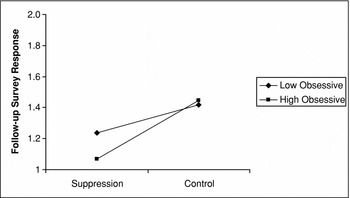
The free-form response to the question on the follow-up survey “Did you learn anything from these thought exercises?” was coded dichotomously as a response to the question “Do you believe that trying not to think about an unwanted thought is a good strategy?” We coded a “no” if the participant reported learning from the suppression exercise that suppression is a counterproductive strategy for controlling unwanted thoughts. Since the focus of this study is whether participants learn the futility of suppression, we coded all other responses as “other” (including participants’ reports of learning that suppression is a good strategy or if they did not report learning anything related to the effectiveness of suppression). Coding was completed by a research assistant who was blind to condition and was unaware of the study hypotheses. Scores were submitted to a 2 × 2 ANOVA with obsession group (low, high) and instruction (suppression, control) as between-subjects factors. The obsession group × instruction interaction was not significant, F(1, 58) = .75, p = .39, η2 = .01. However, a main effect of instruction was found such that participants in the suppression condition (M = 1.15) were less likely than those in the control condition (M = 1.43) to endorse suppression as an effective strategy for dealing with unwanted thoughts, F(1, 58) = 6.04, p < .02, η2 = .09 (see Figure 1). Thus, low and high obsessive participants who completed the suppression exercise reported learning the futility of suppression.
Follow-up survey response (“Do you believe that trying not to think about an unwanted thought is a good strategy?”) for low and high obsessive groups under suppression and control conditions in Study 1. Lower score indicates the belief that suppression is a counterproductive strategy

Beliefs about the control of thoughts
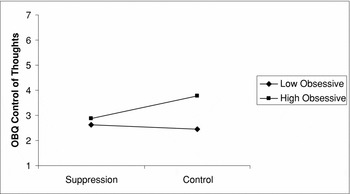
Scores for the OBQ Control of Thoughts subscale were submitted to a 2 × 2 ANOVA with obsession group (low, high) and instruction (suppression, control) as between-subjects factors. A significant obsession group × instruction interaction was observed F(1, 58) = 5.13, p < .03, η2 = .08 and its form was as predicted. Analysis of simple effects showed that high obsessive participants had significantly lower Control of Thoughts scores after suppression (M = 2.87) than after the control condition (M = 3.78), F(1, 59) = 7.97, p < .01, whereas among low obsessive participants there was no difference in Control of Thoughts scores between the suppression (M = 2.62) and control (M = 2.46) conditions, F(1, 59) = .00, p = .99 (Figure 2). Moreover, there was a significant difference in Control of Thoughts scores during the control condition between the low (M = 2.46) and high (M = 3.78) obsessive groups, F(1, 59) = 16.7, p < .001, but not during the suppression condition between the low (M = 2.62) and high (M = 2.87) obsessive groups, F(1, 59) = .7, p = .41.
OBQ-87 control of thoughts subscale scores for low and high obsessive groups under suppression and control conditions in Study 1

Ruling out alternative interpretations
To explore effects of the mental control instruction, we examined occurrences of the suppression target word (“penguin”) in the stream of consciousness reports of the participants in the suppression condition. “Penguin” intrusions were added across the three consecutive 5-minute suppression periods. The difference between the number of intrusions of the suppression target experienced by low obsessive participants (M = 21) and high obsessive participants (M = 19) was not statistically significant, F(1, 30) = .04, p > .83. A similar pattern was observed for intrusions recorded by the participants on the counter. Post-task responses to the item “How often, during the exercise, did you try not to think this thought?” were also not significantly different between the low (M = 12) and high (M = 11) obsessive participants, F(1, 30) = .37, p > .55. Thus, effects of the experimental manipulation are unlikely to be due to a difference in the number of intrusions of the target word or in suppression effort between the low and high obsessive groups. Most important to note is that, with the exception of two participants in the low obsessive group, no one in the suppression condition across the low and high obsessive groups reported perfect suppression. In fact, mean “penguin” intrusions for this group was 20.13, confirming the inefficiency of suppression. As was expected in the control condition, since there was no mention of “penguin” in the instructions, no participant in this condition reported a “penguin” intrusion.
Scores for the Y-BOCS Obsessions subscale were submitted to a 2 × 2 ANOVA with obsession group (low, high) and instruction (suppression, control) as the between-subjects factors. The obsession group × instruction interaction was not significant F(1, 58) = 2.47, p = .12, η2 = .04. Next, scores for the Y-BOCS Compulsions subscale were submitted to a 2 × 2 ANOVA with obsession group (low, high) and instruction (suppression, control) as the between-subjects factors. Again, the obsession group × instruction interaction was not significant F(1, 58) = .05, p = .82, η2 = .001. Thus, effects of the experimental manipulation are unlikely to be due to differences in obsessive-compulsive symptoms.
Summary
Taken together, results show that both low and high obsessive participants report learning the futility of suppression after the suppression exercise. Furthermore, after the suppression exercise, obsessive beliefs about the control of thoughts in the high obsessive group were as low as those of the low obsessive group. This was not the case for the control condition, after which obsessive beliefs about the control of thoughts were significantly higher in the high obsessive group as compared to the low obsessive group.
Study 2: Method
Overview
Participants consisted of individuals with a primary diagnosis of OCD as assessed by a clinical interview, the Structured Clinical Interview for DSM-IV (SCID, First, Spitzer, Gibbon and Williams, Reference First, Spitzer, Gibbon and Williams1995) and a cut-off score of obsessive-compulsive symptom severity. The procedure for Study 2 was similar to that of Study 1, with one exception: in addition to completing the self-report measures following the task, participants also completed these measures prior to the experimental task. At the end of the session, participants were given a packet of questionnaires with instructions to complete and return within 3 days.
Participants
Twenty-nine OCD patients (17 women, 12 men) participated in the study. Clinical participants were recruited from the OCD Clinic at Massachusetts General Hospital and from the community via advertisements. Requirements for inclusion in the clinical group were a primary diagnosis of OCD, a Y-BOCS total score greater than or equal to16, and a Y-BOCS Obsessions score greater than or equal to 8. Participants were excluded from the study if they had a history of psychotic disorders, bipolar disorder, or PTSD, or evidence of substance abuse within the past month. Additionally, participants were excluded from the study if they endorsed prior exposure to the thought suppression demonstration or suppression-related psychoeducation during therapy. One participant was excluded from analysis because she did not return the post-task questionnaires. The mean Y-BOCS score for the sample was 21.68 (SD = 5.24), the mean for the Obsessions subscale was 11.07 (SD = 2.69), and for the Compulsions subscale was 10.61 (SD = 3.48). Thus, our sample was in the moderate range of symptom severity. Of the clinical sample, four (14%) had a comorbid diagnosis of major depressive disorder, three (11%) had a comorbid diagnosis of social anxiety disorder, three (11%) had comorbid generalized anxiety disorder, and six (21%) had comorbid specific phobia. Eleven participants (39%) were on anxiolytic medication. Participants received monetary inducement for participation. Four participants did not enter their ages; the mean age for the rest of the sample was 37.8 years (SD = 13.8).
Procedure
During a phone screen, potential participants completed the Y-BOCS. Inclusion criteria for the clinical group were a Y-BOCS Obsessions score of 8 or higher, and a Y-BOCS total score of 16 or higher. If eligible, participants were invited to the laboratory session. The study procedures were explained to the participants and informed consent was obtained before proceeding. During the session, participants were first asked questions about their psychiatric history and screened for current and past Axis I disorders using the Structured Clinical Interview for DSM-IV. Participants who did not fully meet eligibility criteria were paid for their time and excluded from further participation. Eligible participants completed a set of questionnaires and were randomly assigned to the suppression (n = 14) or control condition (n = 14). The instructions for the conditions were the same as those described above for Study 1. After the task, participants were given a packet of the same questionnaires that they completed prior to the experimental task and were asked to complete the questionnaires and to return them to us within 3 days.
Self-report measures
The Yale-Brown Obsessive Compulsive Scale, the Follow-up Survey, and the Obsessive Beliefs Questionnaire (OBQ-87) are described above.
Structured Clinical Interview for DSM-IV (SCID; First, Spitzer, Gibbon and Williams, Reference First, Spitzer, Gibbon and Williams1995). The SCID was used to assess the diagnostic status for all OCD patients. It is a widely used instrument with acceptable psychometric properties (First et al., Reference First, Spitzer, Gibbon and Williams1995). All SCIDs were administered by authors HR and JF.
Data analysis plan
A 2 × 2 repeated-measures ANOVA was conducted with instruction (suppression, control) as the between-subjects factor. The dependent measures were scores on the follow-up survey and pre/post-task scores on the Control of Thoughts subscale of the OBQ-87.
Results
Baseline asessment
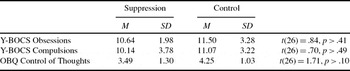
Independent samples t-tests on baseline Y-BOCS and OBQ-87 scores revealed no differences between the suppression and control groups at baseline (see Table 1).
Baseline measures

Learning the futility of suppression
As in Study 1, the free-form response to the question on the follow-up survey, “Did you learn anything from these thought exercises?” was coded dichotomously as a response to the question “Do you believe that trying not to think about an unwanted thought is a good strategy?” As in Study 1, we coded a “no” if the participant reported learning from the suppression exercise that suppression is a counterproductive strategy for controlling unwanted thoughts. An example of a “no” response from our sample was “I learned from the exercise that thoughts seem to become ‘OCD’ when we avoid them and give them power in a sense.” An independent samples t-test with instruction (suppression, control) as the independent variable revealed that participants in the suppression group were less likely to endorse suppression as an effective strategy for dealing with unwanted thoughts than were participants in the control group, t(26) = 3.12, p < .004. Most important to note is that no one in the suppression condition reported perfect suppression. In fact, mean “penguin” intrusions for this group was 23.69, confirming the ineffectiveness of suppression.
Beliefs about the control of thoughts
Scores for the OBQ Control of Thoughts subscale were submitted to a 2 × 2 repeated-measures ANOVA with instruction (suppression, control) as the between-subjects factor and time (pre-task, post-task) as the within-subjects variable. The instruction × time interaction was not significant, F(1, 26) = .32, p = .58, η2 = .01, and neither was the main effect of instruction, F(1, 26) = 2.33, p = .14, η2 = .08.
Summary
Results from this study show that although participants learned the futility of suppression after the suppression exercise, they did not experience a reduction in obsessive beliefs about the control of thoughts.
Discussion
In Study 1, the non-clinical, high obsessive group learned the futility of suppression after the suppression exercise and experienced a reduction in obsessive beliefs about the control of thoughts. Additional analyses confirmed that these results were not due to a difference in number of target intrusions, that is, the low obsessive group was no better or worse than the high obsessive group in its ability to suppress thoughts. Additional analyses also confirmed that these results were not due to a difference in suppression effort between low and high obsessive participants in the suppression group. In Study 2, on the other hand, although individuals with OCD also learned the futility of suppression after the suppression exercise, contrary to our prediction, they did not experience a reduction in obsessive beliefs about the control of thoughts.
Taken together, results of the two studies suggest that learning the futility of suppression may be necessary and sufficient for altering faulty beliefs about the control of thoughts in high obsessive individuals in the non-clinical population, but for individuals with OCD, this learning may be insufficient for altering underlying beliefs. We suspect that underlying beliefs about the control of thoughts may be more ingrained in individuals with OCD and hence altering them may take multiple iterations of the suppression demonstration. In an open trial assessing the effectiveness of cognitive therapy for OCD, Wilhelm et al. (Reference Wilhelm, Steketee, Reilly-Harrington, Deckersbach, Buhlmann and Baer2005) have shown that underlying obsessional beliefs, including beliefs about the control of thoughts, can indeed be altered in patients with OCD. In the trial, however, therapists used Socratic questioning, cognitive restructuring, and mindfulness skills, in addition to the suppression demonstration. Moreover, multiple belief domains were targeted simultaneously, for example, in addition to beliefs about the control of thoughts, the treatment targeted beliefs about overinflated sense of responsibility and over-importance of thoughts. It may be argued that beliefs about the need to control unwanted thoughts become more amenable to change if the patient is simultaneously learning to reduce the importance of unwanted thoughts or beliefs about his/her own responsibility to prevent the consequences of the thought. Finally, the trial was run over a period of 14 weeks. Thus, it may well be possible to modify underlying beliefs in OCD, but only over a longer period of time and with multiple techniques aimed at challenging underlying beliefs.
One possibility is that, in Study 2, since we did not conduct the post-manipulation assessment immediately after the manipulation, and instead allowed participants to turn it in up to 3 days after the session, we might have diminished the likelihood of finding effects of the manipulation. Another limitation of our study relates to the difference in learning during a contrived lab task versus applying it to a personally salient obsession. For example, individuals with OCD have greater practice suppressing their obsessions on a regular basis and this could be one reason why, in Study 2, demonstration with a contrived task did not produce significant learning. Another potential limitation of our design is the lack of pre-manipulation assessment of the key dependent variable (beliefs about the control of thoughts) in Study 1. We have assumed that the combination of fairly large sample size (N = 62) and random assignment to conditions in Study 1 has resulted in comparable pre-manipulation beliefs about the control of thoughts in the suppression and control groups. Additionally, we did test for comparability of pre-manipulation obsessional symptoms and found no difference in symptom severity between low obsessive participants in the suppression and control groups, nor between high obsessive participants in the suppression and control groups. Nevertheless, the fact that we did not measure pre-manipulation beliefs about the control of thoughts could be a potential limitation of Study 1. In Study 2, however, since our sample size was smaller (N = 28), we did complete a pre-manipulation assessment of the key dependent variable to avoid the potential problem of unequal groups at baseline. Finally, 39% of the sample for Study 2 was on anxiolytic mediation. Although this constituted a similar number of participants in the suppression (n = 5) and the control conditions (n = 6), it is possible that medication affected the two groups differentially. Given the small sample size, we were unable to conduct additional analyses to examine the effects of medication on our results.
In our study, we have shown that patients with OCD are able to learn the futility of suppressing a neutral target; however, it may be the case that they are unable to make the connection between suppressing a neutral thought and a personally relevant obsession and hence do not show reductions in underlying beliefs. For OCD patients, this connection may need to be stated explicitly in order to affect their obsessive beliefs. In terms of treatment, this might be accomplished by following up the suppression demonstration with a psychoeducational discussion about the futility of suppression of all types of thoughts, including neutral ones, like thoughts of penguins, and distressing ones, such as their obsessions (see Wilhelm and Steketee, Reference Wilhelm and Steketee2006). Our hope is that through repeating a combination of the suppression demonstration and a psychoeducational discussion about the futility of suppression, over time patients will come to learn that their thoughts are not the problem, but rather it is their maladaptive beliefs about the need to control thoughts and their unrealistic expectations regarding the controllability of thoughts.



Comments
No Comments have been published for this article.