Introduction
On April 20, 2010, the mobile offshore drilling unit Deepwater Horizon exploded 40 miles south of the coast of Louisiana, USA. Over the following three months, it was estimated that ≥4.9 million barrels of oil were released into the Gulf of Mexico. Although the oil well was capped on July 15, 2010, the existing released crude oil is likely to have prolonged effects on marine biota.Reference Peterson, Rice and Short 1 The oil well's proximity to the fishing industry; coastal attractions; and estuarine, marsh and protected ecosystems of the Gulf states of Louisiana, Alabama, and Mississippi placed these resources in jeopardy of destruction.
The oil released by Deepwater Horizon has had consequences for the fishing, oil, and tourism industries of the Gulf coast, 2 as well as potential physical and mental health consequences for those exposed to or affected by the oil spill.Reference Yun, Lurie and Hyde 3 Physical health effects, such as respiratory symptoms, skin irritations, and headache, can result from contact with the spilled oil.Reference Solomon and Janssen 4 However, longitudinal studies of communities in which previous oil spills have occurred suggest that the subsequent mental health effects can be more widespread than physical health outcomes following an oil spill.Reference Palinkas, Petterson, Russell and Downs 5 - Reference Sabucedo, Arce, Senra, Seoane and Vázquez 9 These studies have found higher levels of stress, anxiety, and depression in individuals and communities either exposed to oil, or financially impacted by the spill, than appeared in unexposed communities.
Anecdotal reports from the first three months following the Deepwater Horizon oil spill suggested that the Gulf Coast communities have experienced negative mental health outcomes similar to those seen after the Exxon Valdez oil spill.Reference Abramson, Redlener and Stehling-Ariza 10 However, the public health surveillance systems in place following the Deepwater Horizon oil spill did not specifically address mental health outcomes. 11 , Reference Krisberg 12
To address mental health concerns, the Alabama Department of Public Health, the Alabama Department of Mental Health, the Mississippi Department of Public Health, and the Mississippi Department of Mental Health requested assistance from the Centers for Disease Control and Prevention (CDC) in conducting an assessment in five Gulf Coast counties. The goals of these assessments were to determine the general and mental health needs of the community following the oil spill, and to provide the state and local public health officials with information to guide responses and allocate resources.
The purpose of this paper is to report the mental health findings of the three Community Assessments for Public Health Emergency Response (CASPERs) conducted in those counties, and to discuss their significance to future public health emergency responses.
Methods
Study Area
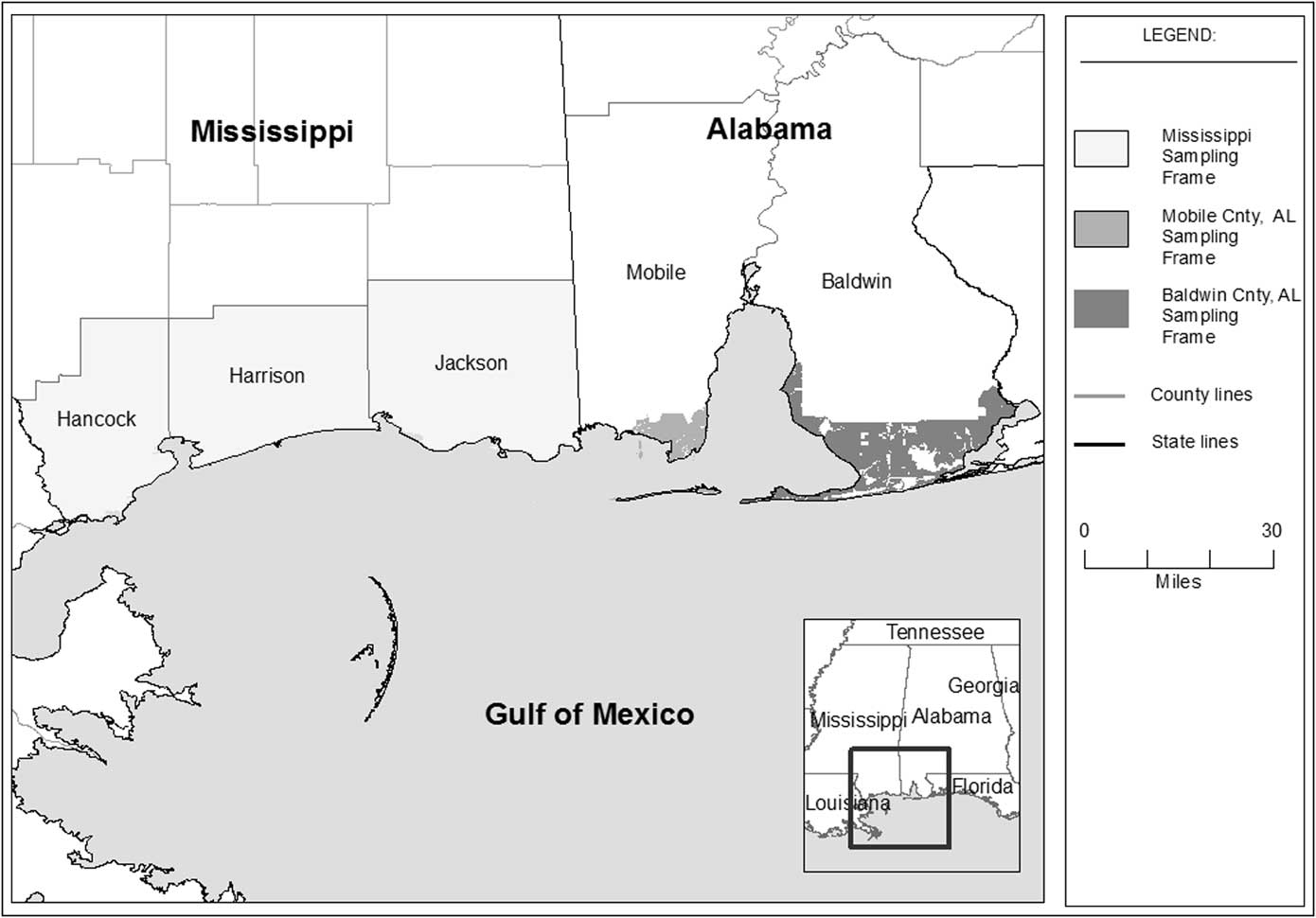
The Gulf Coast counties of Alabama and Mississippi were divided into three sampling areas for the purpose of this study: (1) Baldwin County, Alabama; (2) Mobile County, Alabama; and (3) coastal Mississippi. Divisions were based upon existing public and mental health service districts (Figure 1). The first two assessment areas consisted of only the coastal portions of Mobile and Baldwin counties in Alabama. These counties are served by different health and mental health departments.
Sampling Areas in Mobile County and Baldwin County, Alabama, and Three Gulf Coast Counties in Mississippi During August and October, 2010.

The assessment area in coastal Mississippi included all three of its Gulf Coast counties: (1) Hancock County; (2) Harrison County; and (3) Jackson County. These three counties (hereinafter referred to as “Mississippi”) are served by the same health and mental health departments.
Study Design
The CDC, along with the states involved, used its Community Assessments for Public Health Emergency Response (CASPER) methodology to conduct the mental health needs assessments. The CASPER is an epidemiologic method designed to provide household-based information about an affected community's needs following a disaster; to do so quickly; and to do so at low cost. CASPER uses a two-stage probability sampling method to select a sample of 210 households to be interviewed. In the first stage, 30 census blocks from the 2000 US Census were selected from each of the assessment areas. 13 A CASPER tool developed within Esri ArcGIS (Esri, Redlands, California USA) software made the sample selection. The probability of a census block being selected was proportional to the number of households in the census block. In the second stage, seven households were selected randomly from each of the 30 census blocks. Information gained from the interviews is then shared in a simple format with decision-makers. 14
Study Questionnaire
A two-page questionnaire was developed in coordination with the Alabama and Mississippi Departments of Mental Health, the state health departments, and the CDC's Division of Behavioral Surveillance of the Public Health Surveillance Program Office. The questionnaire included the following: (1) 30 questions regarding respiratory, cardiovascular, dermatologic, and other physical symptoms and signs that had arisen or worsened in the 30 days prior to the interview; (2) nine standardized questions on quality of life, mental health, and social context (plus two additional questions in Mississippi based on requests from the State Department of Mental Health); and (3) 12 individual- and household-level oil spill-related exposure questions.
Interview teams went door-to-door selecting a single individual from each chosen household to answer questions. Some of the questions concerned the entire household, while others, such as the mental health questions, were specific to the individual answering the questionnaire. Eight questions from the CDC's Behavioral Risk Factor Surveillance System (BRFSS) survey were asked of the responding individual in each household. The BRFSS is a state-based annual survey about health risk behaviors, clinical preventive practices, and health care access and use; portions of the survey may change from year-to-year or state-to-state. For the social context BRFSS questions, (two questions) the time frame was changed from “the previous 12 months” in the original version, to “the previous 4” or “5 months” to reflect the time since the oil spill. All other BRFSS questions used the same time frame in the CASPER as was used in the BRFSS.
As with the BRFSS, the depressive symptom questions (two questions) were adopted from the Patient Health Questionnaire-2 (PHQ-2),Reference Kroenke, Spitzer and Williams 15 and the anxiety questions (two questions) were adopted from the Generalized Anxiety Disorder-2 (GAD-2).Reference Kroenke, Spitzer and Williams 16
The Alabama interviews were conducted on August 27, 2010 in Mobile County, and on August 28, 2010 in Baldwin County. In the Mississippi counties, interviews were conducted on October 12 and 13, 2010.
This study was approved by the CDC Institution Review Board and Ethics Committee.
Analysis
Weighted cluster analysis was performed using SAS 9.1 (SAS Institute Inc., Cary, North Carolina USA) to report the estimated percent of households or individuals affected in the assessment area (Tables 1-3). Two weighting variables were utilized: one to account for the probability that the responding household was selected; and one to account for the probability of selecting the individual respondent within the household. The results of each questionnaire were weighted appropriately on the basis of whether the question was addressed to the individual or to the household. All percentages were calculated by use of one of the two sampling weights. Ninety-five percent confidence intervals were calculated using one of the two sampling weights.
Data from the BRFSS questions in the survey were compared to individual state-level BRFSS data for both Alabama and Mississippi, when data were available. The survey data also were compared to nationwide BRFSS data from available states from the most recent year in which a question had been asked. Data from the social context BRFSS questions in which the time frame was changed could not be compared directly to BRFSS data from the states and the nation. The CASPER results were compared to the BRFSS results using a Welch's t-test for samples of unequal variance (GraphPad software 2005; GraphPad Software, Inc., La Jolla, California USA).
Responses from both the PHQ-2 and the GAD-2 questions were scored from 0 (not at all) to 3 (nearly every day), and scores from both questions were summed to derive a PHQ-2 and a GAD-2 score ranging from 0 through 6. Scores from the PHQ-2 of ≥3 classify major depression with a sensitivity of 83% and a specificity of 92%;Reference Kroenke, Spitzer and Williams 15 GAD-2 scores of ≥3 identify a generalized anxiety disorder with a sensitivity of 92% and a specificity of 76%, while the GAD-2 scores identify any anxiety disorder with a sensitivity of 65% and a specificity of 88%.Reference Kroenke, Spitzer and Williams 16 - Reference Kroenke, Spitzer and Williams 17 Similar comparison rates for anxiety disorders in a non-clinical population currently are not available.
Results
In Alabama, survey teams completed 128 of the goal of 210 interviews in Mobile County (61% response rate) and 168 interviews in Baldwin County (72% response rate). In Mississippi, 173 interviews (67% response rate) were completed.
The mean age of the respondents in the assessment areas was 48.2 (95% CI, 44.7-51.8) years in Mississippi. In Alabama, the mean ages of respondents were 55.3 (95% CI, 52.1-58.5) years in Baldwin County, and 51.7 (95% CI, 46.8-56.7) years in Mobile County. The age range of all respondents was 18 through 95 years of age.
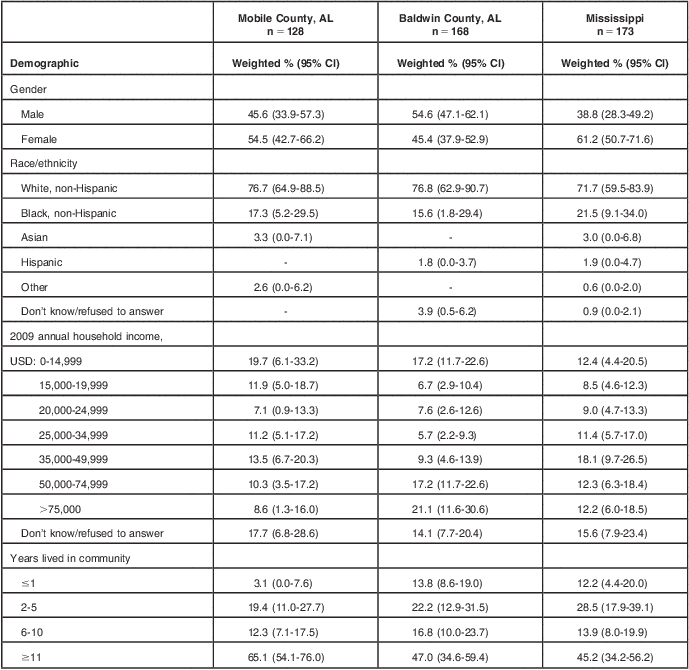
In Alabama, the mean number of years respondents had lived in their communities was 24.3 (95% CI, 19.3-29.3) years in Mobile County and 17.8 years (95% CI, 12.6-23.0) in Baldwin County. In Mississippi, the mean number of years respondents had lived in their communities was 17.2 (95% CI, 13.5-20.7). The majority of respondents were white, non-Hispanic, and had lived in the community for ≥11 years. Household size ranged from one through nine individuals. Approximately one-third (95% CI, 27.9%-38.7%) of all households had an annual household income <US $25,000 in 2009 (Table 1).
Demographics of Respondents by CASPER Sampling in Mobile and Baldwin Counties, Alabama and the Gulf Coast of Mississippi, August and October, 2010

Abbreviations: AL, Alabama; CASPER, Community Assessments for Public Health Emergency Response; USD, US dollars.
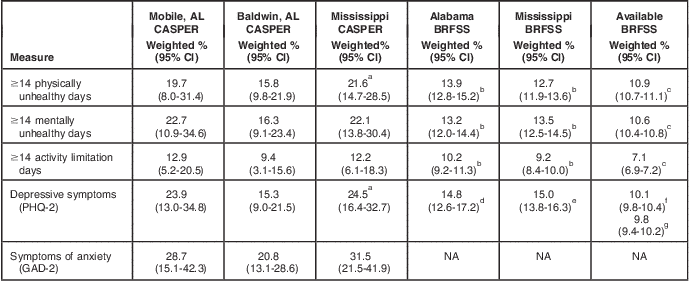
The proportion of respondents reporting ≥14 days of poor physical health, mental health, or limited activity in the past 30 days was greater in all three assessment areas than was reported in the 2009 BRFSS state estimates and available estimates nationwide (Table 2). The highest percentage of individuals (21.6%) who reported ≥14 days of poor physical health in the previous 30 days was noted in the residents of the area surveyed in Mississippi. The difference in this incidence compared with that in previous BRFSS state reports was statistically significant (P = .009).
Individual-Level and BRFSS Weighted Percents and 95% Confidence Intervals of Respondents Reporting Health-Related Quality of Life and Symptoms of Depression and Anxiety in Mobile and Baldwin Counties, Alabama, and the Gulf Coast of Mississippi, August and October 2010

Abbreviations: AL, Alabama; BRFSS, Behavioral Risk Factor Surveillance System; CASPER, Community Assessments for Public Health Emergency Response; CI, confidence intervals; GAD-2, Generalized Anxiety Disorder-2; NA, not available; PHQ-2, Patient Health Questionnaire-2.
aIndicates a statistically significant difference from state BRFSS report at the α = .05 level.
bBRFSS 2009, state data.
cBRFSS 2009, data from 50 states, Guam, Puerto Rico, and the U.S. Virgin Islands.
dBRFSS 2006, state data.
eBRFSS 2008, state data.
fBRFSS 2006, data from 39 states, Puerto Rico, and the U.S. Virgin Islands.
gBRFSS 2008, data from 16 states.
The highest percentage of individuals (22.7%) who reported ≥14 mentally unhealthy days in the previous 30 days was in the citizens surveyed in Mobile County, Alabama. The residents of this county also reported the highest incidence (12.9%) of >14 days of limited activity within the previous 30 days. Depressive symptoms (PHQ-2) were reported by 23.9% and 24.5% of the respondents in Mobile County, Alabama, and in Mississippi, respectively, and by 15.3% of the respondents from Baldwin County, Alabama. While the incidence of depressive symptoms was greater among the respondents in all three assessment areas than indicated in the BRFSS state and available nationwide state estimates, this difference was statistically significant (P = .01) only among the Mississippi respondents. Symptoms consistent with an anxiety disorder were reported by 31.5% of the respondents from Mississippi, and 28.7% and 20.8% of the respondents from Mobile County and Baldwin County, Alabama, respectively. No comparison data are available for symptoms of anxiety (Table 2; GAD-2).
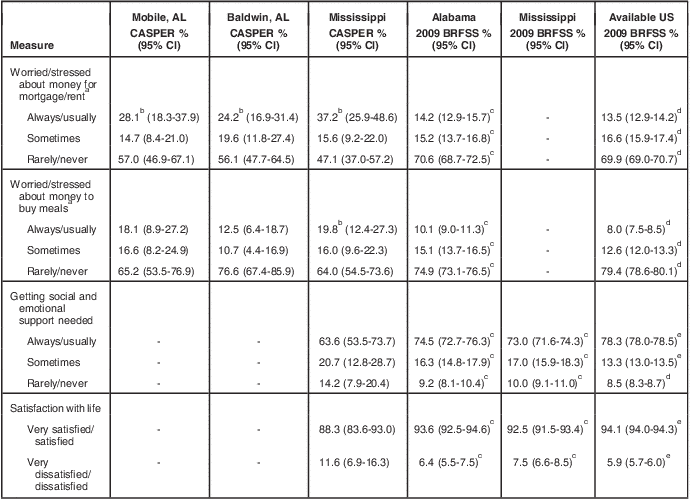
The prevalence of individuals always or usually worried or stressed about having enough money to pay the rent or mortgage or to buy nutritious meals was greater in all three areas assessed than in the BRFSS estimates for the state of Alabama, as well as the nationwide 2009 BRFSS estimates. The percentage of individuals who reported always or usually worrying about money for the rent or mortgage was highest in Mississippi (37.2%), followed by 28.1% and 24.2% of the respondents from Mobile County and Baldwin County, Alabama, respectively. The proportion of individuals reporting always or usually being worried or stressed about having enough money to pay the rent or mortgage in the Mobile County population and in the Baldwin County population was statistically significantly greater than the prevalence reported in the 2009 Alabama BRFSS state estimates (P = .0043 and P = .005, respectively). This question was not included in the state-based 2009 Mississippi BRFSS. However, the proportion of individuals always or usually worried or stressed about paying the rent or mortgage in the Mississippi population was statistically significantly greater than the proportion in the 2009 Alabama BRFSS state estimates (P < .0001).
Individuals who were worried or stressed about having enough money to buy nutritious meals comprised 19.8% of the respondents from Mississippi; 18.1% of the respondents from Mobile County, Alabama; and 12.5% of the respondents from Baldwin County, Alabama. When compared with 2009 BRFSS Alabama state estimates, the proportion of individuals who reported being always or usually worried or stressed about having enough money to buy nutritious meals was significantly greater in the Mississippi population (P = .007). No recent BRFSS state comparison data are available from the state of Mississippi.
Questions regarding social support and life satisfaction were administered in Mississippi only (Table 3). Although the prevalence of individuals who reported that they rarely or never received the emotional support needed, and who were dissatisfied or very dissatisfied with life, was elevated as compared with 2009 BRFSS state (Alabama) and available nationwide estimates, the differences were not statistically significant.
Individual-Level Weighted Percents and 95% Confidence Intervals of Frequency of Worry or Stress According to BRFSS Social Context Categories Among Respondents in Mobile and Baldwin Counties, Alabama, and the Gulf Coast of Mississippi, August and October 2010

Abbreviations: BRFSS, Behavioral Risk Factor Surveillance System; CASPER, Community Assessments for Public Health Emergency Response; CI, Confidence Interval.
aBRFSS asked question “in the past 12 months;” CASPER asked question “in the past 5 months”
bIndicates statistically significant difference from BRFSS state report at the α = .05 level.
cBRFSS 2009, state data.
dBRFSS 2009, data available in 14 states.
eBRFSS 2009, data available for 50 states, Guam, Puerto Rico, and the US Virgin Islands.
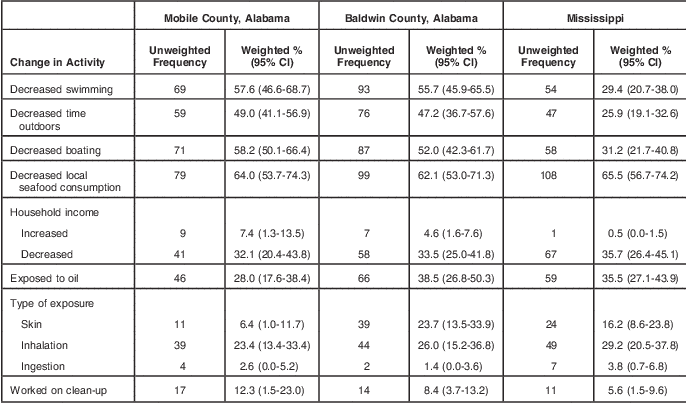
The frequencies of household-level changes in behavior, income, exposure, and involvement in clean-up work following the oil spill are listed in Table 4. Households in all three sampling sections reported a decrease in swimming, boating, time spent outdoors, and consumption of local seafood. A decrease in household income was reported by 32.1%, 33.5%, and 35.7% of respondents from Mobile County, Baldwin County, and Mississippi, respectively. Exposure to oil was reported by between 28.0% and 38.5% of respondents in the assessment areas. The majority of exposures were reported as inhalational exposure to oil in all three areas, although 23.7% of the respondents from Baldwin County, Alabama reported skin exposure to the oil. Of the three assessment areas, Mobile County, Alabama had the greatest percentage of households reporting that at least one member was involved in the oil spill clean-up efforts (12.3%).
Household Level Frequencies, Weighted Percents, and 95% Confidence Intervals of Changes in Behavior, Income, and Exposure Since the Oil Spill Among Respondents in Mobile and Baldwin Counties, Alabama, and the Gulf Coast of Mississippi, August and October 2010

Abbreviations: BRFSS, Behavioral Risk Factor Surveillance System; CASPER, Community Assessments for Public Health Emergency Response; CI, Confidence Intervals.
Discussion
Overall, the proportion of physically unhealthy days, mentally unhealthy days, days of limited activity in the previous 30 days, and symptoms of depression were greater within all three sampling areas of Alabama and Mississippi as compared with state BRFSS estimates. These differences were not statistically significant in Alabama, which may reflect the lower survey completion rates in that state, and thus, larger confidence intervals in the Alabama CASPERs as compared with the Mississippi CASPER. Although no BRFSS data exist to permit the comparison of the prevalence of symptoms of anxiety with this study population, the proportion of anxiety symptoms reported by participants in this study is similar to the proportion of generalized anxiety disorders assessed by use of a different method in affected communities after the Exxon Valdez oil spill. Following that incident, symptoms of anxiety were elevated as compared with control and low-exposure communities.Reference Palinkas, Petterson, Russell and Downs 5
Compared with reports from the 2009 BRFSS, a higher proportion of respondents in the CASPER assessments reported worry or stress about having enough money to pay the rent or mortgage and/or to buy nutritious meals. Many respondents also reported a decrease in household income. On the basis of this survey alone, a link cannot be made between the oil spill and the reported increase in financial concerns. However, other disasters from human-caused events have been associated with both real and perceived detrimental economic outcomes. In turn, these outcomes have had adverse mental health effects similar to those noted in this study. For example, income loss was associated with higher rates of depression, anxiety, and post-traumatic stress disorder in the populations affected by the Exxon Valdez oil spill.Reference Arata, Picou, Johnson and McNally 6 The Deepwater Horizon oil spill resulted in the temporary closure of >37% of the Gulf Coast fishing area and a temporary ban on new offshore oil drilling, both of which affected industries employing a large number of Gulf Coast residents. 18 Mental health issues similar to those that occurred following the Exxon Valdez spill may exist in the Gulf Coast communities, where businesses have experienced decreased revenue as a result of decreased fishing, tourism, or industry. Furthermore, a perceived loss of resources can result in negative mental health outcomes similar to those stemming from the actual loss of resources.Reference Hobfoll 19
The oil spill also had adverse social outcomes in Gulf Coast communities. The large percentage of individuals reporting decreased local seafood consumption, swimming, boating, and spending time outdoors suggests that recreational activities and consumer confidence in the seafood and the tourism industries also were affected. Such negative outcomes may influence the social interactions and cohesiveness of the community. Outdoor recreation and activities promote social wellness and community cohesiveness.Reference Street, James and Cutt 20 In communities where natural resources are used for recreation as well as industry, loss or damage to these resources may amplify social effects, as was seen in many Alaskan Native communities following the Exxon Valdez oil spill.Reference Palinkas, Petterson, Russell and Downs 5 , Reference Abal, Dennison and Greenfield 21 - Reference Palinkas, Russell, Downs and Petterson 22
Furthermore, technological disasters feature circumstances that increase the chronic mental and social effects of the events themselves. These effects include extended litigation periods,Reference Picou and Rosebrook 23 social deterioration,Reference Freudenberg 24 - Reference Kroll-Smith and Couch 27 and long-term negative consequences for local industries.Reference Schneider 28 - Reference Spies, Rice, Wolfe and Wright 29 Although it is too soon to assess the time frame for litigation resulting from the Deepwater Horizon oil spill, the projected time line has increased, and development of the fund for processing and awarding financial claims to individuals affected by the oil spill has changed from original projections. 30
Limitations
This study is subject to certain limitations. First, 2000 census data were used to determine sampling weights. Because the assessed areas have undergone many changes since 2000, those data may not be representative of the current population. However, the discrepancy between the 2000 census data and the present population would not affect the unweighted frequencies presented in this report. Additionally, Mobile County, Alabama survey completion rates were <80%; therefore, the data obtained from this area may not be sufficient to allow generalization of the results to the entire Mobile County sampling area.
Another limitation of this study is that the reported increase in worry or stress regarding finances and decreased income cannot be attributed to the oil spill on the basis of this study alone. The statistical significance of any reported decrease in income could not be determined. However, other factors, including the economic recession, changes in real estate tax incentives, and higher property insurance premiums resulting from recent disasters are likely to have influenced the financial and mental health situation of the residents of the study communities. 2 However, as these economic factors are likely to have an impact on mental health, they should be considered as a component of mental health follow-up activities. 31
Finally, the assessments were conducted between four and five months after the oil spill; the time gap may have induced recall bias. Those who were exposed to oil from the spill may have had a better recollection than those who were not exposed. Further, differences may exist between assessments in Alabama and Mississippi because of the elapsed time between these assessments. This difference, however, is not anticipated to influence the physical and mental health questions or the BRFSS questions, as these questions all used a consistent time frame.
In addition, respondents were aware that interview teams were addressing the effects of the oil spill; this awareness may have influenced responses that were based on a respondent's feelings toward the oil spill or on political events regarding the oil spill at the time the questionnaire was administered. Such awareness, however, is unlikely to have influenced the predictive nature of the adopted BRFSS questions since the adopted questions did not specifically address the oil spill, aside from the changes made in the time line of the social context questions.
Conclusions
Decreased income, increased financial concern, increased reports of negative quality of life indicators, depressive symptoms, and symptoms of anxiety—all suggest that resources should focus on mental health intervention and follow-up of residents of communities affected by the oil spill. Although the decreased income and increased financial concern cannot be causally linked to the negative mental health outcomes reported in this study, the close association between negative economic factors and negative mental health outcomes seen in other technological events suggest that the Deepwater Horizon oil spill will have negative economic and mental health impacts. Future disaster preparedness should incorporate mental health into response and resource planning to mitigate long-term impacts of disasters from natural and technological events. This study also demonstrates for the first time the usefulness of the CASPER methodology in mental health response and planning.
Abbreviations
- BRFSS:
-
Behavioral Risk Factor Surveillance System
- CASPER:
-
Community Assessment for Public Health Emergency Response
- CDC:
-
Centers for Disease Control and Prevention
- GAD-2:
-
Generalized Anxiety Disorder-2
- PHQ-2:
-
Patient Health Questionnaire-2
Acknowledgements
D. Buttke had full access to all of the data in the study and takes responsibility for the integrity of the data and the accuracy of the data analysis. D. Buttke, S. Vagi, T. Bayleyegn, T. Strine, and A. Wolkin, contributed to the conception and design, data acquisition and processing, and critical revision of the manuscript. K. Sircar contributed to supervision, conception and design, and critical revision of the manuscript. M. Allen contributed to conception and design, data acquisition of the Mississippi data, and critical revision of the manuscript. M. Morrison contributed to conception and design of the Alabama data and critical revision of the manuscript. The authors acknowledge Dr. Richard Powers and Dr. Charles Woernle of the Alabama State Department of Public Health, Teresa Porter and the Area 9 Department of Public Health and Alabama Department of Mental Health, the Mobile Department of Public Health, Alta Pointe; Dr. Paul Byers and Barry Mullins of the Mississippi Department of Health, Dr. Ed LeGrande and Scott Sumrall of the Mississippi Department of Mental Health, and the survey teams in both states. The findings presented here are solely the responsibility of the authors and do not necessarily reflect the opinions of the Centers for Disease Control and Prevention.