Due to technological developments, disease diversity, epidemics, and needs in health services, the responsibility of individuals, health workers, and the state regarding public health have gained significance. Access to health services has become much easier with the diversification of health services, the increase in technological services, and the opening of new health institutions. Due to these factors, individuals try to mitigate their health concerns by researching the health problems they experience, observe, and are aware of in their environment from written and visual media on the internet.Reference Frenk, Chen and Chandran 1 Another issue that has gained importance as the Internet has become a substantial source for researching and obtaining health information is “cyberchondria.” Information obtained through online research often triggers individuals’ anxiety and concerns, which in turn causes them to conduct long-term research on their health status over the Internet.Reference Aslantaş and Altuntaş 2
The term “cyberchondriasis,” derived from the words “cyber” and “hypochondriasis,” has been used to describe the negative consequences of searching for health information on the Internet. Increased health anxiety or distress associated with excessive or repeated online searches for health-related information is called “cyberchondria.” Cyberchondria is said to be a dangerous and uncontrollable product of modern civilization.Reference Starcevic and Berle 3
In the study, a literature review was conducted, and the study continued to reveal the computer usage of family physicians, their level of knowledge about cyberchondria, and the situation of taking the necessary protective measures to prevent cyberchondria. In line with the stated main objective, the following sub-objectives were examined:
-
[1] Determining the computer usage proficiency of family physicians.
-
[2] Determining the cyberchondria knowledge of family physicians.
-
[3] Determining the opinions of family physicians regarding the prevention of cyberchondria.
Cyberchondria
The internet has become a widespread source of health information among the public due to the rapid development of information and communication. Cyberchondria refers to the use of the internet to access medical information instead of traditional methods, such as libraries or medical journal research.Reference Elciyar and Taşçı 4 Cyberchondria can be explained as a person diagnosing themselves by doing health-related research on the internet and acting on this diagnosis. People who diagnose themselves by doing online research and are very afraid of getting sick are defined as cyberchondriacs. Cyberchondriacs are people who tend to listen to their bodies. For this reason, they immediately notice the slightest change in their bodies and start investigating.Reference Schenkel, Jungmann and Gropalis 5
Today, when many patients see a physician, they first use expressions such as, “I suspect I have this disease; I did research and the findings are similar to disease x.” Cyberchondria has become uncontrollable today. In health care services, with the rapid development of technology in the last 10 years, the concepts of “conscious patient” and “patient who takes responsibility for himself” have become increasingly widespread. At the same time, it leads to remarkable increase in antisociality and health anxiety in people. Studies have shown that most people who do health research on the internet examine interesting and even frightening situations that are less likely to occur, rather than a situation that is more likely to occur.Reference Nadeem, Malik and Atta 6
Cyberchondriac and Hypochondria
Cyberchondria has recently begun to be facilitated in the medical literature to describe a health behavior and its consequences that have emerged with the rapid advancement of technology. It is called a new frontier in disease anxiety. It describes a negative aspect of searching for health information on the internet. According to some experts, cyberchondria is defined as a virtual form of disease.Reference Nasiri, Mohammadkhani and Akbari 7 Cyberchondria is defined as the use of web search as a diagnostic method. It is the situation of entering queries that define symptoms, sorting the results, and interpreting the information as diagnostic results.Reference Ambrosini, Truzoli and Vismara 8
Cyberchondria is a type of hypochondriasis in which the search for illness in the body is done via internet. The term cyberchondria has been used to describe situations where frequent health-related research can negatively affect human health. After its official definition, the concept of cyberchondria has become a subject of interest in academic journals.Reference Neeraj, Nirmala and Sharma 9
Cyberchondriac disorder is a type of hypochondriasis, a somatoform disorder. The biggest reason why a cyberchondriac person adopts the sick role may be an unconscious call for help and to get attention. The person may use expressions such as, “Look, I’m sick; nobody understands me; nobody wants to help me.” However, the person normally sincerely believes that he or she is sick. Subconscious thoughts reveal why cyberchondria occurs.Reference Jungmann, Gropalis and Schenkel 10
Hypochondria is a fear or belief based on misinterpretation of bodily sensations that make someone think they have a serious illness. The term hypochondria has traditionally been used as a disorder associated with a tendency to have unfounded medical fears. According to the American Psychological Association, it must have a dimension that negatively impacts the individual’s life. At the same time, some psychological factors can also be effective in an individual’s hypochondria. These are depression, anxiety, panic attacks, etc.Reference French and Hameed 11
Factors Affecting Online Health Information Search
Although the information on the Internet is very useful in providing meaningful information to users worldwide, it is not an accurate diagnostic tool. Cyberchondria, influenced by factors such as economic hardship and increased access to information, has become noticeably widespread in societies. Studies on the use of online health information have been conducted, and most of them are quantitative surveys.Reference Szawłoga, Soroka and Śliwińska 12
In a systematic review, Boot and Meijman (2010) developed preliminary hypotheses and foundations regarding motivations for seeking health information online. Although there is no explicit discussion of cyberchondria in the article, there is nevertheless an attempt to conceptualize online health information seeking. They note that research on health information seeking has focused on what people seek, not the reasons for seeking health information.Reference Boot and Meijman 13 Based on the information obtained from the studies, 4 factors that maintain health anxiety have been identified. These are:
-
[1] Cognitive factors: selectivity of perception, rumination, cognitive errors.
-
[2] Emotional factors: anxiety, depression, fear.
-
[3] Physiological factors: changes in heart rate, sleep status, and bowel functions.
-
[4] Behavioral factors are repetitive checking, avoidance behavior, safety behavior, and approval seeking.Reference Durak and Erdoğan Kaya 14
The Impact of Health Information Search on Physicians and Patients
In addition to the health anxiety approach, the focus of researchers and experts on cultural perspectives and conceptual modeling efforts is how the availability of online health information will affect the physician-patient relationship. General evaluations are as follows:Reference Mclean 15
-
[1] Positively, access to online health information empowers patients and allows them to be proactive with their physician in managing their health.
-
[2] Negatively, physicians begin to be questioned by patients about their health information.
Bouwman et al. (2010) state that the internet is useful in diagnosing very rare diseases.Reference Bouwman, Teunissen and Wijburg 16 In short, information found on the internet informs both patients and physicians about rare symptoms while also reducing diagnostic delays.Reference Pauer, Litzkendorf and Göbel 17
The undesirable effects of online health information on the physician-patient relationship are more obvious. The patient tries to test the physician’s knowledge and prove the accuracy of the diagnosis he deems appropriate. In some cases, they consult other physicians, claiming that the physicians do not understand them, and still cannot prove their theses. Increasing the transparency of certain stages in the work process can reduce the control of the profession in that area, and the internet can also cause such a situation.Reference Farnood, Johnston and Mair 18 One of the changes that the internet has brought to daily life is the individual control it brings in accessing health information thanks to the data and sharing it offers. Some researchers see this as breaking the information monopoly of physicians and think that individuals’ own physical and mental health can be negatively affected by their self-diagnosis behaviors. Researchers who look at the situation optimistically argue that the individual is strengthened.Reference Chen and Wang 19
Prevention Of Cyberchondria and Family Medicine
Cyberchondria, which is thought to become more widespread in the future, is the disease of the age. Cyberchondria should not be considered as a disease of researching diseases and treatments on the internet. Cyberchondria involves obsessive research on the internet to calm all kinds of health concerns, fears, and worries. Here, the physician must analyze the individual with cyberchondria characteristics very well.Reference Abu Khait, Mrayyan and Al-Rjoub 20
The person should be examined in detail, both mentally and physically, and the person should be asked open-ended questions to learn the reason for the online health research. In this case, cyberchondriacs think that they are not understood and that the physician is not interested in them increasing their online research. However, the physician has made a diagnosis and planned the treatment process. Family physicians should step in here because they can examine the person’s socioeconomic level, information about their family, the medications they use, their age, the diseases they have had, and all the diagnoses and treatments applied in detail on the health information system. This situation also provides an advantage to the family physician when making a diagnosis. For this reason, family physicians should be informed about cyberchondria, and patients who tend to this issue should be defined as cyberchondriacs, and treatment should be planned accordingly. It is of great importance both for the patient’s health and to reduce unnecessary congestion in health institutions and to allocate enough time to “real patients.” At the same time, cyberchondria can be prevented by increasing health literacy and informing people about the issue.Reference Aslantaş and Altuntaş 2
The fact that the internet has become an important resource today has caused e-health literacy, which is a different form of health literacy, to gain importance. E-health literacy is defined as the ability to search, find, understand, and evaluate health information in electronic resources and to use/apply the information obtained to address or solve health problems. Health literacy is vital issue in terms of public health. Developing e-health literacy in preventing cyberchondria will contribute to future generations’ understanding and interpretation of health information. To prevent cyberchondria, people may consider the following steps:Reference Zhang, Xu and Sun 21
-
[1] Awareness
-
[2] Acceptance
-
[3] Developing self-control
-
[4] Getting psychological support
-
[5] Reducing anxiety
The internet is a virtual library that can be easily accessed by anyone regardless of place and time and contains unlimited information and data. People conducting research also visit sites that contain accurate information, but cyberchondriacs do not filter the information they find and instead base it on pages that contain the worst-case scenarios about the disease they believe in. According to research, as the frequency of health research on the internet increases, access to accurate information decreases.Reference Ryan and Wilson 22
Family Medicine
In family medicine practices, providing health guidance to individuals; providing health development and preventive services; providing maternal and child health and family planning services; making initial assessments of individuals and communicating with individuals; monitoring and screening individuals by age, gender, and disease groups; performing periodic health examinations; performing preventive medicine; and updating health records are common tasks. The characteristics of family medicine practices in this regard can be listed as follows:Reference Akaydın and Baltacı 23
-
[1] Accessibility
-
[2] Coordination
-
[3] Continuity
-
[4] Comprehensiveness
Effective communication in family medicine
Family Health Centers in Turkey are the health institutions that citizens can easily access, and the importance of communication is increasing. A person can go to the family physician they are affiliated with and talk about their physical and mental problems at a comfortable time. Here, communication between the family physician and the patient is very profound and includes the following types:Reference Bayraktar and Mutlu 24
-
[1] Paternalistic model: the physician decides and forces the patient (lower and upper).
-
[2] Informative model: the physician gives technical details (teacher-student).
-
[3] Explanatory model: the physician provides information about the benefits and risks of the model they prefer, and the patient approves (2 equals).
-
[4] Interviewer model: the physician informs, consults, and decides with the patient.Reference Lazcano-Ponce, Angeles-Llerenas and Rodríguez-Valentín 25
Method
The research was quantitative research and experimental. The survey was used as the data collection method. The survey was applied face-to-face.
Universe of the Research
The universe of this research was formed by a survey conducted voluntarily among the family physicians working in the family health centers affiliated with the Çankaya District Health Directorate in the Ankara Province. One hundred and twenty-four family physicians working in the family health centers affiliated with the Çankaya District Health Directorate responded to the survey.
The Questionnaire
The Family Physicians’ Cyberchondria Levels Assessment Questionnaire (FPH-CLAQ) was created by the researcher using questions derived from the relevant literature. The most important of these, the Severity Scale-Short Form, was designed to assess how people search online for illnesses related to health problems they believe they may have.Reference Starcevic, Berle and Arnáez 26 Another reference study is the questionnaire created in accordance with the 33-item scale prepared by McElroy and Shevlin (27) and the 12-item shortened form created by McElroy et al.Reference McElroy and Kearney 27
Data Collection
The research plan and statement were evaluated within the framework of the Higher Education Institutions Scientific Research and Publication Ethics Directive at the meeting of the Ufuk University Social and Human Sciences Publication Ethics Council, dated December 24, 2020, and were found appropriate to be studied from an ethical perspective.
The survey form consists of 2 parts. The first part includes 6 questions designed to determine the demographic information of the participants. The second part is the Family Physicians’ Cyberchondria Levels Assessment Questionnaire (FPH-CLAQ). It is a 5-point Likert-type scale (1. Strongly Disagree, 2. Disagree, 3. Undecided, 4. Agree, 5. Strongly Agree) with a total of 42 items, consisting of 3 sub-dimensions. The computer use sub-dimension consists of 9 items. The Cyberchondria knowledge sub-dimension consists of 13 items. The cyberchondria prevention sub-dimension consists of 19 items.
The Family Physicians’ Cyberchondria Levels Assessment Questionnaire (FPH-CLAQ) questions and the average of their responses in the study group are shown in Table 1.
FPH-CLAQ items and the average of responses

Analysis
The study data were collected using SPSS 26.0. Exploratory factor analysis was used to determine the construct validity of the questionnaire and Cronbach’s alpha coefficient was calculated to determine the reliability level. The conformity of the scores obtained from the questionnaire sub-dimensions to normal distribution was assessed using Shapiro-Wilk. Although the general scores of the FPH-CLAQ and the scores obtained from the Cyberchondria Prevention sub-dimension showed normal distribution, it was observed that the scores obtained from the “Computer Use” and “Cyberchondria Knowledge” sub-dimensions did not show normal distribution. Student’s t test and One-Way ANOVA were used to compare normally distributed scores, and Mann-Whitney U and Kruskal-Wallis tests were used to compare data that did not show normal distribution. Pearson/Spearman correlation analyses were used to compare survey scores.
Validity and reliability
Exploratory factor analysis was conducted to determine the construct validity of the questionnaire used in the study. To understand whether the survey was suitable for factor analysis, the Kaiser-Meyer-Olkin Measure (KMO) and Bartlett test were conducted. The Cronbach alpha coefficient gives the reliability level of the scale.
In the factor analysis conducted for Computer Use, the KMO value was calculated as 0.891. Accordingly, the sample size was suitable for factor analysis (KMO > 0.500). Within the scope of the Bartlett test, the X Reference Aslantaş and Altuntaş 2 value was found to be 1020.479 and statistically significant (P < 0.05). According to the results of the KMO and Bartlett tests, it was concluded that the data were suitable for factor analysis. The total variance explanation rate of the scale was 70.323%, and the reliability coefficient was 0.944.
In the factor analysis conducted for Cyberchondria Knowledge, the KMO value was calculated as 0.882. Accordingly, the sample size is suitable for factor analysis (KMO > 0.500). Within the scope of the Bartlett test, the X Reference Aslantaş and Altuntaş 2 value was found to be 872.582 and statistically significant (P < 0.05). According to the results of the KMO and Bartlett tests, it was concluded that the data were suitable for factor analysis. The total variance explanation rate of the scale was 47.999%, and the reliability coefficient was 0.895.
In the factor analysis conducted for the Prevention of Cyberchondria, the KMO value was calculated as 0.722. Accordingly, the sample size is suitable for factor analysis (KMO > 0.500). Within the scope of the Bartlett test, the X Reference Aslantaş and Altuntaş 2 value was found to be 487.059 and statistically significant (P < 0.05). According to the results of the KMO and Bartlett tests, it was concluded that the data were suitable for factor analysis.
The total variance explanation rate of the dimension was 38.159%; the reliability coefficient was 0.721. Accordingly, the reliability level of all dimensions was quite high.
Findings
Demographics
The study group consists of Family Physicians working in Family Health Centers affiliated to Çankaya District Health Directorate; 47.6% are male, and 52.4% are female. It was determined that the rate of participants over 55 years of age was higher than other groups. Most participants (68.5%) were general practitioners. When marital status was evaluated, 87.1% were married and 12.9% were single.
Access to information technologies
Participants’ access to information technologies was 84.7% (n = 105) with internet connection at home, 100.0% (n = 124) with internet use at work, 83.9% (n = 104) with mobile phone/tablet/PDA, 16.1% (n = 20) with Wi-Fi HotSpots, and 4.8% (n = 6) with others.
Social network membership
When the participants in the study were compared according to their social network membership status; it was found that 7.3% were not members of any social network, 65.3% used Facebook, 50.8% used Instagram, 34.7% used Twitter, 90.3% used WhatsApp, and 4.0% used other memberships. The study found that the most used online tool was the WhatsApp application. Characteristics of the study group are given in Table 2.
Characteristics of the study group

Correlation between FPH-CLAQ and its sub-dimensions
In the study, a positive correlation was found between the scores obtained from FPH-CLAQ and the scores obtained from all sub-dimensions. The correlation matrix created between FPH-CLAQ and its sub-dimensions in the study is given in Table 3.
Correlation between FPH-CLAQ and sub-dimensions

*P<0.05; **P≤0.01; ***P≤0.001.
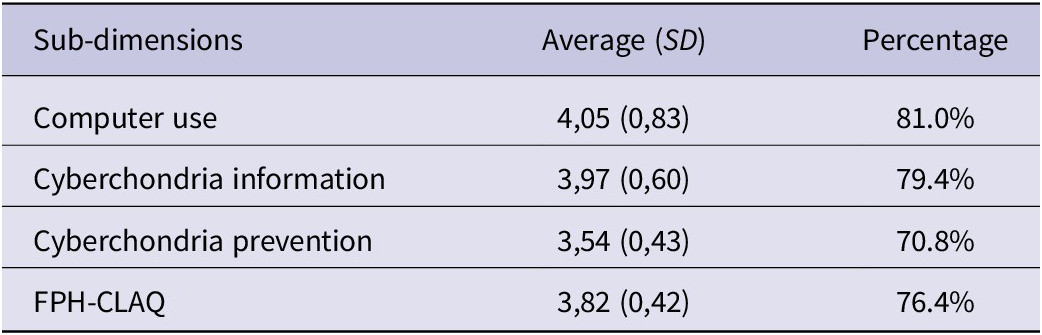
The average scores of the 37 items in the FPH-CLAQ questionnaire in the study group were found to be 4.05 (sd: 0.83) for the Computer Use sub-dimension, 3.97 (sd: 0.60) for the Cyberchondria Knowledge sub-dimension, 3.54 (sd: 0.43) for the Cyberchondria Prevention sub-dimension, and 3.82 (sd: 0.42) for the overall FPH-CLAQ (Table 4).
Scores obtained from FPH-CLAQ and its sub-dimensions

Results
Demographic Analysis
Gender
In the study, no statistical difference was found in the comparison of the participants’ gender and the scores they received from the FPH-CLAQ and its sub-dimensions (P < 0.005).
-
[1] In the “Computer Usage” sub-dimension, the score received by female participants was 79.8% and the score received by male participants was 82.2%.
-
[2] In the “Cyberchondria Knowledge” sub-dimension, the score received by female participants was 80.4% and the score received by male participants was 78.6%.
-
[3] In the “Prevention of Cyberchondria” sub-dimension, the score received by female participants was 71.2% and the score received by male participants was 70.4%.
-
[4] It was found that female participants received 76.6% and male participants received 76.2% points in the FPH-CLAQ.
Age
In the study, no statistical difference was found in the comparison of age and the scores obtained from the FPH-CLAQ and its sub-dimensions (P < 0.029).
-
[1] The scores they received from the “Prevention of Cyberchondria” sub-dimension were found to be high, with a statistically significant difference between the ages of 41-45.
-
[2] It was observed that the “Computer Usage” sub-dimension changed according to age, and the computer usage skills of the participants between the ages of 36-40 were higher at 88.4% compared to the older ages.
-
[3] No statistically significant difference was found in the “Cyberchondria Knowledge” sub-dimension, and the participants in the 41-45 age group had a higher score than other age groups, with a level of 81.8%.
In all sub-dimensions of FPH-CLAQ, participants in the 41-45 age group showed a high rate of participation with 80.2%. It was also observed that the sub-dimensions of “Cyberchondria Knowledge” and “Cyberchondria Prevention” varied according to age; the 41-45 age group had a higher level of mastery of the subject of cyberchondria than other age groups.
Educational status
In the study, a statistically significant difference was found in the comparison of the scores obtained from the FPH-CLAQ and its sub-dimensions according to educational status (P < 0.029).
-
[1] From the “Computer Usage” sub-dimension, General Practitioners were found to be at the level of 78% and Specialist Physicians were found to be at level of 87.4%.
-
[2] From the “Cyberchondria Knowledge” sub-dimension, General Practitioner Physicians were found to be at the level of 78.8%, and Specialist Physicians were at the level of 81.4%.
-
[3] From the “Prevention of Cyberchondria” sub-dimension, General Practitioners were found to be at the level of 70.4% and Specialist Physicians were found to be at the level of 71.6%.
-
[4] Although it was determined that the participants’ education level and the computer usage competence of the Specialist Physicians in the FPH-CLAQ were higher, no difference was found in terms of their mastery of the subject of cyberchondria.
Social network membership
There was no difference in the scores of FPH CLAQ and its subdimensions between the family physicians who were members of any social network and those who were not (P > 0.05).
Marital status
No relationship was found between marital status and the FPH-CLAQ and its sub-dimensions in the study group (P > 0.05).
Analysis of Sub-Dimensions
Computer use
In terms of having basic skills to operate a computer, the General Practitioners were found to be at the level of 84% and the Specialist Physicians were at 92% (P < 0.002).
-
[1] In terms of presentation, calculation, and word processing program usage, the General Practitioner Physician’s level was found to be 72% and the Specialist Physician’s level was 88% (P < 0.000).
-
[2] In terms of being able to install the necessary software on my computer, the General Practitioner was at the level of 68% and the Specialist Physician was at 82% (P < 0.003).
-
[3] The rate of problem-free use of computers and mobile devices while connecting to the internet was found to be 84% for General Practitioners and 92% for Specialist Physicians (P < 0.004).
-
[4] Regarding competence in using the internet, the General Practitioner was found to be at the level of 80% and the Specialist Physician was at 90% (P < 0.011).
Cyberchondria information
When the responses given to the FPH-CLAQ items in the study were examined in terms of educational status when the sub-dimension of “Cyberchondria Knowledge” of Specialist Physicians was examined:
-
[1] There was a statistical difference in the rate of patients’ anxiety increasing after researching their illnesses on the internet (P < 0.045), with Specialist Physicians at 88% and General Practitioners at 82%.
-
[2] No statistical difference was found in seeing cyberchondria as a health problem; the score of Specialist Physicians was 84% and the score of General Practitioners was 80%.
-
[3] There was no statistically significant difference regarding the patients who applied to my unit by doing research on the internet and diagnosing themselves, and both Specialist Physicians and General Practitioners agreed with the statement at a level of 86%. Both Specialist Physicians and General Practitioners agreed with the statement, at a level of 81.6%, that patients who applied to their units by researching on the internet increased their workload.
-
[4] Specialist Physicians agreed with 94% and General Practitioners agreed with 90% in explaining the diagnosis and treatment of their diseases to patients in a clear manner.
-
[5] General Practitioners agreed at a rate of 82% and Specialist Physicians agreed at a rate of 88% regarding the diagnostic method or medication that patients read on the internet and believed they needed.
Prevention of cyberchondria
When the responses given to the FPH-CLAQ items in the study were examined in terms of educational status when the sub-dimension of “Prevention of Cyberchondria” of Specialist Physicians was examined:
-
[1] There was a statistically significant discrepancy in terms of agreement with the statement that patients registered with Family Medicine can easily reach their physicians and find answers to their questions on the Family Medicine website (P < 0.031); Specialist Physicians were at 70% and General Practitioners were at 60%.
-
[2] There is no statistical difference in terms of each Family Medicine practice having its own website (P < 0.060). Specialist Physicians participated at 70% and General Practitioners participated at 62%.
-
[3] No statistical difference was found in terms of participation in the opinion that doing health research on the internet delays treatment; 72% of Specialist Physicians and 74% of General Practitioners participated.
-
[4] There was no statistically significant difference in terms of agreement with the statement that patients relieve their anxiety by making explanations about the information they researched and conveyed on the internet, with 82% of General Practitioners and 86% of Specialist Physicians agreeing.
-
[5] A statistically significant difference was found in terms of agreement with the statement that there is no accurate data on the internet regarding diagnosis and treatments (P < 0.037), with 62% of Specialist Physicians and 54% of General Practitioners agreeing.
-
[6] Specialist Physicians and General Practitioners agreed with the statement that my patients should transfer the information they obtain on the internet and apply to another health institution if the explanations given are not sufficient.
Likert and correlation analysis
This study evaluated and identified dimensions of cyberchondria readiness (Table 3). The level of Computer Use readiness was 81.0%, and “ready but needs a few improvements for readiness.” The level of cyberchondria information readiness was 79.4%, and “ready but needs a few improvements for readiness.” The level of cyberchondria prevention readiness for Turkish Family Medicine Physicians was 70.8%, and “not ready enough and needs some work to improve readiness.” The total FPH-CLAQ readiness was 76.4%, and “needs a few improvements for readiness.”
According to the correlation analysis data in Table 2, a positive relationship was found between the scores obtained from FPH-CLAQ and all sub-dimensions. It was determined that there was a relationship between computer use and cyberchondria knowledge. The cyberchondria knowledge (79.4%) of the family physicians who had active computer use (81%) was found to be similarly high.
Limitations
The presence of health-related information pollution on the internet and inadequate health literacy cause individuals to have difficulty accessing accurate information and experience health anxiety because they cannot correctly evaluate the information they receive. As a result of increased health anxiety, the person wastes their energy and time, occupies health institutions to find answers to their questions, stops the medication they use regularly as a result of their research, or starts the medication they find appropriate, which negatively affects their health. Diagnostic criteria have not yet been specified for cyberchondria, and the only assessment tool is the Cyberchondria Severity Scale. The Cyberchondria Severity Scale consists of 34 questions created to measure the level of cyberchondria. The scale is a psychometric scale that was developed in 2014. The basic approach in its treatment is psychoeducation. A pharmacological treatment has not yet been defined.
Conclusion
In today’s information world, the internet can provide individuals with a low-cost source of health information. Individuals can easily access information about health institutions and physicians through online research. In the study, family physicians highly agree with their patients’ research on the internet in choosing a physician and hospital, and they think that patients who conduct health research on the internet have high levels of anxiety. Low socioeconomic status also pushes patients to research on the internet. Family physicians agree with the view that there is sufficient information on the internet regarding diagnosis and treatment if accurate research is conducted. However, family physicians are concerned that individuals with low health literacy conduct health research on the Internet. It can apparently be observed that family physicians are knowledgeable about cyberchondria and warn their patients about cyberchondria. The data obtained through this study show that patients conduct research on the internet, self-diagnose and apply to the Family Health Center, share the diagnostic method they have researched with their family physician, and request tests or medications they think they need. Health anxiety increases the workload of the individual, the family physician, and health institutions. One of the results reached in the study is that providing information on e-health literacy, creating awareness about cyberchondria, and sharing information about health problems that are lacking in society or for informative purposes on the websites of family physicians will positively affect public health. Family physicians are active on the internet, and providing online information will positively affect public health in preventing cyberchondria. In general, this result suggests that family physicians can easily use the internet for information access, patient records, and health research and that this can shorten the diagnosis process. In the study, family physicians stated that their patients’ anxiety increased after they conducted online research. Family physicians participating in the study have access to information technologies at work and through WhatsApp (their most preferred social network), which provide positive developments in patient/physician communication.
Author contribution
The author confirms the sole responsibility for the conception of the study, presented results, and manuscript preparation.
Funding statement
The study did not receive any funding from non-commercial or commercial organizations.
Competing interest
None declared.