Introduction
Loneliness
Loneliness is a sentiment experienced by a person defining his or her form or level of relationships as inadequate (Weiss, Reference Weiss1973). A sizable proportion of older persons aged 65 and above report significant levels of loneliness, with approximately 40% suffering from loneliness at least sometimes (e.g. Havens et al., Reference Havens, Hall, Sylvestre and Jivan2004; Savikko et al., Reference Savikko, Routasalo, Tilvis, Strandberg and Pitkälä2005; Routasalo et al., Reference Routasalo, Savikko, Tilvis, Strandberg and Pitkälä2006) or indicating high levels of loneliness (Havens et al., Reference Havens, Hall, Sylvestre and Jivan2004).
Theoretical framework
In this paper, we examine loneliness in relation to the MODEL (Model of Depression and Loneliness; Cohen-Mansfield and Parpura-Gill, Reference Cohen-Mansfield and Parpura-Gill2007) theoretical framework which describes environmental, health, psychological, and situational reasons for loneliness in old age. Specifically, environmental factors that contribute to loneliness include lack of opportunities to meet people, living arrangements, and diminished financial resources. Health factors consist of poor health and mobility difficulties. Psychological factors relate to insufficient social skills and low social self-efficacy. Lastly, stressful life events, including retirement, widowhood, death of friends, and relocation, decrease the number of meaningful social contacts and therefore increase loneliness.
Longitudinal findings
Few studies on loneliness in old age have been longitudinal. Some of these studies found that loneliness significantly increases in old age (Jylhä, Reference Jylhä2004; Wenger and Burholt, Reference Wenger and Burholt2004; Dykstra et al., Reference Dykstra, Van Tilburg and Gierveld2005), while others reported only non-significant trends of increase (Tijhuis et al., Reference Tijhuis, Jong-Gierveld, Feskens and Kromhout1999; Tiikkainen and Heikkinen, Reference Tiikkainen and Heikkinen2005) and, in one case, a significant reduction (Holmén and Furukawa, Reference Holmén and Furukawa2002).
Although several studies examined the factors associated with loneliness in old age, only a couple (Jylhä, Reference Jylhä2004; Dykstra et al., Reference Dykstra, Van Tilburg and Gierveld2005) dealt with the longitudinal predictors of loneliness. These predictors include the absence of a spouse or partner (Jylhä, Reference Jylhä2004; Dykstra et al., Reference Dykstra, Van Tilburg and Gierveld2005) and decreased functional capacity (Dykstra et al., Reference Dykstra, Van Tilburg and Gierveld2005).
Cross-sectional findings
In cross-sectional analyses, several demographic characteristics have been found to be associated with higher levels of loneliness, including female gender (Pinquart and Sörensen, Reference Pinquart and Sörensen2001), older age (Fees et al., Reference Fees, Martin and Poon1999; Pinquart and Sörensen, Reference Pinquart and Sörensen2001), institutionalization (Tijhuis et al., Reference Tijhuis, Jong-Gierveld, Feskens and Kromhout1999; Pinquart and Sörensen, Reference Pinquart and Sörensen2001), living alone (Havens et al., Reference Havens, Hall, Sylvestre and Jivan2004; Jylhä, Reference Jylhä2004; Routasalo et al., Reference Routasalo, Savikko, Tilvis, Strandberg and Pitkälä2006), and having low levels of income and educational attainment (Pinquart and Sörensen, Reference Pinquart and Sörensen2001; Savikko et al., Reference Savikko, Routasalo, Tilvis, Strandberg and Pitkälä2005; Routasalo et al., Reference Routasalo, Savikko, Tilvis, Strandberg and Pitkälä2006). Findings from a meta-analysis indicated that the association between income and loneliness appears to be stronger than the association between education and loneliness (Pinquart and Sörensen, Reference Pinquart and Sörensen2001). Several studies have found that being unmarried or widowed was positively related to loneliness (Routasalo and Pitkala, Reference Routasalo and Pitkala2003; Havens et al., Reference Havens, Hall, Sylvestre and Jivan2004; Wenger and Burholt, Reference Wenger and Burholt2004; Routasalo et al., Reference Routasalo, Savikko, Tilvis, Strandberg and Pitkälä2006), while in one study this association was not found (Kim, Reference Kim1999).
Greater loneliness has been associated with measures of poor health (Routasalo and Pitkala, Reference Routasalo and Pitkala2003), including poor subjective health (Havens et al., Reference Havens, Hall, Sylvestre and Jivan2004; Savikko et al., Reference Savikko, Routasalo, Tilvis, Strandberg and Pitkälä2005; Routasalo et al., Reference Routasalo, Savikko, Tilvis, Strandberg and Pitkälä2006), depression (Tiikkainen and Heikkinen, Reference Tiikkainen and Heikkinen2005; Routasalo et al., Reference Routasalo, Savikko, Tilvis, Strandberg and Pitkälä2006), and functional disability (Kim, Reference Kim1999; Jylhä, Reference Jylhä2004; Savikko et al., Reference Savikko, Routasalo, Tilvis, Strandberg and Pitkälä2005; Routasalo et al., Reference Routasalo, Savikko, Tilvis, Strandberg and Pitkälä2006). Regarding the association between cognitive function and loneliness, some studies found cognitive decline to be positively related to loneliness (e.g. Havens et al., Reference Havens, Hall, Sylvestre and Jivan2004), while others found no such relationship (e.g. Fees et al., Reference Fees, Martin and Poon1999; Tijhuis et al., Reference Tijhuis, Jong-Gierveld, Feskens and Kromhout1999).
With regard to social factors, most studies found loneliness to be negatively related to frequency of contact with others (e.g. Iecovich et al., Reference Iecovich, Barasch, Mirsky, Kaufman, Avgar and Kolfogelson2004), although one found no such relationship (Routasalo et al., Reference Routasalo, Savikko, Tilvis, Strandberg and Pitkälä2006). Loneliness is negatively related to social participation (Jylhä, Reference Jylhä2004) and positively related to dissatisfaction with social networks or with the level of social support (Wenger and Burholt, Reference Wenger and Burholt2004; Tiikkainen and Heikkinen, Reference Tiikkainen and Heikkinen2005). However, the relationship between loneliness and social support may be mediated by other factors. For example, findings of a meta-analysis (Pinquart and Sörensen, Reference Pinquart and Sörensen2001) indicated that an inverse relationship between friendship and loneliness was significant for unmarried participants, but not for married participants. The authors suggest that friendship may be less crucial to married persons who have sufficient support from their spouse.
Cross-cultural comparisons and the Israeli context
Cross-cultural studies have shown that there are differences in the prevalence of loneliness in older adults across cultures (Routasalo and Pitkala, Reference Routasalo and Pitkala2003) and in the associations between loneliness and other factors (e.g. Perlman, Reference Perlman2004). Israel has a unique social context which may influence the manifestation of loneliness in old age. The majority of Israeli older adults are immigrants who came to Israel shortly after it was founded in 1948, when it was a poor state struggling for survival. In addition to the economic hardships of living in Israel during that period, the majority of immigrants were refugees who had undergone traumatic experiences such as persecution and the Holocaust prior to immigration. Many lost opportunities for education due to war and immigration experiences. Most of the immigrants had to learn a new language and accommodate a new culture, and intergenerational rifts may have occurred in some cases. In addition, a series of wars and acts of terrorism resulted in the loss or injury of many people's loved ones. Such traumatic histories have left many older persons living in Israel particularly vulnerable to the stresses that characterize Israeli society. Thus, during the Lebanon War, for example, older persons responded with a sharper rise in depressive symptoms compared to younger members of society, who were more directly threatened (Solomon and Ginzburg, Reference Solomon, Ginzburg and Lomranz1998).
In contrast to these historical developments, which may have put the Israeli older person at increased risk of loneliness, there are other characteristics of Israeli society that can potentially negate this vulnerability. Many older persons, for example, live within their ethnic communities and have strong family relationships, both of which can mitigate the effects of loneliness.
The purpose of this study is to elucidate the changes in loneliness that take place in old age over time and the factors that affect these changes by analyzing data from the Cross-Sectional and Longitudinal Aging Study (CALAS), a longitudinal study of a national random sample of older people in Israel. The longitudinal design of this study makes it a valuable resource for contributing to the understanding of change in loneliness over time in old age within the Israeli context. Our research questions were:
(i) Do older people experience loneliness more frequently over time? Based on the MODEL theoretical framework, hypothesis 1 depicts a rise in loneliness with processes occurring in old age which reduce the size of social networks without providing the tools or opportunities to replace them.
(ii) What are the characteristics of the lonely older population? Hypothesis 2 predicts that indicators of lower socioeconomic status such as low income and low education, which according to the MODEL can translate into fewer opportunities for social engagement, are associated with greater loneliness. Hypothesis 3 is that poor health will be positively related to loneliness, corresponding to the MODEL's assertion that poor health presents a barrier to maintaining and re-establishing social ties. Hypothesis 4, based on predictions of the MODEL framework, is that greater loneliness will be negatively related to social network factors.
(iii) What are the predictors of becoming lonely in old age?
(iv) What are the predictors of loneliness diminishing during old age?
Methods
Participants
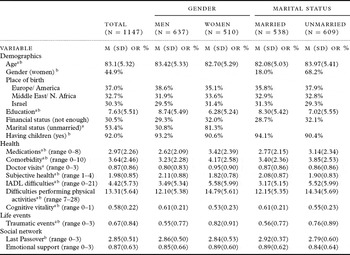
The CALAS provides information on the health, mental, and social status of Jews aged 75 years and older living in Israel. The dataset includes a randomly selected sample from the Israeli National Population Register (a complete listing of the Israeli population) stratified by age (75–79, 80–84, 85–89, 90–94), gender, and place of birth (Europe/America, Middle East/North Africa, Israel). The current study examined two waves of data (wave 1: 1989–1992; wave 2: 1993–1994) with an average gap of 3.5 years between them. Because institutionalization involves a host of factors that can affect loneliness (e.g. living in a group setting or physical limitations that may have prompted institutionalization), this study focused on participants who were self-respondent and non-institutionalized. Of the initial potential sample of 2,400 individuals aged 75–94 drawn from the NPR on 1 January 1989, 1,820 (75.8%) were located and interviewed, 15.7% of the sampled individuals were not located, and an additional 8.5% refused to be interviewed. Of the 1,820 individuals remaining, 75.2% (n = 1,369) were interviewed in person, and 24.8% (n = 451) were proxy interviews. Of the 1,369 participants interviewed in person, 1,200 were non-institutionalized and 1,147 of them provided information on the loneliness measure which was examined in this study. Of these 1,147 participants from wave 1, in-person interviews were collected for 606 participants at wave 2 and 588 provided information on the loneliness measure. Thus, this analysis included 1,147 non-institutionalized self-respondent participants at wave 1 and 588 participants at wave 2 who were self-respondent at both waves and non-institutionalized at wave 1. While information on the reasons for attrition between wave 1 and wave 2 is unavailable, there was no significant difference in loneliness between participants who were only available at wave 1 and those interviewed at both waves. Nonetheless, participants who were only interviewed at wave 1 were significantly older, less educated, less financially secure, with more medications, lower subjective health, more difficulties with instrumental activities of daily living (IADL) and performing physical activities, and less cognitive vitality at wave 1 than participants who were interviewed at both waves (analysis available from the authors). Table 1 displays participant characteristics at wave 1.
Participants’ characteristics at wave 1 and t-tests/χ2 test results comparing men with women and married with unmarried participants

a Indicates significant differences between men and women at the ≤ 0.05 level.
b Indicates significant differences between married and unmarried participants at the ≤ 0.05 level.
Procedure
The study is a secondary analysis of the CALAS data, other parts of which have been published previously (e.g. Walter-Ginzburg et al., Reference Walter-Ginzburg, Shmotkin, Blumstein and Shorek2005). The questionnaire which was used was based on previous epidemiological studies of older persons (Cornoni-Huntley, Reference Cornoni-Huntley, Brock, Ostfeld, Taylor and Wallace1986; Kovar and Fitti, Reference Kovar and Fitti1987), translated into Hebrew, and adapted to the Israeli environment. Multilingual trained interviewers interviewed participants in their residence. Participants with low fluency in the Hebrew language were interviewed in their native language. The interviewers read the questions aloud as phrased in the study questionnaire booklet and recorded the participants’ responses. The study was formally approved by the Helsinki Committee of Tel-Hashomer Hospital, and the participants signed an informed consent.
Measures
Loneliness
Loneliness was the dependent variable in this study. It was measured by a single question, from the 20-item Center for Epidemiologic Studies Depression Scale (Radloff, Reference Radloff1977), asking about the frequency at which participants had felt lonely during the last month (0 = no, 1 = sometimes, 2 = most of the time, 3 = almost every day).
Socio-demographics
These included age, gender (0 = woman, 1 = man), place of birth (1 = Israel, 2 = Middle East/North Africa, 3 = Europe/America), education (number of years of education), financial situation (subjective evaluation of having enough money: 0 = no, 1 = yes), marital status (0 = unmarried, 1 = married), and having children (0 = no, 1 = yes).
Health indicators
These included medication use, comorbidity, doctors’ visits, subjective health, IADL, difficulties in performing physical activities, and cognitive vitality. Medication use refers to the number of medications the participant was taking at the time of the interview (range 0–8). Comorbidity refers to the number of medical conditions the participant reported. The interviewers asked about 26 conditions, including high blood pressure, diabetes, heart attack, other heart problems, circulatory diseases, respiratory diseases, thyroid disease, kidney disease, gastroenterological and biliary diseases, osteoporosis, paralysis, cardiovascular attacks, arthritis, rheumatism, hemorrhoids, anemia, thyroid gland disease, depression, Parkinson's disease, dizziness, tumors, pain, prostate diseases, gynecological problems, Alzheimer's disease, and having had a hysterectomy (range 0–10; 10 or more diseases was recoded to 10). Doctor's visits included the number of visits to the doctor in the last month (0 = 0 visits, 1 = 1 visit, 2 = 2–4 visits, 3 = 5 or more visits). Subjective health refers to the participant's evaluation of his or her current health, ranging from 1 (very poor), to 4 (excellent). IADL (Lawton and Brody, Reference Lawton and Brody1969; Fillenbaum, Reference Fillenbaum1985) refers to reported difficulty performing seven instrumental activities of daily living, including preparing meals, doing daily shopping, doing non-daily shopping (buying clothes, sweets and gifts), doing easy housework (making the bed, washing dishes), doing difficult housework (washing floors, cleaning windows), going by oneself to the nearest bus stop, and doing laundry. Participants rated the difficulty of each of the activities from 0 (no difficulty) to 3 (extreme difficulty) and the final score is a sum of the difficulty ratings for all seven activities (range 0–21). Cronbach's α reliability for IADL was 0.90. Difficulties in performing physical activities (Rosow and Breslau, Reference Rosow and Breslau1966; Nagi, Reference Nagi1976) refers to reported difficulty performing seven relatively strenuous activities including pushing a heavy object; bending, crouching, or stooping; walking 1 kilometer; climbing 10 steps without resting; lifting or carrying up to 5 kilograms; reaching or stretching arms above shoulders; and writing or using small objects. Participants rated each of the activities from 1 (without difficulty) to 4 (cannot perform), and the score is a sum of the ratings for each of the seven activities (range: 7–28). Cronbach's α reliability for the scale was 0.90. Cognitive vitality is a scale indicating whether participants had difficulty with the performance of tasks with cognitive components: identifying people without difficulty; writing or using small objects; reading newspapers; attending movies, restaurants, concerts, or the theater often; writing letters often; managing finances without difficulty; using the telephone without difficulty; and reporting age at last birthday which matches official age within 1 year (Walter-Ginzburg et al., Reference Walter-Ginzburg, Shmotkin, Blumstein and Shorek2005). The score is the number of tasks with which the person did not have difficulty. Cronbach's α reliability for cognitive vitality was 0.64.
To assess traumatic life events, the interviewers asked the participants whether they had experienced any traumatic events which had influenced their lives. The participants were asked to tell the interviewers about up to three traumatic events and the score was the number of traumatic events which the participants reported (range 0–3).
Social network factors included queries about how the participant spent the last Passover and about emotional support. In Israel, an especially important aspect of family and social life is getting together on holidays, such as Passover. Accordingly, spending this holiday with family or friends was used as an indicator of social network in this study. Hence, “Last Passover” assessed with whom the last Passover holiday was spent (1 = alone, 2 = with strangers, 3 = with close friends or relatives). To measure emotional support, participants were asked to name up to three people who provided them with emotional support, such as helping to talk through problems. The score was the number of people who provided emotional support (range 0–3).
Statistical analysis
We used both longitudinal and cross-sectional analyses. In order to answer the first research question about whether participants experience loneliness more frequently over time, we conducted a paired t-test between the reported frequencies of loneliness at wave 1 and wave 2. We examined the second question regarding the characteristics of the lonely older population by first conducting exploratory bivariate analyses, including correlations and χ2 tests of loneliness and background information at wave 1. Then, in order to control for the multiple comparisons used in the exploratory analyses, we conducted a forced entry multivariate regression which included those variables that were highly correlated on a bivariate level using wave 1 data. We examined the third question, concerning the predictors of becoming lonely in old age, by comparing those who were not lonely at both waves 1 and 2 (scored 0 at both waves) to those who became lonely between waves 1 and 2 (scored 0 at wave 1, and 1–3 at wave 2), first through exploratory t-tests and χ2 tests. Then, in continuation, the variables which were significant in the bivariate analyses were entered into a logistic regression predicting becoming lonely. Additionally, we performed the same types of analyses (exploratory t-tests and χ2 tests followed by a logistic regression to control for multiple comparisons) to address the predictors of loneliness diminishing completely in old age by comparing those who were lonely at wave 1 (scored 1–3 at wave 1) and remained so (scored 1–3 at wave 2) to those whose loneliness diminished completely between waves 1 and 2 (scored 0 at wave 2). We used variables at wave 1 to predict loneliness diminishing completely at wave 2. For all of the analyses mentioned, p-values that were smaller than 0.05 were considered to be statistically significant. The analyses were conducted using SPSS 16.0.
Results
Loneliness over time in old age
The mean frequency of feeling lonely increased significantly from wave 1 (M = 0.62) to wave 2 (M = 0.80: t = 4.08, df = 587, p < 0.001). At wave 1 (N = 1147), 38.1% of participants reported feeling lonely at least some of the time (scored 1–3 on the loneliness scale), whereas at wave 2, 45.7% reported this frequency of loneliness.
Characteristics of lonely older persons in the wave 1 sample
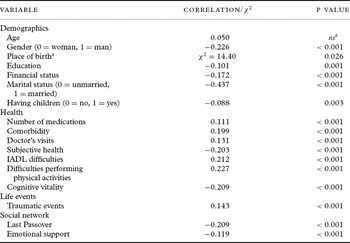
An exploratory analysis using correlations and cross-tabulations between loneliness and background variables showed that women, those born outside of Israel, less educated persons, those who felt they did not have enough money, unmarried persons, and childless persons were significantly lonelier than their counterparts (Table 2). The majority of unmarried persons were widowed (91.5%). Age was not significantly associated with loneliness. All of the indicators of ill health (number of medications, comorbidity, doctors’ visits, IADL functioning, and difficulties in performing physical activities) were significantly related to higher levels of loneliness, and the indicators of better health (subjective health and cognitive vitality) were significantly associated with lower levels of loneliness. In addition, we found a significantly positive relationship between the experience of traumatic events and loneliness. Lastly, those who spent last Passover alone and those with less emotional support were significantly lonelier than those who had spent last Passover with other people and those who had more persons available to provide emotional support.
Associations between loneliness and background variables at wave 1 (N = 1147)

a Place of Birth had three values: Israeli (23.8% of loneliest), Middle East/North Africa (38.1% of loneliest), and Europe/America (38.1% of loneliest).
b p > 0.05.
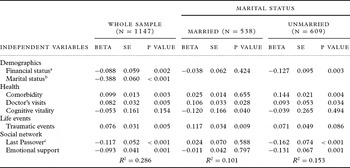
A multivariate linear regression was conducted to clarify which of the variables holding significant bivariate associations with loneliness were independently related to loneliness. As Table 3 shows, the following variables independently contributed to loneliness: the demographic variables of being unmarried and having fewer financial resources, the health variables of greater comorbidity and more doctor's visits, a higher number of traumatic events, and both social network variables, i.e. having spent Passover alone and having less emotional support. Altogether, these variables explained 28.6% of the variance in loneliness.
Significant results of a forced entry multivariate linear regression at wave 1 with loneliness as the dependent variable

Note: The following variables were not significant predictors of loneliness in any of the groups: gender, education, having children, IADL difficulties, subjective health, difficulties performing physical activities, and number of medications.
a 0 = not having enough money, 1 = sufficient income.
b 0 = unmarried, 1 = married.
c 1 = alone, 2 = with strangers, 3 = with close friends or relatives.
The finding that marital status was the most potent predictor of loneliness in the regression prompted us to examine predictors of loneliness separately among married and unmarried participants. Additional considerations for this choice included previous findings (e.g. Pinquart and Sörensen, Reference Pinquart and Sörensen2001) reporting that friendship was more important in explaining loneliness for unmarried persons than for married persons, and implications of the MODEL framework indicating that being married may provide an advantage in terms of social support and could therefore provide a different start-point in terms of the need for relationships. Thus, we performed multivariate linear regressions (using the same variables) separately for married and unmarried persons to examine the predictors of loneliness in each subgroup (see Table 3). Findings showed that for married respondents, lower levels of cognitive vitality, the experience of more traumatic events, and a greater number of doctor's visits were associated with greater loneliness. For unmarried participants, spending Passover alone, less emotional support, financial difficulties, greater comorbidity, and a greater number of doctor's visits were significantly related to greater loneliness. The variables entered into the regressions explained 10.1% of the variance in loneliness for married participants and 15.3% for unmarried participants.
Predictors of loneliness change over time
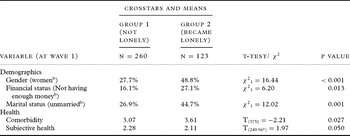
In comparing those who became lonely between waves 1 and 2 (i.e. who shifted from score 0 to any of 1 to 3) to those who remained not lonely (scored 0 at both waves) (Table 4), we found that women, unmarried persons, those with fewer financial resources, and those with higher comorbidity and lower subjective health at wave 1 were more likely to become lonely at wave 2. A logistic regression to examine the independent predictors of becoming lonely at wave 2 in those who were not lonely at wave 1 yielded both lower financial status (OR = 1.9, 95% CI = 1.10–3.38, p < 0.05) and female gender (OR = 1.9, 95% CI = 1.10–3.34, p < 0.05) as significant risk factors for loneliness at wave 2.
Univariate comparisons of those who remained not lonely to those who became lonely between waves 1 and 2 (n = 383)

Note: the following variables did not show significant differences between the groups: age, education, IADL, traumatic life events, emotional support, and how last Passover was spent.
a Assuming unequal variances.
b % within loneliness groups.
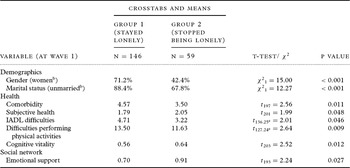
In addition, we compared those whose loneliness diminished completely between waves 1 and 2 with those who remained lonely (scored 1–3 at both waves) (Table 5). Results of bivariate analyses indicated that those whose loneliness diminished completely were significantly more likely to be men, married, and have lower comorbidity, better subjective health, fewer difficulties in performing IADL and physical activities, higher cognitive vitality, and more emotional support at wave 1 than those who remained lonely at wave 2. We conducted a logistic regression to examine the independent predictors of loneliness diminishing completely at wave 2 in those who were lonely at wave 1 with the variables which were significant in the t-tests and cross-tabulations above. The regression yielded male gender (OR = 0.4, 95% CI = 0.17–0.81, p < 0.05) and being married (OR = 0.3, 95% CI = 0.14–0.86, p < 0.05) as predictive factors for loneliness diminishing completely at wave 2.
Comparison of those who remained lonely to those who stopped feeling lonely between waves 1 and 2 (n = 205)

Note: the following variables did not show significant differences between the groups: age, education, traumatic life events, emotional support, and how last Passover was spent.
a Assuming unequal variances.
b % within loneliness groups.
Discussion
In this study, the prevalence of experiencing loneliness at least sometimes was similar to that found worldwide at approximately 40%. Furthermore, the findings showed a significant increase in the mean frequency of loneliness from wave 1 to wave 2, agreeing with the MODEL's (Cohen-Mansfield and Parpura-Gill, Reference Cohen-Mansfield and Parpura-Gill2007) prediction of an increase in loneliness, supporting our first hypothesis, and reinforcing previous findings that people do become lonelier over time in old age (e.g. Jylhä, Reference Jylhä2004; Dykstra et al., Reference Dykstra, Van Tilburg and Gierveld2005).
Characteristics of the lonely older persons in the wave 1 sample
Among the demographic factors, low income was significantly related to greater loneliness in both bivariate and multivariate analyses, whereas lower education was only significantly related to greater loneliness in the bivariate analysis. These findings correspond with previous studies in which low income and education were associated with greater loneliness (e.g. Savikko et al., Reference Savikko, Routasalo, Tilvis, Strandberg and Pitkälä2005; Routasalo et al., Reference Routasalo, Savikko, Tilvis, Strandberg and Pitkälä2006) and support our second hypothesis. Nonetheless, the relationship between income and loneliness was stronger than the relationship between education and loneliness, as reported in a meta-analysis (Pinquart and Sörensen, Reference Pinquart and Sörensen2001). In addition, our third hypothesis that poor health factors would be positively related to loneliness was strongly supported by the findings. Furthermore, the study's finding that greater loneliness was negatively related to social network factors supports our fourth hypothesis and agrees with previous findings that greater loneliness is related to low scores on social network variables (e.g. Routasalo and Pitkala, Reference Routasalo and Pitkala2003; Dykstra and Gierveld, Reference Dykstra and Gierveld2004).
The most potent predictor of loneliness in this sample was marital status, with married persons significantly less lonely than unmarried persons in accordance with the findings of previous studies (e.g. Wenger and Burholt, Reference Wenger and Burholt2004). The role of the marital status variable, nevertheless, could be complex. The impact of marital status on loneliness could be direct, through the companionship provided by the spouse or through the spouse's social network (e.g. Dykstra and Gierveld, Reference Dykstra and Gierveld2004). Additionally, the influence of marital status on loneliness could be indirect, through the multiple correlates of marital status. As can be seen in Table 1, married persons were more likely to have children, who were more likely to be a part of their parents’ social support network. In addition, married persons were healthier on all health indicators, enabling them to have greater mobility and to be more able to engage in social activities, as suggested by the MODEL.
Different variables explained loneliness among married and unmarried persons. Among the married, lonelier persons tended to have experienced more traumatic events, and had worse health and cognitive function. In contrast, among the unmarried, loneliness was higher in those with financial difficulties, poor health, and less social network support. The difference in association between cognitive vitality and loneliness with marital status could perhaps partly explain the mixed findings regarding the association between cognitive function and loneliness noted previously (Tijhuis et al., Reference Tijhuis, Jong-Gierveld, Feskens and Kromhout1999; Havens et al., Reference Havens, Hall, Sylvestre and Jivan2004).
Predictors of loneliness change over time in old age
Gender, marital status, and financial status, as well as comorbidity and subjective health, predicted becoming lonely between waves 1 and 2 in the bivariate analyses. The significant colinearity between gender and other factors at wave 1 can perhaps partially explain the fact that gender was the only variable which emerged as a significant factor in the logistic regressions for predicting both the development of loneliness at wave 2 and its disappearance. As can be seen in Table 1, women were significantly more likely to be unmarried, sicker, and to have more functional limitations. Gender is therefore the most parsimonious risk factor for becoming lonely at wave 2 (although marital status was the best predictor of being lonely at wave 1). The central role of gender may also stem from the increased likelihood of women to become widowed in old age and possibly from the more affiliative inclination of women (e.g. Fuhrer and Stansfeld, Reference Fuhrer and Stansfeld2002).
Low and insufficient income is a known phenomenon among older persons in Israel, with approximately 20% of older persons living below the poverty line (Brodsky et al., Reference Brodsky, Shnoor and Be'er2007). The effect of financial status on loneliness may be mediated by its impact on the ability to socialize. Fewer financial resources may limit socialization in multiple ways, as posited by the MODEL, including transportation barriers, inability to afford activities, such as trips and outings which older persons often highly desire (Cohen-Mansfield et al., Reference Cohen-Mansfield, Parpura-Gill, Campbell-Kotler, Vass and Rosenberg2005), as well as inadequate housing and resources to host friends at one's residence. The specific mechanisms by which economic barriers hinder social activities in this group need to be further studied.
The predictors of becoming lonely provide direction in targeting preventive interventions to those who are most at risk of becoming lonely in old age, namely women, persons lacking financial means, and persons with poorer health. An understanding of the mechanisms underlying the vulnerability of each of these populations is necessary for developing such programs.
As stated earlier, the mean frequency of loneliness was significantly higher at wave 2 in comparison to wave 1, indicating that loneliness increases with the aging process. Nonetheless, we did not find a significant correlation between loneliness and age at wave 1. One possible reason for the lack of effect of age in the cross-sectional data may be the skewed distribution of the loneliness variable. When using nonparametric bivariate methods, (i.e. Spearman correlations), age and loneliness at wave 1 were found to be significantly, though weakly, related (rs = 0.06, p < 0.05. Note: for all other variables, Spearman correlations were very similar to the Pearson correlations presented above). Although loneliness increases as part of the aging process, its trajectory along progressively older cohorts of the aged may not be linear.
Several findings were unique to this study. One is the difference in predictors of loneliness among married and unmarried persons. Additionally, the significance of past traumas to loneliness in the older population has not been reported in other populations. This finding may be specific to the Israeli social context, in which traumatic events play a significant role in the lives of many older adults, especially those who are immigrants and have experienced multiple traumas (Solomon and Ginzburg, Reference Solomon, Ginzburg and Lomranz1998), both in their countries of origin and through the wars they have endured in Israel. In support of this, our findings indicated that those born in Israel had significantly lower levels of loneliness than those born elsewhere. Yet, to understand the importance of immigration and trauma, they need to be examined in other contexts and in other populations. Lastly, this study contributes to the literature on loneliness in old age by examining the predictors of becoming less lonely over time, which have not been reported previously. While one might have thought that increasing and decreasing loneliness are the mirror image of each other, our findings indicated that each direction is more affected by certain factors than the other. Whereas financial difficulties contributed to the development of loneliness (in accordance with the MODEL), lack of financial difficulties does not alleviate loneliness, but rather married status. Such findings are critical to reaching a better understanding of the protective factors against loneliness in old age and for developing appropriate interventions.
The study had some methodological limitations. There was a 3.5 year gap between wave 1 and wave 2, during which the attrition of self-respondent participants was very high (approximately 50%). Those who did not participate at wave 2, while not being significantly lonelier in wave 1, had many of the risk factors for becoming lonelier (they were significantly older, less educated, less financially secure, and with poorer health and function than those who participated at both waves). An additional possible limitation of the study was the loneliness measure, which consisted of a single item inquiring about the frequency of feeling lonely. Although this measure has limitations, it has been used in numerous studies (e.g. Holmén and Furukawa, Reference Holmén and Furukawa2002; Savikko et al., Reference Savikko, Routasalo, Tilvis, Strandberg and Pitkälä2005; Tiikkainen and Heikkinen, Reference Tiikkainen and Heikkinen2005) and has been reported to have good face and predictive validity (Routasalo et al., Reference Routasalo, Savikko, Tilvis, Strandberg and Pitkälä2006). Furthermore, since the CALAS dataset does not include a measure of social network size, we were unable to examine the effects of a decrease in network size. Finally, the measure of how the participant spent the last Passover is a culturally based indicator of social network. Being alone on Passover was taken to indicate lack of a social network, as most Jews in Israel tend to celebrate the holiday with family and/or friends. This variable may be somewhat problematic since it also involves religiosity in addition to indicating the presence of a social network. On the other hand, most Israeli Jews do celebrate Passover to some extent, whether or not they are religious or observant.
The percentage of variance explained by the regression analyses was modest, indicating the need for further research to reach a more comprehensive understanding of the factors which lead to loneliness in old age. Such research may need to include psychological variables, such as social self-efficacy (Cohen-Mansfield and Parpura-Gill, Reference Cohen-Mansfield and Parpura-Gill2007), or environmental factors, such as opportunities for socialization outside the home (e.g. distance from a social center), as the MODEL would suggest. It would also be important for future research to investigate the perspective of the older person regarding how past trauma, health, functional status, financial difficulties, and cognitive impairment affect social activity and loneliness. Lastly, future research should investigate populations which are particularly vulnerable to loneliness to further understand the underlying mechanisms of loneliness development. This study's unique findings on the risk factors for becoming lonely could be useful to this end. Such research would lay the groundwork for interventions or preventive work related to widowhood, and to social opportunities for the frailer segment of the population.
The implications of these findings are that when planning interventions for reducing loneliness in older people, it may be appropriate to base interventions on different models for the married and the unmarried to suit their different needs. Lastly, these findings suggest that interventions to reduce loneliness in older people should take demographics, health factors, and previous traumatic life events into account when targeting social network factors. This is important since these factors place persons at risk of not being able to access, enjoy, develop, or maintain meaningful social networks.
Conflict of interest
None.
Description of authors’ roles
Professor Jiska Cohen-Mansfield was responsible for the initial concept of the study, as well as analyzing and interpreting the data, preparing and reviewing the manuscript during every stage of its development, and approving the final version for publication. Professor Dov Shmotkin contributed his ideas to the analysis and interpretation of the data, reviewed drafts of the paper for intellectual content, and approved the final version to be published. Shira Goldberg reviewed the literature on loneliness in old age, performed the statistical analyses, worked on writing up the paper and critically reviewing it, prepared the paper for publication, and approved the final version.
Acknowledgments
The first two waves of the Cross-Sectional and Longitudinal Aging Study (CALAS) were funded by grants from the U.S. National Institute on Aging (R01–5885-03 and R01–5885-06) to the Department of Clinical Epidemiology at the Chaim Sheba Medical Center.