Introduction
Patients with borderline personality disorder (BPD) perform more poorly than healthy individuals in multiple neurocognitive domains (Reference Bazanis, Rogers and Dowson1–Reference Travers and King6). However, the cognitive profile of BPD remains to be fully elucidated because of negative or inconsistent findings (Reference Fertuck, Lenzenweger and Clarkin7–Reference LeGris and van Reekum9). Inconsistent results raise questions about the specificity and stability of these reported neuropsychological deficits. This variability in findings may in part result from methodological differences among studies (such as the definition of BPD and use of self-reported, semi-structured, or unstructured interviews) and in part from the use of different neuropsychological measures (Reference Ruocco10).
The symptoms and problematic behaviours of BPD, however, may be linked to dysfunction of neurocognitive domains: the acquisition of cognitive ability is inextricably linked to emotion and personality development, and inhibitory capacity influences the acquisition of prosocial behaviours, affect regulation, and problem solving (Reference Derryberry and Reed11–Reference Silbersweig, Clarkin and Goldstein13), often impaired in people with BPD. Some groups have reported working memory deficits in BPD populations (Reference Burgess14–Reference Swirsky-Sacchetti, Gorton, Samuel, Sobel, Genetta-Wadley and Burleigh17), while others have not (Reference Judd18–Reference van Reekum, Links, Mitton, Fedorov and Patrick20). In particular, one recent study reported that patients with BPD showed specific deficient attention and immediate and delayed memory (Reference Seres, Unoka, Bodi, Aspan and Keri21) which correlated to impulsivity. Moreover, our group previously reported that the mechanism of actively improving recall of neutral memory contents through repetition of retrieval is impaired in BPD patients (Reference Sala, Caverzasi and Marraffini22).
Based on the controversy of the literature, the aim of this study was to further clarify the role of verbal working memory and sustained attention for the pathophysiology of BPD, particularly in relation to impulsivity. We hypothesised that patients with BPD have impairment in such neuropsychological domains which in turn associate to increased impulsivity, particularly for working memory.
Methods
Participants and clinical examination
Fifteen patients with BPD were recruited at the Centre for Research on Personality Disorders of the University of Pavia, Italy, dedicated to the study and treatment of personality disorders. All patients met the Diagnostic and Statistical Manual of Mental Disorders (DSM)-IV diagnostic criteria for BPD, as determined by the Structured Clinical Interview for DSM-IV (SCID)-II (Reference Williams, Gibbon and First23). SCID-II interviews were administered by evaluators with experience in the procedure, being trained by a senior investigator. The diagnoses were also confirmed by holding regular clinical consensus meetings with the attending psychiatrist, in accordance to the DSM-IV criteria. Also, the Diagnostic Interview for Borderline Patients (DIB) (Reference Gunderson, Kolb and Austin24) was administered to confirm the diagnosis of BPD and the Zanarini Scale for BPD (ZAN-BPD) (Reference Zanarini, Vujanovic, Parachini, Boulanger, Frankenburg and Hennen25) (13.4 ± 3.8) was used to assess the severity of the symptomatology. The SCID-I was also administered to detect any Axis-I disorder comorbidity. Patients with any comorbid personality disorder, current medical problems and/or alcohol or substance abuse within 6 weeks preceding the study were excluded. Patient clinical information was obtained from psychiatric interviews, the attending psychiatrist and medical charts. Handedness was determined by using the Oldfield handedness questionnaire (Reference Oldfield26). The subscale of impulsivity of the ZAN-BPD (Reference Zanarini, Vujanovic, Parachini, Boulanger, Frankenburg and Hennen25) was used to assess the severity of impulsivity levels, while the 24-item Hamilton Depression Rating Scale (HAM-D) (Reference Hamilton27) was used to rate depression. We administered the Child Abuse Scale (Reference Soloff, Lynch and Kelly28) to evaluate childhood abuse.
Fifteen healthy subjects were recruited from the local community and 1:1 matched with patients for race, age, gender, handedness and levels of education were recruited. These control participants had no past or current history of any DSM-IV Axis-I or Axis-II disorder as determined by the SCID-I and SCID-II interviews. Also, they had no current medical problems, no history of substance/alcohol abuse, no history of childhood abuse and no history of psychiatric disorders among first-degree relatives. The same scales as for the BPD patients were administered to healthy controls. Twelve BPD patients and 11 healthy subjects were also tested in our prior study exploring cognitive memory control (Reference Sala, Caverzasi and Marraffini22).
All participants provided written, informed consent after receiving a full explanation of the study protocol. This study was approved by the Biomedical Ethics Committee of the IRCCS S. Matteo Hospital.
Instruments
Neuropsychological evaluation
Continuous performance test The computer-based degraded-stimulus continuous performance test (CPT) was used to measure sustained attention, yielding a sensitivity score A′ as a measure of signal-noise discrimination (Reference Nuechterlein and Asarnow29). This task provides a sensitive measure of subtle deficits in signal detection over sustained periods of visual monitoring with minimal working memory involvement, as previously described by our group (Reference Ruberto, Vassos and Lewis30). Participants were shown images of numerals degraded to a fixed degree by blurring and superimposing a random pattern of visual noise. The stimuli were presented for 40 ms each at a rate of 1 per second on a computer screen situated 1 m away from the participants. They were instructed to respond as quickly as possible by button press when a pre-designated target numeral ‘0' appeared. The target numeral occurred in a quasi-random fashion in 25% of the 480 trials (level of stimulus degradation 25%). The numerals immediately preceding the target were balanced to eliminate sequence recognition. Although stimuli are presented continuously, the data were analysed in blocks of trials. The first 160 trials are practice trials and were excluded from the analysis, while the remainder were divided in 4 blocks of 80 trials each. For each block, the following four dependent variables were used: (a) hit rate (HR) or number of correct responses, (b) false alarm rate (FAR) or number of errors of commission, (c) logβ or response criterion, which reflects the amount of perceptual evidence required prior to responding to a stimulus as a target and (d) d′ or sensitivity, a non-parametric signal detection index of sensitivity, a measure of target detection. Reaction time data were not recorded.
N-back test In this test (Reference Cohen, Perlstein and Braver31), participants were presented with a series of single letters, each displayed on a computer screen for 2 ms in a pseudorandom order. In the zero-back condition, participants were asked to indicate by a button press every time a pre-designated target, the letter ‘X', appeared. In the 1-, 2- and 3-back conditions, participants were instructed to indicate whether the letter they currently saw matched the one displayed in the preceding 1, 2 or 3 trials. Outcome measures were number of correct responses, number of errors of omission and number of errors of commission.
Data analysis
SPSS for Windows software, version 11.0 (SPSS Inc., Chicago, IL, USA), was used to perform all statistical analyses, and the two-tailed statistical significance level was set at p < 0.05. First, we compared the demographic variables using the Students' t test or the Mann-Whitney U test for continuous variables and the Pearson chi-square or the Fisher's exact test for the dichotomous variables, as appropriate.
To compare the CPT and the N-back test scores between BPD patients and healthy controls, the Mann-Whitney U test was used since the assumption of normality for the general linear models for repeated measures was not verified. Logarithmic transformation also failed to normalise the distribution. Effect size was estimated using Cliff's δ (Reference Cliff32). Spearman's correlation analyses were used to explore a possible association between clinical variables and neurocognitive test performances.
Results
Demographic and clinical data
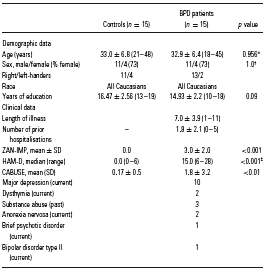
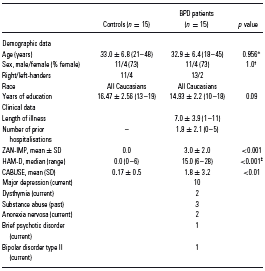
Table 1 gives the demographic and clinical variables for the patients with BPD. Seven patients reported childhood abuse; specifically, two patients reported episodes of sexual abuse, two patients described episodes of physical abuse, and three patients reported episodes of both. None of the healthy controls reported physical or sexual abuse.
Demographic and clinical features
* t test.
† Fisher's exact test.
‡ Mann-Whitney.
BPD = borderline personality disorder, BPRS = Brief Psychiatric Rating Scale, CABUSE = Soloff Childhood Abuse Scale, HAM-D = Hamilton Depression Rating Scale, ZAN-IMP = Zanarini Borderline Personality Disorders impulsivity subscale.
Three patients were not taking medications at the time of testing. Three were treated only with a mood stabiliser (lithium, oxcarbamazepine and valproic acid, respectively), four only with an antidepressant (sertraline or venlafaxine), one only with an antipsychotic (olanzapine), three with a combination of antipsychotic and antidepressant (quetiapine and escitalopram, olanzapine and escitalopram and sertraline and haloperidol, respectively), and one with a combination of a mood stabiliser and an antidepressant (lithium and fluvoxamine).
Neuropsychological data
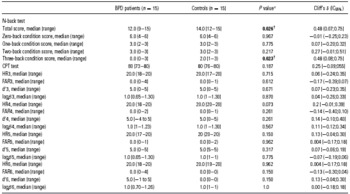
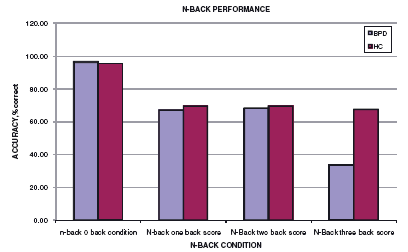
Table 2 shows the comparisons between the neuropsychological data for BPD patients and healthy controls. On the N-back test, BPD patients performed worse than controls in the 3-back condition scores (p = 0.023, Mann-Whitney test) and in total score (p = 0.026, Mann-Whitney test) but not on the zero, 1-, or 2-back conditions (p > 0.05) (Fig. 1). CPT values did not differ significantly between BPD patients and healthy controls; the median and the range values for the HR, FAR, d′ (sensitivity) and logβ (response criterion) are reported in Table 2.
N-back test and continuous performance test (CPT) in borderline personality disorder (BPD) patients and healthy controls
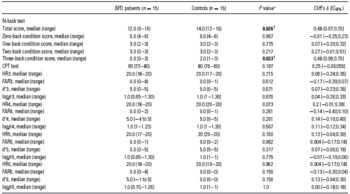
d′ = sensitivity, FAR = false alarm rate, HR = hit rate, , logβ = response criterion.
Effect size estimate by Cliff's δ.
* Mann-Whitney.
† The significance level was placed at p < 0.05.
Performances of borderline personality disorder (BPD) patients and healthy controls on the different N-back conditions.
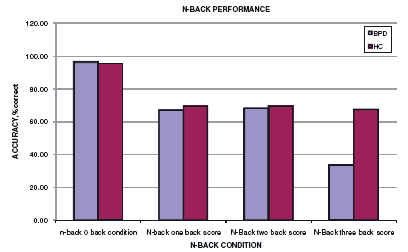
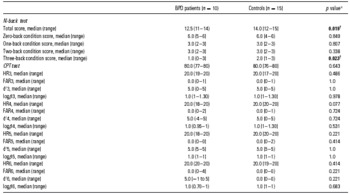
Table 3 shows the comparisons of neuropsychological data between BPD patients with a current history of major depression (n = 10) and healthy controls. On the N-back test, patients had worse total and 3-back condition scores even considering only BPD patients with comorbid depression (n = 10) (p < 0.02, Mann-Whitney test).
N-back test and continuous performance test (CPT) in borderline personality disorder (BPD) patients with a current history of depression and healthy controls

d′ = sensitivity, FAR = false alarm rate, HR = hit rate, logβ = response criterion.
* Mann-Whitney.
† The significance level was placed at p < 0.05.
Correlations
Spearman's correlation analyses showed that impulsivity levels, as detected with the Zanarini subscale, were negatively correlated with the scores at the total back condition (r s = −0.546; p = 0.035) and at the 3-back condition in BPD patients (r s = −0.578; p = 0.024).
We did not find any significant correlation between depression severity, as detected with the HAM-D, and the scores at the total back condition (r s = 0.144; P = 0.610), 3-back condition (r s = 0.038; p = 0.894) and CPT (HR) in BPD patients (r s = 0.195; p = 0.485).
No significant correlations were found between neuropsychological performances and any other clinical variable in BPD patients and healthy controls, when considered separately (Spearman's correlation analyses, p > 0.05).
Discussion
In accordance with our hypothesis, deficits of verbal working memory in BPD patients were present when working memory demands were high. In fact, this deficit was not significant for the basic levels of this test (0-, 1- and 2-back conditions) but only for the 3-back condition. This last condition requires the highest levels of performance, considering that the N-back task can be parametrically varied in terms of increasing set size or load and in delay, which are imposed over the zero-, 1-, 2- and 3-back conditions.
To address the possibility that working memory deficits might be affected by attentional impairments, in this study both the N-back task and the CPT were performed. Interestingly, BPD patients showed the ability to support a lengthy performance on the CPT test with attention that was quite similar to that of healthy participants; further, this attention did not decrease in the subsequent phases of the test period (about 8 min), as happens in other psychiatric conditions, like bipolar disorder (Reference Sax, Strakowski, McElroy, Keck and West33). It can reasonably be concluded that working memory is impaired in BPD in the presence of preserved sustained attention, being therefore such deficits not attributable to attention. Moreover, levels of depression did not appear to modulate performance on the N-back test. We found no correlation between depressive symptomatology (HAM-D scores) and neurocognitive performance, and the performance of patients with a current history of comorbid depression was similar. Our results are consistent with those of a previous study by Lenzenwenger et al. (Reference Lenzenweger, Clarkin, Fertuck and Kernberg3), where they also reported in BPD preserved performance on tasks exploring sustained attention (continuous performance test-identical pairs version, CPT-IP) and deficits on those investigating higher processing load executive functioning (Wisconsin card sorting test) (Reference Lenzenweger, Clarkin, Fertuck and Kernberg3).
In this perspective, it should be considered that the N-back task comprises a variety of subcomponents, including encoding of stimulus features, temporal indexing, updating (which we take to include target selection and de-selection in the face of competing stimuli) and information maintenance (Reference Owen, Herrod and Menon34). The complexity of these operations in the context of the N-back task may preclude further task dissection, although some of the subcomponent functions themselves may be mapped to areas of the dorsolateral prefrontal cortex. Such a scenario would be consistent with other studies (Reference Callicott, Mattay and Bertolino35–Reference Jansma, Ramsey, Coppola and Kahn38) that have placed a premium on the manipulation of representations in memory and functions of the dorsolateral prefrontal cortex.
In this work, patient performance on the N-back test was inversely correlated with impulsivity levels, as detected with the Zanarini scale, and this correlation was present in BPD patients but not in healthy participants. Considering impulsivity like an imbalance between failure of ‘top-down' control systems in (dorsolateral) prefrontal cortex (DLPFC) (Reference Heinzel, Northoff, Boeker, Boesiger and Grimm39) and hyper-responsivity of limbic regions (Reference Gevins, Morgan and Bressler37), we can reasonably hypothesise that the functionality of DLPFC and hippocampus may be altered in BPD resulting in impaired working memory and impulsivity (Reference Mortensen, Rasmussen and Häberg40). The working memory system allows not only the maintenance and the updating of information over short delays but also is engaged in selecting data correctly to organise cognitive activity and plan behaviours (Reference Bazanis, Rogers and Dowson1,Reference Baddeley41). Interestingly, mirroring our findings, Lenzenwenger et al. (Reference Lenzenweger, Clarkin, Fertuck and Kernberg3) showed that poor cognitive performance, as tapped by the WCST, directly associated with decreased levels of control (i.e. non-affective constraint).
Some limitations of this study require mentioning. First, the small sample size may not have provided enough statistical power to detect subtle abnormalities of working memory or sustained attention. Second, type-I error cannot also completely be excluded. Third, the role of IQ and vigilance per se, which may imply a possible decrement in cognitive performance over time, was not specifically targeted. However, in the case of the CPT, it should be noted that the first 160 trials, which were not included in the analysis, represented practice trials helping in sustaining training and vigilance for this cognitive test. Also, there might exist a potential ceiling effect using this CPT as a measure of attention in BPD population, therefore it cannot be excluded that this ceiling effect may explain the lack of differences between the groups. Finally, although the severity of depression did not apparently affect the performance of the cognitive tests, the potential effects of depression could not completely be ruled out as 10 patients were suffering from current major depressive episode. However, the majority of BPD patients have other comorbid diagnoses in the real clinical world (Reference Skodol, Gunderson and McGlashan42,Reference Soloff43). Therefore, excluding subjects with Axis-I comorbidity would create a non-representative BPD sample that could ultimately limit the generalisability of our findings.
In conclusion, we found an impairment of working memory in patients with BPD, particularly in a subgroup with a high level of impulsivity, which may represent a candidate intermediate phenotype for this disorder. If confirmed, an impairment of working memory abilities associated with pathological impulsivity in BPD sustained by impairment in the dorsolateral prefrontal cortex is particularly interesting, considering that this kind of memory is an evolution of the concept of short-term memory. Working memory is not simply a system that allows detainment of information, but a system of control that allows the monitoring, manipulation, detainment, and updating of remembered information, selecting data correctly to organise cognitive activity and plan behaviours in a way suitable to address new problems (Reference Baddeley41). Thus, what affects working memory can affect the acquisition of prosocial behaviours, emotional regulation and problem solving. Future larger studies should combine imaging and cognitive investigations to understand the correlation between prefrontal cortex anatomy and function and working memory impairments in BPD (Reference Brambilla, Soloff, Sala, Nicoletti, Keshavan and Soares44).
Acknowledgements
This work was partly supported by grants from the American Psychiatric Institute for Research and Education (APIRE Young Minds in Psychiatry Award), the Italian Ministry for University and Research and the Italian Ministry of Health (IRCCS ‘E. Medea') to Dr. Brambilla.