Introduction
Field conservation, which is used for vegetatively propagated plants, has risk of loss caused by disease or unexpected climate. Also, in vitro conservation is susceptible to contamination and somaclonal variation (Towill, Reference Towill1988; Chen et al., Reference Chen, Li, Xin, Zhang, Xin and Lu2011). One of the most effective methods for long-term storage is cryopreservation of biological material in liquid nitrogen (LN) at a low temperature of −196 °C using in vitro collections (Ahuja, Reference Ahuja2011). Previous studies reported the role of cryopreservation as a viable means of long-term preservation in various vegetatively propagated plants, such as strawberry, potato and lily and demonstrated to improve the survival and regrowth of various plants after cryopreservation (Hirai et al., Reference Hirai, Shirai, Shirai and Sakai1998; Bouman et al., Reference Bouman, Tiekstra, Petutschnig, Homan and Schreurs2003; Dhital et al., Reference Dhital, Lim and Manandhar2009; Yi et al., Reference Yi, Lee, Chung, Lee and Lim2013). However, the challenges of genetic stability in cryopreserved plants are not completely resolved (Engelmann, Reference Engelmann2014; Vidyagina et al., Reference Vidyagina, Kharchenko and Shestibratov2021). It is desirable to assess the genetic alterations of plants after cryogenic storage to ensure that the method is appropriate for long-term, stable preservation of genetic diversity. The most commonly used PCR-based markers in studies of genetic stability are Random Amplified Polymorphic DNA (RAPD) (Yadav et al., Reference Yadav, Yadav, Pal and Goutam2013) and inter-simple sequence repeat (ISSR) (Raji et al., Reference Raji, Lotfi, Tohidfar, Zahedi, Carra, Abbate and Carimi2018). For Lilium species, the assessment of genetic stability using an ISSR marker has been reported (Yin et al., Reference Yin, Zhao, Bi, Chen and Wang2013).
Previous studies have been undertaken to examine the genetic stability of Lilium germplasm after cryopreservation using various markers (Liu and Yang, Reference Liu and Yang2012; Khandagale et al., Reference Khandagale, Padmakar, Lakshmana Reddy, Sane and Aswath2014), but few studies have evaluated the differences in morphological characteristics between control and regenerated plants at the mature stage (Yin et al., Reference Yin, Bi, Chen, Zhao, Volk and Wang2014). The aim of this study is to assess the genetic stability of four Lilium taxa regenerated after cryopreservation.
Experimental
One accession each of four Lilium taxa (L. bolanderi ‘Lenora’, L. callosum var. flavum, L. bolanderi ‘Mount Duckling’ and L. bolanderi ‘Mount Dragon’) were used in this study for cryopreservation and determination of genetic stability in Lilium genetic resources. The germplasm accessions used in this study are listed in online Supplementary Table S1.
Cryopreservation
The experimental procedure of cryopreservation is described in online Supplementary Table S2, which was based on the protocol of Kim et al. (Reference Kim, Lee, Shin, Ko, Gwag, Cho and Engelmann2009) with minor modifications.
Morphological characteristics
All samples (in vitro grown without treatment; fresh, before and after cryopreservation; −LN and +LN) were planted in a greenhouse and the morphological traits such as flower, stigma and pollen colour, floral spots and flower direction in 3 years after acclimatization were monitored (online Supplementary Table S1). We monitored the plants for a complete morphological comparison at maturity, not in the early growth stages.
Molecular analysis
To confirm the genetic fidelity using 6 ISSR markers, previously selected for their reproducible band patterns (Wang et al., Reference Wang, Sun, Li, Qian and Zhao2008; Bush et al., Reference Bush, Rollins and Smith2010; Liu and Yang, Reference Liu and Yang2012; Khandagale et al., Reference Khandagale, Padmakar, Lakshmana Reddy, Sane and Aswath2014) (online Supplementary Table S3), genomic DNA was extracted from the young leaves of the fresh plant and the plantlets (−LN and +LN) regenerated in vitro using a QIAGEN DNA extraction kit (QIAGEN Co. Germany). ISSR amplifications were carried out in a 25 μl total volume containing 20 ng of template DNA, 10 mM Tris HCl (pH 8.3), 50 mM KCl, 1.5 mM MgCl2, 0.1 mM dNTPs, 1.0 U Taq DNA polymerase and 0.2 μM primer. DNA was amplified under the following thermal conditions: initial denaturation step of 5 min at 94 °C, followed by 30 to 40 cycles of each at 94 °C for 1 min, 50 °C for 45 s and 72 °C for 1 min with a final extension step at 72 °C for 7 min. Fragments were separated in 1.5% agarose gel and visualized in Gel Image Analysis System (CoreBio-MAXTM, Davinch-K, Seoul, Korea). Amplified bands were sized and scored as present (1) or absent (0) with three replications per treatment. The unweighted pair group method with an arithmetic mean (UPGMA) dendrogram of accessions was constructed with PowerMarker version 3.25 (Liu and Muse, Reference Liu and Muse2005) and using the software MEGA (Tamura et al., Reference Tamura, Dudley, Nei and Kumar2007).
Discussion
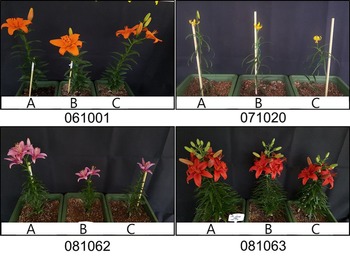
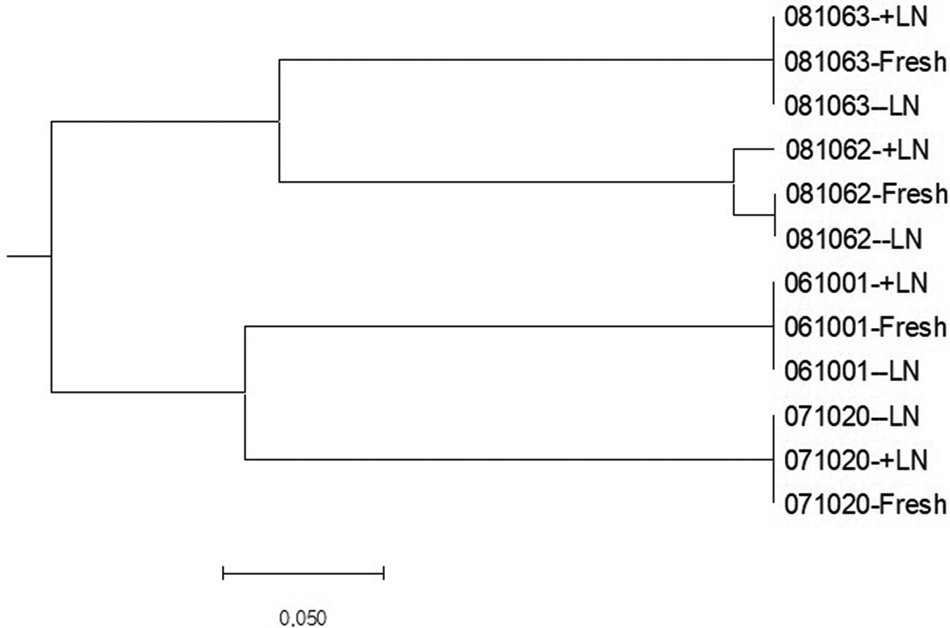
To confirm the genetic stability of Lilium germplasm after cryopreservation, the genetic integrity of four Lilium taxa was assessed via comparison of morphological traits and ISSR analysis under treatment conditions (fresh control, non-cryopreserved (−LN) and cryopreserved (+LN) plants). The results showed no differences in visual morphology such as flower, stigma and pollen colour, floral spots and flower direction between treatments of each accession (Fig. 1 and online Supplementary Table S1). These results are similar to those reported previously in different plants (e.g. Ahuja et al., Reference Ahuja, Mandal, Dixit and Srivastava2002; Chen et al., Reference Chen, Li, Xin, Zhang, Xin and Lu2011; Fki et al., Reference Fki, Bouaziz, Sahnoun, Swennen, Drira and Panis2011). To validate morphological stability, we also assessed the genetic similarity between fresh and pre- and post-cryopreserved plants using ISSR analyses. Six markers were used to generate reproducible and distinguishable patterns of bands in the size range of 0.3 to 2.5 kb for the four accessions. Overall, a total of 79 bands were produced and the number of bands for each primer ranged from 10 to 16, with an average of 13 bands. The number of polymorphic bands ranged from 4 for UBC 880 to 13 for UBC 814, with a mean of 9 bands, and the rates of polymorphism ranged between 40 and 92.9% with a mean of 69.7% (online Supplementary Table S3). No differences in polymorphic bands were observed between +LN treatment plants and fresh and −LN plants. The genetic classification of fresh, −LN and +LN plants of the four Lilium taxa was based on ISSR markers as shown in Fig. 2. The resulting UPGMA dendrogram was used to divide the four taxa into different clusters. All plants exhibited more than 97% genetic similarity between treatments (Fresh, −LN and +LN) in ‘Mount Duckling’ (081062) and 100% in other accessions.
Plant growth regenerated from four accessions of Lilium taxa, including fresh plants (A), non-cryopreserved (B), and cryopreserved (C) regenerants. Accession numbers 061001, 071020, 081062 and 081063 refer to L. bolanderi ‘Lenora’, L. callosum var. flavum, L. bolanderi ‘Mount Duckling’ and L. bolandri ‘Mount Dragon’, respectively.

UPGMA dendrogram of four accessions of Lilium taxa including fresh, non-cryopreserved (−LN) control and cryopreserved (+LN) plants generated using ISSR markers. Accession numbers 061001, 071020, 081062 and 081063 refer to L. bolanderi ‘Lenora’, L. callosum var. flavum, L. bolanderi ‘Mount Duckling’ and L. bolandri ‘Mount Dragon’, respectively.

In conclusion, these results suggest a very low level or the absence of genetic variation among plants regenerated after cryopreservation. Although the cryopreservation has been successfully used for Lilium species, information of genetic stability in the mature plants regenerated from cryopreserved bulblets of Lilium has been lacking. The analysis of morphological and genetic fidelity in the current study supports the continued cryobanking of Lilium germplasm.
Supplementary material
The supplementary material for this article can be found at https://doi.org/10.1017/S147926212200003X
Acknowledgements
This study was supported by ‘Development and application of cryopreservation technique for strawberry and Lilium germplasm and quality management for seed base collection (Project No.PJ014294)’, National Institute of Agricultural Sciences, Rural Development Administration, Republic of Korea.