INTRODUCTION
Community-based natural resource management (CBNRM) policies and projects are proliferating in developing countries (Brosius et al. Reference Brosius, Tsing and Zerner1998). Usually referring to local people as ‘communities’, CBNRM is advocated as a means to improve the livelihoods of communities who depend on natural resources (Chambers Reference Chambers1983; Cernea Reference Cernea1985) and a means to promote democratic decision making and equitable benefit distribution at the local level (Ribot Reference Ribot2004). To facilitate CBNRM, donors and local governments have introduced numerous changes in formal resource governance structures entailing the identification of formal communities (such as user groups, villages, traditional councils or democratic local governments), and the formalization of responsibilities and rights of these communities for governing natural resources (Ribot Reference Ribot2004).
Scholars have, however, questioned whether communities' participation in governing resources have yielded the intended livelihood improvements for the poor, more democratic decision making, and greater equity (Guijt & Shah Reference Guijt and Shah1998; Agrawal & Gibson Reference Agrawal and Gibson1999). A major critique pertains to ‘elite capture’, which generally refers to situations where the more privileged members of communities dominate decision-making processes and, at the expense of other groups, improve their access to collective benefits (Ribot Reference Ribot2004). Participatory projects often have had limited success in targeting the poorest, and there is ample evidence of elite capture (see for example Mansuri & Rao Reference Mansuri and Rao2004; Agarwal Reference Agarwal1997; Kumar Reference Kumar2002; World Bank 2005; Springate-Baginsky & Blaikie Reference Springate-Baginsky and Blaikie2007).
CBNRM projects, which often place strong faith in the ability of formal structures to guide local activities aimed at meeting specific goals, can therefore be criticized (Cleaver Reference Cleaver1999, Reference Cleaver2005; Campbell et al. Reference Campbell, Mandondo, Nemarundwe, Sithole, de Jong, Luckert and Matose2001). For instance, formal structures may not entirely regulate individuals' action because individuals possess ‘agency’; they hold the ability to translate structures into action according to their strategies and interests (Latour Reference Latour1987; Long Reference Long2001). In most cases, agency becomes effective through social relations where different actors are aligned by similar ideas and interests. Agency may accordingly lead to outcomes, such as elite capture, that are very different from those that formal structures were intended to bring about (Latour Reference Latour1987; Long Reference Long2001).
The prevailing image of communities as harmonious and homogenous has been challenged by the argument that communities are heterogeneous and hierarchical comprising multiple actors who differ in terms of power, class, gender, ethnicity and norms (Guijt & Shah Reference Guijt and Shah1998; Agrawal & Gibson Reference Agrawal and Gibson1999). Individual and collective agencies may also be largely shaped by existing social structures which represent inequality and hierarchies (Cleaver Reference Cleaver1999). A wetland project in Tanzania illustrates how these pre-existing informal types of social interactions constrained the poor and women from accessing resources under newly introduced formal participatory institutions (Cleaver Reference Cleaver1999). Likewise, Agarwal (Reference Agarwal1997) identified numerous cultural and social norms and practices in South Asia that constituted structural barriers for women to gain meaningful roles in the formal structures.
Thus, participatory approaches that aim to enfranchise the local population may not improve on existing social structures that represent inequality and hierarchies. Rather, these projects may create a ‘new tyranny’ with the result of further oppression and marginalization of the already marginalized (Cooke & Kothari Reference Cooke, Kothari, Cooke and Kothari2001; Cleaver Reference Cleaver2005; Springate-Baginsky & Blaikie Reference Springate-Baginsky and Blaikie2007). Accordingly, elite capture is not necessarily created by participatory approaches, but is rather an unintended result of the inequality and hierarchies that existed prior to the introduction of these approaches.
This however, does not preclude CBNRM projects from bringing about social change. Scott (Reference Scott1976, Reference Scott1985) argued that marginalized groups are not necessarily powerless, or unable to respond to existing inequality and hierarchies. By referring to ‘the weapons of the weak’, Scott (Reference Scott1985) acknowledged a variety of means and strategies through which the marginalized resist domination and exploitation by elites. Hence, what should be investigated is whether new formal structures introduced by CBNRM projects shape new opportunities for the marginalized to challenge existing social structures and eliminate or at least minimize the risk of elite capture.
This paper aims to contribute to the contemporary debate on elite capture under CBNRM. We investigate whether elite capture is an inevitable outcome and discuss possible measures to alleviate or reduce this risk. Specifically, we aim to answer the following four questions: (1) How has the Indian Government addressed the risk of elite capture under joint forest management (JFM)? (2) What actually happens over time when formal structures of JFM interact with the pre-existing social structure? (3) When JFM results in elite capture, is this due to the formal structures and/or the pre-existing social structures? (4) How can CBNRM be designed to avoid or minimize elite capture?
Our study area was located in Andhra Pradesh, India's fifth largest state, which has a population of 76.2 million people (Government of India 2001). Its 6.4 million ha of forestland constitute 23% of the state's area and 8.2% of India's total forest area (Government of India 2005). In 1994, the first phase of a World Bank forestry project was initiated in Andhra Pradesh to support the new nationwide JFM initiative, which aimed to achieve better forest conservation by promoting participation of local people in forest management (Government of India 1990). Accordingly, JFM established forest protection committees consisting of local villagers and formalized partnerships between these committees and the forest department to jointly protect and manage forests. In return, the committees gained official usufruct rights to certain forest products for their subsistence use and sale. A total of 8663 forest protection committees manage about 2.3 million ha of forests constituting 36% of the forest area in Andhra Pradesh (Government of India 2005).
METHODS
Six villages in Andhra Pradesh, which had joined the World Bank supported JFM project, were surveyed. Mohammed Nagar village (Medak district) was selected to examine whether elite capture is a permanent outcome of CBNRM and to offer insights into the dynamic and continuous interactions between elite domination and resistance of the marginalized.
Within the villages in Medak district, there are caste-associated socioeconomic differences. A typical village in the district comprises a main village and small surrounding satellite hamlets, which are generally located adjacent to forest areas. The main village was inhabited by three castes, namely ‘other castes’, ‘backward castes’, and ‘scheduled castes’ while the hamlets were inhabited by Lambada tribal people. We here refer to these four groups as ‘upper’, ‘middle’ and ‘scheduled’ castes and ‘tribes’, respectively. Among the four castes, the upper and middle castes have relatively high socioeconomic status. This is reflected in differences in land ownership patterns, employment relations and forest dependency.
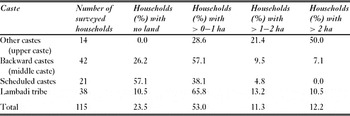
A high proportion of upper caste people (71.4%; n = 14) owned more than one hectare of land, whereas 95.2% of 21 scheduled castes were landless and small holders (possessing < 1 ha of land) (Table 1). The majority of 42 middle castes and 38 tribal people were also small holders (possessing < 1 ha of land).
Land distribution by caste.

Most upper caste people had wage labour relations with landless people from the middle and scheduled castes. The middle and scheduled castes often worked as wage labourers on the upper caste people's land. In general, people belonging to the scheduled caste and the tribes are socially disadvantaged and a high proportion of scheduled caste people work as wage labourers. Previously, scheduled castes have been subject to social discrimination as they were in the category of ‘untouchables’ and had traditionally performed what are considered undesirable jobs, such as cremation services (Narula Reference Narula2008). Most people from the tribes owned small plots of land adjacent to the forest. The fact that the tribes often inhabited separate hamlets far from the main villages underlined their somewhat segregated status.
All the castes depended on forests for subsistence and commercial purposes, but the degree of forest dependency varied by castes and the collection pattern by gender. The scheduled caste and tribal people, and in particular the landless among them, collected larger amounts of forest products than the upper and middle castes. The lower castes needed these products for subsistence and to supplement their incomes. According to another case study of six villages including Mohammed Nagar (Seva Samgam, unpublished data 2007), tribal people on average collect more fuelwood for household consumption than other castes. Some tribal segments are further engaged in fuelwood selling and wood-cutting, which makes their business dependent on ample fuelwood and pole-size trees in the forests. By contrast, some upper caste segments had electrical stoves for cooking and do not use fuelwood. Approximately one-third of the people from the upper and middle castes and around 10% of the scheduled castes buy fuelwood from tribal people rather than collecting it themselves.
With regard to gender differences, our survey showed that women collected fuelwood to be used for cooking and for sale by head load, whereas men collected firewood by cartload. Non-timber forest products such as medicinal plants and leaves were mainly collected by women for subsistence and sale. Both women and men collected fodder from the forests for goats and sheep. Poles were collected mainly by men and used for agricultural implements and construction purposes.
There were thus significant differences among the four caste groups in terms of socioeconomic status and forest dependence, and men and women had different patterns for collecting forest products. Owing to the significant overlaps between caste and socioeconomic status, and to the gender specific differences in collection patterns, we used caste and gender as analytical units for examining the occurrence of elite capture considering the upper and, to a large extent, the middle castes and men as the elites.
Survey methods
The first of our four research questions regarding the Indian government's official intentions with JFM was assessed through desk analyses of laws, rules, guidelines and project documents. We addressed the second question concerning actual local level social outcomes of JFM by analysing more than 10 years' of forest management history covering three terms of the forest protection committees in Mohammed Nagar village. This was based on the results of four months of field work in Mohammed Nagar during 2007 and 2008. Semi-structured and open-ended interviews were conducted with a total of 54 villagers both as individuals and in groups including all castes, and with both males and females (Appendices 1 and 2, see supplementary material at Journals.cambridge.org/ENC). With the help of two enumerators, a total of 223 people (113 male and 110 female) from 115 households were surveyed. These 115 households were selected from a total of 325 households through proportionate stratified random sampling within each caste group (Appendices 1and 2, see supplementary material at Journals.cambridge.org/ENC). The sample included 14, 42, 21 and 38 households from other castes, backward castes, scheduled castes and tribes, respectively. The third and fourth research questions about the structural reasons for elite capture and how elite capture can be minimized are addressed by discussion of the case study results.
RESULTS
How has the Indian Government addressed the risk of elite capture?
The Andhra Pradesh forest department has stipulated specific implementation structures for forest protection committees through a series of government orders. These orders include specific measures to prevent elite capture within communities.
First, the orders aim to promote active participation of all segments of the community in JFM through mandatory representation of socially marginalized groups within committees. Two members from each household should join a general body, the members of which select a management committee, the JFM executive body at village level, and a chairperson of the committee (Government of Andhra Pradesh 2002). For the general body, one of the two household members should be a woman, and households from lower caste groups, such as scheduled castes and tribes, are automatically included as members (Government of Andhra Pradesh 2002). Mandatory proportions of female representatives within the management committee have increased from 30% in 1996 to 50% in 2002. It has also become obligatory that a woman should hold the position of chairperson or vice chairperson (Government of Andhra Pradesh 1996, 2002). Second, JFM promotes collective action in rule making and implementation. Forest protection committees must make micro plans to collectively decide how to protect and manage forests, holding regular general body and management committee meetings to collectively discuss the implementation status and plan future actions (Government of Andhra Pradesh 2002). Third, mandatory recording of village level public documents, micro plans, meeting minutes and account books reflects an official intention to ensure transparency in committee activities (Government of Andhra Pradesh 2002). To prevent accumulation of power in the hands of particular people, it has been mandated that the management committee has a maximum tenure of three years (Government of Andhra Pradesh 2002).
What actually happened over time when formal structures of JFM interacted with the pre-existing social structures?
According to informants in Mohammed Nagar, caste and gender did not play any significant role in regulating villagers' use of forests prior to the introduction of JFM. At that time individual villagers' forest use was officially surveyed by the forest department, which held exclusive legal rights to forest resources, and hired forest guards to prevent villagers from accessing the forests. It was, however, easy to avoid the forest guards, and villagers availed themselves of forest products to satisfy their individual needs irrespective of caste and gender affiliation.
The first term (1997–2002): the constitution of the forest protection committee and the accumulation of power by the elites
In 1997, forest department officers visited Mohammed Nagar together with a local non-governmental organization (NGO) staff member. They highlighted the serious problem of forest degradation in the surrounding areas, and emphasized the importance of protecting forest resources to meet their livelihood needs by constituting a forest protection committee. The villagers agreed to constitute a committee to manage 554 ha of forest demarcated by the forest department.
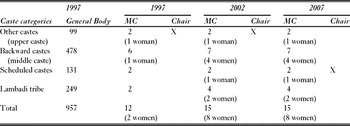
Following the official requirements, two members (one male and one female) from each household constituted a general body. The general body nominated 12 management committee members. In 2002, the number of management committee members was increased to 15. According to key informants, the villagers agreed that the number of management committee members for each caste should be determined according to their proportion of the whole village population. In 1997, the upper, middle and scheduled castes, and the tribal people had two, six, two and two members, respectively (Table 2). After 2002, these numbers changed to two, seven, two and four members, respectively. The number of female representatives within the management committee increased from two in 1998 to eight in 2002. Each caste nominated their representatives on a consensus basis.
Management committee (MC) representatives (n) by caste (source: unpublished Mohammed Nagar micro plan 1997 and interview). X indicates the group the chairperson belongs to.

The official rules do not specify any particular method for appointing the chairperson. In Mohammed Nagar, the management committee members nominated one chairperson among themselves in the presence of a local NGO and a forest department officer. This method of identifying the chairperson was applied throughout the three terms studied. The members unanimously agreed to nominate a male person from the upper caste.
The upper and middle castes together occupied the largest number of seats both in the general body and in the management committee (Table 2). The most influential position as chairperson belonged to an upper caste. Nevertheless, the nomination of the first chairperson was reported to take place without any conflict among the villagers.
Under the leadership of the first chairperson, the villagers devised common rules that applied to everybody in the village in order to regenerate forests while meeting peoples' basic needs. According to these rules, each household was permitted to collect only dry fuelwood by head loads, and two poles per year for agricultural implements free of charge. Beyond these amounts, people had to pay fees to the committee, for example, Rs 30 (Rs 30 = US$ 0.64 in January 2002) for a cartload of fuelwood, and Rs 300 (Rs 300 = US$ 6.44 in January 2002) for a cartload of poles. These prices were still below the market price. The villagers were, furthermore, prohibited from forest encroachment, from cutting live tree branches for fuelwood and from grazing goats in the forest. Violators would be fined by the committee. The committee also decided to employ two forest watchers from the village to do daily patrols in the forests. For effective forest protection, the committee decided to transfer 25% of the collected fines to villagers who caught forest offenders, while the rest was to be deposited in the committee's common fund.
According to informants from all four caste groups, these rules were enforced quite effectively throughout the first term. Villagers, who needed more than the amounts of forest products free of charge, paid the collection fees to the chairperson. Two forest watchers patrolled the forests twice a day. Groups of villagers also participated in forest protection activities. Where violations of rules were found, a warning was given to violators if the quantity of illegally collected products was small. Otherwise, violators were brought into a general body meeting, where fines were decided. Those who caught the violators were rewarded with 25% of the collected fines, while the remaining 75% was deposited in the common fund.
The main purpose of these rules was forest protection. Nevertheless, they had significant adverse consequences for those who used most forest products for their livelihoods, predominantly people from the tribes. Many tribal people became obliged to pay fees to obtain fuelwood collection rights, aside from some individuals from the middle caste and scheduled caste. Other villagers who collected only by head load for subsistence continued to do so free of charge or to purchase fuelwood from tribal people at the same rate as before JFM. Accordingly, while the rules and their implementation were effective in regulating forest use, they also resulted in a redistribution of forest revenue from the forest dependent groups to the common fund. This obviously conflicted with the official objective of JFM to improve the livelihoods of forest dependent people.
Apart from improving forest conservation at the cost of livelihood opportunities for the poorest, the implementation of collective rules had several additional consequences at village level. One was the emergence of what we might term ‘new social categories’ related to forest management such as forest rule followers, enforcers, and violators. These new categories largely corresponded with the pre-existing social categories. Village informants explained that the upper, middle and scheduled castes were the main followers and enforcers of the rules, whereas the tribal people were the main violators. These new social categories created by JFM later became important in the conflict between castes over who should benefit from the common fund (see later discussion of the second term). Women's representation was nominal, even though one post from each household was allocated for the general body and two out of 12 seats in the management committee were reserved for women. In practice, it was their husbands who attended the meetings. The women explained this by citing their heavy household workload and the social expectation that they should not attend these male-dominated meetings.
Another phenomenon was the accumulation of power and authority of the first chairperson, who held numerous key functions in the committee. The chairperson facilitated the meetings, distributed the wages they received from the forest department to villagers who participated in forest management works, paid monthly salaries to the two forest watchers, collected user fees from villagers, fined rule violators and paid 25% of the fines to the catchers of violators. The chairperson also managed the micro plans, the minutes and the account book. The effective forest protection activities led to forest regeneration, as well as generation of a sizable common fund from fines and collection fees, which by 2002 amounted to a total of Rs 164 861 (US$ 3537.03 in January 2002).
The chairperson had an influential role in determining the use of this common fund. He decided that it was to be used for salaries for two private watchers, furniture for the Gram Panchayat (local government) office and construction of three Hindu temples in the main village. The chairperson proposed that in the future two additional temples should be constructed for the scheduled castes and the tribal people. Through these responsibilities, the chairperson gained increased power, which also meant that management quality became largely dependent on the stature of the chairperson. Still, many respondents from all the castes characterized him as having an egalitarian and benevolent nature, and he remained popular throughout the term.
In summary, during this first term the introduction of JFM resulted in elite capture and further marginalization of the poor. However, lower caste people were not rendered completely powerless. For instance, the tribal people resisted the system by deliberately violating rules they considered unfair.
The second term (2002–2007): political interference and a temple controversy
The following quote by an upper caste informant characterizes an important transformation of villagers' interests in forest protection committee activities that occurred during the second term: ‘the interest of the villagers gradually changed from regenerating forests towards gaining revenues from the forest protection committee for their own benefits’.
In contrast with the first election where nobody showed interest in becoming the chairperson, the power and revenue generating capacity of the chairperson began to attract attention from all the caste groups including the sarpanch (head of the Gram Panchayat). This became a key issue in 2002, when the second management committee election was held.
During the second election, the sarpanch publicly nominated an upper caste person who belonged to his political party for the position of chairperson. The sarpanch was so influential that the majority of those who belonged to his party felt obliged to support his proposed candidate. The supporters included many of the selected management committee members who would nominate the chairperson. Due to this party political interference, the two scheduled caste members of the 15 committee members boycotted the process. Yet, since the majority of committee members must openly oppose a candidate to block appointment, the nominated upper caste male became the second chairperson.
According to key informants, the second chairperson's management style was characterized by a low degree of transparency. Minutes and account books were not properly kept or openly shared with the general members. The account book records indicate that those who belonged to the same political party as his could negotiate lower forest fees while others could not. Moreover, the existing social inequality among castes and between genders became even more pronounced than before. A group of tribal people complained that they were rarely informed about the meetings. Even though the number of women management committee members increased from two to eight in the second term, their actual representation remained nominal. A scheduled caste widow from the management committee complained: ‘I was always the only female who attended the management committee meetings. How can I make my opinions heard when all the other women are absent?’ The frequent absence of tribal people's and women's representatives meant that they were not part of the decision-making processes. Nor were they informed about decisions made by the committee. Consequently, the upper, middle and scheduled castes dominated the meetings. But this did not guarantee the equal ability of scheduled castes to influence decisions. A scheduled caste informant explained that the other castes were unwilling to accept their equal status in decision making by quoting a remark from a group of middle caste people: ‘you are scheduled caste people who are supposed to sit on the floor, while we are supposed to have the chair!’
By far the most significant event characterizing reinforcement of existing social inequalities was the committee's decision to prohibit the construction of temples for the scheduled caste and tribal people promised by the first chairperson. Because temples have a significant religious meaning to all caste groups, the scheduled castes and tribal people felt excluded from collective benefits. As previous untouchables, the scheduled castes were not permitted to enter any of the three newly constructed temples due to ‘social contamination,’ and the tribal people felt no ownership of the temples because they were constructed far from their hamlets. The upper and middle castes justified their decision not to construct temples for the lower castes based on the argument that since they were the most active followers and enforcers of rules they were more entitled to the common fund. Conversely, informants from the scheduled castes and tribal groups believed that, based on their membership status, they were equally entitled to common revenues. Some segments of the tribal groups openly expressed frustration and anger towards the committee, which often punished them. A scheduled caste informant explained that because of this social discrimination, they lost motivation to actively engage in committee-related work. They also began retaliating by refusing to provide funeral services for upper and middle castes.
During the second term, existing social structures thus became further entrenched in committee activities. Higher castes dominated the decision-making processes and continued to monopolize common revenues justified by the argument that they were more active followers and enforcers of forest rules (designed to suit their groups' interests, more than others). The outcome was further oppression and growing frustration among lower castes and women, and people who did not belong to the same political party as the chairperson. Hence, elite capture occurred during the second term.
The third term (2007–present): new opportunities for the lower castes
The third election in 2007 brought about a surprising change. At the beginning of the election, the sarpanch again attempted to position another upper caste person from his political party. This time, however, a critical mass of villagers who had felt oppressed under the second chairperson (scheduled castes, the tribes and all kinds of people belonging to the opposing political party including elite castes) resisted this kind of party political intervention and collectively refused to endorse his nomination. No consensus was reached for the chairperson nomination because all members aimed to nominate a chairperson from their own castes. As a result, open conflict emerged among all the castes and the nomination was postponed. Despite the existing highly hierarchical social structure, lower caste groups were able to put up strong resistance against elite capture.
The chairperson nomination process was now stalled. At this point, a local NGO that had been engaged in village work for more than a decade, attempted to reconvene the elections. They applied pressure and persuasion to gain agreement from key leaders of the four castes that the scheduled castes and tribal people should also have an opportunity to occupy the chairperson post. Consequently, six months after the original elections, re-elections were held. Eventually this committee agreed to nominate a member of the scheduled castes as the chairperson and a middle caste person as vice chair, both of whom were women.
This process thus created new opportunities for lower castes and women to occupy influential posts, and the scheduled castes celebrated their achievement. To them, obtaining political power through a chairperson post meant more than constructing their own temple, as indicated by one scheduled caste informant: ‘the temple does not matter for us any more now that we have the chairperson post’. The third elections were also significant for the tribes. Recognizing that it was possible for the lower castes to occupy influential posts, the tribe informants considered that next time it would be their turn to occupy the chairperson post.
Challenges still remained. For instance, the female chairperson explained that her husband played the de facto role as chairperson. Despite the changes in caste-based social structures, this signifies the persistence of gender structures in response to externally-induced changes. Furthermore, a group of the middle caste informants expressed serious doubts about the capacity of leadership by the scheduled caste de facto male chairperson, and indicated that they were ready to bring him down from his position should he make any mistakes.
The third term election period indicates that elite capture was not an inevitable outcome of CBNRM. However, continuous, consistent and organized efforts from non-elites are still required to resist domination and exploitation by elites.
DISCUSSION
Elite capture occurred to a large extent in Mohammed Nagar despite the fact that questions relating to representation and equality had formally been taken into account. The studied CBNRM project crafted formal measures to inhibit the occurrence of elite capture through mandatory representation of minority groups, such as lower castes and women, in executive bodies ensuring collective decision-making processes and promoting transparency. Nevertheless, elite groups gained influential positions in decision making processes and monopolized collective benefits, while marginalizing socially disadvantaged groups.
When JFM results in elite capture, is this due to the formal structures and/or the pre-existing social structure?
Our results generally support critics who have argued that CBNRM is prone to elite capture (Cooke & Kothari Reference Cooke, Kothari, Cooke and Kothari2001; Cleaver Reference Cleaver2005; Springate-Baginsky & Blaikie Reference Springate-Baginsky and Blaikie2007) owing to the heterogeneous and hierarchical nature of communities (Guijt & Shah Reference Guijt and Shah1998; Agrawal & Gibson Reference Agrawal and Gibson1999). Our results also show that the translational capacity of individual actors (Latour Reference Latour1987; Long Reference Long2001) limits the degree to which formal structures adopted by CBNRM projects can regulate local level activities (Cleaver Reference Cleaver1999, Reference Cleaver2005; Campbell et al Reference Campbell, Mandondo, Nemarundwe, Sithole, de Jong, Luckert and Matose2001). Furthermore, such translational capacity was significantly framed by existing social structures, which represent inequity and hierarchies (Cleaver Reference Cleaver1999, Reference Cleaver2005). This enabled local-level elite actors to reproduce and reinforce their dominance, and elite capture happened largely because of the pre-existing hierarchical social structure.
There are several reasons why elite capture is likely to occur under CBNRM. The first and most significant reason is the way in which CBNRM interacts with pre-existing hierarchical social structures. In our case, JFM facilitated the constitution of a formal ‘community’ that included pre-existing social categories of ‘castes’ and ‘gender’. This made these categories active in relation to forest governance, which was not the case prior to JFM.
The second and closely related reason is that the formal JFM structures do not sufficiently safeguard the rights and benefits of the forest dependent minority groups. In our case, they even resulted in a decline in their benefits from the forest. Although a minimum number of seats in the executive body were reserved for marginalized groups, these groups remained insufficiently represented. The forest protection committee determined the number of committee seats for each caste by their proportion of the whole population. Since the elite castes outnumbered the lower castes, this made it easier for them to dominate decision-making processes through majority rule. In our case, the most forest dependent people's customary use of the forest was not adequately considered in the rule making processes. Nor were the low caste people sufficiently compensated for their disproportionate loss of forest derived benefits. Rules that safeguard democratic procedures for electing the leader of the formal community and holding them accountable between elections were also lacking. Furthermore, our case showed that power was primarily in the control of the chairpersons and that, in particular, the second chairperson misused these powers. There was a lack of official democratic election rules and of official procedures to oust a chairperson between official elections, for example at an extraordinary general meeting.
Party politics had a negative influence on the committee, presumably as a consequence of the significant powers and revenue-generating capacity of the committee. In our case study, the chairperson, who was strongly influenced by a political party, tended to favour politically like-minded elites within the community.
In summary, the occurrence of elite capture was largely owing to the existing social structures and partly due to formal JFM structures that did not provide sufficient safeguards to prevent the already marginalized from becoming even further marginalized, or to ensure democratic election procedures and responsiveness of the chairperson.
Our case also showed new patterns of interaction among village-level actors, which produced unforeseen outcomes. The implementation of JFM created new caste-based social categories in relation to forest management. This observation coincides with that of Agrawal (Reference Agrawal2005). By introducing the concept of ‘environmentality’ inspired by Foucault's concept of ‘governmentality’, the construction of formal forest committees has the potential to gradually create new environmental subjects and promote new types of social interaction in villages (Agrawal Reference Agrawal2005). In our case, however, environmental subjects were initially constructed primarily according to caste and gender: that is, higher castes and men became environmental subjects by devising and enforcing environmentally friendly measures that suppressed or punished other groups.
The formalized interactions under JFM also exposed this form of elite domination and exploitation within the formal community. In turn, this enabled the oppressed groups to form strong enough alliances with other castes and a local NGO to resist and challenge elite domination by claiming ‘equal rights’, a concept supported by the formal JFM structures. Here, the NGO representative's individual agency played an important catalytic role in establishing consensus among different groups with conflicting interests to nominate a leader from a marginalized group. This observation partly corresponds with Scott's (Reference Scott1976, Reference Scott1985) proposition that the marginalized groups are not entirely powerless. Rather, they possess agency to resist and challenge elite domination and exploitation. Equally important is that, in combination with the third party engagement, the formal CBNRM measures enabled collective agencies of marginalized groups by legitimizing their equal rights of the elites, which effectively challenged existing hierarchies.
This overall observation suggests that CBNRM approaches do not necessarily end up as a ‘new tyranny’. While CBNRM approaches often face initial elite capture, this should not prevent us from seeing their positive long-term potential. This raises important questions concerning how CBNRM approaches can be designed to avoid or minimize the risk of elite capture.
How can CBNRM be designed to avoid or minimize elite capture?
Our case illustrates the inherent difficulties of transforming pre-existing hierarchical social structures by applying new formal measures. Even so, centrally defined formal structures may establish opportunities for marginalized groups to justify (new) rights to equal decision-making powers and a fair share of collective benefits. Ultimately this might help the marginalized groups to challenge existing social structure, as our case illustrates. In order to harness such potential to alleviate adverse effects and minimize the risk of elite capture under CBNRM, we propose four possible measures for how these formal structures may be designed.
The first measure is to ensure minimum social standards, for instance through reserving a minimum number of influential positions for marginalized groups. More importantly, rights of minorities could be ensured through centrally defined procedures for the constitution of committees. Such procedures may entail (1) the establishment of a resource dependence inventory prior to the implementation of CBNRM, and (2) prohibition of the implementation of locally devised operational rules that may significantly reduce any group's net benefits from resource use without their prior consent and/or adequate compensation. These procedures would establish more transparency and hence promote responsiveness of a formal community towards marginal groups who generally depend more than others on natural resources. If the overall harvesting level must be reduced either permanently or temporarily to safeguard environmental objectives, the veto rights of the most resource dependent groups, or the requirement for a community to use common funds to compensate their losses, would help to ensure that the social costs of pursuing such objectives are shared more equitably among members.
The second measure is to promote direct democratic elections of chairpersons and committee representatives. Although direct elections are not sufficient to guarantee a fair democratic process, frequent elections (for example every third year) where all residents above a certain age are entitled to vote for independent candidates through secret ballots does seem a fruitful path for making elected leaders accountable to their constituencies.
The third measure is to ensure that key management functions and decisions are shared with and monitored by all the members of the management committee and ultimately the constituency. This would counter the concentration of unchecked powers in the hands of one leader. Mandatory record keeping, public auditing and procedures to oust leaders who abuse their public mandates would be relatively simple measures to establish transparency and accountability.
The final measure is to bring marginalized groups into contact with equity–promoting third parties such as independent NGOs or government institutions. While this may be expensive or cannot be used universally, the engagement of a third party may promote inclusion and equal status of the marginalized in decision-making, and strengthen their capacity to refuse operational rules that would significantly adversely affect them, to claim a fair share of collective benefits and to undertake leadership roles.
CONCLUSIONS
Our case showed that CBNRM initially led to elite capture, largely because of existing social structures and partly because CBNRM did not sufficiently safeguard the interests of the marginalized groups. However, elite capture was not a permanent outcome. Rather, CBNRM led to a continuous rise and fall of elite capture. The formalized interactions introduced by CBNRM exposed the forms of elite domination. Hence, the marginalized formed an alliance with a local NGO to successfully challenge elite capture by demanding ‘equal rights’, a concept supported by CBNRM. This shows that CBNRM through its formal measures created new opportunities for the marginalized to resist elite domination. To further alleviate and minimize the risk of elite capture, CBNRM policies should ensure key measures including minimum social standards, democratic elections and decision making, and third party engagement.
ACKNOWLEDGEMENTS
We thank Forest and Landscape Denmark at the University of Copenhagen, the Japanese International Cooperation Agency for supporting our study, and Sunnam Sathish for his invaluable help with fieldwork and data collection. We also thank Anja Nygren, Casper Bruun Jensen, Jesse Ribot, three anonymous reviewers and editors for helpful suggestions for how to improve this paper. We are very grateful to the villagers of Mohammed Nagar, local NGOs, Seva Samgam and the Centre for People's Forestry, and the Andhra Pradesh Forest Department for their cooperation and hospitality during the study.