Introduction
Mealybugs (Hemiptera, Pseudococcidae) are the second large family of scale insects (Coccomorpha). About 2000 species are described (García Morales et al., Reference García Morales, Denno, Miller, Miller, Ben-Dov and Hardy2016), including many species of economic importance as pests of different crops (Franco et al., Reference Franco, Zada, Mendel, Ishaaya and Horowitz2009), such as the citrus mealybug, Planococcus citri (Risso) and the citrophilus mealybug, Pseudococcus calceolariae (Maskell). These two cosmopolitan and polyphagous pest species may occur together in some habitats, such as citrus orchards (Franco & Marotta, Reference Franco and Marotta1999).
Most mealybug species are biparental (Gullan & Kosztarab, Reference Gullan and Kosztarab1997), in which virgin females release a sex pheromone to lure the males. Actually, the structure of the sex pheromone is known for 17 mealybug species (El-Sayed, Reference El-Sayed2017), including P. citri (Bierl-Leonhardt et al., Reference Bierl-Leonhardt, Moreno, Schwarz, Fargerlund and Plimmer1981) and P. calceolariae (El-Sayed et al., Reference El-Sayed, Unelius, Twidle, Mitchell, Manning, Cole, Suckling, Flores, Zaviezo and Bergmann2010). The commercial synthesis of some of these compounds enable their utilization in the monitoring and pest management tactics, such as mass trapping, mating disruption, and lure and kill (Franco et al., Reference Franco, Gross, Silva, Suma, Russo and Mendel2004, Reference Franco, Zada, Mendel, Ishaaya and Horowitz2009; Millar et al., Reference Millar, Daane, McElfresh, Moreira, Bentley, Petroski, Tellez and Behle2005; Cocco et al., Reference Cocco, Lentini and Serra2014). Knowledge on the reproductive biology of the target insect pest is essential for the successful implementation of pheromone-based pest management tactics. For example, when designing mating disruption tactics, information on multiple mating and mating performance of each gender is highly important (Lanier, Reference Lanier, Ridgway, Silverstein and Inscoe1990; Boake et al., Reference Boake, Shelly and Kaneshiro1996; Suckling, Reference Suckling2000).
Multiple mating (i.e., mating with more than one potential mate) is known as polyandry, in the case of females and as polygyny, in the case of males (Gowaty, Reference Gowaty2012). Male mealybugs have been considered polygynic. This information is based on the study of few species and very little has been reported on male mating performance (e.g., James, Reference James1937). On the other hand, female mealybugs have been presumed to be monandrous, but this idea is still debated (Waterworth et al., Reference Waterworth, Wright and Millar2011). Waterworth et al. (Reference Waterworth, Wright and Millar2011) reported that virgin females of mealybugs might remain receptive for several days after mating and eventually mate multiple times.
With the present work, we intended to understand how general is multiple mating in biparental mealybugs, by investigating the occurrence of polygyny and polyandry in two pest mealybugs, P. citri and P. calceolariae. The following specific objectives were pursued: (i) to quantify multiple mating capacity of mealybug males; (ii) to investigate the effect of male mating history on the fecundity of mealybug females; (iii) to test how long mealybug females remain receptive to males after the first mating; and (iv) to reveal whether the fecundity of mealybug females is benefited by multiple mating.
Material and methods
Mealybugs and rearing
The mealybug colonies in the study originated from individuals collected in sweet orange (Citrus sinensis (L.) Osbeck) trees, at Silves, Portugal (37°12′N, 8°18′W), in June 2006 (for P. citri) and September 2007 (for P. calceolariae). The insects were reared under controlled conditions (24.0 ± 0.5°C; ~60% r.h.; at darkness) on sprouted potatoes (Solanum tuberosum L.), within plastic containers (Silva et al., Reference Silva, Branco, Mendel and Franco2013). Up to ten generations were completed before the bioassays.
The virgin-naïve mature males and females used in the bioassays were obtained by isolating prepupae and third instar nymphs, respectively, in plastic containers with potato sprouts. The males were kept in darkness until the onset of bioassays, as male predisposal to mate seems to be influenced by exposure to light (Silva et al., Reference Silva, Branco, Mendel and Franco2013). Male and female age was determined as the number of days since their emergence. Based on previous findings on mealybug male sexual activity (Silva et al., Reference Silva, Mouco, Antunes, Mendel and Franco2009), only males at least 29 h old (mature males) were selected for the bioassays, whereas the virgin females were 5–6 days-old (Silva et al., Reference Silva, Branco, Mendel and Franco2013).
Bioassays
Bioassays were carried out at laboratory conditions (21–23°C; 50–70% r.h; light ca. 300 lux), during the morning (8:00–13:00, unless mentioned otherwise). Copulation events were confirmed by direct observation under a stereomicroscope, by placing a mirror under the Petri dish arena.
All the females were kept on potato sprouts in small containers (60 mm Ø, 15 mm height), at 24.0 ± 0.5°C, 50–70% r.h. and darkness. Fertilization was considered successful whenever oviposition occurred. Female fecundity was estimated by counting the number of eggs, whereas the percentage of egg hatching was used to estimate female fertility.
Polygyny and male mating capacity
For both mealybug species, male mating capacity was estimated based on: (i) the number of females fertilized per male per day; and (ii) the number of fertilized females during male lifespan. Additionally, female fecundity and fertility was determined in function of the mating history of the male (number of previous mating events).
Every day, each male was exposed to ad libitum young virgin females (i.e., N = 20, based on Silva et al., Reference Silva, Branco, Mendel and Franco2013), in Petri dish arenas (90 mm Ø, 15 mm height). Females were placed in the arena, and allowed to settle for 1–2 min, before introducing a male. This procedure was repeated until the male died.
We estimated male mating performance of both P. citri and P. calceolariae by exposing them to the females during 4 h (8:00–12:00 a.m.) per day (N = 50). This scenario was based on the finding that mealybug male flight for mate searching is limited to 2–4 h per day (Zada et al., Reference Zada, Dunkelblum, Assael, Franco, Silva, Protasov and Mendel2008; Silva et al., Reference Silva, Mouco, Antunes, Mendel and Franco2009). However, longer male mating activity has been reported (Mendel et al., Reference Mendel, Protasov, Jasrotia, Silva, Levi-Zada and Franco2012; Silva et al., Reference Silva, Branco, Mendel and Franco2013). Therefore, in a preliminary trial, we tested if the daily exposure time of females to males affected the male performance. Only P. citri was studied in this trial (N = 40), comparing 4 h exposition (8:00–12:00 a.m.) with 24 h exposition. Then, males were kept isolated in Petri dish arenas (60 mm Ø, 15 mm height), in laboratory conditions (as described above), until the following morning and then exposed to another set of virgin females. For the 24 h exposure, each male was in contact with the same group of females during a 24 h period, and daily transferred to another Petri dish arena with a renewed group of virgin females.
Effect of male mating history on female fecundity and fertility
Considering that mealybug males have a limited amount of sperm and that they may perform multiple mating events during their lifespan, we hypothesized that female fecundity and fertility may be affected by potential shortage of sperm depending on male mating history. We tested this hypothesis by submitting naïve mature virgin males to a sequence of up to three controlled mating events. Each male of both P. citri and P. calceolariae was exposed to groups of 20 young virgin females, in Petri dish arenas (90 mm Ø, 15 mm height), and the occurrence of mating was recorded. Mated females were isolated in Petri dish arenas to determine their fecundity and fertility in function of the number of females the respective male fertilized before (i.e., 0, 1, or 2). The experiments were carried out in laboratory conditions (as described above), with at least 11 replicates.
As in the experimental conditions reported in the previous section (polygyny and male mating capacity), male age may be considered a proxy of male mating history; we also used data collected in those experiments to test the effect of male mating history.
Hypothesis of polyandry
The hypothesis of polyandry in P. citri was tested under laboratory conditions by exposing virgin mature males to recently fertilized young females (one pair per replicate), in Petri dish arenas (90 mm Ø, 15 mm height) (N = 50). In a first set of experiments, four different periods between the first and the second mating were tested: (i) 0.5, 1.5, 2.5, and 3.5 h. A second set of experiments was conducted, considering larger periods since first mating, up to one day: 8, 16, and 24 h. Mating frequency in function of time after first mating was used to estimate for how long mated females maintain their sexual receptiveness. Female fecundity was recorded in the second set of experiments.
To test the possible beneficial effect of polyandry in terms of fecundity, females of both P. citri (N = 7–16, depending on the number of mates) and P. calceolariae (N = 40) were submitted to controlled multiple mating events (up to three, in P. citri and up to five, in P. calceolariae) with naïve mature adult males. Experiments were conducted in Petri dish arenas (90 mm Ø, 15 mm height) as described before. The difference in the number of mating events between the two species, as well as in the number of replicates reflected the different mating behavior of the two mealybug species, as shown by Silva et al. (Reference Silva, Branco, Mendel and Franco2013): the males of P. calceolariae are much more ready to mate than those of P. citri. Female fecundity was determined in function of the number of mating events.
Double-choice tests were performed, using static-air olfactometer (Vet, Reference Vet1983), to investigate if females maintain their attractiveness to males after mating and for how long, considering that their attractiveness is related to sex-pheromone emission, which is expected to cease after mating. The static-air olfactometer consists of a row of three acrylic glass chambers (50 mm Ø, 16 mm high) connected to each other by a single corridor (20 mm wide, 5 mm high), covered by a single glass lid (Silva et al., Reference Silva, Branco, Mendel and Franco2013). Each virgin male was released into the middle chamber and its subsequent choice of one of the two alternative chambers was recorded. Three dual choice combinations were carried out: (i) virgin female vs. fertilized female 0.5 h after mating; (ii) virgin female vs. fertilized female 3.5 h after mating; and (iii) virgin female vs. fertilized female 24 h after mating. Only for P. citri, each tested combination was repeated 50 times, for a maximum of 30 min, with a different male and female each time. Between assays, the olfactometer was washed with water and detergent and then cleaned with hexane and dried. The allocation of each tested treatment to the two opposite olfactometer chambers was switched in each replication, in order to prevent eventual position effect. This olfactometer device and experimental procedure was used and validated in a previous study, with the same mealybug species (Silva et al., Reference Silva, Branco, Mendel and Franco2013).
Statistical analysis
Generalized linear models (GLMs) were used to analyze the effect of male's age, on the number of: (a) young virgin females fertilized for 4 h exposure; (b) young virgin females fertilized for 24 h exposure; (c) eggs laid per female (fecundity); (d) hatched eggs per female (fertility). For the variables (a) and (b), we used the Poisson distribution with log link function, and for the variables (c) and (d), we used the Negative Binomial distribution with log link function. For all GLMs, we used the type III test and results are presented in the form of Wald χ2 statistics. Each species and bioassay were treated separately. For P. calceolariae, the analysis considered only the males until 4 days-old since 5 days-old males did not fecundate any female.
The period during which the females are expected to remain receptive for a second copulation was estimated by linear regression by grouping the available data on the percentage of mates in function of time until 24 h after the first copulation. The effect of time elapsed between mating events (8, 16, and 24 h after the first copula) on female fecundity was analyzed by GLM with Negative Binomial distribution. Similar models were used to test the effect of female's multiple copulation(s) on female fecundity and fertility. Each species was treated separately.
For the olfactometer bioassays, the number of males that choose a given female was tested by χ2 tests by comparison with random choice (p = q = 0.5; N = 50).
Data are presented as mean ± SEM (standard error of the mean). The significance level was set at α = 0.05. All analyses were performed with SPSS 24.0 for Windows (IBM SPSS Statistics 21, USA).
Results
Polygyny and male mating capacity
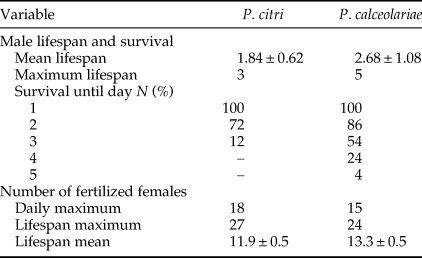
When exposed to ad libitum virgin females, the males of P. calceolariae lived longer than those of P. citri: up to 5 vs. 3 days, respectively (table 1).
Male lifespan, survival and mating performance in Planococcus citri (Risso) and Pseudococcus calceolariae (Maskell) when exposed to ad libitum young virgin females (20 per day) during lifespan.

The preliminary trial showed that the mean number of P. citri females fertilized per male, when males were exposed to females during 4 h per day, was similar to that obtained for 24 h exposure (χ2 = 0.008, df = 1, P = 0.929). Therefore, all results presented therein correspond to 4 h exposure.
The mean number of females fertilized per male during male lifespan (4 h exposition per day) in P. calceolariae was significantly higher than in P. citri (χ2 = 4.288, df = 1, P = 0.04; table 1). The maximum reproductive capacity of male mealybugs is reported in table 1.
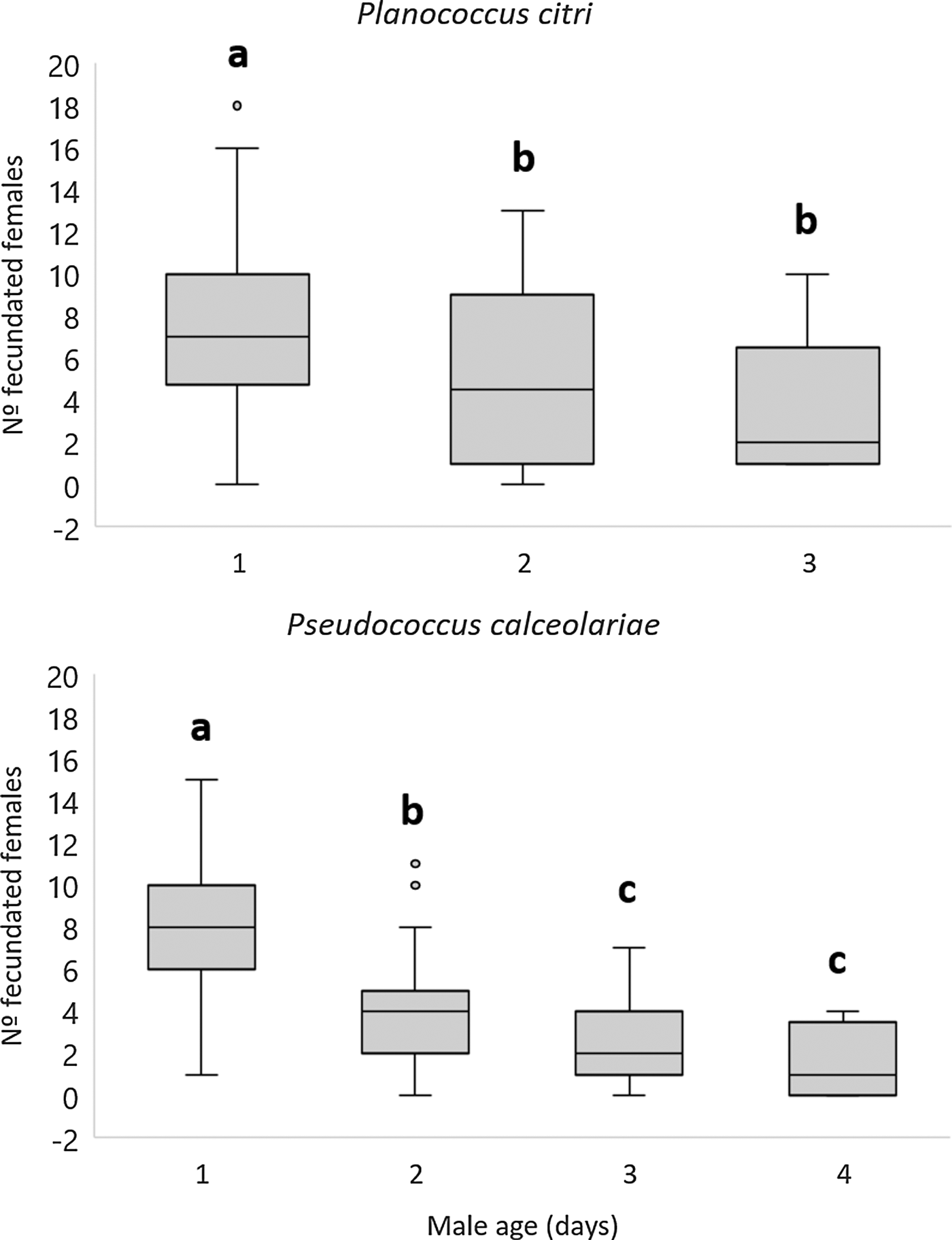
The effect of male age (and implicitly its mating history) on the number of mated females per male was significant for both P. citri (χ2 = 8.227, df = 2, P = 0.016; fig. 1) and P. calceolariae (χ2 = 104.591, df = 3, P < 0.001; fig. 1). This variable in P. citri decreased significantly between 1 and 2 days-old males (P = 0.009), whereas no significant differences were found between 2 and 3 days-old males (P = 0.098). For P. calceolariae, the same variable decreased significantly between 1 and 2 days-old males (P < 0.001), as well as between 2 and 3 days-old males (P < 0.001); differences between 3 and 4 days-old males were not significant (P = 0.238), and 5 days-old males did not mate at all.
Number of female fertilized (mean ± SEM) in function of male age, for both Planococcus citri (Risso) and Pseudococcus calceolariae (Maskell). Bars capped with the same letter are not significantly different within each species (P < 0.05).

Effect of male mating history on female fecundity and fertility
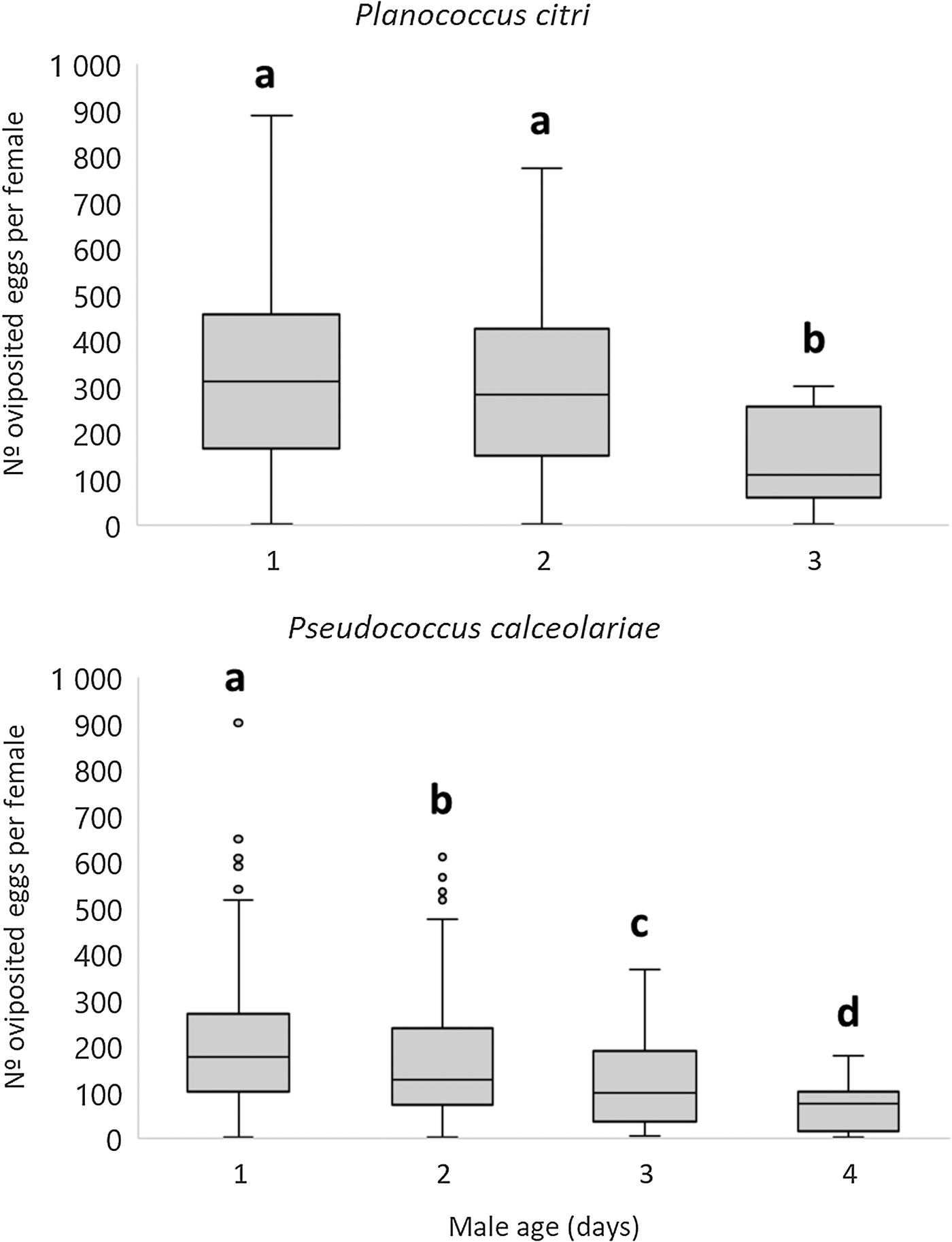
We found no significant differences in female fecundity and fertility for both P. citri (fecundity: χ2 = 0.108, df = 2, P = 0.948; fertility: χ2 = 0.074, df = 2, P = 0.964) and P. calceolariae (fecundity: χ2 = 0.146, df = 2, P = 0.903; fertility: χ2 = 0.105, df = 2, P = 0.949), when fertilized by males with different mating history (up to three mates). However, when we used male age as a proxy of mating history, we observed a significant effect on female fecundity for both P. citri (χ2 = 23.523, df = 2, P < 0.001; fig. 2) and P. calceolariae (χ2 = 34.989, df = 3, P < 0.001; fig. 2). The number of eggs laid per female was not significantly different between females of P. citri fertilized by 1 and 2 days-old males (P = 0.311), but decreased significantly for those fertilized by 3 days-old males (P < 0.001). For P. calceolariae, the same variable decreased significantly between females which mated with 1 and 2 days-old males (P = 0.010), as well as with 2 and 3 days-old males (P = 0.016), and with 3 and 4 days-old males (P = 0.023).
Number of eggs (mean ± SEM) oviposited per mealybug female in function of male age, for Planococcus citri (Risso) and Pseudococcus calceolariae (Maskell). Bars capped with the same letter are not significantly different within each species (P < 0.05).

Polyandry
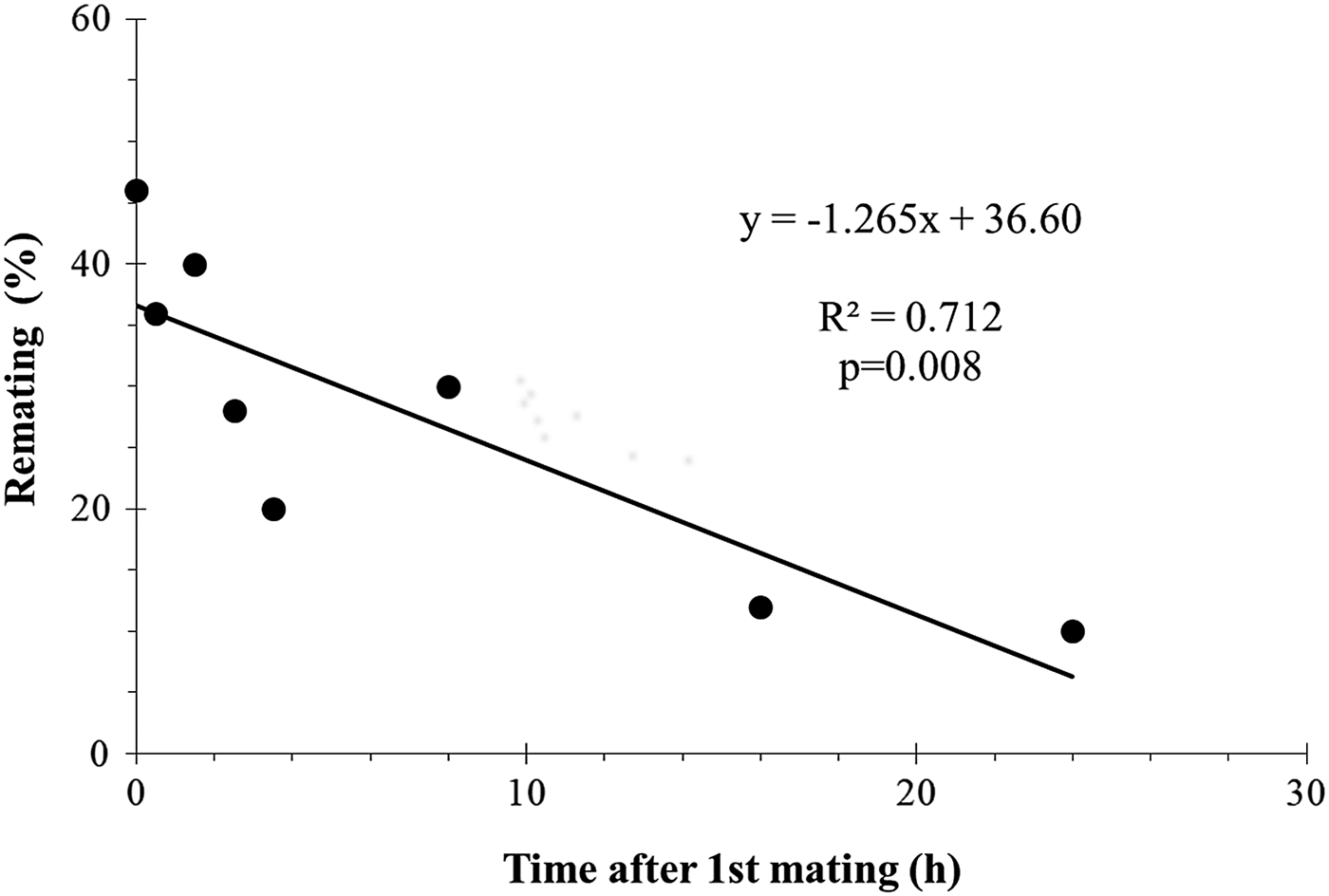
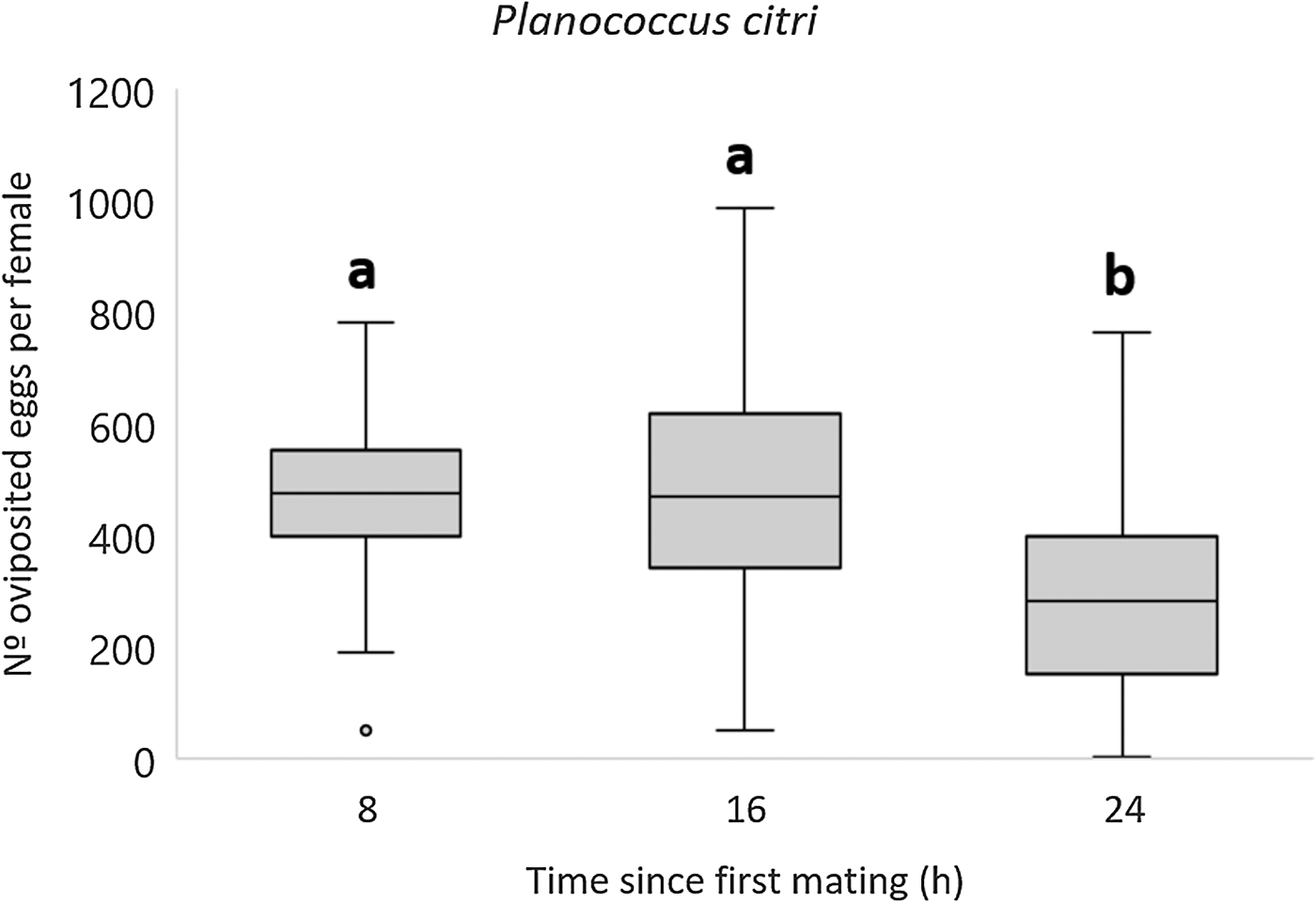
The females of P. citri stayed receptive at least up to 24 h after mating. The percentage of remated females decreased linearly with time elapsed since the first copula (fig. 3). Time elapsed since first mating significantly affected the fecundity of remated females of P. citri (χ2 = 6.659, df = 2, P = 0.036; fig. 4). A significant reduction in the number of oviposited eggs was found for females remated 24 h after first copula, in comparison with those remating 16 h or less after their first copula. No significant difference was observed between females remating 8 and 16 h after first copula, for the same variable.
Percentage of remating in females of Planococcus citri (Risso) in function of time (hours) since first mating. Time t = 0 corresponds to first mating.

Number of eggs (mean ± SEM) oviposited per remated female of Planococcus citri (Risso), in function of time since first copula (8, 16, and 24 h). Bars capped with the same letter are not significantly different (P < 0.05).

No significant differences in fecundity were registered between single and multiple mated (up to five times) females of P. calceolariae (χ2 = 0.667, df = 4, P = 0.955). No significant differences were also observed in the fecundity (χ2 = 0.018, df = 1, P = 0.893), and fertility (χ2 = 0.003, df = 1, P = 0.960) of P. citri females, when mated with one or multiple males (up to three).
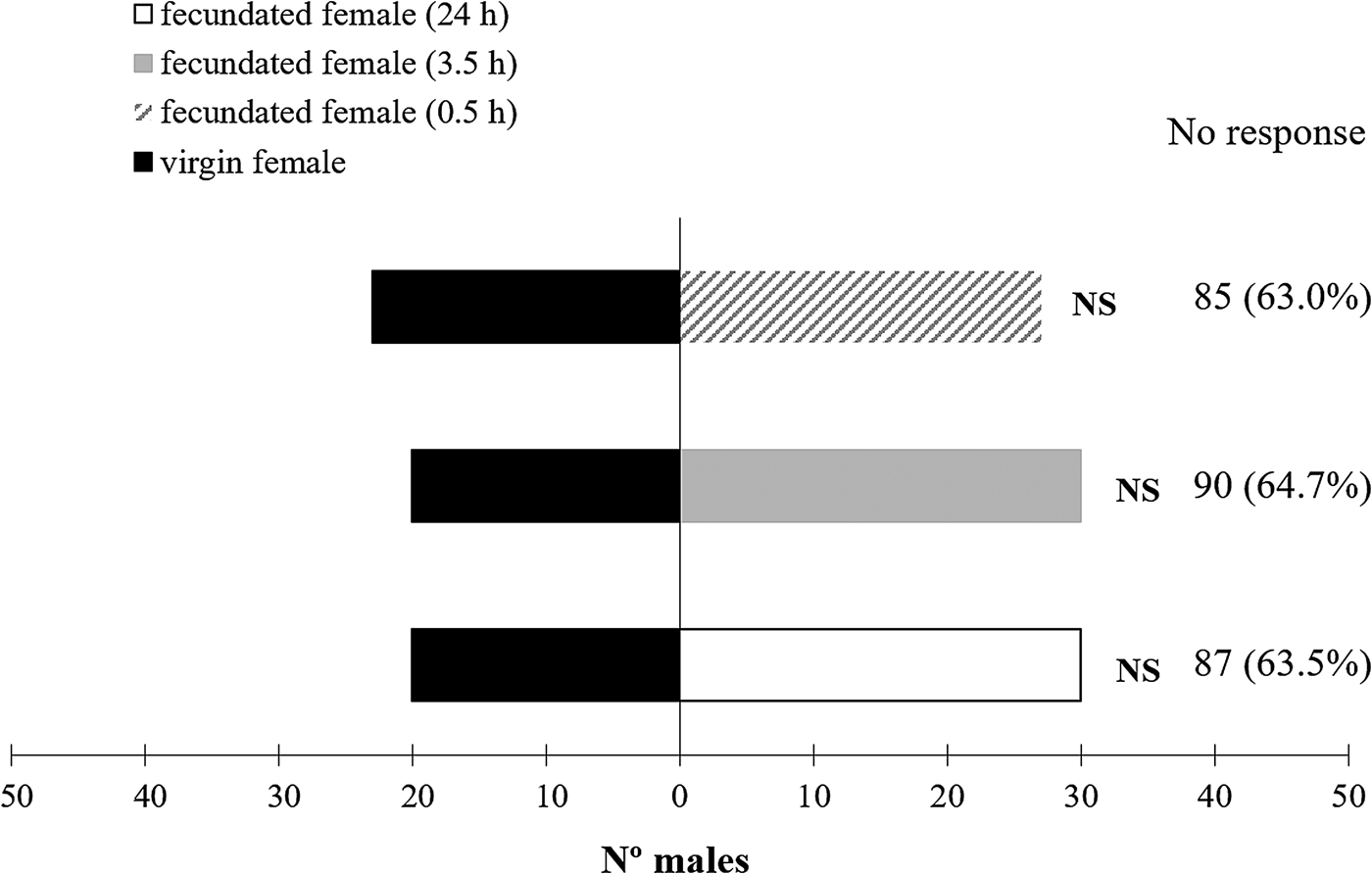
In the olfactometer choice tests (fig. 5), no significant differences were detected in the response of P. citri virgin males when selecting between virgin females and fertilized females, independent of the time passed since mating: 0.5 h (χ2 = 2, P = 0.157), 3.5 h (χ2 = 2, P = 0.157) and 24 h (χ2 = 320, P = 0.572).
Number of responses of Planococcus citri (Risso) males, in dual choice tests in a static-air olfactometer, in the following treatments: (I) 5 days-old virgin female vs. 5 days-old fertilized female 0.5 h after mating; (II) 5 days-old virgin female vs. 5 days-old fertilized female 3.5 h after mating; and (III) 5 days-old virgin female vs. 6 days-old fertilized female 24 h after mating. NS indicates that the observed frequency did not differ significantly (P > 0.05) from that to be expected if the males had chosen at random between treatments (N = 50). The number of non-responders is presented at the right side of the figure and the numbers in parentheses correspond to the respective percentage.

Discussion
Polygyny and male mating capacity
Polygyny has been reported for several mealybug species, including P. citri (James, Reference James1937; Nelson-Rees, Reference Nelson-Rees1959), Planococcus ficus (Signoret), Pseudococcus viburni (Signoret) (Waterworth et al., Reference Waterworth, Wright and Millar2011), Pseudococcus longispinus (Targioni-Tozzetti) (James, Reference James1937; El-Minshawy et al., Reference El-Minshawy, Karan and El-Sawaf1974; Waterworth et al., Reference Waterworth, Wright and Millar2011), and Pseudococcus maritimus (Ehrhorn) (Waterworth & Millar, Reference Waterworth and Millar2012). Here, we demonstrated for the first time the occurrence of polygyny in P. calceolariae and confirmed it for P. citri. Our study is also one of the very few published works estimating the potential reproductive capacity of mealybug males. For example, James (Reference James1937) reported that during their lifespan, the males of P. longispinus and P. citri mated with an average of 8.2 (maximum, 20) and 9.1 females (maximum, 23), respectively. Our estimates are relatively higher than those obtained by James (Reference James1937): an average of 13.3 (maximum, 24), for P. calceolariae and 11.9 females (maximum, 27), for P. citri. Besides the variable results obtained for different species and populations, these apparent differences most likely reflect the dissimilar experimental conditions or the employed methods.
Our results are most probably overestimates of male reproductive capacity in nature, as they were obtained under optimal conditions, in which the males did not need to fly (and also could not, due to the physical constraints of Petri dish arenas) for mate searching, as they were exposed to ad libitum females during their lifespan. Mealybug males have an unrenewable energy budget, as they terminate feeding toward the end of second nymphal instar (Franco et al., Reference Franco, Zada, Mendel, Ishaaya and Horowitz2009). Therefore, we would expect a trade-off between the different male activities (flight/mate search and mating) and longevity. For example, a male that did not mate during the first day as mature adult is anticipated to live longer than a conspecific one of the same age but with multiple mating experience. Recent experiments, comparing the longevity of P. citri males allowed to mate with ad libitum females, with that of unmated males throughout their lifespan, support this hypothesis (Silva et al., unpublished data). Furthermore, during their short life, mate searching in mealybug adult males is limited to 2–4 h per day (Zada et al., Reference Zada, Dunkelblum, Assael, Franco, Silva, Protasov and Mendel2008; Franco et al., Reference Franco, Zada, Mendel, Ishaaya and Horowitz2009; Silva et al., Reference Silva, Mouco, Antunes, Mendel and Franco2009). In this scenario, the reproductive performance of a male is dependent on its efficiency in finding, during that short period, mealybug colonies with enough receptive females. In low mealybug densities, with many isolated individuals and few colonies (Nestel et al., Reference Nestel, Cohen, Saphir, Klein and Mendel1995), we would expect a much lower male reproductive potential than that estimated by us in the present study, as in this case males will often find and mate only isolated females in each day.
Both mealybug species showed a reduction in the number of mated females per day along male lifetime, although it was more conspicuous for P. calceolariae. This reduction may be related with a depletion of sperm and energy reserves in the males that lived 2 or more days, due to multiple matings they performed previously (Waterworth et al., Reference Waterworth, Wright and Millar2011). Mealybug males do not feed and therefore are not capable of replenishing depleted sperm and energy reserves after mating. The delivering of fewer sperm or smaller spermatophores by mated males, in comparison with virgin males, has been documented among other insects, such as Lepidoptera (Torres-Vila & Jennions, Reference Torres-Vila and Jennions2005; Lauwers & van Dyck, Reference Lauwers and van Dyck2006; Marcotte et al., Reference Marcotte, Delisle and McNeil2007; King & Fischer, Reference King and Fischer2010).
Based on our results, we suggest that the mating system of mealybug males corresponds to scramble competition polygyny. According to Thornhill & Alcock (Reference Thornhill and Alcock2001), in this type of polygyny, some males mate with more than one female but make no effort to defend an exclusive mating territory. Instead, males attempt to outrace their competitors to receptive females.
Effect of male mating history on female fecundity and fertility
We hypothesized that female fecundity/fertility could be affected by male mating history. The results of the experiments comparing the fecundity/fertility of mealybug females, which were exposed and mated males with different mating history (copulated with up to three females), did not support our hypothesis, for both P. calceolariae and P. citri (fig. 3). On the other hand, when we considered male age as a proxy of mating history, we observed that the number of oviposited eggs per female decreased for females mated with 3 and 2 days-old or older males, for P. citri and P. calceolariae, respectively (fig. 2). This result suggests that the amount of sperm transferred to females is reduced after an average of 13.3 and 8.3 mating events by a P. citri and P. calceolariae male, respectively, considering that 1 and 2 days-old males of P. citri and 1-day-old males of P. calceolariae fertilized an average of 7.9, 5.4, and 8.3 females, respectively.
Hypothesis of polyandry
Our results showed that the females of both P. citri and P. calceolariae remain receptive to males after mating and may mate multiple times with the same or different males, supporting the hypothesis that this is a general mating behavior in biparental mealybugs, which may be more promiscuous than we expected. The experiments carried out with P. citri suggest that the period of female receptivity is shorter than that referred by Waterworth et al. (Reference Waterworth, Wright and Millar2011) and Waterworth & Millar (Reference Waterworth and Millar2012) for other mealybug species. These authors reported that at least some mealybug females remated 1 or more days after first copulation (up to 23 days, in the case of P. longispinus), despite differences in the length of female receptiveness period among the studied mealybug species. For P. citri, we showed that the frequency of mating events decreased linearly with time since the first copulation, up to 24 h (the maximal period tested in our experiments) although some females could maintain receptivity for longer periods.
In polyandrous species, female receptivity is often reduced after mating. Inhibition of female remating may be related to different factors transferred by males during copulation, such as anti-aphrodisiacs, mechanical stimulation, sperm, and seminal fluids (Miyatake et al., Reference Miyatake, Chapman and Partridge1999; Wedell, Reference Wedell2005). The release of sex pheromones by receptive females can be inhibited in this process. In the case of mealybugs, Levi-Zada et al. (Reference Levi-Zada, Fefer, David, Eliyahu, Franco, Protasov, Dunkelblum and Mendel2014) showed based on sequential SPME/GCMS analyses that females of P. citri and P. ficus ceased releasing sex pheromone 2–3 days after mating. However, these authors did not determine since when the emission of the pheromone was switched-off. The olfactometer choice test results indicate that P. citri males are not able to distinguish on a short-range level between the pheromone signal emitted by virgin females and that of fertilized females 0.5, 3.5, or 24 h after mating, suggesting that mated females may still release pheromone 24 h after mating. Nevertheless, further studies are needed to clarify this issue. Sequential SPME/GCMS analysis (Levi-Zada et al., Reference Levi-Zada, Fefer, David, Eliyahu, Franco, Protasov, Dunkelblum and Mendel2014) could be used to compare the amount of pheromone released by mated females within 24 h after mating, and determine the switch-off of pheromone emission.
According to Waterworth et al. (Reference Waterworth, Wright and Millar2011), at least some mealybug females mated again several days after first copulations: up to 5, 11, and 23 days, in the case of P. viburni, P. ficus, and P. longispinus, respectively. The occurrence of mating in females with no pheromone emission could be explained if a sufficient amount of pheromone was retained in their body surface (which is covered by different types of wax particles, e.g., Cox & Pearce, Reference Cox and Pearce1983; Foldi, Reference Foldi1983) to elicit responses from males, as suggested by Waterworth et al. (Reference Waterworth, Wright and Millar2011). Nevertheless, the receptive period of mated mealybug females cannot exceed the pre-oviposition period, as the ovisac segregated by females during oviposition constitutes a physical barrier to males. Panis (Reference Panis1969) reported that pre-oviposition periods of P. citri, P. longispinus, and P. viburni at 26.5°C were 7–10, 10–28, and 9–22 days, respectively. Silva et al. (Reference Silva, Branco, Mendel and Franco2013) refer that P. citri required 3 days for the onset of egg laying, at 24°C, regardless of female age, whereas pre-oviposition period of P. calceolariae varied with female age: at least 8 days for 5 days-old females, and only 3 days for 26 days-old or older females.
The observation that a female has copulated with multiple males does not demonstrate that more than one male has fertilized the eggs. In many insect species, the sperm from the last mate most likely fertilizes female's eggs (Boake et al., Reference Boake, Shelly and Kaneshiro1996; Thornhill & Alcock, Reference Thornhill and Alcock2001). In a previous study, we showed that there was a genetic contribution of both mated males to the progeny using microsatellite genotyping of pools of eggs resulting from controlled crosses of one P. citri female with two males (Seabra et al., Reference Seabra, Brás, Zina, Silva, Rebelo, Figueiredo, Mendel, Paulo and Franco2013).
Polyandry may have significant fitness consequences for females (Arnqvist & Nilsson, Reference Arnqvist and Nilsson2000). Mating costs to females include time and energy costs, as well as increased exposure to disease or predation. However, these costs may be overcome by direct and indirect benefits (Arnqvist & Nilsson, Reference Arnqvist and Nilsson2000; Hosken & Stockley, Reference Hosken and Stockley2003; Arnqvist & Andres, Reference Arnqvist and Andres2006). Direct benefits of polyandry include replenishment of depleted or unviable sperm supplies, the transfer of nuptial gifts and nutrients, access to resources, and protection from male harassment, whereas indirect genetic benefits are related to increased viability and/or reproductive success of the progeny (Martens & Rehfelt, Reference Martens and Rehfelt1989; Rowe, Reference Rowe1992; Wedell, Reference Wedell1997; Jennions & Petrie, Reference Jennions and Petrie2000; Thornhill & Alcock, Reference Thornhill and Alcock2001; Arnqvist & Andres, Reference Arnqvist and Andres2006). Here we tested the hypothesis that multiple mating could benefit mealybug females by increasing offspring numbers. Although the number of oviposited eggs per female increased with the number of mating events in both P. calceolariae and P. citri, we found no significant differences among treatments in the two mealybug species. This result is in accordance with that reported by Waterworth et al. (Reference Waterworth, Wright and Millar2011) for P. ficus, P. longispinus, and P. viburni. However, in our experiments, all males used were virgin. A single ejaculate may be inadequate to guarantee enough egg production if the first male was not virgin or a low-quality male. In such a case, remating would contribute to increase offspring numbers. In fact, our data indicate high variability in male mating performance of mealybugs and that females fertilized by males with multiple mating history oviposit less eggs (fig. 2). The number of oviposited eggs is apparently a function of the amount of sperm retained by the female in the spermatheca. Nevertheless, further studies are needed to investigate other possible benefits of mealybug polyandry.
Based in our results, we suggest that polyandry is possibly the mating system of female mealybugs in biparental species, with female receptivity restricted to a relatively short period of the life cycle (Thornhill & Alcock, Reference Thornhill and Alcock2001).
Practical implications for pest management
The apparently high mating capacity of individual males for both studied mealybug species would indicate a potential negative effect on the effectiveness of pheromone-based pest management tactics, such as mating disruption, as suggested by Waterworth et al. (Reference Waterworth, Wright and Millar2011). However, as explained before, the obtained results are most probably an overestimate of male reproductive potential. In field conditions, we expect a much lower male performance, in particular in low mealybug densities. Under mating disruption conditions, we expect the frequency of mate finding and copulation will be markedly affected, considering that male flight activity is restricted to 2–4 h per day and that males have a very short-life (Zada et al., Reference Zada, Dunkelblum, Assael, Franco, Silva, Protasov and Mendel2008; Franco et al., Reference Franco, Zada, Mendel, Ishaaya and Horowitz2009; Silva et al., Reference Silva, Mouco, Antunes, Mendel and Franco2009). In our bioassays, the mean lifespan of P. citri and P. calceolariae males was about 1.8 and 2.7 days, respectively. As the males in those bioassays were maintained in Petri dish arenas and thus not able to fly, most likely the corresponding lifespan of feral males is probably lower as flight is an energy-consuming activity and consequently flying mealybug males are expected to live less. In mating disruption experiments, the frequency of P. ficus mated females was about 29% in pheromone-treated plots, compared with 85% in the control plots (Cocco et al., Reference Cocco, Lentini and Serra2014). This suggests a ratio of one mated female per three virgin females, and a reduction of about 66% in the rate of mate finding and copulation in vine mealybug populations under mating disruption. However, as those experiments (Cocco et al., Reference Cocco, Lentini and Serra2014) were carried out in vineyards with relatively high populations of the vine mealybug, we expect that in low mealybug densities, the frequency of mated females would be lower than 29% and the reduction in the rate of mate finding and copulation would be higher than 66%. In fact, the impact of mating disruption on the vine mealybug was shown to be density-dependent (Sharon et al., Reference Sharon, Zahavi, Sokolsky, Sofer-Arad, Tomer, Kedoshim and Harari2016). In low population densities, the shutdown of pheromone traps was registered in the first year of the treatment, along with a reduction of the infestation level, whereas for high population densities, trap shutdown was observed only after the second year of mating disruption and the reduction in the infestation level was gradual (Sharon et al., Reference Sharon, Zahavi, Sokolsky, Sofer-Arad, Tomer, Kedoshim and Harari2016). Furthermore, female delayed mating is expected to be much more frequent under mating disruption conditions, particularly in low population densities. Recently, Lentini et al. (Reference Lentini, Mura, Muscas, Nuvoli and Cocco2017) showed that mating delays higher than 7 days will reduce population growth rates of the vine mealybug. Our previous studies (Silva et al., Reference Silva, Branco, Mendel and Franco2013) also support the idea that female delayed mating may negatively affect mealybug reproduction. We observed that the frequency of both courtship and copulation in mealybug males of P. citri decreased with female age, with males ignoring oldest females (33 days old). Nevertheless, this behavior might be species-dependent, as no effect of female age was observed in P. calceolariae.
The existence of polyandry in mealybugs has practical implications. For example, we expect that effective mating disruption would have more impact on polyandrous females than in monandrous females, as under that scenario (very low chance of female location and mating by mealybug males), the mating rate is limited and that of multiple mating almost nil (Seabra et al., Reference Seabra, Brás, Zina, Silva, Rebelo, Figueiredo, Mendel, Paulo and Franco2013). In absence of multiple mating, we expect none of the benefits of polyandry will occur. Waterworth et al. (Reference Waterworth, Wright and Millar2011) suggested that mated females may act as a sink for males, by competing with virgin females, and thus may negatively affect male reproductive success, as the copulation with a previously fertilized female is a wasted effort. However, under mating disruption conditions, it is unlikely that mated females will often mate again as virgin females are expected to be much more frequent, and therefore more apparent for the males than mated ones. Data collected by Cocco et al. (Reference Cocco, Lentini and Serra2014) in mating disruption plots support our hypothesis.
Future directions
Possible effects of mealybug male and female multiple mating on the effectiveness of mating disruption and other pheromone-based pest management tactics are dependent on the effective male mating performance and how frequent polyandry is in feral mealybug populations. Further studies are needed to understand the real meaning of polygyny and polyandry in the mating system of mealybugs in field conditions. Microsatellites have been developed for a few mealybug species, including P. citri (Martins et al., Reference Martins, Zina, Silva, Rebelo, Figueiredo, Mendel, Paulo, Franco and Seabra2012) and P. viburni (Correa et al., Reference Correa, Zaviezo, Le Maguet, Herrbach and Malausa2014), and may be used as a tool to clarify this issue. Microsatellite genotyping of pools of eggs oviposited per female (Seabra et al., Reference Seabra, Brás, Zina, Silva, Rebelo, Figueiredo, Mendel, Paulo and Franco2013), in samples of field-collected ovipositing females, can be applied for estimating the frequency of feral females which were fertilized more than once.
Acknowledgements
Thanks are due to Cristina Pedraz, Joana Prieto and Manuel Cariano for laboratory assistance. We also acknowledge the comments and suggestions of two anonymous reviewers, which helped us to improve the manuscript. This research was funded by Fundação para a Ciência e Tecnologia I.P. (FCT), Portugal through research project PTDC/AGR-AAM/099560/2008, first author fellowships SFRH∕BPD∕22145∕2005 and SFRH/BPD/44923/2008. We also acknowledge the financial support of KKL-JNF Israel (2015–2017). CEF is a research unit funded by FCT (UID/AGR/00239/2013).