Introduction
Intensive agricultural practices have contributed to an increase in the number and severity of insect pests worldwide while concomitantly causing a decrease in biodiversity in managed and impacted natural ecosystems (Donald et al. Reference Donald, Sanderson, Burfield and van Bommel2006; Wilson et al. Reference Wilson, Evans and Grice2010). Among 13 factors associated with intensive agriculture, pesticide use was consistently correlated with reduced biodiversity of carabid beetles (Coleoptera: Carabidae) and birds (Aves) on variously managed European farms (Geiger et al. Reference Geiger, Bengtsson, Berendse, Weisser, Emmerson and Morales2010). Bouvier et al. (Reference Bouvier, Ricci, Agerberg and Lavigne2011) showed that pesticides in the environment negatively affect the population density of resident insectivorous bird species, likely as a result of decreased prey abundance (Benton et al. Reference Benton, Bryant, Cole and Crick2002; Boatman et al. Reference Boatman, Brickle, Hart, Milsom, Morris and Murray2004) or direct neurotoxic effects (DeWitt Reference DeWitt1956; Forsyth and Martin Reference Forsyth and Martin1993; Fry Reference Fry1995). Extirpation of the viceroy, Limentis archippus (Cramer) (Lepidoptera: Nymphalidae), from the southern interior of British Columbia (BC), Canada can be directly attributed to intensive use of pesticides (Guppy et al. Reference Guppy, Shepard and Kondla1994).
Attempts are being made to minimise environmental degradation and loss of biodiversity in managed agro-ecosystems through restricted use of broad-spectrum insecticides, coupled with the adoption of what are presumably environmentally sustainable, organic practices (Geiger et al. Reference Geiger, Bengtsson, Berendse, Weisser, Emmerson and Morales2010). Several comparative studies in various cropping systems show greater local arthropod diversity in organic systems than in conventionally managed crops (Bengtsson et al. Reference Bengtsson, Ahnström and Weibull2005; Schmid et al. Reference Schmid, Moser, Müller and Berg2011; Winqvist et al. Reference Winqvist, Bengtsson, Aavik, Berendse, Clement and Eggers2011), although the effect varies with the size of arable fields and presence of adjacent wild habitats (Bengtsson et al. Reference Bengtsson, Ahnström and Weibull2005; Gabriel et al. Reference Gabriel, Roschewitz, Tscharntke and Thies2006). A major goal of organic agriculture is long-term sustainability of agro-ecosystems and a central tenet is minimisation of environmental impact (Raynolds Reference Raynolds2000; Pimentel et al. Reference Pimentel, Hepperly, Hanson, Douds and Seidel2005). The latter is often assumed but untested when implementing organic pest management tactics.
Apple clearwing moth, Synanthedon myopaeformis (Borkhausen) (Lepidoptera: Sesiidae), is a recent invasive species in Canada and a destructive pest of commercial apple trees in BC, particularly those being grown organically in the Similkameen Valley (Cossentine et al. Reference Cossentine, Aurelian and Judd2013). Adult mass trapping with semiochemical baits (Concord grape juice and sex pheromone) is being developed as an organic pest management tactic for apple clearwing moth in BC (Aurelian et al. Reference Aurelian, Evenden and Judd2012). Mass trapping is being explored under the assumption it is environmentally benign (El-Sayed et al. Reference El-Sayed, Suckling, Wearing and Byers2006) with less impact on overall biodiversity than alternative controls (Geiger et al. Reference Geiger, Bengtsson, Berendse, Weisser, Emmerson and Morales2010). This assumption may depend on the number of traps and types of baits being deployed. In order to remove sufficient apple clearwing moths before mating and/or oviposition gives rise to damaging larvae, mass trapping may require deployment of hundreds of traps ha−1 of orchard (Aurelian et al. Reference Aurelian, Evenden and Judd2012). This level of trapping could reduce local biodiversity and ecosystem function if nontarget arthropods providing important ecosystem services are caught in significant numbers. In this respect, yellow, sex pheromone-baited traps used to monitor or control various moth pests in orchard systems capture a broad array of nontarget arthropods (Meagher and Mitchell Reference Meagher and Mitchell1999; Clare et al. Reference Clare, Suckling, Bradley, Walker, Shaw and Daly2000; Meagher Reference Meagher2001), including various Hymenoptera important for pollination or parasitism. This is not surprising because yellow is considered a general insect attractant (Prokopy and Owens Reference Prokopy and Owens1983) and yellow traps are a good tool for monitoring populations of beneficial insects and parasitoids of apple orchard pests (Neuenschwander Reference Neuenschwander1982). The majority of diurnally active arthropod groups sampled in salt marshes and tropical forests showed a preference for yellow traps (Hoback et al. Reference Hoback, Svatos, Spomer and Higley1999; Abrahamczyk et al. Reference Abrahamczyk, Steudel and Kessler2010). Likewise, yellow, food-baited traps targeting Oriental fruit fly, Bactrocera dorsalis (Hendel) (Diptera: Tephritidae), captured a variety of insect groups (Leblanc et al. Reference Leblanc, Rubinoff and Vargas2009).
Preliminary observations indicated that the yellow traps used for mass-trapping apple clearwing moth in BC captured arthropods belonging to several insect families (Aurelian Reference Aurelian2011). These studies also suggested there may be a difference in the relative attraction of juice-baited and pheromone-baited traps to many insects, including apple clearwing moth. Juice traps are highly attractive to both sexes of apple clearwing moth, whereas pheromone traps are not. It remains unclear how these results might apply to organic apple orchards because preliminary mass-trapping studies were conducted exclusively in conventional orchards (Aurelian et al. Reference Aurelian, Evenden and Judd2012). Organic orchards that depend on biodiversity and natural enemies to regulate populations of pest species could be vulnerable to the negative impacts of mass trapping if nontarget species providing these important ecosystem services are caught in significant numbers. As such, this study has three major goals: (1) to characterise and quantify the by-catch of arthropods captured in semiochemical-baited traps targeting the apple clearwing moth, (2) to use these two traps to document whether arthropod diversity (as measured to family level) differs between conventionally and organically managed apple orchards in the southern interior of BC, and (3) to examine the effect of orchard management on the abundance of a few key taxa as measured by these semiochemical-baited traps.
Materials and methods
Study sites
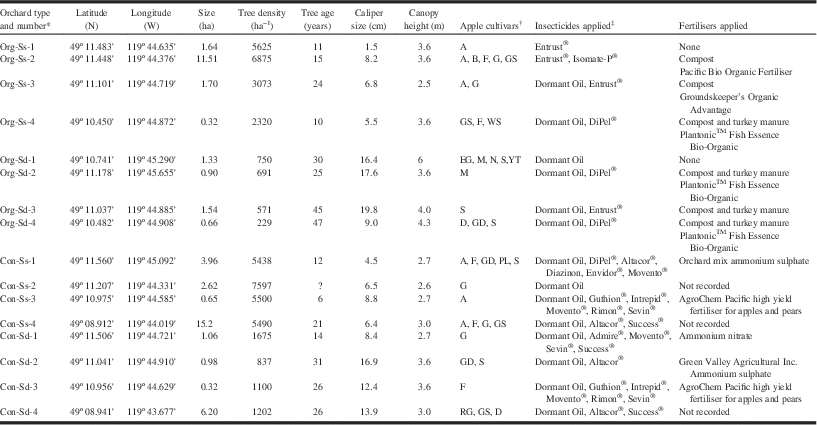
Populations of apple clearwing moth were trapped at 16 orchard locations scattered throughout the Similkameen Valley in BC, Canada (Table 1). Trapping apple clearwing moths leads to catches of many nontarget arthropods (Aurelian Reference Aurelian2011) that indirectly provides an opportunity to examine the diversity and abundance of above-ground arthropods in these same orchards. Eight of the sampled apple orchards were classified as being under organic management, sometimes for over 40 years, and certified under the auspices of the Certified Organic Associations of British Columbia programme (www.certifiedorganic.bc.ca). The other eight orchards classified here as being under conventional management consisted of apple orchards that were treated with various synthetic pesticides and fertilisers. Among the eight orchards in each management type, four were standard plantings and considered low density averaging 882 apple trees ha−1 with a range from 229 to 1675 apple trees ha−1. The other four plantings in each management class are called superspindle-type plantings and considered high density averaging 5235 apple trees ha−1 with a range from 2320 to 7597 apple trees ha−1. The latitude and longitude coordinates, physical description, horticultural characteristics, and general management details for each test orchard are provided in Table 1.
Location, horticultural characteristics and general management details for each apple orchard included in 2009 arthropod by-catch survey in the Similkameen Valley, British Columbia, Canada.

* Management and planting types of each orchard are Organic Superspindle (Org-Ss), Organic-Standard (Org-Sd), Conventional Superspindle (Con-Ss), and Conventional Standard (Con-Sd).
† Apple cultivars are: Ambrosia (A), Braeburn (B), Delicious (D), Early Gold (EG), Fuji (F), Gala (G), Golden Delicious (GD), Granny Smith (GS), McIntosh (M), Pink Lady (PL), Wine Sap (WS), Newton (N), Spartan (S), and Yellow Transparent (YT).
‡ Isomate-P is a pheromone mating-disruption product that reduces catches of male apple clearwing moths in pheromone traps. Data from Org-Ss-2 orchard was removed from any comparisons involving this species.
Semiochemical-baited traps
Apple clearwing moth mass trapping in BC is being conducted with two semiochemical baits: female sex pheromone, 3Z,13Z-octadecadienyl acetate (Judd et al. 2011), which attracts males only and Concord grape juice, which attracts and catches both males and females (Aurelian et al. 2012). Pheromone-baited traps consist of an all-yellow nonsaturating Unitrap® (AgBio Inc., Westminster, Colorado, United States of America) baited with grey halobutyl rubber septa (West Co., Lyonville, Pennsylvania, United States of America) impregnated with 1 mg of, 3Z,13Z-octadecadienyl acetate (Pherobank, Wageningen, The Netherlands; >95% isomeric purity) diluted in 200 µL of HPLC grade hexane (Aldrich Chemical Co., Milwaukee, Wisconsin, United States of America). We placed a 2.5×5.0 cm insecticidal strip containing 10% dichlorvos (Vaportape™ II, Hercon Environmental, Emigsville, Pennsylvania, United States of America) inside the bucket of each composite unitrap to improve capture and kill insects quickly after entry (Judd and Eby Reference Judd and Eby2014).
Juice-baited traps were constructed from 2-L clear plastic beverage bottles (Bottle Depot, Summerland, British Columbia, Canada) that were painted yellow (Krylon® Fusion for Plastic™; Krylon Products Group, Cleveland, Ohio, United States of America) of similar spectral reflectance to the unitraps (Judd and Eby Reference Judd and Eby2014), and had two 13×13 cm windows cut out on opposing sides as described by Aurelian et al. (Reference Aurelian, Evenden and Judd2012). A 473-mL translucent polypropylene container (Fabri-Kal® PK16S-C Deli Container, Kalamazoo, Michigan, United States of America) was placed in the bottom of each bottle and filled with 300 mL of fresh Concord grape juice (SunRype™, Kelowna, British Columbia, Canada). In this bottle trap, grape juice acts as an attractant and serves as the trapping medium (Aurelian et al. Reference Aurelian, Evenden and Judd2012).
Experimental design
Arthropods were collected for seven weeks from 12 June to 31 July 2009, which corresponded to most (>91%) of the apple clearwing moth flight that season (G.J., unpublished data). Two pheromone-baited and two juice-baited traps were positioned a minimum of 20 m from the edge of each orchard about 1.5 m above the ground and separated by at least 30 m at each site. Grape juice in each trap was replaced weekly and pheromone lures were replaced every four weeks. Traps were checked weekly and all arthropods captured, including the apple clearwing moths, were removed, placed into labelled 14.8 mL vials (Fisher Scientific, Pittsburgh, Pennsylvania, United States of America), transported to the laboratory and stored at 0–2 °C until they could be processed and identified to the family level.
Arthropods captured in juice traps required cleaning before they could be identified. Upon removal from cold storage, the catch from each individual vial was transferred into 300 mL of distilled water, kept at 40–50 °C and stirred periodically. After five minutes in water, specimens were transferred to a tray and allowed to dry for five minutes before they were placed into 40 mL of HPLC grade chloroform (Fisher Scientific) to be dehydrated for 24 hours. Small (<5 mm) or soft-bodied arthropods (e.g., Neuroptera) were kept separately from the larger ones. Insects were removed from the chloroform, allowed to dry for another 24 hours and then stored in 15.8-mL glass vials for identification to family level and in some cases to genus and species at a later time.
Data analyses
Data analyses were based on a combination of graphical summaries and statistical tools commonly used in community ecology (McCune et al. Reference McCune, Grace and Urban2002). All data analyses were performed using the seasonal totals of the pooled weekly by-catch in each of the two traps for each bait type and orchard separately. Data reduction resulted in 32 independent by-catch samples representing the two bait-types×two management systems×two planting types×four replicates. The seasonally pooled raw untransformed trap counts (number of specimens in each arthropod family) were used to construct a 32 row (samples)×96 column (families) data matrix. Data samples were coded using three nominal variables: bait type, management type and planting type. This ecological data matrix was subjected to an ordination analysis to assess the similarity among the family communities. Ordination reduces complex community samples to singular points and places them along an axis or multiple axes (dimensions) to reveal the strongest spatial clustering of the 32 samples of family communities using the fewest number of axes. Our ordination was based on nonmetric multidimensional scaling (NMDS) of ranked Sørensen distances (McCune et al. Reference McCune, Grace and Urban2002). This distance measure is particularly suitable for our community data because it is less affected by outliers and zeroes (i.e., family absences) than are other distance measures (McCune et al. Reference McCune, Grace and Urban2002). Stress statistics and scree plots of stress versus dimensionality were used to select the minimum number of axes required to represent community data (McCune and Mefford Reference McCune and Mefford2011).
When NMDS analysis revealed that samples clustered, we used the nonparametric multi-response permutation procedure (MRPP) described by McCune et al. (Reference McCune, Grace and Urban2002) to test various hypotheses of no differences between family communities when grouped as (a) juice versus pheromone traps, (b) organic versus conventional orchards, and (c) standard low-density versus superspindle high-density tree plantings. The MRPP analysis used is a nonparametric equivalent of a multivariate analysis of variance that compares the NMDS-derived distances between groups, to the distances within groups (McCune et al. Reference McCune, Grace and Urban2002). The test statistic (T) describes the distance between the groups and the more negative T is, the stronger the separation. We ran several different MRPP analyses, first testing for effects of the three main factors, followed by all possible interactions. When an interaction was significant we partitioned the data and reran the NMDS and MRPP analyses to isolate specific factors and test hypotheses of interest. All community-level analyses were done with PC-ORD (McCune and Mefford Reference McCune and Mefford2011).
Data for several taxa were extracted from the overall data set to test the hypothesis that orchard management affected the abundance of certain arthropods. Six zoophagous taxa were chosen for detailed analysis based on their potential ecosystem function as biological control agents in this managed setting (Epstein et al. Reference Epstein, Zack, Brunner, Gut and Brown2000; Miliczky and Horton Reference Miliczky and Horton2005; Horton et al. Reference Horton, Miliczky, Jones, Baker and Unruh2012). Predators examined included: European earwig, Forficula auricularia Linneaus (Dermaptera: Forficulidae), multi-coloured Asian lady beetle, Harmonia axyridis (Pallas) (Coleoptera: Coccinellidae), spider mite destroyer, Stethorus punctum (LeConte) (Coleoptera: Coccinellidae), snakeflies, in the Agulla Handlirsch species complex (near Agulla unicolor Carpenter) (Raphidioptera: Raphidiidae), and lacewings, Chrysopa Leach (Neuroptera: Chrysopidae) species and Chrysoperla Steinmann (Neuroptera: Chrysopidae) species (near Chrysoperla carnea (Stephens) sensu lato).
Several other species with varied feeding behaviours were caught in sufficient numbers to allow comparison across orchard management systems, these included: an omnivore, mullein bug, Campylomma verbasci (Meyer) (Hemiptera: Miridae), two saprophages, meal moth, Pyralis farinalis Linnaeus (Lepidoptera: Pyralidae), and a sap beetle, Glischrochilus quadrisignatus (Say) (Coleoptera: Nitidulidae), an incidental phytophage, the treehopper, Telamona praealta (Fowler) (Hemiptera: Membracidae), and our target phytophage, apple clearwing moth.
Season-long catches of each taxon in all juice and pheromone traps combined within each of the eight conventional orchards were compared with those in the eight organic orchards. For each taxon we compared mean seasonal catches in organic versus conventional orchards using generalised linear models (GLMs), where catch was specified as the dependent variable and orchard management type as a fixed factor. To account for over-dispersed nonnormal trap-catch data we used negative binomial error terms when fitting all GLMs (Aurelian et al. Reference Aurelian, Evenden and Judd2012). P-values for significance of each variable in the GLMs were generated from the resulting “analysis of deviance tables” and χ2 goodness-of-fit statistics. These GLM analyses were conducted with the R statistical package (R Development Core Team 2010).
Results
A total of 7001 nontarget arthropod specimens belonging to 102 families distributed among 12 orders were collected as by-catch in all semiochemical-baited traps combined during the seven-week sampling period. These totals do not include worker ants (Hymenoptera: Formicidae) or thrips (Thysanoptera) because their numbers in juice traps were simply too great to count accurately. Exclusion of Thripidae, one unknown spider family, one unknown Coleoptera family, and the grouping of several Hymenoptera families as Chalcidoidea, meant all subsequent data analyses were based on 96 family classifications. Many families (e.g., Noctuidae, Lygaeidae, Cicadellidae, Membracidae, Sciaridae, Phoridae, Hybotidae, Apidae, Halictidae, Coccinellidae, Chalcidoidea, Formicidae [winged adults], and Salticidae) were represented by at least seven specimens in each trap type. Apple clearwing moth was the only sesiid species caught in juice traps, but several Sesiidae were caught in pheromone traps.
By-catch of Diptera and Hymenoptera consistently had the greatest numbers of family representatives under both orchard management systems with either bait (Fig. 1). In organic orchards, 77 families were represented in by-catch in juice traps, whereas only 51 families were represented in by-catch in pheromone traps. This pattern was repeated in conventional orchards where 63 families were represented in by-catch with juice traps and 42 families were represented in by-catch in pheromone traps. Examining baits jointly across orchard management reveals that 90 arthropod families were collected in organic orchards, and of these, 19 were exclusive to organic orchards, whereas among the 77 families caught in conventional orchards, only six families were restricted to conventional orchards.
Total number of families in each arthropod order identified in by-catch with juice traps and pheromone traps separately, but each pooled across all organic and conventional apple orchards surveyed from 12 June until 31 July 2009, in Cawston, British Columbia, Canada.
When pooled across orchard types, juice traps caught 91% of the total number of arthropod specimens recorded. Among the 6360 specimens captured in juice traps (Fig. 2), Diptera represented the largest percentage (24%), followed by Coleoptera (19%), moth Lepidoptera (18.5%), lacewing Neuroptera (14%), and Hymenoptera (11%) that included bees, bumblebees, and wasps. The rarest groups in juice traps were true spiders (Araneae) with 25 specimens (0.4%), barklice (Psocoptera) with two specimens (0.03%), and damselflies (Odonata) with one specimen (0.02%).
Comparison of the percentages of specimens in each arthropod order caught as by-catch out of the total number of by-catch specimens caught in all juice and pheromone traps from all organic and conventional orchards combined.
Thirty-six percent of the 94 fly families known from BC (Scudder and Cannings Reference Scudder and Cannings2006) were recovered in juice traps. Grape juice also attracted a high diversity of beetles and moths, catching 14% of the 99 and 11% of the 53 families known from BC, respectively (Scudder and Cannings Reference Scudder and Cannings2005, Reference Scudder and Cannings2007). Four (Chrysopidae, Hemerobiidae, Mantispidae, and Myrmeleontidae) of the eight Neuroptera families known from BC, and one (Raphidiidae) of the two snakefly families present in BC (Cannings and Scudder Reference Cannings and Scudder2007) were recovered from juice traps.
In contrast to the complexity of family communities caught in juice traps, by-catch in yellow pheromone traps was simple and dominated (82.9%) by three orders. Among the 641 arthropods caught in pheromone traps, 31% were Hymenoptera, 26.1% Hemiptera, and 25.8% were Diptera (Fig. 2).
Initial NMDS ordination suggested that the compositions of the 32 family communities collected were best explained by a single axis. The final “stress” value for this one-dimensional solution was 12.4. Systematically overlaying bait, management and planting type on the ordination scores revealed that this one axis was bait type. All ordination scores for juice traps were>0 and all ordination scores for pheromone traps were<0, independent of orchard management and planting density. MRPP analyses supported the conclusion that the ordination distance between groups defined by bait type was significant (T=−20.267, P<0.0001), but distances between groups defined by management or planting density were not significant (Management: T=−1.196, P=0.1071; Planting density: T=1.101, P=1.0), respectively. MRPP analyses also revealed that all interactions involving bait were significant (bait×management: T=−13.218, P<0.0001; bait×planting density: T=−10.743, P<0.0001; bait×management×planting density: T=−7.672, P<0.0001), but the management×planting density interaction was not significant (T=0.413, P=0.5966). Our inability to detect significant effects of management and planting density on family communities in the initial ordination was likely due to these multiple interactions. When we subdivided the data by bait type and reran the NMDS ordination, the compositions of the family communities collected with each bait type were both best explained by two axes (Fig. 3). Final stress values for the two-dimensional solutions of the 16 juice and 16 pheromone trap samples in family space were 12.9 and 16.2, respectively. An overlay of management on the ordination scores within each bait type provided obvious groupings by management with some overlap (Fig. 3). MRPP analyses of these two-dimensional spaces supports the conclusion that the family communities caught in organic and conventional orchards are significantly different when catches in juice (T=−4.613, P=0.0023) and pheromone traps (T=−3.037, P=0.0076) are considered separately (Fig. 3).
Ordination based on nonmetric multidimensional scaling of 32 samples in taxonomic space (96 families) based on seasonal counts (specimens/arthropod family) in juice traps and pheromone traps, from eight organic and eight conventional apple orchards. Axes 1 and 2 explain 52.3% and 32.1% of the variation in family communities caught in juice traps, and 39.9% and 36.6% of the variation in catches with pheromone traps, respectively.
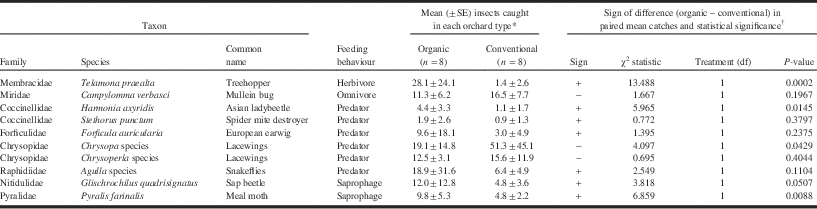
Paired seasonal by-catch of select taxa in organic and conventional orchards illustrates mixed effects of orchard management on insect abundance. Among 10 species examined, five-paired species comparisons were statistically significant, and in four of these, more insects were caught in organic orchards than in conventional orchards (Table 2). Asian lady beetle, meal moth, a treehopper, and sap beetle were all caught significantly more often in organic orchards. The Chrysopa species group of lacewings was the one taxon caught significantly more often in conventional orchards. Any differences in the abundance of the Chrysoperla species group of lacewings, European earwig, snakefly, and spider mite destroyer populations in organic and conventional orchards went undetected by our trapping methods (Table 2).
Seasonal total catches of select taxa in organic and conventional orchards during 2009 in the Similkameen Valley, British Columbia, Canada.
* Catches in two juice-baited and two pheromone-baited traps in each orchard were pooled weekly and summed over the season; actual untransformed means and standard errors shown.
† Hypothesis that mean catches are significantly different in organic versus conventional orchards tested with generalised linear models fitted with negative binomial error distributions and goodness-of-fit determined by an analysis of deviance and χ2 test statistics using 1 degree of freedom (df) for treatment (R Development Core Team 2010).
Orchard management significantly affected catches of apple clearwing moths with both trap types. Mean (±SE) catches of male apple clearwing moths in pheromone traps were significantly greater (χ2=7.017, df=1, P<0.01) in conventional orchards (567.1±151.3) than in organic orchards (234.6±38.9), and mean catches of female apple clearwing moths in juice traps were significantly greater (χ2=12.049, df=1, P<0.001) in conventional orchards (150.1±12.8) than in organic orchards (90.9±17.8).
Discussion
Effect of management practices on overall arthropod diversity
Our results indicate that within the Similkameen Valley the arthropod family communities caught in organic apple orchards are more complex than those caught in conventional orchards. These results are supported by a growing body of literature and paired orchard studies which generally and similarly indicate a greater diversity of arthropods in organically managed farms than in conventional ones (Bengtsson et al. Reference Bengtsson, Ahnström and Weibull2005; Hole et al. Reference Hole, Perkins, Wilson, Alexander, Grice and Evans2005; Schmid et al. Reference Schmid, Moser, Müller and Berg2011). Epstein et al. (Reference Epstein, Zack, Brunner, Gut and Brown2000) conducted a survey of arthropod fauna in paired conventional and organic apple orchards within Washington and Oregon, United States of America; areas that fall within the same bioclimatic zone as the Similkameen Valley. In the Epstein et al. (Reference Epstein, Zack, Brunner, Gut and Brown2000) study, conventional orchard management adversely affected the overall community composition of ground-dwelling arthropods captured in pitfall traps, as well as the abundance of carabid beetles, European earwigs, and hunting spiders (sensu lato). Although considered ground dwellers, our above-ground sampling of European earwigs also showed they were more abundant in organic than in conventional orchards.
The certainty of our observation and conclusion that the diversity of arthropod communities trapped is impacted by differences in organic and conventional management is reinforced by the fact that over 50% of the apple orchards within the Similkameen Valley are organic (Cossentine et al. Reference Cossentine, Aurelian and Judd2013), many orchards are quite small, and often both management types are in close (metres) juxtaposition (Table 1). Arthropod communities might be expected to move these short distances through this landscape, resulting in some evenness in their distributions. Evidence for some homogenisation among family communities in different orchards is provided in the ordination graphs where samples defined by management within the family space show some degree of intersection and overlap (Fig. 3). That this overlap is not greater, given conventional orchards are often surrounded by many organic orchards in the Similkameen Valley, is indirect evidence that management probably impacts arthropod movement into apple orchards from adjacent habitats and this alters the entire agro-ecosystem (Altieri and Schmidt Reference Altieri and Schmidt1986). The degree to which pesticide use in the conventional orchards in this valley (Table 1) is inhibiting movement or establishment of insects remains to be shown.
Effect of management practices on abundance of selected arthropods
Data for several taxa were extracted from the overall data set to examine the hypothesis that orchard management affects the abundance of arthropods with varied feeding behaviours and ecosystem function. Six predators were examined on the basis of their potential role as biological control agents. We expected that differences might be found among zoophagous species because they are often more susceptible to the pesticides that define differences between organic and conventional management (Table 1) than are herbivorous insects (Mullin Reference Mullin1985; Roush and Daly Reference Roush and Daly1990). There is one notable caveat and that is, that the detection of population or taxa differences may depend on the sampling system used as each has inherent weaknesses and bias.
Predator abundance exhibited all possible responses to orchard management. Three generalist predators, an Agulla species complex, F. auricularia, and H. axyridis were caught more frequently in organic apple orchards than in conventionally managed ones, but only H. axyridis showed a statistically significant difference (Table 2). Each of these species feed on aphids and F. auricularia and H. axyridis are recognised as important biological control agents (Carroll and Hoyt Reference Carroll and Hoyt1984; Obrycki and Kring Reference Obrycki and Kring1998; Cannings and Scudder Reference Cannings and Scudder2007). Agulla species adults and larvae are active, generalist predators that feed on a wide variety of soft-bodied insects (Cannings and Scudder Reference Cannings and Scudder2007). Snakeflies are often found in habitats adjacent to apple orchards but have previously gone undetected inside Pacific Northwest apple orchards (Miliczky and Horton Reference Miliczky and Horton2005). We note that 99% of our snakefly detections were with juice traps. Our preliminary information (V.M.A., personal observation) also indicates that Agulla snakeflies are common in hedgerows and Great Basin sage brush habitats adjacent to apple orchards throughout the southern interior of BC. Our collection of snakeflies in organic apple orchards in the Similkameen Valley is among the first, and it suggests that like Coccinellidae, snakeflies may move from adjacent wild areas into orchards perhaps in response to increased prey density (Miliczky and Horton Reference Miliczky and Horton2005). Snakeflies are a poorly studied group of predators (Cannings and Scudder Reference Cannings and Scudder2007) and their relative importance in terms of biological control in organic orchards remains to be determined. The impact of Entrust® on the abundance of snakeflies deserves examination as this is the only insecticide currently registered for control of apple clearwing moth in organic orchards.
Lacewings are a well-studied group of predators commonly found in many Pacific Northwest orchards (Horton et al. Reference Horton, Broers, Hinojosa, Lewis, Miliczky and Lewis2002; Jones et al. Reference Jones, Steffan, Wiman, Horton, Miliczky and Zhang2011). On average, sampled populations of the lacewings, Chrysopa species and Chrysoperla species (near Chrysoperla carnea (Stephens) sensu lato), were greater in conventional than in organic orchards, but this difference was only statistically significant for Chrysopa species (Table 2). We note again that 99.6% of our detections were with juice traps. The relative numbers of these two genera in conventional orchards is difficult to explain on the basis of pesticide use. Species like Chrysoperla carnea have shown some resistance to pesticides without associated fitness costs (Pathan et al. Reference Pathan, Sayyed, Aslam, Razaq, Jilani and Saleem2008; Sayyed et al. Reference Sayyed, Pathan and Faheem2010), while others, like Chrysopa formosa Braue, appear more susceptible to pesticide exposure (Bozsik Reference Bozsik2009). Both of these findings run counter to our results.
Differences in the abundance of Chrysopa species in organic and conventional orchards could have several origins. Adult Chrysopa show a strong preference for aphids over other soft-bodied insects (Canard Reference Canard2001) and all of the conventional orchards examined were severely infested with woolly and rosy apple aphids (V.M.A., personal observation). Larger numbers of lacewings in conventional orchards compared with organic orchards might indicate lacewings are moving into these orchards and perhaps staying longer in response to prey density. Alternatively, smaller catches of lacewings in organic orchards could be due to activities specific to these orchards. The spinosad-based Entrust® is classified as a reduced-risk material and an approved organic insecticide. Organic apple growers in BC can make repeated applications of Entrust® for control of a variety of pests, in some cases up to six annually for apple clearwing moth (Table 1). Spinosad can be highly toxic to adult lacewings when ingested (Medina et al. Reference Medina, Budia, del Estal and Viñuela2003; Nadel et al. Reference Nadel, Johnson, Gerik and Daane2007; Mandour Reference Mandour2009) and certain juvenile stages are seriously affected (Maroufpoor et al. Reference Maroufpoor, Safaralizadeh, Pourmirza, Allahvaisy and Ghasemzadeh2010). Spinosad also causes sublethal effects by delaying adult reproductive maturity, decreasing fecundity, and increasing infertility of female lacewings (Nadel et al. Reference Nadel, Johnson, Gerik and Daane2007; Rimoldi et al. Reference Rimoldi, Schneider and Ronco2012).
Stethorus punctum is a predator of spider mites and an important biological control agent (Biddinger et al. Reference Biddinger, Weber and Hull2009). Adult S. punctum are susceptible to several insecticides, including organophosphates and growth regulators (Biddinger and Hull Reference Biddinger and Hull1995), both of which are rarely used in BC (Table 1; G.J., personal observation), but in general this species is able to tolerate other broad spectrum insecticides better than H. axyridis (James Reference James2003). These differences may partially explain why catches of S. punctum in organic and conventional orchards were not significantly different and those of H. axyridis were lower in conventional orchards.
Campylomma verbasci is an omnivorous species, being both a pest on developing apple fruits (McMullen and Jong Reference McMullen and Jong1970; Pourhadji Reference Pourhadji2001) and an important predator of various mites and aphid species (Ismailov et al. Reference Ismailov, Niyazov, Sugonyaev, Yakovuk and Gabro2004; Almatni and Khalil Reference Almatni and Khalil2008). In this study there was no significant difference in the total number of adult C. verbasci specimens captured in organic and conventional orchards. This result corroborates the findings of McBrien et al. (Reference McBrien, Judd, Borden and Smith1994) who caught similar numbers of male C. verbasci in organic and conventional orchards in the Similkameen Valley when adult male populations were monitored throughout summer and fall with female sex pheromone. Our summer sampling period would have missed the spring emergence of C. verbasci in apple orchards when their populations are often lower in organic orchards than in conventional orchards (McBrien et al. Reference McBrien, Judd, Borden and Smith1994); our seasonal data pooling would also obscure any time-sensitive differences. McBrien et al. (Reference McBrien, Judd, Borden and Smith1994) attributed these springtime population differences to reductions in overwintering eggs by the increased activities of parasitoids and predators in organic orchards but the diet breadth and flexible life history of this omnivore cannot be discounted as a reason for its abundance in variably managed orchards.
Two saprophagous species, meal moth, P. farinalis, and sap beetle, G. quadrisignatus, were significantly more abundant in organic than in conventional orchards. Presence of P. farinalis in apple orchards was initially unexpected because this exotic species is an important pest of stored grain (Levinson and Buchelos Reference Levinson and Buchelos1981; Madrid and Sinha Reference Madrid and Sinha1982). Many organic apple growers in BC fertilise their orchards with poultry manure (Table 1), a known larval food source for P. farinalis (Rueda and Axtell Reference Rueda and Axtell1997). The abundance of P. farinalis in organic orchards compared with conventional orchards is likely the result of it being introduced in poultry compost (Table 1). During the season populations of P. farinalis probably increase because compost attracts adults and decaying organic matter is a very suitable oviposition substrate (Rueda and Axtell Reference Rueda and Axtell1997). This decaying organic matter likely plays host to other saprophages. Many Nitidulidae feed on decaying plant materials and are attracted to fermenting fruits. Glischrochilus quadrisignatus is readily captured in food-baited traps in various cropping systems (Alm et al. Reference Alm, Hall, Ladd and Williams1985; Lin and Phelan Reference Lin and Phelan1991; Dowd Reference Dowd2005); this would explain large catches of this species in juice traps. This sap beetle has not been documented as a pest of tree fruits in BC but is an important indirect pest on previously damaged fruit and vegetables in Ontario, Canada (Luckmann Reference Luckmann1963; Pree Reference Pree1968).
The treehopper, T. praealta, is the one phytophagous species we examined that was caught more often in organic orchards than in conventional orchards. We note that 74% of the T. praealta specimens recovered in this study were captured in grape juice-baited traps. To our knowledge this is the first report of a treehopper being captured with juice, identifying it as a potential tool to monitor emergent treehopper pests. Treehopper species like T. praealta (Yothers and Allen Reference Yothers and Allen1941) and Ceresa species (Beirne Reference Beirne1961) occasionally become minor pests in orchards due to their rapid population build-up, multiple generations and repeated infestation (Loye Reference Loye1982). Parasitoids that may be more numerous in organic orchards are of minor importance in regulating population densities of T. praealta (Beirne Reference Beirne1961). Recommended insecticides for treehoppers are generally lacking but many commonly used insecticides (Table 1) are likely effective. Differences in pesticide use and lack of effective natural enemies may partially explain why populations of T. praealta were greater in the organic orchards.
Particularly noteworthy is our observation that fewer apple clearwing moths were captured in organic orchards compared with conventional orchards. This result is supported by pheromone trapping carried out in every apple orchard within the Similkameen Valley from 2009 to 2013 (G.J., unpublished data). Lower populations of apple clearwing moth in organic orchards may reflect greater activity of natural enemies in this environment. Larvae of S. myopaeformis are attacked by F. auricularia (V.M.A., personal observation) and pupae are parasitised by Pimpla varians (Townes) (Hymenoptera: Ichneumonidae), a parasitoid commonly associated with the codling moth, Cydia pomonella (Linnaeus) (Lepidoptera: Tortricidae) (Cossentine et al. Reference Cossentine, Aurelian and Judd2013). The impact of natural enemies on populations of apple clearwing moth, particularly F. auricularia, needs closer examination as increasing use of Entrust for apple clearwing moth may be particularly damaging to earwig populations (Shaw Reference Shaw2010).
Effect of bait type on the diversity of arthropod by-catch
Over the course of seven weeks, 7001 arthropod specimens were recovered from both the pheromone-baited yellow unitraps and grape juice-baited yellow bottle traps. A large variety of arthropod families was recovered from both trap types but most (91%) of the by-catch specimens were caught in juice traps. This fact reinforces the argument that abundance and biodiversity estimates are highly dependent on the collection technique (e.g., Agulla and Chrysopa species with juice). The juice bait and its snaring of insects while they feed in open bottle traps explains most of the differences across trap types (G.J., personal observation). The chemical profile of Concord grape juice is both complex and dynamic, changing as the juice ferments (Massa et al. Reference Massa, Robacker and Patt2008). Complex chemical profiles, especially those containing acetic acid, are often generally attractive to many arthropods (El-Sayed et al. Reference El-Sayed, Heppelthwaite, Manning, Gibb and Suckling2005; Landolt Reference Landolt2005; Landolt et al. Reference Landolt, Suckling and Judd2007). For example, traps baited with methyl eugenol, a known food cue for the Oriental fruit fly, B. dorsalis, or a mixture of methyl eugenol and decaying Oriental fruit flies attracted a large number of nontarget species including 187 species endemic to Hawaii, United States of America (Leblanc et al. Reference Leblanc, Rubinoff and Vargas2009). Similar to our study, most captures in the Leblanc et al. (Reference Leblanc, Rubinoff and Vargas2009) study were represented by Diptera (94.9% of total specimens captured) probably as response to acetic acid in fermenting juice (Massa et al. Reference Massa, Robacker and Patt2008).
The less specific nature of raw juice traps might limit their use in organic orchards by negatively affecting the abundance of nontarget groups, especially pollinators, parasitoids and predators. In terms of overall impact on parasitic (Braconidae, Chalcidoidea, and Ichneumonidae) and predacious (Vespidae) Hymenoptera, juice traps caught 17.8× more specimens in these families than pheromone traps, 30:1, 248:21, 48:5, and 245:5, respectively. Any subsequent optimisation and use of these food-baited traps to mass-trap apple clearwing moth (Aurelian et al. Reference Aurelian, Evenden and Judd2012) should seek to minimise their impact on nontarget arthropods. Identification and use of grape volatiles as a replacement for raw grape juice to more specifically attract apple clearwing moths may help to reduce nontarget by-catch. Likewise, use of trap colours other than yellow in combination with food baits or identified volatiles may inhibit attraction of nontarget insects without greatly impacting catches of apple clearwing moth (Judd and Eby Reference Judd and Eby2014).
The diversity of species caught by yellow unitraps was significantly less than that seen in juice traps, but 50% of the by-catch in unitraps was made up of insect families that provide important ecosystem service. Among the Apidae, Bombyliidae, Megachilidae, and Syrphidae, pheromone-baited unitraps caught 7.1× more specimens than juice traps, 25:8, 10:2, 20:1, and 59:5, respectively. Bees and hoverflies are important flower pollinators and their removal by mass trapping could negatively impact species that are probably already vulnerable. While the apple clearwing moth pheromone is not known to attract insects other than the Sesiidae, yellow unitraps are consistently attractive to bumblebees (Bombus Latreille (Hymenoptera: Apidae) species), honey bees (Apis mellifera Linnaeus (Hymenoptera: Apidae)) and other acualeate Hymenoptera (Herman et al. Reference Herman, Cameron and Walker1994; Weber et al. Reference Weber, Robbins and Averill2005). According to Lunau (Reference Lunau1990), naive bumblebees show a strong innate attraction to the contrasting colour of flowers and both of our yellow traps have a strong intensity contrast with dark green apple foliage (Judd and Eby Reference Judd and Eby2014). Hover flies (Diptera: Syrphidae) are more attracted to yellow than to green or yellow-green pan traps (Laubertie et al. Reference Laubertie, Wratten and Sedcole2006). In general, flies are most attracted to longer frequency wavelengths varying between 500 and 580 nm, irrespective of the bait used in coloured traps (Robacker et al. Reference Robacker, Moreno and Wolfenbarger1990). The peak wavelength of yellow colour is around 570 nm, well within the attractive frequency range exhibited in flies. Unfortunately, catches of male apple clearwing moth are also greatest in yellow pheromone traps, but Judd and Eby (Reference Judd and Eby2014) concluded it was reflectance from the funnel section of a composite unitrap that most influenced its attraction to apple clearwing moth. It remains to be shown whether beneficial Hymenoptera and hoverflies are as visually discriminating, if not, then combining clear lid and bucket components with yellow funnels in composite unitraps might minimise impacts on beneficial insects while retaining high attraction to apple clearwing moth.
Planting density and arthropod by-catch
Interestingly, planting density (i.e., standard low versus superspindle high) did not affect the overall arthropod community composition that was trapped. To our knowledge the present study is the first to examine the effect of planting density on community-level arthropod diversity. The apple trees in the standard plantings had a greater canopy cover compared with the trees in the superspindle plantings. Canopy cover in tropical and subtropical forests had a significant effect on the number of Hymenoptera parasitoids captured in pan traps (Abrahamczyk et al. Reference Abrahamczyk, Steudel and Kessler2010). The lack of any significant differences between the two planting densities may be a consequence of broad sampling of our traps and habitat heterogeneity around orchards. Habitat heterogeneity increases local butterfly biodiversity in cereal field headlands and margins by promoting habitat availability (Rundlöf and Smith Reference Rundlöf and Smith2006). Our general sampling area included a wide variety of orchard types (e.g., apple, pear, peach, cherries, or mixtures), vineyards and wild habitats including riparian areas on the Similkameen river banks. The dominant plant communities around orchards were Artemisia tridentata Nuttall (Asteraceae) (Great Basin sagebrush), shrub-steppe plant communities interspersed with Pinus ponderosa Douglas ex Lawson (Pinaceae) pines. Dispersal of many arthropod groups into proximal agricultural systems is a regular occurrence (Duelli et al. Reference Duelli, Studer, Marchand and Jakob1990; Samu et al. Reference Samu, Sunderland and Szinetár1999; Fuentes-Montemayor et al. Reference Fuentes-Montemayor, Goulson and Park2011). Farm size also plays an important role in shaping biodiversity in agro-ecosystems of a wide variety of organisms such as birds, bumblebees, butterflies, and herbaceous plants (Belfrage et al. Reference Belfrage, Björklund and Salomonsson2005).
Semiochemical-baited traps being developed to mass-trap apple clearwing moth in the southern interior of BC capture a large number of nontarget arthropods that might negatively affect local arthropod diversity and ecosystem function. It remains to be shown whether this tactic is any less damaging than conventional pest management practices (Table 1), that clearly affect overall arthropod community structure and population densities of key predator species in apple orchards. A balanced risk-to-benefit approach should be taken as this developing technology is optimised and implemented. Choices among different traps could be critical to this optimisation. Identification of key chemical, physical, and visual components necessary for trapping apple clearwing moth and possible elimination of generic attractants should help to optimise this technology.
Acknowledgements
The authors thank Larisa Aurelian, Tiffany Fransbergen, and Lia McKinnon for field and laboratory assistance; Mark Gardiner for preparing pheromone lures; Bob Bengag, Tony Dawson, Fred Danenhower, Trevor and Debbie Evans, Manjinder Gill, Wilfred Mennell, Wayne Ritchie, Greg Sanderson, Rob Dawson, Ron Schneider, Andrea Turner, and Nirmal Sidhu for access to their orchards; Jaime Pinzon for statistical help; and staff from SunRype for making grape juice available in bulk quantities. Two anonymous reviewers improved the quality and clarity of this manuscript. This research was supported in part by a University of Alberta Department of Biological Sciences teaching assistantship and Queen Elizabeth II Scholarship to V.M.A., a Natural Sciences and Engineering Research Council of Canada Discovery Grant to M.E., and funding provided by Agriculture and Agri-Food Canada to G.J.