In October 1894, Mrs. Laura Ormiston Chant, a feminist purity reformer, successfully challenged the music and dancing license of the Empire Theatre of Varieties before the licensing committee of the London County Council. Mrs. Chant raised two objections to the management of the Empire: first, that “the promenade, an open space behind the dress circle in front of the bar,” where 500 people circulated nightly, was used “as the habitual resort of prostitutes in pursuit of their traffic.” Her “second indictment” was that parts of the performance on stage were exceedingly indecent, including the costumes of the ballet dancers (“London County Council”). Chant had gone to the Empire promenade, twice dressed in her “best” evening gown, and been herself accosted. Her protest, declared The Sketch, provoked the “battle of the Empire,” a “great fight . . . waged with a war of words, a battery of correspondence, and a skirmish of sketches” (qtd in Faulk 77). Visually commemorated in the illustrated press and in numerous music hall spoofs, the “Battle of the Empire” was most extensively covered in the correspondence columns of the Daily Telegraph, under the heading, “Prudes on the Prowl.”Footnote 1
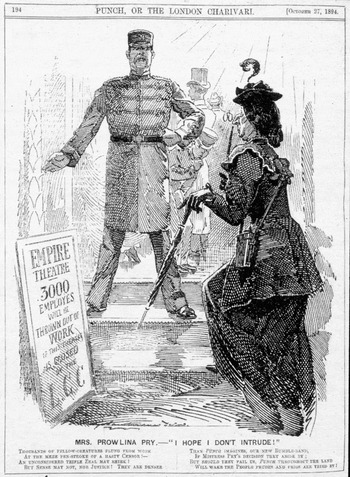
Punch's October 1894 cartoon of “Mrs. Prowlina Pry” (Figure 1) introduces its readers to the leading “prude” (“Mrs. Prowlina Pry”). “Mrs. Prowlina Pry” capitalizes on certain elements of Mrs. Chant's own appearance, notably her sartorial eccentricity and strong aquiline nose. But it mostly consolidates a well-recognized visual stereotyping of the strong-minded woman cum unattractive spinster (Tickner 169). Mrs. Chant is rendered visually ludicrous by her profile, long nose, bespeckled, lined face, and heavy chin, by her dowdy costume, consisting of a black opera cape covering a shapeless uncorseted figure. A female of uncertain age, she comes equipped with opera glasses to spy on the proceedings, and she also sports a campy umbrella (Tickner 160; Harrison).
“Mrs. Prowlina Pry,” Engraving, from Punch 107 (27 Oct. 1894): 194. Courtesy of Johns Hopkins University.

Punch fixes Mrs. Pry as an outsider and oppositional figure. It captures her at the moment she endeavors to gain entrance to the Empire Theatre in Leicester Square, but finds her way blocked by an enormous doorman/commissionaire (Faulk 88). Protected from the intruding gaze of female “prudes on the prowl,” the gents in opera hats in the bright, electrically-lit interior are free to enjoy their unspecified visual and sensory pleasures in complete safety – all with Punch's endorsement.
Unlike Mrs. Prowlina Pry, Mrs. Chant had, in fact, gained entry into the theatre, and her observations about her visits to the Empire promenade had a decisive impact on the London County Council. On the basis of her testimony, the Progressive-dominated County Council prohibited the sale of alcoholic drinks within the auditorium. It further insisted that the management of the Empire reduce the space of the two promenades by adding rows of seats and constructing a barrier between the bar and the promenade (Davis 155). The management reluctantly agreed. It erected a canvass screen, but warned its 647 employees that this might spell the financial ruin of the Empire, as a substantial proportion of its profits derived from promenade patrons and their drink.Footnote 2 Outraged by this compromise, the young aristocratic bloods and toffs who frequented the Empire used their walking sticks to destroy the barricade, sallying forth into Leicester Square, carrying fragments of timber and canvass as “trophies.” The ringleader of the group was a young cadet from Sandhurst, Winston Churchill, who, in these “rather unvirginal surroundings,” delivered his maiden political speech, calling for a Tory victory in the next election (Churchill 156, 157; Jones; Pennybacker; Waters 59–60). At the same time, many other groups and individuals joined the fray, including intellectuals and aesthetes such as G. B. Shaw and Arthur Symons. In 1895, the Licensing Committee reversed its decision against the Empire promenade because its inspectors “reported to them that the change had made no difference in the class of persons attending the music-halls” (Hibbert). Music hall promenades would continue to operate as a zone of commercialized sex until 1916, when wartime exigencies forced their closure.
Thanks to the media attention and the music hall parodies it provoked, the “Battle of the Empire” became an emblem of the naughty nineties. Scholars of Victorian studies continue to invoke the Battle of the Empire as a potent social drama and testing ground of power/knowledge, urban epistemologies, and body politics (Jones; Summerfield; Bristow; Stokes; Pennybacker; Davis; Koritz Gendering Bodies; Faulk). Overall, they assess the music hall/variety theatre either as a space of economic and social determination, embodying the logic of capital and empire or as a laboratory for social change, establishing the expressive conditions of possibility for new social selves and even collective mobilization in the public sphere. I build on these studies, while disrupting their entrenched dichotomies. I also position Mrs. Chant's campaign in relation to another key word: cosmopolitanism, a term widely deployed at the time to describe the urban pleasures and social mingling on offer at the Empire Theatre.
By so doing, I am making a historically-grounded contribution to current debates on the gendered status of cosmopolitanism and its discontents. Like music hall studies, scholarly debates over cosmopolitanism tend to bifurcate into accounts of cosmopolitanism as a privileged, aesthetic, and ethical form of thinking beyond the nation or as a form of material knowledge gained by transnational migrants through adverse daily routines (Nussbaum; Anderson; R. Walkowitz; Clifford). Overwhelmingly, this discussion has focused on cosmopolitanism as a textual practice. There has been little attention to cosmopolitanism as an historical construct aligned to urban space, even though numerous scholars (Breckenridge et al.) have called for materialist, historically-specific studies of cosmopolitanism to flesh out its shifting practices and discordant meanings. This essay is part of a larger project that takes up this challenge. In the spirit of Raymond Williams's “keywords” project, it treats cosmopolitanism as a significant “binding” word linked to urban material experiences and ways of seeing in the localized spaces of London's West End (Williams 13).
In the late nineteenth century, cosmopolitanism exploded into popular print to describe the cultural practices and urban spaces of Central London. As popularly advertised, cosmopolitanism was less associated with disinterested humanitarianism than with transnational forms of commercialized culture and with transnational migrants. Popular journalism linked cosmopolitanism to foreign practices, bodies, and spaces that came to mark the central area of London's West End as a site of pleasure and danger. Commentators at the time frequently remarked on the prevalence of foreign cultural artifacts along the commercial thoroughfares of the center that bordered the foreign, cosmopolitan, and proletarian district of Soho. Taking the form of foreign restaurants, department stores, and variety theatres, these amenities promoted a visual culture where women predominated both as spectacles and increasingly as spectators. (Weightman; Bailey Popular Culture and Performance; Green; Kaplan and Stowell; Stowell; Rappaport; J. Walkowitz, “Vision”). By the late nineteenth century, cultural entrepreneurs had even refashioned the music hall as variety theaters, incorporating novelty acts, ballet, and other performance genres from abroad (Russell).
Cosmopolitanism conveyed a fascination with these cultural imports but also a suspicion of them as tainted. As a system of distinction and taste, cosmopolitanism reordered the economy of the city, drawing new constituencies into expanding consumer markets, altering the social mapping of groups inside and outside the metropolis and the nation (Montgomery-Massingbred; Honeycombe; Barker and Robbins). This process confirmed some existing hierarchies, but it disrupted others, altering the social and sexual spaces of the city and challenging Victorian constructions of corporeality that were central to ideas of nation, gender, sexuality, and class (J. Walkowitz, “Vision”).
These subjective and social remappings crystallized during Mrs. Chant's campaign against the Empire Theatre and its aftermath. Rather than leave Mrs. Chant out in the cold, as Punch and other historians have done, I want to put her back into the variety theatre, not simply as the cool, detached observer of its dangerous cosmopolitanism, but also as the engaged insider susceptible to its expressive economy. Previous studies have tended to represent Mrs. Chant as a naïve, provincial, staunchly liberal critic of the Empire's worldly, jingoist culture. In contrast, I intend to show that she was more engaged with geopolitical alignments, imperialism, and kinesthetic fantasies of movement than has been previously assumed. Against the normative values of imperial masculinity and dangerous cosmopolitanism represented by the Empire Theatre, Mrs. Chant championed an alternative empire, a republican Anglo-American version of empire to be moralized by female activists (Tyrrell). As a dress reformer and physical culture advocate, she despised the licentious “Can Can,” but she adored the strong, unfettered bodies of foreign female acrobats. Her own investment in transnational forms of female mobility helps us to appreciate the unexpected consequences of the Empire controversy for feminism, female bodily idioms, and cosmopolitan practices in London's West End.
Although best known for her star turn in the “Battle of the Empire,” Mrs. Chant had already earned an international reputation as a charismatic, “magnetic” speaker, an ardent proponent of women's rights, non-denominational preacher, and moral reformer, who regularly lectured across America and Britain in defense of “God, Home, and Humanity” (“Mrs. Chant in America”). In 1888, the Woman's Penny Paper profiled Chant as a model New Woman: active and mobile in the public domain and a partner in a successful companionate marriage (“Mrs. Ormiston Chant”). She was interviewed, amidst her children and her pets, in her home at 49 Gower Street in Bloomsbury, a district of snug middle-class life, modest hotels for foreign tourists, and headquarters of culture enterprises “aligned with the lives of London's progressives, radicals, and New Women” (Blair 820). Her “experience in life,” it went on to state, “has been varied.” For “some years she was a successful teacher; another period was spent as a nurse in the London Hospital; and for a year she was the manager of a lunatic asylum. About eleven years ago she became the wife of Mr. Thomas Chant, a surgeon” (Mrs. Ormison Chant).
The unpublished memoir of her granddaughter emphasizes another side of Mrs. Chant's “varied” experience: her rebellious nature, her propensity for risk-taking and her struggles with authority. A rebel daughter, Laura ran away from home at twenty, to become trained as a nurse – originally as preparation for missionary work in India – to the great disapproval of her father, who regarded nursing as a degraded occupation and disowned her. Her marriage to Thomas Chant violated hospital rules and led to her dismissal. If she were a trial to her parents and to the administration of the London Hospital, she would also prove a trial to her children, particularly as she had their hair cut short and dressed them in artistic and sanitary costumes – short, knitted stockings and open work sandals (Lester; Nickson; Donohue 23, 24; “Mrs.Chant in America”).
Chant's activities, from dress reform, social purity, physical culture, temperance reform, to the social gospel, embraced a wide range of liberal feminist causes that revolved around “body politics” in the late-nineteenth century (Durbach; Fischer; Newton). The late-Victorian “religion of health,” to which Chant firmly subscribed, aligned health and morality as pathways to social and individual improvement and opposed them to the degenerative effects of unregulated sexual expression and wasteful consumption.Footnote 3
This feminist body politics had considerable spatial implications. At the global level, it connected women reformers to transnational political networks and to imperial politics (Burton). As editor of the purity journal, the Vigilance Record, Chant both denounced the European corruption of colonial subjects, as well as the persistence of indecent native customs (“Plague in India”; “Editorial Notes” Jan. 1888). On both sides of the Atlantic, she embraced a heterodox, syncretic, universalist religion closely aligned to theosophy – in so doing she refashioned the Nonconformist conscience into something more appropriate for a citizen of the world (Burris).
New systems of communication and transportation enabled Mrs. Chant to be a woman on the move at many levels. Building on the old abolitionist alliance of the early nineteenth century, she participated in a set of transatlantic exchanges that cemented a tradition of Anglo-Saxon, racial imperialism. This racial imperialism was founded on constitutionalism, racial purity, and the cherished freedoms and mobility of a liberal political heritage (Kramer). She juxtaposed this transatlantic connection of Old and New England to the denigrated traffic in bodies, objects, and cultural forms emanating from Europe and on display in London's West End.
Mrs. Chant's moral and cultural empire contrasted sharply with the imperial culture celebrated by the management of the Empire Theatre and the aficionados of its promenade. She disdained the rampant commercialism of the halls. She repudiated the kind of imperial man who visited the Empire to rendezvous with others returning from the “waste places” of the world (Green 72). To Chant, these men and their amusements embodied the negative elements of British imperial rule: aggressive militarism and jingoism, libertine capitalism, loose, undomesticated sexual morality, wasteful expenditure, and the sanctioning of continental and oriental – “foreign” – profligacy.
An opposing imperial vision was not the only reason that Mrs. Chant attacked the Empire Theatre. As a metropolitan reformer, she judged erotic display and commercialized sex to be “unhealthy,” immoral, and practical impediments to women's free circulation through the metropolis, particularly the city center. This desire to transform that center, with its variety theatres, shopping, restaurants, clubs, and hotels, into an orderly heterosocial space, illustrates what Mary Ryan has called a major “civic project” of the nineteenth century: the provision of public space for respectable women (Ryan 78).
In her metropolitan journeys, Mrs. Chant subscribed to the principles of movement, mapping, and circulation that broadly informed nineteenth-century urban planning and reform. As historians have noted, city planners and reformers tried to remake Victorian London into a city of constant motion, possessed of arteries and veins (Nead; Joyce; Ogborn; Winter). These commercial arteries enabled the production of the “Freeborn English Pedestrian,” to quote Patrick Joyce. This figure was a recent historic product of sociotechnical developments, of pavements, curbs, gutters, queues, train and bus tickets, and walking through the city in lines. A new culture of walking took form, one also indebted to discursive genres such as Wordsworthian “spatial stories” (Joyce 64). These developments changed bodily and habitual modes of using the city.
As a late-Victorian denizen of the metropolis, Mrs. Chant had absorbed all these forms of regimentation and cognition into her understanding of orderly locomotion. This understanding also informed the County Council's failed effort to control prostitution in the Empire Theatre through the construction of a barrier and fixed seating.Footnote 4 For Chant and her allies on the Council, “the rule of freedom,” to use Joyce's term, involved self-reflexive, self-watching, internalized disciplines, coupled with formal and reformed police structures and structural revisions of the material environment to insure moral regulation (J. Walkowitz Prostitution; J. Walkowitz, City; Bland; Mort, Dangerous; Donohue). Chant openly disparaged an unthinking celebration of “the liberty of the subject” as “a lot of nonsense.” “The fact is that possession of liberty is relative,” she declared in 1899 (“Women and the Streets” 129).
The prostitute remained a potent focal point for the tensions embedded in Chant's liberal body politics. During the late 1880s, Chant engaged in a campaign to make the streets safer for “ladies” and working women. This meant ridding the thoroughfares of Central London of streetwalkers, so that respectable women like herself could traverse those public spaces without fear of attack or loss of reputation (J. Walkowitz “Going Public” 11, 12). Her commitment to mobile and self-contained female embodiment also led her to support rational dress reform and physical culture. Mrs. Chant combined the circulatory model of the self-regulating body/machine, with another, biblically-sanctioned, image of the female body as the temple, or home, of the soul (Ferry). She heartily endorsed physical culture – gymnastics, competitive sports, bicycling – to promote a strong, robust female body that could move through space (Chant “Woman as an Athlete”). According to Chant, female muscle development, achieved through bicycling and other forms of physical culture, did not change female character, nor did it “unsex” women; on the contrary it aided reproduction and accentuated sexual difference (King; Newton). Similarly, she supported rational dress as a way for women to present themselves in public as natural, chaste and sexed bodies, unconstrained by inconvenient and constricting fashions, and protected from the intrusive eyes of men.
Rational dressers like Chant were closely connected to other emancipatory causes of women, but they also defended rational dress on geopolitical and aesthetic grounds. They denounced tight corseting as a threat to women's childbearing capacities and condemned the domination of Paris fashion as detrimental to national trade and industry (King 26, 27; “Notes and Comments”; “How will Dress Reform”). They condemned spectacular ornamentation, especially the décolleté of fashionable evening dress, as another barrier to women's cultural evolution. “Women always feel themselves in the position of being looked at rather than looking,” declared E. M. King, the president of the Rational Dress Society and early semiotician of the male gaze – “the reverse is the case with men” (King 13).
In keeping with these sentiments, Chant idealized a fully-draped, female body that would move through the crowd unobserved. Chant endorsed an outfit that was “useful,” rational, and modern: it would safeguard privacy and health, protect the body from air and seal off draughts. Her reformed dress would, moreover, follow the contours of the natural body, as manifested in the “S” shaped lines of Greek statuary. The harsh, constricting curves of the corset would be replaced by the more flexible, serpentine curvature of the “body of modernity” (Montague 91).
This mobile, female form could also circulate as a sentient body, an observing subject, who could safely interact with the slow-moving human traffic of the street to produce reliable social narratives. Like male social investigators of her day, Chant imagined her urban spectator to be a rational observer, who could establish a universal knowledge of “man” and his world. Yet, this rationalist tradition of urban spectatorship also harbored an unacknowledged propensity for fantasy, for voyeurism, and for social masquerades (J. Walkowitz, City ch.1 and 2). All these conflicting dispositions towards regimentation, expressiveness, and mimicry were realized in her participation in the Battle of the Empire.
When Mrs. Chant visited the Empire Theatre in 1894, it was not the first time she had inspected a music hall. In the years preceding the Empire campaign, she had visited the halls in her capacity as key propagandist for the purity movement. Chant published a series of articles in the Vigilance Record, detailing her visits to the halls in 1888 and 1889 (“Amused London No. I”; “Amused London No. II”; “Amused London No. III”; “Amused London No. IV”; “Amused London No. V”). Her assessment of music hall entertainments was not uniformly negative. She admired Cockney comic singers like Albert Chevalier as a harmless, domesticated popular entertainment (Chevalier 134). She also praised acts of physical dexterity and strength. She waxed enthusiastic about a “delightfully clever Japanese juggler” and a “woman athlete” who “performed marvels on a trapeze suspended to the roof of the lofty Theatre” (“Amused London No. I”). Chant's defense of the acrobat is especially worthy of note. It signaled her interest in unconventional forms of female embodiment as well as her assessment of theatrical spaces as showcases for new ways of seeing and imagining the female body (Glenn 51). Chant chose not to dismiss the acrobat as a low, mindless, popular attraction who exhibited fetishistic bodily distortions. Nor did she elect to represent her as the epitome of non-narrative abstract art, in the manner of some Bohemian aesthetes. Chant incorporated the female acrobat into her own political project as a fine, healthy specimen of female physical culture. Although she neither approved of the “sensational” position of the female acrobat nor her scanty costume, she hoped that “the immense muscular power displayed by a woman must have dispelled from the spectators any pet theories as to innate physical incapacity in the weaker or more accurately speaking, the undeveloped sex” (Chant “Amused London No. IV” 89; Steedman).
In contrast, Mrs. Chant was outraged by the “indecency” of theatrical costumes, particularly the attire of the corps de ballet who wore “flesh-coloured tights” draped with “transparent gauze” (“Amused London IV” 89). To her mind, the spectacular ballet exuded continental vice, as did the foreign novelty acts that increasingly featured in variety entertainments (Chant “Amused London No. II” 69; “Amused London No. III”). Chant was also disturbed by homegrown acts – the noisy jingoism of the East End halls and the exhibition of child performers in a “nautical spectacles” (“Amused London II” 69). But she judged the popular music halls, overall, to be vastly superior “in tone and decency” to the fashionable West End establishments that attracted sporting aristocrats, military officers, colonial bureaucrats, students, clerks, and tourists from the dominions (“Amused London II” 69).
Mrs. Chant does not name the establishments in question, but she was undoubtedly referring to the Alhambra and Empire theatres in Leicester Square, where the late-Victorian ballet found its home. These theatres boasted a spacious auditorium, a large proscenium arch, and a deep stage that could accommodate a large troupe of dancers. Patrons crowded into these spaces to watch spectacular ballets, featuring prima ballerinas from Southern Europe and a huge cast of “native” English dancing girls.
Spectacular ballets were the latest in a series of sensational public exhibitions of the “female form divine” associated with Leicester Square, home to the great “Shows of London.” According to Tracy Davis, the Leicester Square theatres were a focal point of “a vital nexus of West End immorality involving prostitutes, alcohol, variety theatres, supper clubs, dancing halls, and gambling houses” (Davis 155). Leicester Square's raffish environment, declared the Queen in 1950, made it the “best known spot in London” prior to the Second World War. Foreigner, provincial, exiled Briton, all wanted to make a “bee-line for Leicester Square” because of its “world wide reputation for naughtiness” (“They All Loved”). The Empire gained this reputation from the staging of spectacular ballets as “leg shows” and from the “nightly ballet” of the “Ladies of the Night,” who executed their “peculiar, exaggerated swing of the body from the hips” in the promenade bar. The heavily mirrored walls of the promenade enhanced the doubling effect of these two performance sites (Bennett, Man 11).
Sumptuous appointments, modern scale and comforts, and licensed order were the governing principles of the Empire Theatre. Its classical “Renaissance” exterior of marble and freestone imitated the dignity of financial institutions, but its interior was given over to wild eclecticism, summoning up continental and oriental excesses, with different rooms appointed in Persian, Egyptian, and Louis Seize designs. Order was guaranteed by giant commissionaires and by price-stratified seating for 1300 (from three-guinea boxes to six-penny seats in the gallery), with separate entrances for separate areas of the theatre, and interior connecting spaces appropriately decorated according to the social character of the public destined for each part of the auditorium (Colson; “Bohemian”). Seated in the dark, patrons remained still and silent, passively consuming the brilliantly-lit moving spectacles on stage. But another order – one that involved greater interaction and physical intimacy – prevailed in the five-shilling promenade at the back of the second tier. Here, in a space adapted from certain features of the café chantant, men of a “good class” could sit at tables and spend “a good deal of money in refreshments and liquor” upon women who had entered the establishment “without the escort of a man” and slowly circulated through the promenade to attract attention (Kirwan 467).
These amenities established the Alhambra and Empire as the greatest “cosmopolitan” clubs in the world. They were the place where French visitors made their home in London, and where Englishmen could sometimes forget that they were English, but never that they ruled the Empire (Macqueen-Pope). Leicester Square's proximity to the foreign, proletarian district of Soho, where successive waves of political and economic refugees had settled, including “lean and hungry conspirators from the four quarters of the globe,” further enabled this imaginative expatriation (Taylor). Arthur Symons remembered Soho as a “sordid” but “irresistible reminder of Paris and Italy” where successive waves of political and economic refugees had settled (qtd. in Brooker 32). The district of Leicester Square and Soho beckoned as a syncretic amalgamation of European urbanity with “something more indigenously English” (Brooker 32).
The Empire's entertainments mimicked the hybrid artifice of the neighborhood, combining the homely and the exotic: Andalusian dancers succeeded Cockney comedy singers, followed by Bohemian acrobats, Cossack horsetrainers, dancing dogs, etc. The ballets, the evening's featured presentations, were also assembled from indigenous and continental talent. A well-organized English corps de ballet provided a visual frame for the foreign ballerina (Koritz, “Moving Violations” 428). In the Empire Theatre's advertisements, the dancing girl figured as a healthy, good-humored daughter of Britannia, akin to the Gaiety Girl (the featured attraction of George Edwardes's musical comedies at the Gaiety Theatre in the Strand) and readily transformed into an emblem of the nation.Footnote 5 For all its cosmopolitanism, the Empire was a belligerently British establishment: in addition to the smiling dancer, Britannia herself graced the Empire program covers, surrounded by banners, flags, and crests (Weightman 78–79). Sufficiently cosmopolitan to appeal to foreign tourists (many of whom would not be able to follow Cockney comic singers) as well as to Londoners desirous of a touch of the Continent, the Empire reassured its national audience that it still remained on British soil.
In 1894, the Empire Theatre stood as a conspicuous bastion of male privilege in a leisure and entertainment zone that was becoming heterosocial and populated by men and women of many classes. While other parts of the commercial West End were increasingly feminized as a daytime zone of female pleasure, Leicester Square and its establishments remained a distinctly masculine nighttime space, a nocturnal “no-go” area for unaccompanied ladies (“They all Loved”).
Heterosexual encounters, however, were not the only kind of erotic performances that contributed to the ambiguity and frisson of this sexually charged space. The book dealer Cyril Beaumont recalled his visits to the promenade as a young boy in the 1890s: he was bored by the ballet, but fascinated by the circulating traffic of seductive, mysterious, and sinister “temptresses” in the promenades. They reminded him of the androgynes of Aubrey Beardsley's drawings of Wilde's Salome (Beaumont, qtd. in Guest 92).Footnote 6 Beaumont's memoir gestures toward the homoerotic encounters in the promenades that were open secrets. “To the habitué,” insisted J. B. Booth, “the feminine lure of the promenade made small appeal.” Instead, men went there for “the companionship of other men,” to rendezvous with other Men of the Empire (qtd. in Green 72).
In the promenades, one form of masquerade could shade into another. Female erotic display on stage and in the promenade could provide a pretext for sexual conversation between men and a prototype for homosexual prostitutes. These covert practices of sexual and social cross-dressing seem to have eluded Mrs. Chant's own field of vision, partially because “sodomites” could not always be visually distinguished from men who were conventionally masculine. But flamboyant West End “poofs” were the subject of a protesting letter against the presence of “sodomites” in the lower promenade retained in the archives of the County Council (Empire Theatre).Footnote 7 They may well have contributed to the Council's readiness to close down the promenades, anticipating by one year the sensational repudiation of Bohemian decadence during the trials of Oscar Wilde (“County of London”; “Police”).
Another form of erotic display did not escape Mrs. Chant's attention. They were tableaux vivants, also known as poses plastiques, or Living Pictures. Tableaux vivants exploited the technological innovations of spectacular theatre. Presented in a colossal gold frame and attired in flesh-tinted tights, female performers would strike an artistic pose and stand silent and immobilized as a picture (J. Walkowitz, “Vision”). Sometimes tableaux vivants would take their inspiration from genre and history paintings, but the most notorious ones were based on ancient Greek statuary, mythological subjects, or recent French salon paintings featuring orientalist representations of the nude. The Palace Theatre of Varieties, located on Charing Cross Road, revived this practice as a form of erotic entertainment in 1893 in order to edge out its competitors in Leicester Square. Following the triumph of tableaux vivants at the Palace, other variety theatres followed suit, including the Empire, whose pictures were considerably less “daring” than the Palace (Donohue 57).
The proliferation and elaboration of erotic display was a key factor in Mrs. Chant's decision to step up the campaign against the variety theatres of the West End. In 1894, Mrs. Chant and Mr. W. A. Coote, the paid secretary of the National Vigilance Association, unexpectedly challenged the dancing and music licenses of the Empire and Palace Theatres. Echoing contemporary discussions in the press concerning the salacious influence of French salon painting, Mr. Coote insisted that a demoralizing foreign influence was at work in the selection of original art works selected for reproduction on the Palace stage.Footnote 8 Despite his protest, the Palace license was renewed, but the Palace directors were cautioned to be more careful in the future. When it came time to consider the Empire's license, Coote's place was taken by Mrs. Chant and six ladies and gentlemen she called as witnesses.
Mrs. Chant astonished members of the Council and the press by conducting the case against the Empire herself. She presented herself before the Committee and the public as a “citizen,” a representative of the “women of England” (Chant, Transcript Testimony 11) and the “calm, steady voice of the Non-Conformist conscience” (Chant, Why We Attacked 5). Yet it was her transatlantic connections that set into motion her campaign. Her attention was first called to the Empire earlier that year when some American friends had gone there, on her recommendation, to hear Albert Chevalier “sing his coster songs” (“London County Council” 12). Instead of enjoying an evening of wholesome, popular entertainment, they complained that “they were continually accosted and solicited by women.” Moreover, they were shocked at the “character and want of clothing in the ballet” (Chant, Transcript Testimony 4). “For that reason I determined to visit the Empire, but I did not do so till the Living Pictures [at the Palace] had made so much stir in July” (Chant, Transcript Testimony 4).
Finding the Living Pictures at the Empire to be unobjectionable, Mrs. Chant focused instead on the nightly ballets on stage and in the promenade. She went about making her case by detailing her investigative strategies, keen to show herself to be a skilled interpreter of the performing body who took careful “notes” and “made observations.” She was intent on presenting her case in a dispassionate, lawyerlike way, to offer credible evidence that the Empire management knowingly permitted its premises to become an “habitual” resort of prostitutes (Donohue 99). Nonetheless, Chant's testimony exposed her own blurred performances as spectator and spectacle, a blurring that moved her closer than she would have liked to the theatricality of other social actors in the hall.
Chant began her testimony with an account of her entry into the promenade. To investigate the promenade, Mrs. Chant adopted a form of impersonation. On the first three occasions that she had visited the Empire, she dressed “quietly,” but for this very reason she was marked by the uniformed attendant in the promenade “as a stranger.” In cross-examination, she explained that on the fourth and fifth occasion, she dressed “gaily,” wearing her “prettiest evening dress in order that she might get her information more readily.” The disguise, she hastened to add, did not extend to “dėcolletage” (qtd. in “London County Council” 13). So disguised, she was accosted by a gentleman, who apologized “directly he looked into her face” (“A Facer” 193).
Mrs. Chant observed the appearance and behavior of the young and attractive women who entered the theatre, “very much painted,” and all of them “more or less gorgeously dressed.” These women did not enter the orchestra seats but chose to sit in the unreserved seats in the lounge or “walked round the promenade” on the lookout for men (Chant, Transcript Testimony 13). “She noticed that these women took no interest in the performance, and that during the necessary darkening of the theatre for the tableaux vivants their behavior was very objectionable indeed.” She saw women accost men (Chant Transcript Testimony 14).
From these visual signs – gorgeous dresses, painted faces, carriage and bearing, indifference to the performance, constant circulation, accosting men, “intentional suggestiveness” – Mrs. Chant concluded that female patrons of the promenade were “prostitutes in pursuit of their traffic.” She bolstered this visual evidence with bits of conversation she was able to catch as a member of the throng. She “heard men and women talking” behind her; “some words caught my attention and made me listen to what was going on.” “The impression, in my mind, or rather the conviction, was that it was a case of offer to procure. I have not the slightest doubt in my own mind from various signs – from various things that were said” (Transcript Testimony 14, 15). She heard fragments of other sexual conversations when a “little later on I moved place again with another portion of the crowd” (Transcript Testimony 16).Footnote 9
As a participant observer, Chant partially mimicked the body idioms and licensed practices of the promenaders, by moving about and not attending to the performance (Transcript Testimony 7). Participating in her masquerade required her to engage in the same level of distraction as her neighbors. At one point in her testimony, she acknowledged that she momentarily forgot her role as undercover detective and started to pay too much attention to the performance: “the words [of the singer] were completely drowned by the loud and exceedingly objectionable conversation of one very tall highly painted young woman who stood near the stalls . . . . [Had I] been there for any other purposes than I was, I should have called ‘silence’ at once. But I was there to take notes and make my observations, and did not wish to attract unnecessary notice” (Chant, Transcript Testimony 7).
When she focused on the stage, Chant adopted a second form of impersonation. Her observations became more resolutely judgmental: she pronounced the dresses of the dancers in “La Frolique” and “The Girl I Left Behind” to “be conceived for the express purpose of publishing the bodies of the women to the utmost extent” (Transcript Testimony 9). “There seemed not the least attempt to disguise that which common sense and decency required to be hidden.” To confirm this impression of indecency she resorted to binoculars. “There was one dancer in flesh-coloured tights, and she had to use opera-glasses to see whether they really were tights at all.” By emulating the practice of the stage door Johnnies, Chant departed from the position of transparent authenticity to immerse herself in the theatricality of the milieu (“London County Council”).
Mrs. Chant's testimony evoked the dreamlike intensity of the urban adventure, marked by an abrupt discontinuity of time and space, a forgetfulness and suspension or confusion of identities (Simmel 175; Bailey, “Adventures in Space”). Caught up in the crowd and the spectacle, Mrs. Chant became distracted, even momentarily forgetting to attend to her investigative mission. Chant's confusion did not escape the notice of her critics, who began to vilify her immediately following her testimony before the Licensing committee. In the Daily Telegraph, “An Englishman” condemned the “self-advertising women” with “wizened faces” who opposed the Empire's license as “spies” and “prudes” and who failed to see the humor of their being accosted (“Englishman” 5). Within the space of one week, 170 letters appeared in the Telegraph under the banner of “prudes on the prowl.” Other newspapers also took up the matter, public meetings were held, and dozens of petitions sent, pro and con, to the London County Council. While “men of the world” roundly condemned Chant, working-class spokesmen were divided. The handful of trade unionists elected to the County Council supported her challenge to the Empire, as did women's groups and temperance organizations throughout London. Conversely, the theatrical trade unions, the London Trades Council, and the radical clubs of Central London vehemently opposed the new restrictions (Faulk; Donohue).
George Bernard Shaw was both impressed by Mrs. Chant's example of democracy at work and critical of her intervention. “You can't have a better example of democracy than the Empire case. . . . Here is Mrs. Chant . . . and she flounces in and floors the whole County Council” (qtd. in Faulk 81). Yet he mockingly rebuked her for slandering stage performers and for disclosing in an interview the enormous profits made by promenaders, as much as twenty to thirty pounds a week: “That single utterance of Mrs. Chant is calculated to make more prostitutes than the ballet and the Living Pictures make in ten years” (81). All in all, he recognized her as a Shavian heroine: a woman of the governing classes whose rebellious energies both enabled and undercut her zeal for social order and left chaos and disarray in her wake.
Bohemian poet and journalist Arthur Symons was particularly vocal in his defense of the liberties of the halls against Chant's assault. Unlike Shaw, he saw no overlap between his aesthetic/political practice and Mrs. Chant's campaign. He simply challenged Chant's reading of the Empire Theatre, countering her views with his own extensive knowledge as a journalist who regularly reviewed its dance offerings. Throughout the nineties, Symons helped to circulate a cultural defense of dance that significantly altered its dubious reputation as sexually improper and debased. Symons was, to quote one critic, the leading “ambassador” for French poetry in London (Brooker 29). In his journalism, he introduced French symbolist theory that elevated dance as a vanguard cultural form. Following Mallarmé, he argued that the dancer was a living image, poetry in motion, the essence of art as distinct from ordinary experience. The dancer's art resided in her artifice, in her abstract and fluid transcendence of naturalist experience (Beckson; Brooker; Stokes).
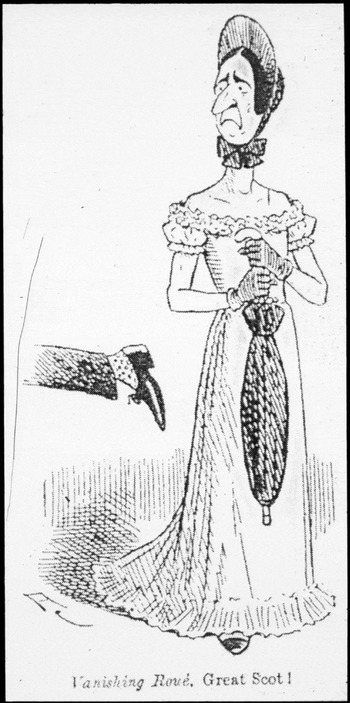
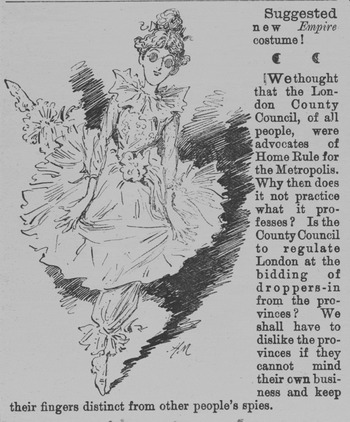
This defense of dance found minimal expression during the Battle of the Empire, although, as we shall see, it considerably informed one of the striking long-term effects of the affair. Overall, Chant's critics offered little commentary about the actual performances on the stage or in the promenade. Instead they repeatedly caricatured Mrs. Chant's body image and performance (Gill). One Judy cartoon, entitled “A Facer” (Figure 2), summons up the moment when the roué who accosted Chant realized his mistake once he looked into her face. A Moonshine cartoon (Figure 3) imagines the reformed ballet costume that would pass Mrs. Chant's inspection: the Empire dancer appears, bespectacled, covered from head to toe, sadly lacking in sex appeal and glamour, a striking contrast to the smiling leggy, dancing girl who regularly embellished the Empire program covers, or the decorative women who frequented the promenade.
“A Facer,” Engraving, from Judy, 24 Oct. 1894, 193. Courtesy of the New York Public Library.

“Suggested new Empire costume!” Engraving, from Moonshine, 27 Oct. 1894, 194. Courtesy of the New York Public Library.

How do we assess the significance of Mrs. Chant's bodily adventures in the Empire Theatre? In many ways Mrs. Chant was the ideal liberal subject, seeking to create a hygienic, self-regulating, urban citizenry whose rule of freedom was ensured not only by discourse and formal policing, but by the organization of the built environment. Yet she was herself was clearly disorderly, and it is not difficult to see why Shaw recognized her as a kind of Shavian heroine: her dress, her intrusion into the male precincts of the promenade and the licensing committee, her engagement with kinesthetic forms of expression, her affinity for the assertive spectacular female body of the acrobat – all challenged the accepted conventions of femininity.
Mrs. Chant's disruptive performance forced diverse constituencies to articulate opposing views on metropolitan encounters and geopolitical alignments. While historians have been alert to the competitive patriotism at stake in the controversy, they have oversimplified the multiple geographic imaginings operating on both sides of the conflict (Jones; Faulk). Mrs. Chant supported the traditions of the English music hall in the form of the sentimental, comic Cockney singer, but she opposed tainted foreign, i.e. continental, imports. She and her supporters upheld a “rule of freedom” in accordance with little Englander notions of propriety and decency, appropriate to all classes. But this rule of freedom had transnational dimensions. It was consistent with an expanded and republican ideal of Greater Britain, a cultural union of Old and New Englands. This international context frames the Empire affair: it was, after all, Mrs. Chant's friends from America who alerted her to the indecent performances in the Empire Theatre. Against Chant and her allies, the most vocal patrons of the music asserted a more elite, male privileging of sexual license and pleasure defended at the time as simultaneously imperial and cosmopolitan. They condemned Chant and her friends as “nobodies” from the provinces or from North London suburbs, who threatened the cosmopolitan pleasures of Men of the World in the center. Yet Mrs. Chant, a denizen of the West End, had worldly ambitions of her own. She championed an alternative empire, a space to be moralized by female activists.
The Battle of the Empire not only registered contradictory imaginative geographies at the heart of the late-Victorian metropolis; it also precipitated some long-term political consequences. Its legacy illuminates how tastes, codes, and skills of the cosmopolitan attractions of variety entertainments could be appropriated and deployed as “tactics” by women. Feminists used these codes to mobilize women in the public sphere, while female cultural innovators showcased transnational bodily forms to refashion women's bodies and desires.
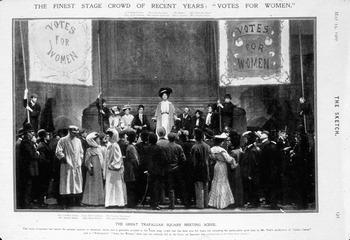
Despite Mrs. Chant's stagy performance, the Battle of the Empire consolidated a negative reputation for feminists as puritanical, anti-fashion, and anti-theatrical – a reputation that the next generation of Edwardian feminists felt obliged to challenge and revise. To advertise feminism, the Edwardian suffrage movement appropriated the technologies of spectacular theater, involving the massing of bodies, sumptuous set designs and elaborate costuming. Suffragists also recruited attractive actresses to their cause. One of their prime recruits was the American actress Elizabeth Robins, whose performances and independent production of Hedda Gabler in 1891 marked the successful arrival of a stylishly dressed Ibsenite heroine on the London stage. Robins's 1907 play, Votes for Women, rewrote the story of Hedda Gabler, so that, instead of choosing suicide, an embittered and passionate woman-with-a-past told her story before a London crowd in Trafalgar Square and incited a political movement (Figure 4). The Sketch took note of the juxtaposition of popular burlesque and feminist melodrama. It judged the Trafalgar Square crowd scene to be the “finest stage crowd of recent years”: uproariously funny, chaotic, full of crowd patter, of burlesque, comic bodies who interrupted the melodrama of the public orator (“Finest Stage Crowd”). It was as if Mrs. Ormiston Chant, with a new fashion consultant, had vindicated herself amidst the Prude correspondents or the devotees of the Promenade (Tickner; Rolley; John; Farfan; Winkiel; Barstow).
“The Finest Stage Crowd of Recent Years: ‘Votes for Women,’” Sketch, 15 May 1907, 131. Courtesy of the New York Public Library.

Other productive consequences occurred within the precincts of the music hall. Mrs. Chant's campaign against indecent performances in the variety theatres failed in the short term. However, music hall managers had learned an important lesson: the need to mollify licensing authorities who were sympathetic to the complaints of “the Non-Conformist conscience” (Chant, Why We Attacked 5). These concessions increased managerial control over the verbal and gestural performances of music hall stars. But censorship codes also made managers receptive to cultural innovations in theatrical dancing.
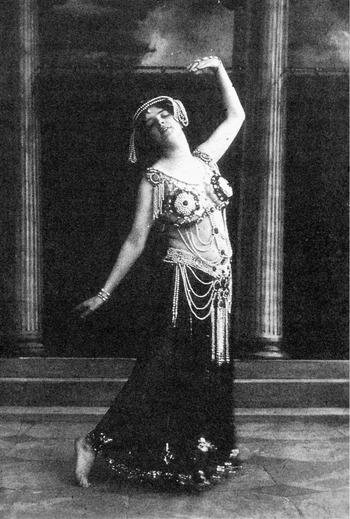
The management of the Palace Theatre in 1907 adopted a strategy of cultural innovation, when, under renewed pressure from social purity groups, the London County Council finally banned Living Pictures. The Palace manager, Alfred Butt, began to cast around for an act that would fill the sex appeal slot yet escape the censorship prohibition. He was also anxious to attract ladies as theatre patrons. He invited the North American interpretive dancer Maud Allan to perform, as a kind of mobile substitute for Living Pictures, who would satisfy the cultural distinctions of high art and also manifest disturbing signs of animated modernity and sexuality (Figure 5). Allan represented a striking combination of the contending cultural forces at work in the Battle of the Empire. Like Isadora Duncan, she took up the aesthetic theories of Symons and the symbolists to legitimize her performance. As Salome, she exuded the decadence associated with the Continent, the Orient, and Oscar Wilde, at the same time that she referenced all those “androgynes” circulating in the back of the London theatres. However, Allan's performative vocabulary derived from the women's physical culture tradition so heavily valorized by Mrs. Chant. Allan performed a version of American Delsarte, an exercise program, taught in schools and in women's institutes that enabled middle-class women and girls to remake their bodies into noble bodies. Her projection of a “natural,” flexible, serpentine body, unfettered by corsets, disciplined from within, placed her firmly in the camp of a modern body management advanced by dress reformers of Chant's ilk (J. Walkowitz, “Vision”). In such ways did Mrs. Chant's campaign publicize and incite the contradictory imperatives of expressive freedom and emotional discipline.
“Maud Allan as Salome,” 1908. Collection of the author.

The Empire theatre reminds us, once again, of the imaginative resonance of the prostitute and the crowd in middle-class women's fantasies of sexual danger. Specifically, it shows us how a liberal feminist like Chant, with her strong commitment to women's free, disciplined movement through city spaces, energetically marked herself off from grotesque female bodies while she also made a spectacle of herself that partially blurred those differences. Her story demonstrates how urban subjectivity was assembled, to quote Frank Mort, from the negotiations of manifold practices and shaped into “a diversity of positions rather than any one single stance” (Mort, Cultures 187). Second, the case illuminates how a spatial story of the metropolitan center exercised a hold on the national imagination and highlighted contested systems of empire and transnational networks. As a citizen and Englishwoman, Mrs. Chant challenged the legitimacy of the Empire, because it signified the normative values of imperial masculinity: easy access, total possession, complete sway over the pleasures of the globe (Donohue 236–38). These were also the values the Empire underscored when it advertised itself as the greatest “cosmopolitan club” in the world. Against this dangerous cosmopolitanism, Mrs. Chant's championed a set of transnational values (Anglo-American) to fashion an alternative vision of empire and metropolitan order. Finally, Mrs. Chant's story teaches us that cultural politics rarely possess a coherent, driving logic or single trajectory. Mrs. Chant's “rule of freedom” might have supported a puritanical regime of bodily discipline, but her feminist body politics also established the conditions of possibility for the emergence of more expressive, feminist forms of “cosmopolitanism” and embodiment.