Introduction
Because I have been caught in the rain, I always want to hold an umbrella for someone else.
—A popular Chinese saying
In recent years, China has played a pivotal role in global poverty alleviation, making substantial contributions to reducing poverty worldwide (Ahlstrom & Ding, Reference Ahlstrom and Ding2014). As the world’s largest developing economy, China continues to face a pronounced urban–rural divide, with rural underdevelopment remaining a persistent challenge (Yin, Chen, & Li, Reference Yin, Chen and Li2022). Consequently, narrowing this gap and addressing rural poverty have become critical national priorities. In 2014, the Chinese government launched the ‘Mass Entrepreneurship and Innovation’ initiative, which has since played a central role in poverty reduction efforts. By the end of 2020, 770 million rural residents had been lifted out of poverty, accounting for over 70% of global poverty reduction during the same period (Chen, Liang, & Yang, Reference Chen, Liang and Yang2022).
Entrepreneurship, long recognized as a key engine of economic growth (Kimmitt, Muñoz, & Newbery, Reference Kimmitt, Muñoz and Newbery2020), has increasingly been viewed as an effective means of alleviating poverty in developing countries (Si, Zahra, Wu, & Jeng, Reference Si, Zahra, Wu and Jeng2020). Among its many forms, digital entrepreneurship – enabled by digital platforms and technologies – has emerged as a transformative force (Si, Hall, Suddaby, Ahlstrom, & Wei, Reference Si, Hall, Suddaby, Ahlstrom and Wei2023), lowering entry barriers and granting rural entrepreneurs greater access to broader markets (Sohns & Revilla Diez, Reference Sohns and Revilla Diez2018). It thus creates new economic opportunities that foster rural poverty reduction. However, despite its growing significance, existing research on digital entrepreneurship and poverty alleviation has largely focused on macro- or organizational-level outcomes (e.g., Bruton, Ketchen, & Ireland, Reference Bruton, Ketchen and Ireland2013; Salemink, Strijker, & Bosworth, Reference Salemink, Strijker and Bosworth2017; Si, Yu, Wu, Chen, Chen, & Su, Reference Si, Yu, Wu, Chen, Chen and Su2015). Our understanding of the micro-level foundations – particularly the individual mechanisms through which digital entrepreneurship drives poverty reduction – remains limited. To fully capture how digital entrepreneurship contributes to poverty alleviation, it is essential to investigate these individual-level dynamics in greater depth.
Psychological research suggests that early life experiences can leave enduring imprints on individuals’ cognitive schemas, shaping their perceptions, behaviors, and decision-making over time (Freud, Reference Freud1920; Holman & Silver, Reference Holman and Silver1998). Among these, formative experiences of poverty – marked by limited access to social and economic resources (Xu & Ma, Reference Xu and Ma2022) – can significantly shape individuals’ risk orientation, long-term strategic thinking, and sensitivity to social inequities, thereby profoundly influencing their behavior (Duncan, Ziol‐Guest, & Kalil, Reference Duncan, Ziol‐Guest and Kalil2010). Entrepreneurs with such backgrounds often demonstrate heightened resilience in adversity, a stronger tendency toward frugal innovation strategies such as jugaad (Prabhu & Jain, Reference Prabhu and Jain2015; Si, Ahlstrom, Wei, & Cullen, Reference Si, Ahlstrom, Wei and Cullen2021), and a deeper empathetic understanding of the challenges faced by disadvantaged groups. These traits, in turn, shape their strategic choices and social commitments. However, research explicitly linking early poverty experiences to poverty reduction outcomes remains scarce – particularly within the context of digital entrepreneurship. To better understand how personal history experience as a micro-level origin of digital entrepreneurship drives poverty reduction, we pose a critical yet underexplored question: To what extent does an entrepreneur’s past poverty experience influence the poverty reduction outcomes of their business?
Furthermore, while past experiences clearly shape entrepreneurial outcomes, their influence is often gradual and indirect, operating through intermediate mechanisms (Marquis & Tilcsik, Reference Marquis and Tilcsik2013). Yet, current research remains fragmented and insufficiently process-oriented, leaving the mechanisms that connect experiences to outcomes largely underexplored (Johnson, Reference Johnson2007). Recent evidence indicates that proximal outcomes can function as mediating pathways through which formative experiences exert their effects on more distal business and social outcomes (Simsek, Fox, & Heavey, Reference Simsek, Fox and Heavey2015). For example, entrepreneurs’ cognitive frameworks – imprinted by their early experiences – may guide the development of specific organizational capabilities that ultimately enhance long-term performance (Marquis & Huang, Reference Marquis and Huang2010; Narayanan, Colwell, & Douglas, Reference Narayanan, Colwell and Douglas2009).
Following this logic, it is plausible that such a mediating mechanism also exists between an entrepreneur’s early poverty experience and poverty reduction outcomes. Clarifying this mechanism is essential to understanding how personal adversity is translated – through specific organizational processes – into tangible social and economic impact. Accordingly, this study further examines the mediating role of digital capabilities in the relationship between past poverty experience and entrepreneurial poverty reduction outcomes, thereby responding to calls for greater attention to process-oriented mechanisms in imprinting research (Marquis & Huang, Reference Marquis and Huang2010).
Therefore, this study, based on the imprinting theory, explores how digital entrepreneurs’ past poverty experience influences poverty reduction outcomes of their ventures, with a particular focus on the mediating role of digital capabilities. Rural China presents an ideal setting for this study for two main reasons. First, developing countries have made substantial progress in poverty reduction in recent years, with much of this progress driven primarily by China (Ahlstrom & Ding, Reference Ahlstrom and Ding2014; Si et al., Reference Si, Yu, Wu, Chen, Chen and Su2015). Given our focus on how entrepreneurship contributes to poverty alleviation, China’s remarkable achievements offer an essential case for understanding effective poverty reduction strategies through entrepreneurial activities. Second, the rapid expansion of China’s e-commerce ecosystem has become a critical driver of rural economic development, creating fertile ground for digital entrepreneurship and unlocking new opportunities for poverty alleviation (He, Reference He2019; Jiang & Murmann, Reference Jiang and Murmann2022). This e-commerce-driven model not only provides rich empirical data but also yields insights applicable to other regions facing similar socio-economic challenges.
This study makes several key contributions. First, it offers a more nuanced understanding of how individual adversity shapes inclusive entrepreneurial outcomes by demonstrating that entrepreneurs’ past poverty experience significantly influences the poverty reduction outcomes of their digital ventures. This micro-foundational perspective underscores the importance of incorporating personal history into the theoretical framework of digital entrepreneurship and poverty alleviation. Second, the study advances imprinting theory by identifying a process-oriented mechanism – digital capabilities – through which poverty experience is translated into entrepreneurial outcomes. This shifts the perspective from static notions of imprinting to a dynamic understanding of capability formation within digital ventures. Third, it deepens our insight into the contextual contingency of imprinting effects by showing that resource constraints moderate the relationship between poverty imprints and digital capability development. Specifically, the transmission from poverty imprint to digital capability development is amplified when the current entrepreneurial environment mirrors past conditions of adversity.
Theoretical Background and Hypotheses Development
Imprinting Theory
Researchers have long used imprinting as a theoretical lens to understand a variety of important phenomena from a historical perspective for explanatory, evaluative, and managerial purposes (Simsek et al., Reference Simsek, Fox and Heavey2015). The concept of imprinting first emerged in animal behavior research (Lorenz, Reference Lorenz1935), based on the observation that ‘early experience has … proved to exert a crucial and permanent influence in a variety of [behavioral] phenomena’ (Immelmann, Reference Immelmann1975: 16). Stinchcombe first introduced this concept into organizational theory in 1965, inspiring a series of studies on how founding conditions influence subsequent organizational outcomes (Johnson, Reference Johnson2007; Tilcsik, Reference Tilcsik2014). The imprinting literature emphasizes that, whether it is an individual or an organization, there are several ‘environmentally sensitive periods’ in their development (Marquis & Tilcsik, Reference Marquis and Tilcsik2013). During a brief sensitive period of transition, the focal entity exhibits high susceptibility to external influences and develops characteristics that are adapted to features of the environment to reduce uncertainty (Marquis & Tilcsik, Reference Marquis and Tilcsik2013; Milanov & Fernhaber, Reference Milanov and Fernhaber2009). These characteristics continue to persist and generate a lasting impact on behavioral decisions despite significant environmental changes in subsequent periods (Marquis & Tilcsik, Reference Marquis and Tilcsik2013; Mathias, Williams, & Smith, Reference Mathias, Williams and Smith2015).
Research on the formation and identification of entrepreneurial imprints often regards a particular experience of entrepreneurs in the past as the source of imprints and explores their lasting impact on subsequent corporate management decisions (McKeever, Jack, & Anderson, Reference McKeever, Jack and Anderson2015; Phillips, Reference Phillips2005). By systematically combing through the existing literature, the imprinting theory offers a compelling theoretical framework for exploring how entrepreneurs’ past poverty experience affects poverty reduction outcomes of digital entrepreneurship. Specifically, experiencing poverty entails enduring persistent material deprivation. In such an environment, individuals face not only threats to their survival but also social exclusion, marginalization, and disadvantage (Xu & Ma, Reference Xu and Ma2022). This constitutes the formation conditions of the ‘sensitive period’ experienced by individuals (Marquis & Tilcsik, Reference Marquis and Tilcsik2013). During this crisis period, entrepreneurs develop imprints that align with the core characteristics of a resource-constrained environment, which, in turn, influence long-term behavior and decision-making processes within their businesses. Therefore, we believe that imprinting theory provides an appropriate theoretical perspective for our research.
Entrepreneurs’ past poverty experience and digital poverty reduction outcomes
According to imprinting literature, individuals’ past experiences leave enduring imprints on their cognitive patterns, psychological preferences, and value judgments (Malmendier, Tate, & Yan, Reference Malmendier, Tate and Yan2011; Xu & Ma, Reference Xu and Ma2022). These imprints persist in their subconscious and shape their responses to challenges, opportunities, and risk assessments (Marquis & Tilcsik, Reference Marquis and Tilcsik2013). As the well-known aphorism suggests, ‘What doesn’t kill you makes you stronger’. The psychological imprints formed during poverty – characterized by resource scarcity, uncertainty, and survival challenges – leave a lasting impact on entrepreneurs’ mental models and decision-making processes (Zhang, Wang, & Jia, Reference Zhang, Wang and Jia2022). We argue that digital entrepreneurs who have experienced poverty are likely to carry certain imprints that strengthen their capacity to achieve greater poverty reduction outcomes.
These imprints manifest in two key ways that contribute to poverty reduction outcomes. First, research has shown that individuals who have lived through poverty often develop a deep sense of empathy and understanding of the struggles experienced by those in similar situations (Hahn & Gawronski, Reference Hahn, Gawronski and Wixted2018). As a result, digital entrepreneurs with past poverty experience tend to develop a stronger intrinsic sense of social responsibility (Xu & Ma, Reference Xu and Ma2022; Yao, Wang, Sun, Liao, & Cheng, Reference Yao, Wang, Sun, Liao and Cheng2020), which fosters their greater altruistic and socially oriented behaviors (O’Sullivan, Zolotoy, & Fan, Reference O’Sullivan, Zolotoy and Fan2021; Wang & Wang, Reference Wang and Wang2019). In other words, they are more likely to take on poverty reduction responsibilities driven by genuine moral commitment. A real-world example is the case of Chen Yinzi, a woman from a poor rural background in China who, motivated by her difficult upbringing, seized the opportunity provided by the digital economy to escape poverty, and afterward, took the initiative to help many other impoverished households increase their income.Footnote 1
Second, poverty experience represents a unique set of material context in which resource scarcity strengthens individuals’ risk management awareness (Bernile, Bhagwat, & Rau, Reference Bernile, Bhagwat and Rau2017; Haushofer & Fehr, Reference Haushofer and Fehr2014) and environmental adaptability (Prabhu & Jain, Reference Prabhu and Jain2015). Specifically, participating in poverty alleviation initiatives allows entrepreneurs to influence the allocation of socio-economic resources and garner stakeholder support, thereby alleviating resource constraints and mitigating operational risks (Vilanova, Lozano, & Arenas, Reference Vilanova, Lozano and Arenas2009). Consequently, digital entrepreneurs with past poverty experience are often more inclined to proactively assume poverty reduction responsibilities. They are typically highly motivated to leverage their sharpened environmental sensitivity and mobilize diverse resources to build scalable and sustainable solutions that address poverty. Moreover, individuals and organizations accustomed to operating under resource-constrained conditions tend to demonstrate strong environmental adaptability. They excel at creatively leveraging limited resources and existing technologies to maximize output, enabling them to effectively navigate environmental uncertainty and volatility. For instance, Prabhu and Jain (Reference Prabhu and Jain2015) observed that Indian innovators who have long suffered from systemic resource shortages often adopt frugal, flexible, and inclusive strategies to foster innovation and entrepreneurship.
Therefore, we propose the following hypothesis:
Hypothesis 1 (H1): Digital entrepreneurs’ poverty experience is positively related to poverty reduction outcomes.
The mediating role of digital capabilities
Imprinting is a process that refers to the actual occurrence of imprint formation and the mechanisms that occur during the sensitive period (Marquis & Tilcsik; Simsek et al., Reference Simsek, Fox and Heavey2015). This process involves the imprinted entity transforming imprinter features into capabilities or resources to cope with environmental conditions, opportunities, and constraints (Simsek et al., Reference Simsek, Fox and Heavey2015), which in turn has a profound impact on more distal organizational behaviors or outcomes (Marquis & Huang, Reference Marquis and Huang2010; Narayanan et al., Reference Narayanan, Colwell and Douglas2009). Specifically, the role of the imprinter is seen as a source of these potential capabilities or resources that the organization can draw on when needed (Colombo & Piva, Reference Colombo and Piva2012; Geroski, Mata, & Portugal, Reference Geroski, Mata and Portugal2010). Recent literature primarily focuses on the direct impact of imprints on organizational outcomes (e.g., Azoulay, Ganguli, & Zivin, Reference Azoulay, Ganguli and Zivin2017; Gao, Li, Cheng, & Shi, Reference Gao, Li, Cheng and Shi2010; Jia, Wang, & Chen, Reference Jia, Wang and Chen2022). Indeed, the review of Simsek et al. (Reference Simsek, Fox and Heavey2015) revealed that imprinting can have proximal and distal paths of impact. Initially, imprints might affect firms’ ability to acquire resources and pursue opportunities, which in turn may affect more distal behaviors or outcomes, such as survival, growth, and performance. It may provide the necessary mediating mechanisms to better explain why imprints generate lasting impacts on more distal outcomes (Marquis & Huang, Reference Marquis and Huang2010).
Based on this perspective, we argue that firms’ digital capabilities could play a mediating role between entrepreneurs’ past poverty experience and poverty reduction outcomes in the context of digital entrepreneurship. The emergence and development of digital technologies have set the tone for a shift in business strategies, placing substantial pressure on firms to adapt (Agarwal & Helfat, Reference Agarwal and Helfat2009; Amankwah-Amoah, Khan, Wood, & Knight, Reference Amankwah-Amoah, Khan, Wood and Knight2021). As a result, digital capability – referring to a firm’s skill, talent, and expertise in managing digital technologies to facilitate new digital innovations (Khin & Ho, Reference Khin and Ho2019) – is particularly critical in the realm of digital entrepreneurship (Levallet & Chan, Reference Levallet and Chan2018; Orlandi, Reference Orlandi2016; Ritter & Pedersen, Reference Ritter and Pedersen2020; Tortora, Chierici, Briamonte, & Tiscini, Reference Tortora, Chierici, Briamonte and Tiscini2021). It helps enterprises rapidly adapt to dynamic changes in the technological environment by extensively integrating digital resources and other organizational resources within the value network through digital technology to realize digital value creation and has been proven to be an important prerequisite for firms to ensure sustained competitive advantage in the digital age (Annarelli, Battistella, Nonino, Parida, & Pessot, Reference Annarelli, Battistella, Nonino, Parida and Pessot2021).
Digital entrepreneurs who have experienced poverty in the past carry with them a unique set of imprints that may significantly influence the development of digital capabilities within their organizations. First, past poverty experience usually endows entrepreneurs with a high sensitivity to environmental changes (Bernile et al., Reference Bernile, Bhagwat and Rau2017; Xu & Ma, Reference Xu and Ma2022). It can allow firms to accurately perceive and respond quickly to changes in the external environment, adapting to new digital trends and technologies (Teece, Reference Teece, Furman, Gawer, Silverman and Stern2017). The constant need to navigate through resource constraints in the past has trained these individuals to be highly attuned to cost-effective and innovative solutions, often found in digital tools and platforms that enhance efficiency and scalability. Thus, they are often more flexible and open to experimenting with new digital tools, processes, and business models. Second, entrepreneurs who experienced poverty in the past have developed a keen awareness of risks and opportunities (Bernile et al., Reference Bernile, Bhagwat and Rau2017; Feng & Johansson, Reference Feng and Johansson2018). The poverty experience instills a mindset that constantly evaluates the environment for potential dangers and opportunities, fostering a culture of continuous learning and adaptation within their enterprises (Kish-Gephart, Reference Kish-Gephart2017; Xu & Ma, Reference Xu and Ma2022). This cognitive imprint drives them to be vigilant and proactive in adopting and enhancing digital technologies, as they understand that staying ahead of digital trends is crucial for survival and growth in the modern business landscape. For example, some scholars found that past adversity shapes entrepreneurs’ proactive approaches to risk management and digital technology utilization (Feng & Johansson, Reference Feng and Johansson2018).
In general, sensitivity to the environment and awareness of risk management generated from the imprints of poverty experience ensures that these entrepreneurs are more likely to invest in digital tools and processes, thus enhancing the overall digital capabilities of new ventures. Therefore, we propose the following hypothesis:
Hypothesis 2 (H2): Digital entrepreneurs’ poverty experience is positively related to digital capabilities.
Furthermore, digital capabilities could positively affect digital poverty reduction outcomes due to their ability to create new resources and update or alter the resource mix. In the digital economy, the cycle of technological change is shortened, and the external environment presents a rapidly changing and fleeting opportunity window. Some studies believe that digital capabilities, as high-order dynamic capabilities, can positively affect a firm through reduced costs and increased flexibility (Drnevich & Croson, Reference Drnevich and Croson2013). These digital capabilities, including the adoption of digital technologies and the use of digital platforms, reconfigure resources and achieve their effective use in response to technological change (Grewal & Tansuhaj, Reference Grewal and Tansuhaj2001; Hardwick & Anderson, Reference Hardwick and Anderson2019). They are viewed as an important prerequisite for enterprises to gain sustainable competitive advantages (Annarelli et al., Reference Annarelli, Battistella, Nonino, Parida and Pessot2021). For example, Heredia, Castillo-Vergara, Geldes, Gamarra, Flores, and Heredia (Reference Heredia, Castillo-Vergara, Geldes, Gamarra, Flores and Heredia2022) analyzed data from the World Bank’s Enterprise Surveys 2020, which included 999 firms from 27 countries, and found that digital capabilities have a positive impact on firm performance. Similarly, Wang, Tian, Li, and Xiao (Reference Wang, Tian, Li and Xiao2022) found that digital platform capabilities can drive service innovation. Levallet and Chan (Reference Levallet and Chan2018) found that digital capabilities foster managerial improvisation.
Digital capabilities are particularly important in poverty areas because they can break the limitations of traditional markets. As we all know, rural areas often face challenges such as inefficient information utilization, limited financing channels, and weak market supervision, resulting in high entrepreneurial transaction costs (Bruton et al., Reference Bruton, Ketchen and Ireland2013). Digital enterprises in these areas can continuously seek to reconfigure and rebuild resources and core capabilities with strong digital capabilities, significantly reducing transaction costs related to business activities (Cui, Pan, Newell, & Cui, Reference Cui, Pan, Newell and Cui2017) while improving competitiveness (Heredia, Castillo-Vergara, Geldes, Gamarra, Flores, & Heredia, Reference Heredia, Castillo-Vergara, Geldes, Gamarra, Flores and Heredia2022; Wang & Ahmed, Reference Wang and Ahmed2007). As a result, digital businesses that achieve growth may gain more opportunities to provide new employment and income opportunities for poor groups. For instance, Zhang, Yang, Shen, and Li (Reference Zhang, Yang, Shen and Li2024), using questionnaire survey data from 490 farmer entrepreneurs in China, empirically test the effect of digital capabilities on the sustainable growth of entrepreneurial income. Mbuyisa and Leonard (Reference Mbuyisa and Leonard2017) also concluded, through a systematic literature review, that digital technologies can serve as a tool for driving socio-economic development, including poverty reduction, by small and medium-sized enterprises (SMEs).
In general, the imprinting process transforms the characteristics developed by entrepreneurs during periods of resource scarcity into the enhancement of organizational digital capabilities to help them proactively adapt to environmental conditions and consistently overcome resource constraints, which in turn assists enterprises in optimizing resource allocation, ultimately contributing to poverty reduction outcomes. Therefore, taken together with H2, we propose the following hypothesis:
Hypothesis 3 (H3): Entrepreneurs’ poverty experience has a positive indirect relationship with digital poverty reduction outcomes through digital capabilities.
The moderating role of resource constraints
There is growing recognition that imprinting effects are not static but rather context-dependent (Marquis & Tilcsik, Reference Marquis and Tilcsik2013; Tilcsik, Reference Tilcsik2014). Imprinting theory emphasizes that imprint–environment fit – the degree of congruence between the initial formative context and subsequent conditions – may significantly influence the strength of the imprinting effects (Tilcsik, Reference Tilcsik2014). In other words, the greater the alignment between the specific imprint content formed during an individual’s sensitive period and the characteristics of the current environment, the stronger the imprinting effects on organizational outcomes.
Resources play a vital role in the survival (Pfeffer & Salancik, Reference Pfeffer and Salancik2003), growth (Villanueva, Van de Ven, & Sapienza, Reference Villanueva, Van de Ven and Sapienza2012), and competitive advantage (Clarysse, Bruneel, & Wright, Reference Clarysse, Bruneel and Wright2011) of an entrepreneurial venture. Conversely, resource constraints – including financial limitations, limited physical resources, weak social networks, and shortages in human capital (Aldrich & Fiol, Reference Aldrich and Fiol1994; Baker & Nelson, Reference Baker and Nelson2005) – pose substantial barriers to firm growth and survival (Becchetti & Trovato, Reference Becchetti and Trovato2002; Musso & Schiavo, Reference Musso and Schiavo2008). Drawing from imprinting theory, resource constraints, thus, are considered as a moderating variable precisely because such constraints create an environmental context highly congruent with the initial conditions under which poverty-related imprints were formed, characterized by scarcity, uncertainty, and survival pressures. This similarity is critical because imprinting theory argues that congruent environmental conditions activate and strengthen previously established imprints, thereby amplifying their effects.
Specifically, high resource constraints signify a more challenging environment where firms encounter heightened pressure to achieve survival, and growth, and maintain their competitive edge (Desa & Basu, Reference Desa and Basu2013). Such an environmental situation is somewhat consistent with the context of poverty characterized by resource scarcity, uncertainty, and survival challenges. In resource-scarce contexts, the similarities between the harsh conditions of business survival and entrepreneurs’ previous poverty experience reinforce their poverty imprints (De Cuyper, Clarysse, & Phillips, Reference De Cuyper, Clarysse and Phillips2020; Tilcsik, Reference Tilcsik2014). Consequently, entrepreneurs become more motivated and proactive in enhancing their firms’ digital capabilities, as digital strategies provide cost-effective, flexible solutions crucial for survival and competitiveness in resource-constrained contexts. In contrast, under abundant resource conditions, new ventures have more slack resources to invest in extensive search, experimentation, and implementation (Welter, Xheneti, & Smallbone, Reference Welter, Xheneti and Smallbone2018). The absence of intense pressures and challenges reduces the resemblance to entrepreneurs’ formative poverty environments, weakening the activation and salience of their poverty imprints. Therefore, entrepreneurs in such environments have fewer incentives to prioritize developing digital capabilities to reduce risk (Tilcsik, Reference Tilcsik2014; Welter et al., Reference Welter, Xheneti and Smallbone2018).
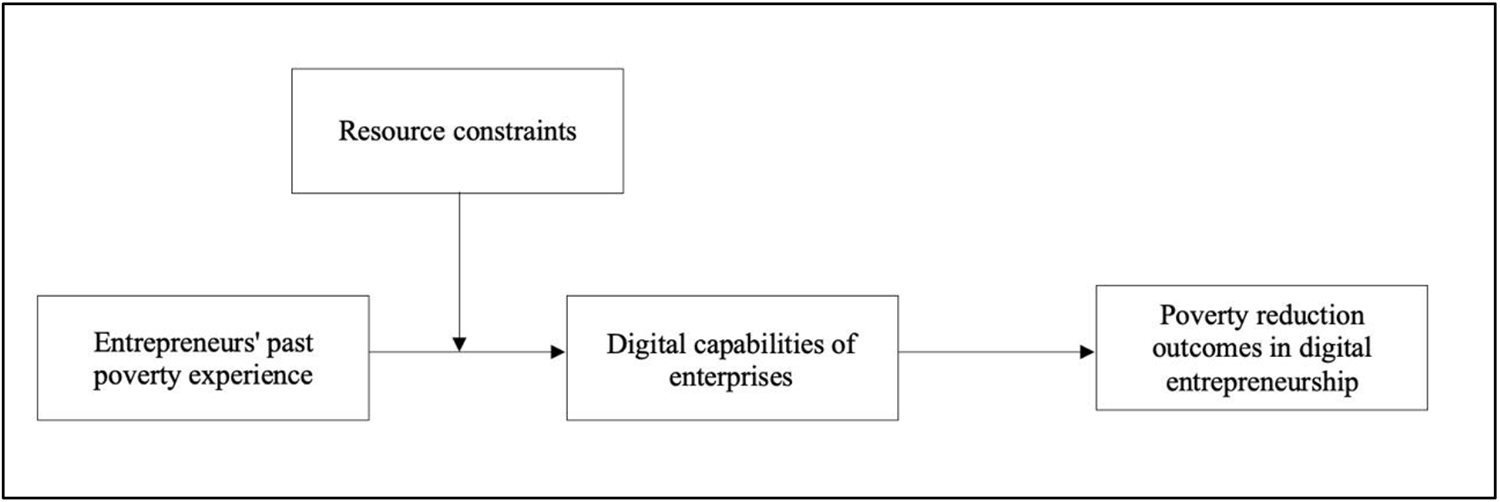
In sum, resource constraints represent an environmental condition closely aligned with those of entrepreneurs’ initial poverty experience, strengthening the imprinting effects and subsequently enhancing their firms’ digital capabilities. Together with the previously proposed mediating role of digital capabilities between entrepreneurs’ poverty experience and poverty reduction outcomes proposed earlier, high resource constraints, which mirror the challenging environment akin to entrepreneurs’ past poverty experience, strengthen the positive imprinting effect of such experience on the digital capabilities of enterprises, thereby further improving poverty reduction outcomes in digital entrepreneurship. In other words, resource constraints positively moderate the mediation effect of firms’ digital capabilities by creating an environment that resonates with their formative adversities. Therefore, we propose the following hypothesis:
Hypothesis 4 (H4): Resource constraints positively moderate the mediation effect of firms’ digital capabilities on the relationship between entrepreneurs’ past poverty experience and poverty reduction outcomes in digital entrepreneurship.
Figure 1 shows our research framework.
Research framework

Methods
Sample
Digital entrepreneurship is a proven pathway out of poverty (Sutter, Bruton, & Chen, Reference Sutter, Bruton and Chen2019; Wu, Si, & Yan, Reference Wu, Si and Yan2022). In our study, we tested our theoretical hypotheses using a sample of digital entrepreneurial firms from rural China, which we believe provides an ideal context for exploring our research question. First, developing countries have made great progress in poverty reduction in recent years, and much of this progress has been driven primarily by China (Ahlstrom & Ding, Reference Ahlstrom and Ding2014; Si et al., Reference Si, Yu, Wu, Chen, Chen and Su2015). A key distinction between developing and developed countries lies in the robustness of their rural commercial ecosystems – while developed countries generally maintain well-established business infrastructures in rural and remote areas, this is not the case for most developing nations. Rural China, in particular, faces distinct socio-economic constraints, including inadequate infrastructure, financial exclusion, and limited market access (Sohns & Revilla Diez, Reference Sohns and Revilla Diez2018). As a result, poverty in China is predominantly concentrated in rural areas. However, by the end of 2020, China had successfully eliminated all absolute poverty nationwide. A total of 770 million rural individuals in China were lifted out of poverty, accounting for more than 70% of the global poverty reduction achieved during the same period (Chen et al., Reference Chen, Liang and Yang2022). This highlights the effectiveness of China’s poverty reduction strategies, particularly in rural areas, which have historically faced more severe economic challenges.
Second, the rapid development of China’s e-commerce ecosystem has become a critical driver of rural economic development and poverty reduction. E-commerce platforms, with their low capital entry threshold, have created new opportunities for farmers to engage in digital entrepreneurship (Jiang & Murmann, Reference Jiang and Murmann2022). Traditionally, entrepreneurial activities require significant financial capital, which many rural farmers lack. However, the expansion of e-commerce in China has provided these farmers with the tools and platforms to overcome financial barriers and participate in the market (He, Reference He2019). Following the Chinese government’s three-year (2015–2017) e-commerce poverty alleviation initiative, the rapid expansion of digital platforms – such as Taobao, JD.com, TikTok, and Pinduoduo – has fundamentally reshaped the rural entrepreneurial landscape. According to data from the Ministry of Commerce of China, national rural online retail sales are expected to reach 2.49 trillion yuan by 2023, and the e-commerce poverty reduction model has helped millions of farmers start businesses or find local employment, increasing the income of 6.19 million impoverished individuals. The scale and success of China’s digital entrepreneurship initiatives provide valuable insights that can contribute to global discussions on digital poverty reduction, offering a framework for other regions facing similar challenges.
As mentioned earlier, China plays a crucial role in advancing digital poverty reduction strategies, with its e-commerce-driven poverty alleviation model standing out as particularly valuable. This model leverages digital tools and platforms to address poverty in a large rural population – an issue that many developing countries also face. The scale and success of China’s digital entrepreneurship initiatives offer rich empirical data that can inform similar strategies in other parts of the world. Therefore, the context of digital farmer entrepreneurship in China not only serves as a fitting research setting for our study but also provides deeper insights that can contribute to global discussions on digital poverty reduction.
From April to May 2024, we conducted a two-stage survey design on Credamo, a one-stop service survey platform, to collect data in rural China. We focus on digital farmer entrepreneurs in rural China who sell agricultural products and other rural specialty products through Internet platforms such as Taobao, JD.com, TikTok, and Pinduoduo. These SMEs are registered and operated in rural areas. The researchers performed a pre-survey before implementing the formal survey and modified the questionnaire based on the results. In addition, several measures were taken to limit potential common method variance. First, the anonymity of the respondents was considered during the data collection process (Podsakoff, MacKenzie, Lee, & Podsakoff, Reference Podsakoff, MacKenzie, Lee and Podsakoff2003). Second, a two-stage survey method was adopted where the independent and dependent variables were placed in different surveys. Third, the model included both self-reports of entrepreneurs (e.g., digital capabilities, poverty reduction effects) and objective indicators (e.g., poverty experience, local economic development). Further, in the subsequent analysis, the potential influence of common method variance was tested using Harman’s one-factor test (Podsakoff & Organ, Reference Podsakoff and Organ1986). The results showed that there was no common method bias.
A total of 462 questionnaires were distributed, and 266 questionnaires were valid in the first-stage survey. The second-stage survey ultimately yielded 221 valid responses with a gender distribution of 55.66% female. The second-stage response rate was 83.1%. The proportion of digital farmer entrepreneurs from eastern, central, western, and northeastern China is 47.06%, 23.98%, 22.17%, and 6.79% respectively, ensuring the typicality and comprehensiveness of samples.
Measures
We measured all variables based on objective conditions or well-established scales that were adapted, if necessary, to the context of digital entrepreneurship in rural China. All well-established scales in our study were designed with 5-point Likert-type scales (ranging from 1 = ‘strongly disagree’ to 5 = ‘strongly agree’).
Digital poverty reduction outcomes
A large proportion of farmer entrepreneurship in China is survival-oriented, with the primary objective being to increase income and improve living conditions (Wu, Song, & Yang, Reference Wu, Song and Yang2020). As such, this study primarily focuses on individual-level poverty reduction outcomes, using the reported improvement in family living conditions of farmer entrepreneurs as a proxy for digital poverty reduction outcomes, in line with Sen’s (Reference Sen1982) definition of poverty. Moreover, given the multifaceted nature of poverty reduction, the study also includes the poverty reduction outcomes for employees as a robustness check. This dual focus strengthens the findings, ensuring that they capture the broader impact of digital entrepreneurship on poverty alleviation at the individual level.
Poverty experience
Research suggests that the degree of poverty in the region where an entrepreneur resides can exert a significant influence on their personality and behavior, even if they are not from an impoverished family within that region (Zhang et al., Reference Zhang, Wang and Jia2022). Following Zhang et al. (Reference Zhang, Wang and Jia2022), we assessed the previous poverty experience of entrepreneurs by determining whether they lived in a poverty-stricken county in China. The entrepreneurs’ living locations were compared with the list of national poverty-stricken counties released by the Chinese government in 2012. We developed the dummy variable of poverty experience if the entrepreneur had lived in a national poverty-stricken county, which is equal to 1 if the entrepreneur had lived in a national poverty-stricken county, and 0 otherwise.
Digital capability
Digital capabilities represent an important precondition for firms to secure a sustained competitive advantage (Annarelli et al., Reference Annarelli, Battistella, Nonino, Parida and Pessot2021). In this study, the measurement scale of digital capabilities was adapted from Bachmann, Rose, Maul, and Hölzle (Reference Bachmann, Rose, Maul and Hölzle2024). One sample item is ‘My firm can identify and use appropriate sources in digital environments based on my information needs’. The reliability alpha was 0.652.
Resource constraints
Resource pressure increases the various risks and uncertainty faced by enterprises, which is similar to the initial conditions for the formation of poverty imprints. We measured resource constraints using the six-item scale from Fultz and Hmieleski (Reference Fultz and Hmieleski2021) to assess the extent to which firms lacked adequate resources. One sample item is ‘In general, our firm lacks sufficient physical resources such as equipment, technology, raw materials, physical location, etc’. The Cronbach’s alpha was 0.835.
Controls
This study controlled for several variables at the individual, firm, and environmental levels to exclude their potential confounding effects on the empirical results.
First, at the individual level, demographic variables such as gender, age, and education were included, as these factors have been widely shown to be associated with entrepreneurial outcomes (Martin, McNally, & Kay, Reference Martin, McNally and Kay2013; Zhao, O’Connor, Wu, & Lumpkin, Reference Zhao, O’Connor, Wu and Lumpkin2021). Party membership and household income were accounted for, because they reflect an entrepreneur’s social status and access to informal support networks (Chen et al., Reference Chen, Liang and Yang2022). In addition, we also considered entrepreneurial motivation, due to its recognized links with poverty reduction efforts (Wu & Si, Reference Wu and Si2018). Lastly, prior e-commerce experience was added, as it plays a crucial role in enhancing digital competencies essential for digital entrepreneurship.
Second, at the firm level, we controlled for firm age and size. Firm age was determined by the number of years since the company’s foundation and firm size was captured by the natural logarithm of the number of employees. These factors are closely tied to resource availability (Brush & Chaganti, Reference Brush and Chaganti1999; Elsayed, Reference Elsayed2006), which can, in turn, influence both firm performance and poverty reduction outcomes.
Third, at the environmental level, local economic development, measured by the natural logarithm of county-level GDP, was included, alongside a control for whether the firm is located in a government-designated entrepreneurship pilot zone. These variables can also influence the outcomes of digital entrepreneurship (Busenitz, Gomez, & Spencer, Reference Busenitz, Gomez and Spencer2000; Soluk, Kammerlander, & Darwin, Reference Soluk, Kammerlander and Darwin2021; Wu et al., Reference Wu, Song and Yang2020).
Results
Table 1 presents the descriptive statistics and the Pearson correlations among all variables. As shown in Table 1, entrepreneurs’ poverty experience and digital capabilities were positively correlated with digital poverty reduction outcomes, providing initial support for the main hypotheses. A further test of the variance inflation factor (VIF) indicated that the VIF score had a maximum of 1.76, well below the threshold of 10. It signifies the absence of substantial multicollinearity and its negligible impact on our study.
Descriptive statistics and correlations

Table 1 Long description
Lower-triangular correlation matrix for 16 variables including poverty reduction, digital capabilities, poverty experience, demographics, firm characteristics, and regional factors. The largest positive association is between e-commerce experience and firm age, indicating these tend to rise together. Firm size is positively related to household income and also to firm age and e-commerce experience. Resource constraints show notable negative relationships with digital capabilities and with household income, and are also negatively related to e-commerce experience, firm age, and firm size. Poverty reduction is positively related to digital capabilities and to e-commerce experience, and negatively related to resource constraints and regional economic development. Poverty experience is positively related to major events and to resource constraints, and negatively related to household income. Several other correlations are small, suggesting weak linear relationships for many pairs. Statistical markers indicate some relationships are more reliable than others, but correlations do not establish cause and effect.
***,**,* Notes: p < 0.01, p < 0.05, p < 0.1
To avoid common method bias and social desirability bias during the research process, we first emphasized that all data would be analyzed anonymously and kept confidential, and informed the respondents that there were no wrong answers (Podsakoff et al., Reference Podsakoff, MacKenzie, Lee and Podsakoff2003). Second, we conducted the Harman single-factor test, and the results showed that there was no common method bias (Podsakoff & Organ, Reference Podsakoff and Organ1986).
We also calculated the factor loadings for all variables measured by scales. The results showed that all standardized factor loadings for the items were above the critical value of 0.5. And all composite reliability values exceeded the threshold of 0.7. Additionally, the average variance extracted values were greater than 0.5. These results indicate good convergent validity for all the variables. Furthermore, as only two constructs – digital capabilities and resource constraints – were measured using multi-item scales, we compared a two-factor model with a one-factor alternative. The results showed that the two-factor model provided a significantly better fit (χ2/df = 2.333, RMSEA = 0.078, SRMR = 0.037, TLI = 0.947, CFI = 0.972) than the one-factor model (χ2/df = 6.708, RMSEA = 0.161, SRMR = 0.078, TLI = 0.863, CFI = 0.771). Following Byrne (Reference Byrne2001), these indicate that the two-factor model demonstrates an acceptable fit.
Table 2 shows the regression results. Model 1 includes all control variables. In Model 2, we added entrepreneurs’ poverty experience to test its main effect on digital poverty reduction outcomes. The result indicated a significantly positive relationship between entrepreneurs’ poverty experience on digital poverty reduction outcomes (b = 0.380; p < 0.01), thus supporting H1. In Model 3, the relationship between entrepreneurs’ poverty experience and digital capabilities was tested. The result showed that entrepreneurs’ poverty experience was positively related to digital capabilities (b = 0.127; p < 0.05), thus supporting H2. Similarly, the regression result of Model 4 demonstrated that there was a significantly positive relationship between digital capabilities and digital poverty reduction outcomes (b = 0.652; p < 0.01). Taken together, the stepwise regression results of Models 2, 3, and 4 support the mediating role of digital capabilities, which initially supports H3.
Regression results of entrepreneurs’ past poverty experience and digital poverty reduction

Table 2 Long description
Five regression models report coefficients and t statistics for outcomes labeled poverty reduction (Models 1, 2, and 4) and digital capabilities (Models 3 and 5). Past poverty experience shows positive, statistically significant associations with poverty reduction in Model 2 (0.380) and Model 4 (0.297), and with digital capabilities in Model 3 (0.127) and Model 5 (0.110). Digital capabilities are a strong positive predictor of poverty reduction in Model 4 (0.652), suggesting that higher digital capability aligns with greater poverty reduction when included in the model. Resource constraints are negatively associated with digital capabilities in Model 5 (−0.150), while the interaction between poverty experience and resource constraints is positive and significant (0.153), indicating the poverty-experience link to digital capabilities is stronger when constraints are higher. Among controls, regional economic development is consistently negative and significant for poverty reduction across Models 1, 2, and 4 (about −0.107 to −0.113), and household income is positive and significant for poverty reduction in Models 2 and 4 (0.089 and 0.096). Entrepreneurial motivation is negative and weakly significant for poverty reduction in Models 1, 2, and 4 (around −0.119 to −0.124), while most other controls are not statistically significant. Model fit is modest overall, with adjusted R squared ranging from 0.013 to 0.191, highest in Model 4. Coefficients reflect associations from regression models and should not be read as definitive causal effects.
***,**,* Notes: t statistics in parentheses; p < 0.01, p < 0.05, p < 0.1
We then tested the indirect effect by constructing a bootstrapping based on the method proposed by Preacher and Hayes (Reference Preacher and Hayes2008). As shown in Table 3, there was the indirect effect of entrepreneurs’ poverty experience on digital poverty reduction outcomes, through digital capabilities, with a significant critical ratio (b = 0.083, p < 0.1). Hence, H3 is fully supported.
Bootstrapping results for mediation analysis

Table 3 Long description
The table reports bootstrap results for a mediation analysis, listing observed coefficients, bootstrap standard errors, z values, p values, and normal-based 95 percent confidence intervals for indirect and direct effects. The indirect effect estimate is 0.083 with a bootstrap standard error of 0.043 and a z value of 1.94. Its p value is 0.053, and the 95 percent confidence interval ranges from minus 0.001 to 0.167, which includes zero, indicating borderline evidence. The direct effect estimate is 0.297 with a bootstrap standard error of 0.137 and a z value of 2.17. Its p value is 0.030, and the 95 percent confidence interval ranges from 0.029 to 0.566, which stays above zero, indicating statistical significance. Overall, the direct effect appears stronger and more clearly supported than the indirect effect, but the indirect effect is close to conventional significance thresholds and may be sensitive to sample size and assumptions.
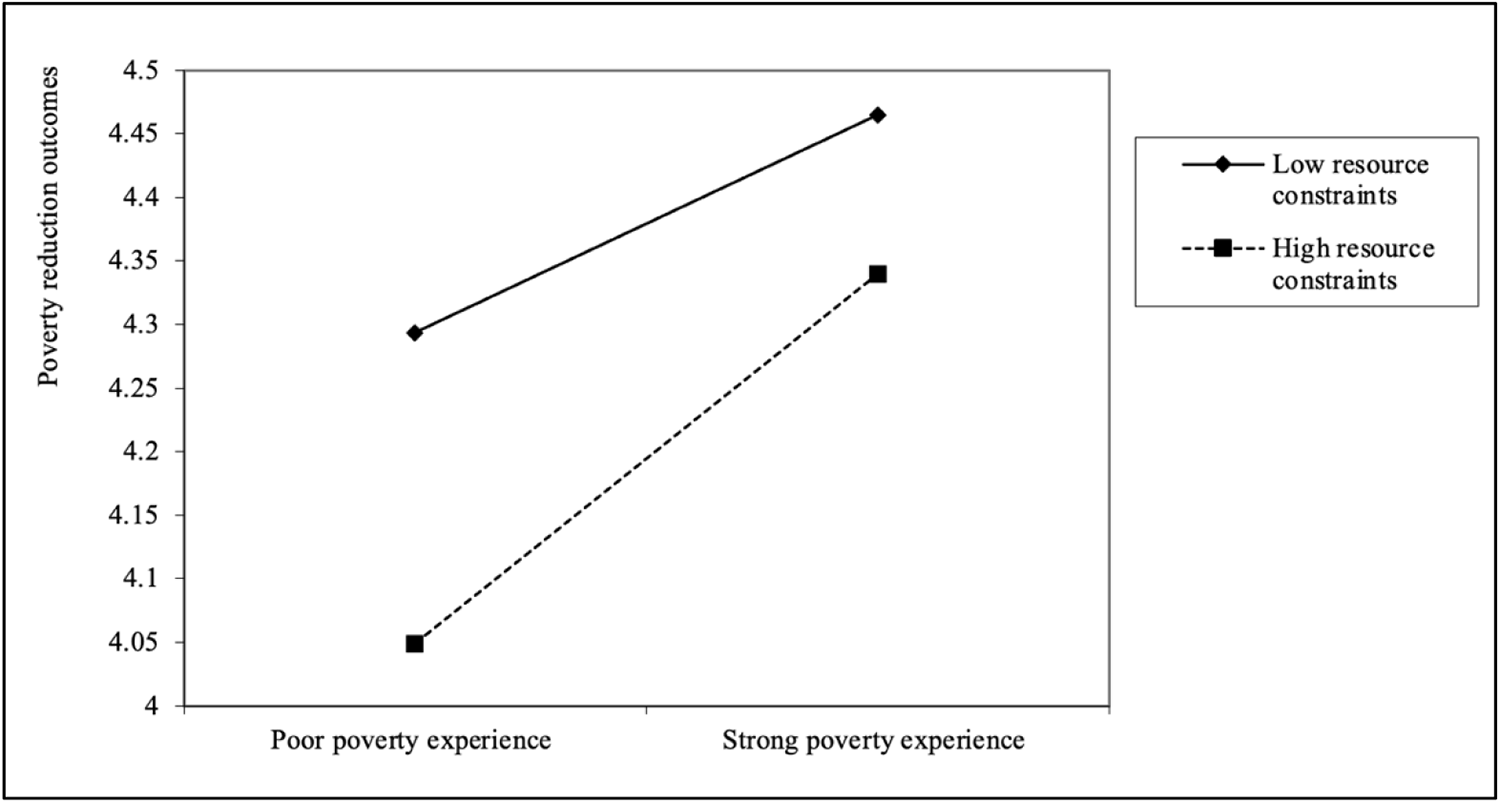
Before moderation analyses, we mean-centered entrepreneurs’ past poverty experience and the moderators to avoid multicollinearity concerns (Cohen, Cohen, West, & Aiken, Reference Cohen, Cohen, West and Aiken2013). Model 5 in Table 2 showed that the interaction between entrepreneurs’ past poverty experience and resource constraints was significant (b = 0.153, p < 0.01). A simple slope test showed that the effect of entrepreneurs’ past poverty experience on digital capabilities was stronger when resource constraints were higher. This interaction is plotted in Figure 2. Therefore, H4 received support.
The moderating effect of resource constraints

Finally, following Preacher and Hayes (Reference Preacher and Hayes2008) and Hayes (Reference Hayes2018), we conducted a bootstrap-based moderated mediation analysis using PROCESS v4.1 with 5,000 resamples (the default setting in PROCESS). As shown in Table 4, the indirect effect of entrepreneurs’ past poverty experience on poverty reduction outcomes through firms’ digital capabilities was statistically significant when resource constraints were high (indirect effect = 0.128, boot SE = 0.058, 95% CI [0.042, 0.262]) and medium (indirect effect = 0.059, boot SE = 0.033, 95% CI [0.007, 0.135]). In contrast, when resource constraints were low, the 95% bootstrap confidence interval included zero (95% CI [−0.087, 0.057]), indicating a non-significant indirect effect. These results suggest that the indirect pathway is only activated under conditions of moderate to high resource constraints.
Bootstrapping results for moderated mediation analysis

Table 4 Long description
The table reports conditional indirect effects across three levels of resource constraints, with standard errors and bootstrap confidence intervals. At low constraints, the indirect effect is negative and close to zero, and its confidence interval spans negative to positive values, suggesting uncertainty about the direction. At the mean level of constraints, the indirect effect is positive at 0.059 with a confidence interval from 0.007 to 0.135, indicating a positive indirect effect. At high constraints, the indirect effect increases to 0.128 with a confidence interval from 0.042 to 0.262, also indicating a positive indirect effect. Overall, the indirect effect becomes larger and more positive as resource constraints increase. The index of moderated mediation is reported as 0.101, consistent with moderation of the indirect effect. Confidence intervals are based on bootstrap resampling, so results should be interpreted in light of sampling variability and the model assumptions.
Notes: Bootstrapping was calculated using the PROCESS v4.1 with 5,000 repetitions.
Furthermore, the significant index of moderated mediation (index = 0.101, boot SE = 0.050, 95% CI [0.031, 0.223]) indicates that the strength of the indirect effect significantly varies as a function of resource constraints. The fact that the confidence interval does not include zero provides strong evidence for a conditional indirect effect. The increasing magnitude of the indirect effect across levels of resource constraints highlights the amplifying role of resource constraints in shaping the relationship between entrepreneurs’ past poverty experience and poverty reduction outcomes via digital capabilities. These findings provide empirical support for H4.
Robustness Test
We performed two sensitivity analyses to check the robustness of our findings by building alternative digital poverty reduction outcomes. First, some scholars argued that measuring the degree of poverty reduction through monetary standards such as income is generally consistent with the understanding of poverty (Sen, Reference Sen1982). Thus, apart from the degree of improvement in family living conditions, we further employed entrepreneurial performance as another proxy variable for digital poverty reduction outcomes. Following Stam, Arzlanian, and Elfring (Reference Stam, Arzlanian and Elfring2014) and Rauch and Hatak (Reference Rauch and Hatak2016), we asked farmer entrepreneurs to rate the extent to which their firms were successful relative to their major competitors based on seven items, such as sales growth, profit growth, and market share growth. As shown in the robustness checks in Tables 5, 6, and 7, we found consistent results for this robustness check.
The result of replacing digital poverty reduction outcomes (performance)

Table 5 Long description
The table reports five regression models with controls included, using poverty reduction or digital capabilities as the outcome. In the poverty reduction models, poverty experience is not a reliable predictor in Model 2 and becomes negative and still not reliable in Model 4. Digital capabilities show a large, statistically reliable positive association with poverty reduction in Model 4, and this model has the highest adjusted R-squared at 0.482. For digital capabilities as the outcome, poverty experience is positive and statistically reliable in Models 3 and 5. In Model 5, resource constraints are negatively and statistically reliably related to digital capabilities, while the interaction between poverty experience and resource constraints is positive and statistically reliable, indicating the poverty experience association with digital capabilities is stronger when constraints are higher. Model fit is modest for digital capabilities outcomes, with adjusted R-squared values of 0.013 in Model 3 and 0.153 in Model 5. Statistical significance is indicated by star markers, and the values in parentheses are test statistics, so results should be interpreted as associations rather than causal effects.
***,**,* Notes: t statistics in parentheses; p < 0.01, p < 0.05, p < 0.1
Bootstrapping results for mediation analysis

Table 6 Long description
The table reports bootstrap results for a mediation analysis, listing observed coefficients, bootstrap standard errors, z values, p values, and normal-based 95% confidence intervals for indirect and direct effects. The indirect effect estimate is 0.114 with a bootstrap standard error of 0.051 and a z value of 2.24. Its p value is 0.025, and the 95% confidence interval ranges from 0.014 to 0.214, indicating a positive effect that is statistically significant at the 0.05 level. The direct effect estimate is negative at minus 0.040 with a bootstrap standard error of 0.079 and a z value of minus 0.50. Its p value is 0.617, and the 95% confidence interval spans from minus 0.195 to 0.116, which includes zero and suggests no clear direct effect. Overall, the results support evidence of mediation through the indirect pathway, while the direct pathway is not distinguishable from zero. Interpretation should consider that these are normal-based confidence intervals from bootstrap estimates and may depend on model assumptions and sample characteristics.
Bootstrapping results for moderated mediation analysis

Table 7 Long description
The table reports bootstrapped conditional indirect effects across three levels of resource constraints, with standard errors and a 95 percent confidence interval. At low constraints, the indirect effect is negative at minus 0.096 with a wide interval from minus 0.834 to 0.527, indicating substantial uncertainty. At the mean level, the indirect effect is 0.603 with standard error 0.260 and an interval from 0.107 to 1.154, which stays above zero. At high constraints, the indirect effect increases to 1.302 with standard error 0.402 and an interval from 0.640 to 2.191, also entirely above zero. Overall, the indirect effect becomes larger and more positive as resource constraints increase. The index of moderated mediation is reported only for the mean row as 0.103, so the table does not provide its confidence interval or significance test here.
Notes: Bootstrapping was calculated using the PROCESS v4.1 with 5,000 repetitions.
Second, given the multifaceted nature of poverty reduction, which encompasses not only the improvement of entrepreneurs’ living standards but also the positive impact on their employees, we employed a self-reporting method by farmer entrepreneurs to assess their perceptions of changes in employees’ financial abilities to access good health services, to take care of family, and to improve income level (Alkire & Foster, Reference Alkire and Foster2011; Osei & Zhuang, Reference Osei and Zhuang2020). The results are shown in Tables 8, 9, and 10, and all these additional analyses remain consistent findings.
The result of replacing digital poverty reduction outcomes (poverty reduction effect for employees)

Table 8 Long description
The table reports five regression models linking poverty reduction and digital capabilities, with controls included in every model. Poverty experience has little direct association with poverty reduction: it is small and not statistically reliable in Model 2 and negative and not reliable in Model 4. Poverty experience is positively associated with digital capabilities in Model 3 and again in Model 5, where the effect is statistically significant. Digital capabilities show a large, statistically significant positive association with poverty reduction in Model 4. In Model 5, resource constraints are negatively associated with digital capabilities, while the interaction between poverty experience and resource constraints is positive and statistically significant, indicating the poverty experience link to digital capabilities is stronger when constraints are higher. Model fit is highest for Model 4, with a much larger adjusted R squared than the other models. Statistical significance is indicated by stars, and the reported test statistics suggest some coefficients are not distinguishable from zero.
***,**,* Notes: t statistics in parentheses; p < 0.01, p < 0.05, p < 0.1
Bootstrap results for mediation analysis

Table 9 Long description
Bootstrap mediation finds a significant indirect effect of 0.109 with p 0.030, while the direct effect is not significant with p 0.434. See long description.","Long_Description":"The table reports bootstrap estimates for a mediation analysis, listing observed coefficients, bootstrap standard errors, z values, p values, and 95 percent confidence intervals for indirect and direct effects. The indirect effect has an observed coefficient of 0.109 with a bootstrap standard error of 0.050, z 2.17, and p 0.030. Its 95 percent confidence interval ranges from 0.011 to 0.207, staying above zero, which supports evidence of mediation through the indirect path. The direct effect has an observed coefficient of negative 0.079 with a bootstrap standard error of 0.101, z negative 0.78, and p 0.434. Its 95 percent confidence interval runs from negative 0.277 to 0.119, crossing zero, indicating the direct effect is not statistically distinguishable from zero. Interpretation should consider that statistical significance does not imply practical importance and depends on the study design and assumptions of the mediation model.
Bootstrapping results for moderated mediation analysis

Table 10 Long description
The table reports conditional indirect effects across three levels of resource constraints, with standard errors and bootstrap confidence intervals, plus an index of moderated mediation. At low constraints, the indirect effect is minus 0.013 with a confidence interval from minus 0.114 to 0.073, which includes zero. At the mean level, the indirect effect is 0.080 with a confidence interval from 0.015 to 0.156, which excludes zero. At high constraints, the indirect effect is 0.172 with a confidence interval from 0.087 to 0.289, which also excludes zero. The indirect effect increases steadily from low to high constraints, suggesting a stronger positive indirect effect as constraints rise. The index of moderated mediation is reported as 0.137, indicating the indirect effect varies by the moderator, though the table does not provide a confidence interval for this index. Results are based on bootstrap resampling, so conclusions should focus on the confidence intervals rather than single point estimates.
Notes: Bootstrapping was calculated using the PROCESS v4.1 with 5,000 repetitions.
Discussion
Poverty reduction is essential for world peace and human development. In today’s digital globalization era, digital technology brings new opportunities for poverty reduction in rural areas. Based on imprinting theory, this study, collecting data from digital entrepreneurial enterprises in rural China, examines how digital entrepreneurs’ past poverty experience influences poverty reduction outcomes in digital new ventures, with a particular focus on the mediating role of digital capabilities in this process. The results show that digital farmer entrepreneurs’ past poverty experience positively affects poverty reduction outcomes, and that the digital capabilities of new ventures play a mediating role between the two. Additionally, resource constraints positively moderate the mediation effect of firms’ digital capabilities on the relationship between entrepreneurs’ past poverty experience and poverty reduction outcomes in digital entrepreneurship. These findings provide us with a nuanced perspective on digital poverty reduction through entrepreneurship.
Theoretical Contributions
Our study makes three key theoretical contributions. First, this study identifies a specific individual-level antecedent – past poverty experience – and provides empirical evidence that it significantly enhances the poverty reduction outcomes of digital entrepreneurial ventures. While digital entrepreneurship is widely recognized as a powerful driver of economic growth and job creation (Nambisan, Reference Nambisan2017), existing studies predominantly explore its poverty alleviation impact from macro- and meso-level perspectives. By identifying past poverty experience as a crucial micro-foundation, this study highlights its role in shaping digital entrepreneurial capabilities and, ultimately, poverty reduction outcomes. This contribution enriches our understanding of the micro-level mechanisms through which digital entrepreneurship fosters poverty alleviation and offers a more nuanced framework for future research on the intersection of personal history and entrepreneurial outcomes in poverty reduction.
Second, this study advances imprinting theory by identifying digital capabilities as a key mediating mechanism linking entrepreneurs’ past poverty experience to their poverty reduction outcomes. Imprinting theory posits that early-life experiences exert a lasting influence on individuals’ cognitive and behavioral patterns, thereby shaping their subsequent decision-making and actions (Marquis & Tilcsik, Reference Marquis and Tilcsik2013). While previous research has underscored the long-term effects of such experiences, limited attention has been paid to how imprinting processes operate within entrepreneurial contexts, particularly in the domain of digital entrepreneurship. Our study addresses this gap by examining how entrepreneurs’ past poverty experience shapes the development of digital capabilities, which in turn enhances poverty reduction outcomes. In doing so, we reveal the mechanisms through which imprinted early-life experiences shape their ability to overcome resource constraints and generate sustainable poverty reduction outcomes. This moves imprinting research beyond static influence models toward a process-based view that emphasizes capability development as a pathway through which early experiences shape later entrepreneurial outcomes.
Third, this study enriches contextual factors of imprinting effects by examining how resource constraints moderate the relationship between entrepreneurs’ past poverty experience and poverty reduction outcomes through digital capabilities. According to imprinting theory, ‘an imprint can be perfectly suited to one type of context while clashing irreconcilably with another’ (Higgins, Reference Higgins2005: 4). Our findings reveal that the imprinting effect of early poverty experience on digital capability development is significantly amplified when entrepreneurs operate under conditions of resource constraints environments. This underscores the importance of environmental fit in activating or reinforcing the utility of imprinted experiences. Moreover, it offers important valuable insights into how contextual resource factors interact with individual histories to shape the effectiveness of organizational capability development, ultimately influencing poverty reduction outcomes.
Managerial Implications
This study also highlights several key managerial implications. First, our findings suggest that entrepreneurs with past poverty experience can leverage their heightened environmental sensitivity and strong sense of resource stewardship to develop robust digital capabilities, that challenges the traditional stereotype, instead underscoring the potential positive imprints poverty experience can leave. It encourages a more objective assessment of what it means to have endured poverty. This insight indicates that individuals who have faced resource-scarce contexts are uniquely positioned to detect overlooked opportunities and respond more rapidly to technological changes. Thus, digital entrepreneurs shaped by such an imprint should actively reflect on and embrace their past adversities as an asset, systematically channeling these experiences into learning new digital technologies and crafting solutions tailored to underserved markets. By doing so, they not only enhance their ventures’ competitive edge but also contribute to broader poverty reduction initiatives by developing products and services that resonate with the needs of low-income communities.
From an organizational perspective, this study highlights the importance of nurturing digital capabilities as a critical bridge between entrepreneurs’ past poverty experience and poverty reduction outcomes. Firms founded or led by individuals who have experienced poverty may benefit from embedding resilience, risk awareness, or social empathy into their culture and decision-making processes. The study indicates that these characteristics can be systematically transformed into digital technology competencies. It, thus, offers valuable insights for firms when forming new venture teams. Organizations may consider integrating the recruitment of individuals with poverty imprints into their talent acquisition strategies. Such an approach not only diversifies the team’s skill set but also bolsters the firm’s capacity to respond creatively to market and societal challenges. Furthermore, these firms should institutionalize training programs and internal processes that capitalize on entrepreneurs’ unique skill sets, effectively converting personal imprints into organizational strengths. By embedding this digital-first mindset throughout the firm, firms can generate more employment or income opportunities for disadvantaged groups, thereby achieving both social impact and long-term business sustainability.
Finally, our findings indicate that resource constraints significantly moderate the positive impact of entrepreneurs’ poverty experience on digital capabilities. Policymakers can leverage these insights by implementing targeted measures – such as subsidized training programs, low-interest loans, or infrastructure upgrades – that enable digital entrepreneurs in resource-scarce regions to convert their poverty imprints into tangible technological proficiencies. For example, tailored digital skill-building initiatives can equip entrepreneurs from impoverished backgrounds with the tools needed to adapt quickly to shifting market demands, thereby fostering locally driven engines of growth and poverty alleviation. Furthermore, policymakers can enhance cultural engagement and guidance to encourage socially driven ventures. Showcasing success stories through documentaries or public campaigns can highlight how individuals with poverty imprints have successfully harnessed their experiences to address socio-economic challenges. By cultivating an environment where entrepreneurs embrace and build on these formative influences, policymakers can advance digital development and promote inclusive economic growth.
Limitations and Opportunities for Future Research
As with any empirical research, this study has several limitations, many of which open up interesting avenues for future research. First, while our study provides valuable insights into digital entrepreneurship and poverty reduction, it is important to acknowledge that the findings are based on a specific contextual setting. China’s unique position as both the largest developing economy and a global leader in digital poverty reduction make it an exceptional case for studying the effects of digital entrepreneurship in rural areas. However, the applicability of these findings to other countries, particularly those in different stages of economic development, remains an open question. The rural context of China is characterized by rapid technological adoption and a government-led digital empowerment strategy, which may not be present in other regions. Therefore, future research could benefit from replicating our study in other developing countries to examine the generalizability of our results.
Second, our data were sourced from digital entrepreneurs through two-stage cross-sectional surveys, which, while providing valuable insights, cannot fully capture the changing impact of past poverty experience on entrepreneurial behavior or outcomes over time. To address this limitation, future research should adopt longitudinal tracking methods, which would allow for a more comprehensive examination of how the relationship between poverty experience and entrepreneurial outcomes develops over time. This approach would provide deeper insights into the long-term effects of digital entrepreneurship on poverty reduction. Furthermore, tracking the continued impact of individual experiences at the organizational level would enhance our ability to draw causal inferences and help uncover the mechanisms by which digital entrepreneurship fosters sustained economic empowerment for rural communities. Investigating these temporal dynamics could significantly deepen our understanding of digital entrepreneurship in the context of poverty reduction.
Conclusion
What explains why some digital entrepreneurs generate more effective poverty reduction outcomes than others? Our findings suggest three main insights. First, entrepreneurs’ past poverty experience enhances poverty-reduction performance. Second, this relationship is mediated by the development of digital capabilities, which serve as adaptive tools for navigating resource-constrained environments. Third, resource constraints moderate this mediation, such that the transmission from poverty imprint to digital capability is strongest when entrepreneurs operate in environments with more severe resource limitations. These findings advance the integration of imprinting theory and the capability-based view by demonstrating that early poverty experience functions not merely as a background condition, but rather a strategic imprint. This imprint equips entrepreneurs with the capacity to develop digital capabilities that deliver both economic value and social impact within the context of digital entrepreneurship.
Data Availability Statement
The data sets generated for this study are available on request from the corresponding author.
Acknowledgements
This research is funded by the National Natural Science Foundation of China (Grant No. 72072192).
Song Lin (linsong1998@gmail.com) is a professor at the Business School of the Central University of Finance and Economics in Beijing, China. His research interests encompass entrepreneurial failure, digital entrepreneurship, and the growth of small and medium-sized enterprises. His research has been published in top management journals, including the Academy of Management Journal and Journal of International Business Studies. In this study, he contributed to the survey design, data collection and curation, as well as manuscript writing.
Yanan Lin (summerlim0725@163.com) received her PhD degree from the Business School of the Central University of Finance and Economics in Beijing, China. Her research interests focus on digital entrepreneurship, and the growth of small and medium-sized enterprises. In this study, she contributed to the research design, data collection and analysis, as well as manuscript writing.