Introduction
Maximizing profitability of the protein production supply chain is the ultimate objective of the vast majority of animal production systems and related industries. The strategic use of feed enzyme technology is one viable way to contribute to this challenging goal and this has been done with considerable success since the mid-1980s when xylanases and glucanases were first introduced. Currently, as penetration of the feed market with phytase gains momentum, the simultaneous use of carbohydrases and phytase is increasingly common and the additivity of matrix recommendations is under debate. In this context, various authors have demonstrated that, depending on the limiting nutrients in the diet and the model used, sub-additivity, full additivity or even synergy can be expected. However, quantification and qualification of substrate is often overlooked and it is actually this which dictates the magnitude and consistency of effect. An appreciation for the inherent digestibility of the control diet to which enzymes will be added is crucial if a prediction is to be made regarding the likely effect on productivity. One example is that the inherent digestibility of amino acids in the diets of monogastrics follows a remarkably constant pattern, where methionine is typically very readily digested and cysteine very poorly. Intuitively, one would not expect an enzyme to deliver the same improvement in methionine digestibility compared with cysteine and in fact this is exactly what is noted from the literature. These rules also apply to energy (where low digestible energy corns are likely to respond emphatically to enzyme intervention but corns with a high inherent solubility/digestibility may not benefit at all). Crucially, when considering the likely additivity of enzymes (xylanase and phytase) or indeed other feed additives, the incremental return is highly likely to diminish as each new additive is incorporated.
The additivity of nutritional matrices for dietary ingredients has been debated for many years in the scientific literature (Ravindran and Bryden, Reference RAVINDRAN and BRYDEN1999) and no unilaterally agreed model has been confirmed to date, at least for poultry. The use of apparent digestibility values for both energy and amino acids does not include a correction for energy and amino acids of endogenous origin, and so cannot be considered to be an accurate reflection of the true value of that ingredient. An ingredient which increases the loss (from the terminal ileum) of nutrients, which would otherwise have a nutritional value for the animal, should have those losses considered in feed formulation. The limitations of the use of apparent digestibility values in feed formulation have been summarized by several authors (Ravindran et al., Reference RAVINDRAN, HEW, RAVINDRAN and BRYDEN2005). Importantly, apparent digestibility is influenced by protein and dry matter intake (Fan et al., Reference FAN, HAN, XU, WANG and SHI2009; Angkanaporn et al., Reference ANGKANAPORN, CHOCT, BRYDEN, ANNISON and ANNISON1994) whereby low protein intakes will result in a relatively greater proportion of luminal nitrogen (N) being from endogenous origin. Thus ingredients with a relatively low protein content may have the true digestibility of amino acids for that ingredient underestimated, and this may be especially true for amino acids present at high concentrations in endogenous proteins e.g. threonine. Similarly the true digestibility of amino acids with a low concentration in endogenous protein (e.g. methionine) may be overestimated. This principal also holds true for endogenous energy losses related to dietary ingredients with a low energy density.
The problems associated with the ambiguity of additivity of apparent nutrient digestibility values for ingredients can be (theoretically) overcome by the use of a correction term for basal endogenous flow. Several methods have been employed to measure this ‘diet independent’ endogenous loss including fasting (Sibbald, Reference SIBBALD1986), feeding N-free diets, the use of peptide alimentation (Moughan et al., Reference MOUGHAN, DARRAGH, SMITH and BUTTS1990) and others. All these methods have advantages and disadvantages and these have been reviewed and summarised previously (Ravindran and Bryden, Reference RAVINDRAN and BRYDEN1999). The problem currently is in reaching a global agreement about which method for standardization should be used and, until this is agreed and implemented, the use of standardised digestibility values for poultry will not gain momentum.
An appreciation for the above argument is important to put into context the likely additivity of matrix values for energy and amino acids for feed enzymes, especially if these effects are mediated via changes in endogenous loss. It is the purpose of the current review to summarise the effect of carbohydrases and phytase on ileal amino acid digestibility to illustrate the point that full additivity between additives is rare and the degree of sub-additivity is predictable.
Effect of carbohydrases on ileal amino acid digestibility
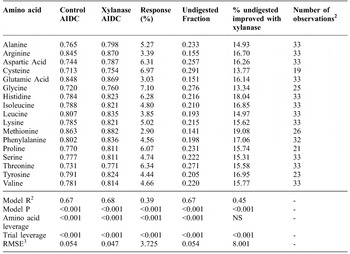
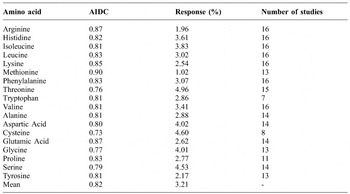
Though carbohydrases are traditionally considered to be used to improve energy digestibility, improvements in ileal amino acid digestibility (IAAD) are consistently reported in the scientific literature. To the authors knowledge there have been 19 peer-reviewed papers between 1998 and 2009 that report the effect of carbohydrases (primarily xylanase and glucanase) on IAAD in pigs (eight reports) and poultry (11 reports) (Table 1).
Effect1 of carbohydrases on apparent ileal digestibility coefficients (AIDC) of amino acids for poultry and pigs.

1 Model terms ’trial’ and ’amino acid’, values shown are the least square means
2 Number of individual trials = 19 (8 pig; 11 poultry); Bedford et al., Reference BEDFORD, SCOTT, SILVERSIDES, CLASSEN, SWIFT and PACK1998; Danicke et al., Reference DANICKE, SIMON, JEROCH, KELLER, GLASER, KLUGE and BEDFORD1999; Hew et al., Reference HEW, RAVINDRAN, MOLLAH and BRYDEN1998; Im et al., Reference IM, RAVINDRAN, RAVINDRAN, P.H. and BRYDEN1999; Ravindran et al., Reference RAVINDRAN, SELLE and BRYDEN1999a,b; Zanella et al., Reference ZANELLA, SAKOMURA, SILVERSIDES, FIQUEIRDO and PACK1999; Yin et al., Reference YIN, MCEVOY, SCHULZE and MCRACKEN2001a,b; Hong et al., Reference HONG, BURROWS and ADEOLA2002; Selle et al., Reference SELLE, BRYDEN, PITTOLO, RAVINDRAN and RAVINDRAN2003; Barrera et al., Reference BARRERA, CERVANTES, SAUER, ARAIZA, TORRENTERA and CERVANTES2004; Diebold et al., Reference DIEBOLD, MOSENTHIN, PIEPHO and SAUCER2004; de Souza et al., Reference DE SOUZA, LINDERMANN and CROMWELL2007; Nortey et al., Reference NORTEY, PATIENCE, SIMMINS, TROTTIER and ZILLSTRA2007; Nitrayova et al., Reference NITRAYOVA, PATRAS, HEGERA, BROZ and SOMMER2007; Rutherfurd et al., Reference RUTHERFURD, CHUNG and MOUGHAN2007; Cowieson and Ravindran, Reference COWIESON and RAVINDRAN2008; Woyengo et al., Reference WOYENGO, SANDS, GUENTER and NYACHOTI2008; Cadogan et al., Reference CADOGAN, SELLE, PARTRIDGE and RAVINDRAN2009
3 RMSE = Root Mean Square Error
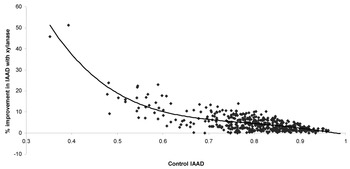
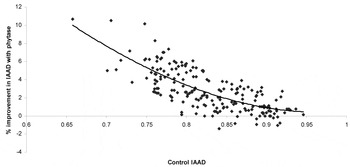
The mean improvement in IAAD associated with xylanase addition was 4.8%, ranging from 2.9% for methionine to 7.1% for glycine (Table 1). Instructively, more than 64% of the variance in response to xylanase for IAAD can be explained by control IAAD (Figure 1), where the relatively poor response for methionine, arginine and glutamic acid and the relatively good responses for cysteine, threonine and aspartic acid are simply explained by the low or high digestibility of these amino acids in the respective controls. The relationship between control IAAD and the response to xylanase is illustrated by the 4th order polynomial equation:
Y = 19.156016-18.253403X-18.120164(X-0.80344)2-220.74218(X-0.80344)3+526.14759(X-0.80344)4
Where, Y = percentage improvement with xylanase in IAAD and X = control IAAD (as a coefficient). For example, if total lysine is 1.4% and digestible lysine is 1.25% then the digestibility coefficient of lysine is 0.89, which by calculation would result in a predicted improvement in ileal lysine digestibility with xylanase of approximately 2.9%.
Correlation (R2=0.65; P<0.001) between control ileal amino acid digestibility coefficients and the response to exogenous carbohydrase (average of 19 studies, ~538 observations).

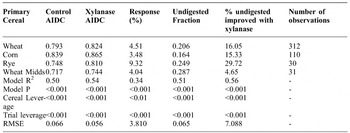
Further, it is possible to calculate what proportion of the undigested fraction for each amino acid is rendered more digestible with enzyme addition, being around 16% for all amino acids (Table 1). This suggests that, regardless of the amino acid, and for most vegetable ingredients, xylanase will improve the digestibility of the undigested amino acid fraction by approximately 16%. There are some exceptions to this rule of thumb such as for ingredients with high concentrations of insoluble fibre (wheat middlings or DDGS) where the improvement of the undigested fraction is lower (around 5%; Table 2) and for ingredients with high concentrations of soluble fibre (rye or barley) where the improvement of the undigested fraction is higher (around 30%; Table 2).
Effect1 of carbohydrases on apparent ileal digestibility coefficients (AIDC) of amino acids for poultry and pigs based on primary cereal in the diet.

1 Model terms ’trial’ and ‘primary cereal’, values shown are the least square means
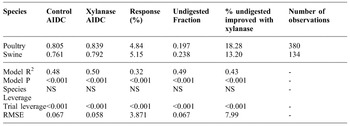
As xylanase appears to influence IAAD in a ‘mass average’ manner and the magnitude of this is apparently associated with the soluble carbohydrate concentration of the ingredient in question it may be that viscosity reduction is a more widespread and influential mechanism than previously thought. Certainly, a reduction in intestinal viscosity may explain why there is such a constant percentage improvement in the undigested fraction with xylanase addition, as changing diffusion constants will likely influence the digestibility of all amino acids to a similar extent. Interestingly, there were no differences between poultry and swine in terms of the response to xylanases on IAAD (Table 3), suggesting that these principals apply equally to both species. These effects make possible a novel way to assign matrix values to carbohydrases where the substrate (the undigested fraction of the diet at the terminal ileum, estimated by calculation of total minus digestible nutrient content) directly influences scale of response.
Effect1 of carbohydrases on apparent ileal digestibility coefficients (AIDC) of amino acids for poultry and pigs.

1 Model terms ’trial’ and ‘species’, values shown are the least square means
Effect of phytase on ileal amino acid digestibility
The effect of phytases on IAAD for pigs and poultry has been summarized and reviewed previously and will not be repeated in the current paper. For a comprehensive review of this topic the reader is referred to Selle et al. (Reference SELLE, RAVINDRAN, BRYDEN and SCOTT2006) and Selle and Ravindran (Reference SELLE and RAVINDRAN2007a; Reference SELLE and RAVINDRAN2007b). However, the overall effect of phytase on IAAD for poultry is presented in Table 4 and similar trends compared with the xylanase effects are evident. According to Selle and Ravindran (Reference SELLE and RAVINDRAN2007a) the mean response to phytase on IAAD is 4.4% for studies where either TiO2 or AIA were used as an indigestible marker, and 1.4% for studies where CrO2 was used.
Effect of phytase on the apparent ileal digestibility coefficient (AIDC) of amino acids for broilers (adapted from Selle et al., Reference SELLE, RAVINDRAN, BRYDEN and SCOTT2006; Selle and Ravindran, Reference SELLE and RAVINDRAN2007a).

Interestingly when the percentage improvement with phytase for IAAD is correlated with control IAAD, the R2 is 0.94 for TiO2/AIA studies but only 0.48 for CrO2 studies and the control IAAD is substantially higher when CrO2 is used (Selle and Ravindran, Reference SELLE and RAVINDRAN2007a). These relationships suggest that CrO2 may overestimate control digestibility reducing measured enzyme response by increasing the perceived quality of the control ration. Indeed, control IAAD in phytase studies where CrO2 was used was 0.85 and where TiO2 or AIA was used only 0.78 (Selle et al., Reference SELLE, RAVINDRAN, BRYDEN and SCOTT2006). From the data presented by Selle et al. (Reference SELLE, RAVINDRAN, BRYDEN and SCOTT2006) a relationship between control IAAD and response to phytase can be generated (Figure 2) and has a 3rd order polynomial equation:
Y = 26.0609501-29.126339X+95.431866(X-0.82891)2+51.388245(X-0.82891)3
Where, Y = percentage improvement with phytase in IAAD and X = control IAAD (as a coefficient). If the control IAAD values from CrO2 (0.85) and TiO2/AIA (0.78) are used in the above equation predicted phytase-mediated improvements in IAAD are 1.89% for CrO2-based studies and 4.11% for those that utilized TiO2/AIA as indigestible markers. These values agree closely with the actual measured responses in the review by Selle and colleagues (+1.48% with phytase in CrO2 studies and +4.79% with phytase in TiO2/AIA studies) and confirm that the higher control IAAD predicted using CrO2 as a marker is the primary reason why the use of CrO2 tends to mute enzyme response.
Correlation (R2=0.56; P<0.001) between control ileal amino acid digestibility coefficients and the response to exogenous phytase (average of 16 studies, ~248 observations).

It would appear, particularly for xylanase, that the magnitude of enzyme response is substantively mediated by the measured quality of the control diet and this is in agreement with the enzyme models presented by Rosen (2002a, b). In the enzyme holo-analyses presented in the reviews of Rosen (2002a, b) control performance is implicated as making the largest single contribution to the model Sum Squares of any of the 8-10 significant variables in the final models.
Enzyme combinations and ileal amino acid digestibility
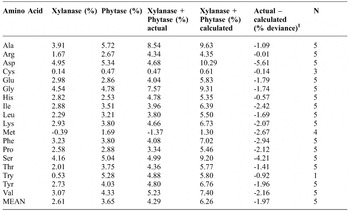
To the authors knowledge there have been only four peer-reviewed papers published on the effects of xylanases and phytases on ileal amino acid digestibility (IAAD) where the full factorial arrangement of treatments has been used (Ravindran et al., Reference RAVINDRAN, SELLE and BRYDEN1999a; Selle et al., Reference SELLE, BRYDEN, PITTOLO, RAVINDRAN and RAVINDRAN2003; Nortey et al., Reference NORTEY, PATIENCE, SIMMINS, TROTTIER and ZILLSTRA2007; Woyengo et al., Reference WOYENGO, SANDS, GUENTER and NYACHOTI2008). These trials represent a relatively small sub-set of the published literature on enzyme combinations but are reasonably representative of the mass average performance effects (for a full review, see Rosen, Reference ROSEN2004). However, all four of these reports are based on data generated using wheat-based diets and thus may overestimate the effects in corn, as this is generally less responsive to phytase and xylanase than wheat (Rosen, Reference ROSEN2002a and b). In fact, to date there have been no published papers showing the effect of carbohydrases and phytases on the IAAD of corn-based diets (where the full factorial arrangement has been implemented) and corn-based data on enzyme combinations in general is scarce, especially for IAAD. Nevertheless, the effects of xylanase and phytase on IAAD are presented in Table 5.
The effect of xylanase, phytase and xylanase+phytase on ileal amino acid digestibility coefficients in wheat-based diets for poultry and swine (adapted from Ravindran et al., Reference RAVINDRAN, SELLE and BRYDEN1999a; Selle et al., Reference SELLE, BRYDEN, PITTOLO, RAVINDRAN and RAVINDRAN2003; Nortey et al., Reference NORTEY, PATIENCE, SIMMINS, TROTTIER and ZILLSTRA2007; Woyengo et al., Reference WOYENGO, SANDS, GUENTER and NYACHOTI2008).

1 Calculated (% measured response to xylanase + % measured response to phytase)-actual (measured) response to the combination of xylanase and phytase. A negative number suggests sub-additivity between xylanase and phytase for that amino acid, a positive number indicates a degree of synergy
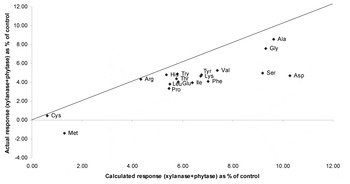
The overall response for IAAD for xylanase (+2.61%) and phytase (+3.65%) are in general agreement with other reports for the use of these enzymes (Cowieson et al., Reference COWIESON, HRUBY and PIERSON2006a; Selle and Ravindran, Reference SELLE and RAVINDRAN2007a; Selle and Ravindran, Reference SELLE and RAVINDRAN2007b; Cowieson and Ravindran, Reference COWIESON and RAVINDRAN2008). Further, the effect of the combination of carbohydrase and phytase for poultry (Table 5; +6.1%) also agrees well with the effect of this combination on IAAD for poultry fed corn/soy-based diets (Cowieson et al., Reference COWIESON, SINGH and ADEOLA2006b). Instructively, there is a good correlation (Figure 3) between the calculated response and the measured response to the combination of xylanase and phytase (R2=0.72). The equation associated with the line is: actual response = (0.7161*predicted response – 0.1966), indicating that there is a general sub-additivity between xylanase and phytase for IAAD in these four studies. This is confirmed by the mean response where the predicted response was 6.26% but the actual measured response was only 4.29%. The amino acids that deviated from the estimated additivity most obviously were Met, Asp, Ser and Phe.
Relationship between xylanase+phytase measured response and the calculated response assuming full additivity in poultry and swine (after Ravindran et al., Reference RAVINDRAN, SELLE and BRYDEN1999a; Selle et al., Reference SELLE, BRYDEN, PITTOLO, RAVINDRAN and RAVINDRAN2003; Nortey et al., Reference NORTEY, PATIENCE, SIMMINS, TROTTIER and ZILLSTRA2007; Woyengo, 2008).

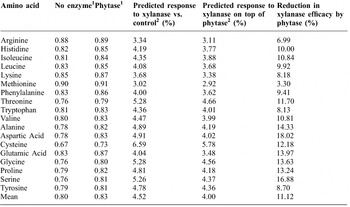
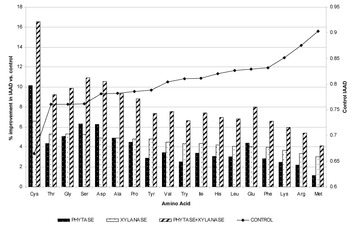
That phytase and xylanase are not fully additive for all amino acids is perhaps not surprising and may be explained, at least in part, by the equation for xylanase effects on IAAD presented above. As the magnitude of response to xylanase for IAAD is driven largely by control IAAD, any factor which inflates control IAAD will concomitantly mute xylanase efficacy. This relationship is clearly illustrated in Table 6 where the predicted response to xylanase for IAAD over the control diet is approximately 4.5% but this is reduced to 4.0% when phytase is present. Crucially, the calculated reduction in xylanase efficacy associated with the presence of phytase is very low for arginine (6%) but high for aspartic acid (18%) suggesting that one of the main reasons for the poor additivity between xylanase and phytase for aspartic acid (Figure 3) is because of the large response to phytase addition for that amino acid. Indeed, the three amino acids where additivity between xylanase and phytase is the least apparent are threonine, serine and aspartic acid (Figure 3) and these amino acids are amongst those with the greatest reduction in xylanase efficacy associated with phytase presence (Table 6; Figure 4).
Predicted muting of xylanase efficacy on ileal essential amino acid digestibility coefficients by the presence of phytase based on the relationship between control performance and xylanase functionality (after Selle and Ravindran, Reference SELLE and RAVINDRAN2007a; Table 4).

1 actual responses based on the mean of 5 studies presented by Selle et al., Reference SELLE, RAVINDRAN, BRYDEN and SCOTT2006; Selle and Ravindran (Reference SELLE and RAVINDRAN2007a) 2 predicted using the equation presented in Figure 1
Effect of phytase (Selle et al., Reference SELLE, RAVINDRAN, BRYDEN and SCOTT2006), xylanase (Table 7) and xylanase+phytase (Table 7) on ileal amino acid digestibility (IAAD) in monogastrics and the relationship with control digestibility.

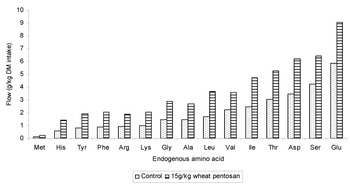
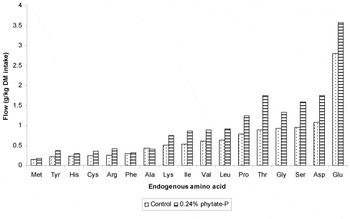
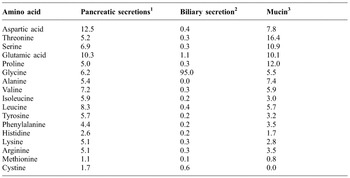
These patterns of response in IAAD to xylanase, phytase and the combination of xylanase+phytase are instructive and suggest that part of the mechanisms whereby xylanase and phytase improve IAAD may overlap, especially for Ser, Thr and Asp. It has been demonstrated previously that both fibre and phytate can increase mucin production and associated losses from the GI tract of rats (Satchithanandam et al., Reference SATCHITHANANDAM, VARGOFCAK-APKER, CALVERT, LEEDS and CASSIDY1990; Larsen et al., Reference LARSEN, MOUGHAN and WILSON1993), pigs (Morel et al., Reference MOREL, PADILLAR and RAVINDRAN2003), ducks (Onyango et al., Reference ONYANGO, ASEM, SANDS and ADEOLA2004) and chickens (Angkanaporn et al., Reference ANGKANAPORN, CHOCT, BRYDEN, ANNISON and ANNISON1994; Cowieson et al., Reference COWIESON, ACAMOVIC and BEDFORD2004; Cowieson & Ravindran, 2007; Onyango et al., Reference ONYANGO, ASEM and ADEOLA2009). Intestinal mucin is rich in Thr, Ser, Asp, Glu and Gly, with these amino acids making up more than 55% of the total protein (Lien et al., Reference LIEN, MCBURNEY, THOMSON and SAUER1996; Reference LIEN, SAUER and FENTON1997; Table 7). Thus anti- or pro-nutrients that influence mucin secretion and loss will have more profound effects on those amino acids than on amino acids that are present at low concentrations in mucoproteins e.g. Met (Lien et al., Reference LIEN, SAUER and FENTON1997; Piel et al., Reference PIEL, MONTAGNE, SALGADO and LALLES2004). These effects have been confirmed both for fibre (Angkanaporn et al., Reference ANGKANAPORN, CHOCT, BRYDEN, ANNISON and ANNISON1994) and phytate (Cowieson and Ravindran, Reference COWIESON and RAVINDRAN2007) where the flow of endogenous Glu, Ser, Asp, Gly and Thr were markedly influenced compared with several other amino acids (Figure 5 and Figure 6).
Effect of 15g/kg wheat pentosans on the flow of endogenous amino acids (g/kg DM intake) in the ileum of broiler chickens (adapted from Angkanaporn et al., Reference ANGKANAPORN, CHOCT, BRYDEN, ANNISON and ANNISON1994).

Effect of 2.4g/kg phytate-P on the flow of endogenous amino acids (g/kg DM intake) in the ileum of broiler chickens (adapted from Cowieson and Ravindran, Reference COWIESON and RAVINDRAN2007).

Amino acid composition (g/ 100 g amino-nitrogen) of various endogenous secretions.

1 Corring and Jung (Reference CORRING and JUNG1972)
2 Juste (Reference JUSTE1982)
3 Lien et al. (Reference LIEN, SAUER and FENTON1997)
Axiomatically, it appears likely that if the anti-nutrients overlap in their mechanism of action (i.e. as intestinal aggresors increasing mucin production), then the pro-nutrients (i.e. xylanase and phytase) may also overlap in the way in which they alleviate nutritional stress associated with endogenous protein flow. It may be no coincidence that the most gross overlap in effect between xylanase and phytase for IAAD are in those amino acids that are present at highest concentrations in intestinal mucin. Instructively, Fernandez and colleagues reported that exogenous xylanase actually increased mucin output from intestinal goblet cells (Fernandez et al., Reference FERNANDEZ, SHARMA, HINTON and BEDFORD2000), which may be related to a reduction in luminal viscosity (Sharma et al., Reference SHARMA, FERNANDEZ, HINTON and SCHUMACHER1997). Thus, the apparent lack of additivity between xylanase and phytase for ileal Thr and Ser digestibility coefficients may be due to a conflict in mechanism by which phytase reduces and xylanase increases goblet cell output. That xylanase can improve ileal digestibility of Thr and Ser in the absence of phytase may be related to changes on a different nutritional axis e.g. improved digestibility of dietary amino acids though why then this would not be additive with the effect of phytase is not clear. Importantly, amino acid presence in the lumen always represents a balance of secretion and absorption thus the arguments above may be associated with an increase in mucin secretion with xylanase but an enhancement in autolytic recovery.
Aspartic acid is another amino acid where there appears to be a substantial degree of sub-additivity between xylanase and phytase. A rich source of endogenous Asp is pepsin/pepsinogen and it has been suggested previously that phytate, because of its capacity to render dietary protein partially refractory to pepsin digestion, may increase pepsinogen and HCl production (Cowieson and Ravindran, Reference COWIESON and RAVINDRAN2007; Selle et al., Reference SELLE, COWIESON and RAVINDRAN2009) and loss. Zebrowska and co-workers have linked fibre (and phytate) to an increase in pepsin and HCl output in growing pigs (Zebrowska et al., 1983) and this may be in response to the poor solubility of the diets fed in that particular study. Thus, from the literature it appears that both phytate and fibre may increase pepsinogen production. However, though reductions in pepsin production with phytase have been recently demonstrated (Liu et al., Reference LIU, RU and LI2009) the same has not been noted for xylanase (Fan et al., Reference FAN, HAN, XU, WANG and SHI2009).
The apparent additivity (or even synergy) between xylanase and phytase for ileal arginine digestibility is interesting and is suggestive of two independent, but complimentary mechanisms between the enzymes. The aleurone fraction of cereals is known to contain relatively high quality protein, rich in lysine and arginine (Peterson et al., Reference PETERSON, SAIGO and HOLY1985; Fulcher, Reference FULCHER1986). Thus, it seems probable that improvements in ileal digestibility of lysine and arginine with xylanase addition may be explained by improved digestibility of this fibre-associated protein. As phytin is also implicit in the solubility of aleurone-associated proteins (Peterson et al., Reference PETERSON, SAIGO and HOLY1985) it is feasible that the combined action of xylanase (to reduce the integrity of structurally important carbohydrate) and phytase (to improve the solubility of cell contents and/or to further facilitate the destruction of phytate-associated fibre) may play a synergistic role on two or more axes in the ileal recovery of arginine.
Implications for the simultaneous use of xylanase and phytase
As the use of exogenous phytase becomes increasingly ubiquitous, it is of relevance to consider what additional advantages may be conferred by the simultaneous use of xylanase. The review of Rosen (Reference ROSEN2004) suggests a full additivity between xylanase and phytase, but these data are bias heavily toward wheat-based diets and also do not consider the responses seen in swine. It is clear from several reports that, although additivity may be assumed in wheat-based diets for poultry and modest sub-additivity for corn-based poultry diets, swine do not respond in as unequivocal a manner and gross sub-additivity appears to exist. However, some important factors should be considered as the mass average effects on FCR and BWG do not necessarily translate to energy or amino acids. For example, if formulating to digestible lysine or arginine the effects of both phytase and xylanase may be fully additive, allowing an enhanced value to be assigned to the admixture. However, if digestible threonine or serine is of interest, xylanase and phytase may be almost entirely cannibalistic and matrices for these amino acids should not be considered additive. These relationships are especially important when formulating for minimum crude protein, all vegetable diets, or for meat yields where some amino acids e.g. gly+ser, glu+pro, thr or arg, may be influential.
Conclusions
The magnitude of effect of exogenous enzymes on ileal amino acid digestibility coefficients is largely driven by the nutritional value of the control diet to which they are added. If carbohydrases are to be added to a diet that already contains phytase a muting in efficacy is likely as the nutritional value of the control diet is improved compared with a diet containing no enzyme. However, these effects are amino acid dependent where sub-additivity between xylanase and phytase is apparent for threonine, serine and aspartic acid and synergy exists for arginine and glycine. In order to maximise the consistency of response and return on investment an appreciation for the factors which influence enzyme bioefficacy should be considered carefully and an understanding of the digestibility of the incumbent diet is crucial.