Eduard Hanslick, the nineteenth century's most famous music critic, wrote for Vienna's Neue Freie Presse for 40 years, from 1864–1904. This newspaper became one of the most important daily papers for Vienna and beyond.Footnote 1 Although Hanslick published nine volumes of collected reviews and essays during his lifetime, and a historical-critical edition of his writings has been underway since 1993, the Neue Freie Presse is still the only source for most of Hanslick's writings.Footnote 2
While there was no equivalent of Hanslick in Germany, the general level of music criticism at that time was exceptional. According to Max Graf, ‘the German dailies accommodated their critics with plenty of space in which to set forth their well-founded opinions. Certainly in no other country were musical questions treated so earnestly and so thoroughly as they were in Germany.’Footnote 3 These music critics have not been studied in depth because the only way to access most of their reviews is to retrieve them from where they appeared: in the newspaper.Footnote 4
While the nineteenth century was the great newspaper century, the twenty-first century is the era of digitization and increased access to these papers. Nineteenth-century German-language newspapers are being digitized and put online by various state- and corporate-sponsored projects in Europe that are independent of commercial providers like EBSCO or ProQuest. Three open-access platforms currently cover the most publications: ANNO (AustriaN Newspapers Online) and ZEFYS (ZEitungsinFormationssYStem), and Europeana Newspapers.
ANNO
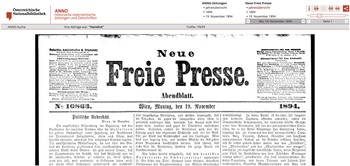
The ANNO database was launched in 2003.Footnote 5 It has since expanded beyond Austrian newspapers to include other serial holdings in the Austrian National Library, such as weekly journals with more specialized subject matter, including music journals.Footnote 6 It currently contains more than 1,400 periodical titles, which can be accessed by alphabetical list, year and subject matter of the publication. Some publications from areas formerly part of the Austrian or Austro-Hungarian empire are in Czech, Hungarian and other languages. It has a full-text search function, and searches can be narrowed down to within a single title or a single day (see Fig. 1). ANNO can also be searched as part of the ‘Digital Reading Room’ on the Austrian National Library's main website.Footnote 7 ANNO's support from multi-national, regional, corporate, state, and private foundations must be lavish: it is a well-designed, up-to-date platform for accessing serial publications.
Sample page from the Neue freie Presse Provided by ANNO

ZEFYS
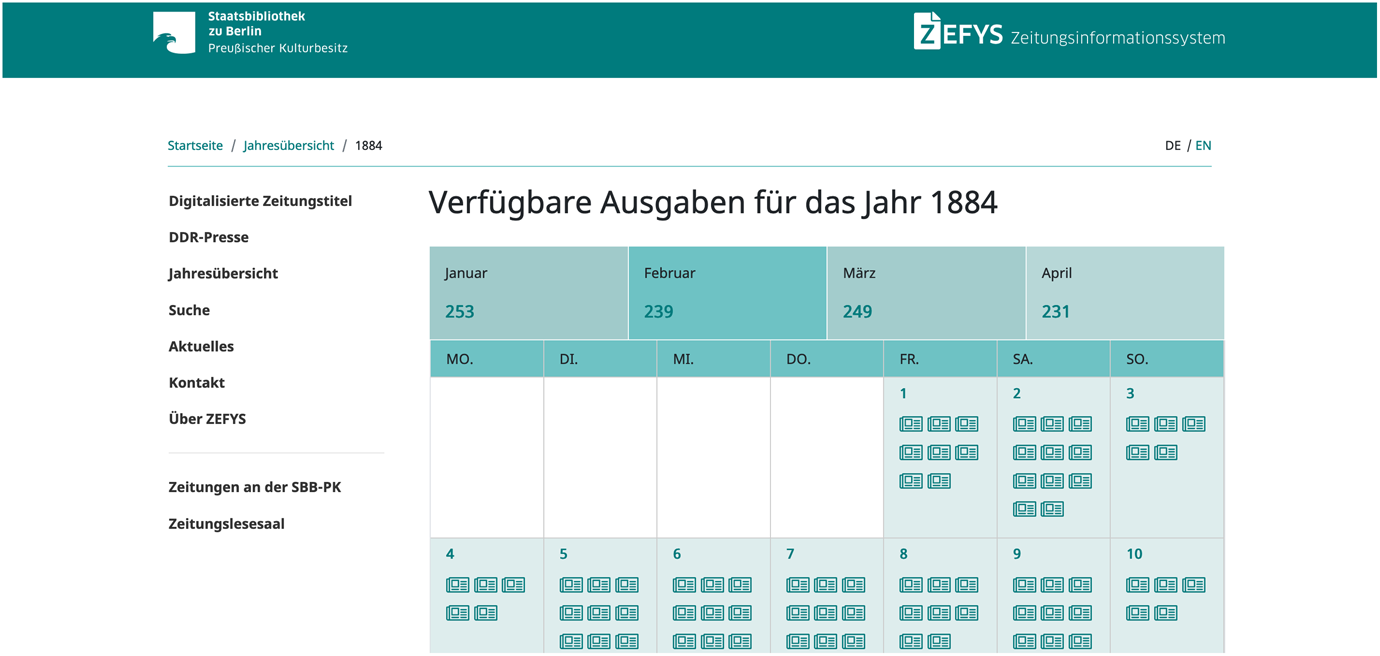
The ZEFYS (ZEitungsinFormationssYStem) of the Berlin State Library (SBB), Germany's largest collection of digitized newspapers, was launched as a newspaper portal on the SBB website in 2009. It currently lists 193 newspapers from Germany and historical German-language papers in other countries.Footnote 8 These titles can be viewed as an alphabetical list or by year. A calendar shows how many papers are available for each day; mousing over the newspaper icon shows the title (see Fig. 2).
ZEFYS Calendar tool.

If ZEFYS is not as user friendly as ANNO, it is because full-text search is still lacking. Only about 50 per cent of the scans have been processed with OCR (optical character recognition).Footnote 9 For the period with the most coverage, from 1857 to 1939, the predominant typeface for German was Gothic (Fraktur, blackletter). Damage to the SBB's collection from the Second World War left more gaps in coverage than usual. An announcement on the SBB blog in 2020 promised that more newspapers covering the period of the German Empire (1871–1918) would be added over the next few years.Footnote 10 One of the most recent and important additions has been the Vossische Zeitung, which was founded in Berlin in 1722. The years 1848–1934 have been digitized through the Europeana Rise of Literacy project.Footnote 11 Reviews by two important music critics in Berlin, Gustav Engel (critic from 1861–1895) and Max Marschalk (1895–1934) can now be accessed. The Berliner Tageblatt is also on ZEFYS. The paper was founded in 1871 and had a string of important music critics, including Heinrich Ehrlich (1878–98), Leopold Schmidt (1897–1927), Adolf Weissmann (1900–1905) and Alfred Einstein (1927–1933). Titles that are not yet digitized that are important for Berlin music criticism include the Berliner Börsen Courier, the Berliner Lokal-Anzeiger and the National-Zeitung.
Newspapers supplemented the more specialized publications that were usually published weekly. They related last-minute cancellations, changes to programmes, rumours and gossip. Newspaper advertisements provide information left out of reviews, such as venue and ticket prices. When the pandemic brought about a global lockdown in March 2020, I started posting a daily blog entry, reporting on musical news from Berlin in 1907 until the end of the concert season. I limited my sources to the newspapers available on ZEFYS. These posts offer a sample of music-related content that can be found by going through multiple newspapers on a daily basis.Footnote 12
Europeana Newspapers
Europeana NewspapersFootnote 13 is part of Europeana, a website founded as an initiative by the European Union to collect and make available a wide range of ‘cultural material’ beyond texts and pictures. This includes audio recordings, ephemera, and items from decorative arts collections from European libraries, archives and other collections. The organization also sponsors research in developing digital tools that make use of this cultural material.Footnote 14 The platform is designed for different kinds of content, but the search functions currently favour the visual. For instance, the option to search by ‘colour’ is part of every search on this website. The varying formats of the metadata, which have been submitted by the contributing countries in their own languages, can make searches frustrating. Another problem is the goal to make this resource both available to scholars for professional use and attractive to the public. The categories of ‘collections’ and ‘topics’ may encourage browsing, but do not appear to be organized in a way that would be useful for anything beyond that. Nor is it clear what distinguishes a collection from a topic.
‘Europeana Newspapers’ is to be found amongst the topics, despite being a major project that currently encompasses newspaper collections from about 20 different providers, including ZEFYS and ANNO. Full text searches are possible, and can be narrowed by date, search term, language and providing country (but not by the country of the newspaper).
Besides these three big platforms, many German university libraries have smaller collections of digitized, open-access historical newspapers. The ‘digiPress’ is the Bavarian State Library's portal for its digitized newspapers.Footnote 15 Although digiPress has over one thousand titles and over seven million pages, the nineteenth-century German newspaper (and music journal) collection is disappointingly spotty, albeit well organized with full-text search.
The Leipziger Tageblatt (from 1883–1905) is at SLUB (Sächsische Landesbibliothek Staats- und Universitätsbibliothek Dresden) as part of their newspaper collection, which concentrates on titles from Saxony.Footnote 16 There are over 38,000 issues of the Berlin Deutsche Reichsanzeiger and Preußische Staatsanzeiger from the period 1819–1945 that are digitized at the University of Mannheim Library website.Footnote 17 ‘Zeit.punktNRW’ is a portal for local and regional historical newspapers from the state of North Rhine Westphalia, which includes the cities of Aachen, Bonn and Düsseldorf, up to the end of World War Two.Footnote 18
Two additional websites should be mentioned: the Newspaper Databank (Zeitschriftendatenbank) and the German Digital Library (Deutsche Digitale Bibliothek). The Zeitschriftendatenbank (ZDB) is a database of all printed and electronic versions of newspapers held in German and Austrian libraries.Footnote 19 The current count is 66,300 newspapers from 3,630 German and Austrian libraries. Most of these thousands of titles exist in print or microfilm only, but links for the titles that have been digitized are included and it is the intention to expand this feature. The Deutsche Digitale Bibliothek (DDB) was launched in 2012 as ‘a national portal for digitalized artistic and cultural assets’. As a national version of Europeana it is aimed at both the amateur and the professional and has similar issues with organizing different kinds of media.Footnote 20 In the unspecified future it will be the location for the portal for all historical newspapers from Germany.Footnote 21
Current Limitations and Future Possibilities for the Databases
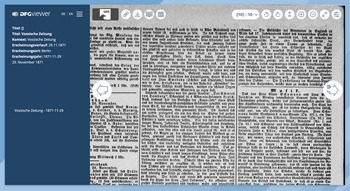
ZEFYS uses the viewer of the German Research Foundation (DFG) (Fig. 3). Reading an issue or even a single page with the DFG viewer is time consuming because an issue is made up of high-resolution pictures of each page. The pages are too big to view more than one at a time, and the print is too small to read a complete page on one screen. Since ZEFYS lacks a full-text search, finding music reviews can require going through an issue page by page. By the end of the nineteenth century, a single issue of a newspaper could balloon to 40–50 pages. PDF downloads are possible on the DFG reader, but only one page at a time. ANNO's viewer is better integrated and easier to navigate between pages, issues, volumes, and titles (see Fig.1).
Sample page from Vossische Zeitung using the DFG Viewer

For all these databases, the representation of their content can be misleading on multiple levels. A title might appear on the list of digitized papers, but upon closer inspection may be found to be represented by a small proportion of years or issues from a given year. Since papers expanded by adding supplements and additional daily editions, even a title with an issue for every day could be incomplete. Blurry or cut-off scans from old microfilms won't yield results in a full-text search.
Caveats aside, these resources offer new opportunities for researchers all over the world. For instance, the collection of local and regional papers from North Rhine Westphalia mentioned above could be the basis for regional studies of everyday musical life. Investigations of performers, theatres, concert series, festivals, clubs, and other organizations through case studies or statistical analysis are already becoming richer in detail and more substantial in scope. It is exciting to see how the growing corpus of digitized newspapers and increasingly sophisticated digital search and analysis tools are transforming nineteenth-century music history.