Many of the most important policy choices facing governments involve long-term or slowly evolving problems. Challenges such as climate change, a rising pension burden, and diminishing supplies of oil and other natural resources are expected to generate their greatest social and economic impact decades from now. Most of the plausible solutions, however, require governments to act in the short run – to impose tax increases, benefit cuts or regulatory burdens on constituents in the near term. A wide range of policy predicaments, that is, confront governments and citizens with a stark intertemporal dilemma: whether to pay short-term social costs to invest in long-term social benefits.
For elected officials, investment in the long run is usually thought to pose acute political risks. Prominent arguments and findings in the literatures on public policy making and political economy suggest that politicians face powerful incentives to maximize short-run net policy benefits and that they invest in the long term only at their electoral peril.Footnote 1 A key premise of such arguments is that citizens are strongly myopic: that, in evaluating governments’ policy choices, voters give far less weight to temporally distant policy consequences than to those that emerge in the near term. Remarkably, however, this basic assumption of citizen myopia has gone virtually untested. While analysts have examined other temporal features of mass attitudes (for example, retrospective and prospective voting),Footnote 2 not a single study has examined citizen attitudes at the individual level to determine whether the timing of a policy's future costs and benefits systematically affects policy support. Moreover, the possible causes of citizen myopia in policy reasoning have rarely been explored theoretically or investigated empirically. To the extent that citizens’ policy attitudes are tilted against the long term, we know little about why.
This article analyses the nature and sources of citizen myopia. We begin by probing the basic premise that citizens discount temporally distant outcomes when evaluating public policies. Our central concern, however, is why and under what conditions citizens time-discount policy consequences. We hypothesize that citizens might prefer earlier over later net policy benefits for at least three distinct reasons: because they value near-term welfare over longer-term welfare (positive time preference); because earlier benefits can help even out (or smooth) the flow of income over time (consumption-smoothing); or because they have less confidence in longer-term policy promises (uncertainty).
While positive time preferenceFootnote 3 and consumption-smoothingFootnote 4 are commonly explored in economic and psychological studies of intertemporal decision-making, we argue that uncertainty effects are likely to be especially prevalent in decisions about public policy. Uncertainty is a pervasive feature of political and policy choice. Moreover, we hypothesize, voters’ uncertainty about policy outcomes should depend on timing: both the causal complexity of public policy and the fragility of political commitments mean that citizens should be more uncertain about policy consequences that lie further in the future. We thus propose that citizens may discount the long run because – however much they may value future outcomes – they find longer-term policy promises less certain.
In testing these hypotheses, we draw on an on-line survey experiment in which subjects were asked to evaluate a proposed policy reform – relating to the financing of the US Social Security system – and randomly assigned to receive different information about the timing of the reform's benefits. Our analysis yields clear evidence of temporal discounting: as the benefits of an intertemporal policy tradeoff recede into the future, support for the policy falls. More importantly, the results allow us to distinguish quite clearly between the alternative causes of this timing effect. We find only modest evidence that mass temporal discounting derives from a pure preference for earlier welfare gains (that is, that citizens are simply ‘impatient’) and no sign that citizens seek to schedule policy benefits so as to smooth consumption over time. In contrast, our results point clearly to the central role of uncertainty about the long term in shaping mass intertemporal policy attitudes. We conclude that citizens’ bias in favour of short-term policy benefits arises in large part because they do not find the promise of long-delayed policy rewards to be credible.
In tracing the temporal structure of citizens’ policy attitudes, the analysis examines a normative tension deeply embedded in democratic political life: the mismatch between the long-term nature of many policy problems and the short intervals of time over which elected officials must seek public approval. On one level, the findings presented here help to explain why elected politicians often favour the present over the future when making public policy. At the same time, our results point to crucial sources of variation in governments’ willingness to invest in the long run and suggest conditions under which farsighted policy making is most likely to emerge.
In illuminating the mechanisms underlying mass policy discounting, this article also highlights both the sources and the effects of uncertainty in democratic politics. A large political-economy literature has emphasized the challenges of credibility that actors face when trying to strike bargains involving non-simultaneous exchange.Footnote 5 The present study points to a distinctive type of credibility problem that can afflict intertemporal exchanges implicitly struck between elites and mass constituencies. In doing so, the analysis also uncovers novel implications of political trust for democratic decision making. We contend that citizens’ level of trust in government affects their level of certainty about future policy effects, the temporal leeway that they grant their representatives, and – ultimately – the scope available to politicians for investing in solutions to long-term social problems.
Existing Approaches to the Study of Long-term Policy Attitudes
Macro-level studies of policy making commonly characterize politicians’ electoral incentives as biased heavily in favour of the short run.Footnote 6 Empirical scholarship on public opinion and political cognition at the individual level, however, has been mostly silent on the role of time in citizens’ assessments of public policies. While analysts have explored a range of cognitive, affective and informational determinants of mass policy attitudes, scholars have yet to systematically examine whether or why variation in the expected timing of a policy's future consequences affects citizens’ willingness to support it. Work on economic voting has extensively addressed one important temporal feature of voter reasoning: the degree to which voter judgements are based purely on information about past conditions as opposed to prospective information about future economic outcomes.Footnote 7 This question may be of some relevance to temporal discounting: if retrospective economic perceptions dominate prospective ones, this might imply a bias away from the future. Yet even this literature has been silent on the central concern of the present study: how and why differences in the timing of future policy consequences – how far into the future they are expected to occur – affect citizens’ policy preferences.
A number of studies have examined public opinion or electoral behaviour in relation to specific policy issues with long-term implications, such as pension affordability, climate change, natural-disaster preparedness, and debt and deficits.Footnote 8 Yet few analyses have sought to examine how that temporal quality – the ‘long-termness’ of the relevant policy consequences – shapes citizen attitudes on such issues. More fundamentally, the data typically employed can tell us little about time-discounting. Available survey items rarely specify for respondents the temporal features of the policies to be evaluated – i.e., when the policies’ costs and benefits will arrive. Because policies such as pension reform, environmental regulation, or debt reduction can be designed with widely varying temporal profiles, responses to such questions do not reveal the temporal profile of consequences – if any – to which individuals might be reacting.
One exception – Healy and Malhotra's analysis of US natural-disaster policiesFootnote 9 – explicitly considers the role of citizen myopia in shaping electoral behaviour. The study draws on aggregate voting data to examine why such policies are biased towards relief spending rather than investments in disaster-preparedness. Among the hypotheses tested is that the benefits of preparedness emerge with a longer lag than those of relief spending and may therefore be discounted by short-sighted voters. While the analysis offers a rare test of the existence of temporal effects,Footnote 10 the study does not seek to discriminate among alternative reasons why citizens might discount future policy outcomes. We note, moreover, that aggregate data are limited in their ability to speak to this question. Alternative theories of policy discounting, as we will argue, make distinctive predictions about the individual-level variables that should condition and mediate timing effects, implying relationships that are relatively difficult to detect and disentangle at the aggregate level. We turn now to theorizing alternative reasons why citizens might discount longer-term policy outcomes.
Theorizing Intertemporal Policy Attitudes
In the first instance, this article seeks to address a basic question about citizens’ policy attitudes: does the mass public engage in temporal discounting of future policy outcomes? By temporal discounting we mean any consideration of the timing of future valued outcomes that leads a decision maker to discount more temporally distant outcomes relative to equivalent but more temporally proximate ones. We specifically distinguish discounting of future outcomes – which involves a response to information about their timing – from mere inattention to the future, which may derive, for instance, from a dearth of prominent or salient information about longer-term outcomes. Our concern in this study is primarily with the former.
Secondly, and more central to the article, to the extent that citizens do engage in temporal discounting, we seek to determine why. We delineate below three sets of mechanisms through which the timing of policy consequences might affect citizens’ policy attitudes – three theories about why voters might discount longer-term policy benefits. We further consider the possibility that citizens might not engage in temporal policy discounting – understood as a form of reasoning about the timing of consequences – and derive an alternative, non-discounting explanation for any bias towards the short term in mass policy attitudes.
In the discussion below, we describe the causal logic by which each mechanism might generate a myopic policy bias among citizens, and we identify conditional relationships implied by each logic that will be important for empirically distinguishing among them. Throughout the discussion, we posit an electorate judging a policy tradeoff: a policy that will have both costs and benefits for most citizens. We assume that the policy's costs are to be imposed in the near term. The question of theoretical interest is then: why might citizens be less likely to support the policy as its benefits recede into the future?
Positive Time Preference
Standard micro-economic theories of intertemporal choice are grounded in the discounted utility (DU) model, originally proposed by Samuelson.Footnote 11 In the DU model, individuals contemplating future paths of consumption are assumed to apply an exponential discount rate to the utility derived from future consumption. In the original DU setup, this discount rate reflects pure time preference: the relative value that the individual places on her wellbeing at different points in the future. Individuals are assumed to have a positive time preference: all else equal, people place greater value on temporally proximate utility than on temporally distant utility. They are impatient with respect to their own welfare. With respect to policy choice, positive time preferences are one potential reason why, ceteris paribus, citizens might be more likely to oppose an intertemporal policy bargain as its benefits become more distant in time. Moreover, to the extent that impatience varies across individuals, a clear conditional prediction follows: individuals with stronger positive time preferences should display greater aversion to benefit delay.
Consumption-Smoothing
While the ‘discount rate’ in an intertemporal utility function is commonly interpreted as pure time preference, positive time preference is not necessary for temporal discounting. Citizens may prefer earlier policy rewards not because they value current over future welfare, but because they rationally seek to receive marginal benefits at points in time at which those benefits will generate the greatest utility. In particular, the standard assumption of a concave utility function – i.e., the diminishing marginal utility of consumption – implies that individuals can improve their welfare by smoothing a given amount of consumption over time.Footnote 12 Applied to policy judgements, a concave utility function means that citizens can enhance their welfare by shifting policy benefits to the periods in which they expect to have the fewest resources. While this logic could in principle favour shifting payoffs either forward or backward in time, consumption-smoothing would favour quicker delivery of benefits whenever people expect their financial position to improve over time. For instance, if citizens expect their incomes to rise with career-advancement over time, then they ought to be more likely to support policies that deliver benefits sooner (when they are poorer) rather than later. More generally, if consumption-smoothing underlies time-discounting of policy benefits, then discounting effects should increase with the slope of the expected future consumption path, with the strongest myopic bias among those who expect the greatest improvement over time.
Uncertainty
Alternatively, citizens may be less likely to support a policy with longer-delayed benefits because temporally distant policy outcomes are less certain than near-term ones. The connection between uncertainty and time has received some attention in existing studies of intertemporal choice in economics and psychology,Footnote 13 more often as a potential confounding effect than as a variable of interest. However, there are at least two reasons to expect uncertainty to be an important component of citizens’ intertemporal choices in the sphere of politics.
First, chains of policy causation often involve considerable complexity. Between policy implementation and policy outcome typically lie multiple, imperfectly understood causal links, the operation of which will depend on prevailing social and economic conditions. While some policies have easier-to-predict consequences than others, the causal complexity inherent in much government activity leaves ample scope for uncertainty in voters’ prospective policy judgements.
For policies involving substantial causal complexity, the magnitude of this uncertainty should depend on timing. The effects of a policy often hinge critically on features of the context in which the policy is implemented. The consequences of a fiscal stimulus package, for instance, depend on levels of unemployment and public debt. Likewise, the effects of an expansion of public health insurance are conditional on (among other things) the extent of private insurance coverage, rates of medical inflation and the organization of medical delivery. Over longer time horizons, however, the state of the world becomes less knowable, and key features of the societal context become more likely to change in ways that will disrupt chains of policy causation. Importantly, the passage of time should most threaten those chains of policy causation that depend on the most complex causal interactions with social and economic forces. Equally, policies that are perceived as causally simple should be viewed as more temporally robust – less dependent on changeable features of context and therefore less vulnerable to the passage of time. The effect of timing on citizens’ uncertainty about policy outcomes should thus be conditional upon the perceived causal complexity of the policy mechanisms involved.
In principle, this uncertainty could be symmetrical: causal complexity could be as likely to generate better-than-promised as worse-than-promised policy outcomes. But for two reasons, the average effect of this type of uncertainty should be a reduction in citizen support. First, if citizens are risk-averse, then even a mean-preserving increase in the variance of the probability distribution of potential consequences should depress support. Secondly – and completely independent of attitudes to risk – well-established negativity biases in the dissemination and processing of information should lead to downward-biased expectations. As documented in numerous studies, the media supply more information about and citizens attend more closely to and more readily recall negative events than positive events.Footnote 14 Citizens should, therefore, find past instances of policy failure far more cognitively accessible than past instances of unexpected success. Confronted with uncertainty about long-term policy outcomes, voters should thus be predisposed to reason more about the possibility of things going wrong than of things going unexpectedly well.Footnote 15 The result should be a downward-shifted probability distribution and lower expected value of future benefits, leading to a reduction in voter support.Footnote 16
The second reason why timing may affect the certainty of policy benefits derives from politics itself. Consider a policy that would make an investment in long-term benefits for society at near-term cost – such as a policy that raises current taxes to pay down public debt or to pre-fund future pension benefits. Such policies involve non-simultaneous exchanges – the imposition of losses today in exchange for a promise of future payoffs. Where the extracted resources are fungible or the investment is reversible, these future payoffs will depend in part on whether politicians maintain the initial commitment to deliver them.Footnote 17 Such commitments are often vulnerable, first, to the well-known problem of time inconsistency:Footnote 18 after extracting resources from constituents for a stated long-term goal, politicians may face incentives to divert those resources towards unrelated purposes. Secondly, even if today's incumbents remain committed to the original long-run project, their successors may have divergent policy preferences and little moral or political stake in a policy bargain to which they were not a party.Footnote 19
As with uncertainty deriving from policy complexity, political uncertainty should be sensitive to timing. Over longer stretches of time, turnover in the control of public office becomes increasingly likely. Furthermore, the potential political or fiscal temptations to renege – the number of other policy purposes towards which resources might be diverted – will multiply. Politics, then, provides voters with good reasons for uncertainty about the outcome of many intertemporal policy bargains, and political uncertainty ought to be greater the longer citizens must wait for a policy's benefits to arrive.
Importantly, if political uncertainty leads voters to discount temporally distant benefits, this effect should be conditional on those factors that affect perceptions of the credibility of government commitments. As a large literature suggests, one of the chief determinants of credibility perceptions in political and economic exchange is trust.Footnote 20 When it comes to policy bargains in particular, the effect of the timing of benefits on a voter's uncertainty about those benefits should depend on her level of trust in government. Past research indicates that political trust has important consequences for citizen evaluations of policies that invoke matters of credibility.Footnote 21 We hypothesize, in turn, that political trust should be an important moderator of the effects of timing on citizen uncertainty about policy benefits. Citizens who view politicians as trustworthy should perceive policy commitments to be relatively reliable and should, thus, become only modestly less certain about policy benefits as they recede in time. Those with little trust in government, in contrast, should be keenly sensitive to the time lag between the costs that politicians impose and the benefits they promise to deliver. Moreover, political uncertainty should be straightforwardly negative in its effect on expected benefits: a lack of political trust implies an expectation that politicians become systematically less likely to deliver promised benefits as those benefits recede into the temporal distance.
In sum, we theorize that a delay in the receipt of policy benefits reduces citizen support for the policy by raising negatively biased uncertainty about those benefits. If present, we would expect this uncertainty effect to be strongest under conditions that make the policy appear more vulnerable to the passage of time: time-discounting should increase as perceived causal complexity rises and as political trust falls.
Why Citizens Might Not Discount
There are also reasons to doubt that citizens will engage in temporal policy discounting, defined as a form of reasoning about the temporal features of policy effects. Many accounts of public opinion downplay the causal role of material policy outcomes – relative to ‘symbolic’ considerations such as political values and party identification – implying that the timing of such outcomes may also be largely irrelevant to policy attitudes.Footnote 22 Even if citizens do engage in consequentialist reasoning, however, the bounds on citizen rationality may dampen timing effects. As a multitude of studies demonstrates, the average voter possesses modest political knowledge, pays limited attention to political information, and economizes on cognitive effort through the use of simple heuristics.Footnote 23 If we think of timing as one feature of a policy's consequences to be considered – alongside a range of others, such as the nature, size and incidence of the policy's costs and benefits – there is no reason to assume that a ‘cognitive miser’ would devote substantial attention to this particular consideration. Moreover, reasoning through the temporal implications of a policy's consequences – consider, for instance, the logic of consumption-smoothing – will frequently impose substantial computational demands on citizens. The average citizen might thus display only modest discounting simply because she is unable to take timing and its implications fully into account.
A view of citizens as cognitive misers also suggests an alternative, non-discounting explanation of temporal effects on the electorate's policy attitudes. Information about near-term policy outcomes will often be clearer, more vivid, and more prominent than information about the long run, making short-run consequences more salient or cognitively accessible. Hence, if the electorate displays policy myopia, this temporal bias might emerge not from citizens’ reasoning about timing and its implications but simply from the reduced salience of longer-term outcomes. A key implication of this salience-based explanation is that timing effects should be absent when informational quality is held constant – when information about short-term and long-term outcomes is equally clear, prominent and vivid.
Study Design
This article tests for the presence and mechanisms of temporal policy discounting in the mass public by analysing data from an on-line survey experiment. The experiment was administered to a representative sample of voting-age American citizens.Footnote 24 Unless otherwise noted, N = 1,213 in all analyses.
Stimulus
The experiment centred on the financial problems facing the US Social Security system, the national public pension programme financed by payroll contributions from workers and their employers. While the programme is currently running surpluses, demographic change is expected to place enormous financial strain on the system at some point in the future.Footnote 25 One possible solution would be the enactment of an intertemporal policy reform: the imposition of costs on workers and/or seniors today in order to accumulate resources that would close the financing gap tomorrow. The experiment confronted subjects with this policy problem and this potential solution in a format that we term a policy brief (see Appendix for complete text).
As will be recalled, the central hypotheses to be tested (aside from the non-discounting, salience-based explanation) all assume that citizens are aware of a policy's temporal profile of costs and benefits: the hypotheses diverge from one another on whether and how such temporal knowledge, in turn, shapes citizen reasoning and policy attitudes. Thus, a central design concern was maximizing the comprehension and absorption of key policy information by our subjects. The structure of the policy brief was dictated by the need to (1) effectively manipulate subjects’ understanding of a policy option, and (2) deliver sufficient detail for subjects to reason about the option in a variety of potential ways. Rather than seeking to mimic a real-world information source (for example, a newspaper article), the brief thus presented, in a clearly organized format, only information directly relevant to the evaluation of the policy.
All subjects were informed about the following features of the policy choice:
1. Policy context: The Social Security programme was briefly described.
2. Policy problem: Subjects were informed of the cause and the timing of the financial problem that Social Security faces.
3. Costs of policy problem: The brief stated that, if nothing was done, then broad-based payroll tax increases and benefit cuts would be required at a future date.
4. Nature and cost of the solution: A reform proposal, involving a clear intertemporal tradeoff, was described. The reform would impose an immediate tax increase ($300/year) and benefit cut ($300/year) that would allow the programme to accumulate a surplus that would be saved to help pay future benefits.Footnote 26
5. Benefits of the solution: Such action, subjects were told, would avoid a much larger tax increase and benefit cut that would otherwise be required at a future point. Orthogonally with the main manipulations described below, equal numbers of subjects were randomly assigned to two different expressions of these benefits: a ‘numerical’ condition, in which the benefits were expressed as the avoidance of $600/year in payroll tax increases and $600/year in benefit cuts; and a ‘verbal’ condition, in which it was indicated only that the avoided tax increases and benefit cuts would be ‘much larger’ than the reform's costs, with no dollar figure provided for the former.
6. Intertemporal comparison: To ensure understanding of the tradeoff over time, subjects were reminded that the reform ‘would have real costs in the present’ for seniors and workers while Social Security's problems still lay in the future.
A final screen offered a bullet-point summary of the problem and solution, which remained on-screen while subjects responded to questions about their level of support for the reform.
Experimental Manipulations
Two orthogonal manipulations were employed to deliver the main experimental treatments:
1. Timing of benefits: The timing of the benefits of the reform varied between two conditions. We manipulated benefit timing by varying the stated date of the future financial crisis that the reform was designed to avert. In one condition, large tax increases and benefit cuts would occur in five years in the absence of reform; in the other condition, these losses would occur in forty years without reform. This variation roughly reflected the bounds of real-world debate over the timing of Social Security's financial troubles.Footnote 27 Sizeable variation in benefit timing was also chosen in order to enhance our chances of detecting the intergroup differences and conditional effects of timing that are central to distinguishing between discounting mechanisms. In regression analyses reported below, timing is a dummy variable, equal to 1 in the five-year condition and 0 in the forty-year condition. In order to ensure absorption of this key information, the policy brief included ten distinct references to the timing of reform benefits in each condition.
2. Causal complexity: In a ‘low-causal-complexity’ condition, respondents read additional statements citing expert consensus that the reform would be simple to implement and stating that similar plans had been carried out before. In the causal-complexity-control condition, respondents received no such additional information.
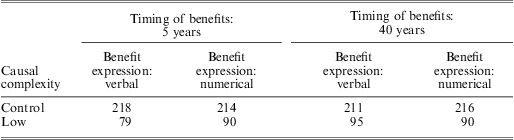
Table 1 presents the full experimental design. In all conditions, it was indicated that the costs of reform would begin immediately. Equally importantly, the experiment held constant the structure of the information about reform benefits across timing conditions.
Experimental Design
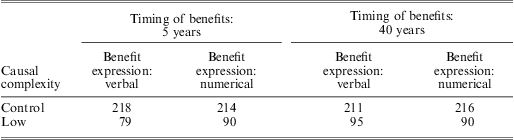
Cell entries indicate the number of subjects in each condition.
Intertemporal Policy Choice: Experimental Design Dilemmas
We note that the study confronts a set of design dilemmas deriving from fundamental limits on experimental control in the study of intertemporal policy choice. These constraints emerge from interactions between, on the one hand, the nature of intertemporal calculations of economic value and, on the other hand, the logic of policy design and properties of mass political cognition. Put differently, the design dilemmas derive largely from the fact that policy tradeoffs that are formally equivalent may be substantially different from the perspectives of human information-processing or policy logic. These dilemmas, in turn, force choices about which influences to control through the design of our manipulations.
Consider a generalized form of the intertemporal tradeoff in the present experiment: a policy that establishes m periods in which a cost, C, must be paid, followed by n periods in which a benefit, B, is to be received. To calculate the long-run economic value of this tradeoff – its net present value (NPV) – we must first discount the tradeoff's streams of benefits and costs. We discount the benefits and costs in each period at the market interest rate, i, to reflect the opportunity costs of delayed income (and, conversely, the benefit of delayed cost-payment). Note that this discount is independent of the discounting effects (time-preference, consumption-smoothing and uncertainty) theorized in the last section: it represents the purely economic fact that income that is deferred in time cannot be invested in the interim. In this sense, earlier policy payoffs have greater economic value than later payoffs because they allow individuals to reap a longer stream of private investment returns. The policy's NPV is then the difference between two streams of discounted payoffs: a stream of summed, discounted benefits minus a stream of summed, discounted costs. The net present value of the policy can be expressed as:
 $$ NPV\, = \,\mathop{\sum}\limits_{t\, = \,1}^m {\frac{{{\rm{ - }}{{C}_t}}}{{{{{(1\, + \,i)}}^t} }}} \, + \,\mathop{\sum}\limits_{t\, = \,m\, + \,1}^{m\, + \,1\, + \,n} {\frac{{{{B}_t}}}{{{{{(1\, + \,i)}}^t} }}} $$
In this expression, the stream of policy costs, captured in the first term, runs from t = 1 until t = m; the policy's benefit stream, the second term, begins in the following period (m + 1) and continues for n periods. The timing manipulation in the present experiment is thus represented by the term m.
Three dilemmas of experimental design follow: a dilemma of economic value, a dilemma of mortality, and a dilemma of policy rationality. The dilemma of economic value derives from the interaction between the structure of the intertemporal tradeoff and the limitations of human cognition. The problem is that it is impossible to vary timing – the policy feature of interest – without also varying a second policy feature that could plausibly influence subjects’ policy attitudes. To see why, note first that manipulating the timing of benefits means varying m. In the light of the above expression, however, varying m necessarily means varying the economic value (NPV) of reform: first, benefits that are longer delayed must be discounted by the interest rate, i, over a longer time horizon; and, secondly, at a higher m, the policy has a longer stream of costs. The result is a potential confound with timing: as benefits are delayed in time, the lower economic value of the policy might itself reduce citizen support – completely apart from the discounting effects theorized in the last section.
The only way to maintain the tradeoff's economic value across timing conditions – to hold NPV constant while varying m – is to vary one or more additional parameters (C, B, i or n) together with timing. Yet these parameters are themselves likely to affect subjects’ evaluations of the reform. One could, for instance, hold NPV constant across timing conditions by covarying B, the periodic (in this study, annual) benefit, with timing. This strategy, however, would require presenting subjects in the forty-year timing condition with an annual benefit of reform that was several times higher than that presented to subjects in the five-year condition.Footnote 28 While preserving a formal equivalence across conditions, this design choice would be unlikely to achieve experimental control. Although a perfectly rational decision maker would compute equal NPVs in the two conditions, the average respondent (or citizen) is extremely unlikely to do so, given the complexity of the calculation and the well-known limits on human information-processing. Indeed, as indicated by a wealth of evidence on economic literacy, most adults lack a basic grasp of the financial concepts – such as compound interest – required for such a calculation.Footnote 29 Instead, subjects would be highly likely to respond to the vast and readily apparent difference in the stated annual benefit size between the two timing conditions.Footnote 30 In short, given a boundedly rational subject pool, a significant potential confound would persist.
The mortality dilemma derives from the distinctive temporal logic of public policy and the finiteness of human lifespans. In general, it is difficult to hold constant the length of a stream of policy benefits, n, while varying the timing of those benefits, m. The character of most policy benefits (such as the mitigation of climate change, the construction of a road or bridge, saving Social Security) is such that, once they arrive, they continue for a long or indefinite period of time. Given the fact of mortality, this means that the length of the benefit stream accruing to any individual citizen will implicitly decline as the start date of the benefits recedes into the future – moving closer to the citizen's expected end of life. Manipulating the timing of a long stream of policy benefits, in other words, means simultaneously manipulating the length of time for which a given citizen can expect to enjoy those benefits. A subject might thus favour the earlier payment of benefits simply because she will enjoy a longer stream of payments and larger total benefits over her lifetime – not because she is discounting future payoffs.
The policy rationality dilemma involves a similar difficulty arising for the length of the cost stream. In the tradeoff formalized above, the policy's costs are – in either timing condition – paid until the point at which the policy's benefits begin. This temporal structure broadly characterizes many investment-oriented policies, such as the building of physical infrastructure or investments in education and training: a period of net cost-payment followed by a period of net benefit-enjoyment. This common temporal structure, however, also generates a potential confound: as the benefits recede in time, the stream of policy costs becomes longer.
In principle, an experimental manipulation could be designed to hold the length of the cost stream constant while benefit timing varies. In our setup, subjects in both the five-year and forty-year benefit-timing conditions could be asked to pay the policy's costs over the same five-year (or shorter) period. While eliminating one confound, however, this approach would create another: it would generate covariance between the timing of benefits and the temporal rationality of the policy. In particular, a stark irrationality would emerge uniquely in the forty-year condition: in this condition, the reform would require respondents to pay the full costs of a solution within the next five years even though Social Security's financial deficit lies forty years away – strangely inflicting far quicker and more concentrated pain than the timing of the problem requires. Subjects in the five-year condition, in contrast, would face no comparable anomaly. Holding the length of the cost stream constant would, thus, mean varying the plausibility and reasonableness of the policy's temporal structure between the two timing conditions.
These three design dilemmas imply that we must choose which potential confounds to eliminate experimentally and which to analyse statistically after the collection of data. In the present study, we address these design dilemmas as follows:
1. Economic value dilemma: We have opted to hold constant across timing conditions those policy features – the periodic costs and benefits, B and C – that we expect to be most salient to subjects in the light of common findings on mass-level cognitive sophistication. This decision, in turn, forces the reform's NPV, which we expect to be less salient, to vary. Assuming a constant interest rate, this means that respondents in the five-year condition are offered a higher NPV of reform than are those in the forty-year condition.
2. Mortality dilemma: Because the benefits of any Social Security rescue would naturally accrue for a long and indefinite period of time, we specify no end date to the benefits stream. This implicitly allows the length of the benefit stream accruing personally to respondents to covary inversely with benefit timing.
3. Policy rationality dilemma: We opt to preserve the temporal rationality of the reform across timing conditions. Thus, the plan always imposes its costs from the present until the start of its benefits (i.e., until the date of the financial crisis to be averted). This choice allows the length of the cost stream to covary with timing.
We devote a subsection of the data analysis to testing for potential effects of variation in NPV and in the lengths of the cost and benefit streams on support for the reform. To anticipate these results, we find no evidence of a confounding effect of any of these design factors on the results.
Observational Variables
We describe here the main observational variables that are common to all analyses reported in this article. For ease of exposition, we describe other variables as they are introduced into the analysis. Following presentation of the policy brief, subjects were asked to evaluate the proposed reform by responding to a three-item battery of questions.Footnote 31 For the main analyses below, our dependent variable is an additive index, the reform support index, combining responses to these items. Across all three measures, a majority of respondents – ranging from 56 to 60 per cent – opposed the reform. The items are highly correlated and form a highly reliable index for analysis (Cronbach's α = 0.94), which is scaled to the (0, 1) interval.Footnote 32
In addition to reporting comparisons of means across experimental conditions, we seek to maximize the precision of our estimates by estimating a number of regression models. All regression models estimated in the article include controls for income, age, education, race, egalitarianism, congressional approval and political trust.Footnote 33 Income is measured on a nineteen-point scale, which is coded to vary along the (0, 1) interval. Age, measured in years, is represented as both a linear and a quadratic term. Education is captured with a pair of dummy variables: degree-holders and those with less than high school credentials are contrasted with high school graduates holding less than a university-level degree. An indicator variable for racial identification distinguishes African-American identifiers from all others. Egalitarianism is measured with one component of the standard American National Election Study (ANES) battery (# V045214); likewise, congressional approval utilizes the standard ANES item (# V043036). We measure political trust using a slightly adapted version of the standard ANES battery on trust in government, discussed in greater detail below.Footnote 34
Data Analysis
The data analysis proceeds in three steps. First, we test for the presence of time-discounting in mass policy attitudes by analysing the effects of the timing factor on reform support. Secondly, and more importantly, we seek to discriminate between the discounting mechanisms theorized above: time preference, consumption-smoothing and uncertainty. We employ two strategies to distinguish between these mechanisms. The first strategy is to test for the distinctive conditional relationships – i.e., for predicted moderators of the strength of the timing effect – that each logic of discounting implies. The second strategy is to examine the mediation of timing effects by subjects’ reasoning about the reform; the mediation analysis draws on open-ended responses that subjects provided in the course of the survey. Finally, we test for potential confounding effects of the design choices discussed in the preceding section.
Timing and Support for Reform
We begin by noting that the timing manipulations were highly effective in shaping subjects’ temporal beliefs. Following the policy brief and reform support questions, respondents were asked to indicate, using any real number, the number of ‘years from now’ that they think the Social Security system ‘will run into financial trouble’. At both levels of timing, the modal timing perception is equal to the level specified in the treatment, and mean timing perceptions varied across the two levels of timing by approximately fifteen years: from 10.7 years in the five-year condition to 26.1 years in the forty-year condition (t-test significant at 0.001 level).
We turn then to the most basic question about intertemporal policy attitudes: do citizens discount more temporally distant policy effects? We find that the timing manipulation did indeed affect policy attitudes in the expected direction. Among subjects in the five-year timing condition, the mean of the reform support index is 0.44 (SD = 0.29; N = 601). At the forty-year level of timing, however, support falls to 0.37 (SD = 0.29; N = 612). This shift is highly significant statistically (p < 0.001) and implies that moving benefits from forty years into the future to just five years increases the average reform support score by nearly 20 per cent.
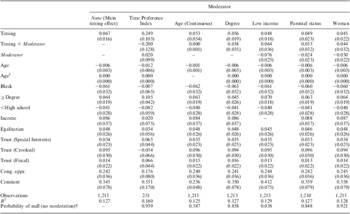
To probe the importance of timing relative to other determinants of reform support, we analysed an ordinary least squares (OLS) regression model including likely demographic and attitudinal influences (the controls identified in the previous section). The estimated coefficient on timing in this model is reported in the first column of Table 2. The coefficient estimates for the other terms in the model reveal that the effect of timing on reform attitudes in our experiment is similar in magnitude to that of many other between-subject differences that are commonly considered important drivers of public opinion. The impact of the timing manipulation, for instance, is comparable in size to the effect of a university education (0.064 points), a ten-year increase in age (−0.052), or movement from the lowest to the highest income bracket (0.086). While the effect of timing is thus substantively significant, we also note that these results do not support the notion of an electorate that radically discounts delayed policy benefits.
Moderation of Timing Effect on Reform Support: Time Preference Index and Time-preference Proxies

Note: OLS estimates. Standard errors in parentheses. †The procedure for assessing the statistical significance of all moderation effects is described in fn. 35.
We further observe that the impact of timing emerges despite the high and equal prominence and clarity of information about benefits across conditions. In both timing conditions, the benefits of reform were stated multiple times and in diverse ways and remained on-screen as we elicited respondents’ attitudes towards the reform. The observed effect thus cannot be explained as a salience effect: rather than simply failing to attend to more distant policy consequences, individuals were engaged in some form of temporal reasoning that favoured more proximate over more distant benefits. Put simply, timing itself mattered. The remainder of the analysis examines the sources of this temporal discounting.
Testing Alternative Discounting Mechanisms
Why do citizens prefer policies with more temporally proximate benefits? We distinguish between alternative theories through the analysis of both moderators and mediators of timing effects. As noted above, the analysis of moderation involves testing for the distinctive conditional relationships that each mechanism implies. In theorizing each mechanism earlier in this article, we hypothesized one or more factors that should amplify or reduce the strength of time-discounting if that mechanism is present. In the moderation analysis, we test these conditional propositions by analysing interactions between the timing factor and predicted moderators of timing effects.Footnote 35 In the mediation analysis, we then make observations of elements of the cognitive process that lies between the experimental treatment and the dependent variable (reform support). Drawing on open-ended responses collected during the survey, we analyse a measure of the considerations on which subjects drew in formulating their attitudes towards the reform. Here we take advantage of the fact that each discounting mechanism, if operating, should generate a distinctive line of reasoning. In both the moderation and the mediation analyses, all models include the full set of controls described in the Study Design section.
Positive Time Preference
We first test the theory that the effect of timing on policy attitudes reflects pure impatience – a basic preference for current over future utility. If a time-preference mechanism is in operation, then a particular moderating relationship should hold: specifically, the effect of timing on policy attitudes should be strongest for those respondents with the most strongly positive time preferences (i.e., those who are most impatient). We adopt two strategies for testing this hypothesis, one using a direct measure of time preferences, the other employing proxies for this concept.
First, we draw on a direct gauge of subjects’ levels of impatience. We presented a subsample of respondents (n = 252) with a version of the questionnaire that included a measure of time preferences widely used in the psychological and economic literatures: a series of three choice tasks. These tasks, involving hypothetical monetary rewards, asked subjects to choose between paired alternatives: in each case, between an earlier but smaller payoff (for example, ‘a $200 gift today’) and a longer-delayed but larger payoff (for example, ‘$400 in five years’). Summing responses to this series of tasks generates a time-preference index score for each subject. If time preferences moderate intertemporal policy attitudes in the hypothesized direction, then we should observe a positive interaction between the time-preference index and timing. In fact, we find a large interaction effect in the opposite direction to that predicted: those who opt more often for earlier but smaller financial awards in the choice tasks are less sensitive to the timing manipulation (see Table 2). A direct test thus yields no evidence of the operation of a time-preference mechanism.
It is, however, possible that this result is affected by oft-cited challenges of reliably gauging individuals’ time preferences. Direct measures of impatience routinely confront two significant problems. First, intertemporal choice tasks may capture the effect of other considerations relevant to decision-making over time, such as consumption-smoothing or uncertainty. Secondly, measures of the construct are known to be highly unstable, sensitive to the context and object of choice and to the method of elicitation.Footnote 36
Accordingly, we supplement this direct test with a series of analyses using an alternative set of indicators of impatience. We employ, as proxies, several plausible correlates of time preference drawn from a survey of theoretical arguments and empirical evidence in the economic and psychological literatures on intertemporal choice. To maximize reliability, we select only correlates that have received broad support across multiple studies. We detail these variables and their operationalizations here:Footnote 37
1. Age. A wide range of studies finds a positive relationship between age and impatience, commonly explained by older individuals’ expectations of a shorter and lower-quality stream of future potential utility. We analyse interactions between timing and diverse structures in age, including linear and curvilinear modelsFootnote 38 and several age dichotomies.Footnote 39
2. Education. Numerous studies have concluded that educational attainment is both a consequence and a cause of greater patience. We consider interactions between timing and various structures in education: university degree-holders v. all others; less-than-high-school credentials v. all others; and university degree-holders v. less-than-high-school credentials v. all others.
3. Parental status. Studies of life-cycle savings behaviour yield substantial evidence of a bequest motive suggesting that parents have a ‘dynastic utility function’, deriving utility from the welfare of their children. For a policy that may affect future generations, we would thus expect positive time preferences to be weaker for those with children than for the childless. Accordingly, we evaluate the interaction between parental status and timing.
4. Income. It has been consistently found that patience increases with financial resources, possibly because poverty blinds individuals to future needs or limits children's future capacity to delay gratification. We test for this effect by interacting timing with (a) a dummy variable for low income respondents, (b) dummies for all income quartiles (save the reference category) and (c) the natural log of income.
5. Gender. While leaving the reason untheorized, studies of intertemporal preferences have consistently found women to be more patient than men. In the analysis, woman is a dichotomous variable (1 = woman).
As summarized in Table 2, our analysis of these proxy moderators turns up minimal evidence of a time-preference effect.Footnote 40 The only proxy to yield a significant moderation effect in the predicted direction is low income, with the poorest quartile of our sample displaying greater aversion to the delay of benefits than the top 75 per cent. Not only does the low-income finding stand alone – no other proxy comes close to significance in the right direction – but this isolated result admits of alternative explanations (such as consumption-smoothing by those currently low on resources). In sum, employing a range of potential measures, our analysis uncovers limited support for a time-preference mechanism.
Consumption-Smoothing
Alternatively, timing effects might reflect consumption-smoothing behaviour – a preference for shifting consumption over time towards periods of relatively fewer resources. A consumption-smoothing explanation implies a specific prediction about the moderation of timing effects: temporal discounting should depend on an intertemporal comparison between individuals’ current financial status and their future expectations. If consumption-smoothing is operating, then we should observe timing effects to be strongest for those who expect their financial situation to improve over time; these individuals should prefer to receive policy benefits in the near term, when they are poorer, rather than in the distant future, when they expect to be richer.
To evaluate this conditional prediction, we employ measures intended to capture the expected path of respondents’ resource endowments over time. Respondents were asked to evaluate both personal and national economic conditions, as citizens might logically seek to smooth consumption either for themselves or for society as a whole. Most importantly, we sought to tap respondents’ perceptions of future paths of consumption by asking how they expected their financial situation and national economic conditions to develop over time, relative to the present.Footnote 41 We place these responses on a 0 to 1 scale (increasing in optimism) to create measures of prospective egocentric economic perceptions and prospective national economic perceptions. A consumption-smoothing logic would predict a positive interaction between at least one of these prospective measures and timing: those who expect the greatest future resource gains (under status quo policy) should be most interested in maximizing net policy benefits in the near term. To enable a further test, we also asked respondents to rate their own and the country's current economic conditions. Such judgements should implicitly contain information about future expectations, assuming that citizens evaluate economic circumstances relative to a perceived normal or baseline condition. The measures of current egocentric economic perceptions and current national economic perceptions place responses on a 0 to 1 scale, increasing in positivity of assessment. Consumption-smoothing theory predicts a negative interaction between timing and at least one of these variables: discounting of future policy benefits should be strongest for those who rate current personal or national conditions least favourably.
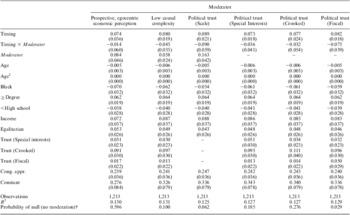
We thus analyse four separate models, each representing an opportunity to find evidence of consumption-smoothing. In none of the four models, however, do we find that timing effects are significantly differentiated by economic perceptions (results for prospective egocentric perceptions in Table 3; all other results in on-line appendix). The data, in sum, yield no indication that citizens seek to reap policy benefits at those points in time when they will yield the greatest marginal utility.
Moderation of Timing Effect on Reform Support: Economic Perceptions, Causal Complexity and Political Trust

Note: OLS estimates. Standard errors in parentheses. †The procedure for assessing the statistical significance of all moderation effects is described in fn. 35.
Uncertainty
We turn now to the possibility that temporal discounting is driven by uncertainty about the long term. As with positive time preference and consumption smoothing, we first examine this hypothesis by evaluating proposed moderators of timing's effects on uncertainty. We examine two theorized moderators: causal complexity and political trust.
Causal complexity manipulation
As described above, we experimentally manipulated the causal complexity of the policy reform within the policy brief. Within each timing condition, subjects were randomly assigned to one of two causal-complexity conditions. In the low-causal-complexity condition, the policy brief included a screen with statements that underlined the causal simplicity of the reform (see Appendix). Respondents were told that experts ‘agree the plan would be easy to carry out’ and were provided with a quotation from a social insurance specialist saying, ‘We know how to solve this problem. It's a simple matter of bookkeeping, balancing the program's income against its expenses.’ They were also told that similar reforms have been carried out in the past. The control condition was identical except for the absence of this screen. We emphasize that the low-causal-complexity treatment contained no temporal reference or cue, making no explicit link between timing and the reform's causal processes.
To recall, the uncertainty hypothesis holds that uncertainty about policy benefits derives in part from the causal complexity of the policies that produce them, and that such uncertainty increases with the delay between policy adoption and benefit delivery. By implication, the more causally complex the policy, the more vulnerable its benefits should be to the passage of time. If this hypothesis is right, then timing effects should be moderated by causal complexity: uncertainty about policy benefits – and hence support for the reform – should be less sensitive to timing in the low-causal-complexity condition than in the control.
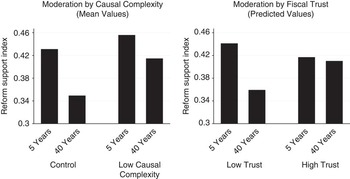
We present the raw data in the left panel of Figure 1, which plots mean values of the reform support index against timing and causal complexity (Figure 1, left panel). Two patterns are immediately apparent. First, within each timing level, mean support for the reform is, quite sensibly, higher among respondents to whom the policy is described as causally simple.Footnote 42 Secondly, and more importantly, the difference in mean support by timing condition is substantially smaller for those in the low-causal-complexity group than for those in the complexity-control. To assess this effect more precisely, we regress reform support on timing, causal complexity and their interaction, with our standard set of controls. For the complexity control condition, the regression estimates imply a drop of 0.08 in the reform support index when moving from the five-year to the forty-year level of timing (significant at the 95 per cent level); the counterpart difference in the low-causal-complexity condition is a statistically insignificant 0.03.Footnote 43 Moreover, as indicated in Table 3, the interaction between causal complexity and timing is itself statistically significant at the 0.10 level.
Moderation of timing effects on reform support by causal complexity and fiscal trust
Note: The left panel plots mean values of the reform support index, which varies from 0 to 1, within experimental conditions. The right panel plots predicted values of the index based on the coefficient estimates reported in Table 3 (Political Trust [Fiscal]).

Next, we consider a potential rival explanation of this effect. In view of the role of authoritative sources in political persuasion,Footnote 44 it could be that readers of the policy brief interpreted statements in the low-causal-complexity condition as an expert endorsement of the reform. If they took such a ‘source cue’, then perhaps subjects in the low-causal-complexity condition did not attend closely to potentially important features of the policy itself – including, but not limited to, benefit timing. Reduced attention to timing in the low-causal-complexity condition might thus explain the treatment's moderating effect.
To test this alternative explanation, we note that an endorsement cue – if it is operating – should not moderate the effect of benefit timing alone. Rather, it should generally dampen the influence of a range of determinants of reform support by directing subjects’ attention away from substantive considerations relevant to the proposed policy. If, however, we observe a moderating effect of the causal-complexity manipulation only for variables logically related to temporal discounting for uncertainty, then the uncertainty hypothesis receives significant additional support. We carry out this test by regressing support for the reform on successive interactions between causal complexity and all other determinants of support in our model. We find only one interaction effect significant at 0.10 or better.Footnote 45 Critically, this one interaction is a component of our political trust scale (the ‘special interests’ measure, described below), which is itself conceptually related to uncertainty, as theorized earlier. Rather than operating as a generalized cue, therefore, the causal-complexity manipulation has a highly specific effect: it moderates only those considerations that relate to the timing of the policy benefits and to the certainty with which they will be delivered.
In sum, given no cue about the temporal implications of the information, subjects told that the policy would be simple to carry out displayed less aversion to a delay in policy benefits than did subjects in the control group. Respondents, in other words, drew out the temporal implications of the information – and only those implications related to timing and uncertainty – for themselves. These results provide strong experimental evidence that uncertainty – specifically, uncertainty derived from the complexity of policy – is an important source of citizens’ policy bias towards the present.
Political trust
A citizen sensitive to the uncertainty of temporally distant policy benefits should respond not just to the complexity of policy but also to long-term uncertainty deriving from politics itself: the possibility that politicians tomorrow will fail to deliver on promises made today. Such uncertainty, we have hypothesized, should increase as promised benefits recede into the temporal distance. Moreover, discounting for political uncertainty should be conditioned by respondents’ levels of trust in government: we should observe the strongest timing effects among those with the lowest levels of political trust. We thus test for the effect of political uncertainty by evaluating the interaction between timing and measures of respondents’ trust in government.
As noted above, our measure of political trust is modelled on the standard, three-part ANES trust battery. The battery taps three perceptions: beliefs about the degree to which government is ‘run for the benefit of most of the people’ versus that of special interests; beliefs about the ‘crookedness’ of public office-holders; and beliefs about whether politicians ‘waste a lot of the money we pay in taxes’.Footnote 46 We begin by combining the three measures to form an additive index, and then interact this political trust index with timing. Our hypothesis implies a negatively signed interaction, with higher trust dampening timing effects. The results clearly bear out the above prediction: the coefficient estimate is negative and the effect is statistically significant at the 0.062 level (see Table 3).
We can, however, also evaluate a far more precise implication of our theorized mechanism. We do this by evaluating the relative importance of the individual components of the political trust index. If uncertainty about policy benefits is moderated by a form of trust, then it should be trust in government to undertake the type of task that the policy in question requires. The policy brief in our experiment describes a plan that would extract financial resources from citizens today, accumulate those resources over time, and use them to pay future Social Security benefits. This reform, in essence, requires government to be a reliable manager of fiscal resources. Turning to our three-part political trust battery, one of the items – asking whether politicians ‘waste a lot of the money we pay in taxes’ – comes much closer than the others to tapping trust perceptions within the relevant domain. If mass policy discounting derives from political uncertainty, then this particular disposition – which we term fiscal trust – should more powerfully moderate timing effects in our experiment than beliefs about politicians’ crookedness or favouring of special interests.
The analysis provides strong confirmation of this more precise prediction. Table 3 reports estimates of the interaction between the timing factor and the individual components of the trust scale. The two items that we expect to be the relatively weak moderators of timing effects – ‘Special Interests’ and ‘Crooked’ – yield insignificant interactions with timing by any criterion. Fiscal trust, by contrast, emerges as a strong moderator of timing effects. The coefficient on the interaction term for fiscal trust is more than double the size of the coefficients for the other trust measures. Furthermore, the interaction between fiscal trust and timing is highly significant (probability of the null hypothesis = 0.029).
We also test the robustness of this result to the inclusion of a wide range of additional controls, adding to the model interactions between timing and factors that might be both correlates of political trust and moderators of timing effects. The potential confounds tested include a range of demographic characteristics (age, gender, income, employment status, education, parental status, African-American racial identification), political predispositions (party identification, egalitarianism, orientation towards limited government), attitudes towards current incumbents (presidential approval, congressional approval), attitudes on the policy issue in question (support for Social Security spending), measures of cognitive sophistication (a political knowledge scale and an economic knowledge scale), and our four measures of economic perceptions.Footnote 47
The pattern of results is undisturbed by the inclusion of any of these controls.Footnote 48 Among other things, this result implies that our trust findings are not driven by political attitudes potentially correlated with trust, such as partisan loyalty or evaluations of the current administration or Congress. We also note that the specificity of the fit between theory and data – the strengthening of results as the measure of the logically relevant trust perception becomes more precise – considerably diminishes the probability that the relationship is driven by an omitted variable that we have not considered.Footnote 49
We present the results graphically in the right panel of Figure 1, which plots predicted values (derived from the model estimates) of the reform support index against timing and fiscal trust. Most striking is the absence of timing effects among ‘high-trusters’: the marginal effect of timing within this group is a statistically insignificant 0.007. By contrast, a shift in benefit timing from forty to five years among ‘low-trusters’ – those at the minimum of fiscal trust – increases reform support by 0.08: put differently, moving the reform's payoffs forward from 2048 to 2013 increases the average level of support among the low-trusters by 22 per cent.
This analysis brings mechanisms of temporal discounting into relatively sharp relief. The effect of timing seems to depend on individuals’ beliefs about how good politicians are at carrying out precisely the kind of task that the reform described in the policy brief would require of them. Respondents’ sensitivity to delay in the receipt of benefits appears to reflect a specific concern about what the government will do with their money while they wait.
Furthermore, these findings provide additional leverage on the alternative theories of discounting. As we have noted, timing effects are essentially undetectable among those who trust government to manage resources, leaving exceedingly limited scope for the operation of other discounting mechanisms. The reason is straightforward. If they were present, time preference and consumption-smoothing mechanisms should logically operate at full strength among high-trusters, reducing support as benefits become more temporally distant. Yet removing distrust from the equation essentially eliminates the effect of timing.
Examining Mediators: Timing Effects on Open-ended Responses
The foregoing analysis has focused on the empirical implications of each discounting theory for the moderation of timing effects by other variables. We turn now to examine evidence of the mediation of timing effects by the specific forms of temporal reasoning that each theory implies. In the light of warnings in the recent literature regarding conventional mediation analysis, we focus only on the first step in the causal chain: the predicted effect of the treatment on the mediating variable.Footnote 50 We draw on open-ended responses given by our subjects during the survey. Following the attitude questions that comprise our reform support index, we asked subjects (keyed to their last response): ‘Why do you think the reform [is/is not] a good idea? We're interested in the reasons why you [support/oppose] this plan.’ Subjects were invited to type their replies into a text box, and over 82 per cent did so. Open-ended responses were evaluated by trained coders using a detailed protocol intended to capture the range of possible considerations relevant to judging the hypothetical reform.
To allow for a test of the alternative discounting theories, we group considerations together according to their conceptual relevance to each of the theorized mechanisms.Footnote 51 For each mechanism, we then compute an index that counts the number of relevant mentions. This procedure is designed to capture the relative salience of alternative potential reasons for discounting, providing a gauge of those discounting logics that were most cognitively accessible to each subject. Each discounting theory implies that longer delay in the receipt of policy benefits should more powerfully activate reasoning relevant to that particular form of discounting. Thus, if a given discounting theory is right, then we should observe the relevant set of considerations playing a more prominent role in subjects’ judgements in the forty-year than in the five-year timing condition. For each mechanism, we estimate negative binomial regressions of the relevant index of mentions on the timing variable and our standard set of controls.
The results provide no evidence that delay in the receipt of benefits activates consumption-smoothing reasoning:Footnote 52 while a quarter of the respondents mentioned a consideration that could indicate consumption-smoothing, such mentions were unaffected by a timing condition (p = 0.941). By contrast, we find significant differences between timing conditions in mentions of considerations relevant to both the time-preference and uncertainty mechanisms. About 17 per cent of respondents mentioned time-preferential considerations, and timing's effect on the number of such mentions just passes a significance test at the 0.10 level (p = 0.096). Even more respondents – roughly a quarter – mentioned the uncertainty of future reform benefits, and the effect of timing on these mentions is clearly statistically significant (p = 0.046) and substantial in magnitude: increasing the benefit delay from five to forty years increases the frequency of uncertainty mentions by more than 25 per cent. We also note that these results are not artefacts of the difference in reform support levels across timing conditions: both effects remain significant when the analysis is limited only to reform opponents.
Eliminating Study-Design Factors
The remaining analytical question is whether some part of the observed timing effect might be explained by features of the experiment deriving from the three design dilemmas discussed previously. One threat consists of the implicit differences across timing conditions in the reform's long-term economic value (its net present value or NPV). As discussed, the reform's NPV is lower in the forty-year timing condition both because the payoffs must be discounted at the market interest rate for a longer period of time and because the reform's nominal costs, being paid at a constant annual rate over a longer period of time, are higher. Even if subjects do not calculate the policy's NPV, however, they might be sensitive to differences in the length of the cost and benefit streams: the cost stream being longer and the benefit stream shorter (given finite lifespans) for the forty-year group. For these correlations with timing to explain part of the timing effect, it is necessary for subjects to have noticed and responded to one or more of the covariates: NPV, cost-stream length, or benefit-stream length. We adduce here five types of evidence to determine whether reform attitudes were affected by these features of the reform options. Further, we explain why our findings on the mechanisms of discounting (as opposed to the size of the discounting effect) are unlikely to be affected by such confounds even if they exist.
First, to test subjects’ responsiveness to variation in NPV, we manipulated the availability of the information that would be required to estimate this quantity. As described above, orthogonally with the timing manipulation, we randomly assigned equal numbers of respondents to either a ‘numerical’ expression of the reform's benefits ($600/year in payroll tax increases and $600/year in benefit cuts avoided) or a ‘verbal’ condition, in which the tax hikes and benefit cuts avoided were said only to be ‘much larger’ than the reform's costs.Footnote 53 Thus, in the verbal condition, subjects lack a piece of information – a monetized benefit quantity – that is critical to the calculation of the tradeoff's NPV. If subjects were sensitive to differences in NPV across the timing conditions – and if that difference were driving the timing effect – then the effect of the timing manipulation should, therefore, be reduced in the verbal condition. The pattern of results, however, is just the reverse: the timing effect is more than twice as large in the verbal than in the numerical condition (interaction significant at 0.10 level; results available in on-line appendix).Footnote 54 In other words, subjects were most sensitive to timing when the tradeoff's long-run economic value was least precisely conveyed.
We next test for an NPV effect in a second way, by modelling the effect of an individual characteristic that should shape NPV calculations: subjects’ interest-rate expectations. As detailed above, NPV hinges on the value of i, the rate at which a private alternative market investment is expected to pay off. At higher levels of i, the five-year option should look relatively more attractive in NPV terms than the forty-year option because each year of delay will be discounted (for the opportunity cost of deferred income) at a higher rate of interest. Thus, if subjects are responsive to the reform's NPV, then timing effects should be greater for those with higher interest-rate expectations. Accordingly, we estimate a market interest-rate expectation for each subject based on her response to an item asking how much she believes one thousand dollars invested in the ‘average stock or mutual fund’ will be worth in a year. The item, which allowed the input of any real number, elicited wide variation: the implied interest rate has a mean of 8.2 per cent, with the 25th and 75th percentiles at −4.7 and 10 per cent, respectively (data collected prior to the market crash of autumn 2008). Despite this high variance in i, however, we find no significant interaction between i and timing. The result is the same for both a continuous implied interest rate measure and for a dichotomy distinguishing those expecting positive returns from all others (interactions significant at 0.282 and 0.272, respectively).
To summarize the findings so far, subjects were most sensitive to the timing treatment when they would have been least able to estimate an NPV. Moreover, their response to the timing manipulation bears no relationship to a critical component of an NPV calculation, the expected market rate of interest. These results strongly suggest that respondents did not engage, even intuitively, in estimates of the reform's NPV and that our timing effect cannot be explained by variation in this factor.
Next, we address the possibility that subjects – even if they did not consider the tradeoff's overall value – responded to the differing lengths of cost and benefit streams between the two timing conditions. It is conceivable, first, that subjects preferred the reform in the five-year condition because of the longer stretch of time for which benefits would be enjoyed before the end of life. To address this issue, we exploit the fact that the expected length of the benefit stream for each individual varies inversely with age within each timing condition. At a given level of timing, that is, older subjects should expect personally to enjoy a shorter stream of benefits than younger subjects. In turn, if subjects attend to the length of benefit streams, then we should find (ceteris paribus) a negative relationship between age and reform support within two groups: (a) for all respondents within the five-year timing condition and (b) for respondents under approximately age 40 in the forty-year condition.Footnote 55 Regressing the reform support index on age and appropriate controls,Footnote 56 however, we find no significant age effects for either group (within the five-year condition, p = 0.270; for the under-40s in the forty-year condition, p = 0.824.Footnote 57 We find no evidence, in other words, that subjects were responsive to the strongest and most obvious determinant of the length of the benefit stream that they could expect to receive: their own age at the beginning of that stream. It is, in turn, highly improbable that the effect of the timing manipulation derives from differences in the average length of the benefit stream.
Because the length of the cost stream varies perfectly with the timing variable, we cannot similarly isolate variation in the length of the cost stream. However, the coding of the open-ended responses, described above, allows a test of attentiveness to cost-stream length. If subjects were sensitive to the length of the cost stream, it should be because a longer stream of costs (with constant annual costs) means greater total costs. If the length of the cost stream mattered to subjects, the costs of the reform should thus have been a more salient and important feature of the policy choice to subjects in the forty-year than in the five-year condition. To examine this effect, we follow the procedure in the preceding subsection to count the number of mentions of cost considerations for each respondent. We then estimate a negative binomial regression of this quantity on timing and the standard set of controls. We note that costs were a common consideration, mentioned by roughly 30 per cent of our sample. But the extent of cost-based reasoning is indistinguishable across the timing conditions (p = 0.914). Respondents, in sum, showed no sign of sensitivity to the length of either the benefit or the cost stream, making variation in these parameters an unlikely explanation of the timing effect.
A further and critical source of leverage is the specific pattern of results for uncertainty moderators and open-ended mentions reported earlier. We make two observations about this pattern. First, if subjects were responsive to variation in NPV or in the length of streams across timing conditions, these confounds should logically operate at high levels of certainty about reform benefits: if respondents are primarily concerned about the tradeoff's economic value or about cost or benefit stream lengths, these considerations should remain highly relevant when the benefits are perceived to be certain. Thus, if the timing manipulation's effect on attitudes derives from either differences in the reform's NPV or in the length of streams, that manipulation should have as strong an effect on reform support at high levels of political trust as at low levels of trust. As we have reported, however, the effect of our timing manipulation disappears among the high-trusters, a pattern highly inconsistent with an NPV or stream-length effect.
Secondly, and more fundamentally, this article's tests of alternative mechanisms of discounting do not depend on the absence of an effect of NPV or stream lengths. Two separate analytical issues must be distinguished from one another. The first is whether part of the effect of the timing treatment derives from variation in NPV or stream length, rather than from the timing of the benefits themselves. We have presented multiple pieces of evidence suggesting that these design factors have little effect, if any, on reform attitudes. A separate and more important question, however, is whether such an effect would threaten our analysis of the sources of citizen time-discounting. In other words, if part of the timing treatment effect does derive from variation in NPV or stream length, can this fact explain away our finding of an uncertainty mechanism? We do not believe that it can. The reason is that any alternative explanation of the uncertainty results would have to account for the several relationships observed between the timing treatment and uncertainty-related variables: the moderation of timing's effect by causal complexity, the moderation of timing's effect by the most logically relevant component of political trust, and the differential in uncertainty mentions across timing conditions. Even if part of the timing treatment's ‘main’ effect derives from variation in NPV or stream length, it would nonetheless be difficult to explain this pattern of results without positing a central role for an uncertainty mechanism in the formation of citizens’ temporal policy judgements.
Conclusion
Achieving substantial long-term welfare gains or avoiding future catastrophe often requires governments to impose costs on society long before the benefits of state action arrive. How do citizens judge the intertemporal tradeoffs that such public investments require?
We find clear evidence that the mass public discounts longer-term policy benefits: our subjects were sensitive to the temporal distance of benefits, favouring a policy with more proximate payoffs over one with more distant rewards. Moreover, with the expression and prominence of information about benefits held constant, this effect of timing could not simply have been a result of the differing salience of information about short-term as compared to long-term outcomes. We have also presented evidence that the strength of this effect was independent of other formal properties of the reform that varied with benefit timing (net present value and length of cost and benefit streams). We thus infer that differences in support between the timing conditions in our experiment derive from the way in which citizens think about the timing of policy benefits. We also note that, despite a relatively strong and effective treatment, we do not find evidence of a radically myopic electorate indifferent to future policy benefits, at least when the prominence of information about those benefits is held constant. While our results thus broadly confirm common views of public attitudes as biased towards the short run, they also caution against overstating the magnitude of the electoral risks facing politicians who enact costly investments in the long term.
What, then, is the source of time-discounting in citizens’ policy attitudes? Clear and consistent evidence of the operation of one of our theorized mechanisms contrasts sharply with weak-to-no evidence for two alternatives. We detect no tendency – in either our moderation-based or first-stage mediation analyses – for citizens to seek earlier policy benefits in order to smooth consumption over time. The data also yield surprisingly little indication of the discounting mechanism that has received the greatest attention in the psychological and economic literatures on intertemporal choice: time preference. Though mediation analysis turns up some evidence of time-preferential reasoning, moderation tests across a large range of conditioning variables and alternative measures lend thin support to the impatience hypothesis. In sum, we find only modest sign that citizens care less about longer-term policy benefits strictly because they would be enjoyed at a more distant point in time.
In contrast, we find strong evidence across a diverse set of tests that uncertainty looms large in citizens’ intertemporal policy assessments. The benefits of a public policy usually lie at the end of a long and contingent chain of delegation and causation: they depend on processes of elite decision making and social dynamics that are, from the citizens’ perspective, both remote and complex. Our analyses find subjects to be highly attuned to the dangers of extending these processes over long periods of time. As revealed in their open-ended responses, respondents paid substantially more attention to the uncertainty of policy benefits as those benefits receded into the distance. And subjects’ sensitivity to the timing of policy payoffs was highest in the presence of two conditions that make the delay of benefits appear riskier: causal complexity and distrust in government. Indeed, the effects of a difference in timing of thirty-five years effectively vanished in the absence of these potential sources of uncertainty, dropping dramatically when the policy was depicted as causally simple and disappearing among those with high levels of trust in government's capacity to manage fiscal resources. To be clear, the results do not imply that these conditions for low discounting are prevalent in the real world. To the contrary, both high trust in government and perceptions of low policy complexity are likely to be relatively rare phenomena. However, the strong moderating effect of these two variables helps bring the sources of temporal discounting into sharp focus.
In demonstrating the prominent role of uncertainty in intertemporal policy attitudes, the analysis also identifies two prevalent features of democratic politics that are likely to be common sources of uncertainty, and hence important determinants of citizens’ attitudes and governments’ policy incentives. The first is the causal complexity of state action. Across a wide range of contexts, political analysts have noted a trend of rising complexity in, and interactions among, public programmes and state institutions over time.Footnote 58 Our analysis implies that this complexity leaves citizens less certain about policy effects, more sensitive to their temporal profile, and less tolerant of long-range public investments with short-run costs.
Secondly, the results point to a distinctive effect of political trust on citizen uncertainty and policy opinions. In recent years, political analysts have amassed persuasive evidence that trust has important implications for policy attitudes,Footnote 59 governmental performanceFootnote 60 and economic outcomes.Footnote 61 Scholars, however, have yet to explore possible linkages between citizen trust and timing – the ways in which the effects of trust might depend on temporal features of politics or the potential effects of trust on citizens’ intertemporal choices. This is surprising. Viewed through the lens of arguments about credible commitment, the problem of trust is primarily a problem of time: the credibility of promises matters most when exchanges between agents are non-simultaneous. Exploring this line of reasoning in the context of mass policy attitudes, our results suggest an important sense in which trust in government matters. Politicians’ capacity to invest with electoral safety will depend substantially on how credible citizens find governments’ commitments. Greater levels of public trust ought to lend officeholders greater temporal room for manœuvre, allowing them to impose a larger sacrifice on constituents today in order to generate longer-run social gains. Moreover, these results suggest a micro-level explanation of the widely observed correlation between trust and economic performance: in societies with higher levels of trust, citizens may grant their governments greater leeway to invest at short-term expense in the long-run goods – public infrastructure, education, public health – upon which economic prosperity depends.
In closing, we suggest ways in which the present line of investigation could be extended, both analytically and across policy fields. First, future studies might probe alternative responses to the dilemmas of experimental design that confront the analysis of intertemporal policy choice. While the study reported here held periodic costs and benefits and the temporal rationality of the policy constant as benefit timing varied, it would be fruitful to test the robustness of our results to alternative design choices. In particular, future investigations might choose to sacrifice control over periodic payoffs and the policy's temporal logic in order to hold the policy's net present value constant across timing conditions.
On a more substantive level, a second avenue of research would inquire further into the determinants of citizens’ sensitivity to the political uncertainty of the long run. To what extent, for instance, does citizens’ willingness to trust intertemporal policy bargains depend on features of the macro-level political setting? The literature on credible commitment would point, in particular, to the importance of institutional rules in making long-run commitments credible.Footnote 62 Future experimentation could examine whether and how the institutional locus of authority for managing a long-term policy initiative – whether authority lies, for instance, with elected officials or with an arms-length agency – moderates the effect of benefit timing on citizen support.
A third line of investigation might unpack cognitive processes to which the present study speaks only indirectly. We surmise that two factors will be especially strong determinants of intertemporal cognitions: informational salience and framing. While the salience of information was held constant in the present experiment, there is considerable variance in the vividness of information about policy outcomes in the real world. Future research could examine the degree to which voter support for investment-oriented policies hinges on the form and salience of the information about such policies’ long-run payoffs.
Likewise, intertemporal policy choices logically implicate a vast range of considerations, including both those theorized in this article (time preferences, consumption-smoothing, uncertainty, NPV) and others not discussed here (such as matters of intergenerational justice). With the supply of considerations outstripping most citizens’ computational capacities, intertemporal attitude-formation should be a prime site for framing effects. Additional experimentation could examine the extent to which alternative discounting mechanisms can be activated – or counteracted – by elite rhetorical strategies, revealing the degree to which politicians can mould public sentiments favourable to the intertemporal choices that they wish to pursue.
The text of the policy brief employed in the experiment follows. As indicated in Table 1, respondents were randomized along three orthogonal factors: timing of benefits (5/40 years in the future), benefits expression (Numerical/Verbal), and causal complexity (Low/Control). Each assignment affects multiple elements of the text. Experimental manipulations are enclosed in braces and labelled by factor.
Screen 1: THE FUTURE OF SOCIAL SECURITY: PREPARING FOR {Timing: 2013/2048}
Screen 2: HOW DOES SOCIAL SECURITY WORK? The Social Security system supports millions of senior citizens when they retire from work. All workers pay payroll taxes to fund the system. But at some point in the future, the Social Security system is expected to run into trouble.
Screen 3: WHAT IS THE PROBLEM? The problem is that the number of senior citizens receiving Social Security benefits is growing quickly. But the number of workers paying into the system is growing slowly. So Social Security's expenses are growing faster than its income.
Screen 4: WHAT IS THE PROBLEM? By the year {Timing: 2013/2048}, the system will run into financial trouble. The system will continue to pay benefits to seniors. But {Timing: 5/40} years from now, seniors will see their benefits go down while workers will see their payroll taxes go up.
Screen 5: WHAT CAN BE DONE? Many proposals are under discussion in Washington. One plan for reform would save money by raising taxes and reducing retirement benefits today. By acting now, this plan could avoid more drastic measures in {Timing: 5/40} years’ time.
Screen 6: HOW WOULD THE REFORM PLAN WORK? For the average worker, the plan would immediately increase payroll taxes by $300 a year. For the typical senior citizen, the plan would immediately cut benefits by $300 a year. These tax increases and benefit cuts would stay in place for the next {Timing: 5/40} years. The savings would build up in the Social Security system until we need the money in {Timing: 2013/2048}.
Screen 7: HOW WOULD THE REFORM PLAN WORK? By saving this money today, the plan aims to avoid a {Benefits expression : much larger payroll tax increase and a much larger benefit cut/payroll tax increase of $600 a year and a benefit cut of $600 a year} in {Timing: 2013/2048}.
{Causal Complexity: Low condition receives this slide; control condition skips to the next.
Screen 8: HOW WOULD THE REFORM PLAN WORK? Many experts have examined the reform plan, and they agree that it would be easy to carry out. Similar reforms have been adopted in the past and worked smoothly. Commenting on the plan, Dr Gerald Tickner of the Institute for Social Insurance has remarked: ‘We know how to solve this problem. It's a simple matter of bookkeeping, balancing the program's income against its expenses.’}
Screen 8/9: A DIFFICULT CHOICE Social Security's problems are {Timing: years/decades} away. But the reform plan would have real costs in the present. Many seniors and workers face financial difficulties today. This plan would make it even harder for them to make ends meet right now. The question is: Are Americans willing to pay the costs of this reform plan?
Screen 9/10: SUMMARY OF REFORM PLAN Here are the key points to keep in mind:
• Social Security faces financial trouble in {Timing: 2013/2048}
• Reform plan would immediately raise payroll taxes $300 a year and cut benefits $300 a year
• Savings now could avoid a {Benefits expression: much larger payroll tax increase and benefit cut/payroll tax increase of $600 a year and a benefit cut of $600 a year} in {Timing: 5/40} years
• {Causal Complexity: Low Condition only: Experts agree the plan would work.}