Introduction
The oocyte ability to undergo successful fertilization, cleavage and embryonic development depends on meiotic maturation and developmental competence acquisition. Aspirated pig oocytes in different germinal vesicle (GV) stages resume meiosis once they are placed in culture and reach metaphase II over a period of 32–44 h. The GV stage is characterized by intense transcription of the decondensed genome. This process enables the accumulation of RNA for the period of oocyte maturation and early embryonic development (Beux et al., Reference Beux, Richard and Sirard2003). Although most oocytes resume meiosis and progress to metaphase II after in vitro maturation, in vitro cytoplasmic maturation is generally compromised resulting in low development rates.
In a study conducted by Kubelka et al. (Reference Kubelka, Motlík, Schultz and Pavlok2000), beneficial effects of the two-step culture system were evaluated using reversible inhibition of germinal vesicle breakdown (GVBD) of bovine oocytes. This approach ensured enough time for acquisition of full meiotic competence and successful cytoplasmic maturation by the oocyte. Therefore, delayed GVBD can be achieved by the inhibition of metaphase promoting factor (MPF). Cycloheximide (CHX), a protein synthesis inhibitor in eukaryotic cells, was used for G0/G1 synchronization of swine fibroblast (Goissis et al., Reference Goissis, Caetano, Marques, Barros, Feitosa, Milazzotto, Binelli, Assumpção and Visintin2007) and to arrest GVBD through inhibition of MPF in swine oocytes (Beux et al., Reference Beux, Richard and Sirard2003). In bovine oocytes, meiotic arrest with CHX does not affect posterior oocyte and embryo development. Once inhibition has been reversed and maturation resumed, oocytes can be successfully subjected to in vitro fertilization and culture (Lonergan et al., Reference Lonergan, Fair, Khatir, Cesaroni and Mermillod1998). In a recent study, CHX was used to synchronize in vitro nuclear maturation of porcine oocytes with no impact on posterior developmental capacity (Ye et al., Reference Ye, Flint, Campbell and Luck2002). In bovine, Pavlok et al. (Reference Pavlok, Kanka, Motlik and Vodicka2000) showed that oocytes incubated with butyrolactone I (MPF inhibitor) continue RNA synthesis, which decreased only after chromatin condensation, improving cytoplasmic maturation. However, in our previous studies, butyrolactone I and CHX effectively arrested/resumed maturation; but the percentage of oocytes in metaphase II was the same in CHX and control groups, while lower in butyrolactone I group. (Marques et al., Reference Marques, Nicacio, Oliveira, Nascimento, Caetano, Mendes, Mello, Milazzotto, Assumpção and Visintin2007).
Adequate oocyte cytoplasmic maturation is essential for fertilization or activation, because mature oocytes have calcium channels of an appropriate density that regulate the influx of calcium ions after sperm penetration or artificial activation. A prolonged maturation period permits oocytes to accumulate more proteins, therefore resulting in higher activation rates. However, longer maturation periods increase the incidence of oocyte deterioration (Zhu et al., Reference Zhu, Telfer, Fletcher, Springbett, Dobrinsky, De Souza and Wilmut2002).
Determination of optimal culture conditions is still considered a priority for porcine assisted reproduction. Optimal culture conditions ensure the in vitro development of embryos with maximum viability and normal metabolic activity, resulting in cleavage, blastocyst and cell number rates similar to in vivo produced embryos (Coy & Romar, Reference Coy and Romar2002). The most frequently used medium for in vitro production of pig embryos is NCSU23 (North Carolina State University 23). It is less efficient than physiological conditions, but it produces high blastocyst rates (Coy & Romar, Reference Coy and Romar2002). However, there has been a recent increase in the use of PZM3 (Porcine Zygote Medium), composed by inorganic elements, energy substrates from pig oviduct fluid and amino acids (Yoshioka et al., Reference Yoshioka, Suzuki, Tanaka, Anas and Iwamura2002).
Studies using in vivo- and in vitro-derived cultured embryos demonstrated that development to the blastocyst stage at day 7 was similar between PZM3 and NCSU23. However, the percentage of day-8 hatched blastocysts and blastocyst cell number were higher for PZM3 cultured embryos (Yoshioka et al., Reference Yoshioka, Suzuki, Tanaka, Anas and Iwamura2002). In accordance, Yi & Park (Reference Yi and Park2005), did not demonstrate any difference between NCSU23 and PZM3 culture media for cleavage and blastocyst rates or number of blastocyst cells on day 6. Furthermore, embryos produced by parthenogenetic activation cultured in PZM3 or NCSU23 until the blastocyst stage had similar development rates and number of cells (Im et al., Reference Im, Liangxue, Liu, Hao, Wax, Bonk and Prather2004).
According to results provided by Yi & Park (Reference Yi and Park2005); 12.7 ± 1.8% and 10.3 ± 1.9% (IVF and AP, respectively) and Yoshioka et al. (Reference Yoshioka, Suzuki, Tanaka, Anas and Iwamura2002) 28% and 29% (IVF and AP, respectively), it is possible to state that results of in vitro production of swine embryos are very inconstant.
Based on these data, the objective of this study was to determine the effects of reversible meiotic inhibition and culture media (PZM3 or NCSU23) on the production of porcine embryos by either in vitro fertilization (IVF) or parthenogenetic activation (PA).
Materials and methods
Unless otherwise indicated, all chemicals used in this study were purchased from Sigma-Aldrich Chemicals.
Ovary collection, follicle aspiration and oocyte selection
Ovaries from gilts were obtained at a slaughterhouse and transported to the laboratory at 25–28°C. Follicles (2 to 5 mm in diameter) were aspirated using an 18-gauge needle attached to a 10 ml syringe and follicular fluid was transferred into 50 ml conical tubes for sedimentation. The oocyte pellet was placed in a petri dish and examined under stereomicroscope. Oocytes with a thick and intact cumulus oophorus layer and cytoplasm with homogenous granules were selected for in vitro maturation (IVM).
Arrest and resumption of nuclear maturation
Maturation medium consisted of TCM199 (Gibco) with 3.05 mM glucose, 50 IU/ml gentamycin, 0.91 mM sodium pyruvate, 0.57 mM cysteine, 10 ng EGF/ml, 10% porcine follicular fluid (pff). Oocyte meiotic inhibition was performed in maturation medium supplemented with cycloheximide (5 μg/ml) for 10 h. Maturation of the Control group (no CHX treatment) and CHX group (after 10 h of the meiotic inhibition) was performed for 22 h in maturation medium supplemented with gonadotrophins, 10 IU hCG/ml and 10 UI eCG/ml (Chorulon and Folligon, respectively; Intervet International B.V.) and 14, 18 or 22 h without hormone supplementation. Oocyte incubation was performed at 38.5°C in 5% CO2 atmosphere in air and under high humidity condition.
Experiment 1: Effect of cycloheximide on nuclear maturation
This experiment was designed as a 3 × 2 factorial arrangement of treatments to evaluate CHX and Control groups. After different maturation periods (36, 40 and 44 h), oocytes of the Control and CHX groups were denuded by repeated pipetting in PBS (without calcium and magnesium) containing 5 mg/ml hyaluronidase. Oocytes were fixed and permeabilized in 3.7% paraformaldehyde containing 0,1% Triton X-100 for 1 h, followed by 1 h incubation in PBS containing 0.3% BSA and 0,1% Triton X-100. Oocytes were then placed on glass slides, mounted with cover slips in a drop of glycerol containing 10 μg/ml Hoechst 33342 and examined under epifluorescence microscopy (Axiorvert 100, Carl Zeiss, Oberkochen, filter of maximum excitation of 365 nm and maximum emission of 480 nm) to evaluate nuclear maturation status. The experiment was replicated five times using 98–110 oocytes per treatment.
Experiment 2: Effect of cycloheximide and embryo culture media on IVF and PA preimplantation embryonic development
This experiment was designed in a 2 × 2 factorial arrangement (CHX or Control; PZM3 or NCSU23) of treatments to evaluate the effects of reversible meiotic inhibition on IVF or PA-produced embryos cultured in PZM3 or NCSU23. Considering that all production systems are different and that all oocytes subjected to IVM were used for IVF and only MII oocytes were used for PA, rates of IVF- and PA-derived embryos were not compared.
In vitro fertilization (IVF)
Boar semen (sperm-rich fraction) were obtained by the gloved-hand method and used for IVF. Semen (2 ml) were diluted in 10 ml of PBS solution (Nutricell) supplemented with 1 mg/ml BSA and 50 IU/ml gentamycin and later centrifuged at 1200 g for 3 min. The pellet containing the sperm was re-suspended in the same medium and subjected to a second centrifugation at 1200 g for 3 min. The pellet was then resuspended in IVF Tris-buffered medium (mTBM) supplemented with 2.0 mM caffeine, 0.57 mM cysteine and 1 mg/ml fatty acid-free bovine serum albumin (BSA-FAF), and centrifuged at 1200 g for 3 min. After centrifugation, sperm motility and concentration were assessed. The sediment was then re-suspended in fertilization medium.
After the maturation period described in Experiment 1 (CHX 40 h and Control 44 h), denuded oocytes were placed in 100-μl microdrops of fertilization medium and fertilized with a 3 × 10⁵ sperm/ml insemination dose at 38.5°C Then, they were kept under 5% CO2 in air and high humidity conditions for 6 h. The experiment was replicated nine times using 320–490 oocytes per treatment.
Parthenogenetic activation (PA)
Denuded oocytes with the first polar body (PB) were incubated for 1 h in TCM199 supplemented with sucrose (0.05 mol/l) and demecolcine (0.4 μg/ml) to facilitate selection. Oocytes in metaphase II (MII) were placed in a 0.28 mM manitol solution supplemented with 0.1 mM MgSO4 and 0.05 mM CaCl2 and subjected to two electric stimuli of 1.5 KV/cm DC for 30 μs (BTX–Electronic Genetics), followed by 1 h of incubation in culture medium (PZM3 or NCSU23) supplemented with 4 mg/ml BSA and 10 μg/ml CHX. After incubation, oocytes were subjected again to two electric pulses of 1.5 KV/cm DC for 60 μs. The experiment was replicated five times using 180–300 oocytes per treatment.
Embryo culture
Embryos produced by IVF and PA were washed three times in culture medium followed by incubation in 100-μl drops of culture medium under mineral oil for 7 days at 38.5°C; 5% CO2 in air and high humidity conditions. The IVF and PA groups were subdivided into two culture groups: NCSU23 and PZM3. Both culture groups were supplemented with 4 mg/ml BSA and 10 mg/ml EGF. Fresh culture medium (45 μl) was added to culture drops at days 3 and 5 after IVF or PA (feeding). Embryo development was assessed at the third and seventh day of culture to determine cleavage and blastocyst rates, respectively.
Blastocyst cell counting
In order to count blastocyst cells, IVF or PA embryos at day 7 of development (18–24 per treatment) were placed on glass slides, mounted with coverslips in a drop of glycerol containing 10 μg/ml Hoechst 33342 and examined under epifluorescence microscopy (Axiorvert 100, Carl Zeiss, filter of maximum excitation of 365 nm and maximum emission of 480 nm).
Statistical analysis
All data were evaluated using SAS System for Windows (SAS Institute Inc.). Chi-squared (χ2) test was used to analyze MII oocytes rate. To analyze embryo development, the number of cells between embryo production groups (IVF and PA) and the interaction between maturation treatment and culture media were evaluated by ANOVA using PROC MIXED. Differences between least square means were determined using the Tukey test. A significance level of 5% was considered in all analysis.
Results
Experiment 1: Effect of cycloheximide on nuclear maturation
It is possible to state that the recommence of maturation with CHX caused the acceleration of oocyte nuclear maturation because of the high number of MII oocytes after 36 h observed in CHX group [63.55% (68/107)] compared with control group 36 h (7%; 7/100).
The proportion of oocytes that reached the MII stage was higher for CHX 40 h (75.55%; 74/98), CHX 44 h (81.81%; 90/110) and control 44 h (75.5%; 77/102) than control 40 h (59%; 59/100). For IVF and PA procedures, the following maturation periods were selected: 40 h for the CHX-treated group and 44 h for the control group. The best MII rates and younger oocytes were used.
Experiment 2: Effect cycloheximide and embryo culture system on preimplantation embryonic development
No interaction of treatment with CHX and culture media was observed on cleavage (p = 0.08 and 0.92, respective for IVF and PA), blastocyst rates (p = 0.12 and 0.62, respective for IVF and PA) and total cell number of blastocysts (p = 0.56 and 0.67, respective for IVF and PA).
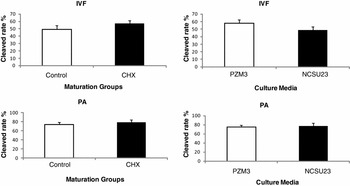
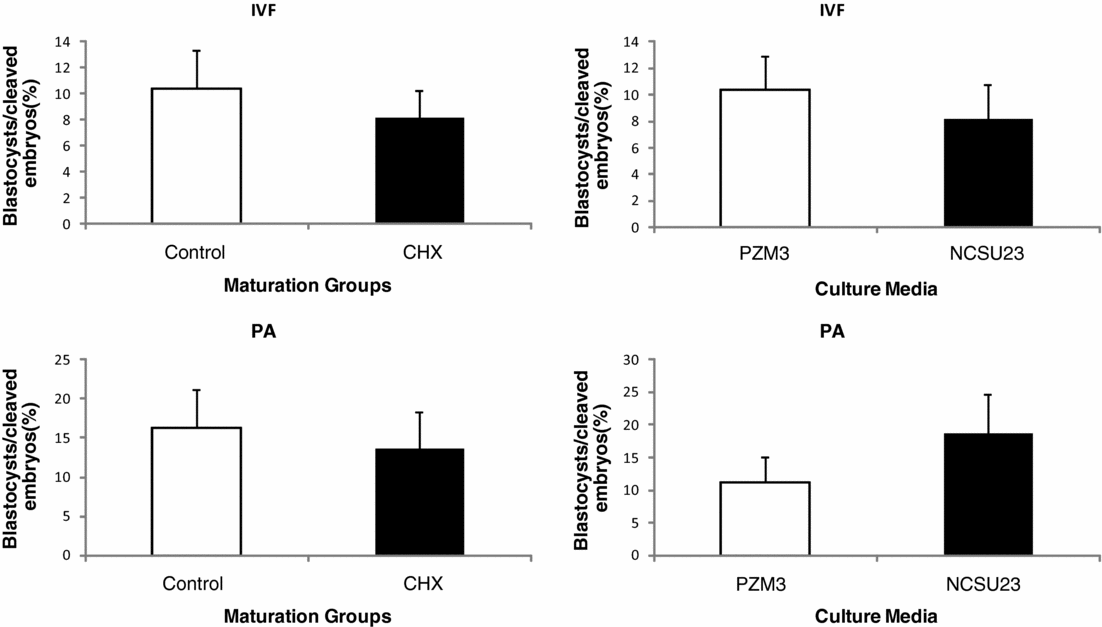
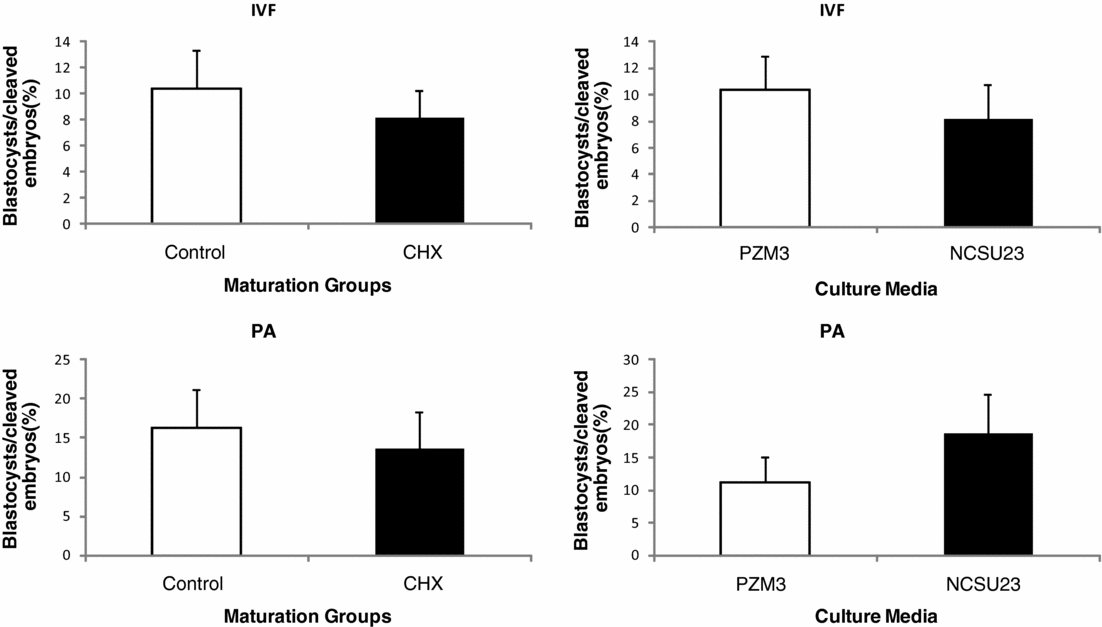
Treatment with CHX and culture media did not affect cleavage rates (D3), for both in vitro embryo production systems, IVF and PA (Fig. 1). No effect of treatment with CHX and culture media was observed on blastocyst rates (D7), for both IVF and PA (Fig. 2).
Cleavage rates for in vitro fertilization (IVF) or parthenogenetic activation (PA) after oocyte maturation with or without CHX (Control) and cultured in NCSU23 or PZM3 media. Data represent least squares (LS) means ± SEM.

Blastocysts rates for in vitro fertilization (IVF) or parthenogenetic activation (PA) after oocyte maturation with or without CHX (Control) and cultured in NCSU23 or PZM3 media. Data represent least squares (LS) means ± SEM.
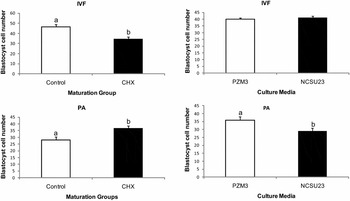
There was a negative effect of meiotic inhibition on total cell number of IVF-derived blastocysts (p = 0.0006) (Fig. 3). However, meiotic inhibition increased total cell number of PA-derived blastocysts (p = 0.0014) (Fig. 3). No effect of culture media on total cell number of IVF embryos was observed. However, for the embryos produced by PA, PZM3 showed better results (p = 0.011) (Fig. 3).
Average number of blastocyst cells produced by in vitro fertilization (IVF) or parthenogenetic activation (PA) after oocyte maturation with or without CHX (Control) and cultured in NCSU23 or PZM3 media. Data represent least squares (LS) means ± SEM. a, bMeans differ p < 0.05.

Discussion
Oocyte quality or developmental competencies are obtained during oocyte maturation. Therefore, more detailed studies of oocyte quality and of optimum conditions for in vitro maturation is extremely important. This study evaluated the impact of oocyte maturation blockage on development of pig embryos produced by IVF or PA and cultured in NCSU23 or PZM3 media.
Ye et al. (Reference Ye, Campbell and Luck2005) demonstrated that pig oocytes pretreated with CHX in order to temporarily arrest meiosis, can be successfully fertilized and develop to blastocyst stage at higher frequency than untreated oocytes. Our data do not agree with their results, but match with data that other authors have reported in bovine (Saeki et al., Reference Saeki, Nagao, Kishi and Nagai1997; Hashimoto et al., Reference Hashimoto, Kimura, Iwata and Takakura2003) as no higher blastocyst rates were obtained.
Three facts combined could explain the results on effect of CHX obtained in this article. The first factor is the acceleration of oocyte nuclear maturation caused by CHX. In previous studies (Marques et al., Reference Marques, Nicacio, Oliveira, Nascimento, Caetano, Mendes, Mello, Milazzotto, Assumpção and Visintin2007), no differences regarding VG status were observed between oocytes immediately obtained from ovaries (0 h) and after 10 h of CHX blockage. In this study, we obtained a higher rate of MII oocytes in CHX group at 36 h. This finding is in agreement with other authors (Beux et al., Reference Beux, Richard and Sirard2003), which demonstrated that porcine oocytes that resumed maturation after CHX arrest reached MII stage at 24 h of maturation, while control, butyrolactone I and roscovitine groups did not.
This effect is also observed in bovine (Saeki et al., Reference Saeki, Nagao, Kishi and Iritani1998). In this species CHX-treated oocytes showed accelerated nuclear maturation and reached complete maturation 8 h sooner than control group. At 16 h of maturation, CHX-treated oocytes were in MII while control oocytes still were in MI.
Maturation interval was shorter in the CHX-treated group due to accelerated GVBD (Saeki et al., Reference Saeki, Nagao, Kishi and Iritani1998). Oocytes subjected to maturation arrest with CHX achieved the mature stage earlier than the control group because CHX did not completely prevent chromatin compaction. Therefore, in the absence of CHX a faster nuclear membrane breakdown increased the rate of oocytes that reached MII. Thus, at the moment of IVF or PA, even choosing a short maturation period (40 h) at CHX group, it is possible that most oocytes were already aged because they reached mature state before 36 h.
The second factor is that oocyte age could have played a role in oocyte activation. Complete nuclear and cytoplasmic maturation is essential for proper oocyte activation (Bing et al., Reference Bing, Che, Hirao, Takenouchi, Rodrigues-Martinez and Nagai2003). When compared with oocytes that underwent longer maturation periods (44 h), young oocytes presented higher concentration of MPF. Leal & Liu (Reference Leal and Liu1998) described that there is an age dependency on the ability of oocytes to be activated; aged oocytes invariably activate easier than those taken immediately after reaching metaphase II, because aged oocytes tend to contain lower MPF activity which facilitates activation. Considering this fact, we are able to explain why a maturation arrest improved the number of cells in parthenotes. Although no effect of CHX-maturation on cleavage and blastocysts rates were observed, we obtained higher quality blastocysts. Thus, maturation arrest with CHX is recommended in oocytes that will be used for nuclear transfer, since it improves cell number of parthenotes.
The third factor is that older oocytes are more susceptible to polyspermy after IVF (Grupen et al., Reference Grupen, Nagashima and Nottle1997). As polyspermy was not evaluated in this study, we deduce that at the time of CHX treatment, oocytes were older, what could have increased the rate of polyspermic oocytes. According to Abeydeera (Reference Abeydeera2002), blastocysts obtained from oocytes with more than two pronuclei presented reduced number of cells, especially in the inner cell mass, when compared with oocytes with two pronuclei. In the current study, meiotic inhibition decreased the number of cells in the IVF derived blastocysts.
In this experiment as in Yoshioka et al. (Reference Yoshioka, Suzuki, Tanaka, Anas and Iwamura2002) and Im et al. (Reference Im, Liangxue, Liu, Hao, Wax, Bonk and Prather2004), no culture medium effect over embryo number of cells was observed for both systems (IVF and PA). According to these authors, PZM3 was more effective only in a low O2 atmosphere, with higher embryo development potential and higher number of embryo cells than NCSU23. The average number of blastocysts cells at day 7 was 49.41 ± 18.42 at NCSU23 group. Coy & Romar (Reference Coy and Romar2002) used the same fertilization media and NCSU23 media for in vitro culture, obtained day-7 blastocysts with 20.5 ± 8.5 cells similar to the quality of embryos produced in our study.
In conclusion, the CHX treatment for 10 h followed by oocyte maturation for 40 h is an efficient protocol to produce high quality parthenogenetic embryos, especially when they are cultured in PZM3. However, this protocol is not satisfactory for IVF embryos production. In this case, a shorter maturation period could provide better embryo quality.
Acknowledgements
The authors thank Camila Infantosi Vannucchi, Fabíola F. Paula Lopes and Flavia Regina Oliveira de Barros for critical reading of the manuscript. Also, Marcelo Demarchi Goissis at Michigan State University for English revision. Financial support was provided by FAPESP.