Introduction
Korsakoff's syndrome (KS) is a neuropsychiatric disorder characterized by severe amnesia that is caused by alcoholism and thiamine (vitamin B1) deficiency (Kopelman, Reference Kopelman1995). KS often develops in self-neglecting alcoholics; therefore, additional somatic disorders are frequently present (Sechi and Serra, Reference Sechi and Serra2007). In alcoholics, the prevalence of the KS neuropathology lies between 12% and 15% (population: between 0.04% and 2.1%) (Zahr et al., Reference Zahr, Kaufman and Harper2011; Kril and Harper, Reference Kril and Harper2012). Due to their cognitive deficits, KS patients are often in need of lifelong care. Specialized facilities for KS patients have been demonstrated to be beneficial for social and cognitive functioning of KS patients compared to traditional psychogeriatric nursing homes, but are relatively scarce (Blansjaar et al., Reference Blansjaar, Takens and Zwinderman1992). Therefore, many patients with KS are repeatedly admitted to addiction centers or regular nursing homes (Popoola et al., Reference Popoola, Keating and Cassidy2008).
Very limited literature exists on the care and course of patients with KS living in specific long-term care facilities. Also, the reports on the psychological well-being in KS are minimal in number. This while a recent study on the characteristics of care for KS patients in a long-term care facility suggests that a lack of systematic reports on behavioral symptoms in KS will contribute to an overuse of psychotropic drugs in patients with KS (Gerridzen and Goossensen, Reference Gerridzen and Goossensen2013). Quality of Life (QoL) of institutionalized patients has become increasingly recognized as an important clinical and policy concern, but little is known about progression of QoL in patients with KS that live in specialized long-term care facilities. Recently, KS patients were found to show differences in their QoL compared to elderly dementia patients (Oudman and Zwart, Reference Oudman and Zwart2012). KS patients tended to have more social relationships and positive emotions and showed less restless behavior than dementia patients. However, KS patients felt less at home in a long-term care facility than dementia patients. To date, multiple studies have been performed on the change in QoL over time in dementia. Results indicate either a small decline over time (Lyketsos et al., Reference Lyketsos, Gonzales-Salvador, Chin, Baker, Black and Rabins2003; Vogel et al., Reference Vogel, Bhattacharya and Waldorff2012), a relatively stable QoL (Selwood et al Reference Selwood, Thorgrimsen and Orrell2005; Missotten et al., Reference Missotten2007; Hoe et al., Reference Hoe, Hancock and Livingston2009) or an increase in QoL (Funaki et al., Reference Funaki, Kaneko and Okamura2005). A recent review suggests that factors that contribute to evolution of QoL in dementia are cognition (self-rated quality of life), mood (self-rated and proxy-rated QoL), and dependency (proxy-rated QoL) (Beerens et al., Reference Beerens, Zwakhalen, Verbeek, Ruwaard and Hamers2013).
A large deal of papers on QoL in dementia applied proxy-based measures of QoL (Missotten et al., Reference Missotten2007). The current study investigated QoL in KS. Deficits in decision making and memory affect the reliability of QoL self-reports in KS (Brod et al., Reference Brod, Stewart, Sands and Walton1999; Egger et al., Reference Egger, Wester, De Mey and Derksen2002); moreover, there is currently only one proxy-based study on QoL in KS available (Oudman and Zwart, Reference Oudman and Zwart2012); therefore, a proxy measure of QoL is applied in the current study (Bouman et al., Reference Bouman, Ettema, Wetzels, van Beek, de Lange and Droës2011). To our knowledge, systematic longitudinal reports on QoL of KS patients in long-term care facilities are currently not available. The aim of the current study was to investigate different aspects of QoL in KS in a follow-up study, to increase understanding of social and emotional well-being in patients diagnosed with KS in a long-term care facility.
Stabilization of emotional and cognitive decline is an important objective of long-term care facilities in the care for KS patients and neuropsychiatric patients in general (de Lange et al., Reference de Lange, Meertens and Smits2001). Therefore, it was hypothesized that QoL remains stable over time.
Methods
Participants
Study participants were 72 patients with KS living in two long-term care facilities for KS patients in the western part of the Netherlands. Both facilities are expertise centers for long-term Korsakoff care. The facilities cooperate in a larger Dutch center for innovation in Korsakoff's syndrome called “Korsakoff Knowledge Center.” All patients in the original cohort fulfilled DSM-IV criteria for alcohol-induced persisting amnestic disorder and the criteria for KS described by Kopelman (Kopelman et al., Reference Kopelman, Thomson, Guerrini and Marshall2009). The amnestic syndrome was confirmed by neuropsychological testing and multidisciplinary diagnostics. In total, 33 patients from the long-term care facilities were not included in the original sample of 72 patients that were enrolled in the study, because of known brain abnormalities that were at odds with the diagnosis KS (i.e. tumor, trauma, infarction). In addition to diagnosis, standard socioeconomic information, alcohol use history, neuropsychological data, and time at the long-term care facility were obtained. The follow-up study was conducted approximately 20 months after the baseline assessment. The residents in the original study who were still living in their original long-term care facilities were reassessed.
Design and measures
A quantitative cross-sectional longitudinal design was adopted to investigate evolution of QoL in KS. The following data were retrieved from patients’ administration files and medical charts: demographic data, Body Mass Index, admission dates, and estimated average consumption of alcohol per day in milliliters (prior to admission). Years of Educations was scored using seven categories for the Dutch Educational System: 1 = lowest (less than primary school), 7 = highest (university degree) (Verhage, Reference Verhage1964). General cognitive functioning was assessed with the Mini-Mental State Examination (MMSE; Folstein et al., Reference Folstein, Folstein and McHugh1975; Kok et al., Reference Kok, Verhey and Schmand2004) and the Word-Fluency Animals (Mulder et al., Reference Mulder, Dekker and Dekker2006). The QUALIDEM is a validated and reliable QoL instrument developed for patients with cognitive disorders in residential settings and is currently an appropriate instrument for evaluating QoL in patients with cognitive disorders (Ettema et al., Reference Ettema, de Lange, Dröes, Mellenbergh and Ribbe2005a; Reference Ettema, Dröes, de Lange, Mellenbergh and Ribbe2005b; Reference Ettema, Dröes, de Lange, Mellenbergh and Ribbe2007a; Reference Ettema, Dröes, de Lange, Mellenbergh and Ribbe2007b). The multidimensional behavior observation scale contains 37 items allocated to nine subscales: “care relationship,” “positive affect,” “negative affect,” “restlessness tense behavior,” “positive self-image,” “social relations,” “social isolation,” “feeling at home,” and “having something to do.” The internal consistency reliability coefficient of QUALIDEM has been assessed in multiple samples of long-term care residents and has been found to be in the 0.70 to 0.80 range (Ettema et al., Reference Ettema, Dröes, de Lange, Mellenbergh and Ribbe2007a; Reference Ettema, Dröes, de Lange, Mellenbergh and Ribbe2007b; Bouman et al., Reference Bouman, Ettema, Wetzels, van Beek, de Lange and Droës2011). In the current study, the QUALIDEM showed a reliability of 0.85. At the start of the project, all members of the care staff were instructed on scoring the QUALIDEM based on the instruction guide. The inclusion criteria for the care staff were as follows: All nurses had to be the primarily responsible nurse for the resident. In addition, a close relationship with the assessed resident was needed, as reflected by being primarily responsible for the care plan of the resident. Moreover, nurses had to be at work on the most days within the last month prior to data collection to establish a close relationship with the resident being assessed.
The staff were instructed to score the 37 items of the QUALIDEM on a 4-point scale (never, seldom, sometimes, and often) with two nurses on one score sheet based on the instruction of the manual, after observing the participant for two weeks. The score on each subscale was linearly transformed from 0 to 100, such that higher scores reflect a better QoL. The scores on all subscales were than averaged to reflect a general parameter for QoL (Oudman and Zwart, Reference Oudman and Zwart2012).
Data analysis
The current study reports descriptive findings regarding QUALIDEM scores at baseline (T1) and 20-month follow-up (T2). Differences between T1 and T2 on the subscales were tested using non-parametric within-subjects Wilcoxon Signed-Rank Tests (U), since the normality assumption was violated for four of the nine subscales (Positive self-image, Social isolation, Negative affect, and Restless tense behavior). We displayed the distributions in QUALIDEM subscale scores with their 95% confidence interval. Furthermore, baseline-corrected Pearson's correlation coefficients (r) were calculated for the subscale scores that significantly changed over time. For the statistical analysis, a two-tailed p value less than 0.05 was considered statistically significant. Analysis was performed using Statistical Package for the Social Sciences (SPSS) version 17.0 (SPSS Inc., Chicago, IL).
Results
Demographics
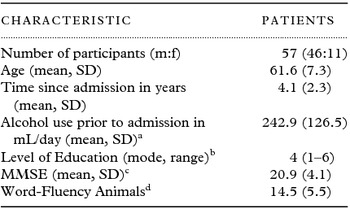
Of the initial 72 patients included at baseline, seven patients had died (9.7%), four patients had been discharged to a different long-term care facility (5.6%), and for four patients the follow-up assessment was not available (5.6%). Therefore, the final study comprised 79.2% of those still alive (57 participants). General characteristics of these KS patients are displayed in Table 1. The KS patients in baseline assessment had an average age of 61.1 (SD 8.2), while the average age in the 20 follow-up assessment was 61.6 (SD 7.3). The KS group consisted for 13.9% of woman in the baseline assessment and for 19.3% in the follow-up assessment. 95% of the participants in the baseline assessment was widowed or unmarried, while this was 91.3% in the follow-up. All participants that were admitted did stay in the long-term care facility in the period between T1 and T2.
Demographic variables and neuropsychological test results for the Korsakoff's patients at T1 (n = 57)

Note. n = number; m = male; f = female; SD = standard deviation; mL = milliliter; MMSE = Mini-Mental State Examination; IQ = intelligence quotient.
aAlcohol use prior to admission was assessed by the responsible physician at time of admission. Alcohol consumption was converted to mL/day for 27 participants. For the remainder of participants, no absolute values were present, but all scored in the “alcohol abuse” range, according to DSM-IV.
bEducational level was scored using seven categories: 1 = lowest (less than primary school), 7 = highest (university degree). Data were available for 51 participants (Verhage, Reference Verhage1964).
cThe standardized Dutch version of the Mini-Mental State Examination was available for 38 participants (Kok et al., Reference Kok, Verhey and Schmand2004).
dWord-Fluency Animals (one minute), raw score was available for 39 participants (Mulder et al., Reference Mulder, Dekker and Dekker2006).
Change in quality of life scores over time
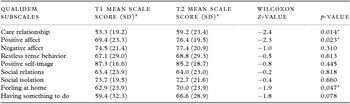
Patients scored statistically significantly higher on “Positive Affect,” “Care Relationship,” and “Feeling at Home” in the follow-up compared with the baseline score. There was also a trend toward a significant increase on “Having something to do.” Table 2 displays the average QUALIDEM scores per subscale and statistical analyses.
Observed quality of life in Korsakoff's syndrome (n = 57) at baseline (T1) and after 20 months (T2). Results indicate an increased care relationship, positive affect, feeling at home over time in Korsakoff's syndrome patients. Having something to do showed a trend toward a significant increase

Note. KS, Korsakoff's syndrome; SD, standard deviation; n = number.
aQUALIDEM mean scale scores range: 0–100, higher scores indicate a better quality of life.
*p < 0.05.
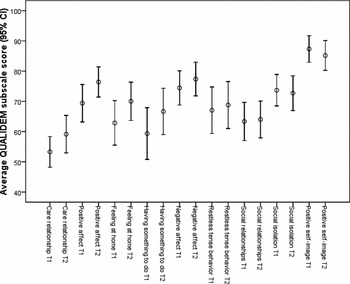
The other five subscales were not statistically significantly different between T1 and T2 (see Table 2 for statistics). Figure 1 displays the distributions in QUALIDEM subscale scores in the form of the average score per subscale (with 95% confidence interval) at T1 and T2. The subscales are ordered based on the T-value that reflected the change between T1 and T2 (see Table 2). It could be inspected that all QUALIDEM subscales show quite large variations in the 57 study participants.
Line graph of the average subscale scores (with 95% CI) on the QUALIDEM in 57 patients diagnosed with Korsakoff's syndrome.

Correlational analysis
To further investigate the nature of change in QoL, we performed additional correlations on the four subscales that significantly increased over time, controlling for the baseline assessment. Results are displayed in Table 3. “Having something to do” shows a weak positive association with “Positive Affect.” “Care Relationship” is weakly related to “Positive Affect” and “Feeling at Home.” The results suggest that changes in QoL of KS over time are inter-related, although the inter-relation is relatively small. Results are further elaborated in the discussion.
Pearson's correlations between the subscale scores on T2, corrected for T1, in QUALIDEM subscales that showed an increase over the 20-month period (n = 57 patients diagnosed with Korsakoff's syndrome; df = 53)

Note. *p < 0.05, **p < 0.01, ***p < 0.001.
Discussion
To our knowledge, this is the first study that investigated whether QoL in KS remains stable over time in a long-term care facility. Because it is difficult to evaluate QoL in patients with cognitive deficits, we used the QUALIDEM, a proxy-based assessment tool for QoL. The QoL for the participants in the current study suggests a relatively stable QoL in KS as a group over a 20-month period. Patients with KS scored significantly better in the follow-up on the QUALIDEM subscales “Positive Affect,” “Care Relationship,” and “Feeling at Home.” There was a trend toward a significant increase in “Having something to do.” The changes in QoL were relatively minor and the extent varied within the patient group.
The results of the current study suggest that KS patients tend to show a stable, moderate-to-good QoL in a long-term care facility. Based on the relatively unstable lives that led to this severe disorder, it could be expected that patients showed a much lower QoL (see, e.g. Sechi and Serra, Reference Sechi and Serra2007 and Kopelman et al., Reference Kopelman, Thomson, Guerrini and Marshall2009 for a clinical description of the syndrome). Specific increases in subscales were therefore also unexpected. In clinical observations, it was striking that a positive change in “Positive Affect” and “Care Relationship” was sometimes a reflection of the ability to positively influence the mood of the patient by members of the care staff. We therefore suggest that a reciprocal relationship between the patient and the member of the care staff is influential on the emotions and well-being of the KS patient.
The results of the present study on KS are discrepant from findings of declined QoL in dementia over time (e.g. Lyketsos et al., Reference Lyketsos, Gonzales-Salvador, Chin, Baker, Black and Rabins2003). Although there are similarities between KS and dementia in the severity of the amnesia and the frequency at which additional somatic disorders are present (Sechi and Serra, Reference Sechi and Serra2007), KS patients do not experience the same cognitive decline as patients with dementia and show a different profile on measures of QoL (Fujiwara et al., Reference Fujiwara, Brand, Borsutzky, Steingass and Markowitsch2008; Oudman and Zwart, Reference Oudman and Zwart2012). Moreover, the mortality of KS patients in the current study was much lower (9.7% in 20 months) than in a comparable study in dementia (50.8% in 24 months) (Lyketsos et al., Reference Lyketsos, Gonzales-Salvador, Chin, Baker, Black and Rabins2003). The findings of the current study therefore support the view that both patient groups are in need of different types of care (Oudman and Zwart, Reference Oudman and Zwart2012). We stress that it would be relevant to compare the results of the current study with other study samples (e.g. early-onset dementias), however, such studies are currently lacking in the literature. More research into specific groups of patients that are in need of long-term care is therefore highly recommended.
In the current study, relatively minor, but significantly higher group scores on the subscales “Positive Affect,” “Care Relationship,” and “Feeling at Home” could possibly be explained by the client-centered care that was applied in the long-term care facilities enrolled in the current study. As an inherent part of the long-term care for patients with KS, patients have the opportunity to discuss their wishes and desires in a multidisciplinary team consisting of a physician, a psychologist, an occupational therapist, a physiotherapist, and a primary responsible nurse. Moreover, roadmaps to handle patients with KS were weekly discussed and adjusted in meetings with the care staff that were responsible for the care of the KS patients in supervision of a psychologist. It could also be argued that patients will get adopted over time to their specific circumstances. The correlational results do suggest inter-relations between the changes of QoL, reflecting that changes are likely to show a more general tendency of development in QoL of KS.
As earlier research suggested, KS patients do not feel at home in a long-term care facility compared to dementia patients (see Oudman and Zwart, Reference Oudman and Zwart2012). The results of the current study show that there is a small increase in “Feeling at home” for patients with KS over time. Importantly, the total score on this subscale is still lower than in a study population of dementia patients (Ettema, et al., Reference Ettema, Dröes, de Lange, Mellenbergh and Ribbe2007a; Reference Ettema, Dröes, de Lange, Mellenbergh and Ribbe2007b; Oudman and Zwart, Reference Oudman and Zwart2012). Moreover, the change in “Feeling at home” was not related to any other significantly changed characteristic of QoL, showing that whether KS patients have the tendency to reflect that they like to stay in a long-term care facility is independent of other QoL characteristics. An important strength of the current study is the homogeneity of the study sample. All patients that were included in the study had a history of chronic alcohol abuse and thiamine deficiency and lived in a long-term care facility for KS patients. Moreover, the current study has a reasonable sample size and is one of the first exploratory behavioral studies on well-being in KS. This study also has limitations. First, our study had a 20-month follow-up. Initially, it was planned to follow-up after 18 months, but because of time constraints the follow-up was delayed. Nevertheless, we suggest that the results of the current study contribute to the very little information that is currently available on patients with KS in long-term care facilities. Second, it would have been relevant to the literature on QoL in KS to include predictors of change in QoL in our study. Since the number of participants that were enrolled in the baseline was relatively small and did not involve more information than standard demographic variables, we chose not to include possible speculations on predictors of QoL in KS. Third, we chose for a proxy-based scale to index QoL in KS. It could be argued that a self-report scale would be more relevant than a proxy-based scale. However, results on earlier assessments of personality traits in KS patients showed that if patients with KS do self-report, they show an extraordinary flat profile, merely reflecting a lack of illness insight than personality traits (Egger et al., Reference Egger, Wester, De Mey and Derksen2002). Nevertheless, it would be very relevant to study self-report scales and their inter-relation with proxy-based scales in KS. Moreover, although we are not certain about the reliability and validity of the self-reports of QoL in KS, it could be recommended to discuss the different aspects of QoL that are indexed by the QUALIDEM in interaction with the patient. Fourth, the current study reflects the development of QoL in a specific study sample, namely patients with KS that live in a long-term care facility. It could be argued that QoL does change differently over time in a different setting. Ideally, QoL instruments should be tested in different environments. Fifth, we did not have the opportunity to index neuropsychological functioning at the start and at the end of the project. Based on earlier research, we know that neuropsychological functioning remains relatively stable for a prolonged time in KS (Fujiwara et al. Reference Fujiwara, Brand, Borsutzky, Steingass and Markowitsch2008), however, including repeated neuropsychological testing in future studies on the evolution of QoL in KS could lead to relevant information regarding the inter-relation between cognitive decline in KS and change in QoL.
Conclusions and recommendations
QoL in KS remains stable over time in a long-term care facility, but increased on specific aspects of QoL. Results do suggest that prolonged stay in a long-term care facility for KS patients does not inherently have a negative effect on QoL. This study forms an initial starting point into the investigation of QoL in KS. More research is highly recommended, specifically on the factors that contribute to a change in QoL in KS.
Conflict of interest statement
The authors declare to have no conflict of interest.
Description of authors’ roles
Both authors contributed equally.