During his visit to East Germany for the Bachfest in 1983, New York Times reporter Michael Levin dreamed of the potential in Leipzig's ‘exuberant classical architecture that still dominates the monotony of more recent offices and housing blocks’. In his eyes, this better past had been buried under city-wide decay from communist misrule, which he imagined was yielding ‘the drab, sad resignation of people in the streets to a hundred bureaucratic barriers and government entanglements’.Footnote 1 Six years later, Leipzigers disproved allegations of ‘sad resignation’ when they turned out by the tens of thousands to end communist rule. What had citizens in this future capital of the 1989 Revolution been thinking when Levin had watched them trudge through their deteriorating neighbourhoods back in 1983? How did they transform from such apparent passivity into the dynamic civic activists of the fall 1989 Monday Demonstrations?
In telling the story of an illegal bowling alley – built by restive local officials with free labour from a frustrated populace – this article unpacks the real existing interrelationship between state organs, local party bureaucrats and engaged citizens less than three years before Leipzig rebelled against the ‘democratic centralism’ that reigned from the politburo in Berlin. Western reporters were hardly alone in their surprise when Leipzigers marched in 1989. Neither the reigning Socialist Unity Party (Sozialistische Einheitspartei Deutschlands; SED) nor even the public had expected a revolution. But after four decades of disappointments from on high, Leipzigers had lost any remaining belief that SED authorities in Berlin really cared about them or their city's past, present or future. This was especially the case in the depressing urban environment, which wove together public grievances about pressing economic, environmental and political crises. Just days before the fall of the Berlin Wall, the first free East German documentary film scandalised the country with interviews from outraged residents and footage exposing the desperate condition of Leipzig's expansive historic neighbourhoods. It was not just rhetorical that the film was called ‘Can Leipzig Still be Saved?’Footnote 2
State–civic relations in 1989 stood in stark contrast to those when the East German state had formed four decades before. Right after the Nazi catastrophe, war-weary residents had expressed general goodwill for giving socialism a chance to rebuild; they had issued numerous creative proposals to city leaders and actively participated at urban planning exhibitions. Throughout the 1960s, however, both state and local leaders had killed belief in building a socialist future by pushing through demolitions hostile to consistent and outspoken public concern. This had peaked with the brazen dynamiting of Leipzig's intact Gothic University Church in 1968 against sustained broad-based popular opposition – the largest protest experience in East Germany between the 1953 Uprising and 1989 Revolution.Footnote 3
The resulting malaise of discontent and disengagement worsened as often mediocre modernism in the urban core was surrounded by accelerating decay – in no small part a consequence of the Honecker administration's diversion of resources to prefab blocks in new suburbs, as well as the growing drain of funding, materials and skilled labour to build showpieces in the capital. Among numerous indicators, interviews by Leipzig sociologist Alice Kahl revealed dissatisfaction with living conditions in sterile prefab high-rise settlements and homesickness for the communities that residents had once enjoyed in historic neighbourhoods.Footnote 4 By the 1970s local officials were promising the people a pleasing synthesis between modern and historic construction, but they repeatedly failed to deliver. Formation of local preservation organisations in the 1970s likewise failed to stem public disenchantment due to immense funding shortfalls. Hopes were so low by the late 1980s that the East German Cultural League (Kulturbund) begged its Leipzig division to at least cover the historic iron Könneritz bridge with a new coat of paint, lest it rust into oblivion.Footnote 5 Similarly, although the Honecker administration had raised hopes for greater investment in recreational pursuits, funds continued to diminish for both the ‘high-brow’ venues favoured under socialist realism and everyday ‘low-brow’ spaces for popular fun.Footnote 6
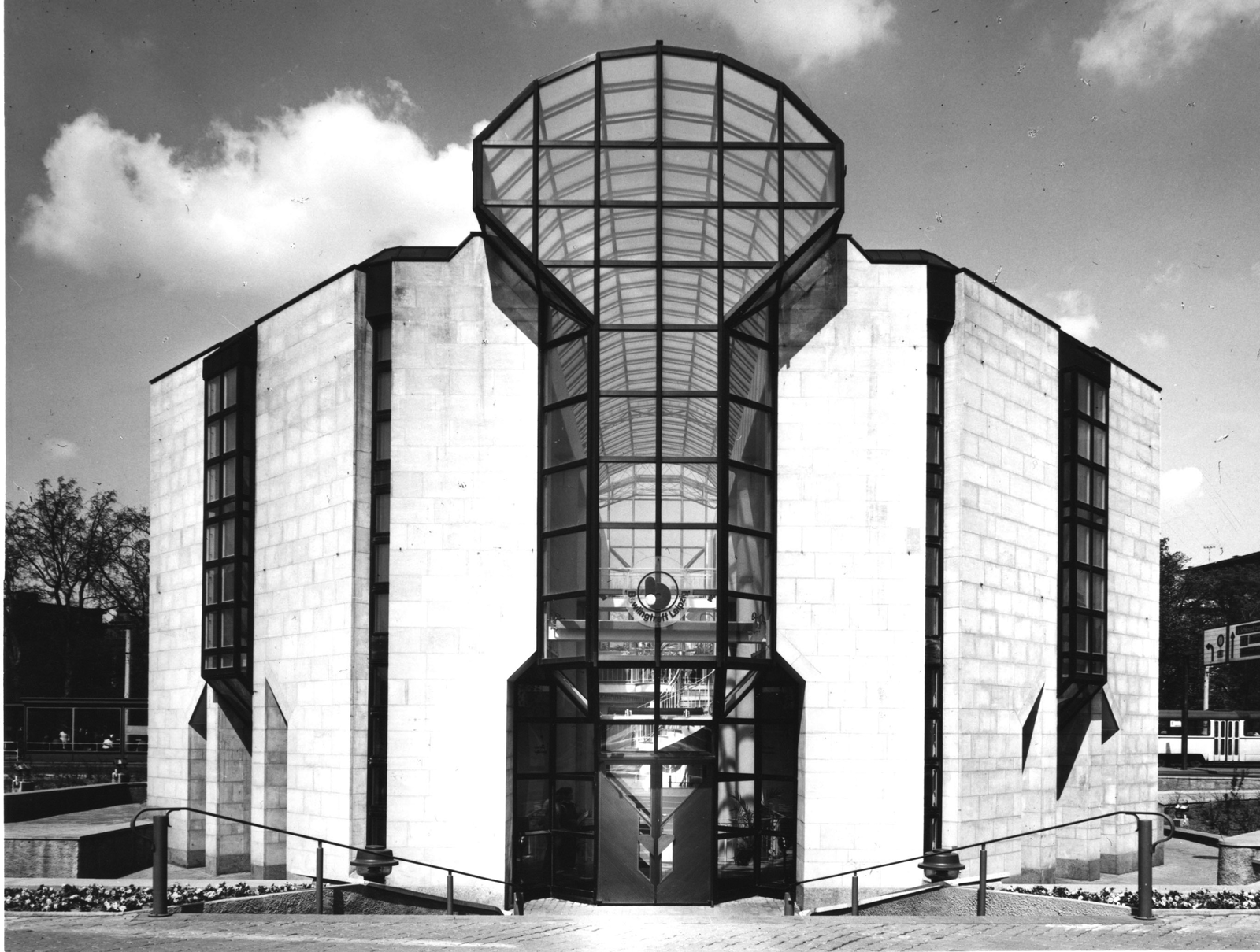
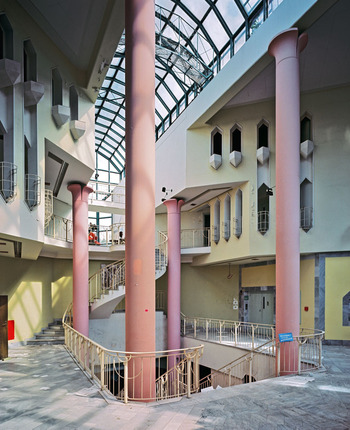
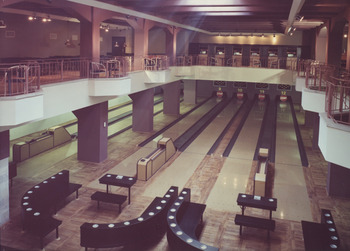
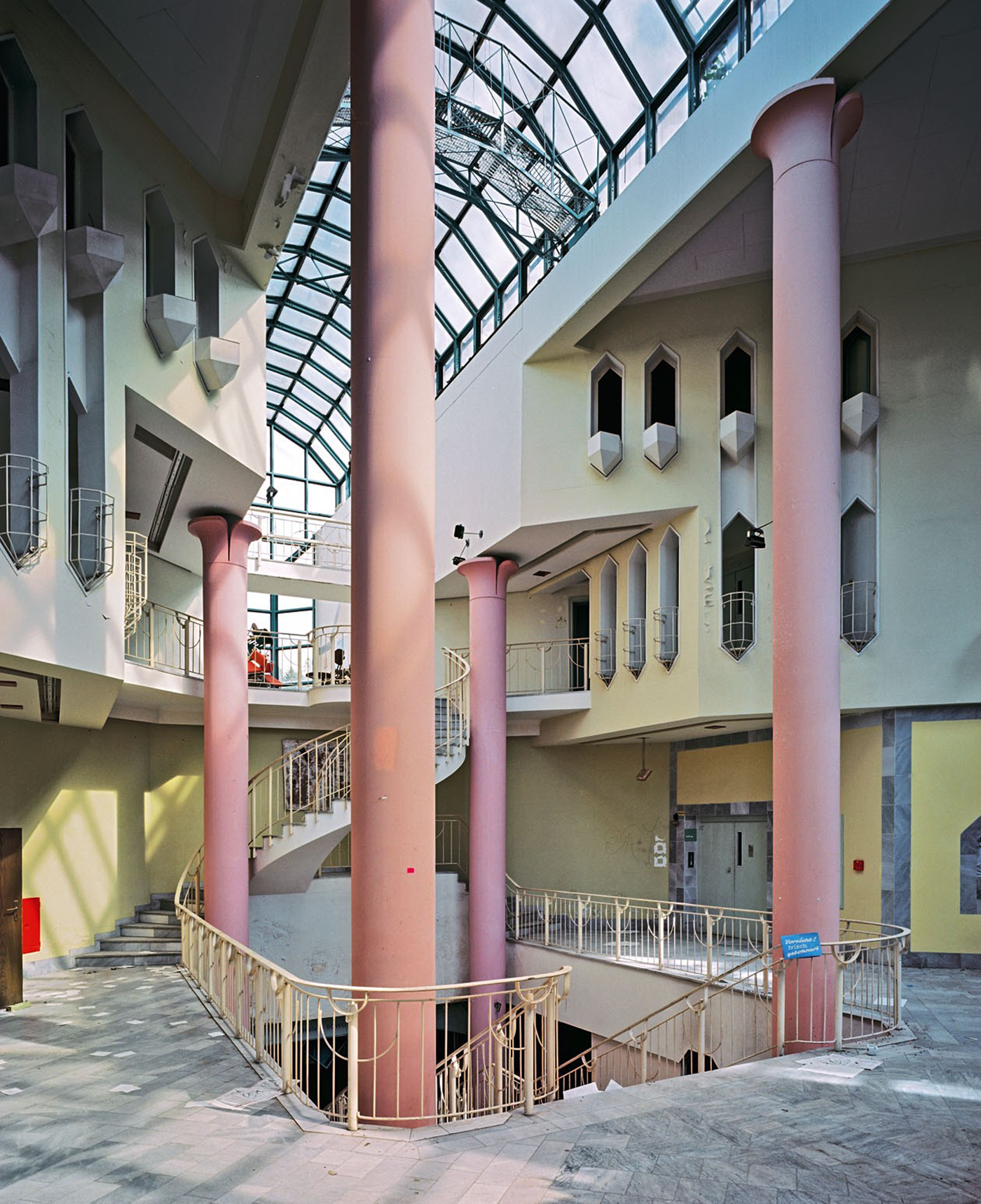
Then, on 25 July 1987 the disaffected residents of East Germany's second-largest city received a state-of-the-art recreational centre with fourteen bowling lanes, a fitness centre, five billiard tables, six Poly-Play video game machines and 310 seats at various cafes, restaurants and bars.Footnote 7 It contrasted sharply with the rapid decay of a surrounding urban centre that languished under a film of brown coal dust, and it was alien to the cheap monotony of endless rows of ‘Plattenbau’ prefab apartment blocks that were spreading from the periphery into the historic core. At last, in this elegant glass-and-sandstone People's Bowling Palace – with its oak parquet and marble floors, pink Egyptian-themed pillars and broad stairways that descended into a repurposed subterranean power station – the weary populace could find a place to play. Even though regime propaganda of ‘work with us’ (mach mit) had long since lost its ideological appeal, 6,675 Leipzigers contributed 40,050 hours of volunteer labour to ensure that this new ‘Bowlingtreff’ took shape in only fourteen months and without knowledge from central authorities in Berlin until the very end. How did local authorities win such profound public involvement to ‘build socialism’ on the very eve of the 1989 Revolution? What can this incident of apparent optimism tell us about the evolution of state-citizen relations in the final years of East Germany? (See Figure 1.)
Bowlingtreff Exterior, circa 1987

At the opening of the Bowlingtreff on 25 July 1987 Rolf Opitz, the powerful chairman of the Leipzig district (Bezirk) council, framed the whole affair in terms that would have suited ‘ostalgic’ yearnings by post-communist characters in the 2003 film Goodbye Lenin.Footnote 8 Celebrating close and collegial coordination between the district and city councils, 110 firms at the building site and ample volunteer labour, he professed: ‘fourteen months ago as construction started, hardly anyone suspected that, from grey and dreary [underground] spaces, such an architectural gem could ever come into being; it bears such obvious witness to the imagination of our architects, their creativity and sense for what is economically possible’.Footnote 9 In 1980s Moscow or Leningrad residents could descend to palatial metro stations; in Berlin, people could celebrate life in the Palace of the Republic or stroll through the city's ‘new old town’ in the Nikolai quarter. Now, at last, local communist officials had triumphed over the ‘bureaucratic barriers and government entanglements’ Levin had observed on his 1983 tour to make sure that beneath the catastrophic decrepitude of East Germany's second-largest city, the people had a bowling palace where they could escape and find joy.
Hardly an ‘ostalgic’ tale of socialist paradise lost, however, the story of Leipzig's Bowlingtreff illustrates how ‘real existing socialism’ functioned on the eve of its destruction as a haphazard interplay between inventive officials and their cynical subjects. On the one hand, local authorities worked around centralised failings to give the people an architectural victory that might redeem socialism for a disintegrating urban environment – and in so doing demonstrated that ‘democratic centralism’ could only function when it was bypassed. This finding adds to Christian Rau's argument that by the Honecker era, district and city-level political figures were not merely carrying out orders from the centre, but also acting on their own responsibility;Footnote 10 and it foreshadows Gareth Dale's observation that by 1989 some party leaders had deviated from the prevailing hard line to repress protesters.Footnote 11 On the other hand, local citizens chose to ‘work with’ their leaders’ initiative so they could get something out of an otherwise moribund system – and their object of desire was a bowling alley, in many ways an icon of Western capitalism. Given such contrasting motives, the successful completion of the Bowlingtreff could not bring local officials and residents together into a joint celebration of socialism because the very dreams and methods that achieved its construction illustrated the dysfunctional machinery of the system and the miniscule relevance of its rhetoric.
Such cynicism about leadership initiatives – but willingness to take part in them for isolated gains – substantially nuances Mary Fulbrook's assertion that East Germany was a ‘participatory dictatorship’, within which the state and populace worked together to attain ‘common humanitarian goals’ in both their interests, such as healthcare, mass housing, organised sports and universal employment.Footnote 12 When by the 1980s local leaders sought to attain ‘participatory dictatorship’ through the popular Bowlingtreff project, they had to circumvent Berlin to attain socialist goals in light of a Politburo that was incompetent and even hostile to local needs. To build socialism they undermined the very centralised system their own rhetoric claimed could deliver it. And they only won popular participation, because Leipzigers were sufficiently keen about enhancing their local setting to work with them. Far from ‘participation’ to attain socialist goals set by a centralised ‘dictatorship’, the story of Leipzig's Bowlingtreff evinces local officials’ initiative against centralised goals to redeem socialism through urban patriotism. And not long thereafter, such urban patriotism helped to start a revolution.
Over the course of five principal sections, this article applies diverse archival sources and interviews to juxtapose contrasting motives – at the local official and public levels – in the effort to build a liveable urban space in the last years of communism. After first outlining the complicated prehistory for the Bowlingtreff, during which local officials realised that the centralised system obstructed their ability to offer the people a much needed recreational centre, the second and third sections examine the genesis of Leipzig's Bowlingtreff. At the official level dedicated local authorities overcame years of bureaucratic proscriptions and built ‘off the record’ (in essence illegally) through personal connections and guile; although some members of the bureaucracy remained corrupt or inept at meeting public concerns and needs, this was a refreshing change from the outright hostile and dogmatic leadership that had wrecked local trust in the 1960s. This is not to say that local authorities were attempting to reform the system (much less revolt from it); rather, they were banding together to work within local power structures to give the people an isolated victory in their putrid surroundings.Footnote 13 In a climate where nothing was possible, they sought to prove to the people (and themselves) that they could attain something. To achieve greater stability they were willing to take desperate measures to prove that they could still act in the interests of the people.Footnote 14 In so doing, however, they also illustrated the brokenness of the centralised system. Only through a rogue action achieved by local initiative could they yield a graspable achievement that reflected communist promises to improve the lives of ordinary residents.
At the grassroots level the Bowlingtreff illustrates how local people disillusioned with communism seized the chance to build some liveable space for themselves in a dying city.Footnote 15 In contrast to sunny claims by district council chairman Rolf Opitz and his colleagues that at last the people were happily ‘working with’ those in charge, by the 1980s Leipzigers entertained flexible interpretations of official promises about the Bowlingtreff, exploiting their leaders’ good will to secure a coveted architectural reflection of the ‘imaginary West’. For if, as Alexei Yurchak contends, East Bloc residents projected an ‘imaginary West’ as their object of desire, this phenomenon was even stronger in Leipzig than in cities further east like Dresden because their antennas could receive West German television.Footnote 16 More than just stubborn resolve in private niches, this was a conscious choice and individual initiative to ‘work with’ officials in the hope of an attractive return – a quintessential symbol of the Western luxuries they wanted on their side of the Wall.Footnote 17 Defying labels like ‘belief’, ‘collusion’ or ‘resistance’ often associated with the concept of ‘self-awareness’ or ‘individual initiative’ (Eigensinn), this was an attempt to appropriate one's intimate sense of ‘home space’ (Heimat) despite centralised incompetence, repression and errors that had ravaged the city to the point that (in keeping with the provocative November 1989 documentary title) many wondered if it could even be ‘saved’.Footnote 18
The fourth and fifth sections then unpack what happened when the resulting bowling palace gave Leipzigers a piece of the ‘imaginary West’ in the heart of their city. Of course, local authorities upheld the Bowlingtreff as physical proof of grassroots socialist collaboration. But on two levels they had come to appreciate that participatory dictatorship was a chimera. On the one hand, the centralised system was a proven failure: in the process of risking Berlin's ire to build a bowling palace, they had seen only too well that the SED bureaucracy in Berlin was itself the problem. On the other hand, the attainment of a new landmark further demonstrated the desperate reality of decay on all sides. Although those Leipzigers who could gain admittance relished their new leisure facilities, this island of the ‘imaginary West’ only whetted their appetite for a better reality. Rather than stimulating public gratitude, in its most extreme form this heightened dissatisfaction transformed the Bowlingtreff itself into a gathering place for young people who plotted escape from East Germany. In the name of Heimat and personal interests, spontaneous mass action built a bowling palace; just over two years later, Heimat and personal interests again fuelled spontaneous mass action, this time in revolution against the regime.Footnote 19
Prehistories for the Bowlingtreff
Wilhelm Leuschner Square spanned an area where before the Second World War residents had frequented both the city's market arcade and its 1883 hexadecagonal panorama exhibition hall beside what had once been one of its most beautiful parks. Beneath this expanse, a 27,960 square metre subterranean transformer station was completed in 1926 to convert direct current to alternating current. By 1965 transition to alternating current rendered the transformer hall obsolete. Descending through multiple levels 16.5 meters beneath a footprint of 140 square metres that stretched under the city's traffic ring and adjoining, now desolate square, an intact and centrally located series of halls awaited development.
In April 1974 Wolfgang Horn, a member of Leipzig's Office of the Chief Architect (Büro des Chefarchiteken; BCA), proposed turning the unseen subterranean chambers into a recreational centre with the objective of giving the beleaguered public a leisure space it could ‘adopt’.Footnote 20 Although Chief Architect Horst Siegel demanded consultation rights and refused to approve the project unless explicit state investment figures were forthcoming,Footnote 21 Horn travelled to Berlin in August 1974 to examine the prototype for his ambitions: the newly opened Rathauspassagen bowling centre in the basement of an apartment and shopping block beside the Berlin city hall. Through discussion with technical facilitators on-site, Horn ascertained that no Eastern Bloc company could produce the technology needed for bowling lanes. In like manner, the small bowling hall slated for the basement of Berlin's Palace of the Republic could only come into being if the regime spent $200,000 (over $1 million today) from its scarce Western currency reserves on equipment from the American AMF company.Footnote 22 Before anyone could even consider the issue of Western currency, however, the project was effectively killed because budgetary funds were not forthcoming from Berlin, and Horst Siegel's BCA had no interest in pursuing the project. Such obstructionism illustrated that nothing could be accomplished if attempted through official channels as they stood.
Local Officials Plan the People's Bowling Palace
By the 1980s structures built without permission (Schwarzbauten) had become an integral part of East German urban planning at the local level. They were above all an attempt to work around impossible balance sheets, where material and worker shortfalls otherwise proscribed the most attractive projects.Footnote 23 At Leipzig's district and municipal levels, respective financial officials Uta Nickel and Liesel Schön disproportionately delegated internal ‘reserves’ to cultural and athletic projects in no small part due to Theo Ullrich, the charming city minister for international work and recreation (Stadtrat für Internationale Arbeit und Erholungswesen). By the mid-1980s Ullrich had also mustered support from the mayor's office, district party secretary Horst Schumann, district council chairman Rolf Opitz, district vice-chairman Jochen Draber and the BCA, whose new chief architect Dietmar Fischer happily made available talented young architects, notably Winfried Sziegoleit and Volker Sieg, who had worked on the Gewandhaus. Although technically no such project could be undertaken without signed approval from the Ministerial Council and State Planning Commission in Berlin, local officials produced a final plan in October 1985 that demanded 15 million East German marks, of which 8.4 million would come from an opaque reserve of ‘budget resources’ (Haushaltsmittel).Footnote 24 Despite the enormity of the endeavour, the posting of a police guard, extensive correspondence to secure supplies and a massive campaign for volunteer labour, Berlin remained somehow oblivious that anything important was getting built under Wilhelm Leuschner Square. Only when the shell of the above-ground entry hall took shape in the final months did local leaders petition Berlin for emergency funds – too late for central authorities to refuse without scandal and public outrage.
To avoid both ballooning costs and attention from Berlin, plans for the entirety of Wilhelm Leuschner Square were left in limbo; freed from coordinating with a larger plan, architects could craft the new entry hall as they wished. Dissatisfied with Sieg's February 1985 draft of a dull glass box for the entry building,Footnote 25 on 1 April the BCA and Ullrich's department oversaw an internal competition to ensure an ‘entry building whose architectural configuration is fashioned with the highest quality’.Footnote 26 Just three days later the eight submissions had been judged, and Sziegoleit unanimously won first prize for his glamorous octagonal edifice. In concert with Sieg's plans for remaking the subterranean halls, Sziegoleit's entry building – to his amazement executed almost exactly as projected – had little in common with uninspired bowling alley designs in Berlin and across the West. This was to be a People's Bowling Palace.Footnote 27
Local lore that the Bowlingtreff profited from leftover building supplies from the Gewandhaus – unlikely and impossible to verify – testifies to the ‘magic’ dedicated officials displayed when they tapped into established contacts to access export ready materials that never should have been available for a bowling alley. Not least through personal connections established in building the Gewandhaus, Sziegoleit and his colleagues secured the very best materials, including marble, oak parquet, high-quality steel and glass and sandstone panels. For instance, Elbe sandstone acquired for the Gewandhaus via a firm in Cotta south of Dresden was once more secured for the Bowlingtreff thanks to existing ties with the District Building Staff (Aufbaustab).Footnote 28 Naturally, as former construction site manager Jörk Buch recalls, the firms that gave them such rich materials expected that one day they would do something for them in return.Footnote 29 (See Figure 2.)
Bowlingtreff Entry Hall Interior, circa 2009
What did local officials hope to gain by this elaborate (and unofficial) construction? Leipzig's mayor justified the enormous investment and – it was implied – risk of building without Berlin's approval as a way to give the dejected public a forum for ‘sensible free time and athletic activities’.Footnote 30 Perhaps for this reason Ullrich had the bowling lanes designed a few centimetres shorter than international standards, so that Berlin would not be able to hijack the recreational centre for use in professional competitions.Footnote 31 Another point of pride, reflected in the 1987 final report, was the fact that ‘for the first time in East Germany, all of the bowling lane surfaces were installed with synthetic plastic’, which was expected to have greater durability than the wooden lanes in Berlin.Footnote 32 On 29 November district vice-chairman Draber signed Resolution 184/85 formally approving construction and earmarking 8.41 million marks to complete the basic superstructure by the end of 1986.Footnote 33 The grand opening was slated for Leipzig's hosting of the Eighth East German Gymnastics and Sport Festival in July 1987 – a seemingly impossible but prestigious deadline that, if attained, would put pressure on Berlin to retroactively approve the project when it became known.
Challenges dogged the construction process. On 5 June 1986 construction equipment accidentally cut power cables, leaving nearby apartments, the state bank and a central shopping centre in the dark. Then the project's stockpile of precious Cuban marble vanished one night and planners had to quickly find replacement marble from Bulgaria. A particular challenge was finding bowling machinery, ultimately attained through a secret meeting at Leipzig's fall trade fair with the Hungarian firm Vilati, which agreed to build the bowling mechanisms for 800,000 marks using a US license.Footnote 34 One by one each hurdle was overcome, but ever there loomed the most intractable problem of all: how was sufficient labour to be secured on such a short deadline when skilled hands were few and the money was fast running out?
The People Labour on their Bowling Palace
‘Volunteer labour battalions’ (freiwillige Arbeitseinsätze) were something of a national tradition in East Germany (and much of the Eastern Bloc) by the 1970s. And as belief in socialism diminished, raw compulsion became entangled with a sense of incentive. As Buch reflects, volunteers poured onto the construction site out of profound restlessness to ‘do something’ for the decrepit but ‘actually incredibly beautiful city’. As site manager he was quickly overwhelmed by the ‘catastrophic’ flood of inexperienced and enthusiastic young men, whom he still recalls meandering around the construction site ‘like a big beehive’.Footnote 35 From 29 August onward the district also mustered a daily supply of twenty party officials for free labour on the important construction site. As leading finance official Ursula Waage recalls, she and her fellow free labouring bureaucrats had no idea ‘who procured the necessary building materials and how. No one cared about that. Only completion was important’.Footnote 36 By October 1986 the Free German Youth (Freie Deutsche Jugend; FDJ) had adopted the site as a ‘youth object’ and released a call for all local organs to contribute students for evening shifts at five marks per hour to realise ‘this great political highlight’, adding ‘above all this concerns support labour that does not require previous training’.Footnote 37 After they had completed paid labour at day jobs, volunteers arrived in shifts from three p.m. to midnight; they wore their own clothing and shoes, but were given protective gear like helmets, gloves and rain coats. They focused on support tasks like moving earth, materials and equipment. Each month a different collective supplied the largest block of volunteers. These included Leipzig university students in November 1986, the city technical colleges in December, high school students in January 1987 and volunteer firefighters in February.Footnote 38 Apart from a few FDJ workers paid just 5 marks per hour, most labourers were only compensated with a complimentary entry ticket for the future Bowlingtreff.Footnote 39
In addition to ‘free labour’, the Bowlingtreff secured skilled workers through a longstanding Eastern Bloc tradition of afterhours work brigades (Feierabend Arbeit).Footnote 40 Noted Cold War economist Gregory Grossman has gone so far as to surmise that in the Soviet context legal wages were low because the state presumed that everyone earned their real income from the second economy.Footnote 41 Such moonlighting was particularly appealing in East Germany, because the 1975 ‘Lawbook 35’ explicitly exempted afterhours labour from taxation if workers registered it as ‘reimbursement’.Footnote 42 Some of the skilled labour at the Bowlingtreff came from fifteen Leipzig technical school students who arrived through the late summer of 1986.Footnote 43 By September the Building Staff was so frantic about the pending deadline that it begged for further skilled labourers – regardless of whether they came from the city's construction collective or other firms. ‘It is crucial’, they concluded, ‘that forty workers are allocated for the main thrust of construction in October 1986’. They also insisted that ‘given the extraordinary situation’, overtime pay should be accrued by all expert personnel overseeing the site until it was completed.Footnote 44 As building engineer Matthias Flechsig recently reaffirmed, afterhours work was paid out of budget and without tax deduction.Footnote 45
When the SED paper Neues Deutschland celebrated the opening of the Bowlingtreff in July 1987 as an ‘athletic gem’, it interviewed twenty-one year old Jan Himpel, who along with his fellow workers had laboured ‘afterhours’ to build the Bowlingtreff, and had just been given the chance to inaugurate one of the lanes. ‘It was a point of honour for us that we completed this new gem on time for the Gymnastics and Sport Festival’, he attested. Without any rhetoric about building socialism, he concluded that, though his brigade preferred soccer, he and ‘men’ now planned to start bowling as well.Footnote 46
Regardless of whether construction of the Bowlingtreff exhibited socialist solidarity, it truly was a collective effort to complete it on time. Ullrich grew frantic by the end of May that ‘all reserves have to be mobilised’ for a punctual finish; ‘extended shifts’ and weekend labour were mustered to ensure daily progress.Footnote 47 In the final weeks the building site was abuzz with volunteers and moonlighters of all ages.
Official Success: The Palace Doors Open
Local officials were keen to portray the Bowlingtreff as a success for local belief in socialism – and thus steal any possible glory from Berlin. Right after work concluded on 20 July the district council paid for three receptions (21, 22 and 23 July), wherein 250 volunteers from worker collectives were invited (with their spouses if they were married) to the main bowling hall for congratulatory speeches delivered by Draber and Ullrich. Draber praised all those gathered for making possible a ‘monument’ that (in apparent contrast to monotone blocks everywhere else) ‘carries the distinctive signature of many experts and specialists and testifies to the great ability and solid quality from all the construction workers who contributed here’. Although the scale and timetable of the project had been difficult, he concluded, ‘it has shown what genuine socialist communal labour is capable of, what is possible when all involved are animated by the will to keep to schedule’.Footnote 48 The morning of 25 July workers were given awards in the company of ‘honoured guests’ on the steps of city hall to the wordless theme of the national anthem.Footnote 49 Perhaps to dissipate top-town rancour, district chairman Opitz included his glowing speech about socialist participation in the package of project finance papers he sent to Berlin.Footnote 50
Berlin had plenty of reason to resent Leipzig's unexpected success for real existing socialism. District finance officer Uta Nickel transmitted to district chairman Opitz in August 1987 that costs had reached 19,835,000 marks, of which only 11.9 million came from internal district funds.Footnote 51 A good deal of the remainder had to get filled in from central coffers. And Berlin had to comply, as Nickel recalls, because ‘in the end this project could not be left half-finished’.Footnote 52 For its part, Berlin only discovered the Bowlingtreff in the last month of construction, not long before the flashy edifice won the annual district architectural prize (conferred on Sziegoleit's team amid festivities at the opening ceremony).Footnote 53
For his part, Draber choreographed the opening ceremony so that party bosses could see for themselves how 40,050 volunteer hours by 6,675 citizens in concert with 110 firms over the course of fourteen months had produced fourteen bowling lanes, numerous cafes and restaurants, a fitness centre, billiard tables and a videogame area, whose six Poly-Play machines had been made in East Germany.Footnote 54 In the company of district and city officials, district secretary Schumann greeted his eminent guests on 6 August with a toast in the larger bowling hall where potato soup, bratwursts, sandwiches and beer had been prepared to smooth tensions.Footnote 55
Immediately after the sport festival, the State Planning Commission (which oversaw the Building Ministry in Berlin) assembled a commission to examine ‘the legality of the construction of the Bowling centre’. The chief concern, the Stasi gathered, was the question of ‘who gave permission to allow this bowling alley, which had imported lanes [paid for] with Western currency’.Footnote 56 In its final report Berlin's Building Ministry was practically aglow that ‘this concerns a popularly effective project’, upheld that prefab apartment construction had not suffered and celebrated how ‘the economical application of means is astounding and led to a tasteful arrangement’. But it critiqued the fact that ‘although the project was approved by the district council, it was not contained in the central plan’. In particular, it criticised that costs had risen from initial estimates in 1985, an expense they claimed that the district itself had admitted was ‘indefensible’.Footnote 57 This was a mild critique: plans often overshot initial costs. The report extolled the outcome but demanded that future efforts of such magnitude should secure central approval. In essence, Berlin retroactively accepted the Bowlingtreff as an exceptional local triumph. And local officials knew too well that this lone triumph could not save their dying city.
Perhaps with this frustration in mind even Draber gave up on socialism shortly after he was promoted to district council chairman in December 1989. By January 1990 the dedicated local official who had tried to redeem the system by working around it abandoned the SED party as too ossified to reform. In building the Bowlingtreff he had accumulated all the evidence he needed that participatory dictatorship could not extend beyond isolated exceptions.
Public Responses to an Island of ‘the West’
Both at the time and in reminiscences the Bowlingtreff sustained particular draw as a simulated island of ‘the West’. Visitors flocked from across the region and packed the bowling palace from 9 a.m. to midnight each day. Rumours circulated about how best to acquire tickets. Food and service were of high quality at moderate prices. Werner Kießling wistfully recollects that it was always a relief to escape from the grey everyday outside and descend to the bowling lanes. ‘You said farewell to socialism and came into a totally new, unusual world’, he recalls, ‘lots of light, really shiny, much glamour, everything gleamed and was stylish. Lovely aromas came up from the kitchen. A pair of glasses clinked at the bar’. And when their magical journey was through, he and his friends climbed back up and out into the city, where at once they recognised ‘that they had landed back in the terrific socialist world of East German existence’.Footnote 58 Fond memories of this enchanted ‘Western wonderland’ are still palpable in conversations with older Leipzigers. Hardly a case of ‘bowling alone’, the Bowlingtreff became an instant emblem of communal life, a place to take friends and finally feel pride in being a Leipziger.Footnote 59 (See Figure 3.)
Bowlingtreff Underground Interior, circa 1987

Whenever they ascended back out of this underground ‘imaginary West’ into the drab streets of their decaying city, few Leipzigers could escape the stark contrast with Honecker's ‘real existing socialism’. One dramatic result, as Stasi files indicate, was that the People's Bowling Palace quickly became a hub for conspirators so tantalised by the West that they tried to escape. This coincided with Stasi observations that, alongside frustration with political repression and social problems, ‘now as ever, illusionary conceptions about the lifestyle in the capitalist West’ dominated reasons for leaving East Germany.Footnote 60 As Leipzig's proud showpiece, the Bowlingtreff was awarded 150 of the city's best gastronomical and technical personnel. Its gifted manager, affiliated with scores of party organisations, had been specially decorated for his volunteer labour in building the Bowlingtreff. Trouble started to arise, however, when a fellow trainer at the Bowlingtreff fitness centre – unbeknownst to him Stasi informant ‘Walter’ – overheard him mention that he had sold his car. In retrospect, Walter later admitted, he should have been suspicious that the manager was converting his possessions into cash.Footnote 61
During a tour through West Germany with his fellow FDJ district leaders on 7 November 1987, the Bowlingtreff manager wandered off in the night and telephoned his mother in East Germany two days later to relate that he would not be returning.Footnote 62 The Stasi concluded that he had abandoned East Germany ‘because he was impressed with the Western way of life and better career opportunities’.Footnote 63 He had been a model East German citizen, lavished with the best job in Leipzig's sterling new bowling centre – but this taste of the West had not been enough. Bowling lane manager Eva Wolf keenly recalls the day she and her colleagues found out that their boss had made it free into the West. ‘Naturally, that was [really something] for us’, she reminisces, ‘already at 9 a.m. we were drinking champagne’.Footnote 64
This mood of unrest gave the Stasi good reason to increase their attentions on the Bowlingtreff. By early 1988 two Bowlingtreff personnel had travelled to West Germany citing urgent family events and never returned. By November 1988 a total of nine Bowlingtreff workers had issued requests for emigration, citing six key motives: ‘personal dissatisfaction, the economic situation in East Germany, discrepancy between income and availability of goods, better career development chances, limited freedom to travel, the development of prices’. Given the spike in emigration requests, the Stasi identified Leipzig's Bowlingtreff as ‘the absolute epicentre’ for potential escapees among Leipzig businesses – a clear sign that this showpiece of Western aesthetics and leisure options was attracting interest in leaving for the West.Footnote 65
The greatest scandal, however, came when three Bowlingtreff employees followed their former manager's example and attempted an escape for themselves. The ringleader, Andreas, was a machine operator and mechanic from a working-class family background with no party affiliation.Footnote 66 During his obligatory military service from 1982 to 1985 he had served as a petty border officer near Sonneberg and had come to know a potential weak point in the German–German no-man's land. Thereafter, he had worked for Leipzig's Polish Cultural and Information Centre and fallen in love with a co-worker who had travelled to and illegally remained in West Germany. As of 15 June 1987 he had taken up employment as an operator in the newly opened Bowlingtreff machine rooms. Perhaps to reunite with his sweetheart or perhaps solely to reach the ‘golden West’, he applied to the district authorities on 22 September for emigration on the grounds that he wished to marry; he was denied 11 December 1987. Inspired by his manager's recent exploit, he lost patience with official channels and started to conspire with his two co-workers. Bernd was a metalworker from a white-collar family background with no party affiliation who started work as a cook at the Bowlingtreff when it opened on 15 June 1987; his application to leave for West Germany on 13 March 1988 was rejected on 27 April. Christoph was a waiter from a working-class family with no party affiliation and had been a star athlete until an injury in 1979. The Party had rejected his application to emigrate and marry a girlfriend in West Germany as just a pretence.
On 25 October 1988 Andreas rented a green Wartburg from ‘VEB Taxi Leipzig’ near Johannis Square. The morning of 27 October all three called in sick at the Bowlingtreff, and by 5 p.m. they had reached a lonely border area Andreas knew from his patrol days, where a country road met the first border fence. Jumping over the fence from the roof of the car, they miraculously avoided buried mines, barbed wire and other obstacles in a dash through the weeds to the next barrier fence, which Andreas knew they could surmount by climbing up a tree that had grown near to it. The next day at 3:30 p.m., they telephoned the Bowlingtreff with news of their exploit.Footnote 67 Mortified that the trio had successfully emulated their manager, the Stasi acted ‘to break up the concentration of those seeking emigration’ by dispersing the Bowlingtreff staff.Footnote 68 In deepening hunger for the ‘imaginary West’, the Bowlingtreff had prompted too many staff members to consider or attempt an escape to the West. This had to end.
Leipzigers were, of course, keenly aware that this lone semi-legal showpiece could not solve their city's overarching crisis. By fall of 1988 a group of young Leipzigers marched in front of the belching brown coal stacks at the Espenhain power plant just south of town with the banner: ‘Bowling Centre– no thanks! Filter– yes please!’Footnote 69 Rather than a literal demand to abolish the popular recreational centre, they were applying a familiar icon to protest injustice. Why celebrate this isolated underground extravaganza when the air outside was poisoning the population? Just a year later, Leipzigers marched against the regime and triggered the Peaceful Revolution that ended communism. Crucial elements that explain this epochal shift were latent in the Bowlingtreff incident. Although the Bowlingtreff had nothing to do with hostile proto-revolutionaries, dedicated leaders and engaged citizens alike had demonstrated their belief that change was urgently needed. Revolution had hardly surfaced as a remote possibility, but the quest to build a Bowlingtreff had exhibited the breakdown in the centralised system and public yearning for a better future. Far from passive, Leipzigers had taken action to save their city. And if the Bowlingtreff alone could not save Leipzig, they were receptive toward taking greater action when the opportunity came.Footnote 70
Conclusion
The Bowlingtreff came into being to satisfy the mismatched desires of local authorities and citizens in the twilight of communist rule. Whereas Leipzig's leaders broke with ‘democratic centralism’ to inspire public belief in communist efficacy through mass participation on an ambitious construction project, love of Heimat inspired enough local patriotism to overcome resentment against a regime loathed for corruption, Stasi spies and the Berlin Wall. In sum, popular participation crystallised to complete the Bowlingtreff on the eve of Revolution, because (1) local officials had decided that Berlin's interests ran contrary to their own and laboured discreetly outside the centralised system to produce a visible sign of communist capabilities to combat public alienation and (2) local residents desired the material outcome their local officials proposed. But the panacea of a flashy new recreational centre could not cure a dying city, nor could it redeem a dying system. It could neither satisfy official hopes about saving socialism, nor resident yearning for the real existing West.
The consequent end of socialism and surge of Western influences may help to explain the extraordinary edifice's unhappy fate. Like something out of a fairy tale, the gleaming People's Bowling Palace exchanged fortunes with the surrounding decayed city after 1990. At the same tempo with which the city emerged from its scaffolding as a shining mix of historic and post-modern glitz, the Bowlingtreff seemed to absorb all the malaise that had once surrounded it. As the ‘real West’ arrived with vastly expanded possibilities for local leisure activities, the long lines at the Bowlingtreff disappeared. This was not improved by the city's decision to lease out the property to the private Aubo Restaurant Administration Company, which went bankrupt in 1993; this reduced the opulent entry hall to a cheap textile clearance house. Particularly devastating was the dark tinted glass that replaced Sziegoleit's clear glass ceiling; from their penthouses in the West, capitalist developers had apparently failed to appreciate that the architect's brighter design also included an innovative ventilation system, which eliminated the need for tinting.Footnote 71 The result was a much gloomier impression inside and a dramatic loss for the elegant external aesthetic. Thanks to witless capitalism, the onetime ‘imaginary West’ was looking more and more like the failed East.
After its tenth anniversary in 1997 the bowling palace was closed forever by capitalist investors who lacked the necessary imagination to keep it in operation. As if it were built 100 rather than just ten years ago, this island of the ‘imaginary West’ was obsolete for Western marketing: an alien relic now that the ‘real’ West had come with its profusion of offerings. When in 2007 local architectural historian Annette Menting opened its sealed graffiti covered entranceway for the local technical school's annual architectural exhibition, Sziegoleit mourned with the volunteer clean-up crew over the oak parquet floor that vandals had destroyed. They dusted off ancient relics from a mere decade ago: bowling pins and shoes, dishes and little teapots with their trademark ‘b’ logo, still packed away in cases. The exhibition ended with hope that ‘many visitors [will] consider this site's potential’.Footnote 72 Spontaneous interviews with passers-by at the time elicited rosy memories and hope that the bowling palace had a future.Footnote 73
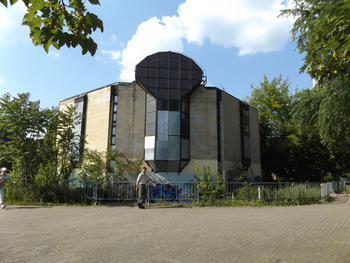
But although it was placed under historic preservation status in 2009, the Bowlingtreff was further abandoned to rats, cockroaches and vandals. Despite its excellent location, the monument failed to attract private investors. Building on a 2008 resolution, in 2015 Leipzig's city council mandated integration of the Bowlingtreff into future plans for the square as a ‘unique example of socialist post-modernism’ that had ‘courageously broken with the theoretical narrowness of socialist construction’. It lamented that the Bowlingtreff was a ‘forgotten object on a forgotten site that ceased to exist in 1997’, concluding: ‘The Bowlingtreff is a building in need of explanation. The current appearance of this inaccessible structure cannot deliver this explanation’.Footnote 74 Two young Leipzigers sought to convey just such an explanation on their own initiative that same year: life returned to the bowling catacombs when Thomas Beyer and Adrian Dorschner produced an artistically powerful documentary, wherein architects, officials, and ordinary citizens exchanged insights on the yet-intact but threatened landmark.Footnote 75 (See Figure 4.)
The Leipzig Bowlingtreff as a Ruin, 2018

Perhaps today this time capsule of the ‘imaginary West’ is what Leipzigers need to salve their disappointment with the banality of global capitalist chains and kitsch. Given the profusion of malls and marketing, the singular authenticity of Sziegoleit's architectural masterpiece with its distinctive history of local activism could invigorate civic identity on a central site the post-communist city has failed to appropriate. Perhaps just as the Bowlingtreff was a reprieve from Eastern drabness, it might yet become, as Kießling proposes, a retreat ‘from the daily stress in our Western world in which we now live, where we can just go bowling and be sociable and relax’.Footnote 76 In like manner, Topfstedt continues to uphold the tarnished edifice's ‘influences from post-modern building style on a qualitative level seldom matched by other contemporary structures built in East Germany’Footnote 77 and concludes: ‘the experts say it's possible to save it, but one has to do it’.Footnote 78 As of August 2018 the city had removed ninety-eight tons of rubbish from the vandalised interior in the hopes that this might help to attract an investor.Footnote 79 But it remains to be seen whether Leipzig – gleaming amid fresh global capitalist investment – has enough creativity and willpower left to re-enliven its People's Bowling Palace.
Acknowledgments
I wish to thank the Alexander von Humboldt Foundation, Leipzig's Humanities Center for East Central Europe (GWZO), and American University for financial support that made this article possible. I also wish to thank my interview partners, those who provided images, the Bowlingtreff filmmakers Thomas Beyer and Adrian Dorschner, as well as archivists and librarians across Leipzig for their support as this article progressed. Finally, I wish to thank my partner and fellow scholar Rebecca Mitchell for her careful reading of the initial manuscript just days before our little son Archie Ray was born in 2018. I dedicate this article to both of them.