I. INTRODUCTION
The key technology to apply hydrogen energy effectively is to develop safe, economical, and efficient hydrogen storage system. Reference Liu, Wu, Wu and Bai1 Hydrogen fuel cells with high energy efficiencies caught more and more attention and are expected to play important roles toward a better hydrogen-economy society. To meet the fast increasing hydrogen demand of fuel cells, mass hydrogen storage and utilization become a big challenge. Reference Nagar, Schechter, Ben-Moshe and Shvalb2–Reference Morelle, Jepsen, Jensen, Sharma, Hagemann and Filinchuk6 Complex hydride materials, due to their high hydrogen storage capacities, are regarded as a promising way to satisfy the urgent hydrogen supply requirements. Bogdanovic’ et al. Reference Bogdanović and Schwickardi7 observed hydrogen release and absorption for titanium-catalyzed NaAlH4, which was composed firstly by Finholt Reference Finholt, Jacobson, Ogard and Thompson8 in 1955. Later, P. Chen et al. Reference Chen, Xiong, Luo, Lin and Tan9 and A. Züttel et al. Reference Züttel, Rentsch, Fischer, Wenger, Sudan, Mauron and Emmenegger10 investigated LiNH2 and LiBH4 related structures and properties, respectively. Reference Ley, Jepsen, Lee, Cho, Colbe, Dornheim, Rokni, Jensen, Sloth, Filinchuk, Jørgensen, Besenbacher and Jensen11 Futhermore, the complex light-weight hydrogen mixtures which have high gravimetric and volumetric hydrogen densities can be regarded as desirable candidates for the efficient hydrogen storage, since, comparing with single material, the problems of elevated decomposition temperature, reversibility, and impurities in the released gas can be solved through mixing hydride. Reference Schouwink, D’Anna, Ley, Daku, Richter, Jensen, Hagemann and Černý12–Reference Ravnsbaek, Sørensen, Filinchuk, Besenbacher and Jensen14 The hydrogen storage and generation performances of complex hydride materials, for instance, metal borohydrides, have been widely studied in aqueous solutions. Reference Wu, Zhang and Yi15–Reference Li and Wang20 Recently, solid state hydrogen generation based on metal borohydrides became very attractive Reference Züttel, Wenger, Rentsch, Sudan, Mauron and Emmenegger21,Reference Lee and Kim22 because of the potential of higher hydrogen storage capacity and good operating convenience. However, the thermal decomposition kinetics of simplex metal borohydrides is not satisfied at present. Therefore, composite borohydride–amide materials, Reference Chen, Xiong, Wu, Liu, Hu and Luo23–Reference Bai, Zhao, Wang, Liu, Wu and Wu28 in which different components can reduce stability each other, thus resulting in better kinetics and high hydrogen generation amount, are regarded as an alternative choice. A new type of mixed alkali metal hydride system was proposed by F.E. Pinkerton in 2005, Reference Pinkerton, Meisner and Meyer29 composed of LiNH2 and LiBH4, forming a unique interaction, i.e., N–Hδ+/Hδ−–B, defined as the “dihydrogen bond”. Reference Huang and Autrey30,Reference Richardson, de Gala, Crabtree and Siegbahn31 The lowered hydrogen desorption temperature can be attributed to the combination of protic Hδ+ and hydridic Hδ−. Later, various alkali and alkaline earth metal amide−borohydride have been studied extensively, including NaBH4–NaNH2 system which is a promising solid hydrogen storage material. Reference Somera, Acar, Koz, Kokal, Höhn, Cardoso-Gil, Aydemir and Akselrud25,Reference Yu, Guo, Sun, Yang, Ranjbar, Guo, Liu and Dou32,Reference Chu, Xiong, Wu, Guo, Zheng, Teng, Wu and Chen33 However, if they are expected to be used for hydrogen fuel cells, thermal decomposition kinetics of the composite borohydride–amide materials should be improved further.
Catalyst is a good way to help overcoming the energy barrier, and thus effectively improve the kinetics. So far, metal boride catalysts, such as Co–B, Reference Wu, Wu, Bai, Yi and Zhang17,Reference Wu, Bai, Wu, Yi and Zhang19,Reference Xu, Wang, Guo and Ji34–Reference Netskina, Ozerova, Komova, Odegova and Simagina38 Fe–B, Reference Wu, Bai and Wu39,Reference Tuan, Yi, Lee and Lee40 Ni–Co–B Reference Xu, Wang, Guo and Ji34,Reference Wu, Bai, Liu, Wu, Pang and Yi41 have been widely used for hydrogen generation from the hydrolysis of complex hydrides. Recent research elaborated that Co–B can also be used as a catalyst for the thermal decomposition of complex hydrides. Reference Bai, Wu, Wu, Zhao, Yang, Long and Yi27 However, since cobalt is an expensive and very limited resource, low cobalt or non-cobalt catalysts are still of our concern. Furthermore, for better practical application, more metal boride catalysts have been studied. According to our previous work, in alkaline secondary batteries, Mg–Co–B Reference Wu, Bai, Wu, Wang, Lu and Qiao42 exhibits the similar electrochemical hydrogen storage performance as Co–B, Reference Wu, Bai, Wu, Dong, Wang, Yang and Zhang43 and the cobalt content of this material is much lower than that of Co–B. Inspired by this idea, it is worth researching if Mg–Co–B can play the similar role as Co–B for the thermal decomposition of NaNH2–NaBH4. Therefore, in this work, Mg–Co–B was used as a catalyst to improve the thermal decomposition kinetics of composite hydrogen storage material NaNH2–NaBH4 (2/1). Furthermore, the structure and the thermal decomposition behaviors of composite NaNH2–NaBH4 (2/1) were discussed. Exactly as expected, it is proven that Mg–Co–B was indeed highly effective for the help in improving the kinetics.
II. EXPERIMENTAL
A. Preparation of catalyst
The Mg–Co–B catalyst was prepared via a chemical reduction method. A typical synthesis procedure was as follows: an aqueous 0.40 mol/L MgCl2 + 0.40 mol/L CoCl2 co-solution was first introduced into a flask. Subsequently, an excessive NaBH4 alkaline solution was pumped into the flask by stirring, whereupon a dark precipitate was produced. Thereafter, the mixture was stirred for a further half an hour to ensure the complete precipitation and removal of H2, and the precipitate was washed with deionized water to remove the soluble ions and then vacuum-dried at 50 °C for 12 h. The as-prepared sample was designated as Mg–Co–B.
B. Preparation of catalyst promoted NaNH2–NaBH4 (2/1)
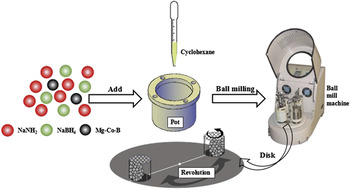
NaBH4 (98% assay, Alfa Aesar, Haverhill, Massachusetts) and NaNH2 (99% assay, Acros Organics, Pittsburgh, Pennsylvania) were used directly without pretreatment. NaNH2 and NaBH4 with a molar ratio of 2:1 containing 3 wt% Mg–Co–B were weighed in an argon-filled glove box and then put into a ball milling jar, as shown in Fig. 1. The ball-to-powder mass ratio is 20:1 and the stainless steel balls’ diameter was 8 mm. The ball milling process was carried out in a QM-3SP2 (Nanjing NanDa Instrument Plant, Nanjing, China) planetary ball mill machine under a protection of argon atmosphere at 300 rpm, and the ball milling time was 16 h, wherein the process was paused 0.2 h after every alternative operation of 1 h. After milling for 16 h, the ball milling jar was opened and the sample was taken out in the glove box. The as-prepared sample was named as S16Mg–Co–B. The entire operations of the samples were conducted under inert atmosphere, and all the samples and materials were stored in an argon-filled glove box (H2O ≤ 1 ppm, O2 ≤ 1 ppm; Mbraun LABSTAR8510, Mbraun InertGas-Systeme GmbH, Garching, Germany).
Schematic illustration of the milling process.

C. Thermal analysis
The thermogravimetry and differential thermal analysis (TG-DTA) test was conducted with a ZCT-A thermogravimetric analyser/differential thermal analyser (Beijing Jingyi High-tech Instrument, Co., Ltd., Beijing, China). 5–10 mg sample was weighed and put into a corundum crucible in the glove box and then quickly transferred into the TG-DTA instrument. High purity argon (99.999%) was served as a protective gas; the flow rate was 10 mL/min; TG range was 10 mg; DTA range was 50 UV; sampling interval was 1 s. Thus the samples were measured from room temperature to 450 °C with a heating rate of 10 °C/min.
D. Structural characterization
Crystal structures of the as-prepared samples were characterized by a Rigaku DMAX2400 X-ray diffractometer (Rigaku Corporation, Tokyo, Japan) adopting Cu Kα radiation. The tube voltage was 40 kV and the tube current was 20 mA. The scanning range was from 10° to 80°, while the scanning rate was 8°/min.
In addition, because the hydrogen generation performance of the composite NaNH2–NaBH4 (2/1) samples were tested by TG-DTA, the samples used in the tests were in the milligram level, and the mass of solid products after decomposition by heating was extremely less, which was difficult to collect and detect. Therefore, to characterize structures of the decomposed samples, an alternative method was selected, namely, two grams of catalyst-promoted NaNH2–NaBH4 (2/1) was heated to 380 °C in a tubular furnace under the protection of argon, then being kept for 20 min, and the final product thereof was characterized by X-ray diffraction (XRD).
E. Activation energy calculation
In this paper, the activation energy was calculated by the Achar differential method, Eq. (1), and the Coats–Redfern integral method, Eq. (2), based on the thermogravimetry curves of the main temperature ranges, as described in detail in our previous work. Reference Bai, Wu, Wu, Zhao, Yang, Long and Yi27 By plotting the curves of ln[dα/dT/f(α)] versus 1/T and ln[g(α)/T 2] versus 1/T, respectively, and fitting the least squares linear, the varying E, which is the slope of each straight line, can be obtained. When the E values obtained by the two methods are similar and the linear fitting correlation coefficients are of maximum value, this value is the corresponding material activation energy of the decomposition reaction,
 $${\rm{ln}}\left[ {{{{{{\rm{d}}\alpha } \mathord{\left/ {\vphantom {{{\rm{d}}\alpha } {{\rm{d}}T}}} \right. \kern-\nulldelimiterspace} {{\rm{d}}T}}} \over {f\left( \alpha \right)}}} \right] = {\rm{ln}}\left( {{A \over \beta }} \right) - {E \mathord{\left/ {\vphantom {E {RT}}} \right. \kern-\nulldelimiterspace} {RT}}\quad {\rm{,}}$$
 $${\rm{ln}}\left[ {{{g\left( \alpha \right)} \over {{T^2}}}} \right] = {\rm{ln}}{{AR} \over {\beta E}} - {E \mathord{\left/ {\vphantom {E {RT}}} \right. \kern-\nulldelimiterspace} {RT}}\quad {\rm{.}}$$
III. RESULTS AND DISCUSSION
A. XRD analysis of Mg–Co–B promoted NaNH2–NaBH4 (2/1)
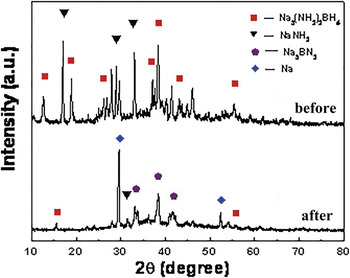
To explore the structural characterization of the composite of Mg–Co–B doped NaBH4–NaNH2(1/2), we collected the sample containing 3 wt% Mg–Co–B and detected the crystal characterization via XRD measurement. Comparing the compounds with the Joint Committee on Powder Diffraction Standards (JCPDS) database including the elements Na, N, B, and H, as shown in Fig. 2, after being ball milled with the Mg–Co–B catalyst for 16 h, the composite NaNH2–NaBH4 (2/1) exhibits distinct peaks at 2θ = 12.64, 18.86, 38.09, and 43.05, which are inconsistent with the diffractions of Na3(NH2)2BH4 in the previous work, Reference Wu, Bai, Yang, Wu and Long26 indicating the formation of a new complex Na3(NH2)2BH4 phase. In addition, several characteristic peaks of NaNH2 were also observed, while there is no characteristic peak of NaBH4 anymore. Therefore, the crystal structure of the Mg–Co–B promoted sample S16Mg–Co–B is very close to that of the pristine NaNH2–NaBH4 (2/1), Reference Wu, Bai, Yang, Wu and Long26 which implies that the Mg–Co–B catalyst has good compatibility with light-weight NaNH2–NaBH4, and this composite hydrogen storage system can be stably stored.
XRD patterns of the sample S16Mg–Co–B before and after being heated at 380 °C.

To further understand the dehydrogen performance of the novel compound Na3(NH2)2BH4, we heated the sample to a certain temperature. After being heated to 380 °C at a heating rate of 10 °C/min in a tubular furnace with the protection of argon, and then kept for 20 min, the sample S16Mg–Co–B was further detected by XRD, as shown in Fig. 2. It can be seen that the peak at 2θ = 29.37 is in good agreement with the strongest characteristic diffraction of metal Na, while the peaks at 2θ = 33.47, 38.30, 41.26 are assigned to a combination of diffractions of Na3BN2. Furthermore, the peak at 2θ = 31.31 is in agreement with the diffraction of NaNH2, which is extremely weak in the XRD pattern of the sample S16Mg–Co–B. Therefore, thermal decomposition products of S16Mg–Co–B comprise metal Na, Na3BN2, small amount of undecomposed NaNH2, and without NaBH4 and B.
B. TG-DTA of S16Mg–Co–B
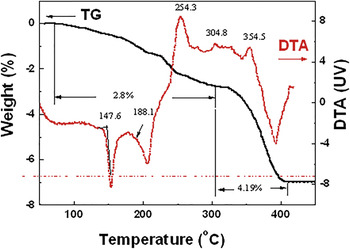
TG analysis and DTA were conducted simultaneously with a temperature-rising program from room temperature to 450 °C (10 °C/min). Based on the TG curve, the whole process can be roughly divided into three steps, which is in accord with the DTA curve, as shown in Fig. 3. The first stage is in the temperature range 72–210.3 °C and the second stage of degradation occurs in the range 210.3–304.6 °C, with a mass loss of 2.8 wt% in these two stages, which accounts for about 40% of the total weight loss. The third stage is in the temperature range 304.6–410 °C, and this step is a major dehydrogenation process with a mass loss of 4.19 wt%. Meanwhile, three endothermic peaks at 153.3, 207, and 391 °C, as well as three exothermic peaks at 254.3, 304.8, and 354.5 °C are observed in the DTA curve. Combined with the TG curve, it is reasonable that the phase-transition temperature of S16Mg-Co–B is 147.6 °C and the fusion temperature of S16Mg–Co–B is 188.1 °C. Three exothermic peaks at 254.3, 304.8, and 354.5 °C make clear that the decomposition process of S16Mg–Co–B consists of three steps, after reaching its fusion temperature. Meanwhile, it demonstrates that the dehydrogenation process of the novel compound Na3(NH2)2BH4 is an exothermic decomposition reaction. The third endothermic peak at 391 °C means the phase-transition process of the decomposed products. Based on the above analysis, it is explicit that the main decomposition stage of Co–Mg–B promoted NaNH2–NaBH4 is a multi-step reaction, and the total weight loss is close to the theoretical value. Furthermore, according to the investigation of Bai, Reference Wu, Bai, Yang, Wu and Long26 the peak temperature with the maximal decomposition rate of the solid ball-milling product is 346.2 °C, which is higher than 254.3 °C of the corresponding peak temperature of the sample S16Mg–Co–B, comparing the varying composite NaNH2–NaBH4 (2/1) systems. It can be concluded that the thermal stability of the composite hydrogen storage material with the catalyst Co–Mg–B is further reduced and the dehydrogen thermodynamic performance is efficiently improved.
The TG-DTA curves of the sample S16Mg–Co–B.

C. Kinetics of Mg–Co–B-promoted NaNH2–NaBH4 (2/1)
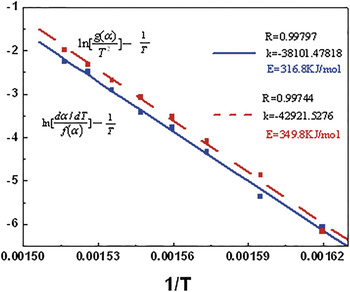
From the TG curve, it can be seen that below 300 °C, the weight loss curve is relatively flat, and the weight loss rate is very sharp, which indicates that the activation energy of this stage may be relatively low. The decomposition reaction of 3 wt% Mg–Co–B promoted NaNH2–NaBH4 (2/1) occurs in two main stages, which are 72–304.6 °C and 304.6–410 °C, as shown in Fig. 3. The temperatures of conversion rate α from 0.1 to 0.9 were obtained from the TG curve, and the activation energies were calculated with these 32 kinetic functions of 32 diverse mechanisms. The kinetic data of the sample S16Mg–Co–B at the major thermal decomposition stages are listed in Tables I and II, respectively. And the activation energies of the two stages calculated by Ginstling–Brounstein function are 76.4 KJ/mol and 349.8 KJ/mol, respectively, as shown in Figs. 4 and 5.
Kinetic data of the sample S16Mg–Co–B at the first thermal decomposition stage of 72–304.6 °C.

Kinetic data of the sample S16Mg–Co–B at the second thermal decomposition stage of 304.6–410 °C.

Linear fitted plots of the data originated from the Ginstling–Brounshtein equation for the sample S16Mg–Co–B at the first thermal decomposition stage of 72–304.6 °C.

Linear fitted plots of the data originated from the Ginstling-Brounshtein equation for the sample S16Mg–Co–B at the second thermal decomposition stage of 304.6–410 °C.

The detailed equation derivation and the data analysis method were published in our previous work. Reference Bai, Wu, Wu, Zhao, Yang, Long and Yi27 Therefore, compared with the activation energy of the pristine NaNH2–NaBH4 (2/1), namely, 159.6 KJ/mol, Reference Bai, Wu, Wu, Zhao, Yang, Long and Yi27 that of the sample S16Mg–Co–B becomes rather lower below 304.6 °C, which indicates that the Mg–Co–B catalyst works highly efficiently in the low temperature range. Of course, for practical utilization, the hydrogen yield in the low temperature range still needs to be improved.
D. Catalytic mechanism of Mg–Co–B-promoted NaNH2–NaBH4 (2/1)
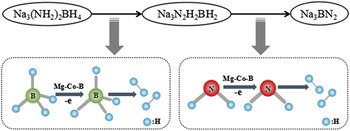
The Mg–Co–B catalyst investigated in this study has a similar structure as that of Co–B, which is a kind of amorphous alloy. The amorphous alloy, with a short-range ordered and long-range disordered structure, is totally different from the crystal metal in the array of atoms. There are many vacant electron orbits and unsaturated coordination sites on the surface of the Mg–Co–B catalyst. The reasons of the modification after being doped with the Mg–Co–B catalyst are the following: (1) H− of BH4 − loses electrons easily and Mg–Co–B speeds up the process of losing electrons, while the H atoms losing the electrons combine and generate H2. (2) B unoccupied orbital and the N lone electron pair establish the donor–acceptor attraction to each other, which promotes the extrusion of H in NH2 −, then form H2. Finally, Na, B, N recombine and generate Na3BN2, as shown in Fig. 6. We conclude that the specific amorphous alloy structure of the Mg–Co–B catalyst can effectively accelerate the formation of H2.
Schematic diagram of the catalytic mechanism of NaNH2–NaBH4 (2/1) decomposition promoted by the Mg–Co–B catalyst.

Moreover, we conclude the possible functions of Mg in the ternary Mg–Co–B catalyst as follows: (1) Cobalt is an expensive and very limited resource; low cobalt or non-cobalt catalysts are of our concern. And Mg metal has a low price. (2) The electronic structure of magnesium element and cobalt element is similar since the number of electrons in their outer shell is two. Therefore, Mg–Co–B can play the similar role as Co–B for the thermal decomposition of NaNH2–NaBH4. Moreover, the substitution of metal magnesium for partial cobalt intensifies the amorphous alloy structure of short-range ordered and long-range disordered. And the Mg–Co–B alloys are amorphous or crystalline compounds, rather than simple mixtures of metallic elements. Reference Wu, Bai, Wu, Wang, Lu and Qiao42 (3) With increasing heat-treating temperature, both the Mg–Co–B and Co–B precursors change from an amorphous phase to a mixture which includes CoB. In the previous study, Reference Wu, Wu, Bai, Yi and Zhang17 we concluded that CoB is the key component for accelerating the reaction. We deduce that the Mg–Co–B alloys can decompose to CoB at a lower temperature.
IV. CONCLUSIONS
In summary, the corresponding influences of the Mg–Co–B catalyst on the thermal decomposition behaviors of NaNH2–NaBH4 (2/1) based light-weight hydrogen storage material were evaluated and discussed. According to the thermal analysis, the activation energy of Mg–Co–B promoted NaNH2–NaBH4 (2/1) was calculated by the Ginstling–Brounstein function. It is notable that the kinetics of NaNH2–NaBH4 (2/1) is effectively promoted by the Mg–Co–B catalyst. Namely, when the temperature is lower than 300 °C, NaNH2–NaBH4 (2/1) with the Mg–Co–B catalyst achieves a low activation energy of 76.4 KJ/mol, which implies that the composite metal boride Mg–Co–B is helpful to accelerate the thermal decomposition in the low temperature range. Therefore, hydrogen supply strategy based on the NaNH2–NaBH4 (2/1) composite with the Mg–Co–B catalyst is promising for low temperature fuel cell applications.
ACKNOWLEDGMENTS
The present work is supported by the National Natural Science Foundation of China (Grant No. 21476027) and Program for New Century Excellent Talents in University (Grant No. NCET-13-0033).