I. INTRODUCTION
It is well known that there are many novel functional materials containing rare-earth elements. Abundant inermetallic compounds with excellent properties were found during the past few decades. Searching for novel compounds, especially rare-earth compounds, with excellent properties is very important for developing new potential function materials. A new quaternary compound of Tb3CuAl3Ge2 was found during our investigation on the phase relationship of the Al–Cu–Ge–Tb system. The crystal structure and powder X-ray diffraction (XRD) data of new compounds are very important for the phase identification in the materials research and applications. In this paper, the crystal structure and powder XRD data of the Tb3CuAl3Ge2 compound are reported.
II. EXPERIMENTAL
The sample of Tb3CuAl3Ge2 was prepared by arc melting of Al (99.8%), Cu (99.99%), Tb (99.5%), and Ge (99.99%) in a water-cooled copper hearth with a non-consumable tungsten electrode under argon atmosphere. The sample of Tb3CuAl3Ge2 was turned over and remelted three times to ensure sample homogeneity. The weight loss of the sample was less than 1 wt%. The obtained ingot of Tb3CuAl3Ge2 was annealed in an evacuated quartz tube at 800 °C for 480 h, and then cooled down slowly at a rate of 10 °C h−1 to room temperature. The specimen of Tb3CuAl3Ge2 for XRD measurements was ground in an agate mortar and pestle to a particle size of less than 10 μm. Powder sample of Tb3CuAl3Ge2 was loaded to an Al-holder and gently pressed. Two sets of the powder XRD patterns, with or without Si (99.9999%) added as an internal standard, were collected at room temperature on a Rigaku D/Max 2500 V diffractometer (with CuKα radiation and a graphite monochromator). The scan ranged from 10° to 110°2θ with a step size of 0.02° and a counting time of 2 s per step. The Jade 6 software package (Materials Data, Inc., 2002) was used to analyze the data. The XRD pattern of the Tb3CuAl3Ge2 specimen with high-purity Si internal standard was used to obtain the observed peak positions 2θ obs for indexing, whereas the XRD pattern without Si internal standard was used to pick out the observed intensity of each peak, I obs. The 2θ obs values of the peaks were determined by the Savitzky–Golay second derivative method after background subtracting, Kα 2 stripping and Si internal standard calibration using PDF 027-1402 (ICDD, Reference Kabekkodu2011) with λ = 1.540 56 Å.
III. RESULTS AND DISCUSSION
A. Crystal structure
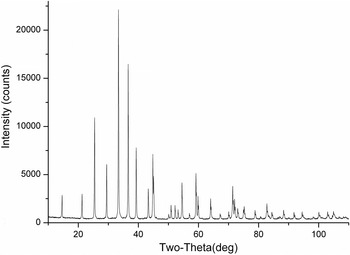
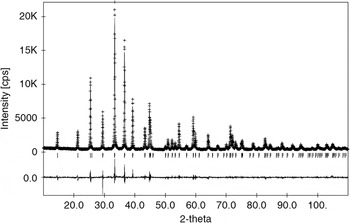
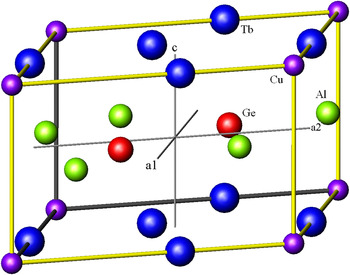
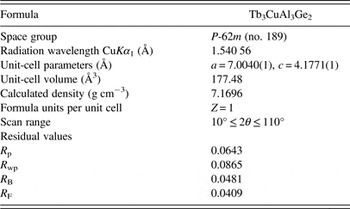
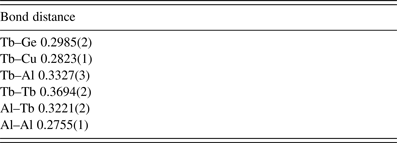
The powder XRD pattern of Tb3CuAl3Ge2, shown in Figure 1, was successfully indexed using the Jade 6 program in a hexagonal unit cell with the lattice parameters a = 7.0041(2) Å and c = 4.1775(1) Å. No conditions for reflections of the Tb3CuAl3Ge2 pattern pointed to five possible space groups: P6/mmm (no. 191), P-62m (no.189), P-6m2 (no. 187), P6mmm (no. 183), and P622 (no. 177) (Hahn, Reference Hahn1992). By comparing the crystallographic characteristics of the Tb3CuAl3Ge2 compound with those presented in the structural type database it was found that Tb3CuAl3Ge2 and Y3NiAl3Ge2 (Zhao and Parthe, Reference Zhao and Parthe1990) have the same structure type. So the space group P-62m (no. 189) and the atomic position parameters of Y3NiAl3Ge2 were taken as the starting values to refine the structural parameters of Tb3CuAl3Ge2. The Tb sites correspond to the Y sites and the Cu to the Ni sites in Y3NiAl3Ge2. The structural refinement of Tb3CuAl3Ge2 was then performed using the DBWS9807a program (Young et al., Reference Young, Larson and Paiva-Santos2000). The pseudo-Voigt function was used for the simulation of the peak shapes. The indexing results for Tb3CuAl3Ge2 were taken as the starting lattice parameters. A total of 23 parameters of the Tb3CuAl3Ge2 compound were refined, including peak shape parameters, scale factor, cell parameters, atomic coordinates, isotropic displacement parameters, full-width at half-maximum (FWHM) parameters, and preferred orientation parameter. The background of the XRD data of Tb3CuAl3Ge2 was refined with a polynomial. The final Rietveld refinement led to agreement factors of: R p = 6.43%, R wp = 8.65%, and R B = 4.81%, and R F = 4.09%, respectively. The details of the Rietveld Refinement of Tb3CuAl3Ge2 are summarized in Table I, and the atomic positions and thermal displacement factors for Tb3CuAl3Ge2 are presented in Table II. The observed, calculated, and residual powder XRD patterns of Tb3CuAl3Ge2 are shown in Figure 2 and the crystal structure of Tb3CuAl3Ge2 is given in Figure 3. The selected atomic distances are listed in Table III.
Powder XRD pattern of Al3CuGe2Tb3.

The observed, calculated, and residuals powder XRD patterns of Tb3CuAl3Ge2.

(Color online) The crystal structure of Tb3CuAl3Ge2.

Rietveld refinement data of Tb3CuAl3Ge2.

 $${R_{\rm P}}=\displaystyle{{\sum {\left\vert {{Y_i}\lpar {\rm obs}\rpar - {Y_i}\lpar {\rm calc}\rpar } \right\vert } } \over {\sum {{Y_i}\lpar {\rm obs}\rpar } }}\comma \; {R_{{\rm WP}}}={\left\{{\displaystyle{{\sum {{\omega _i}{{\left[{{Y_i}\lpar {\rm obs}\rpar - {Y_i}\lpar {\rm calc}\rpar } \right]}^2}} } \over {\sum {{\omega _i}{{\left[{{Y_i}\lpar {\rm obs}\rpar } \right]}^2}} }}} \right\}^{1/2}}$$
 $${R_{\rm B}}=\displaystyle{{\sum {\left\vert {{I_{\rm H}}\lpar {\rm obs}\rpar - {I_{\rm H}}\lpar {\rm calc}\rpar } \right\vert } } \over {\sum {{I_{\rm H}}\lpar {\rm obs}\rpar } }}\comma \; {R_{\rm F}}=\displaystyle{{\sum {\left\vert {{{\lsqb {I_{\rm H}}\lpar {\rm obs}\rpar \rsqb }^{1/2}} - {{\lsqb {I_{\rm H}}\lpar {\rm calc}\rpar \rsqb }^{1/2}}} \right\vert } } \over {\sum {{{\lpar {I_{\rm H}}\lpar {\rm obs}\rpar \rpar }^{1/2}}} }}$$
Atomic coordinates and thermal parameters for Tb3CuAl3Ge2.

Selected interatomic distances (nm) for Tb3CuAl3Ge2.

B. X-ray powder diffraction data
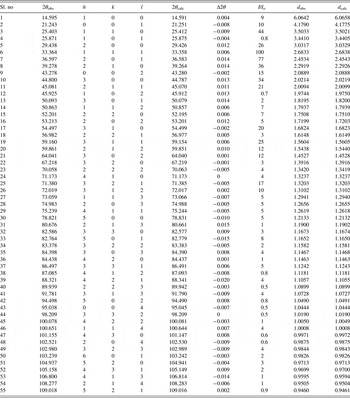
The Tb3CuAl3Ge2 compound is in a hexagonal unit cell with parameters a = 7.0041(2) Å, c = 4.1775(1) Å, and unit-cell volume V = 177.48 Å3. The figure of merit for the indexing F N (Smith and Snyder, Reference Smith and Snyder1979) is F 30 = 120.9 (0.0073, 34). The powder XRD data for Tb3CuAl3Ge2 are listed in Table IV.
Powder diffraction data for Tb3CuAl3Ge2 (CuKα 1,with λ = 1.540 56 Å).

ACKNOWLEDGEMENTS
This work was supported by the National Natural Science Foundation of China (grant no. 51261002) and the Natural Science Foundation of Guangxi (grant numbers 2011GXNSFD018005 and 2012GXNSFAA053211).
SUPPLEMENTARY MATERIALS AND METHODS
The supplementary material refered to in this paper can be found online at http://www.journals.cambridge.org/PDJ