Twenty years ago, SSLA published a review of tense-aspect research in second language acquisition, “From Morpheme Studies to Temporal Semantics” (Bardovi-Harlig, Reference Bardovi-Harlig1999). The following year saw the publication of three monographs on L2 temporality (Bardovi-Harlig, Reference Bardovi-Harlig2000; Li & Shirai, Reference Li and Shirai2000; Salaberry, Reference Salaberry2000), which Slabakova (Reference Slabakova2002) described as both a maturing of the field and an opportunity for additional research. The number of studies of the acquisition of temporality and tense and aspect has grown dramatically in the last two decades. In this review, we present a critical synthesis of recent research addressing the aspect hypothesis (AH) (Andersen, Reference Andersen and Meisel1986, Reference Andersen, VanPatten and Lee1990, Reference Andersen, Huebner and Ferguson1991, Reference Andersen, Salaberry and Shirai2002; Andersen & Shirai, Reference Andersen and Shirai1994, Reference Andersen, Shirai, Ritchie and Bhatia1996), the single most influential hypothesis in second language acquisition (SLA) research regarding tense and aspect.
Research in the last 20 years can be characterized as having tested the universal against the particular. The universal is represented by the aspect hypothesis, and the particular by proficiency, first language, input, and task. The overarching question has been whether the aspect hypothesis holds, or whether the acquisitional sequences it predicts can be disrupted by individual variables.
As L2 research on the AH developed, researchers provided clear operationalization for future research, breaking the AH down into easily testable hypotheses (Andersen & Shirai, Reference Andersen, Shirai, Ritchie and Bhatia1996; Shirai, Reference Shirai1991), simplifying tests for identifying aspectual categories (Shirai, Reference Shirai, Salaberry and Comajoan2013), describing calculations (Bardovi-Harlig, Reference Bardovi-Harlig2000, Reference Bardovi-Harlig, Salaberry and Shirai2002), and discussing research methodology pertaining to the study of tense-aspect (Salaberry & Comajoan, Reference Salaberry and Comajoan2013; Salaberry & Shirai, Reference Shirai2002). The increased accessibility of the AH has made it a popular topic of investigation, and in this review, we assess the accumulated empirical support for the AH, discuss the impact that four recurrent variables have on tests of the AH and our ability to interpret them, and propose theoretically motivated questions for future research.
THE ASPECT HYPOTHESIS
THE EVOLUTION OF THE ASPECT HYPOTHESIS
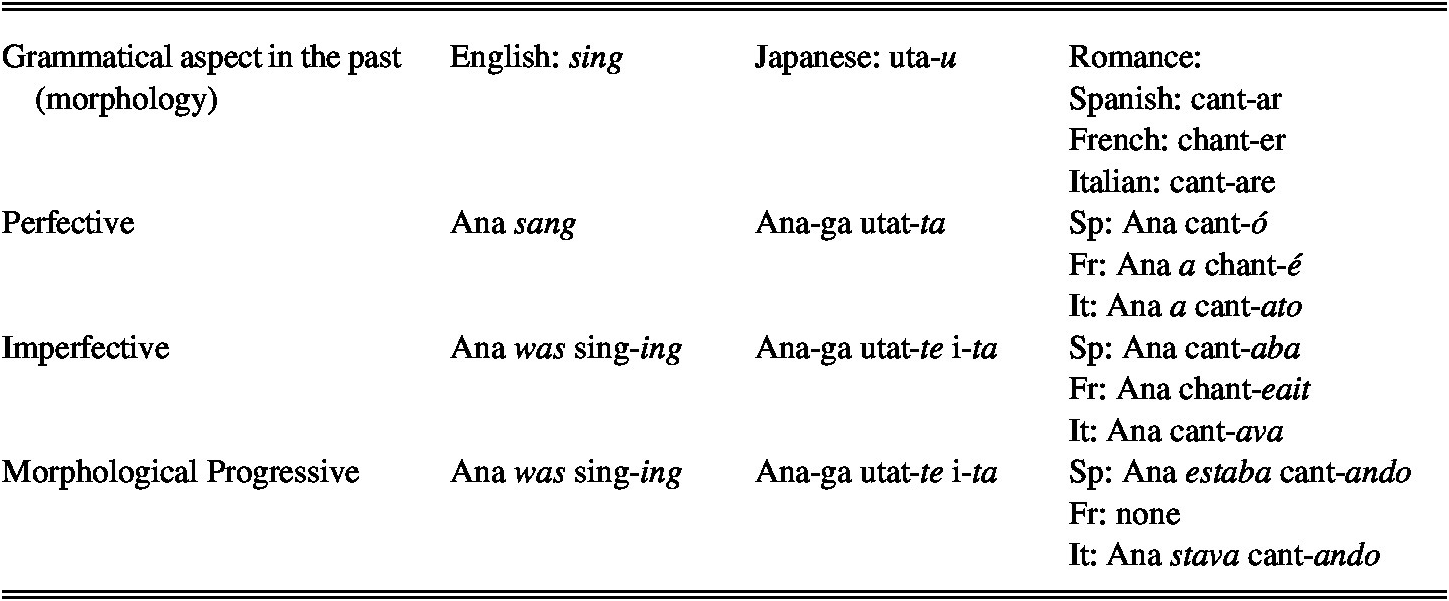
The AH builds on three main constructs: tense, grammatical aspect, and lexical aspect. Tense establishes the location of an event in time (Comrie, Reference Comrie1985). Grammatical aspect allows for “ways of viewing the internal temporal constituency of a situation” (Comrie, Reference Comrie1976, p. 3).Footnote 1 Grammatical aspect is sometimes called viewpoint aspect (Smith, Reference Smith1983) because the choice between progressive and simple, or perfective and imperfective, for example, often reflects the speaker’s view of the action (Table 1).
Grammatical aspect in the past in three language families

For instance, in English, a contrast in grammatical aspect is found between simple past and past progressive (cf. “Ana sang” and “Ana was singing”). A similar distinction is found in Japanese. In Romance languages, the contrast between perfective and what is called general imperfective is found only in the past: the preterite (in Spanish), passé composé (in French), and passato prossimo (in Italian) are the perfective forms; and the imperfect (in Spanish), the imparfait (in French), and the imperfetto (in Italian) are general imperfective forms. Whereas perfective morphology, in general, presents a situation from the outside and has a terminative interpretation, imperfective morphology views the situation from the inside and has an unbounded interpretation, with different functions (habitual, progressive, or continuous; Deo, Reference Deo and Binnick2012; De Swart, Reference De Swart and Binnick2012). Spanish and Italian (among others) also have a morphological progressive, which like the progressive in English, can occur in different tenses. French, however, lacks a morphological progressive, but progressivity is a concept expressed by the imperfect. Grammatical or viewpoint aspect additionally allows a speaker to portray events for rhetorical purposes (such as the main action of a narration, or as auxiliary information to it).
In contrast, lexical aspect (also known as inherent aspect, Aktionsart, and actionality, Binnick, Reference Binnick1991) is nongrammatical and refers to semantic differences in verbs and their arguments (Dowty, Reference Dowty1979) or verb constellations (Smith, Reference Smith1997), such as whether a predicate has inherent duration like “talk” and “sleep,” is punctual like “recognize” and “notice,” or has elements of both duration and culmination like “build a house” and “paint a picture.”Footnote 2 This may be most clearly illustrated with predicates such as “swim” and “swim a mile.” “Swim” (intransitive) is an activity, whereas “swim a mile” is an accomplishment. “Swim” has no inherent endpoint, whereas “swim a mile” does, namely the end of the mile. Dowty (Reference Dowty1979) used different tests to distinguish lexical aspectual categories. One category is the adverbial test with “for/in” + time: “for” + time distinguishes activities, “He swam for 30 minutes,” from accomplishments, #“He swam a mile for 30 minutes”); “in” + time is acceptable with accomplishments “He swam a mile in 30 minutes” but not with activities #“He swam in 30 minutes,” where “30 minutes” is the duration of swimming. Similarly, the completion test also works to distinguish activities from accomplishments: If someone is swimming and she is interrupted after 15 minutes, did she swim? The answer is “yes.” But if someone who swims a 30-minute mile is interrupted after 15 minutes, did she swim a mile? The answer is “no.” Thus, we see that lexical aspect belongs to the predicate and not the verb (Binnick, Reference Binnick1991; Dowty, Reference Dowty1979; Klein, Reference Klein, Klein and Ping2009; Shirai, Reference Shirai, Salaberry and Comajoan2013).
In its simplest form, the AH for SLA predicts that in the initial stages of the acquisition of tense-aspect morphology by adults, the acquisition of past morphology will be influenced by lexical aspectual categories.Footnote 3 Namely, verbal morphology will be attracted to and will occur with predicates with similar semantics. Perfective past will occur with telic predicates (predicates with inherent endpoints); in contrast, imperfective will occur with unbounded predicates, and progressive will occur with ongoing activities.
The AH in SLA research (Andersen & Shirai, Reference Andersen and Shirai1994; Bardovi-Harlig, Reference Bardovi-Harlig, Tarone, Gass and Cohen1994) underwent a series of refinements in fairly rapid succession in response to empirical evidence. The earliest version of the AH appeared as the defective tense hypothesis (Andersen, Reference Andersen and Meisel1986, Reference Andersen, Huebner and Ferguson1991, following Weist et al., Reference Weist, Wysocka, Witkowska-Stadnik, Buczowska and Konieczna1984) (Figure 1):
In beginning stages of language acquisition only inherent aspectual distinctions are encoded by verbal morphology, not tense or grammatical aspect (Andersen, Reference Andersen, Huebner and Ferguson1991, p. 307; emphasis in the original).
Developmental route of acquisition of tense and aspect morphology in Spanish.
Note: T1=Time 1, T2=Time 2, 2 years after T1. Preterite forms are in italics, imperfect forms are in brackets. Adapted from “Developmental sequences: The emergence of aspect marking in second language acquisition” by R. W. Andersen, in T. Huebner and C. A. Ferguson (Eds.), Crosscurrents in second language acquisition and linguistic theories (p. 314), 1991, John Benjamins. © John Benjamins.

Opposing tense and grammatical aspect appeared to be too strong because emerging morphology was shown to mark past tense as well as favoring congruent lexical aspect (Bardovi-Harlig, Reference Bardovi-Harlig1992; Robison, Reference Robison1995; cf. Bloom et al. Reference Bloom, Lifter and Hafitz1980). The next formulation of the aspect hypothesis (Andersen & Shirai Reference Andersen and Shirai1994, Reference Andersen, Shirai, Ritchie and Bhatia1996)—using the name by which we now know the aspect hypothesis—maintained the importance of the initial influence of aspect, but did not explicitly oppose aspect to tense:
First and second language learners will initially be influenced by the inherent semantic aspect of verbs or predicates in the acquisition of tense and aspect markers associated with or/affixed to these verbs
(Andersen & Shirai, Reference Andersen and Shirai1994, p. 133).In 1996, Andersen and Shirai translated Andersen’s (Reference Andersen, Huebner and Ferguson1991) figure into text and explicitly linked Vendler’s (Reference Vendler and Vendler1967) account of lexical aspect—arguably the dominant theoretical account of aspect at the time (see also Dowty, Reference Dowty1979)—to the AH by stating the predicted developmental stages in terms of the four Vendler categories: states, activities, accomplishments, and achievements (see Figure 1; see Shirai, Reference Shirai1991, pp. 9–10 for first language acquisition).Footnote 4
-
1. Learners first use (perfective) past marking on achievements and accomplishments, eventually extending use to activities and statives.
-
2. Imperfective past appears later than perfective past, and imperfect past marking begins with statives, extending next to activities, then to accomplishments, and finally to achievements.
-
3. In languages that have progressive aspect, progressive marking begins with activities, then extends to accomplishments and achievements.
-
4. Progressive markings are not incorrectly overextended to statives (Andersen & Shirai, Reference Andersen, Shirai, Ritchie and Bhatia1996, p. 533).
Andersen and Shirai (Reference Andersen and Shirai1994, Reference Andersen, Shirai, Ritchie and Bhatia1996) claimed that the Vendler categories were linguistic and cognitive universals in the sense that they could be found in a large number of languages and that they mirrored cognitive and perceptual human distinctions, thus giving the AH the status of a semantic and cognitive universal that accounted for its effect both in L1 and L2 acquisition.
Linking the AH to Vendler categories allowed the hypothesis to be presented as four easily testable hypotheses, instead of one larger, but less specific hypothesis. It made the hypothesis more testable by spelling out the relationship between specific aspectual classes and specific grammatical aspects.
In his last article on the AH, entitled “The Dimensions of ‘Pastness,’” Andersen (Reference Andersen, Salaberry and Shirai2002) again positioned the AH unambiguously in the expression of the past—“The Aspect Hypothesis in its simplest form makes a clear prediction for first and subsequent uses of past forms” (p. 79)—and formulated three subhypotheses.Footnote 5
-
1. Learners first use past marking (e.g., English) or perfective marking (Chinese, Spanish, etc.) on achievement and accomplishment verbs, eventually extending its use to activity and then to stative verbs.
-
2. In languages that encode the perfective-imperfective distinction, a morphologically encoded imperfective past as in Romance languages appears later than perfective past, and imperfect past marking begins with stative and activity verbs, then extends to accomplishment or achievement verbs.
-
3. In languages that have progressive aspect, progressive marking begins with activity verbs, then extends to accomplishment or achievement verbs (p. 79).
Hypotheses 1 and 2, as stated in Andersen (Reference Andersen, Salaberry and Shirai2002), make less of a distinction between the Vendler categories than Andersen and Shirai (Reference Andersen, Shirai, Ritchie and Bhatia1996) did. In Hypothesis 1 achievements are grouped with accomplishments (telics), and in Hypothesis 2 statives are grouped with activities (atelics). Thus, even cases in which accomplishments exhibit greater use of perfective than achievements may be considered evidence in favor of the AH.
The fourth hypothesis (posited in Andersen & Shirai, Reference Andersen, Shirai, Ritchie and Bhatia1996) was eliminated because L2 acquisition shows occasional use of progressive with states: “progressive markers are sometimes overextended to stative verbs in some of the L2 studies” (Andersen & Shirai, Reference Andersen, Shirai, Ritchie and Bhatia1996, p. 544).Footnote 6 Andersen (Reference Andersen, Salaberry and Shirai2002) reduced the eight stages of development from Figure 1 (Andersen, Reference Andersen, Huebner and Ferguson1991) to two lines showing the development of morphology (Figure 2). The figures differed in three ways: First, Figure 2 no longer depicts eight stages of the acquisition of perfective-imperfective morphology, but rather two paths of development (one for perfective and one for imperfective). Second, the depiction of the development of morphology in Figure 2 was simplified in that imperfective emerges later than posited in Figure 1, rather than immediately after perfective emerges in achievements at stage 2. Figure 2 suggests that imperfective emerges only after the perfective spread is well underway, as Andersen (Reference Andersen, Salaberry and Shirai2002, p. 83) explained: “Learners do not use Past Imperfect at all for a long time, even while they are progressing in their use of Preterit on more and more verbs.” Third, the use of present as an imperfective marker preceding the use of the past imperfect (Andersen, Reference Andersen, Huebner and Ferguson1991, Reference Andersen, Salaberry and Shirai2002; Bardovi-Harlig, Reference Bardovi-Harlig, Kempchinsky and Slabakova2005; Kaplan, Reference Kaplan, VanPatten, Dvorak and Lee1987) is no longer depicted in Figure 2. Neither figure illustrates the path of the progressive posited in Hypothesis 3.
Spread of Spanish perfective and imperfective (Andersen, Reference Andersen, Salaberry and Shirai2002, p. 83).
Note: Adapted from “Dimensions of ‘pastness’” by R. W. Andersen, in R. Salaberry & Y. Shirai (Eds.), Tense-aspect morphology in L2 acquisition (p. 83), 2002, John Benjamins.

A REVIEW OF 20 YEARS OF SLA RESEARCH ON THE ASPECT HYPOTHESIS
Identifying Empirical Studies for the Review
This review of research on the AH spans 1999 (the publication of Bardovi-Harlig’s Reference Bardovi-Harlig1999 review) to 2019, 20 years later. It follows a narrative analysis rather than a statistical analysis and considers the perspectives as complementary (cf. Ellis, Reference Ellis2018). For the compilation of SLA research in the AH, we adopted some of the methods in systematic reviews (e.g., EPPI-Centre, 2006). First, we conducted a search of SLA and applied linguistics journals from 1999 to 2019 using the key words tense, aspect, acquisition of morphology, and aspect hypothesis, employing both journal and publisher search engines. We also manually searched the published proceedings of tense-aspect conferences. Second, once the initial list of articles had been compiled, we decided to concentrate exclusively on empirical research on the AH. We then manually searched the articles to verify that they reported an empirical study in which the AH was directly addressed in the research questions or the goal statements of the articles, either by invoking the name of the hypothesis or by a paraphrase of the hypothesis or one of the subhypotheses. Finally, we also considered the references of articles that we were working with, and added any sources that had not been identified in the original computer searches. Because we were focusing on the development of L2 temporal morphology by adults, studies on L1 acquisition and child L2 acquisition were excluded. Doctoral dissertations were also excluded unless they were subsequently published as articles or books. In this way, we identified 36 studies published between 1999 and the third quarter of 2019 in 13 journals, 7 edited volumes, and 2 monographs, establishing a set of studies that test the AH which, if not exhaustive, is at least representative. (See Table S1 in the online supplementary materials for a tabular summary of the studies under review.)
Review of Empirical Studies about the AH in SLA: 1999–2019
In this section, we provide a brief overview of studies that address the AH, first considering studies that claim to support it, and next considering studies that claim to show counterexamples.
Bardovi-Harlig (Reference Bardovi-Harlig1999) described the breadth of research in tense-aspect from multiple perspectives, including meaning-oriented and form-oriented perspectives. When discussing the AH she concluded that it was “widely supported” (p. 362) and suggested what would constitute counterevidence to the AH:
The clearest counterexample to any formulation of the aspect hypothesis would be an interlanguage system that exhibits equal distribution of verbal morphology in all categories—that is, states, activities, accomplishments, and achievements. That would involve the emergence of the preterit, for example, appearing equally in all categories; the same for present, imperfect, and progressive as they emerge. Counterevidence would not necessarily involve contrast between morphemes at the earliest stages (pp. 362–363).
The matter of what constitutes “equal distribution of verbal morphology in all categories” is dependent on the aspectual categories that are implemented in any given study because AH studies initially used binary aspectual distinctions and only later incorporated the four Vendler categories. For instance, authors of early studies considered the evidence from binary distinctions to support the AH (e.g., Kaplan, Reference Kaplan, VanPatten, Dvorak and Lee1987, tested events vs. nonevents, which are telic vs. atelic; and Robison, Reference Robison1990, tested both the punctual-durative contrast and the stative-dynamic contrast). Although the four-way Vendlerian categorization has been widely adopted, three- and five-category analyses have also been proposed (e.g., Kenny, Reference Kenny1963; Smith, Reference Smith1997; see also fn. 4). In this article, we adopt the view that the AH is about the influence (or lack thereof) of the lexico-aspectual properties of verbal predicates in the emergence of past morphology (including both perfective and imperfective morphology), and we consider the binary telic-atelic distinction to be evidence for the AH because the binary distinctions also reflect lexical aspectual categories.
The first and second hypotheses of the AH are the most well researched and are often studied together. Evidence for Hypotheses 1 is found in the distribution of a greater percentage of perfective forms (e.g., past in English, preterite in Spanish, passé composé in French, past “-ta” forms in Japanese) emerging in telic rather than in atelic lexical categories (i.e., emergence in achievements and accomplishments). Evidence for Hypothesis 2 is found in a pattern of emergence and development of imperfective morphology from states and activities to accomplishments and achievements (i.e., earlier emergence with atelic predicates of imperfect forms in Romance languages). Of the 29 studies that have investigated how perfective and imperfective forms emerge (Hypothesis 1 or Hypothesis 2, or both), 23 reported results that they found to be consistent with the AH: 17 found that emergence of morphology was closely linked to lexico-aspectual categories (target languages include Catalan, French, Italian, Portuguese, Spanish, and, for Hypothesis 1 only, English), and an additional 6 reported that the evidence partially supported the AH (target languages include Chinese, English, French, and Korean). (See Table S1 in the online supplementary materials). Among the earliest studies to offer empirical evidence for the development of perfective and imperfective both in written and oral data in the early stages of acquisition were Camps (Reference Camps2005) and Comajoan (Reference Comajoan2006). Camps (Reference Camps2005) provided evidence for the AH in the emergence of both perfective (preterite) and imperfective (imperfect) morphology by studying written language production of true beginner students of L2 Spanish (first-year learners at the university level without any instruction in Spanish in high school). The results of the study showed a clear lexico-aspectual pattern in the emergence of preterite and imperfect: 83.9% of achievements marked with preterite, 67.7% of accomplishments, 63.4% of activities, and 39.1% of states; compared to 47.8% of states marked with imperfect, 29.0% of activities, 22.6% of accomplishments, and 10.7% of achievements in Composition 2 (p. 170). Comajoan (Reference Comajoan2006) investigated beginner learners of Catalan whose oral production showed that there was a clear association of perfective morphology with telics and imperfective with atelics.
In the case of Hypothesis 1, results that are inconsistent with the AH raise two main issues: (a) statives may be marked for past tense earlier than other categories (Ayoun & Salaberry, Reference Ayoun and Salaberry2008; Camps, Reference Camps2005; Domínguez et al., Reference Domínguez, Tracy-Ventura, Arche, Mitchell and Myles2013; Zhao & Shirai, Reference Zhao and Shirai2018; also reported by earlier studies such as Bardovi-Harlig & Reynolds, Reference Bardovi-Harlig and Reynolds1995, and Collins, Reference Collins2002, among others), and (b) perfective forms may be used in all lexico-aspectual categories (e.g., Labeau, Reference Labeau2005; Salaberry Reference Salaberry2000, Reference Salaberry2008). Regarding Hypothesis 2, results that are inconsistent with the AH raise issues of spread (or lack thereof) across categories (imperfective morphology is associated with states and not with activities; Domínguez et al., Reference Domínguez, Tracy-Ventura, Arche, Mitchell and Myles2013; Izquierdo & Kihlstedt, Reference Izquierdo and Kihlstedt2019; imperfective spreads across all categories; Salaberry, Reference Salaberry, Ayoun and Salaberry2005).Footnote 7
That states attract past earlier than predicted has been reported by multiple studies. Without competition from another grammatical past form in English, the simple past appears early on statives (in contrast to Romance languages, in which the contrast between perfective and imperfective is realized only in the past). English shows clear evidence of spread of perfective past from achievements to accomplishments to activities, but the use of past with statives seems to be accelerated compared to the prediction made by Hypothesis 1; that is, the appropriate use of past with statives can surpass activities (Ayoun & Salaberry, Reference Ayoun and Salaberry2008; Bardovi-Harlig & Reynolds, Reference Bardovi-Harlig and Reynolds1995; Collins, Reference Collins2002). Several factors seem to be in play regarding the inflection of stative predicates, including limited stative vocabularies (Bardovi-Harlig, Reference Bardovi-Harlig, Kempchinsky and Slabakova2005), the fact that “be” (the most dominant stative) almost always appears tensed (not in base form), and a lack of competition from other past forms found in the other lexical aspectual categories. In Romance languages, with perfective-imperfective past morphology pairs (e.g., Spanish “ser,” imperfective, “era”; perfective, “fue”; French “être,” imparfait, “était”; passé compose, “a été”), statives seem to follow a different path; they are inflected earlier both in imperfective (as predicted by the AH) and perfective morphology. For instance, Domínguez et al. (Reference Domínguez, Tracy-Ventura, Arche, Mitchell and Myles2013) showed that, in the oral data of the least proficient learners, preterite and imperfect morphology use in L2 Spanish was similar for states (around 20% average use). Salaberry (Reference Salaberry2008) discussed similar results for low-proficiency learners of Spanish.
Some studies have argued against Hypotheses 1 and 2 of the AH stating either that telicity was not the main variable that accounted for use of morphology, but rather other lexico-semantic distinctions (e.g., dynamicity, Domínguez et al. Reference Domínguez, Tracy-Ventura, Arche, Mitchell and Myles2013; González & Quintana, Reference González and Quintana2018) or that learners initially use a default past-tense marker across all lexical categories (i.e., the default past-tense hypothesis, Salaberry, Reference Salaberry2000, Reference Salaberry2008).
Domínguez et al. (Reference Domínguez, Tracy-Ventura, Arche, Mitchell and Myles2013) argued that their data showed that dynamaticity and not telicity influenced the use of tense-aspect morphology, but in fact their data show mixed results regarding the AH. Whereas the group with the lowest proficiency in L2 Spanish (Year 10 of lower secondary school in England, with 200 hours of instruction) had a similar rate of preterite use in states and achievements (contrary to AH), one of the categories (namely, accomplishments) received the highest rate of preterite use. The data from Year 13 (750 hours of instruction) showed that there was no difference in the use of preterite in the dynamic categories (achievements, accomplishment, and activities), and thus it was considered contrary to the AH. However, in the undergraduate advanced learner group (900 hours of instruction), the data showed a clear effect of lexical class because rates of preterite in the four categories were significantly different.
In a second set of data, Domínguez et al. (Reference Domínguez, Tracy-Ventura, Arche, Mitchell and Myles2013) examined the use of imperfect in a personal narrative, an impersonal narrative with a habitual frame (“every day was the same…”) followed by an action frame (“and then one day…”), and a controlled narrative, which elicited nonprototypical combinations of lexical aspect and morphology by supplying pictures with predicates and adverbs. The results showed that use of imperfect tended to follow the expected aspectual pattern in the less controlled narratives, but it did not in the controlled narrative, where the beginner and intermediate learners showed use of imperfect only in states or in states and accomplishments (the use of preterite was not reported).
Even though they acknowledged the influence of task, discourse structure, and learner proficiency in their results, Domínguez et al. (Reference Domínguez, Tracy-Ventura, Arche, Mitchell and Myles2013, p. 12) interpreted their data as counterevidence for the AH: “In the light of all these results, we have enough evidence to argue that a pattern of emergence and development of past-tense forms across different lexical classes consistent with the L[lexical]AH is not supported by our corpus of data.” Such a strong claim, however, needs to be questioned for two main reasons. First, their data did show, as acknowledged by the authors, clear effects of lexical aspect in the use of morphology (e.g., in advanced learners, with use of preterite significantly different in the four categories). However, the clear aspectual pattern was not evident for all learner groups and tasks. Second, even though there was not a clear distinction in the use of morphology according to the four categories, there was in most cases at least a distinction between telic and atelic predicates (Domínguez et al., Reference Domínguez, Tracy-Ventura, Arche, Mitchell and Myles2013, Tables 4 and 5, p. 8). In sum, the data from Domínguez et al. (Reference Domínguez, Tracy-Ventura, Arche, Mitchell and Myles2013) provided inconclusive evidence regarding the AH and in some respect support it if we consider the binary telic-atelic distinction.
González and Quintana (Reference González and Quintana2018) investigated the acquisition of L2 Spanish by L1 English and L1 Dutch learners, and found that their data could be better explained by a durative versus terminative contrast (Verkuyl, Reference Verkuyl1993), which they equate to the telic-atelic contrast (see footnote 4 in González & Quintana, Reference González and Quintana2018), than by the four-category Vendlerian classification. In this respect, the authors claimed that “the L[lexical]AH needs to be revised…. There is no influence of the Vendler classification in the L2 production of our students” (p. 622). However, this seems to be an overstatement. A reanalysis of González and Quintana’s (Reference González and Quintana2018) across-category analysis distinguishes the different Vendlerian categories in the use of imperfect and telic-atelic in the perfective (see “Methodological Issues”).
A second type of counterevidence to the AH is provided by Salaberry (Reference Salaberry2008, p. 13), who posited the default past-tense hypothesis:
During the first stages of L2 development, learners will attempt to mark tense distinctions relying on a default morphological marker (most typically the perfective form), whereas inherent semantic aspect and discursive factors are expected to have an increasing effect as learners’ proficiency improves throughout time.
The evidence for the default past-tense hypothesis comes mostly from the fact that beginner learners of L2 Spanish (L1 English) inflected states with perfective morphology inappropriately in the early stages of acquisition, which resulted in similar rates of use of perfective morphology across aspectual categories (contrary to the AH; see Comajoan, Reference Comajoan2006 for a discussion of results). Although the default past-tense hypothesis was posited to account for the early acquisition of past morphology, Salaberry (Reference Salaberry2008) reviewed a number of studies that showed that advanced learners may follow it as well. Even though the default past-tense hypothesis is presented in opposition to the AH (e.g., Domínguez et al., Reference Domínguez, Tracy-Ventura, Arche, Mitchell and Myles2013; Gonazález & Quintana, Reference González and Quintana2018), Salaberry (Reference Salaberry2008, p. 187) acknowledged that in the case of beginner learners, “the rationale that underlies the proposal of a default marker of past tense is also based on basic notions underlying the LAH and the DH [discourse hypothesis].” In sum, in our view, the default past-tense hypothesis does not contradict the AH, but rather attempts to explain the acquisition of specific pairings of languages (L2 with perfective-imperfective contrast, L1 without, e.g., Spanish-English), in specific learning environments (mostly, classrooms, where perfective forms are often presented first and in an isolated way), and for specific proficiency levels (mostly, beginners).
Hypothesis 3, concerning the spread of past progressive, has been less studied than the other hypotheses. Evidence comes from languages in which the progressive is expressed using specific morphology (e.g., progressive in English, Japanese, or Korean), as opposed to languages where progressive meaning can be expressed by general imperfectives (e.g., in Romance languages). Overall, evidence suggests that Hypothesis 3 holds because progressive past morphology is more frequent in activities than in the other lexico-aspectual categories. Bardovi-Harlig (Reference Bardovi-Harlig, Labeau and Saddour2012) investigated the progressive in a longitudinal study of L2 English and found that the use of progressive morphology mostly occurred with activities with a continuous reading. The progressive next spreads to iterative or repeated readings within the same categories. Although Bardovi-Harlig observed that the development of the progressive had interim stages that precede the spread to accomplishments and achievements, development was consistent with the AH. In contrast, Muñoz and Gilabert (Reference Muñoz and Gilabert2011) claimed to present counterevidence to Hypothesis 3, reporting that progressive forms were more frequently used with accomplishments than with activities (contrary to the AH). However, the difference was not significant and there was a clear task effect. In addition, they did not use the proportional analysis used by other studies. Instead, they used an across-category analysis, which is sensitive to the number of predicates produced in each aspectual class (see “Methodological Issues” section). Muñoz and Gilabert also reported that their picture task favored the production of accomplishments, thus further calling into question their interpretation that greater use of progressive with accomplishments is meaningful as it was task induced, and uncontrolled for in the across-category analysis.
Studies have also investigated the development of progressive morphology in L2 Japanese (Sugaya & Shirai, Reference Sugaya and Shirai2007; Ryu et al., Reference Ryu, Horie and Shirai2015) and L2 Korean (Kim, Reference Kim, Labeau and Saddour2012; Lee & Kim, Reference Lee and Kim2007). The results of these studies draw a general picture of progressive morphology associated with activities, influenced by a number of additional factors (L1, language-specific patterns, U-shaped behavior, instruction, input frequency, and learner characteristics). These results led Ryu et al. (Reference Ryu, Horie and Shirai2015, p. 816) to conclude: “The real issue is perhaps not whether the Aspect Hypothesis holds in all situations, but under what conditions…. Considering this, it would be wise to treat the descriptive generalization of the Aspect Hypothesis as a ‘universal tendency,’ not as an ‘absolute universal.’” Before we discuss the additional factors investigated within the AH , we first focus on methodological issues that determine how results are interpreted.
Methodological Issues in SLA Research on the Aspect Hypothesis
This section discusses three methodological issues that are central to how data are analyzed and interpreted as evidence or counterevidence for the AH: (a) the unit of analysis, (b) data reporting, and (c) within- versus across-category data analyses.
The unit of analysis for lexical aspectual category is the predicate, not the verb (Dowty, Reference Dowty1979), and this has important consequences for how data are quantified and interpreted. Consider accomplishments, which are often compositional as in “build a house,” “read a book,” and “write a paper.” The same verb takes different arguments, and changing the predicate changes the lexical aspect as well: “Read a book” is an accomplishment, but both “read” and “read books” are activities. Thus, studies that analyze verbs rather than predicates show a mismatch of linguistic units of analysis with the concept of lexical aspect, and thus the AH. The studies that most conspicuously base their analyses on verbs rather than predicates are corpus studies (e.g., Daidone, Reference Daidone2019; Tracy-Ventura & Cuesta-Medina, Reference Tracy-Ventura and Cuesta-Medina2018; Wulff et al., Reference Wulff, Ellis, Römer, Bardovi-Harlig and LeBlanc2009).
The unit of analysis is also related to the different lexico-aspectual categories that are taken as basic for the analysis of data. As mentioned earlier, what tests are used and how categories are established varies (e.g., telic vs. atelic; stative vs. dynamic, and so on), and it will necessarily affect study results. A further issue is whether such analyses can be made confidently in interlanguage, illustrated by the question, “how do we know what learners know?” (Lakshmanan & Selinker, Reference Lakshmanan and Selinker2001; Lardiere, Reference Lardiere2003; Shirai, Reference Shirai2007). In this regard, Shirai (Reference Shirai, Salaberry and Comajoan2013) identified a number of methodological problems in assigning a lexical category to predicates produced by learners, and Rastelli and Vernice (Reference Rastelli and Vernice2013) and Rastelli (Reference Rastelli2019) have argued that L2 learners in the beginning stages do not assign lexical aspect to verbal predicates and that when they do so they may do it structurally (using frequent verbs and adjuncts) but not lexically.
The way in which studies report data is also important. Some studies fail to report the data in its entirety, which jeopardizes our ability to understand the process of language acquisition. This happens in at least two ways: failure to report all the forms that learners produce or failure to report on all the learners who participated. Reports that include the full range of tense-aspect forms produced by learners, thus providing an interlanguage analysis, reveal the range of expression of a single temporal concept (e.g., Collins, Reference Collins2002, Reference Collins2004; Comajoan, Reference Comajoan2006; McManus, Reference McManus2013; Sugaya & Shirai, Reference Sugaya and Shirai2007; Uno, Reference Uno2014; Vraciu, Reference Vraciu2013). Learners produce a variety of tense-aspect forms even in past time contexts, which include (for English) past, past progressive, present, base, and other forms, including present perfect (Bardovi-Harlig, Reference Bardovi-Harlig2000; Bardovi-Harlig & Reynolds, Reference Bardovi-Harlig and Reynolds1995). In contrast, other studies report only three forms (Diaubalick & Guijarro Fuentes, Reference Diaubalick, Guijarro Fuentes, Bellamy, Child, González and Muntendam2017; Howard, Reference Howard2004) or two (the preterite and imperfect, Domínguez, et al., Reference Domínguez, Tracy-Ventura, Arche, Mitchell and Myles2013; González & Quintana, Reference González and Quintana2018; Izquierdo & Collins, Reference Izquierdo and Collins2008; Labeau, Reference Labeau2005).Footnote 8 These reports fail to show how developing verbal morphology fits into the larger system. Muñoz and Gilabert (Reference Muñoz and Gilabert2011) report only progressive production and exclude learners who did not produce progressives, thus inflating what learners appear to be able to do.
A similar issue arises from eliminating responses to items. Diaubalick and Guijarro Fuentes (Reference Diaubalick, Guijarro Fuentes, Bellamy, Child, González and Muntendam2017) reported that 112 learners completed the production test, but they did not report how the 112 learners were distributed across proficiency levels. Nevertheless, the number of items should be constant for the entire group. However, almost 50 responses (15%) per category are missing.Footnote 9 If the discrepancies arise from excluding items that learners have left blank, giving an analysis of only those items that learners could answer, this overestimates learner abilities.
Other studies report only correct scores in SOC (supplied in obligatory context) analysis (Ayoun & Salaberry, Reference Ayoun and Salaberry2008; Labeau, Reference Labeau2005; Zhao & Shirai, Reference Zhao and Shirai2018). Sugaya and Shirai (Reference Sugaya and Shirai2007) reported the results of a picture description task by providing SOC scores (pp. 21–23), and they also provided a supplementary interlanguage analysis, reporting “distribution of alternative forms.” The second analysis is important because the AH is an interlanguage hypothesis, and as such rests on what learners produce, not only on what they produce well. Moreover, the suppliance of all forms provides a better test of the AH as Collins’s (Reference Collins2004) analysis of French learners’ use of present perfect shows. The present perfect in English is not simple past, but it is a perfective past for the L1 French learners. Thus, by using present perfect with achievements and accomplishments, learners follow Hypothesis 1. This is an important example of interlanguage analysis, and a response to the creeping “correct use” orientation in AH research.
Distinguishing within-category and across-category analyses of tense-aspect distribution is crucial in assessing whether learner production is consistent with the AH because if one aspectual class has more tokens, it will have a higher percentage of use of morphology. The most common analysis in research on the AH is a within-category analysis, which calculates the distribution of morphology within each aspectual category regardless of the number of tokens of each aspectual category (Bardovi-Harlig, Reference Bardovi-Harlig1999, Reference Bardovi-Harlig2000, Reference Bardovi-Harlig, Salaberry and Shirai2002; Bardovi-Harlig & Reynolds, Reference Bardovi-Harlig and Reynolds1995; Camps, Reference Camps2005; Collins, Reference Collins2002, Reference Collins2004; Comajoan, Reference Comajoan2006; Dominguez et al., Reference Domínguez, Tracy-Ventura, Arche, Mitchell and Myles2013; Salaberry, Reference Salaberry, Salaberry and Shirai2002, inter alia). Comparisons of the within and across analyses exist in the published literature (e.g., Bardovi-Harlig, Reference Bardovi-Harlig2000, Reference Bardovi-Harlig, Salaberry and Shirai2002; Labeau, Reference Labeau2005). For instance, Bardovi-Harlig (Reference Bardovi-Harlig2000, Reference Bardovi-Harlig, Salaberry and Shirai2002) recalculated the across-category analyses of Rohde (Reference Rohde1996) and Salaberry (Reference Salaberry1999, Reference Salaberry2000), respectively, to demonstrate that across-category analyses that were claimed to provide counterevidence to the AH, instead support the AH when presented as within-category analyses (see also Sugaya & Shirai, footnote 9, p. 31). In contrast, across-category analyses are presented by Chan et al. (Reference Chan, Finberg, Costello, Shirai, Filipović and Jaszczolt2012), Fessi (Reference Fessi2016), González and Quintana (Reference González and Quintana2018), and Muñoz and Gilabert (Reference Muñoz and Gilabert2011).
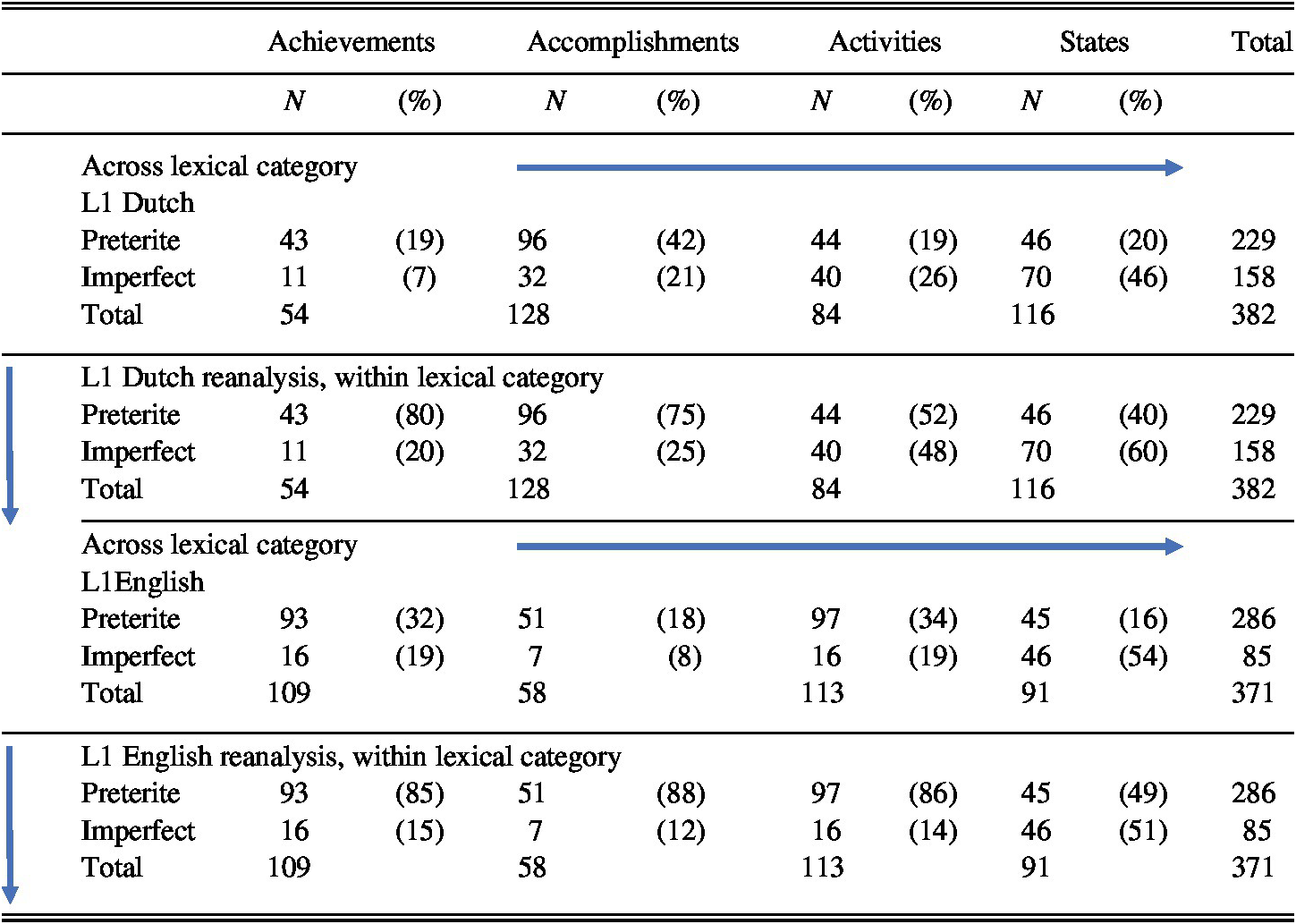
As an illustration, Table 2 provides the original across-category analysis for Dutch-speaking learners of Spanish from González and Quintana (Reference González and Quintana2018). The arrow that runs left to right indicates that the total is calculated across categories. The learners produced 43 achievements and an equal number of activities (44) and more than twice as many accomplishments (96). The occurrence of preterite on accomplishments at 42% is more than twice that of achievements or activities. However, when the distribution is recalculated using the within-category analysis (the arrow points down, indicating that the total is calculated within each aspectual category), thus controlling for the difference in numbers of tokens produced: 80% of achievements, 75% of accomplishments, 52% of activities, and 40% of statives exhibit use of the preterite, supporting the AH. Similarly, the imperfect shows the greatest use with statives (60%), less with activities (48%), and approximately half of that with accomplishments (25%) and achievements (20%). The data from the English L1 learners is similarly presented (Table 2). Thus, the reanalysis challenges the authors’ claim of counterevidence for the AH.
Analysis of L1 Dutch and L1 English results (across-category analysis, González & Quintana, Reference González and Quintana2018, Table 5, p. 620; Table 8, p. 621) and within-lexical-category reanalysis

Note: Adapted from “Inherent aspect and L1 transfer in the L2 acquisition of Spanish grammatical aspect,” by P. González and L. Quintana Hernández, Reference González and Quintana2018, The Modern Language Journal, 102, pp. 620–621. Copyright by Wiley.
In sum, the review of research addressing the AH has shown that the investigation of the acquisition of morphology tracking its emergence and development as it relates to the lexico-aspectual characteristics of verbal predicates has been a fruitful area of research, with past and ongoing debates. The picture that emerges from the review is that in its current formulation (i.e., Andersen, Reference Andersen, Salaberry and Shirai2002) there are more studies whose results are consistent with the AH than not, and that a number of issues need to be examined, which is the goal of the following section.
THE ASPECT HYPOTHESIS AND SLA RESEARCH: FACTORS IN THE USE OF TENSE-ASPECT
When authors reflect on explanations for variation in the acquisition of past morphology relative to the AH, four variables are frequently cited: proficiency, first language, input, and task (see Table S1 in the online supplementary materials). In this section we consider these variables through studies that have specifically set out to test their influence on the outcome of the AH.
We start with learner proficiency, which is directly addressed by the hypothesis, move to two issues related to learnability, namely language transfer and input, and conclude with investigations of task effect. These variables (and more, including, e.g., discourse structure and narrative grounding) are in play simultaneously; however, we present them individually in the following sections.
LEARNER PROFICIENCY
Testing learners at a range of proficiency levels is integral to testing the AH. Including beginning level learners is necessary to test the initial stages of morphological development following the prediction that “second language learners will initially be influenced by the inherent semantic aspect of verbs or predicates” (Andersen & Shirai, Reference Andersen, Shirai, Ritchie and Bhatia1996, p. 533, emphasis added). In addition, studies need to test incrementally more proficient learners to observe the “spread” of past (preterite, imperfect, and progressive) across lexical aspectual categories to document not only initial but “subsequent uses of past forms” (Andersen, Reference Andersen, Salaberry and Shirai2002, p. 79).
Researchers working with higher proficiency learners problematize the observation that the strength of the association of aspectual category and past morphology often increases with proficiency (e.g., Salaberry, Reference Salaberry2008, p. 133; first noted by Robison, Reference Robison1995). We do not find this problematic because the strengthening association is developmental and can be explained mathematically. Low-level learners who begin to use verbal morphology show very low levels of use of past morphology. They also use nonpast forms, such as base forms (or infinitives), present, and progressives (bare and inflected). As null morphology recedes, more verbs are inflected, and alternative forms become past forms (Bardovi-Harlig, Reference Bardovi-Harlig1998). For example, an analysis of oral narratives by a cross-section of learners of English (Bardovi-Harlig, Reference Bardovi-Harlig1998) shows that from the lowest group (Group 10–30, named for 10%–30% overall use of past tense) to the next group (Group 50) base forms drop from 47% to 26% and alternative forms from 20% to 4%, and past rises from 32% to 71%. From Group 50 to 70, base forms drop to 11%, alternative forms stay at 4%, and past rises from 71% to 85%, and so on through the levels. In this manner, uninflected verbs become inflected, inflected verbs become past, and morphology associates with the lexical aspectual categories more strongly. Thus, increased association of past morphology and aspectual category is a result of linguistic development in general, and it is difficult to consider it counterevidence to the AH.
Although there is currently broad interest in the advanced learner (cf. Vraciu, Reference Vraciu2013), this does not always translate well into aspect studies. Several AH studies included learners that are too advanced to test the initial stages that Andersen (Reference Andersen, Salaberry and Shirai2002) described. More specifically, B2- and C2-level learners according to the Common European Framework of Reference for Languages, who have A-levels in French (the equivalent of high GPAs in high school majors in North America; McManus, Reference McManus2013; see also Labeau, Reference Labeau2005) exhibit scores of greater than 80% use of perfective past (passé composé) in French (McManus, Reference McManus2013, Table 8), which is not characteristic of beginning learners (cf. Bardovi-Harlig, Reference Bardovi-Harlig1998, Table 3, true beginners exhibit around 30% use of simple past in English). Proficiency labels have always been problematic in SLA, but using the term “low” for the lowest level of a relatively high-level group is counterproductive. Thus, if B2–C2 students are too proficient to exhibit early stages of perfective past, they seem to be in the middle of a trajectory toward the imperfect, which is acquired much later, demonstrating around 50% use of the imparfait in French (59% use of French imperfect with statives by year 1 university students, Labeau, Reference Labeau2005; 42% use of imperfect with atelics, McManus, Reference McManus2013), which brings us to how more advanced learners can be instrumental in testing the AH.
Where intermediate-to-advanced learners have a genuine role to play is in the determination of when the imperfect enters the system and how it spreads. Research has documented that imperfect emerges after the perfective past, but has yet to determine the time interval and the effects of variables (such as instruction) on the spacing between perfective and imperfective past and the path that it travels. Camps (Reference Camps2005) and Comajoan (Reference Comajoan2006) captured the early stages of imperfect (for Spanish and Catalan, respectively) and provided a starting point for comparisons to higher proficiency learners such as those in Izquierdo and Collins (Reference Izquierdo and Collins2008) and McManus (Reference McManus2013). Furthermore, the performance of truly advanced learners can shed light on the use of nonprototypical associations, namely the preterite with statives and the imperfect with achievements (e.g., Diaubalick & Guijarro Fuentes, Reference Diaubalick, Guijarro Fuentes, Bellamy, Child, González and Muntendam2017; Domínguez et al., Reference Domínguez, Tracy-Ventura, Arche, Mitchell and Myles2013; Izquierdo & Collins, Reference Izquierdo and Collins2008; Salaberry, Reference Salaberry, Salaberry and Shirai2002.)
LANGUAGE TRANSFER
Two early longitudinal studies of L2 temporality concluded that there was a lack of noticeable first-language effects. Bardovi-Harlig (Reference Bardovi-Harlig2000, p. 182) concluded that “there does not seem to be an obvious first language influence in the longitudinal corpus” produced by L1 speakers of Arabic, Japanese, Korean, and Spanish. Dietrich et al. (Reference Dietrich, Klein and Noyau1995) observed that transfer “phenomena are strikingly rare. What is much more striking is the lack of SL [source language] influence where one would expect it,” concluding that “there is no significant SL influence in the acquisition of temporality” (p. 278). They did not rule out transfer entirely, however, stating “We cannot exclude that clear transfer exists, of course; but if so, we have not observed it in the learner varieties studied in this project.”
AH studies have subsequently investigated the effects of language transfer, using the hypothesis as a lens for identifying transfer. Although studies may control for task, proficiency, age, and educational levels (almost all participants are university students and all are instructed learners), studies differ in design, which can make comparisons difficult (Jarvis, Reference Jarvis2000). Studies of a single L1 compare their results against other studies or against the predictions of the AH; other studies following Dietrich et al. (Reference Dietrich, Klein and Noyau1995) and Jarvis (Reference Jarvis2000) have compared two L1s (see Table S2 in the online supplementary materials).
In this section, we discuss studies that self-identified with the term transfer or L1 in the research questions or title. More specifically, AH transfer studies ask a number of questions regarding whether a specific L1 (dis)advantages the acquisition of an L2 tense-aspect system compared to one or more other languages:
-
(a) What is the influence of [+progressive] languages (English) and [–progressive] languages (German, Russian, Ukrainian, Bulgarian) on the acquisition of L2 Japanese progressive and resultative? (Sugaya & Shirai, Reference Sugaya and Shirai2007)
-
(b) What is the influence of [+progressive] languages (Chinese, Japanese, Spanish) and [–progressive] languages (Hebrew, German, Polish) on the use of stative progressives in L2 English? (Fuchs & Werner, Reference Fuchs and Werner2018)
-
(c) What is the influence of L1 French passé composé on English and use of present perfect in perfective (simple past) contexts (namely, achievements and accomplishments)? (Ayoun & Salaberry, Reference Ayoun and Salaberry2008; Collins, Reference Collins2002, Reference Collins2004; Deshors, Reference Deshors2018)
-
(d) Is there an advantage of an L1 (or L2) that makes the perfect-imperfect distinction in acquiring an L2 (or L3) with the same or similar contrast? (Diaubalick & Guijarro Fuentes, Reference Diaubalick, Guijarro Fuentes, Bellamy, Child, González and Muntendam2017; Fessi, Reference Fessi2016; Izquierdo, Reference Izquierdo2009; Izquierdo & Collins, Reference Izquierdo and Collins2008; Salaberry Reference Salaberry, Ayoun and Salaberry2005)
-
(e) What is the influence of different tense-aspect systems in the L2 acquisition of tense-aspect? (L1 English, L1 Dutch on L2 Spanish, González & Quintana, Reference González and Quintana2018; L1 English, L1 German on L2 Italian, Giacalone Ramat, Reference Giacalone Ramat, Salaberry and Shirai2002; or L1 English, L1 German on L2 French, McManus, Reference McManus2013)
These studies investigate whether the influence of transfer is sufficient to disrupt the sequences predicted by the AH, accelerating, slowing, or reordering development in some way. In this regard, Sugaya and Shirai (Reference Sugaya and Shirai2007, p. 10) named two hypotheses addressing L1 transfer: a strong L1 transfer hypothesis, in which L1 transfer could override the AH (Shirai, Reference Shirai2002b), and a weak L1 transfer hypothesis (which Sugaya & Shirai, Reference Sugaya and Shirai2007, attributed to Collins, Reference Collins2002), in which L1 transfer does not override the AH, but rather transfer effects are found within the AH, such as limited use of the present perfect as a competitor to simple past in achievements and accomplishments in L2 English by L1 speakers of French (see question [c] in the preceding text).
Several studies have investigated the influence of an L1 form that is structurally like a present perfect but that semantically is a perfective past on the acquisition of simple past or preterite. There have been enough such studies that they can be compared instructively: the L1s include French (Ayoun & Salaberry, Reference Ayoun and Salaberry2008; Collins, Reference Collins2002, Reference Collins2004; Deshors, Reference Deshors2018) and Dutch (González & Quintana, Reference González and Quintana2018), the L2s English and Spanish; the studies focus on the use of present perfect in perfective contexts. The tasks have included cloze passages, essays, and narrative retells. Collins (Reference Collins2004) tested L1 French speakers (a language with a form equivalent to the English present perfect) and L1 Japanese speakers (a language without a present perfect form) using cloze passages. Both groups of learners exhibited use of simple past as predicted by the AH. However, both groups also used the perfect, contrary to the L1-based prediction. Although the L1 French learners primarily used the simple past, they also used the present perfect as an alternative to the simple past with telics. In contrast, the Japanese speakers were expected to not use the present perfect because it is not part of the Japanese tense-aspect system, but they nevertheless used present perfect and pluperfect as alternatives to the simple past in all categories, suggesting that factors other than transfer may play a role. Ayoun and Salaberry (Reference Ayoun and Salaberry2008, p. 582) similarly reported that both cloze-passage and narrative data reflected a strong effect of lexical category, and that L1 French did not have a “pervasive negative influence” in that there were very few uses of the present perfect. Deshors (Reference Deshors2018) examined the use of present perfect with accomplishments and achievements (where the simple past is expected) in essays and critiques of literary texts from the French subsection of the International Corpus of Learner English and reported that the influence of the French passé composé was weak. Finally, González and Quintana (Reference González and Quintana2018) compared L1 English and L1 Dutch learners of Spanish on a written film retell task in which only the Dutch learners used the present perfect in perfective past contexts (11% of the total); they also used the imperfect more than the English speakers who used preterite. González and Quintana concluded that both transfer and inherent aspect (dynamaticity for L1 English and durative-terminative for L1 Dutch) determined the use of morphology using an across-category analysis.
Studies of Asian languages have also investigated the role of L1 transfer and the AH. Sugaya and Shirai (Reference Sugaya and Shirai2007) investigated transfer and universals following Reference ShiraiShirai (2002b) with two groups of learners, L1 progressive (English) and L1 nonprogressive (German, Russian, Ukrainian, Bulgarian) using two tasks. Results from the grammaticality judgment test showed that there was an effect of lexical aspect in how L2 learners of Japanese used progressive morphology (association of nonpast imperfective –teiru with progressive meaning with activity verbs, more common in the lower level; the past marker associated with achievements at the lower and higher levels). The data also showed that there was no L1 effect because the L1 progressive and nonprogressive learners performed in similar ways.Footnote 10 Data from the oral picture description task investigating the use of progressive and resultative –teiru in the present exhibited an L1 effect in the lower level groups.Footnote 11 In sum, their results suggested that L1 transfer is evident only in the lower level, and it appears to operate within the AH.
In the aggregate, the studies show that L1 influence does not override lexical aspect, but rather, it is subtle and is mediated by two factors, proficiency and task. True low-level learners show greater L1 influence than more advanced learners. This further supports the AH as a semantic and acquisitional universal, especially when we take into account the range of L1–L2 pairs that have been tested.
LANGUAGE INPUT
The question of the influence of input on acquisitional patterns in tense-aspect acquisition was formalized by Andersen (Reference Andersen and Meisel1986, Reference Andersen, VanPatten and Lee1990) as the distributional bias hypothesis. Andersen and Shirai (Reference Andersen and Shirai1994) observed that “native speakers in normal interaction with other native speakers tend to use each verb morpheme with a specific class of verbs, also following the aspect hypothesis” (p. 137). Two types of studies have followed: analyses of large corpora that represent input that learners may encounter and studies of classroom input.
To characterize potential input to L2 learners of English, Wulff et al. (Reference Wulff, Ellis, Römer, Bardovi-Harlig and LeBlanc2009) investigated verb forms in the spoken section of the British National Corpus and the Michigan Corpus of Academic Spoken English (MICASE; Simpson et al., Reference Simpson, Briggs, Ovens and Swales2002). They concluded that frequency biases in the input result in certain verbs being more frequently associated with certain tense-aspect morphology (note that Wulff et al. [Reference Wulff, Ellis, Römer, Bardovi-Harlig and LeBlanc2009] discuss verbs not predicates). Verbs that are distinctively associated with particular tense-aspect forms (like activities with progressive) tend to be the prototypical associations. They concluded that “frequency alone is not enough” (p. 366) and that three factors—frequency, distinctiveness, and prototypicality—interact and are usually positively associated. Tracy-Ventura and Cuesta-Medina (Reference Tracy-Ventura and Cuesta-Medina2018) conducted a similar analysis using native-speaker corpus data for Spanish (Corpus del español, Davies, Reference Davies2002). They found that the top 10 most frequent verbs associated with preterite in the native-speaker corpus were telic, whereas those with imperfect were atelic, and primarily states.
The second approach is to study the input available in specific learning environments (classroom input and instructor talk in classrooms). Camps (Reference Camps2005) illustrated the effect of classroom instruction by collecting narratives in response to the question “What was the best vacation you’ve ever had?” The first narratives were collected after instruction on Spanish preterite, but before instruction on the imperfect, and in these, the learners used only the preterite. Camps repeated the task after instruction on the imperfect, and learners used the imperfect as predicted by the AH (see “Review of Empirical Studies”).
Whereas Camps described instructional input in terms of the forms taught and the length of instruction, later studies included an analysis of classroom language. Collins et al. (Reference Collins, White, Trofimovich, Cardoso, Horst and Muñoz2012) collected 40 hours of classroom input from intensive EFL grade school classrooms in Quebec (6 classes of Grade 3), finding simple past in only 10% of the finite verbs forms in the corpus. Seventy-two percent of past verbs appeared with telics (achievements/ accomplishments), 19% with activities, and 9% with statives. The retrospective verbal reports collected by Collins (Reference Collins2005) indicated that learners may be sensitive to not having encountered certain forms in input. Learners particularly commented on the lack of stative verbs in the past and their use in the present (p. 214), thus suggesting that similar input distributions may be found in a variety of classrooms.
Finally, Daidone (Reference Daidone2019) examined input provided by teachers of Spanish. Recordings of instructor talk from twenty-four 50-minute classes of Spanish in third-, fourth-, and fifth-semester university courses (eight recordings per level) revealed that oral teacher input had more instances of preterite than imperfect (in a single class session, an average of 23 tokens of preterite and 5 tokens of imperfect were provided). In fact, four instructors from the third and fourth semesters produced only the preterite (three were native speakers and only one was a nonnative speaker of Spanish). She also compared teacher input to Spanish native-speaker corpus data from Corpus de referencia del español actual (CREA) and the Corpus del español and found much greater use of imperfect in the corpus data than in teacher input.
These classroom-based studies raise the issue of impoverished input. The form-meaning associations are greatly simplified in at least some foreign-language classrooms. If Spanish foreign-language classrooms are similar to those described in these studies, this would contribute to the robust use of preterite and the absence of imperfect reported by Salaberry (Reference Salaberry1999, Reference Salaberry2000). An analogous situation for L2 Japanese is reported by Ishida (Reference Ishida2004), in which the resultative reading of -teiru was taught exclusively 4 months before the progressive reading (2nd semester vs. 3rd semester), contributing to the resultative-before-progressive order, in contrast to the progressive-before-resultative order reported in all other studies (Shirai, Reference Shirai2002b). In contrast, precollege ESL learners in academic programs in North America may encounter less controlled input in the academic environment and beyond, leading to the production of a range of forms and meanings reported by Bardovi-Harlig (Reference Bardovi-Harlig2000) and Collins (Reference Collins2002).
TASK EFFECTS
The effect of task is part of AH research for two reasons: (a) to test generalizability, that is, to investigate whether the predictions of the AH are borne out across tasks (there may also be an undercurrent of looking for a task in which the AH does not hold) and (b) to facilitate data collection by providing production or interpretation opportunities that result in the greatest number of tokens in the greatest number of aspectual categories (see Table S3 in the online supplementary materials). Longitudinal studies tend to use a variety of tasks both to provide a wide range of tokens and to maintain participant interest (e.g., Bardovi-Harlig, Reference Bardovi-Harlig, Labeau and Saddour2012; Dietrich et al., Reference Dietrich, Klein and Noyau1995, data reanalyzed for the AH by Chan et al., Reference Chan, Finberg, Costello, Shirai, Filipović and Jaszczolt2012). The number of production tasks exceeds the number of interpretation and judgment tasks; the production tasks have predominately been written, with approximately half as many oral tasks, and half again eliciting both oral and written production.
In tense-aspect research, the gold-standard tasks have been those that allow learners to produce personal narratives. The studies reviewed here often treat narrative as a task. However, telling the narrative is the task, and the resulting narrative is a text. Narratives are only one of a range of text-types, each with their own structure and tense-aspect use. Narratives are texts in which “the speaker relates a series of real or fictive events in the order in which they took place” (Dahl, Reference Dahl, Butterworth, Comrie and Dahl1984, p. 116). They are highly desirable because narrative foreground is sequenced, follows chronological order, and provides common contexts for the use of perfective past. Personal narratives are desirable because narrators are inclined to set the scenes for various events, provide motivations for actions, as well as interpretations and evaluations, all candidates for the use of imperfect in the narrative background.
Because learners in the initial stages of acquisition of tense-aspect morphology (the learner population addressed by the AH) are often unable to sustain lengthy personal narratives, and because personal narratives are not reliably comparable across learners (regardless of level of proficiency), researchers often elicit impersonal narratives. The use of impersonal narratives increases comparability, and gives every learner the same amount content to convey, if they are able to do so. However, this tends to sacrifice background information, and hence eliminates the environment for imperfective (Bardovi-Harlig, Reference Bardovi-Harlig2000, Reference Bardovi-Harlig, Kempchinsky and Slabakova2005; Noyau, Reference Noyau and Dechert1990).Footnote 12 This has been supported further by Camps’s (Reference Camps2005) comparison of personal narratives with imperfect to the impersonal narratives that lack imperfect in Salaberry (Reference Salaberry1999, Reference Salaberry2000), and Comajoan’s (Reference Comajoan2005b) comparison of personal narratives in conversation and impersonal narratives in retellings, resulting in more imperfect in conversational narratives than in retellings. Domínguez et al. (Reference Domínguez, Tracy-Ventura, Arche, Mitchell and Myles2013) addressed this issue by eliciting narratives in three tasks with increasing degrees of control over content: (a) personal narratives in a guided interview; (b) impersonal narratives in a picture retell task in which learners were provided with pictures and a habitual introduction (an imperfect context) “todas las mañanas eran las mismas” (every morning was the same) followed by a statement that introduced a sequence of events (a perfective context) “hasta que un día” (until one day); and (c) a guided impersonal narrative in a picture narration task in which pictures were presented with 25 corresponding predicates and adverbial phrases below the pictures in a type of oral cloze test.
Before we leave narratives and the tasks that elicit them, we must consider that every narrative brings a potential confound that is largely unacknowledged by AH studies, namely narrative structure. Narrative discourse is comprised of two parts, the foreground and the background. The foreground relates events belonging to the skeletal structure of the discourse (Hopper, Reference Hopper and Givón1979) and consists of clauses that move time forward (Dry, Reference Dry1981, Reference Dry1983; see also Fleischman, Reference Fleischman1985; Reinhart, Reference Reinhart1984; von Stutterheim, Reference Stutterheim, Huebner and Ferguson1991). In contrast, the background has many functions that together support the foreground. Grounding, like lexical aspect, influences the use of tense-aspect morphology (Hopper, Reference Hopper and Givón1979). Like achievements and accomplishments, activities that are sequenced in the foreground easily appear in the perfective past. Bardovi-Harlig (Reference Bardovi-Harlig1998, Reference Bardovi-Harlig2000) demonstrated that grounding influences tense-aspect distribution, and that with the exception of achievements (which occur with perfective past regardless of grounding), accomplishments show higher use of perfective past than activities (as predicted by the AH), and that accomplishments and activities show higher use of perfective past in the foreground than in the background in learner narratives. Not surprisingly, background activities show robust use of progressive, whereas foreground activities do not, instead appearing in the perfective past. While some studies acknowledge this variable in their literature reviews, only a few include grounding in the analysis (e.g., Comajoan, Reference Comajoan2005b; Domínguez et al., Reference Domínguez, Tracy-Ventura, Arche, Mitchell and Myles2013; Howard, Reference Howard2004; Labeau, Reference Labeau2005; Salaberry, Reference Salaberry2011).
After telling narratives, the most common task in AH research is the cloze passage. Multiple cloze passages allow the greatest flexibility in balancing production across aspectual categories and contexts for perfective and imperfective morphology, which is harder to do naturally in a single narrative. Cloze passages privilege sufficient tokens for evaluation, comparability of production across learners, and balance of aspectual categories over communication (Bardovi-Harlig & Reynolds, Reference Bardovi-Harlig and Reynolds1995; Collins, Reference Collins2002; Izquierdo, Reference Izquierdo2009; Izquierdo & Collins Reference Izquierdo and Collins2008; but see Ayoun & Salaberry, Reference Ayoun and Salaberry2008; Zhao & Shirai, Reference Zhao and Shirai2018, for a 59-item cloze that is not balanced). The potential use of explicit knowledge is minimized by asking the learners to work quickly. Domínguez et al. (Reference Domínguez, Tracy-Ventura, Arche, Mitchell and Myles2013) used guided impersonal narratives that were elicited by presenting sequenced pictures with verbs provided. In contrast to the open cloze passages that allow learners to use any form in their linguistic inventory (including base forms), forced-choice tasks between perfective and imperfective past (such as that used by Salaberry, Reference Salaberry2011) artificially elevate scores by giving learners only two target forms from which to choose.
Bardovi-Harlig (Reference Bardovi-Harlig2000) found no difference in the degree of support for the AH from unconnected short cloze passages and either written or oral impersonal narratives; in the written narrative and cloze passage, achievements and accomplishments exhibited the highest rate of use of past morphology, followed by activities. In the oral narrative, achievements showed higher use of past than accomplishments, followed by activities. The rates of past tense use were highest in the written cloze passage (Bardovi-Harlig & Reynolds, Reference Bardovi-Harlig and Reynolds1995), next highest in the written narrative, and lower in the oral narratives (Bardovi-Harlig, Reference Bardovi-Harlig1998). Collins (Reference Collins2002) replicated the cloze task with a different L1 and different learner population with the same results.
Shirai (Reference Shirai, VanPatten, Williams, Rott and Overstreet2004) speculated that cloze passages may better support the AH than narratives, but in her review of the literature Bonilla (Reference Bonilla2013) found the opposite—that narratives better support the AH than cloze passages. This led to additional comparisons of narratives and cloze passages in French (oral and written Modern Times film retell and cloze passage; Labeau, Reference Labeau2005), Spanish (nine-item cloze passage and one of either a personal narrative or a fairy tale; Ayoun & Salaberry, Reference Ayoun and Salaberry2008), and English (the cloze passage, from Ayoun & Salaberry, Reference Ayoun and Salaberry2008, and an oral personal narrative; Zhao & Shirai, Reference Zhao and Shirai2018). Ayoun and Salaberry found that both the narrative and the cloze passage supported the AH. Zhao and Shirai reported that only the narrative did, and Labeau reported different analyses for the narrative and cloze passage and reported “bias provoked” by data-collection methods, but the learners were likely too advanced for the AH to apply.
Cloze passages differ considerably across studies, most notably whether they represent connected texts or short independent passages. They may also differ within studies; Salaberry (Reference Salaberry, Salaberry and Shirai2002) used three cloze passages from literary texts, and one he constructed to test nonprototypical combinations. In addition, all cloze passages differ from learner-constructed texts (of any type) because learners do not construct the cloze but rather supply verbs one at a time. Impersonal narratives also differ from each other in terms of events and subsequent encoding of those events and situations (Comajoan, Reference Comajoan2006); similarly, Deshors (Reference Deshors2018) noted that the different prompts used to elicit argumentative texts could have influenced their verb choices. This variation emphasizes the fact that tests of task effects occur in the context of both varying learner proficiency and task construction.
Among the studies that have identified task as a central concern, one nevertheless finds problematic procedures often caused by the pressure to elicit sufficient tokens to test the hypothesis. Open-book elicitation, in which the learners look at the pictures during the task, increases deixis, including the use of nonpast and progressive, thus sacrificing the test of past required by the AH (Muñoz & Gilabert, Reference Muñoz and Gilabert2011). Directions that tell learners to use past tenses (González & Quintana, Reference González and Quintana2018) or to write at least 15 verbs and 4 adverbs (Ayoun & Salaberry, Reference Ayoun and Salaberry2008) may encourage the use of explicit knowledge on the part of the learners. Giving learners two days in advance to prepare a personal narrative or a fairy tale assures that learners can complete the task, but it also invites planning and rehearsal even when learners were told not to write their stories (Ayoun & Salaberry, Reference Ayoun and Salaberry2008). Instructions may also direct learners away from the past as in “Describe what you’ve just seen: what are the characters doing?” (Rastelli & Vernice, Reference Rastelli and Vernice2013). In this case, the authors claim that the learners were free to use either past or present, but the directions prime the learners for nonnarrative by using “describe” and present progressive “What are the characters doing?” Also problematic are studies that do not report how the task was performed (e.g., McManus, Reference McManus2013).Footnote 13
Researchers can avoid the pitfalls of over explicit instructions by eliciting texts through defining questions. Von Stutterheim and Klein and colleagues have suggested that texts can be distinguished by the question that they answer, known as the Quaestio (Carroll & von Stutterhiem, Reference Carroll, von Stutterheim and Ramat2003; von Stutterheim, Reference Stutterheim, Huebner and Ferguson1991; von Stutterheim & Klein, Reference Stutterheim, Klein, Dietrich and Graumann1989; von Stutterheim, & Lambert, Reference Stutterheim, Lambert and Hendricks2005). This provides a practical solution to data collection because researchers can use such questions to elicit texts: Narratives answer the question, “What happened next?” (von Stutterheim & Klein, Reference Stutterheim, Klein, Dietrich and Graumann1989), descriptions “What did/does X look like?” (von Stutterheim & Klein, Reference Stutterheim, Klein, Dietrich and Graumann1989) or “What was it like there?” (Carroll & von Stutterheim, 2003), and arguments “What is the evidence for your position?” (Bardovi-Harlig, Reference Bardovi-Harlig, Salaberry and Comajoan2013). Nonnarratives are particularly good linguistic contexts for imperfects and are often the type of text collected in corpora (e.g., Deshors, Reference Deshors2018).
In sum, the AH studies reviewed here show that the preponderance of tasks elicit narratives; however, they also show that narrative texts are often not distinguished from the tasks that elicit them. Eliciting nonnarrative text types, such as descriptions and argumentative texts, through appropriate tasks would provide evidence of the acquisition of other forms (e.g., imperfect, progressive). Tasks that elicit texts are one way to study the use of tense-aspect morphology in relatively lengthy learner-constructed language samples; conversations and conversational interviews are another. Production tasks dominate research addressing the AH in the last 20 years. As we become increasingly interested in nonprototypical associations, we may include truth-value tasks and acceptability judgment tasks to further probe form-meaning associations.
MOVING FORWARD WITH RESEARCH ON THE ASPECT HYPOTHESIS
This section positions the AH within the larger inquiry of SLA, by considering the role of both description and explanation with respect to the hypothesis, and it identifies areas for future research within the domain of the AH that will expand our knowledge of how L2 tense-aspect systems are acquired.
Some criticisms of research in the AH have raised the issue of the explanatory power of the hypothesis, in the sense that it may provide an accurate description of interlanguage development but falls short of an explanation (Labeau, Reference Labeau2005; Salaberry, Reference Salaberry2008; Slabakova, Reference Slabakova2002; see also Andersen, Reference Andersen, Salaberry and Shirai2002). In this respect, it may be useful to make a distinction between theory and hypothesis (VanPatten & Williams, Reference VanPatten and Williams2015, p. 5):
Distinct from a theory, a hypothesis does not unify various phenomena; it is usually an idea about a single phenomenon. Some people use theory and hypothesis interchangeably, but in fact, they are distinct and should be kept separate. In science, we would say that a theory can generate hypotheses that can then be tested by experimentation or observation.
Following VanPatten and Williams’ definition, we can say that the AH does not unify a number of phenomena related to the acquisition of tense-aspect, that is, everything related to the acquisition of tense-aspect in all contexts and tasks and from all L1s. Instead, the AH is a prediction about one phenomenon, namely the early association of past morphology, both perfective and imperfective (and within that both general imperfective and progressive) with lexico-semantic categories of verbal predicates. The explanation for this attraction is the underlying semantics. The encompassing theory in which the AH was proposed is functionalism, and within functionalism, the AH is just one piece of a larger puzzle that is the use of past-tense morphology within discourse (or task, when eliciting data).
In his discussion of SLA theories, Jordan (Reference Jordan2004) distinguishes between the objectives and the domain of theories. Objectives refers to whether theories have goals that are more descriptive (making sense of data) or explanatory (finding causation). Extending this approach to hypotheses, the AH provides both description and explanation: It provides a thorough description of learner data regarding tense-aspect and it provides an explanation for it, namely, the lexical semantics of the verbal predicates influence learners to inflect them with certain morphemes earlier or later. However, as we have shown in the review, this pattern is mediated by additional variables, which should be accounted for, not by an expanded AH, but by other interacting components of a theory of SLA. Jordan defines the domain of a theory of SLA as the number of phenomena and their boundaries that the theory should attempt to explain (e.g., learner internal vs. learner external phenomena). The domains of the different perspectives on the acquisition of tense-aspect morphology are heterogeneous, but studies discussing the AH mostly attempt to explain the same domain, namely the acquisition of verb morphology in relation to lexical aspect. In this respect, one cannot ask for a complete account of L2 acquisition from the AH because the AH at its core makes linguistic claims that will necessarily interact with other learning variables (e.g., discourse grounding in narratives; Comajoan, Reference Comajoan, Ayoun and Salaberry2005a, Reference Comajoan, Salaberry and Comajoan2013).
In this view, not all tense-aspect phenomena are of immediate relevance to the AH and thus not all of them require an explanation from the AH. For instance, one factor that has been almost assiduously ignored in research in the AH is the influence of narrative structure (Bardovi-Harlig, Reference Bardovi-Harlig2000, and Salaberry, Reference Salaberry2011, are two among few exceptions). We do not suggest here that every test of the AH also be a test of the discourse hypothesis, but rather that studies using narratives cease to ignore the internal structure of narratives (namely, foreground and background) that also exerts influence on tense-aspect morphology. By extension, understanding the relation of text types to tense-aspect use through both the text type (Smith, Reference Smith2003) and main and side structures within those text types (Carroll & von Stutterhiem, Reference Carroll, von Stutterheim and Ramat2003; von Stutterheim, Reference Stutterheim, Huebner and Ferguson1991; von Stutterheim & Klein, Reference Stutterheim, Klein, Dietrich and Graumann1989; von Stutterheim, & Lambert, Reference Stutterheim, Lambert and Hendricks2005) will allow researchers to explore imperfective and nonnarrative text types.
In sum, in contrast to calls for extending the AH to include additional variables (e.g., Labeau, Reference Labeau2005), we advocate keeping the relevant hypotheses separate. Theories of SLA need accounts of transfer, input, instruction, and task effects, but those accounts are separate from the linguistically motivated hypotheses concerning the development of specific constructs. A theory of language transfer should apply to every relevant case, not just tense-aspect. Similarly, hypotheses concerning the effects of tasks should be stated generally, and apply to all relevant cases; the same with input and a special case of input, instruction.
As important as it is to understand what is beyond the scope of the AH, it is also important to understand what type of continued research in the domain of the AH would be hypothesis-driven and also expand our knowledge of L2 tense-aspect systems. We suggest three areas of investigation here.
(a) What is the timing of the emergence of preterite (or perfective past) and the imperfect for languages that maintain that distinction? One area of investigation that arises from unresolved differences in the empirical data is the timing of the acquisition of the perfective and imperfective pasts. In his schematic representation of the stages of acquisition (see Figure 1), Andersen (Reference Andersen, Huebner and Ferguson1991) seems to have proposed rather rapid acquisition of imperfect, in stage 3, following the emergence of perfective past in stage 2, out of eight stages. Similarly, Domínguez et al. (Reference Domínguez, Tracy-Ventura, Arche, Mitchell and Myles2013) referred explicitly to the rapid acquisition of the imperfect in their rephrasing of the predictions of the AH: “The imperfective marker appears soon after the perfective marker is first used” (p. 561, prediction 3). In contrast, Andersen (Reference Andersen, Salaberry and Shirai2002, p. 83) revised his estimate, instead claiming that the imperfective does not appear “for a long time,” even though the perfective has begun to spread across categories. Bardovi-Harlig (Reference Bardovi-Harlig, Kempchinsky and Slabakova2005) read the empirical literature to suggest, supported by the additional studies reviewed here, that the imperfect takes longer to emerge than Andersen (Reference Andersen, Huebner and Ferguson1991) had hypothesized. These differences in the timing of the emergence of imperfect morphology are evidence that perfective and imperfective morphology may develop at different rates and that even though lexical aspect influences the development of both, they are not necessarily timed as first posited by Andersen (Reference Andersen, Huebner and Ferguson1991).
(b) What is the relationship between the general imperfective and the progressive in languages that exhibit both? (Hypotheses 2 and 3). Although Hypotheses 1 (the spread of perfective past) and 2 (the spread of imperfect past) are frequently investigated together, Hypotheses 2 and 3 (the spread of the past progressive) have not been. Whereas the perfective and imperfective have a hypothesized order of emergence, no such order has been investigated for general imperfectives and the progressive in languages that have both, such as Spanish, Catalan, Portuguese, and Italian. Addressing such a question would also entail determining the relationship between the semantics of the general imperfective (which includes habituality, progressivity, and continuity or unboundedness) and the progressive (see Giacalone Ramat, Reference Giacalone Ramat, Eliasson and Jahr1997).
(c) Of the three areas that we suggest for further research in the framework of the AH, the most intriguing to us is the investigation of nonprototypical associations of past morphology and lexical aspectual categories, an area that leads back to the semantics of aspect. A number of research questions could be further investigated, such as: (i) Do learners produce such associations, (ii) Do learners understand nonprototypical associations; that is, can they compute the coercions? (iii) If so, when are they able to do so? As we suggested in earlier sections, the comprehension and use of nonprototypical associations of past morphology and lexical aspectual categories is very likely the domain of advanced learners, but this too is an empirical question. Narratives will show predominately prototypical associations, and nonprototypical uses will be relatively rare. Production studies will need to create contexts for four-way contrasts (telic/atelic × perfective/imperfective), creating four combinations (two prototypical and two nonprototypical), whereas interpretation tasks will permit the testing of more nuanced cases.
We identified four studies that have begun to address this question (Domínguez et al., Reference Domínguez, Tracy-Ventura, Arche, Mitchell and Myles2013; Diaubalick & Guijarro Fuentes, Reference Diaubalick, Guijarro Fuentes, Bellamy, Child, González and Muntendam2017; Izquierdo & Collins, Reference Izquierdo and Collins2008; Salaberry Reference Salaberry, Salaberry and Shirai2002). As is the case with new areas of study, there is little consistency in the definition of “nonprototypical associations” in these studies. For instance, Salaberry (Reference Salaberry, Salaberry and Shirai2002, p. 401) considered that “The non-prototypical value is represented by the case when the aspectual inflection is in direct contradiction with lexical aspect” (e.g., use of imperfect in telic predicates). Some studies have investigated the use of imperfect in telic predicates and perfective in atelic predicates (Izquierdo & Collins, Reference Izquierdo and Collins2008; Diaubalick & Guijarro Fuentes, Reference Diaubalick, Guijarro Fuentes, Bellamy, Child, González and Muntendam2017 with external adverbials), and another has focused on grounding, investigating prototypical combinations such as states in the background and achievements in the foreground, and nonprototypical combinations of states in foreground, and achievements in the background (Domínguez et al., Reference Domínguez, Tracy-Ventura, Arche, Mitchell and Myles2013). However, achievements are not unusual in the background. The only class that seems to be at all restricted are statives in the foreground because they cannot be sequenced. In this respect, such contexts do not test nonprototypicality in relationship to the AH, but rather in interaction with the discourse hypothesis, and thus, the learners’ use of morphology due to narrative grounding is difficult to untangle from the influence of lexical aspect. Further research on the acquisition of nonprototypical uses of tense-aspect morphology should explicitly provide a definition of prototypicality and how it applies to lexical aspect and/or discourse grounding as well as other features, such as adverbials.
Following Smith (Reference Smith1997), we suggest that nonprototypical associations used to test the AH consist of combinations of lexical aspect features and verbal morphology that require reinterpretation of a situation, and that these would ideally be tested on the predicate and tense-aspect morphology in isolation. For example, in the imperfective of achievements, the imperfective presents the preliminary stages of the event. In sentences like “The team was reaching the top”/“El equipo estaba alcanzando la cima” or “She was winning the race”/“La corredora estaba ganando la carrera,” there is no suggestion that the achievement takes place. Thus, in a yes/no interpretation task, given the sentence, “The team was reaching the top,” the answer to Did the team reach the top? would be “no” or “I don’t know” and the answer to Did the team climb on the mountain? would be “yes.” In a truth value task, given the sentence “She was winning the race,” the sentence “She was ahead of other runners” would be true, but “She won the race” would be false or unknown.
Similarly, statives with progressive are generally not allowed (such as “*Bill was knowing the answer”), but with “be” statives allow reinterpretation as in “John was being a hero” (Smith, Reference Smith1997). With “be” statives, the progressive usually indicates that the states are transitory “stage-level ways of behaving that involve will and energy, although not necessarily overt activity” (p. 58). These sentences could be tested by truth value tasks in which the target sentence and one interpretation (at a time) is presented (see also Slabakova, Reference Slabakova2003).

Accomplishments with progressive are not read as completed, which could be tested in a judgment task:
-
3a. Mary was walking to school, but she didn’t get there (good)
-
b. #Mary walked to school, but she didn’t get there (not good)
Nonprototypicality within the AH is a type of theoretically defined difficulty, but only a subset of what might constitute interesting learnability issues in the domain of tense-aspect systems. Other areas of “difficulty” may be caused, for example, by the many readings of the imperfect or other tense-aspect forms (such as present perfect vs. preterite readings), questions outside the scope of the AH.
CONCLUSION
This article has reviewed research of the past 20 years that has been conducted to investigate the AH. As we have shown, some studies speak directly to the AH, both in terms of theoretical constructs and research design, and others raise concerns either outside the AH or use designs or analyses that cannot be evaluated as claimed. The AH accurately predicts the adult L2 acquisition of past morphology in a number of languages. This is not to deny that a number of challenges related to proficiency level, L1 transfer, task variation, and methodology persist. However, variation in design, implementation, and analysis seems to confound rather than clarify the interpretation of results. For researchers to be able to compare results across studies, designs should be clearly stated (with tasks included in appendices or supplementary materials, or made available through IRIS), tests of lexico-aspectual categories and problematic cases identified and reported (Shirai, Reference Shirai, Salaberry and Comajoan2013), examples given, and total counts of data for analyses provided. More than 30 years after Andersen (Reference Andersen and Meisel1986) first posited the hypothesis, it is clear that it has generated a wealth of research and that it continues to inspire researchers to investigate the link between lexico-aspectual information and the acquisition of L2 morphology. We have outlined three areas of further investigation within the AH as well as areas beyond the scope of the hypothesis. We hope that researchers will pursue lines of investigation both within and beyond the aspect hypothesis for a better understanding of the acquisition of L2 temporal systems.
Supplementary Materials
To view supplementary material for this article, please visit http://dx.doi.org/10.1017/S0272263120000194.