INTRODUCTION
This paper focuses on variation between the affixes –body and –one in the pronominal quantifiers somebody/someone, anybody/anyone, everybody/everyone, and nobody/no one. Given that the –body/–one pairs behave similarly on standard diagnostics, most literature on the syntax and semantics of these pronouns considers them to be functionally equivalent ways of saying the same thing (see also Jespersen, Reference Jespersen1914:444; Quirk, Greenbaum, Leech, & Svartvik, Reference Quirk, Greenbaum, Leech and Svartvik1985:376–377; cf. Labov, Reference Labov1972).Footnote 1 Both forms occur in analogous contexts within stretches of discourse of individual speakers in spontaneous speech, as in (1).
(1)
a. I think he had somebody else as well as Betty anyway.
But you have to live with someone to know them. (York)Footnote 2
b. No grief off anybody…It's your day, don't have to please anyone else. (York)
c. Oh I think everybody knew someone that went, didn't they?…
During the war everyone helped everyone else, didn't they? (York)
d. There was no one to do it…Nobody likes my jumper. (York)
Despite the similar behavior of these alternants in contemporary English, their histories are quite distinct, deriving from a quantifier plus either the free morpheme body (‘person’) or cardinal one. How these forms emerged as variants during Middle English and the differences across lexical items have been traced through much of the Modern period.
In this paper, we have a number of broad goals. The first is to track the historical development of –body/–one variation. Raumolin-Brunberg and her colleagues have provided a detailed picture of the development of the variants during Middle English (ME) and Early Modern English (EModE; e.g. Nevalainen & Raumolin-Brunberg, Reference Nevalainen and Raumolin-Brunberg2003; Raumolin-Brunberg, Reference Raumolin-Brunberg1991, Reference Raumolin-Brunberg and Kastovsky1994; Raumolin-Brunberg & Kahlas-Tarkka, Reference Raumolin-Brunberg, Kahlas-Tarkka, Rissanen, Kytö and Heikkonen1997). Their work draws primarily on the Helsinki Corpus of English Texts (Kytö, Reference Kytö1996; Rissanen, Kytö, & Palander-Collin, Reference Rissanen, Kytö and Palander-Collin1996) but is supported by a range of additional historical sources: for example, Corpus of Early English Correspondence ([CEEC], Nevalainen, Raumolin-Brunberg, Keränen, Nevala, Nurmi, & Palander-Collin, Reference Nevalainen, Raumolin-Brunberg, Keränen, Nevala, Nurmi and Palander-Collin1998), Century of Prose (Milić, Reference Milić1990a, Reference Milić1990b), Dictionary of Old English (Venezky & Healey, Reference Venezky and Healey1980), Shakespeare (Wells & Taylor, Reference Wells and Taylor1986). The current analysis draws on the Penn Historical Corpora to provide additional empirical evidence of the trajectories of change. These materials overlap with those used in previous research, but they crucially augment the window of analysis by 200 years. This expanded time frame reveals leveling of the lexical differences among the forms by the end of the 19th century.
The second goal is to tie the historical (British) evidence to the contemporary situation in the United Kingdom, drawing on a collection of synchronic corpora from across England and Scotland. The sum of these materials indicates that stylistic and social effects have been continuously significant predictors of variation.
The final goal is to perform a systematic comparative analysis across major varieties of English worldwide: British, American, Canadian, and New Zealand. An intriguing trend is visible across the datasets. There is ongoing change toward use of –one, but not for all quantifiers equally. Despite relatively stable social and stylistic effects, differentiation among the lexical quantifiers emerges across dialects.
THE PAST OF –BODY/–ONE: HISTORICAL CORPORA
Previous research
In Old English (OE), a broad array of forms semantically akin to the contemporary –body/–one quantifiers existed. There were two main syntactic types: (i) simple pronouns (e.g., hwa ‘who’, ‘anyone’, ‘someone’; hwelc ‘which’; sum ‘some’; ænig ‘any’; nænig ‘none, no one’; gehwelc ‘everyone’; ælc ‘each’), and (ii) quantificational collocations with the indefinite pronoun man (e.g., sum man ‘someone’; ænig man ‘anyone’; nan man ‘no one’). An, the ancestor of modern one, had a wide range of functions in OE as in Present Day English (PDE), as, for instance, a numeral (e.g., one as opposed to two), something approaching an indefinite article (PDE a/an), a particularizing/individualizing use (a certain person/thing), a partitive sense (one out of a group), as well as a number of minor types. It was not, however, used pronominally with reference to a particular or indefinite person, this function being supplied by (ge)hwa and man (Rissanen, Reference Rissanen1967). Both the independent pronominal use of one and its use in compounds, as in (2), emerged in the 13th century; compounds with –body, exemplified in (3), followed about a century later. Both innovations competed with the traditional compound, as in (4). In conjunction with ongoing semantic shifts in the meaning of man and narrowing of its scope in other pronominal uses, this competition contributed to the obsolescence of the man compounds (Raumolin-Brunberg, Reference Raumolin-Brunberg and Kastovsky1994; Rissanen, Reference Rissanen and Fisiak1997). In contemporary usage, the man form survives only in a limited number of set phrases and expressions, such as no man's land, everyman's library, and the well-known popular culture example in (5).
(2) Philip answered him, Two hundred peny-worth of bread is not sufficient for them, that eurey one of them may take a litle. (1611, The New Testament, Authorised Version, VI)
(3) A better body drank neyuer wine. (c1340 Cursor M. 3360 [Fairf.])
(4) And sitting in some place, where no man shall prompe him, by him self, let him translate into Englishe his former lesson. (c.1568 Roger Ascham, Asch.e1-h:1v.22)
(5) To boldly go where no man has gone before. (opening narration of Star Trek, 1966)
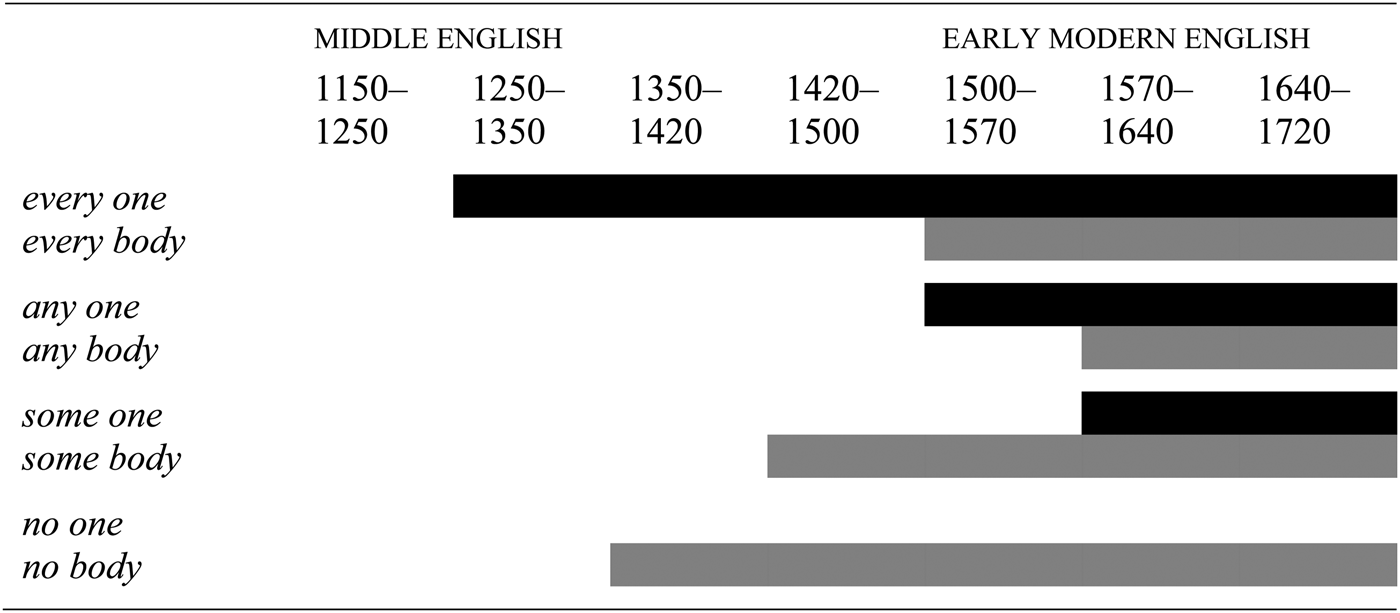
The innovative –body/–one compounds did not enter the language all at once. As outlined in Figure 1,Footnote 3 –one initially occurred with every and only gradually spread to the other quantifiers, while –body first appeared with no before generalizing. Generalization across a common set is a hallmark of grammaticalization (Heine, Reference Heine, Joseph and Janda2003:579–580; Hopper & Traugott, Reference Hopper and Traugott2003:100–103), and it is relevant here because it predicts that the frequency of each form will differ across the individual lexical items, at least in the earlier stages of change. However, what has never (to our knowledge) been reported in the case of competing forms such as this is what happens as such a situation evolves. One expectation is that the variants might ultimately converge on the same pattern (e.g., via analogy). An alternative expectation is that the innovative forms might actually create the paradigm from their ongoing competition..
Development of –body and –one, evidence from the Helsinki Corpus (based on Raumolin-Brunberg & Kahlas-Tarkka, Reference Raumolin-Brunberg, Kahlas-Tarkka, Rissanen, Kytö and Heikkonen1997:75, Figure 4).
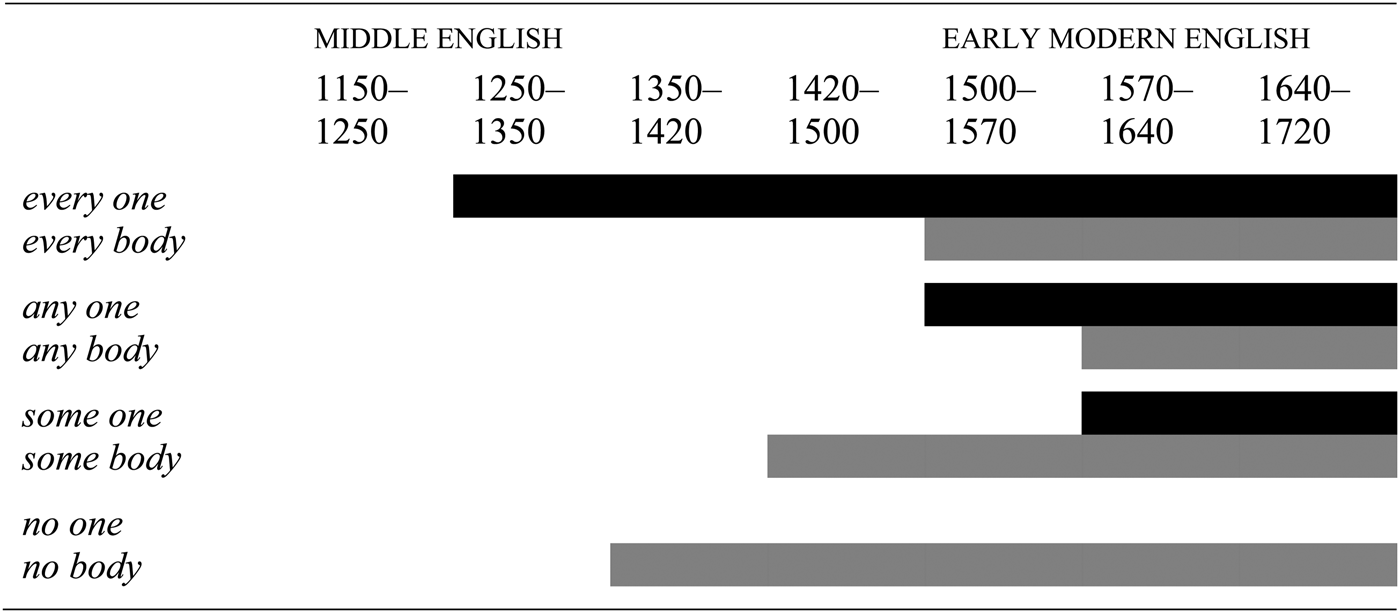
A picture of robust historical variation emerges from Raumolin-Brunberg (Reference Raumolin-Brunberg and Kastovsky1994) and Raumolin-Brunberg and Kahlas-Tarkka (Reference Raumolin-Brunberg, Kahlas-Tarkka, Rissanen, Kytö and Heikkonen1997), who recorded a high degree of variability in the frequencies of –man, –body, and –one in both ME and EModE. However, use of –body increased rapidly after its introduction to the system. By the end of the EModE period, its frequency surpassed that of –one with all of the quantifiers except every (Raumolin-Brunberg, Reference Raumolin-Brunberg and Kastovsky1994; Raumolin-Brunberg & Kahlas-Tarkka, Reference Raumolin-Brunberg, Kahlas-Tarkka, Rissanen, Kytö and Heikkonen1997:66, Figure 3), where –one had first emerged as a pronominal quantifier restrictor and remained well entrenched.
An intriguing question concerns why two variants should develop in all four sets over similar time periods (cf. Raumolin-Brunberg & Kahlas-Tarkka, Reference Raumolin-Brunberg, Kahlas-Tarkka, Rissanen, Kytö and Heikkonen1997:76).Footnote 4 That is, despite having different temporal onsets and rates of development, the –body/–one compounds have arguably been analogous since their inception as pronominal quantifiers (even if not direct competitors until EModE). This suggests that linguistic predictors underlie their use. Additionally, consideration of social predictors reveals that stylistic and social conditioning were present early in the development of the innovative variants, if not from their inception.
In the Helsinki materials, the –body compounds were restricted to oral genres of writing (i.e., fiction, drama, private letters) until the middle of the 17th century (Raumolin-Brunberg, Reference Raumolin-Brunberg and Kastovsky1994:315–316; Raumolin-Brunberg & Kahlas-Tarkka, Reference Raumolin-Brunberg, Kahlas-Tarkka, Rissanen, Kytö and Heikkonen1997:68). It was not until the end of the EModE period that they spread to literate genres. In contrast, the –one forms occurred across genres from the outset. Thus, –body appears to have had vernacular (or colloquial) origins, whereas –one was more ubiquitous. As we shall see, it was this advantage that may have laid the groundwork for its eventual success as the leading variant in contemporary usage.
New findings
The English historical corpora currently at our disposal enable us to probe further stylistic nuances in the use of the alternants. Register differences can be explored by comparing the more formal literary texts of the Penn-Helsinki Parsed Corpus of Early Modern English ([PPCEME], 1500–1710; Kroch, Santorini, & Diertani, Reference Kroch, Santorini and Diertani2004) with the less formal letters of the Parsed Corpus of Early English Correspondence ([PCEEC], 1410–1695; Taylor, Nurmi, Warner, Pintzuk, & Nevalainen, Reference Taylor, Nurmi, Warner, Pintzuk and Nevalainen2006). We can also consider levels of (in)formality within the letter corpus as measured by audience design (Bell, Reference Bell1984), that is, the nature of the writer/addressee relationship.
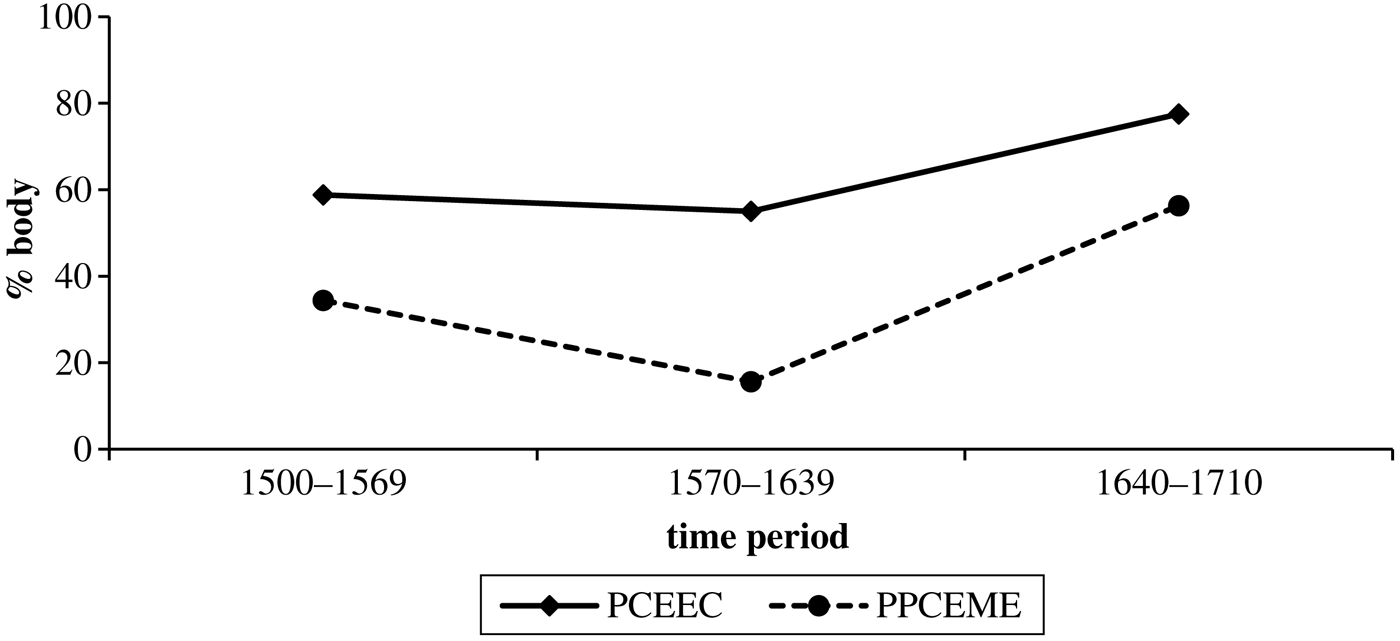
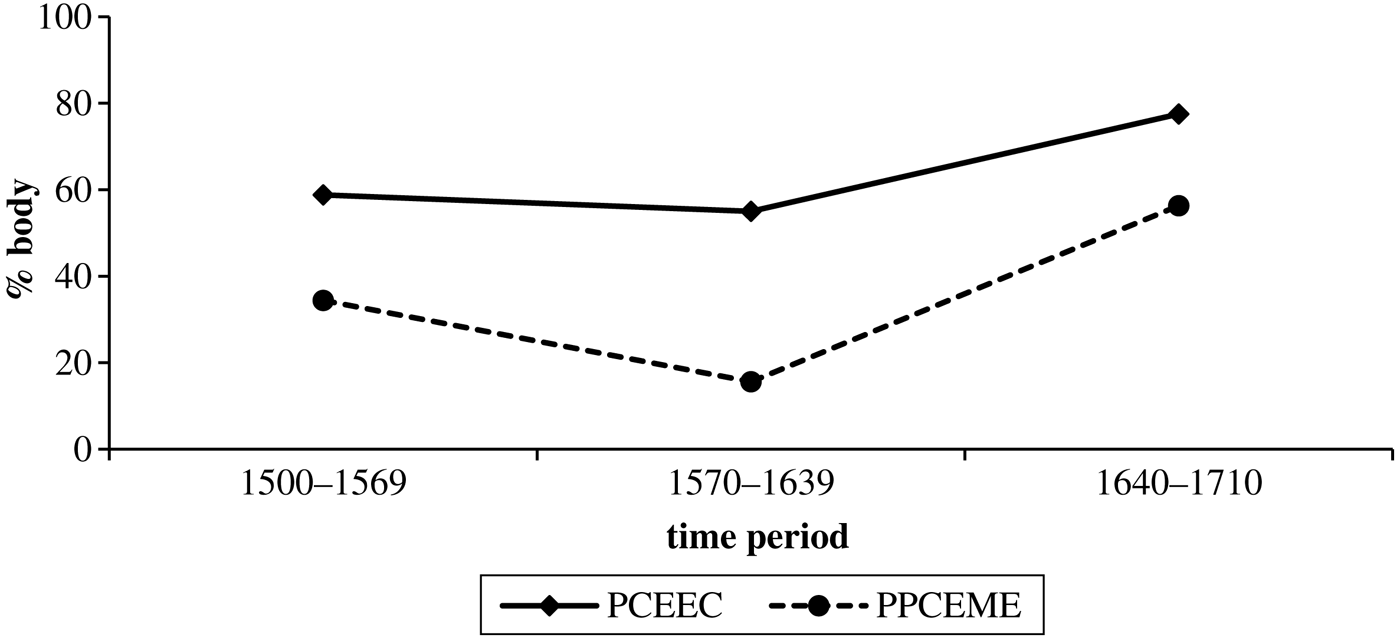
Figure 2 displays the rate of –body over time according to register. To establish continuity with the contemporary data to follow, we calculate all historical rates using the binary contrast between innovative variants (i.e., –body and –one). The results illustrate that the variants are uniformly stratified across the Late ME and EModE periods: –body is consistently more frequent in the informal PCEEC than in the literary PPCEME. Thus, as –body spreads across the quantifiers, a stylistic distinction is maintained. Its occurrence in the literary materials is relatively infrequent until the end of the EModE period, at which time it increases in frequency in both genres.Footnote 5 These findings thus corroborate the results of earlier work: –one was the more prestigious variant, occurring more frequently in literate genres of writing, whereas –body functioned as the more vernacular form. However, it is critical to bear in mind the individual lexical trajectories of Figure 1. Increasing use of –body in Figure 2 is magnified by the late emergence of –one in the no and some sets, giving them inflated rates of –body. The other sets, in which –one developed early, remain majority contexts for –one in literary texts across all time periods.
Distribution of –body over time by genre (letters, PCEEC; literary, PPCEME).
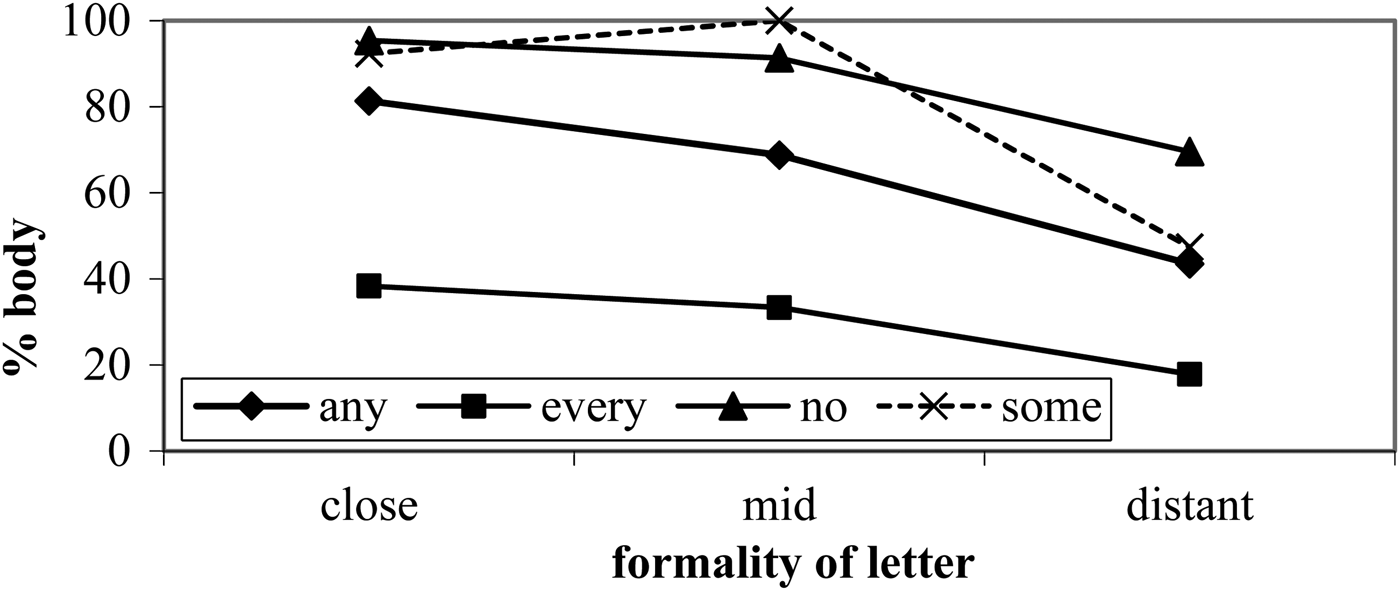
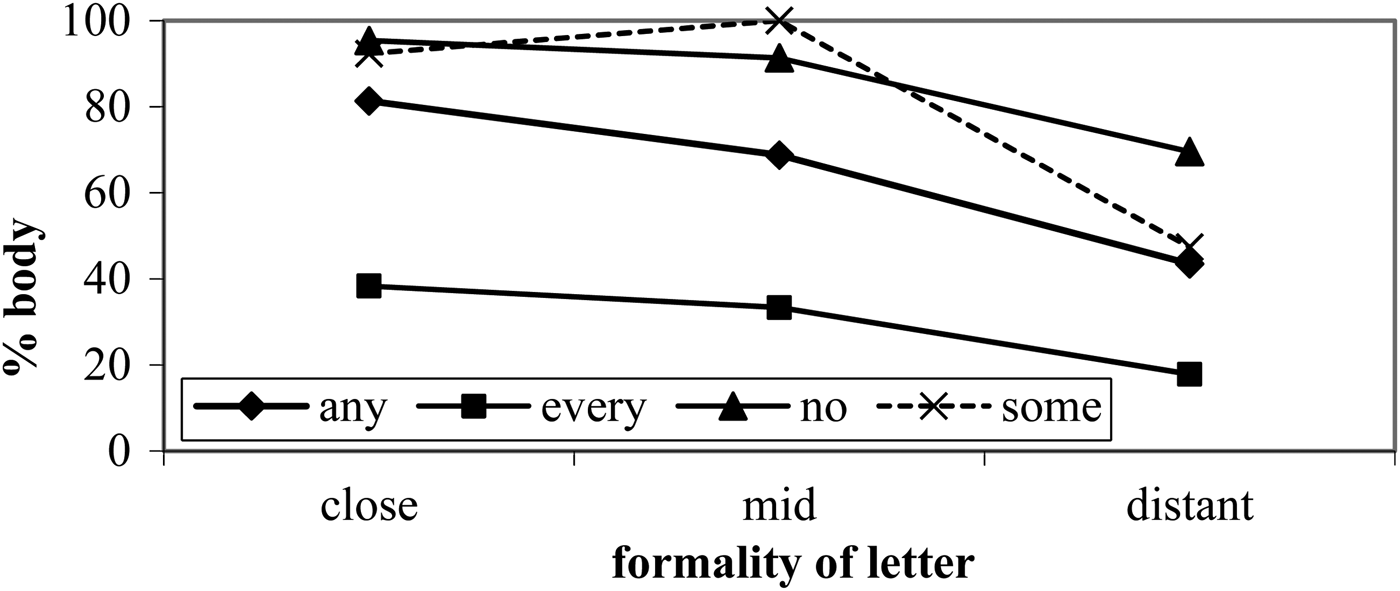
The stylistic effect can be explored further within the PCEEC, where the social and/or emotional proximity of the writer to the intended addressee can be measured, offering insight into style shifting according to familiarity (see Bell, Reference Bell1984:163). The letters were classified as belonging to one of three categories: “close” recipients, typically members of the nuclear family (mothers, fathers, siblings, and so on); “mid-distant” recipients, generally non-nuclear family, friends, and servants; and “distant” recipients, such as business associates and the like.Footnote 6Figure 3 reports the results, revealing that as proximity increases, there is a concomitant increase in the use of –body, a pattern that is visible across the full set of quantifiers.Footnote 7 There is thus a negative correlation between formality and the –body variants, a correlation that is both strong and significant overall (r = –.999986, p = .003). This reinforces the idea that –body was the vernacular form, used in more casual situations. In contrast, –one correlates with formality and the expected traits of a standard variant.
Distribution of –body in the PCEEC according to the proximity of writer and recipient (i.e., formality of letter), 1410–1695.
The mounting historical evidence thus strongly suggests that the –body/–one alternants were stylistic variants. Given that style variation is generally held to derive from social meaning (see Bell, Reference Bell1984:151), it is likely that social forces were also operative during this period. The CEEC materials, which represent a fairly colloquial mode of communication, provide support for sociosymbolic differentiation in the use of –body/–one. Men continued to use the traditional collocations with –man at robust rates into the EModE period. Women, however, led the shift away from these forms and they were marginal contenders from at least 1600 onward (Nevalainen & Raumolin-Brunberg, Reference Nevalainen and Raumolin-Brunberg2003:124). In their stead, women adopted the innovative forms, but not indiscriminately. Until the mid-17th century, women were well in advance of men with respect to –body, yet they lagged behind with respect to –one. In the second half of the century, as has been observed for other features in the CEEC (see Nevalainen & Raumolin-Brunberg, Reference Nevalainen and Raumolin-Brunberg2003:125–130), the gender profiles of the innovative variants reversed. That is, according to the results reported in Nevalainen and Raumolin-Brunberg (Reference Nevalainen and Raumolin-Brunberg2003:124, Figures 6.8a, 6.8b), by the year 1660, women had surpassed men in their use of –one while falling slightly behind them in the use of –body.Footnote 8
The stylistic effect in the Helsinki and Penn materials and the shift in gender associations in the CEEC together suggest that by the EModE period social meanings constrained the choice of the innovative forms. By 1700, the –one forms bore the hallmarks of an emerging “standard” or prestige variant, associated with women and literate genres. In contrast, the –body forms were developing indications of a vernacular variant associated with men and oral genres. These systematic social constraints on –body/–one in the historical materials, therefore, reveal not only the entrenchment of the –body/–one quantifiers in the linguistic system, but also the secondary yet vital development of sociolinguistic meaning (cf. Eckert, Reference Eckert1999; Labov, Reference Labov2001; Tagliamonte & D'Arcy, Reference Tagliamonte and D'Arcy2007).
The remaining issue concerns the ongoing development of the quantifiers in the Modern period. To this end, data from the Penn Parsed Corpus of Modern British English ([PPCMBE], 1700–1914; Kroch, Santorini, & Diertani, Reference Kroch, Santorini and Diertani2010) can be added to the perspective provided by the earlier corpora. The PPCEME and the PCEEC overlap in time (and, to some extent, content)Footnote 9 with the Helsinki Corpus and the CEEC, and so the findings reported for this period overlap with those already published by Raumolin-Brunberg (Reference Raumolin-Brunberg and Kastovsky1994), Raumolin-Brunberg and Kahlas-Tarkka (Reference Raumolin-Brunberg, Kahlas-Tarkka, Rissanen, Kytö and Heikkonen1997), and Nevalainen and Raumolin-Brunberg (Reference Nevalainen and Raumolin-Brunberg2003). The results for the Modern period, post-1700, are new.
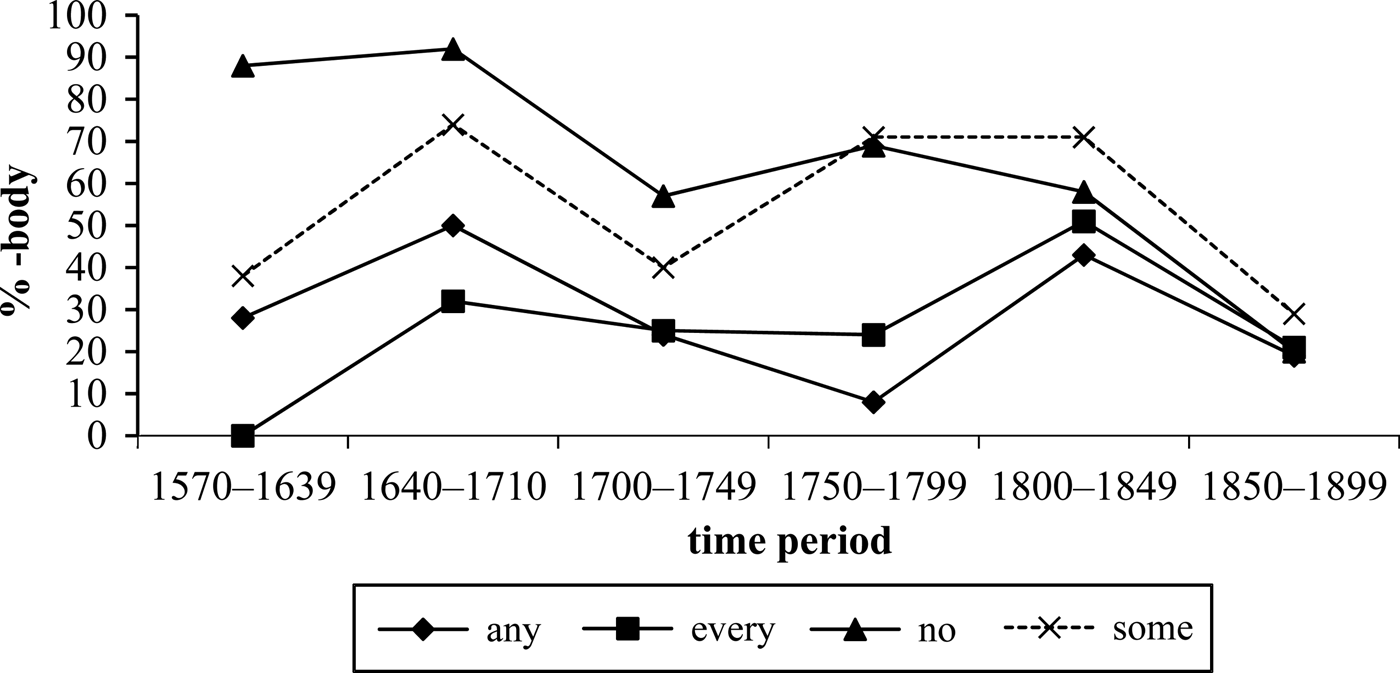
Figure 4 tracks the frequency of –body from 1570 to the end of the 19th century. By 1700, the –man compounds were obsolescent and from that point forward, variation between –body and –one is binary. There is a high degree of variability between the different forms in the EModE data, reflecting their diachronic layering across time.Footnote 10 Consistent with its historical development (Figure 1), –body in this period is most frequent with the negative quantifier, no; as reflected in Figure 4 by the exceptionally high rate of –body in the early periods, this was the final quantifier to host –one.
Distribution of –body by quantifier, 1570–1899 (PPCEME, PPCMBE).
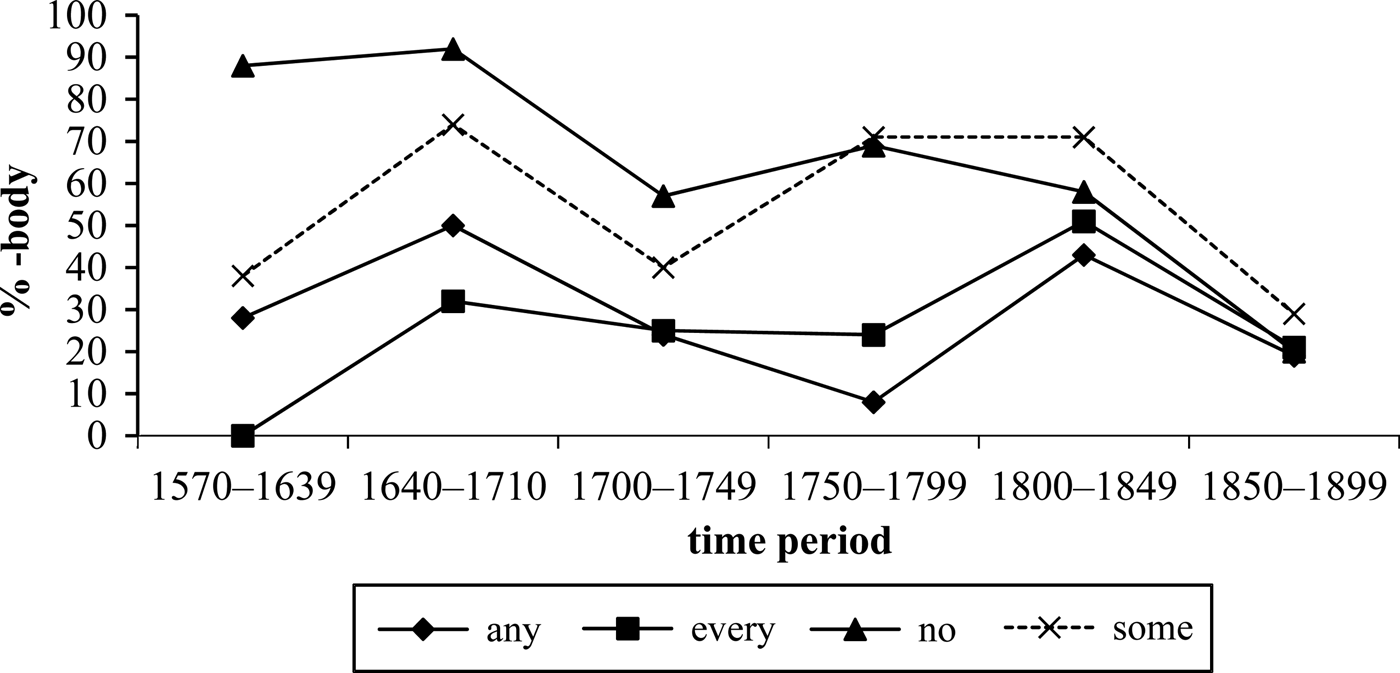
Raumolin-Brunberg and Kahlas-Tarkka (Reference Raumolin-Brunberg, Kahlas-Tarkka, Rissanen, Kytö and Heikkonen1997:77) framed their discussion of –body/–one alternation as “a development towards a tight and symmetrical repertoire of the indefinite pronouns.” That is, an integrated category emerged in which each quantifier constitutes a target for –body and –one. The key insight added by the inclusion of data from 1850 to 1899 is that this development lead to “paradigmatic cohesion” (Lehmann, Reference Lehmann1982:132–137): Earlier lexical differences (1570–1799) gradually yet consistently narrowed across time. First, any converged with every, followed by no and some. Around 1800, the paradigms began to pattern as a homogenous set, and by the end of the window examined here, 1899, any lexical effects in the distribution of –body had leveled. Thus, whereas the ME and EModE periods were characterized by robust lexical differentiation, Figure 4 reveals the eradication of lexical effects and the development of a coherent morphosyntactic category in the Modern period.
The trajectories in Figure 4 also reveal that despite the early overall prominence of –body, lexical leveling entailed a focusing toward –one in written English. Whereas there was an upswing in the use of –body for every and any in the period between 1800 and 1849, in the second half of the 19th century the rate of –body decreased markedly across the board.
The diachronic evidence thus reveals that once introduced, –body and –one ousted –man. The innovative forms behaved independently from one another until the 19th century, at which point paradigmatic leveling occurred, resulting in a cohesive set.Footnote 11 In historical written English, the –one compounds dominated. However, the two variants, –body and –one, had strong social correlates in historical written English, conditioned by style and author sex from the earliest time period, suggesting that –body/–one variation arose with intrinsic social meaning. Twentieth-century grammars record continuity of this meaning (e.g., the –body forms are considered the less elegant option; Jespersen, Reference Jespersen1914:444; Quirk et al., Reference Quirk, Greenbaum, Leech and Svartvik1985:376–378), suggesting that the sociolinguistic roots of –body/–one remain intact. However, it is yet unclear whether lexical leveling resulted in the entrenchment of a stable variable system or whether there is ongoing change. To address these questions, we first draw on a number of synchronic corpora from England and Scotland. We then consider New World Englishes.
THE PRESENT OF –BODY/–ONE: CONTEMPORARY BRITISH DIALECTS
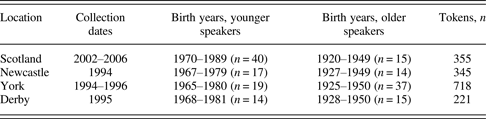
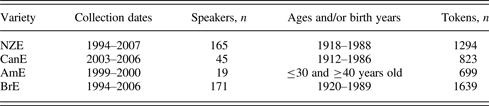
The contemporary British English data come from three regions of the United Kingdom: Scotland, Northern England, and the Midlands. The Scottish data were mined from the spoken components of the Scottish Corpus of Texts and Speech, henceforth the Scots Corpus.Footnote 12 The Northern English data come from the York Corpus (Tagliamonte, Reference Tagliamonte1996–1998) and the Newcastle recordings in the Phonological Variation and Change materials (Milroy, Milroy, & Docherty, Reference Milroy, Milroy and Docherty1997). This latter collection also provided the Midland data, as it includes recordings from Derby. These materials provided 1639 tokens of –body/–one pronouns; Table 1 lists the details.Footnote 13
Contemporary British dialect data
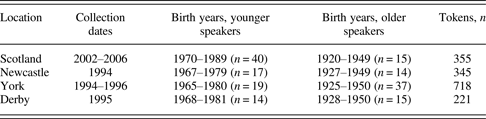
We examine social and linguistic effects on –body/–one by fitting a generalized linear mixed effects regression model, with –body/–one as the dependent variable and a random intercept for speaker.Footnote 14 The fixed social predictors are age group, sex, socioeconomic status (SES), and corpus (region). The first three predictors each have two levels: older vs. younger; men vs. women; and professional vs. nonprofessional.Footnote 15 The fourth predictor has four levels, one for each corpus.
The fixed linguistic predictors are quantifier, with levels any, every, some, and no, and postnominal modifier, with levels present vs. absent. A key distinction between pronouns (e.g., somebody) and quantified determiner phrases (e.g., some boy) is the ability of the former to take a postnominal adjective (somebody nice vs. *some boy nice). The modifier predictor thus tests for the possible effect of a postnominal adjective, as demonstrated in (6), though modification largely reflects a single token type, else, as in (6c) and (6d).Footnote 16
(6)
a. Gatenby's someone different, obviously. (York)
b. Nearest (inc) we have to anybody exotic at the moment is Laura, from Romania. (York)
c. Everyone else ran away and left me to talk to him. (Newcastle)
d. Nobody else would volunteer. (Derby)
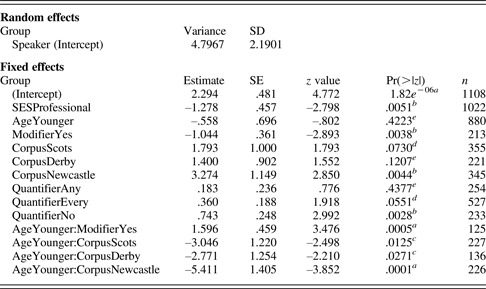
Table 2 lists the results for the predictors selected in the model.Footnote 17 Five fixed effects are reported: SES with the reference level “nonprofessional,” age group with the reference level “older,” modifier with reference level “none,” and corpus with the reference level “York.” In addition, the model includes interactions between age group and modifier, and age group and corpus.
Coefficients (logits), standard errors, z values, and p values for fixed effects in the combined model, with 1 (“application value”) = –body
n observations = 1639; n speakers = 171
Akaike information criterion: 1421; Bayesian information criterion: 1502
logLik: –695.5
deviance: 1391
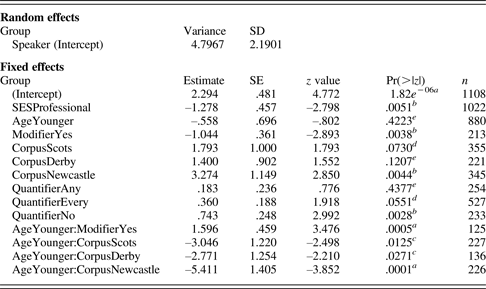
Notes: Significances are as follows: a0, b0.001, c0.01, d0.05, e0.1.
The intercept provides a baseline from which the model predictions are built. In this case, it is highly positive (2.294 in log odds units), and a significant reading (p ≤ .0001) shows the strong tendency in the data toward –body overall. The model also illustrates the relative influence of the social and linguistic predictors. Whereas speaker age overall is not significant, notice the impact of the interaction terms with speaker age and modifier (p ≤ .0001) and speaker age and corpus, which underscores an extreme difference between York and the other corpora, foreshadowed in the corpus effect overall. This suggests linguistic change in progress involving differential patterning geographically across British dialects, as well as an internal linguistic effect involving the quantifiers and their modifiers.
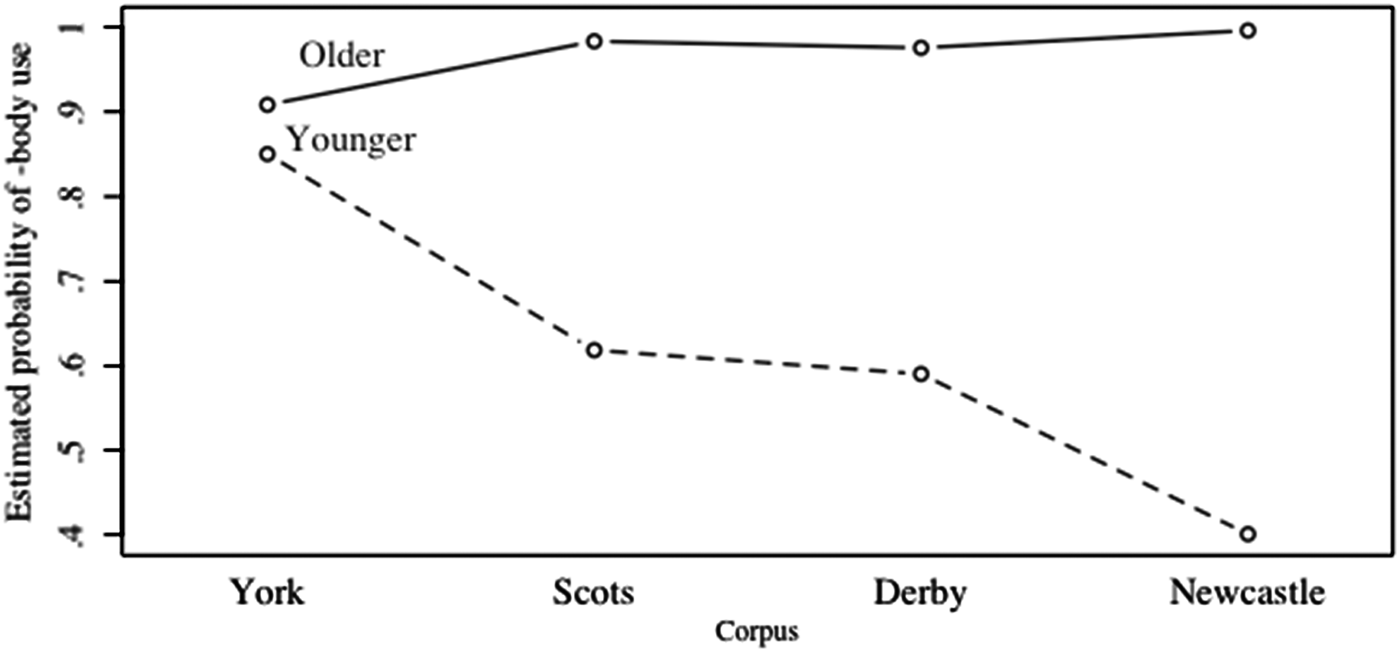
These latter findings lead us to probe the interaction of age and regional effects. We illustrate the relationship between these predictors in the partial effects plot in Figure 5 (in this plot and in other partial effects plots to follow, log odds have been converted to probabilities).
Estimated probabilities for the interaction between corpus and age group.
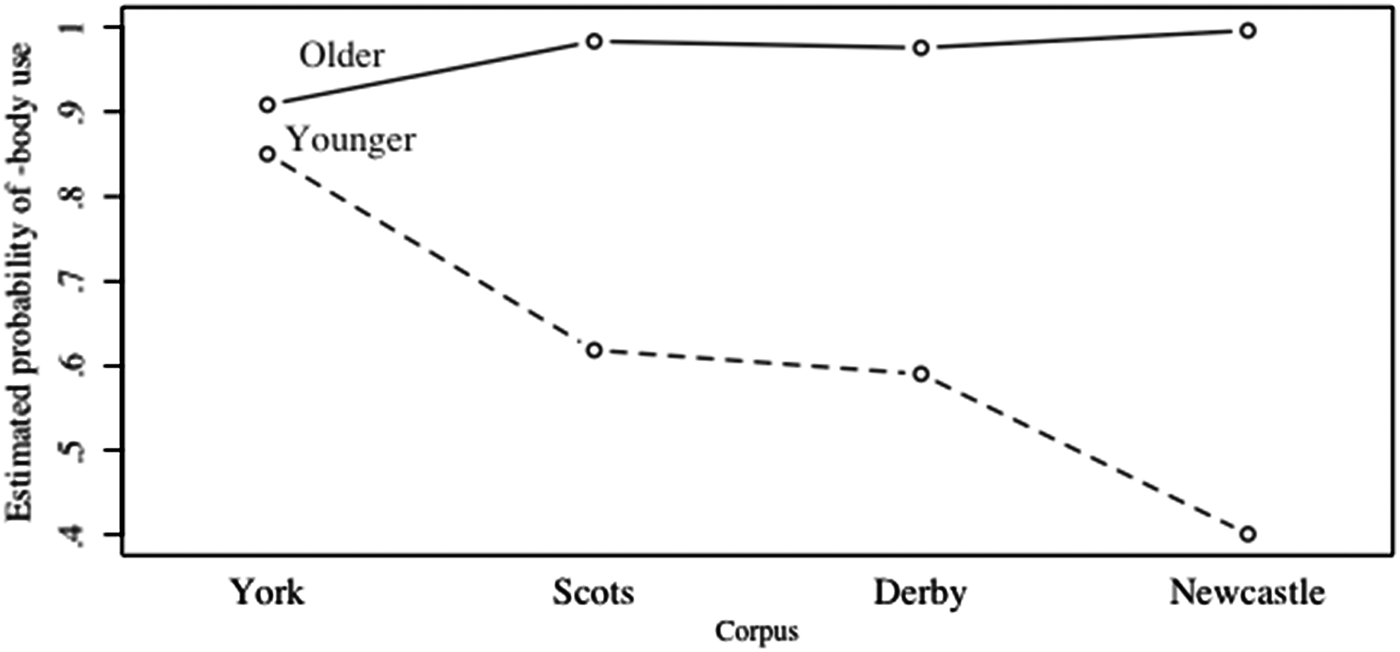
Figure 5 shows a dramatic picture of consistency but also of systematic differentiation across the communities. Younger speakers tend toward –one in all of the corpora (the dashed line), but in the Scots Corpus, Derby, and Newcastle this difference is increasingly marked. It appears that younger people are converging on the –one forms, but they are doing so at a different pace by community. Why are the younger people in all these communities using more –one than their elders are? There are two possible interpretations. One is that this variable is age-graded: younger speakers use more –one; however, this is a passing phase. Another is that these data reflect change in progress: –body is giving way to –one in the community grammars, consistent with the trends in the historical data. One argument in favor of this latter view is theory-internal. Variation between –body and –one is neither highly salient nor imbued with obvious social meaning, factors that are said to be typical of age-grading (e.g., Chambers, Reference Chambers1995). It does not appear, for example, to be subject to metalinguistic commentary by speakers (see Milroy & Gordon, Reference Milroy and Gordon2003:36–37; also, Cheshire, Reference Cheshire, Ammon, Dittmar, Mattheier and Trudgill2005). However, when we probe the results obtained from the York data, in Figure 6, an empirical argument comes to the fore.
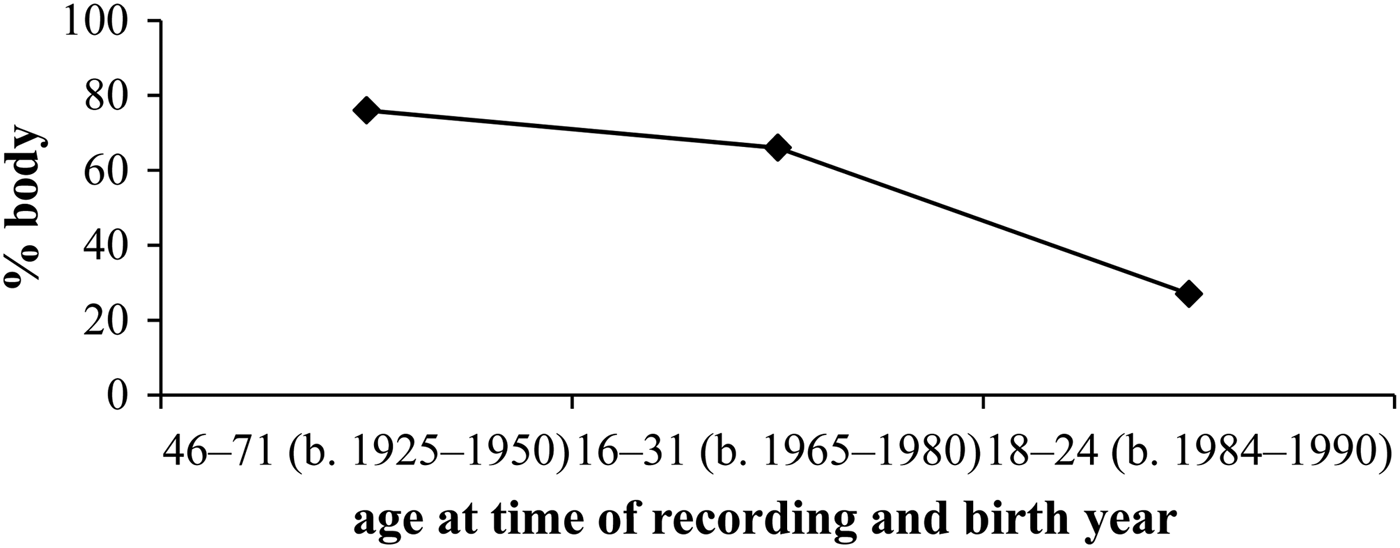
Distribution of –body in York among speakers born 1925–1990.
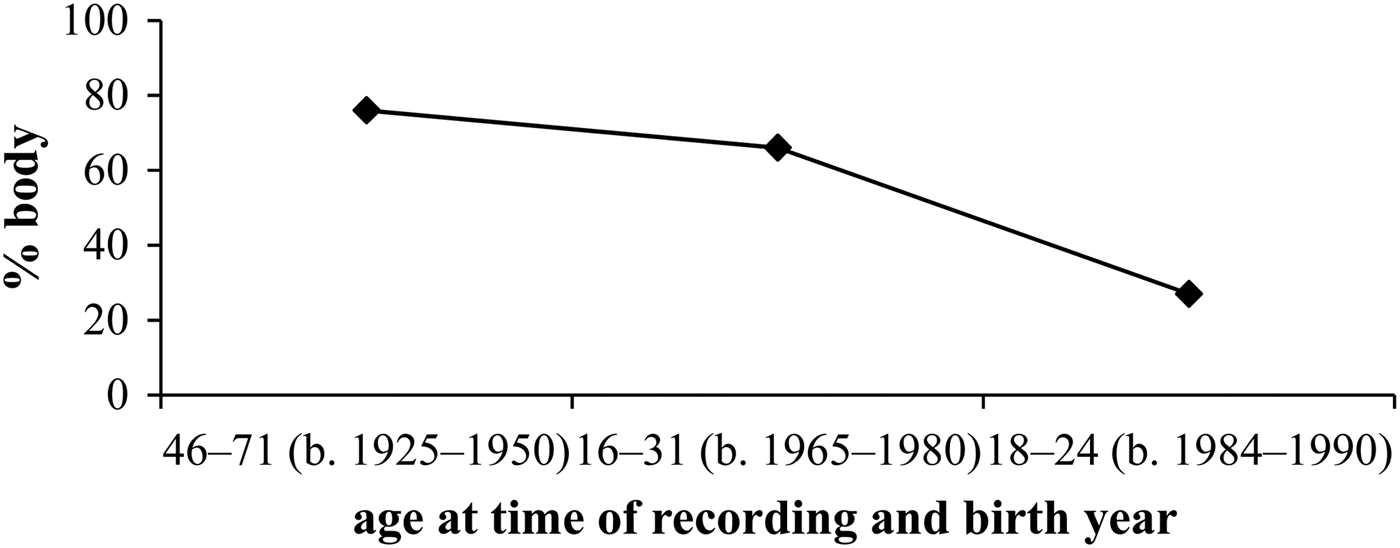
The left two speaker cohorts in Figure 6 illustrate apparent time results from Tagliamonte's York Corpus, collected from 1994 to 1996. The cohort on the far right comes from a similarly constructed sample, collected in 2008.Footnote 18 A decline in the use of –body is visible across the whole of this figure. The real-time decrease, from 66% overall in 1996 among speakers born between 1965 and 1980 to 27% overall in 2008 among speakers born between 1984 and 1990, both reflects and significantly advances the apparent time trajectory (χ2p < .0001), a trajectory that typically underestimates the rate of change. The more recent findings also bring the York distribution into alignment with that of the other corpora, suggesting that York is simply a little more conservative, a finding that echoes other research on this variety (e.g., Tagliamonte, Reference Tagliamonte, van Kemenade and Lou2006; Tagliamonte & Roeder, Reference Tagliamonte and Roeder2009). The overarching trend emerging from the analysis then is that younger speakers are moving away from –body and toward –one in informal contemporary British English dialects, just as is documented in the historical record, albeit at different rates.
At the same time, the results in Table 2 and Figure 5 indicate that overall, –body (not –one) remains the more frequent form. However, this synchronic evidence comes from informal spoken discourse. The diachronic evidence presented earlier, where –one prevails, comes from written materials. As such, the greater frequency of –body in the contemporary materials may straightforwardly derive from the longstanding stylistic effect. If such is the case, then we can extrapolate that paradigmatic leveling was not specific to a particular genre (writing vs. speech), but that it applied across the board as a generalized aspect of the English [+human] pronominal quantifiers.
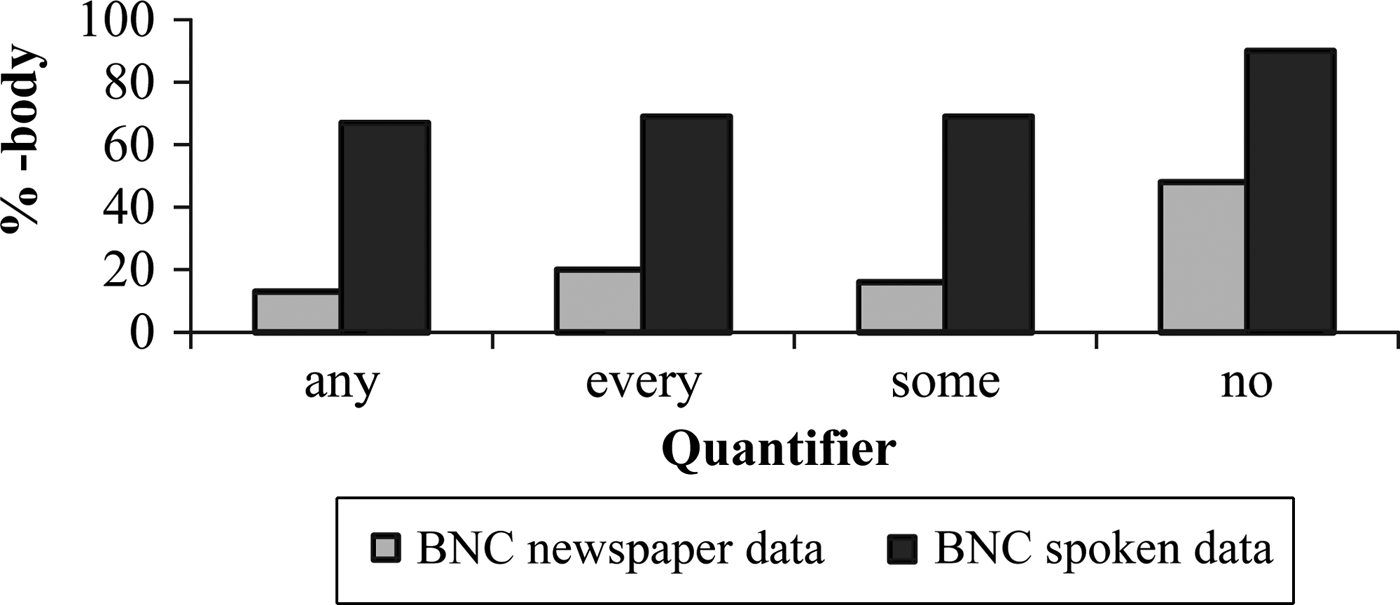
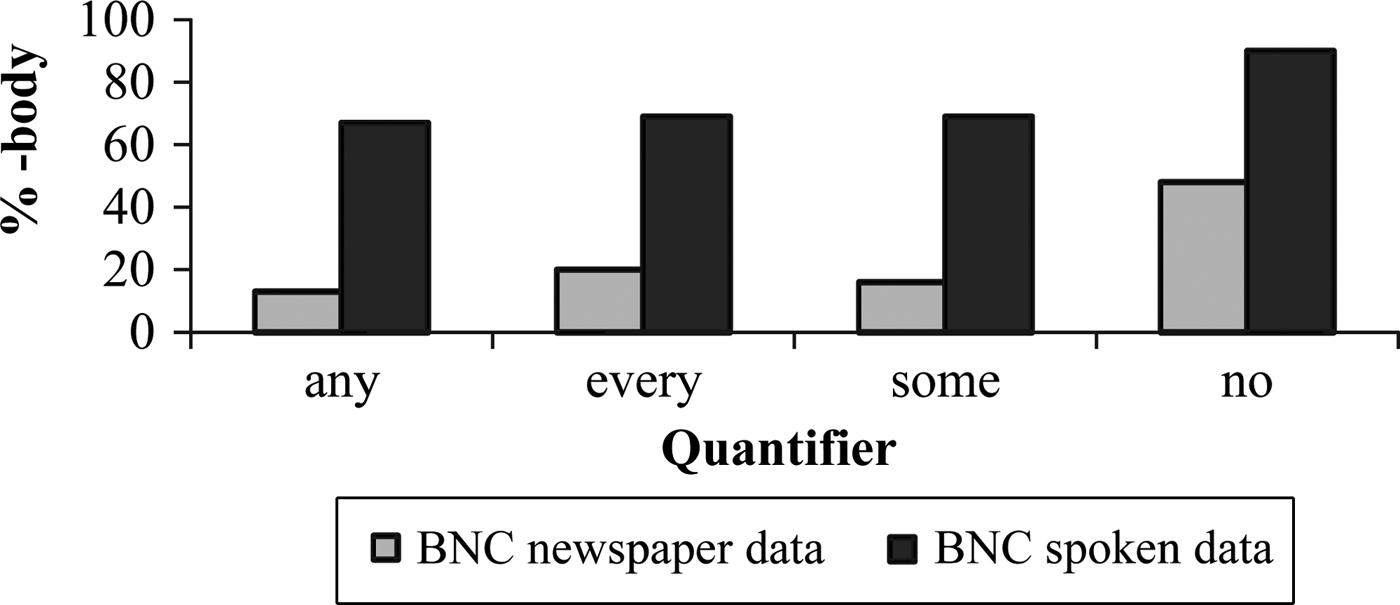
The question of style can be explored further if we marshal the evidence from an additional source of evidence, the British National Corpus ([BNC]; BNC Consortium, 2007), which contains both spoken and written materials (collection years: 1991–1994). To assess written norms, the newspaper section was targeted. The BNC yielded 23,021 tokens across genres (n spoken = 7434; n written = 15,587). The overall distribution of –body in each of the lexical sets is displayed in Figure 7, where—with the possible exception of no—there is no lexical effect. Crucially though, the BNC data reveal clear and systematic stratification of –body/–one in the expected direction: –body is consistently more frequent in speech, and –one is consistently more frequent in texts. Chi-square tests confirm that, for each quantifier, this difference is significant (all p values <.0001). We interpret this as confirmation that the stylistic distinction observed in the historical data is maintained in current usage (cf. Jespersen, Reference Jespersen1914:444; Quirk et al., Reference Quirk, Greenbaum, Leech and Svartvik1985:376–378) and that the high frequency of –body in the contemporary British dialect data derives from its spoken nature—a contemporary reflex of a longstanding diachronic pattern.
Distribution of –body by genre in the BNC.
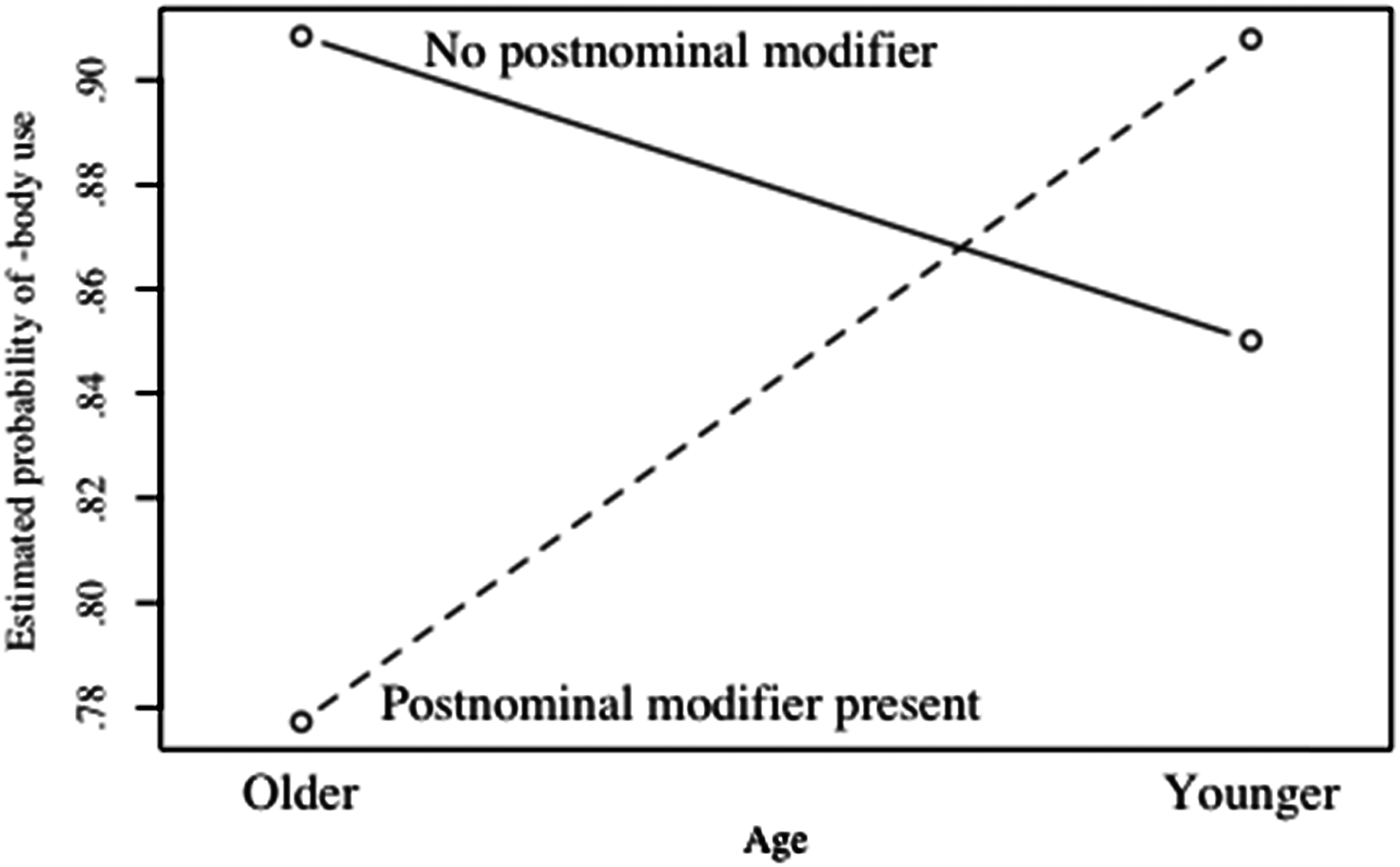
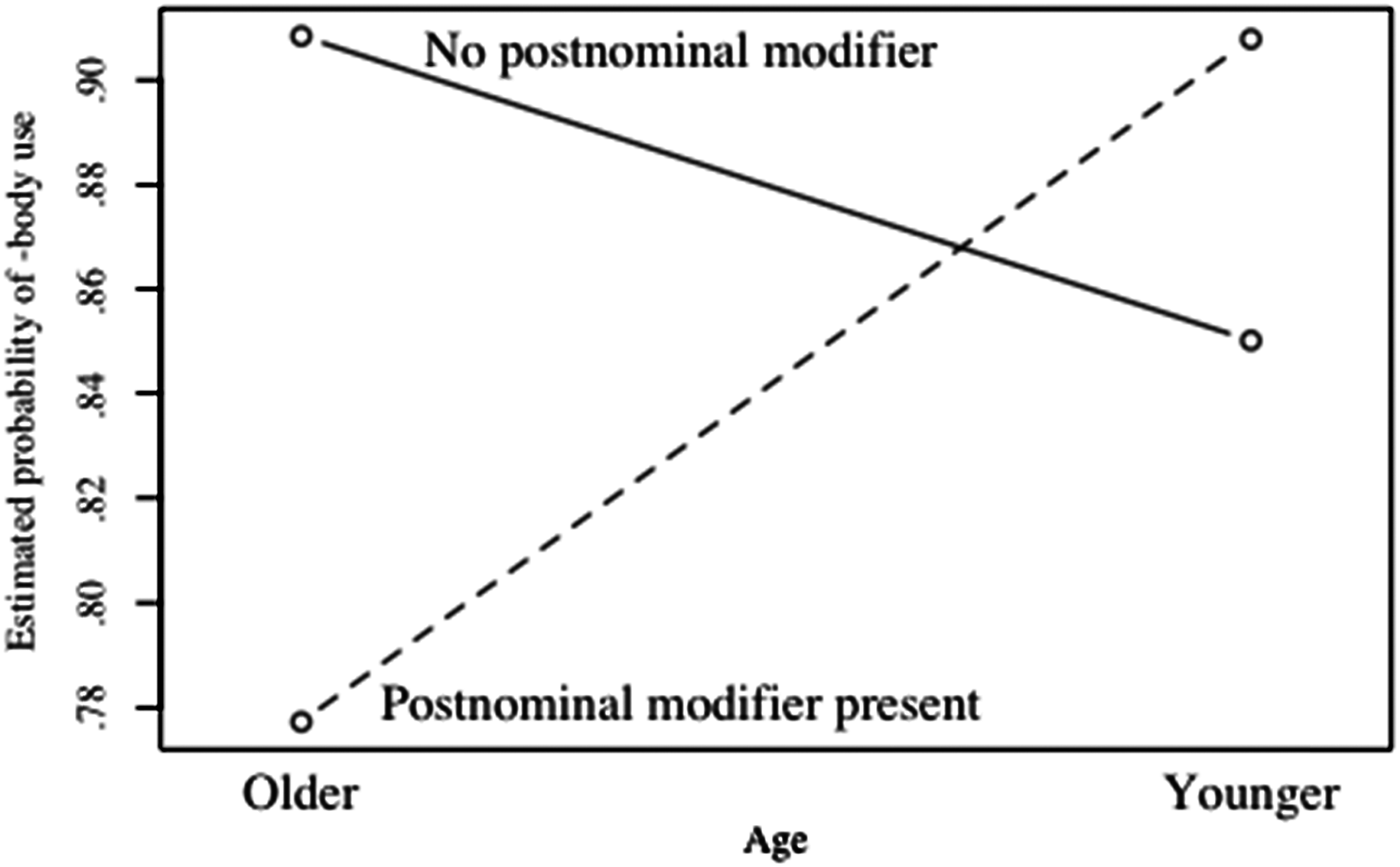
Returning then to the results in Table 2, note the significant interaction between age group and postnominal modification (AgeYounger:ModiferYes p ≤ .0005). We illustrate this interaction in Figure 8. A following adjective (generally else) favors –body slightly for younger speakers, but disfavors –body among older speakers. We will return to this emergent effect in our discussion of New World Englishes.
Estimated probabilities for –body by postnominal modifier and age group.
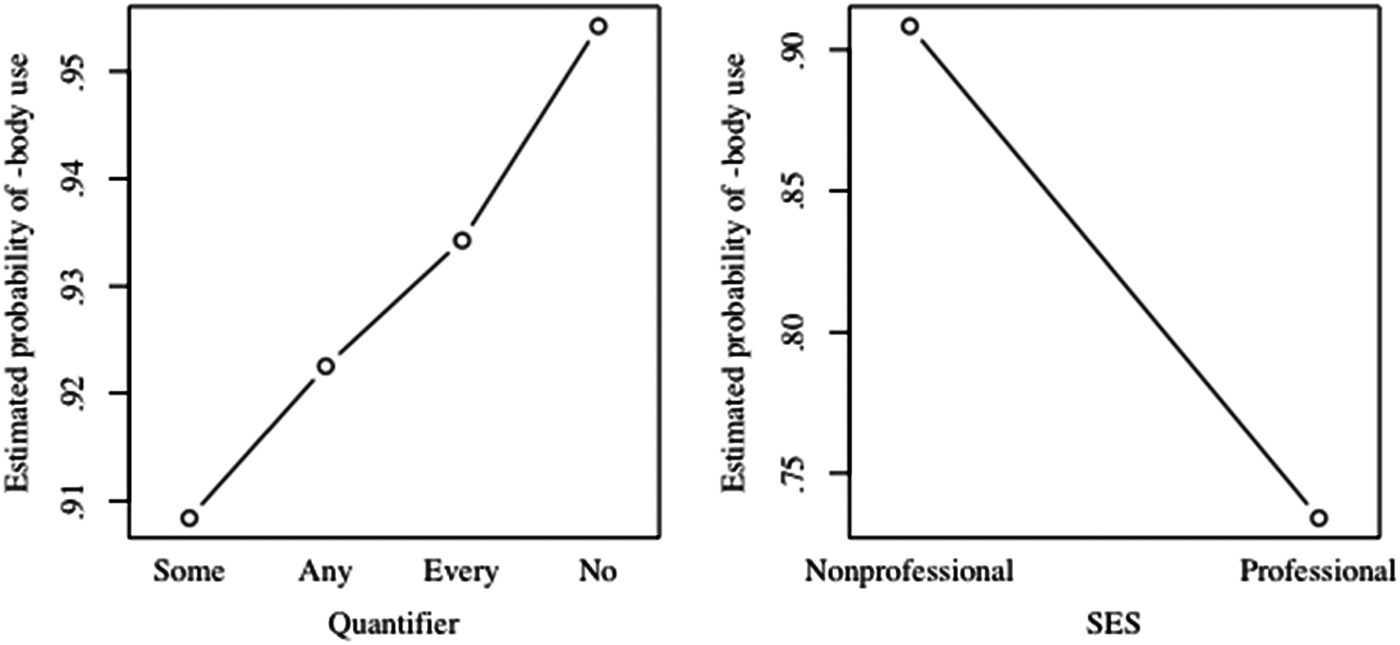
From the perspective of the historical data, the effect of quantifier in Table 2 is also noteworthy. The left panel of Figure 9 plots partial effects for the quantifier predictor, where it is apparent that no favors –body, but some disfavors it. Although the no/some contrast is the only significant one in the model reported in Table 2, this result suggests that despite the view of leveling from the second half of the 19th century, some of the historical lexical effects remain: no was the final quantifier to which –one generalized. This would seem to suggest that—as a consequence of historical persistence—no lags behind in the ongoing change, a result also supported by the BNC results of Figure 7.
Estimated probabilities for quantifier (left) and speaker SES (right).
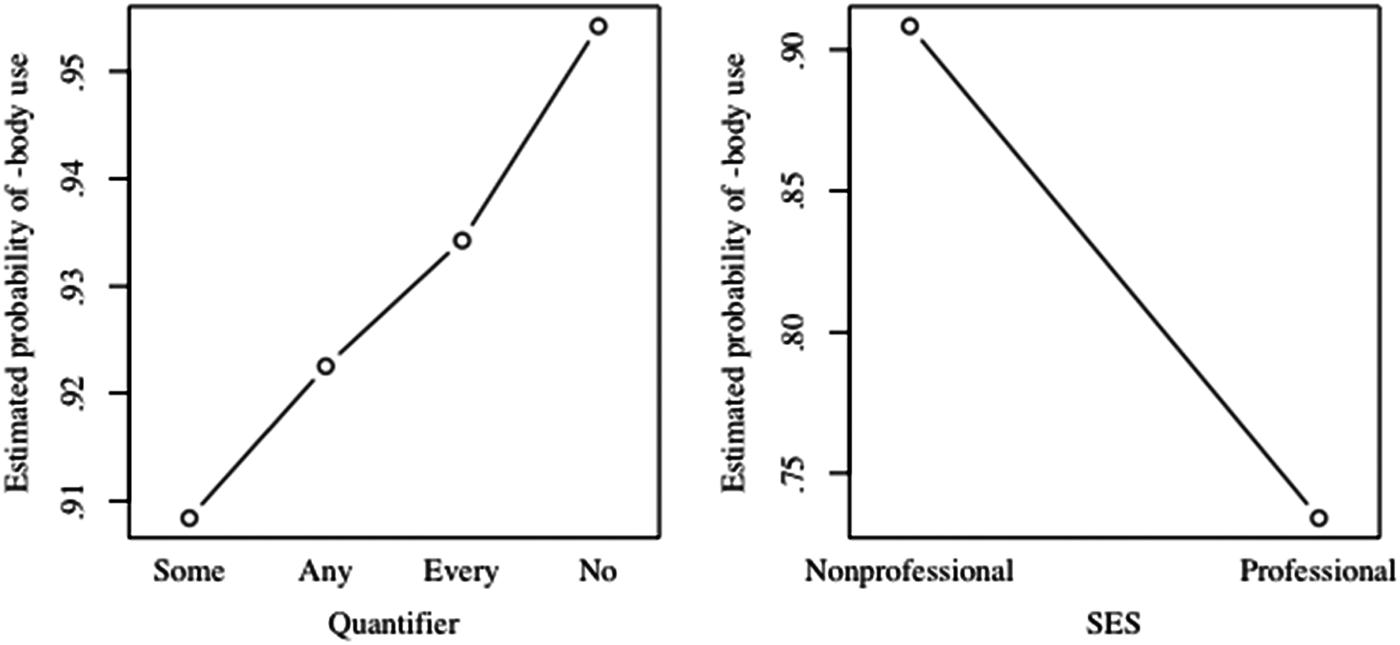
Finally, the right panel of Figure 9 illustrates the effect of speaker SES. Nonprofessional speakers favor –body, and professionals favor –one. This result aligns with the stylistic pattern in which –one is more frequent in both contemporary written texts and in historical formal written genres. In contrast with the (written) diachronic picture, however, there is no evidence of a speaker sex effect in the contemporary (spoken) corpora. Women show slightly higher rates of –body than men do (69% vs. 65%), but this difference is not significant overall.
To summarize, our analysis of the UK corpora has revealed three main results. First, there is evidence for change in progress toward –one. A real-time comparison with a similarly constructed sample in a single locale, York, confirms a real-time advance of –one (obviating an interpretation of age-grading). Second, the data are generally in keeping with the historical evidence in suggesting a leveling of the lexical effect on variation. In the spoken corpora, no favors –body relative to some, but no other contrasts between the quantifiers emerge. Third, there is an overarching commonality across dialects and age groups in the linguistic and social effects on –body/–one variation. That is, other than the developmental effect of postnominal modification (to which we return shortly), the significant interactions with age and variety are consistent with an interpretation of differential rates of change rather than dialect differentiation. We consider these observations further in the following section.
THE PRESENT OF –BODY/–ONE: THE NEW WORLD PERSPECTIVE
Morphosyntax is held to be fairly homogenous across standard varieties of English worldwide (Görlach, Reference Görlach and Görlach1991:25). In contrast, the sociolinguistic embedding of variable forms can be quite distinct from one locale to the next (Buchstaller & D'Arcy, Reference Buchstaller and D'Arcy2009:317–320; Tagliamonte & Hudson, Reference Tagliamonte and Hudson1999:167). In the case of –body/–one, there are claims of regional differentiation in the literature, but these are sometimes contradictory (e.g., Bolinger, Reference Bolinger and Reich1976, states that –one is more frequent in American English, whereas Biber, Johansson, Leech, Conrad, & Finegan, Reference Biber, Johansson, Leech, Conrad and Finegan1999, state that –body is more frequent in that variety). As demonstrated in the previous section, within the United Kingdom there is considerable regional parallelism. To date, however, systematic cross-variety comparisons of –body/–one variation have not been carried out. Given the findings presented in the previous section, it is worth asking which (socio)linguistic properties hold constant across other varieties of English. Given our assertion, based on the British dialect data, that longitudinal change is ongoing, the perspective of New World varieties should offer important insights.
We therefore add three additional synchronic datasets to the analysis, extending the geographic envelope to North America, Canada and the United States, and to the southern hemisphere, New Zealand.Footnote 19 Canadian English (CanE) is represented by the Toronto English Archive (Tagliamonte, Reference Tagliamonte2003–2006). American English (AmE) is represented by the Buckeye Corpus (Pitt, Dilley, Johnson, Kiesling, Raymond, Hume, & Fosler-Lussier, Reference Pitt, Dilley, Johnson, Kiesling, Raymond, Hume and Fosler-Lussier2007). New Zealand English (NZE) is represented by the Canterbury Corpus, the synchronic component of the Origins of New Zealand English Archive ([ONZE]; Gordon, Campbell, Hay, Maclagan, Sudbury, & Trudgill, Reference Gordon, Campbell, Hay, Maclagan, Sudbury and Trudgill2004; Gordon, Maclagan, & Hay, Reference Gordon, Maclagan, Hay, Beal, Corrigan and Moisl2007). All three are large urban samples, and each is representative of, but not tantamount to, broader national norms. However, where the Toronto and Buckeye data were each collected within a circumscribed timeframe (ca. 2004 and ca. 2000 respectively) and within a circumscribed locale (Toronto and Columbus, respectively), the Canterbury Corpus is a monitor corpus with no regional restriction (though all recordings are made in Christchurch and its local surrounds); the data were collected over a period of 14 years. Finally, although it is possible to test for socioeconomic effects in the Toronto and Canterbury datasets, the Buckeye data are restricted to middle-class speakers (Kiesling, Dilley, & Raymond, Reference Kiesling, Dilley and Raymond2006:3).
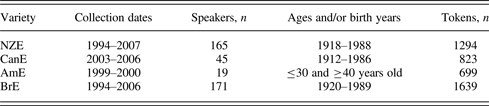
Following the procedure for the UK samples (Table 1), speakers in the New Zealand and Canadian samples were assigned to age groups by birth year. Individuals born before 1951 were coded as “older” and those born after 1964 were coded as “younger.” The Buckeye Corpus classifies speakers as older (>40 years) and younger (<30 years), meaning that the older speakers were born in or before 1959 and younger speakers in or after 1969. This age grouping aligns only partly with that used for the UK (British English [BrE]), Canadian, and New Zealand corpora. We summarize these samples in Table 3.
Contemporary New World data
To compare linguistic and social effects on –body/–one in these New World datasets with those from the United Kingdom discussed previously, we fit a generalized linear mixed effects regression model with all the corpora. We recoded the corpus predictor, grouping the four BrE datasets together. The reconfigured predictor has four levels: NZE, CanE, AmE, and BrE. Because the Buckeye Corpus is not socioeconomically stratified, we do not include the SES predictor in this model. Instead, we model these effects in a separate run which excludes the AmE data. The predictors examined are otherwise the same as those described for the UK corpora, and the variable selection procedure was also the same.
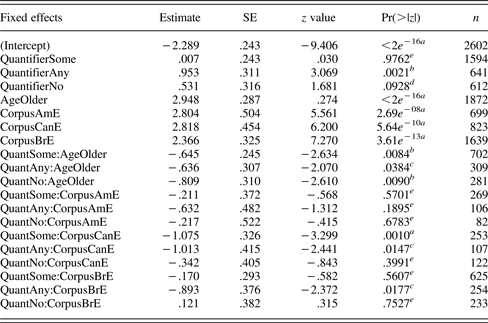
Table 4 lists the results.Footnote 20 There are three fixed main effects: quantifier with the reference level every, age group with the reference level “younger,” and corpus with the reference level “New Zealand.” In addition, it includes interactions between quantifier and age group, and quantifier and corpus. Age aside, there is great constancy of the social predictors across dialects. There are no interactions between corpus and age group, nor with speaker sex.
Coefficients (logits), standard errors, z values and p values for fixed effects in the combined model, with 1 (“application value”) = –body
n observations = 4455; n speakers = 400
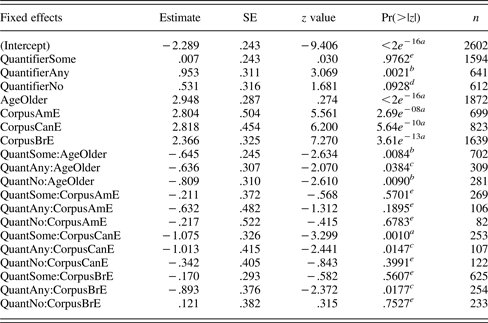
Notes: Significances are as follows: a0, b0.001, c0.01, d0.05, e0.1.
In contrast to the BrE dialect data (Table 2), the intercept is negative (–2.289 in log odds units), reflecting the strong tendency in the data toward –one overall. The model also exposes the relative influence of the social and linguistic predictors. The most significant of these by far is speaker age, whose p values are extremely low. The corpus (i.e., variety of English) is also highly significant. Each is differentiated from NZE with p values of <.0001, exposing the split between North America and the southern hemisphere. Of particular note are the widely varying varietal patterns visible in the interaction of quantifier and corpus. Note in particular quantifier some in the Toronto data (QuantSome:CorpusCanE), which is set apart from all the others, especially every, where the log odds units are –1.075 and the p value is low (p ≤ .0001). In contrast, in BrE any is set apart from every but not the others, and in AmE there is no statistically significant difference across the quantifiers. Finally, the analysis reveals no significant main effects or interactions for following modifier.
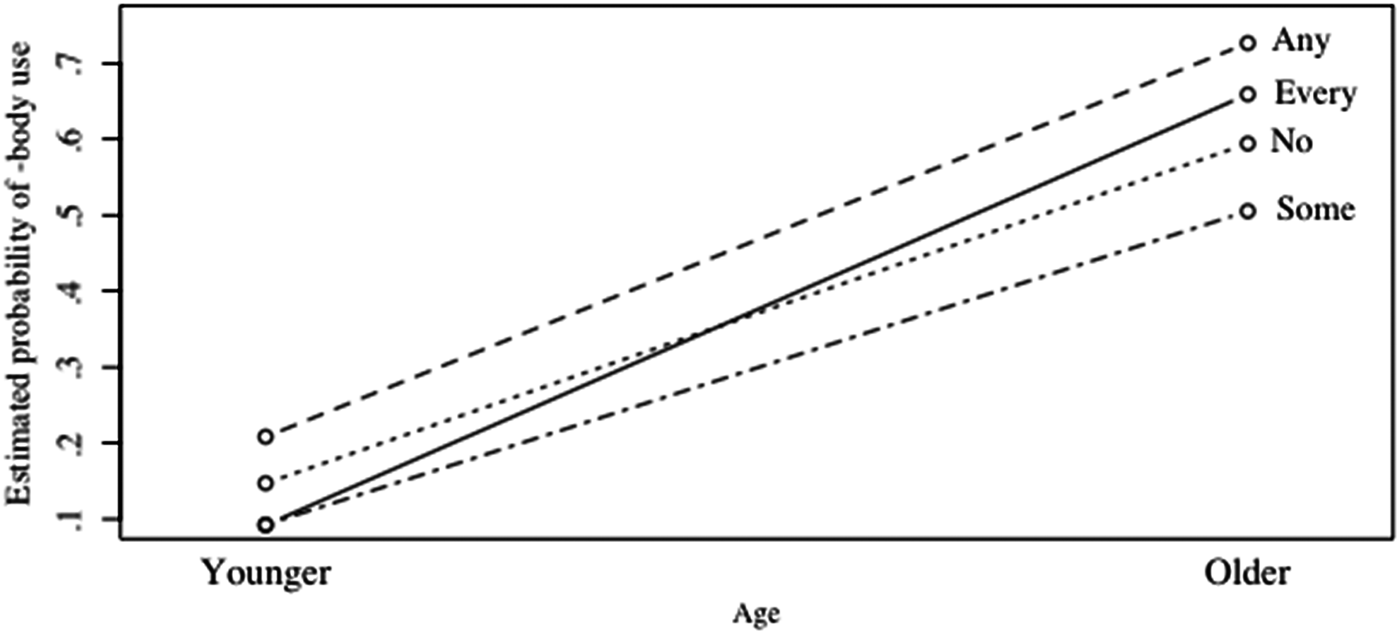
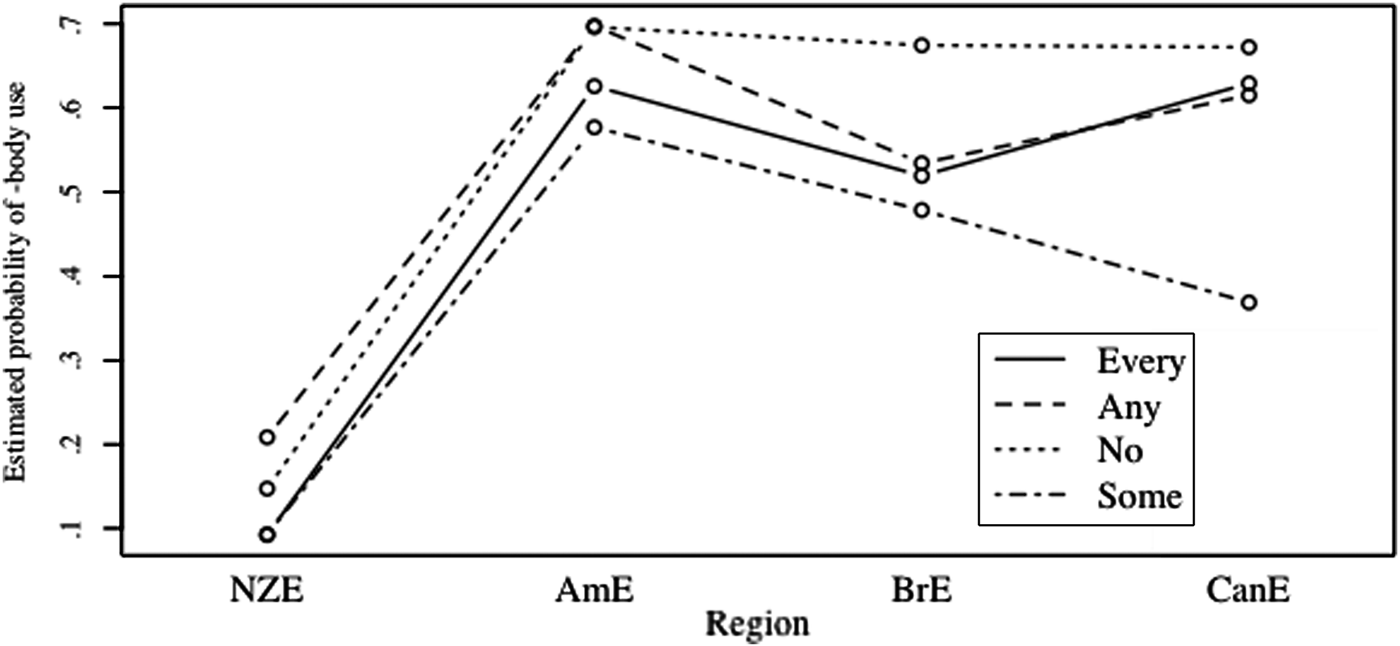
The main results in Table 4 are illustrated in the partial effects plots in Figures 10 and 11, which show the interactions between quantifier and age group, and quantifier and corpus, respectively.
Estimated probabilities for –body by quantifier and age group.

Estimated probabilities for –body by quantifier and variety.
Figure 10 shows an age effect familiar from the UK corpus results discussed previously. Younger speakers tend strongly toward –one, whereas older speakers retain greater use of –body. The analysis reported in Table 4 reveals no significant interactions between age group and corpus. These results suggest that the age effect is constant across the four varieties represented in the model and provide apparent time support for ongoing change toward –one across different varieties of English. This latter finding reflects the gradual shift evident in the historical written data (Figure 4), where use of –body decreased in real time as the system focused on –one. The results also show an interaction within the quantifiers. Among younger speakers, every patterns with some, disfavoring –body, but among older speakers, the coefficient for every is greater than are those for no and some. These findings reveal that as this change progresses, the quantifiers are converging, yet some differentiation remains among them.
Figure 11 plots partial effects for quantifier and corpus, and the results offer a dramatic portrait of dialect differentiation. The interactions reveal local deviations in the effect of quantifier on the choice of –body vs. –one.Footnote 21 They also reveal that regardless of quantifier, New Zealand speakers show far greater use of –one (the probabilities for –body are exceptionally low). In contrast, the North American and UK English samples show significantly greater use of –body.Footnote 22 One possible interpretation of this difference is that NZE is more innovative than are the other varieties. Alternatively, New Zealand speech has strong roots in the varieties of London and southeast England (Gordon et al., Reference Gordon, Campbell, Hay, Maclagan, Sudbury and Trudgill2004:46–47). If, as suggested by Bolinger (Reference Bolinger and Reich1976), –one is associated with southern UK dialects, then the NZE penchant for –one may be a settlement legacy. Mitigating strongly against this interpretation, however, is the perspective provided by the full ONZE Corpus (Gordon et al., Reference Gordon, Campbell, Hay, Maclagan, Sudbury and Trudgill2004). Use of –one is infrequent among the first generation of native speakers, born in 1850 and the decades immediately following (Mobile Unit: 35.2% overall, n = 216). Use of –body remained relatively frequent overall until the 1930s and 1940s, when it began a period of rapid decline.
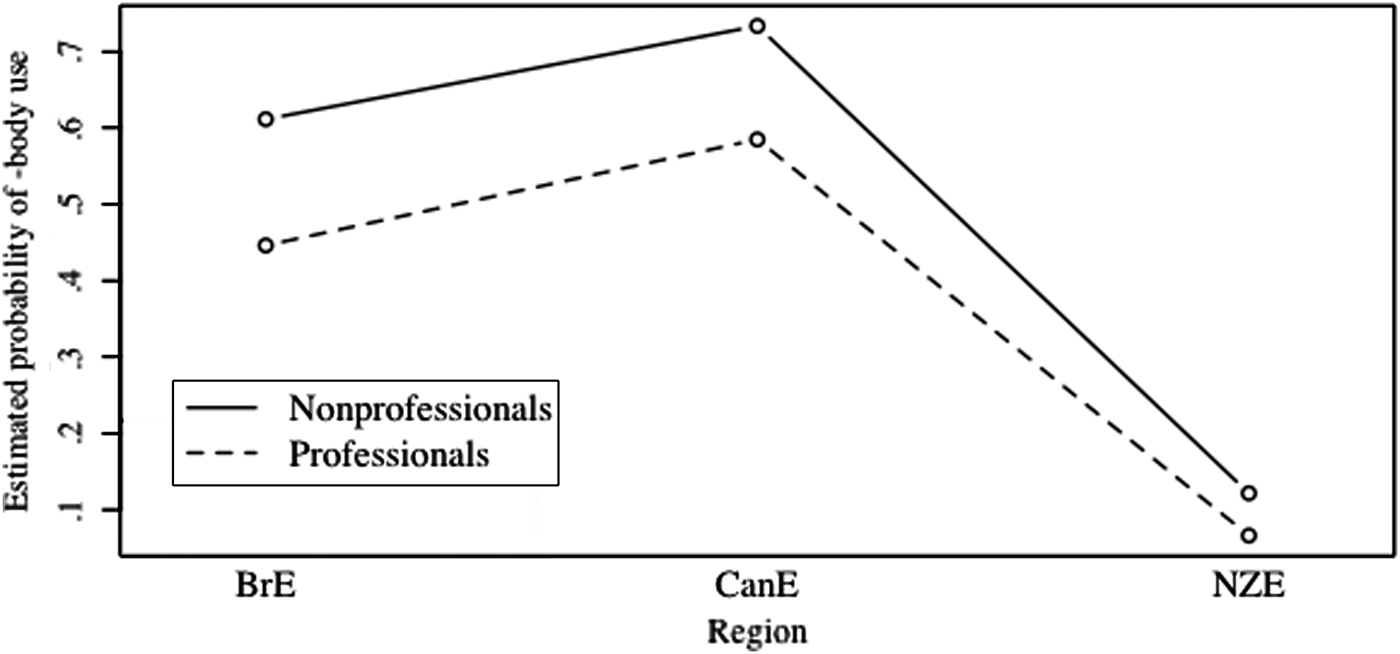
As we have already discussed, because the Buckeye Corpus includes no SES stratification, the model in Table 4 does not include this predictor. To compare the effect of SES in the other samples, we fit a separate model excluding the AmE data. The selected predictors match those of Table 4, with the addition of speaker sex as a main effect. There were no significant interactions with speaker SES. Figure 12 plots the estimated probabilities for speaker SES and shows that CanE and NZE pattern in lock-step with BrE. Nonprofessionals consistently favor –body, whereas professionals consistently favor –one. This social effect thus operates tenaciously across these major varieties of English, entrenched regardless of how far the overall shift toward –one has advanced.
Estimated probabilities for –body by corpus and SES.

To review, the analyses for the contemporary corpora, UK and New World, support two important findings. First, across the seven corpora, there is a strong age effect. Older speakers tend toward –body, whereas younger speakers tend toward –one. The convergence of apparent and real-time evidence suggests that this represents an overarching change in progress toward the –one variants. Second, the models reveal a contrast between linguistic and social predictors across dialects. In each locale, there is a different hierarchy of forms across quantifiers. In NZE, the quantifiers behave similarly in favoring –one; in AmE, the quantifiers behave similarly in continuing to favor –body (despite the trajectory toward –one); in CanE, some is set apart, favoring –one; in BrE, it is no that is set apart, favoring –body. At the same time, the social effects are parallel in each dataset. Except for the interaction between age and corpus in Table 2, which we interpret as reflecting a slower rate of change in York (Figure 2), corpus does not interact with any of the social predictors included in our models (age group, sex, SES). Next, we will discuss some broader implications of these results.
DISCUSSION: NEITHER ECONOMY NOR SYMMETRY
–Body/–one presents a good example of a variable that has persevered for many centuries—at least 500 years for certain quantifiers. As a consequence, this variation offers a unique perspective on linguistic change. The variants are syntactically and semantically equivalent and are apparently to this day unremarked outside of grammar books. Historically, at least two of the quantifiers (any and every) were used with –body more frequently in letters than in formal literary texts, and where these are employed in letter writing, they are more common in letters to close recipients (such as immediate family) than they are in letters to more distant correspondents (such as business associates). Synchronically, this stylistic effect is reflected in the lower rate of –body in written versus spoken data in the BNC (Figure 7) and is mirrored by the higher use of –body among nonprofessionals. The stability of the social distinction between –body and –one may, in part, have prevented the quantifiers from resolving upon one variant or the other. Thus, it appears that ingrained stylistic nuances have maintained long-term variation.
At the same time, we have documented an incremental, longitudinal change. At the onset of the ME period, the preceding quantifier strongly constrained selection of –body vs. –one (1570–1639). Over 300 years, the quantifiers gradually converged (1850–1899, Figure 4), suggesting “paradigmatic cohesion.” From that point onward, there is an ongoing shift toward –one, as reflected in the consistent differences between older and younger speakers in the contemporary data (Figure 10) and in the real-time confirmation from York (Figure 6). Given these congruent findings, we could logically hypothesize that the change toward –one may eventually go to completion, opting for economy of form. However, in reality, the effect of the preceding quantifier varies considerably across varieties of English worldwide (Figure 11). Indeed, virtually every possible outcome obtains. In some varieties, there is continued cohesion, yet each favors a different form (–one in NZE and –body in AmE). In the other varieties, one quantifier or the other favors a form in contrast to the rest of the paradigm (someone in CanE; nobody in BrE). Thus, it appears that linguistic evolution is only systemic to a point. Local conditions offer opportunities for divergence within the same (variable) system.
CONCLUSIONS
The four [+human] indefinite pronominal quantifiers (any–, every–, no–, and every–) of contemporary English originated in the demise of an earlier form (–man), which was first encroached upon by –one, followed by –body. This led to a long period of variation founded in stylistic conditioning. In time, –man fell away; –body and –one competed; and by the 19th century, –one prevailed across all the quantifiers in writing, leading to a linguistic explanation of paradigmatic leveling (Figure 4). Change, however, did not stop there.
Variation in the forms used with the quantifiers endures in spoken English. In all of the synchronic datasets examined here (United Kingdom: Scotland, Newcastle, York, Derby; New Zealand: Canterbury; North America: Toronto, Buckeye), the quantifiers exhibit a continued shift toward –one. Given that –one is the more prestigious of the two variants (historically and contemporaneously), standardization seems an uncontroversial hypothesis, even if the intention of speakers is not necessarily standardization in and of itself. The consistency in the nature (recession of –body) and the timing of when the shift appears to have accelerated (ca. 1930s) across geographically and socially diverse locales, in conjunction with the mundane, quotidian nature of the variation itself, supports this interpretation.
Yet even after hundreds of years, the quantifiers have not shifted to categorical use of –one and thus a wholesale move toward economy and symmetry does not obtain. Instead, the varieties of English represented in our sample go their own way, not only in terms of form but also in terms of the distribution of the form across the quantifiers. Thus, although “unplanned purposefulness” (Keller, Reference Keller1989:113)—the idea that language proceeds of its own accord—may be the mark of evolution of linguistic systems in an idealized universe, the results of our analysis expose a fine-grained array of differentiation in the real world. We suggest that the nuanced cross-variety portrait in English –body/–one variation provides a potent reminder that local linguistic ecologies play a critical role in shaping the practical eventualities of language use in the speech community.