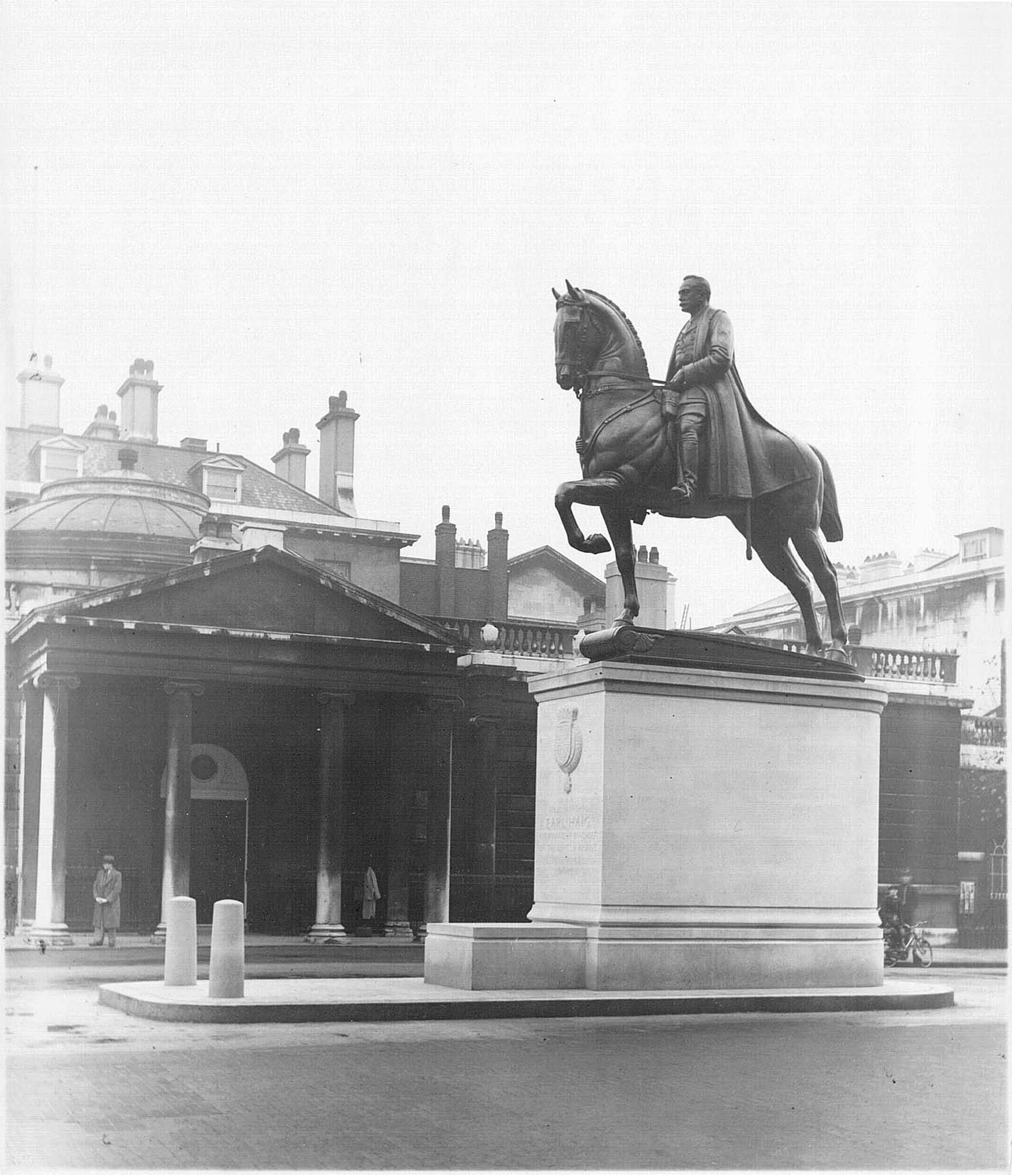
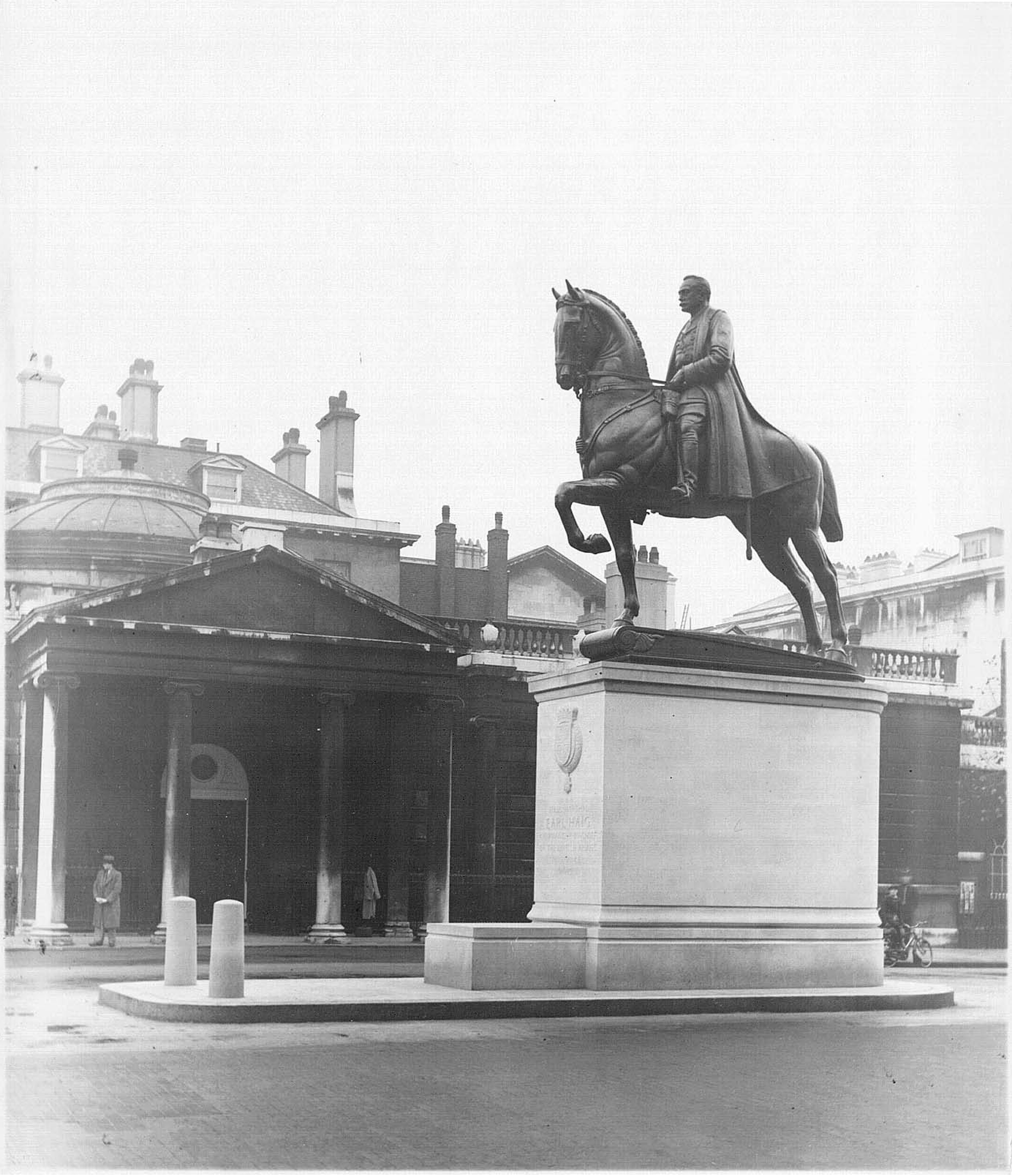
Since 1937, a statue memorializing Field Marshal Earl Haig has stood in the center of Whitehall, some two hundred yards from the Cenotaph (fig. 1). On 6 November 1998, as the eightieth anniversary of the Armistice of the First World War approached, the Daily Express published a full-page opinion on the desirability of removing the Haig memorial. In “Why Do We Let This Man Cast a Shadow over Our War Dead?” the editors suggested the monument was a celebration of victory rather than a register of the tragedy of the Somme and other battles with which Haig was associated.Footnote 1 The proximity and relationship of the Haig statue to the Cenotaph—the national memorial to Britain's twentieth-century war dead—was said to be offensive to the memory of those who served in the military. The erection of the Haig monument was also controversial when it was first proposed in 1928: so controversial, in fact, that public discussion of the memorial's design took up thousands of column centimeters in newspapers, the issue was referred to the cabinet twice, and the eventual statue was delayed by nearly eight years. In 1937, just prior to Haig’s unveiling, the staff writer for the British Legion Journal reported, “Excepting Epstein's work, no statue erected within living memory has aroused such great public controversy as has that of Field Marshal Earl Haig.”Footnote 2 This uproar over Haig's statue focused on a number
—Haig monument just after its erection in Whitehall in October 1937. Alfred Hardiman, sculptor. Photograph courtesy of National Archives, Kew, London (WORK 20/185 image ref. 1).
of interrelated issues: how to represent for posterity the leadership of the nation in modern war, what values made Haig who he was, and whether these were the same values that those who survived believed they had fought for during the Great War.
To date, historians of Britain's Great War memory have concentrated mostly on the collective monuments to the dead and missing.Footnote 3 This is an understandable development given the nature and scope of the Great War and the mass volunteer and mass conscript armies that fought it. A number of new, invented traditions and rituals—the provision of individual, marked graves and large communal monuments to the missing on, or near, the battlefields; the astonishing number of civic and military monuments erected in Britain itself; the two-minute Silence; and the national shrines of the Cenotaph and Tomb of the Unknown Warrior—turned the “Million Dead” into the symbolic (and also quite literal) property of the imperial nation.Footnote 4 Understandably, then, scholarly work has focused on the social meaning of these communal monuments, memorials, and rituals, sometimes as contested “sites of memory.”Footnote 5 Decisions about erecting war memorials, and the meaning of memorial iconography, have also been debated by scholars in terms of whether these monuments justified wartime sacrifices and deflected postwar criticism of the status quo through idealization of the Dead,Footnote 6 or whether they provided consolation to the bereaved by focusing on shared grief.Footnote 7 Memorials to war leaders, like Haig, do not fit easily within such frameworks: in the new era of mass mourning and remembrance, monuments to individual generals seem atavistic and out of touch with the postwar reality. Indeed, an influential early analysis of British war memorials by Nicholas Penny contends that as the Haig monument was erected to honor an individual who was neither a victim of the war nor, in Penny's view, an embodiment of the nation, it should not be considered a war memorial at all.Footnote 8 The analysis presented here will contest this view. Haig was, in fact, one of the few truly national memorials of the interwar years, a monument that was erected by Parliament and thoroughly scrutinized by the national media and by public opinion.
By examining the controversy over the erection of the Haig memorial, this study seeks to explore a liminal moment in the commemoration of the Great War, a moment when questions about the degree to which Great War commemoration valorized the Dead over those who had survived were surfacing with increasing regularity and a moment when outright criticism of the war was both possible and publicized. In this context, the monument controversy—and particularly the popular rejection of any symbolic representation of Haig—should be seen as a populist backlash against two emerging and, in different ways, elitist versions of the Great War's meaning. First, it represented a public aversion to having artists and their patrons—in this case the civil servants who were charged with commissioning the statue—decide what would be an appropriate monument to the man who, for many, personified both victory and survival of the nation at war. Second, it was a rejection of the subaltern officer-intellectuals’ criticism of the war—a disavowal of the ironic tone of many “war books,” such as Erich Remarque's All Quiet on the Western Front, Robert Graves's Goodbye to All That, Richard Aldington's Death of a Hero, and Ernest Hemingway's A Farewell to Arms—that began emerging at the end of the 1920s.
Anxiety about the proposed monument was thus based in fears that the memorial might be an unconscious parody or even a deliberate send-up of the ideals that had taken Britain to war in 1914.Footnote 9 The timing of the decision to build the monument is key to the controversy as it unfolded, because Haig was discussed and erected at a pivotal moment in the evolution of the Great War's commemoration. Instead of continuing to promote the ennobling idea of sacrifice, by the 1930s, in tune with growing pacifist sentiment, the meaning of Armistice Day became orientated more toward depicting the Great War in terms of a didactic memory—a lesson about the disastrous nature of modern warfare and the necessity of preventing its recurrence. Adrian Gregory notes that 1929 was the fulcrum of this shift: the year of the Wall Street crash and the onset of global economic depression, the year that Labour formed its second minority government, and the year that many of the “war books” and public criticism of the way the war was conducted gained notoriety.Footnote 10 The ironic tone and bitterness of many of these works, while not universally accepted by a public that did, or more often did not, read them in the 1930s, certainly helped transform the meanings later ascribed to Great War remembrance.Footnote 11 The Daily Express opinion about the meaning of the Haig statue in 1998 actually reflects the negative view of Haig that was the product of the 1960s and 1970s, which was itself informed by the intellectual turn against the Great War in the war books of the late 1920s and 1930s.Footnote 12 If today we tend to see the Great War in terms of waste and futility, and Haig as responsible for much of its slaughter, we should not assume that Haig's contemporaries also embraced this view.Footnote 13 Indeed, the controversy over his statue indicates that many veterans, for a variety of reasons, actively campaigned against the developing negative view of Haig in the 1930s.
Field Marshal Earl Douglas Haig died on 29 January 1928. Within days of his death, as the tributes from around the world started pouring in, the War Office reminded the prime minister that previous “Soldier Commanders” of similar and of even lesser stature than Haig had been honored with national memorial monuments. Sir Herbert Creedy, permanent secretary at the War Office, told the Prime Minister's Office (PMO) that the “Army will expect, and the British Legion would demand, a National Memorial” and that it should be “on the lines of that voted for Lord Kitchener and Lord Roberts.”Footnote 14 The PMO agreed, and Stanley Baldwin rose in the House of Commons on 8 February 1928 and delivered a memorial speech to the late Lord Haig during which a motion for a national memorial was put before the House.Footnote 15 Baldwin proposed the nation had “a simple primitive desire” for something that would remind them of Haig in perpetuity, and he trusted that the motion would be passed unanimously. But this desire for unanimity was not to be attained. Opposition leader Ramsay MacDonald and other Labour members of Parliament (M.P.s) indicated that a memorial statue would be “stereotyped, almost irreverent.” Labour suggested that Haig's postwar work with the British Legion was a more fitting activity to remember, perhaps with a national fund for ex-servicemen and their families. Labour's amendment calling for a select committee to be struck to discuss a new veterans fund caused an acrimonious debate and a division of the House. The amendment was defeated and the original motion passed on 10 February.Footnote 16
As the Office of Works was responsible for overseeing all monuments and memorials in London's public places and Royal Parks, it fell to this department and its permanent secretary, Sir Lionel Earle, to commission Haig's monument. The PMO initially favored an open competition among artists for the Haig commission, but based on his experience of a decade of war memorial commissions, Earle convinced the PMO that open contests tended to sacrifice the quality of the art produced and that the best artists tended not to enter such competitions.Footnote 17 Earle thus proposed a competition among a limited number of sculptors handpicked by the government. Evidently with one eye on the likely concerns of the British Legion, Earle suggested three younger sculptors who had served during the Great War and who had already produced notable war memorials: Charles Sargeant Jagger (the primary sculptor of the Royal Artillery Memorial, unveiled in 1925), William Reid Dick (who provided panels and carvings for the Kitchener Memorial in St. Paul’s, finished in 1925, and for the Menin Gate memorial to the missing at Ypres, completed 1927), and Gilbert Ledward (who completed the Guards’ Division memorial in 1926). To judge the competition, Earle recommended two assessors be appointed, one from the Royal Academy and the other from the Royal Society of Sculptors. These suggestions were approved by the PMO on 16 March and, at a meeting in July, the details of the competition were hammered out.Footnote 18 Scale models would be submitted to the jury of assessors, which was increased from two to three at the sculptors’ insistence, with the third assessor to be chosen by the Royal Institute of British Architects.Footnote 19 Before the competition could commence, however, a site had to be chosen for the statue.
The task of finding a suitable site fell to the Royal Fine Arts Commission (RFAC), which had been formed in 1924, primarily because of the efforts of Earle, for the express purpose of advising the government on questions such as the appropriate placement of monuments.Footnote 20 The RFAC, after considering the “national status” of the monument, suggested that Whitehall would be the most fitting location. They suggested a spot either in front of the Treasury building or further up the street in front of the Scottish Offices:
The great sweep of Whitehall, extending from Trafalgar Square to the open space of Parliament Square, is a thoroughfare admirably suited in character in scale and tradition, for a memorial to the late Field-Marshal. The two sites available in Whitehall are sufficiently far from the Cenotaph to prevent any competition with it, or to mask its view, while at the same time the Commander-in-Chief of the British forces would be brought into direct relation with the Cenotaph in a manner harmonious to architectural requirements. His memorial would enhance the continuing interest taken by the public in the Cenotaph. No site more relevant and more likely to appeal to public sentiments is available.Footnote 21
It was in fact the British Legion, which had been headed by Haig until his death, which was most concerned with ensuring that Haig's monument came to be connected in the public mind with the Cenotaph in September 1928.Footnote 22 They lobbied both privately and in the press for the site, arguing that Haig himself had always viewed Sir Edwin Lutyens's masterpiece as a symbol of imperial unity in the face of adversity.Footnote 23 The purpose was to reinforce a message of triumph through sacrifice. Others imagined a referential connection between Haig and the war dead.Footnote 24 Lord Lee of Fareham posited that no site could be more appropriate for the “now dead commander of our million dead,” with the “sound of those he wrought for and the feet of those he fought for, echoing round him evermore.”Footnote 25 Another letter writer suggested that a “statue in memory of Lord Haig be placed 100 yards from, and facing, the Cenotaph in Whitehall” so that he could be depicted “saluting the ‘Unknown Warrior’ who among the millions made his great sacrifice to help him, and the Allies, win the Great War.”Footnote 26 This particular correspondent conflated two quite separate shrines to the war dead—the Cenotaph was an “empty tomb,” while the remains of the “Unknown Warrior” lay in Westminster Abbey—but this was perhaps a common conflation in the 1920s.Footnote 27
However, there was also opposition to the statue's placement anywhere near the Cenotaph, a conviction that it would be a matter of “deep regret if a statue of any person, however eminent, were to be brought into proximity with the Cenotaph. To urge that this is a matter of imperial interest is to mistake the whole spirit of the associations which have made the Cenotaph what it has become in the hearts of thousands of people.”Footnote 28 Significantly, King George V agreed with this latter view. He suggested that the Cenotaph had become a national shrine and that a more appropriate place for Haig was Horse Guards Parade, where he “might join the other distinguished Military Captains.”Footnote 29 Before it was even commissioned then, the proposed Haig monument was exposing widening fissures between various constituencies over the dominant memory of the Great War, caused by concerns over the spatial relationship of the national monument to the war dead to the memorial of their deceased commander.
However, it was Westminster City Council that, while declaring that it was at “one with the great body of public opinion” in seeking to honor Haig's memory, proved to be the biggest obstacle to the Whitehall site. The council's objections were pragmatic rather than symbolic, warning of the danger to those who might want to lay a wreath at the base of Haig's monument, which was bound to obscure pedestrians and motorists’ views of one another. London planners in the interwar years were increasingly obsessed with the rapid growth of motorized traffic and the problems of traffic flow and congestion. Cluttering up the city's busy thoroughfares with statues, no matter how symbolically important, hampered the forward progress of the imperial capital into the postwar modern age.Footnote 30 Indeed, the council suggested erecting Haig's statue in the Mall, the broad ceremonial thoroughfare through St. James Park from Horse Guards to Buckingham Palace.Footnote 31 But Earle was aghast at the Mall proposal, arguing that it would be “unwise to turn this great highway leading up to the Palace into a siège allée as in Berlin.”Footnote 32 This trepidation about creating something akin to Berlin's monument-filled avenue (erected to celebrate the Prussian victory over France in 1871) points to continuing official sensitivity to the charge of celebrating or glorifying the war. And yet, for the British Legion and the army, nothing short of Whitehall—the very center of British political power—was good enough for the monument to Haig.Footnote 33
Faced with an impasse, Earle searched for a legal precedent to beat down the opposition of the Westminster councilors. He found it in the 1854 Public Statues Act, which mandated that any monument paid for by Parliament could be put in any public thoroughfare in Britain. He further bolstered his position by reminding Sir John Hunt, the Westminster town clerk, that Parliament was “intensely adverse” to statues of nonroyal individuals being placed in the Royal Parks.Footnote 34 As a sop to the Westminster Council, Scotland Yard was asked to test traffic and pedestrian reaction to a wooden box representing the memorial plinth at various sites along Whitehall. The Yard reported that they had no objection to the monument's placement in Whitehall so long as it was placed in front of Dover House (the site of the Scottish Offices) rather than the Treasury building, but Westminster Council still objected, and Earle was forced to get a decision on the issue from the cabinet in November.Footnote 35 In his briefings for the cabinet, Earle turned the traffic objection into an advantage by noting that the monument might help to slow down traffic that “habitually travels too fast through Whitehall, only to be held up at either end, and that additional obstructions in the centre would help to canalize the traffic and afford additional protection to pedestrians.”Footnote 36 After hearing that the king—on learning that the Scottish Offices site was some two hundred yards from the Cenotaph—no longer opposed it, the cabinet approved the site over the objections of Westminster Council.Footnote 37
With the site decided, the competition for the commission could commence. Jagger had declined to enter, and so Earle wrote to the PMO about adding Alfred F. Hardiman, whom he noted was “a prix de Rome Scholar and ex-service,” to the list of competitors.Footnote 38 Despite Hardiman's comparative obscurity—he had not yet executed a war memorial—Baldwin approved the choice in a letter dated 26 November 1928.Footnote 39 The three assessors were also chosen and their fees decided at this time.Footnote 40 The Royal Academy nominated Sir William Goscombe John; the Royal Society of Sculptors nominated William Reynolds-Stephens; and the Royal Institute of British Architects nominated Herbert Baker. On hearing about these appointments, Earle requested an expansion of the committee, arguing that “two non-professional men of taste should be added to the panel of assessors” because the “more modern ideas in art will be partly stifled by Sir Goscombe John and Mr. Reynolds-Stephens, who are in the van of the old school,” by which he meant the neoclassical revival of the later Victorian period known as the “New Sculpture.”Footnote 41 In demanding more assessors, Earle was evidently pushing for a bold artistic design that would be appropriately monumental for Whitehall. He had studied art and languages at Göttingen, the Sorbonne, and Merton, Oxford, and considered himself somewhat of a connoisseur. To get his additional two assessors, both of whom would have to be remunerated, Earle had to convince both the PMO and the Treasury of their necessity: as was so often to be the case, the penurious Treasury was the more difficult to convince, but Earle carried the day and Lord D’Abernon, chairman of the Tate Gallery, and Sir Augustus Daniel, keeper of the National Gallery, were added to the committee of assessors in January 1929.Footnote 42
The competition was further delayed when in early December Reid Dick pulled out. This withdrawal, added to the earlier refusal of Jagger to compete, now meant that the competition was in the hands of mostly lesser-known talents—precisely the situation Earle had tried to prevent by avoiding an open competition. Popular interest in the competition was already such that criticism over the relative obscurity of the competitors led to the “astonishment” of many that a memorial as important as Haig's was being entrusted to “some of our younger men” who were yet untested in producing “public works of such superior monumental character.”Footnote 43 An anxious discussion ensued at the Office of Works over the question of finding a replacement for Reid Dick or scrapping the competition altogether and simply appointing a prominent sculptor. Ultimately, it was decided to search for a replacement, with William MacMillan accepted as the third competitor by the PMO in late December 1928.Footnote 44 After prolonged debate with the Treasury—who were highly skeptical about the proposed costs of the project—a budget of £8,500 was finally agreed on to cover all the costs of the monument, including the competition, all the artists’ fees, the casting, the architectural base, and the statue's erection.Footnote 45 A July 1929 deadline for the competitors' models was decided, and the date for the final completion of the actual monument was projected to be late 1931.
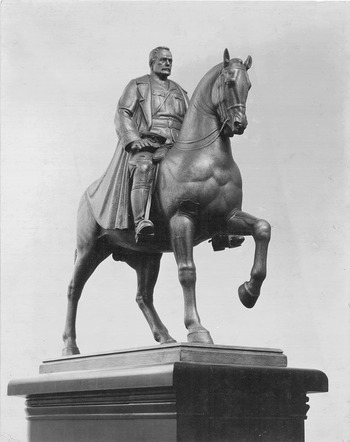
As the Labour Party formed a minority government in May 1929, it fell to the new first commissioner of works, George Lansbury, to oversee the assessment of the competitors’ three models. Lord D’Abernon, chair of the assessment committee, reported to Lansbury through Earle in July 1929 that, with the exception of the architectural plinth and some proposed changes to the costuming of Haig, there was consensus amongst the assessors that Hardiman's design was the strongest of the three.Footnote 46 All three models were displayed to the public at a special viewing at Westminster and in photographs printed in various newspapers after 20 July. Hardiman's model, Haig, was a combination of realist portrait and neoclassical monumental mount; its symbolism lay in the contrast between Haig's calm upright figure and the powerful, Renaissance-style warhorse on which he sat (fig. 2). This juxtaposition would perhaps not have seemed so odd to artistic commentators at the time if Haig had been dressed in Roman or medieval armor, but
—First model of Hardiman's Haig monument, July 1929. Photograph courtesy of National Archives, Kew, London (WORK 20/185 image ref. 1).

he was instead in his field marshal's uniform, with a flowing cape and without his hat.Footnote 47 Military purists were literally horrified at this latter omission (along with the other technical inconsistencies of Haig's uniform), even though it was purely pragmatic: a hat would have cast a shadow over the sculpture's face and obscured its features.Footnote 48
There was an immediate and overwhelmingly negative reaction to Hardiman's model. The Times ran numerous letters on the proposed statue every day from July 24 through until the end of August and sporadically for many weeks after that, noting on several occasions that the daily volume of letters received at the paper ran into dozens, sometimes hundreds, and that only a representative sample of the views received could be published.Footnote 49 This flood of objections to Hardiman's design was perceived by some to be “a popular remonstrance.”Footnote 50 Average folk wrote to numerous papers indicating how “astonished and disgusted” they were by the proposed sculpture.Footnote 51 The PMO and the Office of Works at first tried to ignore the onslaught of hostile reactions. Even in response to reports that the king was “horrified” by the proposed statue, Earle put up a brave front, claiming petulantly on 31 July that he “could get as much support for Mr. Hardiman's conception as there is at present opposition to it.”Footnote 52 He wrote letters to influential former friends of Haig stressing that the point of the statue was not to look lifelike but “magnificent,” that it was for future generations to marvel at, and that neither the reproductions nor the general criticisms in the papers were fair to the artist, who was, he claimed, “a man of considerable genius.”Footnote 53 Earle told Lansbury to reassure Prime Minister Ramsay MacDonald that the Office of Works had taken “every possible precaution to select good men to compete and to choose a board of Assessors that would inspire confidence and ensure the selection of a model holding promise of a worthy memorial.” In his correspondence with the prime minister, Lansbury parsed Earle's opinions of the artist and his work: “The art critics, so far as I have seen their comments, seem to be favorable. The criticisms about details of dress, likeness, etc., may be entirely ignored, as the model that has been photographed is merely a tiny thing. … I have no doubt that Mr. Hardiman, who I feel has genius, in working on the full scale model, will take adequate care to get his details right.”Footnote 54
Whether Lansbury truly shared Earle's assessment of Hardiman and his design is impossible to gauge. He later admitted that it had taken him time to see the merits of the design.Footnote 55 One suspects that this revelation was largely due to Earle's influence. Despite earnest efforts, however, Earle failed to find the support he claimed he would find. Moreover, the government's aloof attitude to the mounting criticism abruptly changed after Lady Haig spoke out against the proposed statue and The Times ran an editorial severely criticizing it.Footnote 56The Times editorial cut past the petty criticisms of military dress and the comportment of the statue's horse and focused on the more general unease expressed in many of the letters. The statue, the editorial suggested, “expressed the wrong idea,” and while not “wholly imaginative or symbolical,” it was “a very untruthful likeness of a real and much-loved man.” Indeed, the “figure in the statue may express ‘heroic leadership’; but it is that of a triumphant brigand. Vainglorious, burly, bloodthirsty, he proclaims the triumph of brute force. … It is a powerful expression of the very spirit which Haig and his soldiers fought to suppress.”Footnote 57 Similar opinions began appearing in the editorials of other newspapers. Both the Morning Post and the Saturday Review were intensely critical of the design, the former suggesting that the selection process was at fault, the latter suggesting that a dismounted figure ought to be now considered, as some concession to popular taste was now necessary and inevitable.Footnote 58 For the Glasgow Herald, the model did not “represent Earl Haig, the Commander-in-Chief as his generation remember him and desire henceforth to picture him and posterity to know him.” The editorial defended the widespread adverse reaction: this was not a philistine public demanding a photographic likeness to the detriment of artistic license. Rather, the statue was missing “inspiration” and failed to capture Haig's “soul.” The “country as a whole has very near its heart a conception of the Field Marshal as a figure of strength and simplicity.” And the paper denounced the monument as all “pomp and baton.”Footnote 59
Numerous correspondents and editorialists echoed this sentiment.Footnote 60 Many letters criticized the “Teutonic” nature of the likeness of Haig and of the statue in general.Footnote 61 Similar thoughts were expressed in private letters to Lansbury and Earle, including one from Haig's niece.Footnote 62 H. Perry Robinson declared the design to be an “adequate conception” not of Haig but of “Field Marshal Hindenburg” and that the spirit it conveyed was German. “It might do for Tamerlane. But it does not even remotely symbolize the spirit in which England entered the War, in which our armies fought, or in which Haig led them. It is as much a libel on England and the spirit of the Empire as it is caricature of Haig.”Footnote 63 The former chaplain of Haig's headquarters thought the statue was very nearly a “speaking likeness of Marshal von Hindenburg” and the “lines of the horse and man shadow forth clearly the ponderous and soulless force of that Prussian spirit which is opposed in very essence to the spirit which inspired Lord Haig and his men.”Footnote 64 From such letters it is clear that a sizable segment of the public expected that the Haig statue should represent those national and/or imperial values that had helped Britain win the war but without resorting to the militarism popularly associated with their former German enemy.
Not only was Hardiman's model perceived as being foreign to the values and tastes of British society and, worse, tainted with a Prussian or Germanic aesthetic, it was also widely derided as being in the vanguard of modern art. Many letters to the newspapers complained that the Office of Works was trying to “foist yet another Epstein on the nation.”Footnote 65 Often this latter charge was explicitly connected to the claim that Hardiman's statue of the Scottish field marshal was an un-English design. One correspondent noted that Haig “deserves to be presented to posterity mounted upon a well-bred charger” and not on the “amorphous type of heavy draught horse” that showed the impact of the “Epstein touch,” another that “Hardiman has produced ‘Blood and Iron’ sitting on a semi-Epstein cart horse.”Footnote 66 This was not the first time that Epstein had been singled out and his art used as a foil with which to contrast English/British memorial aesthetics. In 1917, the Royal Society of British Sculptors (RSBS) had objected to Epstein's being given a commission to memorialize Lord Kitchener. Seizing on the fact that Epstein was American by birth, the council of the RSBS moved that “in justice to British sculptors now serving at the front, no commission should be given for any national memorial till after the peace is declared” and that such memorials when commissioned should be “of the British school, and executed by a sculptor of purely British descent.”Footnote 67 The use of Epstein's name to attack Hardiman's design in 1929 was all the more powerful because of the series of highly publicized controversies over Epstein's commissions in the previous four years. The two most inflammatory discussions were those over Rima—the memorial tablet to naturalist and writer W. H. Hudson, unveiled to a visibly shocked Stanley Baldwin in the Hyde Park bird sanctuary in 1925Footnote 68—and Night and Day, the monumental figures adorning the new London Underground Electric Railway headquarters at the St. James's Park station, which caused an international sensation when unveiled in 1929.Footnote 69Rima, Night, and Day were routinely criticized in the press for being “monstrous,” “nightmarish,” and distinctly “un-English” or out of sympathy with things “typically English.”Footnote 70 All three statues were vandalized numerous times, and Epstein's home was also defaced with swastikas and slogans, including “Jew go home.”Footnote 71 Most significantly, the debate about Night and Day was raging in the press just as the model of Hardiman's Haig was unveiled to the public.Footnote 72
That there were connections among what was perceived to be noxiously foreign to Englishness in modernist art, the infamy of Jacob Epstein, and the reaction to Hardiman's statue of Haig is evident in the report Lansbury provided the Office of Works after being called to Buckingham Palace to explain the government's role in the Haig commission. Lansbury noted of his meeting, “the King is firmly persuaded we are doing our best to land another Epstein ‘monstrosity’ on the nation. He has never seen the ones we have got never wants to but considers them barbarous.”Footnote 73 What makes this reaction so ironic is that Hardiman and Epstein had little if anything in common when it came to their style or technique. Hardiman's design was a new take on a classical tradition, essentially the blending of a classical pose with a modern subject. Given the allegorical size and pose of the horse and romanticized sweep of the cape, the statue did not even match the realism found in Jagger's Royal Artillery memorial with its brutally evocative stone 9.2-inch howitzer.Footnote 74 Ironically, given Earle's predilections, Hardiman's Haig was much closer to the “New Sculpture” of the late Victorian period in its inspiration than it was to the abstract modernism and primitivism of contemporary carving sculptors such as Epstein, Henry Moore, and Barbara Hepworth.Footnote 75 Some contemporaries recognized this fact. Hugh Blaker, for instance, defended Hardiman for fusing modern and classical motifs in a design that was not tainted by an “attitude of cheap realism,” while John Collier posited that at least “the proposed memorial differs widely from the most applauded modern sculpture in which the figures do not resemble any possible living creatures.”Footnote 76 A particularly astute analysis was provided by a provincial art critic who, while drawing attention to the public's association of Hardiman's Haig with Epstein's Night, nevertheless noted that on the artistic spectrum, Epstein was on the far left while Hardiman remained a moderate liberal.Footnote 77 Similarly, the editor of the London Mercury also drew parallels between Hardiman and Epstein and concluded that while the Haig statue was “certainly not open to charges of wild modernity or Oriental paganism,” it had nevertheless aroused greater passions than had the work of Epstein.Footnote 78
Some commentators believed they detected the Renaissance provenance of the horse in Haig; indeed, it was frequently claimed that the horse was reminiscent of Verrocchio's statue of Bartholomeo Colleoni in Venice or Donatello's bronze Gattamalata—the Condottiere—in Padua.Footnote 79 But while emulating a classical model cut no ice with the soldier critics,Footnote 80 F. W. Sargant noted, in evident exasperation, that the whole point of establishing sculpture and architecture scholarships to the British School at Rome was to enable promising students like Hardiman the opportunity to study classical and Renaissance traditions in art: “To give opportunities for study and then to find fault with the logical result seems a bad method.”Footnote 81 Hardiman had other defenders, particularly among art critics, but none of them could be said to be supporters of modernism or indeed part of the interwar avant-garde.Footnote 82 Neither leading modernist artists nor their fledgling organizations—like the London Group and the Seven and Five Society—contributed publicly to the debate on the Haig monument. Artist defenders of Hardiman concentrated on the right of the artist to present his own vision and/or on the monumental qualities of his design. Sculptor Charles Wheeler, for example, called upon the public to recognize that the statue was meant to be “an embodiment of heroic leadership. … He is giving us an epic, not a piece of journalistic description.”Footnote 83 This followed Hardiman's own argument, in his only public comment on the controversy—to the Daily Mail—in which he argued that the monument had to “stand for 500 years, not five minutes.”Footnote 84 But while Hardiman was hardly an abstract modernist, such claims—that it should be up to the artist to decide the form of the memorial—conflicted with a public very much vested in this particular piece of art. A fellow competitor in the Haig competition, Gilbert Ledward, encapsulated the essentially Victorian view of public art evidently held by many lay critics of Hardiman's design when he suggested that modern sculpture, produced for the “intelligentsia” and not the sympathies of the average person, destroyed the very idea of sculpture, which ought to have some social or moral purpose.Footnote 85 Similarly, J. A. Grant complained that the defenders of the statue and of symbolism in modern art in general derided the “exactitude of detail” demanded by the public as immaterial and by these means were trying to foist a statue that “might well represent a conception of a ‘blood and iron’ Hindenburg” as opposed to the beloved Haig.Footnote 86
While some art critics and correspondents supported Hardiman's vision, the depth of feeling expressed in the avalanche of correspondence and commentary persuaded Lansbury that he could not just ignore the criticisms of the model as Earle suggested he ought, as “unfortunately we are dealing with real feeling, perhaps some prejudice and much ignorance.”Footnote 87 Frantic discussions about what to do with the Haig commission surged around the Office of Works in the weeks following The Times editorial. Lansbury had found the king unwilling to discuss Hardiman's model at all: he merely voiced objections to the statue “swallowed whole from the Daily Mail.” The Daily Mail's opposition to the statue was, in fact, particularly vociferous, with the Mail leading demands to give Lady Haig a final say in the controversy, or at the very least, a meeting with the sculptor.Footnote 88 The PMO suggested a new ad hoc review committee to adjudicate objections to the model, but this idea was quashed by Lansbury, who noted to Earle's secretary, “Its personnel would have to satisfy public opinion and at the present juncture such ‘public opinion’ as is getting expression is not cool and level headed.” On hearing this, Earle agreed, suggesting bitterly, “Any ad hoc body unless composed of press critics or soldiers would never satisfy the stupid wolves.”Footnote 89 By this point a fissure had clearly developed between the thrust of public opinion and the view of officials at the Office of Works. Beleaguered by the press onslaught and rallying around the permanent secretary—either out of loyalty or as a result of reactionary defensiveness—the civil servants at the Office of Works could see only the merits of Hardiman's design:
The irony of the situation is that this is the first occasion within living memory in England when a design has been provided for an equestrian statue that promised to be a masterpiece. It seems to me that Hardiman knew exactly what he was doing and balanced finely the requirements of the situation—he did not, as some critics have said, run to the extreme of what you might call abstract symbolism; he was not representing the idea of a conqueror or imperator; he had the great qualities of the man—Haig himself—in mind, and if there is a symbolism it is a symbolism setting forth the nobility and dignity and calm confidence of that great soldier.Footnote 90
Indeed, throughout the entire controversy, none of the officials at the Office of Works seem to have doubted, in writing at least, Earle's estimation of the genius of Hardiman.
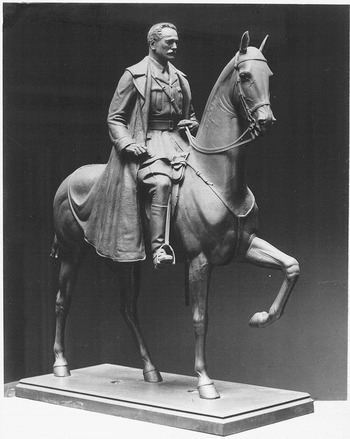
With the press clamoring for action, a meeting between Hardiman, the five assessors, Lady Haig, Lansbury, and Earle was arranged for 11 September 1929. After prolonged discussion, and against the wishes of both Hardiman and Lady Haig, it was decided to have the sculptor prepare a second, larger model that incorporated the suggestions and criticisms of Haig's closest friends and admirers and those of the military experts.Footnote 91 This second model was finished in the autumn of 1930 and approved by the assessors, with a few minor suggestions, on 8 December.Footnote 92 The model was then publicly displayed at Westminster in January 1931 (fig. 3). Reaction to the new model was overwhelmingly negative, with criticisms now coming from both those who had disliked and those who had supported the first design.Footnote 93 Haig's former private secretary, Lieutenant Colonel . J. H. Boraston, expressed a typical view: “When I saw a photograph of Mr. Hardiman's first model for an equestrian statue of Lord Haig I thought that nothing could be worse. I have now seen a photograph of Mr. Hardiman's second model and I realise that I was mistaken.” He urged we “try again.”Footnote 94 But many of those who had defended the original model were dismayed by Hardiman's concessions to the demands of the “realists.” The Manchester Guardian noted, “The likeness may be the Haig his old friends remember best; it is not touched with imagination that would make it the Haig for posterity. The statue is no longer symbolical of resolve and will, but of an ideal happiness and valiancy. … The whole thing is slim and dainty, with a look of fragility about it. … It has become pretty.”Footnote 95 Thus if the first model had expressed the wrong idea—too triumphant, vaingloriously masculine, reminiscent of the “brutality” of Hindenburg and of Prussianism—then the second model was often depicted as feminine—“slim and dainty,” “pretty”—and clearly
—Second model of Hardiman's Haig, January 1931. Photograph courtesy of National Archives, Kew, London (WORK 20/185 image ref. 3).

not masculine enough. Almost everyone agreed that it was the horse that was the problem, but the horse was not seen as merely a part of the pedestal by critics: rather, it reflected directly back on the rider himself.
The representation of the horse was seen as significant precisely because most of the statue's supporters and critics wanted this to be an equestrian monument. When the first model of the proposed memorial was publicly exhibited, there had been questions raised in the press about the choice of an equestrian statue. As an editorial in the Glasgow Herald noted, “We are commemorating the Commander-in-Chief in the Great War, not the cavalry officer of South Africa.”Footnote 96 Indeed, some commentators and letter writers thought it would be more appropriate for Haig to be portrayed on foot,Footnote 97 or in a staff car,Footnote 98 or next to a broken wall “with the words of his immortal order” of 1918 engraved on it,Footnote 99 or simply sitting behind a desk, reading maps and papers.Footnote 100 But former members of Haig's command, members of his extended family and their friends, and leaders of the British Legion were all vociferous in their demands that the monument remain an equestrian depiction.Footnote 101 Haig had been commissioned as a cavalry officer in the Seventh Hussars and Seventeenth/Twenty-first Lancers, had served in the cavalry during the Anglo-Boer War, and had been inspector-general of cavalry in India. Although neither Haig nor any other British officers had had much chance to use the cavalry on the Western Front, clearly there was still a perception of the officer-hero as the mounted soldier, as a modern knight in the service of the people, with all the attendant masculine and warrior values suggested by this image.
In this context, criticisms about the form of the horse were not spurious complaints about the mount but concerns about the image of Haig: a symbolic or ugly horse diminished the reputation and image of Haig himself. After the second model was exhibited, many correspondents suggested that another sculptor more comfortable with equestrian anatomy collaborate with Hardiman on the horse.Footnote 102 Tellingly, the conservative peer the earl of Albermarle (who was also an honorary member of the Royal Society of British Artists) worried in his protest in The Times that Hardiman's effort paled in comparison to the well-received equestrian statue recently erected to honor Marshal Foch (in Grosevenor Gardens, executed by George Malissard). This statue to Foch, the great French field marshal (and an artillery specialist rather than a cavalryman), was a conventional and “lifelike” depiction. Albermarle wrote it would be an “affront to the British public if the [Haig] memorial were to one whit inferior to that to the great Frenchman either as a good portrait or as representative of the British cavalry officer of to-day.” After pointing to the vibrancy of the arts in Britain, he queried why it was necessary to erect Hardiman's grotesquely symbolic effigy of “our greatest soldier.”Footnote 103 The British Legion Journal also pleaded that the statue to Haig be “moulded on the same simple yet dignified lines as that which commemorates Marshal Foch.”Footnote 104 In these claims, nationalist rivalry in the arts had been added to the debate. Many correspondents from the “general public” concurred and suggested that the British Legion step in and force the government to prevent the completion of this “monstrous” monument.Footnote 105 The president of the Legion, Admiral Jellicoe, entreated that “nothing but the best could do justice to Lord Haig or content the men who followed him” and that “nothing but an entirely new design would satisfy the men whom Field-Marshal Earl Haig led to victory.” Indeed, for Legion officials, arguments that the statue could be “symbolic” and not “photographic” in its likeness were “excuses” that were easily refuted by “inspection of the beautiful and lifelike statues of Marshal Foch, recently erected in London, and of Lord Haig himself on the Edinburgh Castle Esplanade.”Footnote 106 The Legion would continue to propose alternatives to the Hardiman design until the actual statue was unveiled.Footnote 107
The Office of Works stood by Hardiman. Earle clearly preferred the first design and as events unfolded evidently worked behind the scenes to push for the original model.Footnote 108 Earle was helped in this task by the adverse views of art critics in the press. While a few thought the new model much more “realistic,”Footnote 109 most declared Hardiman's second model to be “an unsatisfactory compromise” caused by outside interference with the artist's original conception designed to reduce criticism from the general public.Footnote 110 Lady Haig tried to rally public opinion against Hardiman's design throughout February and March of 1931, noting in one letter to the Scotsman that she had received “an enormous number of letters from people in all parts of the country” who concurred with her opinion that the statue “pleases no one” and was “offensive” to many.Footnote 111 At Earle's prompting, Lansbury once again took the issue of the Haig memorial to the cabinet.Footnote 112 After considering the various options, the cabinet agreed to the course of action suggested by Earle all along: Hardiman would be given a free hand to execute the commission as he had originally intended. Lansbury passed the news on to Hardiman in a letter in which he reiterated Earle's opinion, “If your genius is unfettered you will give us a memorial worthy of the Field Marshal, the nation and yourself.”Footnote 113 From the point of view of the government, this settled the matter. The critics were appalled. The Manchester Guardian, which had cautiously supported the first design but was dubious about the second, was savage in its opinion of the government's decision, suggesting that Lansbury “likes Mr Hardiman because he lends himself to the committee or Soviet system of sculpture—a very democratic conception, no doubt, but hardly likely to produce works of art.”Footnote 114 Nonetheless, Hardiman was told to begin the commission in February and signed the contract drawn up on behalf of the Office of Works on 7 August 1931. This did not stop sniping at both the Office of Works and Hardiman over the proposed design. Conservative M.P.s, the British Legion, Lady Haig, and former officers acting on behalf of the Haig clan, continued to petition the Office of Works on a regular basis over the next few years.Footnote 115
Hardiman worked on the full-scale statue for four years, enduring considerable economic hardships along the way owing to the need to construct a huge studio built purposefully for the monumental figure.Footnote 116 By February 1935, the full-size statue was completed in clay, and representatives from the Office of Works, the War Office, and the British Legion were asked to inspect it, as was Lady Haig. The generals reported back to Lord Hailsham at the War Office generally positive reviews of the statue's likeness to Lord Haig, but all remained severely critical of the equestrian mount.Footnote 117 Hailsham, in turn, pleaded with the current first commissioner of works, Ormsby Gore, against erecting a “heraldic monstrosity.”Footnote 118 For his part, Hardiman had anticipated the soldiers’ criticisms but was no longer willing to make further concessions.Footnote 119 Faced with the continued disapproval of the War Office and a now recalcitrant sculptor, the Office of Works prepared for what it believed would be yet another round of controversy once the final casting was made by trying, one last time, to get Lady Haig on its side.Footnote 120 Despite its best efforts, Lady Haig could not after all be mollified: she wrote to the first commissioner in December 1935 that she wanted it known she had absolutely no connection to the statue at all.Footnote 121
The Office of Works recognized that the day of reckoning for the statue would be its formal unveiling, but this was delayed owing to the financial difficulties that the commission caused Hardiman. After much wrangling with the Treasury, the Office of Works took responsibility for the arrangements and payment of the bronze casting and architectural plinth.Footnote 122 The bronze statue was finally cast in late 1936, but four months were thought necessary to complete its erection in Whitehall, and this would conflict with the plans for the coronation of George VI, scheduled for May 1937. Consequently, the erection of the plinth and placement of the statue was delayed until June 1937, with the unveiling planned for the Armistice Day ceremony in November.Footnote 123 A minor skirmish between the Office of Works and the Home Office then developed in the planning of the unveiling ceremonies. The new first commissioner of works, Sir Philip Sassoon, argued that given the continuing interest in Haig and the importance of this particular monument, the king might consider unveiling the statue himself during the Armistice Day ceremony, but the Home Office completely opposed any such plan for both symbolic and practical reasons. The home secretary, Samuel Hoare, thought it an unwise precedent for a monarch to unveil a memorial to an individual subject (and a nonroyal at that). Moreover, he noted the “ritual of Armistice Day has been crystallized into a religious ceremony, and the British public have become hysterical about it. Even a small change in the ceremony, particularly when it is made at the first Armistice Day of a new Reign, is sure to excite some critics.”Footnote 124 Hoare also worried about crowd control and the difficulty of the king's making his way through the expected solid bloc of people arrayed on the street between the Cenotaph and Haig. After much debate, it was decided to have the king's brother, the duke of Gloucester, unveil the statue on 10 November and to have the king lay a wreath at the base of Haig after the formal ceremony at the Cenotaph and the two-minute Silence on 11 November.Footnote 125
The unveiling ceremony on Wednesday, 10 November, was witnessed by members of the cabinet; numerous M.P.s from all parties; some two thousand veterans, including thirty holders of the Victoria Cross; two thousand representatives from the active armed forces; and Haig's immediate family, excepting Lady Haig—who was reported as ill, but who, in actuality, had no intention of attending anyway.Footnote 126 A huge crowd with “medals everywhere”—estimated by the press in the tens of thousands—filled Whitehall behind the military honor guards.Footnote 127 The War Office had arranged the ceremony and insisted that Lloyd George not be allowed to attend, noting this would “cause trouble with the ex-Servicemen.”Footnote 128 But the fears of officials at the Office of Works about another public outcry over the statue never materialized, as the immediate reaction to the statue was muted. The Times art critic decided the finished model was “an agreeable surprise” and that it, with one or two qualifiers, easily excelled all other equestrian statues in London.Footnote 129 The Manchester Guardian's appreciation agreed that Haig was one of the best three equestrian monuments in London: “It has dignity … and is as heroic as the personality and legend of Haig will stand.” In their view, Hardiman had produced a statue “not unworthy of its place.”Footnote 130 The second Earl Haig regretted that the commission had caused so much controversy over the previous nine years and noted that his own anxiety at the unveiling had been needless. He praised the statue for the strength and originality that made it more than just a photograph-in-the-round. He thought it a fine tribute to his father and suggested the whole family was proud of it.Footnote 131 The opinions reported in the Daily Express were less kind. In an article entitled “Hatless Haig on ‘Circus’ Horse Annoys Veterans,” all the old criticisms against the original design were restated. An Express reporter surveyed six women and six men at the unveiling and found that all the former liked the statue while all the latter—all ex-servicemen—disliked it.Footnote 132 The Express effort to discredit the monument by feminizing it also failed to raise controversy in 1937: in the worsening international political situation of the later 1930s, the press seemed less than eager to revisit what must have now seemed increasingly a minor controversy over the Great War.
The much-feared avalanche of criticism in editorials and letters to the editor failed, therefore, to occur.Footnote 133 Instead, both the unveiling ceremony and the king's wreath-laying ceremony were rather overshadowed in the press by the breaking of the two minutes of Silence by a veteran named Stanley Storey: the first time since the inauguration of the ritual that this had happened. Crying, “This is Hypocrisy! You are conniving at war! You are preparing for war!” Storey had run toward the king and the Cenotaph during the Silence but had been wrestled to the ground by the police.Footnote 134 The episode was quickly dismissed as of “no serious significance” when the government reported that Storey was “mentally afflicted” and had “escaped” from the Cane Hill Asylum.Footnote 135 Letters to the press about the Armistice Day rituals and the unveiling of Haig in the days following 10 and 11 November tended, as a result, to concentrate on the Storey incident, praising in particular the king's unflinching conduct throughout the events.Footnote 136 Hardiman's Haig consequently quickly became part of the memorial furniture of central London, the entire controversy seemingly forgotten, at least publicly. After much haggling on the part of the Office of Works with the Treasury, Hardiman was granted an additional £2,000 beyond the original fees (that is, above the £10,700 already spent on the monument by 1937) so that he might dig himself out of the large debts that the Haig commission had caused him.Footnote 137 He was admitted to the RSBS in 1938, which awarded him its silver medal for Haig in 1939.
In conclusion, what then should we make of the entire Haig monument controversy? First, it should be stressed that the storm over Hardiman's Haig between 1929 and 1937 had little to do with latent antipathy toward Haig, nor was it party-politically driven.Footnote 138 This is not to suggest that the monument was not politicized: the very act of building war memorials encapsulated political considerations on the meaning of war.Footnote 139 But to argue for a political dimension in the construction and reception of memorials does not necessarily endorse the view that such monuments are simply about justifying the status quo. War memorials become objects or sites of collective memory precisely because they are “the most public component of the material culture of war remembrance,” and as such they “occupy a space between the public and the private.”Footnote 140 The point is that those who so disliked Hardiman's designs still wanted some form of monument to Haig. Few who believed the idea of any monument to him inappropriate contributed to the debate. While ex-soldiers, artists, and art critics dominated the correspondence to the press—and disagreed about what was needed—they nonetheless represented various different political constituencies (if not all classes or both genders: other than members of Haig's family, for instance, few women seem to have participated in the debate). Indeed, many Labour supporters wrote to Lansbury while he was first commissioner with their own suggestions for the monument. One letter, from a James Wallace, is worth quoting at some length:
[T]he Labour Government has the opportunity of breaking new ground and starting a new tradition. … The majority of the men who fought in our Armies, and who gave any thought to the fundamental issues at stake, were sustained through the years of tragedy and suffering by the ideal that the common crucifixion would in some way, save the world from a recurrence of such an unspeakable horror. I need not enlarge upon the years of disillusionment. Hope now re-awakens, and we are beginning to dare to think that at last the only harvest that could justify all the blood and tears will be reaped.
It seems to many of us who fought under him that it would be little less than a tragedy if the essential Haig were to be travestied by a rampant figure on horseback facing the shrine of our million dead.
At this point it would seem that Wallace was railing against the monument in the same way that the Daily Express would do some seventy years later. But Wallace continued:
Why is it that Lord Haig's fame has become the brighter with the passing of the years? What was it in him that we love and revere and wish our children's children to perceive in the memorial we erect to him? It is not the Victorious General—although he was Victorious. It is not the cavalryman—although he was the beau-ideal of what a cavalryman should be. It is the Man—calm and steadfast.
What was needed, Wallace concluded, was a simple realistic depiction of this man for “the millions of simple steadfast men whom he led” that “would remind generations still unborn of the price which their fathers paid for the peace and security which we now begin again to hope that they will enjoy.”Footnote 141 Evidently, some surviving ex-servicemen like Wallace, even while eager for the new world promised by Labour, saw the statue not in terms of monumental symbolism but in terms of commemorating their own experience of the war.
It was against the backdrop of increasing criticism of the war and the ideas that had sustained the war effort that hostility toward the Haig monument mounted. As the old ideals—courage, glory, honor, patriotism—were increasingly discounted in the early 1930s, the purpose of commemoration came increasingly to be consolation of the bereaved, consolation not with rhetoric of the glorious sacrifice of the past but with hope that the sacrifice of their loved ones in the “war to end all wars” would ensure peace in the future.Footnote 142 Yet focusing on the aspirations of the civilian bereaved tended to marginalize the actual veterans of the conflict. When the Labour government suggested severely reducing the military presence at Armistice Day ceremonies in 1929, the proposal raised the hackles of the British Legion and the ire of King George V,Footnote 143 and attempts by the Prince of Wales to demilitarize the Cenotaph ceremony in favor of veterans also came to naught in the early 1930s.Footnote 144 It is within this framework that the debate about the representation of Haig also ought to be situated. Kitchener had been lost at sea in 1916, ensuring that his legacy was that of martyr to the war—indeed, the most symbolically resonant form of martyr to the Great War: one of the “missing.”Footnote 145 By contrast, Haig was an important symbol of both sacrifice and victory, of duty and survival.
The Cenotaph and the Tomb of the Unknown Warrior were monuments to the missing and the dead, and while important as sites of memory for fallen comrades, they did little to commemorate those that survived the war. Yet, paradoxically, in an era otherwise dominated by memorials to the unidentified and unidentifiable, a memorial to the general that led could carry meaning for those who followed. The aesthetic protestations of the servicemen were not just specious or random objections; rather, when ex-servicemen objected to the statue on the basis of the “unrealistic” nature of the horse or of the failure to accurately capture Haig's persona and appearance or “how he rode,” they were using their specialized knowledge, gained in service to their nation, in order to assert their own place in the postwar culture of commemoration. As the editorialist in the Glasgow Herald noted, Haig “led the British armies in a realist's war, and those who served under him have demanded a realist memorial.”Footnote 146 Similarly, the Daily Mail claimed the statue “may be a true symbol of what Mr. Hardiman feels about the war, and about our dead commander; but the nation, and particularly the survivors of Haig's Army, are agreed that the most faithful symbol of their sentiments would be a true presentment of the man they knew.”Footnote 147 The irony here was that the ex-servicemen wanted a realistic depiction of the soldier and his horse in order to proclaim the symbolic ideals they needed to believe they had fought for. Haig, in reality, may well have been the embodiment of a dying class rather than the epitome of the postwar nation, but that was clearly not how he was perceived by a sizable segment of the war's survivors in the 1920s and 1930s.
A second significance of the Haig controversy lies in the debate over who got to decide the artistic representation of Haig that would forever publicly commemorate him: the artist given the commission; Haig's friends and family; the military and its veterans, who saw the memorial in terms of their own sacrifice and the values they had fought for; or the wider public, who were ultimately paying for this piece of public art? Here there was a conflict between the de jure and de facto patrons of the piece (and, indeed, of all national monuments in the interwar years). As The Times critic put it, “The root cause [of the controversy] was the official inability to distinguish clearly between a private and a public occasion. For the former an accurate and intimate likeness in the round of Lord Haig and his favorite charger would suffice, but the latter demands a largeness of treatment which will tell in space and survive in time.”Footnote 148 The Haig commission, combined with the simultaneous bewilderment about the modernist movement in sculpture represented by the pioneering work of Jacob Epstein, sparked unprecedented public interest in the aesthetics of British monumental art. As one critic noted in 1929, controversies over public art, whether over Epstein's sculptures for the London Underground or Hardiman's Haig, “serve to remind us how the expert and the layman may easily drift apart. The sculptor is the expert, and experts notoriously go their own way—but the public is also the paymaster and not unnaturally they feel that as he who pays the piper may call the tune, so also they who pay the chiseller may draw the line.”Footnote 149 The degree of public interest in public commissions arose, arguably, because of the vast number of war memorials erected after 1918 and the emotional intensity produced by the suffering of the Great War, which together created unique concern on the part of the population about the meanings represented in memorial monuments and public statuary. But while civic leaders were usually part of the planning and commissioning process for local memorials—although not always, nor without controversyFootnote 150—national monuments erected in London were the sole responsibility of the Office of Works and its aesthetic advisory body, the RFAC.
The Office of Works, dominated by its long-serving permanent secretary, Earle, took its mandate seriously and conscientiously but invited little participation beyond that of other relevant government departments in its commissioning decisions. Earle took an elitist position regarding art, trusting his own taste and that of the established bodies representing the plastic arts rather than that of the general public. While not adverse to artistic innovation, and willing to discuss such issues with recognized art experts, he nonetheless clearly resented outside interference in aesthetic decisions except when it could not be absolutely avoided.Footnote 151 This attitude—that connoisseurs ought to decide what public art was good for the nation—reflected his age and Victorian education and also, it should be noted, the dominant views of established professional artistic bodies like the Royal Academy, the Royal Institute of British Architects, and the Royal Society of British Sculptors.Footnote 152 The demands of the general public and of the military men were discounted; they did not “understand” art, nor did they understand the need for monumentality in memorial sculpture, which could not be achieved by “cheap realism.”
As noted above, Earle, his subordinates, and his successors at the Office of Works all parsed Earle's view that Hardiman was a sculptor of “genius” and that he could produce a masterpiece. Evidently, that was what Earle wanted: not something that faithfully represented Haig's appearance or something that represented, abstractly or otherwise, the experience of surviving veterans but a piece of monumental art expressing values appropriate to the imperial capital. Earle recognized that accomplishing this without falling into triumphalism was necessary and difficult, but in his opinion, Hardiman's compromise of realistic Haig and symbolic horse had accomplished this. Thus, while Earle saw the need for the army to be consulted with regard to correct military details of the monument,Footnote 153 he nonetheless resented the intervention of family friends, military-kit purists, veterinarians, and all the other “philistines” on the street demanding a replica of the field marshal more suitable to a wax museum than to the setting of the seat of national and imperial power.Footnote 154 To Earle and his successors’ discomfort, however, ignoring the populace on questions of public art no longer went unchallenged in the later 1920s and early 1930s. The tensions among civil-servant patron, paymaster public, and artist expert were not resolved in the Haig commission, and ultimately the government continued to go with its own men of taste, leaving the concerned public to whine about the process.Footnote 155
However, the long delay between the initial commission and the erection of the statue changed the context of the debate about the Great War itself and therefore also that of Haig's statue. By 1937 the bitter criticism of the war and its conduct was no longer as provocative as it had been in 1929–31, and fears about another war and the need to prevent such an occurrence had changed the didacticism of commemoration rituals (although this had not blunted the emotional nature of the Armistice Day observance). The passions aroused by Haig had thus sufficiently cooled to allow for Hardiman's design to be eventually erected without too much fuss. But Earle's expectation that future generations would look up in wonder at the monument turned out to be rather short-lived, as war with Germany broke out less than two years later, changing again how the Great War and those who had led it would come to be remembered.