Introduction
Acute bacterial rhinosinusitis is common in children and adolescents and is frequently self-limiting. However, a small proportion of patients (3.9 per cent) presenting to an emergency department with sinusitis may also have an associated intracranial abscess, such as subdural empyema, intraparenchymal abscess or extradural abscess.Reference Hicks, Weber, Reid and Moodley1 The spread of infection occurs either via direct extension (e.g. frontal bone osteomyelitis) or haematogenous dissemination of bacterial pathogens from the paranasal sinuses.Reference Lerner, Zalzal, Choi and Johnson2 Children may present with non-specific symptoms such as malaise, headaches and fevers, which can result in a delay of correct diagnosis and subsequently worse outcomes.Reference Patel, Garber, Hu and Kamat3 Previous studies have reported significant morbidity with around half of patients requiring revision surgery, a quarter experiencing neurological disability and a mortality of 3–10 per cent.Reference Schupper, Jiang, Coulter, Brigger and Nation4–Reference Lundy, Kaufman, Garcia, Partington and Grabb6
Optimal treatment of sinogenic intracranial suppuration in children is a contentious issue. A number of studies have reported the results of various treatment strategies; however, the evidence base is largely restricted to small retrospective case series.Reference Bair-Merritt, Shah, Zaoutis, Bell and Feudtner7–Reference Kwang Ong and Tan11 The majority of the patients undergo either sinus drainage procedures or neurosurgical interventions or the combination of the two.Reference Patel, Garber, Hu and Kamat3 In addition, in a small proportion of patients, conservative medical treatment has also been reported.Reference Heran, Steinbok, Cochrane, Chapman, Humphreys and Adelson12 However, the question of how extensive or aggressive the initial treatment strategy needs to be remains unanswered. Although some studies advocate joint interventions addressing both sinus and intracranial suppuration, others report that sinus surgery alone alongside antibiotic therapy may be sufficient to avoid a craniotomy.Reference Garin, Thierry, Leboulanger, Blauwblomme, Grevent and Blanot9,Reference DelGaudio, Evans, Sobol and Parikh13,Reference Gitomer, Zhang, Marquez and Chandy14 However, because of the limited sample sizes and a lack of direct comparisons between treatment arms, it is currently not clear which treatment strategies achieve the most favourable outcomes.
Objectives
The main aims of this study were to compare the outcomes of different treatment approaches used to treat patients with sinogenic intracranial abscesses and to identify the key predictors of poor outcomes. The study also aimed to determine whether combined sinus and neurosurgical interventions are associated with improved outcomes.
Materials and methods
Ethical considerations and governance protocols
The Health Research Authority online tool (http://www.hra-decisiontools.org.uk/research/) was used to confirm that this work did not qualify as research, and therefore no ethical approval was sought. The study proposal was reviewed by the local clinical governance department and was registered as a service evaluation project (number: 3252). The study was carried out and reported in accordance with the Strengthening the Reporting of Observational Studies in Epidemiology guidance.Reference von Elm, Altman, Egger, Pocock, Gøtzsche and Vandenbroucke15
Study design and setting
Potentially eligible patients were identified using the International Classification of Disease-10 diagnosis of all types of intracranial abscesses (i.e. subdural empyema, intraparenchymal abscess and extradural abscess) under the umbrella code of ‘intracranial abscess and granuloma’ (G06.0) between 1 January 2000 and 31 December 2020. Medical records of the individual patients were manually screened, and only patients with sinogenic intracranial abscesses were included in the study. A preliminary report on the outcomes of the first 14 patients has been previously reported by our group.Reference Leong, Waugh, Sinha and De16
Participants and data sources
A retrospective review of paediatric patients (less than 18 years) presenting with sinusitis and extradural abscess, subdural empyema or intraparenchymal abscess (all confirmed on cross-sectional imaging) was performed. Medical records were reviewed to obtain demographic and clinical characteristics. Images and their reports were reviewed to confirm the diagnosis and document sinus involvement, the depth of an intracranial abscess and the type of collection.
Exclusion criteria
Intracranial collections secondary to sources other than sinusitis (e.g. mastoiditis, trauma) were excluded. Intracranial complications of sinusitis that did not have a concomitant abscess, such as meningitis or venous sinus thrombosis, were not eligible for inclusion.
Study end points
The primary study outcomes were the rates of return to the operating theatre during the same admission, neurological deficits (e.g. paresis, dysphasia, cognitive impairment) at six months and the length of hospital stay. The secondary outcomes were death within 90 days of diagnosis and rates of re-admission.
Data management and statistical analysis
The collected data were anonymised and stored on the secure hospital server. Statistical analysis was performed with SPSS® (version 27.0) statistical analysis software. Comparisons between treatment approaches were analysed using the chi-square test. The means for length of hospital stay and ages were compared using the Mann–Whitney U test. A univariate binary logistic regression analysis was carried out to investigate predictive factors (age, sex, combined ENT and neurosurgical intervention, size of collection, time to surgery and subdural empyema).
Results
Demographic and clinical characteristics
A total of 39 patients (13 males, 41 per cent) with a mean age of 11.5 years (range, 4–16 years; median, 12 years; standard deviation (SD), 2.7 years) were included (Table 1). Two thirds of patients were admitted between 2010 and 2020. Twenty-four patients (61.5 per cent) were transferred for treatment from other units. Mean length of hospital stay was 20 days (SD, 19 days). The most common organisms were Streptococcus constellatus and intermedius (see Table 1 in the supplementary material, available on The Journal of Laryngology & Otology website). Median time from admission to surgery was 17 hours (range, 3–189 hours).
Demographic characteristics

*n = 39. SD = standard deviation
Imaging findings
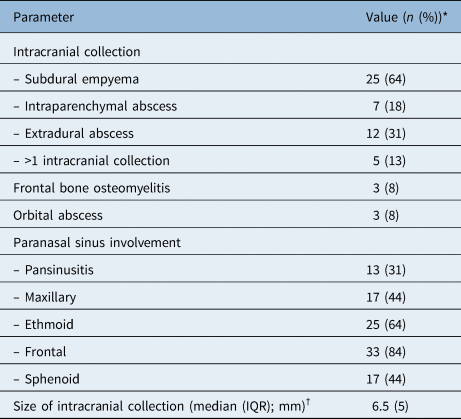
The most commonly involved sinuses, defined as opacification of the sinus cavity, were the frontal (n = 33, 84 per cent) and ethmoid (n = 25, 64 per cent) (Table 2). The most common intracranial complications were subdural empyema (n = 25, 64 per cent) and extradural abscess (n = 12, 31 per cent). Five patients had more than one simultaneous collection. Frontal bone osteomyelitis was found in three patients. Median time from admission to computed tomography (CT) and magnetic resonance imaging (MRI) was 6 hours (range, 2–58 hours) and 15 hours (range, 4–70 hours), respectively. In eight patients, MRI demonstrated an intracranial collection not detected by the CT alone.
Imaging findings

*n = 39; †n = 28
Treatment approaches
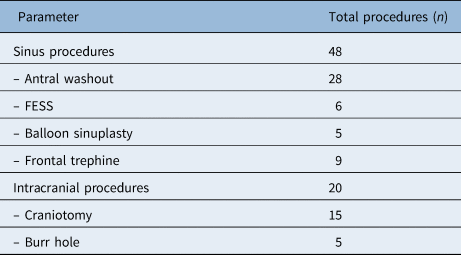
The most common treatment approach was a combined ENT and neurosurgical intervention (16 of 39, 41 per cent) followed by an ENT procedure alone (15 of 39, 38.5 per cent) (Tables 3 and 4). Fourteen patients underwent antral washout only. The remaining patients were managed with neurosurgical only drainage (4 of 39, 10.2 per cent) or conservative treatment (4 of 39, 10.2 per cent). The most common ENT operation was antral washout (28 of 39, 72 per cent) followed by frontal trephine surgery (9 of 39, 23 per cent) and endoscopic sinus drainage (6 of 39, 15 per cent). A craniotomy was performed in 15 patients (38 per cent) and burr holes were placed in 5 patients (12.8 per cent). No significant changes in treatment outcomes were observed after the mid-point of the recruitment period (2010); however, there has been a significant reduction in the use of the antral washout only approach since 2015 (2 out of 14 cases).
Types of surgical interventions

*n = 68. FESS = functional endoscopic sinus surgery
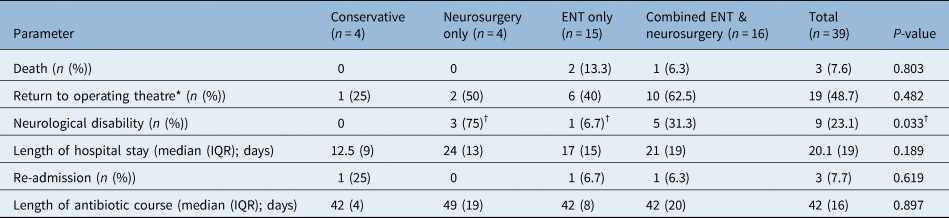
Main outcomes stratified by initial treatment strategy

*Patients who failed conservative management and required surgery were labelled as ‘returned to theatre’; †significant difference in neurological disability was observed between neurosurgery only and ENT only treatment groups, but not between other groups. IQR = interquartile range
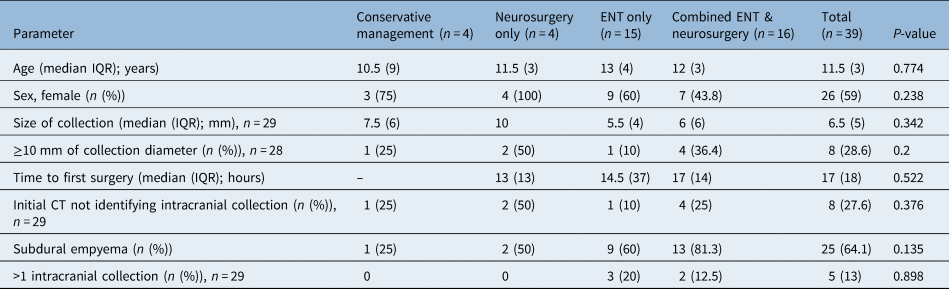
Table 5 summarises the comparisons of the key clinical characteristics between the main treatment groups. Although no statistically significant findings were detected, the size of intracranial abscess was found to be smallest in the ENT only group (median, 5.5 mm). Patients treated by combined neurosurgery and ENT interventions had the largest proportion of patients with subdural empyema (13 of 16, 81.3 per cent).
Patient and disease factors stratified by initial treatment strategy

IQR = interquartile range; CT = computed tomography
Main outcomes
Regarding the total cohort, 19 of 39 patients (48.7 per cent) needed to return to the operating theatre for another surgery after initial treatment. Furthermore, 9 of 39 patients (23.1 per cent) had neurological deficits at 6 months, and 3 of 39 patients (7.7 per cent) died within 90 days of admission. The rate of re-admission related to sinogenic intracranial infection was 3 out of 39 patients (7.7 per cent). Mean length of hospital stay was 20 days (SD, 19 days). Overall, all outcomes except for neurological deficits were comparable across the four treatment approaches (Table 5). The risk of neurological deficits was significantly higher (p = 0.033) in patients treated with neurosurgery alone (3 of 4, 75 per cent) compared with those treated with ENT intervention alone (1 of 15, 6.7 per cent). Patients undergoing antral washout only had comparable outcomes to those managed with either endoscopic sinus surgery, frontal trephine or balloon sinuplasty (see Table 2 in the supplementary material, available on The Journal of Laryngology & Otology website).
Six of 15 patients (40 per cent) initially treated with sinus only interventions required further neurosurgical interventions, whereas 10 of 16 (62.5 per cent) required revision neurosurgical drainage in the combined treatment group. Three out of four patients were successfully treated with intravenous antibiotics without requiring surgical intervention. Median time for revision surgery was 5 days (interquartile range, 20).
Outcome predictors
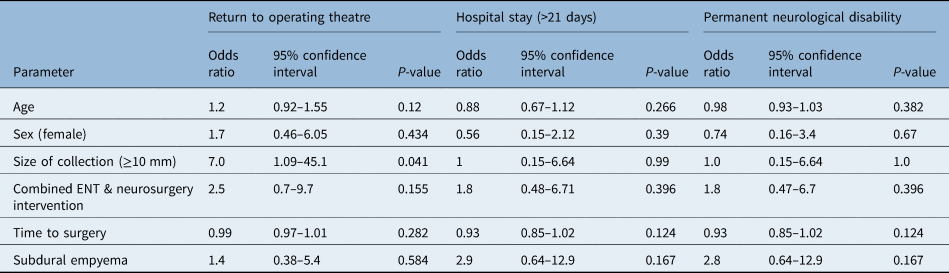
Table 6 summarises the results of the univariate logistic regression analyses for 3 main outcomes: return to the operating theatre, hospital stay (more than 21 days) and neurological deficits. Combined neurosurgical and ENT interventions did not result in lower morbidity. The size of an intracranial abscess (equal to or more than 10 mm) was found to be associated with a significantly increased likelihood of return to the operating theatre (odds radio, 7; 95 per cent confidence interval, 1.09–45.1; p = 0.041), and the remaining predictors were not found to be significant.
Predictive factors in binary logistic regression

Discussion
Synopsis of key findings
The current study represents one of the largest cohorts of children with sinogenic intracranial suppuration reported in the literature. The study findings confirm the significant short- and long-term morbidity previously described: 48.7 per cent required revision surgery and 23.1 per cent were left with neurological disability. The treatment course is complex and lengthy with most children requiring three weeks of in-patient treatment and a total of six weeks of antibiotic therapy. The majority of the patients were found to have either subdural empyema (64 per cent) or extradural abscess (31 per cent) with frontal sinus involvement observed in 85 per cent. Consistent with the literature, joint neurosurgical and sinus interventions were most frequently employed as an initial treatment approach (41 per cent); however, it was not found to result in improved outcomes. A significant proportion (38 per cent) were managed with sinus interventions alone. The size of an intracranial abscess was the most important predictor for requiring revision surgery and patients were 7 times more likely to return to the operating theatre if it measured equal to or more than 10 mm.
Comparison with other studies and clinical implications
Within the limitations of the retrospective data that are discussed below, the outcomes of the initial treatment approach were evaluated and compared. The rates of revision surgery were similar across the four groups, with approximately half of patients requiring a second operation after five days because of progression of intracranial abscess. Notably, 9 out of 15 patients were successfully treated with sinus drainage, thereby avoiding a craniotomy. Although we recognised that there was a trend of larger intracranial abscesses found in patients treated with neurosurgical drainage, the findings suggest that ENT only interventions may have a role in reducing the number of patients undergoing a craniotomy and its associated morbidity. The key question remains as to which patient group is most suited for this approach. Garin et al. have previously reported that the presence of subdural empyema was a contraindication to a functional endoscopic sinus surgery (FESS) only approach because 87 per cent ultimately required a craniotomy.Reference Garin, Thierry, Leboulanger, Blauwblomme, Grevent and Blanot9 On the contrary, 3 out of 4 patients with extradural abscess were successfully managed with FESS alone. In the present study, we found that 60 per cent of patients managed with sinus interventions only did not require a craniotomy despite the high proportion of patients with subdural empyema (60 per cent). This begs the question whether factors other than type of intracranial abscess have a more deterministic effect on the need for revision surgery. Indeed, in the univariate logistic regression analysis we found that the size of an intracranial abscess (equal to or more than 10 mm) had the strongest prediction for the need to return to the operating theatre, whereas the presence of subdural empyema was not found to be significant. Our results are in contrast with those reported in the study by Gitomer et al.,Reference Gitomer, Zhang, Marquez and Chandy14 which found that the presence of subdural empyema was the key predictor for the need to return to the operating theatre; however, the authors did not include the size of abscess in the analyses. Therefore, it remains to be determined whether patients with small intracranial abscesses, including subdural empyema, may be suited for FESS only. Non-operative initial treatment with close observation may also be an option. Three out of 4 patients in our cohort were successfully managed with intravenous antibiotics alone. None of the patients had neurological disability and had markedly shorter hospital stay (median, 12.5 days). However, no firm recommendations can be made regarding the indications for conservative treatment.
Irrespective of the initial approach, two thirds of our cohort underwent neurosurgical intervention at some point during the in-patient stay. Although FESS may prevent the need for a craniotomy in some patients, its role when used in conjunction with neurosurgical intervention is controversial. We found that two thirds of patients required revision surgery despite a joint neurosurgical and ENT approach, the highest proportion when compared with the other treatment arms. Combined treatment was also not found to affect the rates of revision surgery, neurological disability and hospital length of stay. As mentioned before, inherent selection bias may be responsible for the lack of apparent benefit of combined procedures; however, the clinical and disease characteristics were largely comparable across the treatment groups as summarised in Table 5. The current study findings are also consistent with the results from previous studies in adults.Reference DelGaudio, Evans, Sobol and Parikh13,Reference Koizumi, Ishimaru, Matsui, Fushimi, Yamasoba and Yasunaga17 In a retrospective cohort study on 255 adult patients with sinogenic intracranial suppuration, Koizumi et al. investigated the effects of FESS in addition to neurosurgical drainage.Reference Koizumi, Ishimaru, Matsui, Fushimi, Yamasoba and Yasunaga17 The authors did not find that FESS resulted in an improvement in any of the study outcomes, including mortality, requirement for blood transfusion, revision surgery, re-admission and the length of hospital stay. These findings raise an important question as to whether sinus interventions, which can be more technically challenging in children, are warranted in the acute setting considering the likelihood of increased operative time, bleeding and orbital injury. This is particularly relevant in centres where rhinological expertise may not be available. Some authors argue that FESS may serve as an important diagnostic tool by enabling the surgeon to obtain microbiological samples.Reference Garin, Thierry, Leboulanger, Blauwblomme, Grevent and Blanot9 However, in the present study we found that intracranial samples did not yield a culture growth in 3 of 20 cases, and the washout from the sinuses provided microbiological data instead.
The present study found significantly increased risk of neurological deficits in patients treated with neurosurgery alone (75 per cent) when compared with ENT only interventions (6.7 per cent). The findings should be interpreted with caution because of limited cases in the neurosurgery group (n = 4). This observation is most likely a result of a considerable difference in the median size of intracranial abscesses across the groups (median 10 mm in the neurosurgery group vs 5.5 mm in the ENT only group), although this was not statistically significant.
Finally, three deaths were observed in our cohort, two of which were in the ENT only group. All three patients presented with severe sepsis. One patient was deemed too unwell to undergo a craniotomy, and only antral washout was performed. In a second patient, the abscess was located in the pons and was not surgically accessible. A third patient passed away from the complications related to sepsis despite a craniotomy and antral washout.
Limitations
The study has several important limitations. Firstly, the retrospective nature of the data introduces a significant source of selection bias. All the comparisons of outcomes between the treatment groups should be interpreted cautiously. Although we attempted to assess and compare a number of possible sources of bias (e.g. time to surgery, size of collection) between the groups, it is possible that we did not account for some important factors. Secondly, as it was a retrospective review, we were unable to extract the clinicians’ reasoning behind choosing one treatment strategy over another. Thirdly, a small sample of patients treated with conservative and neurosurgery only approaches prevents meaningful comparisons and risk of type 2 error. The data on the individual procedures were provided; however, subgroup analysis stratified by the type of sinus intervention was not feasible because of low patient numbers. Finally, no patient-reported outcomes were collected.
• Sinogenic intracranial suppuration is associated with significant morbidity
• Initial combined ENT and neurosurgical procedures were performed in 41 per cent of patients, whereas 38 per cent underwent sinus drainage only
• Nine of 15 children were successfully managed with sinus drainage only without the need for intracranial interventions
• A combined ENT and neurosurgical approach was not associated with fewer revision surgeries, length of stay or neurological disability
• The size of intracranial abscess (more than 10 mm) was associated with a significantly increased likelihood of revision surgery
Study strengths
This study presents one of the largest series in the literature and captures cases over a 20-year period. All the cases were consecutive, and a complete follow up was available. A variety of factors were considered to address the source of bias. The regression analysis was performed to identify the key prognostic factors.
Conclusion
The current study presents the outcomes of four treatment strategies commonly employed in managing sinogenic intracranial suppuration in children. The key factor in predicting the need for return to the operating theatre was the size of an intracranial abscess. Although sinus interventions were found to be successful in averting the need for a craniotomy in 60 per cent of patients, its role when employed alongside neurosurgical drainage is less clear. Future prospective studies are necessary to develop a robust guidance on the role of endoscopic sinus surgery and neurosurgical interventions.
Supplementary material
The supplementary material for this article can be found at https://doi.org/10.1017/S0022215123000166
Data availability statement
The data that support the findings of this study are available on request from the corresponding author.
Competing interests
None declared.