Over the last decade, childhood-onset bipolar disorder (BPD) has received increasing attention from both the scientific community and the general public (Lofthouse & Fristad, 2004). Previously considered virtually nonexistent, childhood-onset BPD is now accepted by most professionals as a reality, although “conservatives” will probably report very few cases, whereas “liberals” may diagnose BPD in every moody child (Carlson, 2005). Clearly, more definitive markers around the boundaries of bipolar type I, bipolar type II, cyclothymia, and bipolar not otherwise specified (BP-NOS) are needed.
Although no epidemiological studies currently exist for children, Lewinsohn, Klein, and Klein's (1995) community school survey of 14- to 18-year-olds found lifetime prevalence rates for a diagnosis of BPD to be approximately 1%, with an additional 5.7% reporting subthreshold symptoms. Had parents been interviewed in addition to the adolescents, these rates might have been higher. In a retrospective survey, 31% of 500 National Depressive and Manic-Depressive Association group members self-identified with BPD recalled symptom onset during childhood; an additional 28% reported onset during adolescence (Lish, Dime-Meenan, Whybrow, Price, & Hirschfeld, 1994).
The chronic/relapsing course of childhood-onset BPD (Geller et al., 2001, 2002; Geller, Tillman, Craney, & Bolhofner, 2004), wreaks havoc on family, school, and peer functioning. In addition, BPD may lead to legal difficulties, multiple hospitalizations, and increased rates of substance abuse and suicide (Findling, Kowatch, & Post, 2003; Geller et al., 2003; Lewinsohn, Seeley, & Klein, 2003).
The exact cause(s) of BPD is unknown, but substantial evidence in the adult literature and more recent research with children and adolescents suggests a biological basis involving genetics (Craddock & Jones, 1999), neurochemistry (Findling et al., 2003), and neuroanatomical abnormalities (DelBello & Kowatch, 2003). Whereas BPD appears to have a biological cause, its course may be exacerbated by environmental factors such as family, teacher, and peer conflict, academic stress, and disruption of the sleep–wake cycle (see review by Lofthouse & Fristad, 2004).
As psychosocial interventions are necessary to address these issues (Kowatch et al., 2005), a review of recent research on effective psychosocial interventions for adult BPD, childhood unipolar depression, and child anger management treatment programs (the latter was included as irritability is a critical issue for children with BPD) suggests that two family-based treatment components may be beneficial in the psychosocial treatment of BPD: information sharing (psychoeducation) with family members about the disorder, its course, prognosis, and treatments; and the development of cognitive–behavioral skills to help parents and children manage symptoms at home, at school, and with peers (Lofthouse & Fristad, 2004). In addition, recent findings highlight the importance of combination pharmocotherapy–psychosocial intervention (CBT) in the treatment of adolescent depression (TADS Team, 2004). As depression is often the most difficult and risky aspect of BPD to treat with medication, given the concern about pharmacologically induced mania (Kowatch et al., 2005), the development and testing of psychosocial interventions for childhood-onset BPD are critical.
Despite increased recognition of BPD as a condition associated with significant morbidity and mortality (Geller & DelBello, 2003), empirically supported treatments are lacking. In particular, studies are needed that determine treatment effectiveness for youth with mood disorders and other comorbid disorders, include families in treatment, develop interventions for younger children (below age 10), include indicators of functional status in addition to symptom severity measures, and use manualized interventions (Burns, Hoagwood, & Mrazek, 1999).
Our research group has developed and tested two psychosocial interventions for childhood-onset BPD: MFPG and IFP. The foundations of MFPG and IFP are in the adult psychoeducation literature, which has shown positive results for adults with mood and other psychiatric disorders. Adult psychoeducation is rooted in the concept of expressed emotion (EE), discussed below. Variables that may mediate outcome in mood disorders following psychoeducational intervention are then reviewed. These include concordance within families (both parent–parent concordance and parent–child concordance), social skills, hopelessness, and family stress. Following this, results from randomized clinical trials (RCTs) our group has conducted on MFPG and IFP and preliminary findings from a case series of an expanded IFP format are summarized. The paper concludes with recommendations for future research.
EE Studies
Adult EE studies
The concept of EE emerged from a series of studies that focused on relapse rates in patients diagnosed with schizophrenia (Brown, Birley, & Wing, 1972; Brown, Carstairs, & Topping, 1958; Brown, Monck, Carstairs, & Wing, 1962). Critical comments, hostility, and emotional overinvolvement (i.e., high EE) predicted relapse rates in adults with schizophrenia. Although EE was studied initially in families of patients with schizophrenia, more recent studies have demonstrated that EE plays a similar role in families of adults with mood disorders (Hooley, 1998; Hooley, Orley, & Teasdale, 1986; Koenig, Sachs-Ericsson, & Miklowitz, 1997; Miklowitz, Goldstein, Nuechterlein, Snyder, & Mintz, 1988; Simoneau, Miklowitz, & Saleem, 1998). In Butzlaff and Hooley's (1998) meta-analysis of 27 studies they concluded that EE is a general predictor of poor outcome, and EE can be modified. Relapse rates based on whether patients return to high or low EE settings are striking: schizophrenia—high EE, 65%; low EE, 35%; mood disorders—high EE, 70%; EE, 31%; eating disorders—only three studies, effect size of .51 (moderate effect size).
Child EE studies
Whereas the above-mentioned studies all focused on adults as the identified patient, studies by Asarnow, Tompson, Hamilton, Goldstein, and Guthrie (1994) have focused on EE and its relation to childhood depression. They found that EE rates are higher among families of depressed children compared to families of normal controls and children with schizophrenia spectrum disorders; in particular, critical comments are elevated in these families (Asarnow, Tompson, Woo, & Cantwell, 2000). High EE in families of depressed children is associated with a more insidious onset of major depressive disorder (MDD; Asarnow, 1987) and a slower course of recovery (Asarnow, Goldstein, Tompson, & Guthrie, 1993). Other studies have examined EE in different populations. Schwartz, Dorer, Beardslee, Lavori, and Keller (1990) examined 273 high-risk mother/child pairs. They found that high EE tripled the rate of children's diagnoses (major depression, substance abuse, and/or conduct disorder), so that the predicted rate of diagnosis for 15- to 19-year-olds was 62.3% when maternal criticism and parental affective illness were present, and only 6.5% when these two factors were absent. Goodman, Adamson, Riniti, and Cole (1994) studied 20 depressed mother–child dyads and 19 never-depressed mother–child dyads. They found that depressed mothers expressed the most affectively charged negative statements, and that these statements were most associated with low self-worth and high child psychopathology rates. Presence of these negative statements modified the relationship between maternal depression and child psychopathology. Of interest, the mother's current depressive symptoms were unrelated to her EE ratings. Geller et al. (2000) found low maternal–child warmth and high maternal–child and paternal–child tension were significantly greater for a BPD group than an attention-deficit/hyperactivity disorder (ADHD) control group. Further, children and adolescents with BPD who experienced low maternal–child warmth were 4.1 times more likely to relapse at a 2-year follow-up than those with high maternal warmth (Geller et al., 2003). At 4-year follow-up, relapse rates of 86 versus 50% were reported for children coming from low- and high-maternal warmth families, respectively (Geller et al., 2004). Recently, Miklowitz (2005) reported that EE serves as a moderator, but not a mediator of outcome in his study of family-focused therapy (FFT) in adolescents with BPD.
Implications for family-based therapeutic interventions
Because high EE is associated with relapse, it follows that family-based interventions designed to teach families about the impaired member's condition and develop skills to manage symptoms might lower EE in some families along with improving the course of illness. Evidence to date suggests psychoeducation is an effective adjunctive treatment (Anderson, Reiss, & Hogarty, 1986; Clarkin et al., 1990; Clarkin, Carpenter, Hull, Wilner, & Glick, 1998; Falloon & Pederson, 1985; Goldstein, Rodnick, Evans, May, & Steinberg, 1978; Honig, Hofman, Rozendaal, & Deingemans, 1997; McFarlane, 1997; Rea et al., 2003), as described below.
Psychoeducation
Clinical description
Psychoeducational programs typically begin by forming a collaborative relationship between the therapeutic team and family members (Holder & Anderson, 1990). Families participate in a program designed to teach them about the disorder, its course, prognosis, medications, and management. At times, such education is provided to individual families, while at other times it is offered in a multifamily workshop.
Within a psychoeducational approach, psychiatric disorders are presented as “no-fault” illnesses (i.e., neither the patient nor the family member is to blame) that families can learn to control and manage. This approach is taken to prevent family members from blaming and criticizing the patient and each other. The importance of separating symptoms from the individual is emphasized (Fristad, Gavazzi, & Soldano, 1999). Family members are encouraged to “back off” to help the patient recuperate from the current episode. Simultaneously, the family is offered support, validation, and recognition for their own difficult experiences in living with a mentally ill family member. Family members are taught that patients are particularly vulnerable to stress and tension; thus, therapists work with families to reduce the level of stress and tension in their homes. Also, family members are taught to set limits in a matter of fact rather than a critical or hostile way (McFarlane, 1991).
Research findings: Adults
Like EE, psychoeducation was first applied to families of patients with schizophrenia. Hogarty, Anderson, Reiss, and Kornblith (1991) investigated the impact of family psychoeducation on relapse rates for patients with schizophrenia, all of whom came from high EE families. After 2 years of treatment, the group that received family psychoeducation plus medication had a relapse rate of 32% compared to a 66% relapse rate in the medication only group. Similarly, several research groups have demonstrated that psychoeducational interventions reduce relapse rates in adults with BPD, both when intervention is delivered in group format (Colom et al., 2003: 38% relapse vs. 60% relapse in the acute 21-week treatment phase; 67% relapse vs. 92% relapse in the 2-year follow-up phase) or individual family format (Miklowitz & Goldstein, 1990: 11% relapse vs. 61% relapse in a 9-month period; Miklowitz et al., 2003: delays relapse by 21 weeks). Psychoeducation is linked with high patient retention rates as well (Miklowitz, Goldstein, & Nuechterlein, 1995). Following psychoeducation, Honig et al. (1997) reported 31% of relatives of bipolar patients moved from high EE to low EE status, compared to 0% change in EE status for the waitlist control group. Other interventions not labeled as “psychoeducation” contain significant psychoeducational components, and their active treatment ingredients are often included in psychoeducation, suggesting the similarities between these treatments are as notable as their differences. These interventions, which also have demonstrated efficacy in treating adult BPD include CBT (see, e.g., Otto, Reilly-Harrington, & Sachs, 2003) and interpersonal and social rhythm therapy (IPSRT: see, e.g., Frank et al., 1997). In summary, the adult psychoeducation literature has reached a relatively high level of sophistication regarding the use of treatment protocols, manualization of the programmatic content, and randomized studies. Now attention must be paid to how the research findings can inform treatment in the community (Miklowitz & Hooley, 1998).
Research findings: Children and adolescents
The literature concerning use of psychoeducation with families of impaired children and adolescents has not reached the same level of empirical sophistication as the body of literature described above. Fewer studies have been conducted with this population, despite clear evidence that parents of children with disabilities (as well as the children themselves) have many unmet needs, and that assisting families to shift from “emotion-focused coping” to “problem-focused coping” is a useful strategy (Sloper, 1999). Several authors have provided descriptive articles regarding psychoeducation programs they developed for parents of psychiatrically hospitalized children (Dreier & Lewis, 1991), outpatient children, and adolescents and their parents (Jordan, Excell, & Waggoner, 1999), or parents of outpatient adolescents/young adults with schizophrenia (Sheridan & Moore, 1991); these articles provide limited, if any, family outcome data.
Four groups have investigated psychoeducational interventions. Of these, only one investigator (the principal investigator, results described below) has conducted randomized clinical trials with children 12 and under. Of the other three investigators, Brent, Poling, McKain, and Baugher (1993) studied the impact of a 2-hr workshop for families of mood-disordered adolescents. They found that after a 2-hr presentation about depression, parents significantly increased their knowledge and modified some dysfunctional beliefs about depression (e.g., that depressive symptoms are manipulative and that the adolescents should be able to “pull themselves out of it”). In a nonrandomized trial, Pavuluri et al. (2004) demonstrated that 34 youth ages 5 to 17 who received specialty clinic medication management plus psychoeducational intervention, the RAINBOW program, improved significantly, both in terms of decreased bipolar symptom severity and increased global functioning. Miklowitz and colleagues (2004) piloted an adolescent version of their FFT, which includes psychoeducation and skill building, in an open trial with 20 adolescents diagnosed with BPD and their families. They reported decreased ratings of depression and mania on the Kiddie Schedule for Affective Disorders (K-SADS) as well as lower scores on the Child Behavior Checklist (CBCL) Behavior Problems Scale following intervention.
Summary
Psychoeducation is an important intervention for adults with BPD, and preliminary evidence suggests it will be so for children and adolescents as well. More study is needed, not only to determine treatment outcome, but to clarify the mediators and moderators of treatment. In particular, given the content of psychoeducational interventions, a host of mediators might affect ultimate mood stability. Four such possible mechanisms are described below.
Family Concordance
Caregiver concordance
Lack of concordance between caregivers has been linked to higher rates of child problem behaviors (Jouriles et al., 1991; Schoppe, Mangelsdorf, & Frosch, 2001), prediction of future antisocial behavior (Henry, Moffitt, Robins, & Earls, 1993) and less desirable psychological characteristics (Vaughn, Block, & Block, 1988), decreased child social competence (Lindsey & Mize, 2001), less positive child self-concepts (Lau & Pun, 1999), higher rates of bullying behavior (Christie-Mizell, 2003), poor marital quality (Lamb, Hwang, & Broberg, 1989), lower levels of family problem solving (Vuchinich, Vuchinich, & Wood, 1993), increased family stress (Jacob, Grounds, & Haley, 1982), and decreased parental effectiveness (Deal, Halverson, & Wampler, 1989). In particular, Cole and Rehm (1986) found that fathers provided significantly less positive reinforcement for their children during a challenging task than mothers regardless of whether the child was depressed or not depressed. This reinforces the findings that mothers and fathers approach parenting tasks differently, and that fathers in particular may benefit from interventions designed to improve parent–child interactions. Our preliminary data suggest that, following psychoeducational treatment, parents think about and respond to their child and his/her problems in a more uniform (and presumably more accurate) and positive manner (Fristad, Arnett, et al., 1998; Fristad, Gavazzi, et al., 1998). We anticipate this will provide a healthier climate in which the child can recover from his or her current episode (Schock, Gavazzi, Fristad, & Goldberg-Arnold, 2002).
Parent–child concordance
Similarly, parent–child concordance is relevant to family functioning. Hawley and Weisz (2003) found that 75% of child, parent, and therapist triads in an outpatient community mental health care setting began treatment without consensus on a single problem, and nearly half failed to agree on a broad problem area. Further, parent–child disagreement may affect their ability to work toward and attain therapy goals (Yeh & Weisz, 2001). Kendall et al. (1997) demonstrated that parent-child agreement on anxiety symptoms is associated with a steeper slope of child improvement. Similar to increased parental concordance, parent–child concordance may increase as a result of family psychoeducation, which teaches parents and children about the symptoms of mood disorders.
Children's Social Skills
Children with BPD tend to have few friends, have trouble maintaining friendships, demonstrate poor social skills, and experience frequent teasing (Geller et al., 2000). According to Dodge's social information processing model (Crick & Dodge, 1995; Dodge, Pettit, McClaskey, & Brown, 1986), a social–behavioral response is based on encoding and interpreting information, forming social goals, deciding to act in a certain way, evaluating the effects and desirability of these actions (response evaluation), and enacting the chosen action. These discrete components of social functioning are part of the targeted treatment in our psychoeducation models described later in this paper. If children's social relations improve as a result of treatment, one might anticipate this would have a beneficial effect on mood. Thus, improving social skills following psychoeducational intervention may contribute to overall reduction in children's mood symptom severity.
Hopelessness
Research on adults with BPD suggests a negative cognitive style, characterized by dysfunctional attitudes or depressogenic attributions, leads to additional manic and depressive symptoms (Alloy, Reilly-Harrington, Fresco, Whitehouse, & Zechmeister, 1999). Recently, Joiner, Vohs, Rudd, Schmidt, and Pettit (2003) reported that adults with BPD in remission maintain negative problem-solving attitudes and “hopelessness scars.” As with social skills, challenging negative assumptions (in this case, hopelessness) is part of our family psychoeducational interventions. If hopelessness decreases as part of treatment, children's moods might be expected to improve.
Family Stress
Raising a child with BPD is associated with high levels of family stress (Sisson & Fristad, 2001). In adults with BPD, stressful life events are associated with a threefold increase in time to recover (Johnson & Miller, 1997) and a fourfold increase in relapse rates (Ellicott, Hammen, Gitlin, Brown, & Jamison, 1990). This suggests that interventions designed to decrease family stress should reduce vulnerability to relapse. Family psychoeducation is designed, in part, to assist parents and children identify then solve problems associated with symptom manifestation. If successful, this will presumably reduce family stress, thereby contributing to improved mood in the child.
Summary
Childhood BPD is severe, chronic, highly comorbid, and impairing. Pharmacotherapy is a critical first step in treatment; adjunctive psychosocial interventions are also essential to improve functional outcome. Treatment outcome might be mediated by increases in family concordance, improvement in children's social skills, decreases in children's (and parents') hopelessness, and decreases in family stress. These potential mediating variables warrant testing in large-scale clinical trials. Critical elements in psychoeducational intervention target these potentially mediating variables. Psychoeducation is designed to provide support and hope, education about mood disorders, and skills training in managing symptoms. Our clinical research group has developed, tested, and refined psychoeducational interventions for young children with mood disorders. This work is described below.
Family Psychoeducation for Children With Mood Disorders
Over the past 12 years, our research group has initiated a series of coordinated efforts to develop and empirically validate MFPG therapy and IFP as effective treatment modalities for families of children with BPD. These efforts have included: (a) identifying developmental adaptations required to modify adult-based programs to be effective with families of mood-disordered children or adolescents (Fristad, Gavazzi, Centolella, & Soldano, 1996); (b) developing specific therapeutic techniques to work with young children (Fristad et al., 1999; Fristad, Davidson, & Leffler, 2006); (c) developing manual-based, multifamily psychoeducation group therapy and IFP programs for families of children with BPD (see description in Fristad & Goldberg-Arnold, 2003; Goldberg-Arnold & Fristad, 2003); (d) developing and testing instruments required to assess variables of interest to our work (Davidson & Fristad, 2006; Gavazzi, Fristad, & Law, 1997; Sisson & Fristad, 2001); (e) implementing initial outcome studies (Fristad, Arnett, & Gavazzi 1998; Fristad, Gavazzi, & Soldano, 1998); and (f) implementing three RCTs: a pilot study (N = 35) for MFPG (Fristad, Gavazzi, & Mackinaw-Koons, 2003; Fristad, Goldberg-Arnold, & Gavazzi, 2002, 2003) and IFP (N = 20) and a large-scale (N = 165) randomized control study on MFPG. We discuss our former two RCTs in further detail below; the latter RCT is nearing completion and will be reported on at a later date.
Small-scale MFPG RCT
We studied 35 children (ages 8–11) with major mood disorders and 47 of their parents (14 fathers, 33 mothers). Results are presented elsewhere (Fristad et al., 2002; Fristad, Goldberg-Arnold, et al., 2003; Goldberg-Arnold, Fristad, & Gavazzi, 1999) but summarized below. The methodology used for this study is similar to that used in the IFP study described in greater detail below. Primary mood disorder diagnoses included MDD (n = 13, 37%), dysthymic disorder (n = 6, 17%), bipolar I disorder (n = 5, 14%), and bipolar II disorder (n = 11, 31%). All families were encouraged to continue treatment as usual (TAU) during the study. Eighteen families were enrolled immediately into a six-session MFPG (IMM + TAU) condition. Seventeen families were enrolled into a 6-month waitlist condition (WLC + TAU), after which they received MFPG. Four assessments were conducted: Time 1 (T1) at baseline, Time 2 (T2) at 2 months after study enrollment (post-MFPG for IMM), Time 3 (T3) at 6 months after study enrollment (pre-MFPG for WLC), and Time 4 (T4) for the WLC only at post-MFPG.
IMM parents demonstrated (a) significantly more knowledge than the WLC families immediately after MFPG; this gain was sustained at the 6-month follow-up, Group × Time (1–3): F (1, 28) = 7.85, p < .009; (b) improved family interaction ratings, Group × Time: F (1, 26) = 4.09, p < .05. Pre- and postintervention gains in positive ratings were similar for the IMM and WLC groups: MFPG T1–T2 scores versus WLC T3–T4 scores: t (28) = 0.76, ns; (c) improved ability to obtain appropriate services (by T3, 82% of IMM families reported an improvement in their, compared to 20% of WLC families, χ2 = 7.43, df = 1, p < .01); and (d) positive consumer evaluations (immediately following treatment, parents reported multiple benefits, including: 73%, increased knowledge about mood disorders; 54%, receipt of social support; 31%, attitude changes; and 31%, coping skills acquisition. By 4 months posttreatment, 71% of parents reported a positive attitudinal shift.)
IMM children reported a significant gain in perceived social support from their parents from T1 to T3, compared to WLC children, Group × Time: F (1, 26) = 10.77, p < .003. Similarly, IMM children reported an increase in perceived social support from peers compared to WLC children from T1 to T3, although this increase did not reach statistical significance, F (1, 24) = 2.55, p < .12. Their mood severity did not decline significantly following treatment.
Finally, we were interested in whether families of children with BPD (n = 16) differed at treatment entry or responded differently to treatment compared to families of children with depressive disorders (n = 19). Results indicated BPD families entered treatment with more impaired children and more extensive treatment histories; however, both groups of families benefited similarly from intervention (Fristad et al., 2002). Clinically, it worked well to combine these two types of families together in one therapeutic group.
This study had several significant methodological constraints. First, the sample size was small, limiting its power. Second, we utilized a 6-month waitlist control. This meant that T1 and T3 assessments occurred at different times of the year (e.g., if T1 occurred during the summer, a relatively low stress time, T3 would occur in the middle of the school year, a higher stress time). Third, interviewers were not consistently masked to group status. These methodological constraints were addressed in our subsequent studies.
Following study completion, we conducted a four-step review of our treatment program. First, we reviewed anonymous posttreatment qualitative and quantitative feedback from parents and children. Second, we examined parental responses, which indicated parents gained knowledge, and experienced support and positive attitudinal shifts, but their specific skill-building experiences were limited due to insufficient time. Third, we reviewed transcripts of each group session to complete an integrity check and to identify problem areas in treatment provision. Tape reviews documented session content thoroughly covered treatment manual material. Fourth, we held a focus group comprised of study participants and community mental health leaders. As a result of this four step process, we increased the number of MFPG sessions from six to eight to increase the amount of time spent practicing skill development, especially how to get appropriate assistance from school personnel and mental health providers. We also increased session length from 75 to 90 min to allow more discussion time. Finally, we increased utilization of family projects both to enhance learning from the actual session as well as to provide a means of sharing group content with a nonattending spouse/partner. A brief description of our current MFPG program is provided below.
Description of MFPG
Goals of MFPG include teaching parents and children about the child's illness and its treatment, symptom management, and improving problem-solving and communication skills; and providing support, both from other group members and professionals who understand the disorder. The general orientation of MFPG is nonblaming, growth oriented, and takes a biopsychosocial approach to explaining the etiology and course of mood disorders in children.
MFPG consists of eight 90-min sessions for children with bipolar and depressive spectrum illnesses and their parents (Fristad, Gavazzi, & Mackinaw-Koons, 2003). Each session begins with a brief “check-in” meeting of parents and children, during which the previous week's projects are discussed, except at Week 1, when introductions are made. Children and parents then go to their respective groups and discuss that particular session's topics. One therapist leads the parent group, and a therapist and cotherapist lead the child group. The final 15 to 20 min of the children's' session is spent in in vivo social skills training. Children engage in recreational activities of a physical nature and noncompetitive group games to foster appropriate social interactions, develop friendships, and further extend the “lesson” of the day. Each session ends with the children rejoining the parent group, where they explain their session's topic and discuss that particular week's family projects.
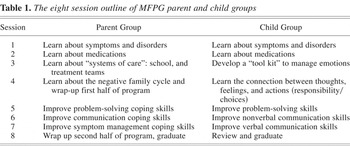
The eight session outlines for parent and child groups are shown in Table 1. Initial MFPG sessions are more didactic in nature. Families learn about manic and depressive symptoms and comorbid conditions including ADHD, anxiety disorders, and psychotic symptoms. Throughout the 8 weeks, parents are encouraged to differentiate what are labeled “can't” behaviors (i.e., those driven by mood states that appear beyond the control of the child) and “won't” behaviors (i.e., those that appear more manipulative in nature). Differing responses to “can't” and “won't” behavior are taught (i.e., a focus on safety vs. limit setting). Families also learn to differentiate the child from his/her symptoms using the “Naming the Enemy” exercise (Fristad et al., 1999), and they develop their own treatment goals. Subsequently, families learn about medications and side-effect management and parents learn about mental health, school- and community-based treatment teams and services, and how to work effectively with service providers.
The eight session outline of MFPG parent and child groups

In later sessions, treatment shifts to skill building. Children's exercises address affect regulation, “feelings management” skills, basic cognitive–behavioral principles (i.e., how thoughts, feelings, and behaviors are related and can be modified), problem-solving and verbal and nonverbal communication skills. Separate parent sessions focus on developing strategies to deal with negative family cycles, the stress of parenting a child with a mood disorder and specific issues in managing manic and depressive symptoms. For a more detailed description of MFPG sessions see Fristad and Goldberg-Arnold (2003) and Goldberg-Arnold and Fristad (2003).
Description of IFP
Transportability issues regarding MFPG led us to develop a second form of intervention, IFP. These issues are as follows. First, many community-based clinicians, especially those in geographically remote areas, do not work in settings conducive to leading groups for children with low base-rate diagnoses. MFPG will probably be implemented most readily in a clinic setting, wherein large numbers of children can be referred to a time-limited group, then return to therapy with their primary clinician after 8 weeks. Second, some families may not feel comfortable sharing personal information in a group setting (e.g., if a parent holds a more public position, such as a physician or teacher in the community, two examples that have occurred during our MFPG recruitment) and may prefer more privacy to work on their clinical issues. Third, if clinics offer MFPG only once or twice a year, a family with a newly diagnosed child may not wish to wait that long for immediate, tailor-made assistance. In this case, the family could participate in IFP then potentially participate again in MFPG to obtain the additional benefit of social support from meeting other parents and children in similar circumstances.
Thus, an individualized version of MFPG, IFP, was developed and tested. The original version of IFP utilized 16 50-min sessions, alternating between parent-only sessions and child-primary sessions with parental “check-in” and “check-out” segments built into each child session. Fifteen sessions dealt with specific issues associated with BPD. One “in the bank” session was available for use at anytime for families to deal with crises and/or review previous material. The “group games” treatment component utilized in MFPG was not included, but an additional unit on Healthy Habits was added that focuses on improving sleep hygiene, nutritional eating practices, and developmentally appropriate exercise routines. This was done because impaired sleep can trigger a manic episode (Malkoff-Schwartz et al., 1998), exercise can decrease depression (Pollock, 2001), and many medications used to treat BPD are associated with significant weight gain, with behavioral alterations needed to combat this adverse side effect (Kowatch et al., 2005).
Small-scale IFP RCT
We conducted a pilot study examining the efficacy of IFP in 20 children with BPD and their parents.
Method
Participants
Thirty-four families with children aged 8 to 11 were screened for participation within a 6-month period. Of these, 28 (82%) passed the screen and came to the baseline assessment. Of these, 20 (71%) met study inclusion criteria. Recruitment resources included psychologist (40%), media (35%), psychiatrist (10%), school counselor (5%), library poster (5%), and another clinical trial (5%).
Most children were male (85%), consistent with other studies of prepubertal BPD (Geller et al., 2000; Pavuluri et al., 2004) and Caucasian (90%). Half of the households included married biological parents, 10% had married stepparents, and one family included married adoptive parents. Single biological parents accounted for 30% of the sample, and one family had a single adoptive parent. Incomes were widely distributed, with 20% below $39,000, 40% between $40,000 and $79,000, and 40% over $80,000. Many families (40%) traveled from rural or geographically remote areas to participate (participant's average roundtrip: M ± SD = 70 ± 70 miles, range = 14–344 miles).
Primary mood disorder diagnoses included 40% bipolar I disorder (10% manic type, 30% mixed type); bipolar II disorder (35%); bipolar disorder, not otherwise specified (BP-NOS: 25%). Children were, on average, impaired a considerable length of time (manic episode, M = 482.2 days, SD = 880.2; MDD, M = 73.5 weeks, SD = 121.8; and depressive episode, M = 85.3 weeks, SD = 145.7). Most (95%) had comorbid behavior disorders; a majority (70%) had comorbid anxiety disorders.
Family history was significant for BPD. Deleting from the analyses one adopted child for whom biological family history data were unattainable, 53% children had first-and/or second-degree relatives with BPD; 79% had first- and/or second-degree relatives with depressive disorders; and 84% had first- and/or second-degree relatives with BPD and/or depressive disorders.
Seven families dropped out before study completion (i.e., the 18-month follow-up), four IMM families (two completed treatment, two did not) and three WLC families (none completed treatment). Study drop-outs were not statistically different from study completers on baseline demographic and clinical variables. Given the study's small sample size, the occurrence of a few unfortunate events (e.g., family illness, out of state move) had a relatively high impact. In addition, due to the small budget for this study, participant compensation for completing follow-up assessments was limited. Two IMM families dropped out after five IFP sessions, one because of scheduling problems after the mother returned to full-time employment, and one after the IFP therapist reported bruises on the child to Children's Services. Between T2 (6-month follow-up) and T3 (12-month follow-up) one IMM and three WLC families discontinued participation in the studies, which was due to diagnosis and treatment of cancer in a family member, the child moved out of state to live with relatives, a mother's concern that participation would disrupt her child's current stable mood, and a family who did not return scheduling phone calls or letters. Between T3 and T4, one IMM family did not return phone calls or letters requesting they schedule an assessment.
Measures
At the initial assessment (T1), comprehensive family, developmental, medical, social, and school histories were taken, along with a mood lifeline (see Quinn & Fristad, 2004, for a description of this procedure) and a brief intelligence test (Kaufman Brief Intelligence Test; Kaufman & Kaufman, 1990) to determine study eligibility and to demarcate clearly the onset, duration, severity, impairment, and offset of mood symptoms during the child's life.
Structured interviews, the Children's Interview for Psychiatric Syndromes—Child and Parent Forms (child: Weller, Weller, Rooney, & Fristad, 1999a; parent: Weller, Weller, Rooney, & Fristad, 1999b) were administered to the parent and child separately to assess mood and comorbid DSM-IV (American Psychiatric Association, 1994) psychopathology.
Severity of mood impairment was rated using the Children's Depression Rating Scale—Revised (CDRS-R; Poznanski et al., 1984) and the Mania Rating Scale (MRS; Young, Biggs, Ziegler, & Meyer, 1978). A Mood Severity Index (MSI) was calculated to determine overall mood severity. The MSI was calculated using the formula CDRS-R score − 17 × 11/17 + MRS, which adjusts for differing minimum scores (CDRS-R = 17, MRS = 0) and for the greater number of items on the CDRS-R. In addition, because both scales rate irritability, its rating was downweighted by 0.5 on each scale.
Families' utilization of medication, therapy, and school-focused services were measured by the Medication Usage Grids and the Mental Health Grids (Goldberg-Arnold & Fristad, 1999; Davidson, Fristad, & Goldberg-Arnold, 2006), which were given to the primary caregiver at each time period. These grids are semistructured interviews designed to record and rate service utilization.
The preceding information was presented at an initial case review to determine study eligibility (i.e., presence of a bipolar spectrum disorder). If eligible, the participant's assessment data were then reviewed independently by two licensed psychologists, well acquainted with BPD, to determine the specific bipolar diagnosis. Following this independent review, a consensus conference was completed to finalize mood diagnoses and to determine a global rating of treatment utilization (i.e., medication, therapy, school, and other miscellaneous services).
Additional instruments were administered at the baseline assessment, but not reviewed at the initial case review or consensus conference. One of these, the Expressed Emotion Adjective Checklist (EEAC; Friedmann & Goldstein, 1993), assessed family EE.
Finally, the Therapy Evaluation Parent and Child Forms are anonymous self-report forms designed to ascertain participants' posttreatment evaluation of IFP (Fristad & Gavazzi, 1994). These forms were given to the parent and child in envelopes by the treatment therapist immediately after their final IFP therapy session. After completion, the parent and child placed the form in a sealed envelope and returned it to the treatment therapist to give to the principal investigator.
Procedure
All recruited families completed T1 baseline assessment batteries, and the obtained information was presented at an initial case review to determine study eligibility, as previously described. If eligible, participants were randomized, by pairs, into the immediate IFP plus treatment as usual condition (IFP + TAU, n = 10) or a waitlist-control condition plus TAU (WLC + TAU, n = 10). Statistical analyses revealed the IFP + TAU and WLC + TAU groups were similar on all baseline demographic variables (i.e., child's gender, age, IQ, ethnicity, family structure) and clinical variables (i.e., baseline MSI score, comorbid behavior disorder, comorbid anxiety disorder, type of BPD).
The IFP + TAU group then received 16 50-min sessions, alternating between parent-only sessions and, after the requisite “check-in,” child-only sessions, as previously described. Follow-up assessments of both groups were conducted at T2 (6 months after study entry) and T3 (12 months) and at T4 (18 months). Following the T3 assessment, the WLC + TAU group received IFP.
Therapists included two clinical psychology postdoctoral study coordinators and one clinical psychology doctoral candidate who also served as a parent advocate for the Child & Adolescent Bipolar Foundation.
Results
Impact on children's mood
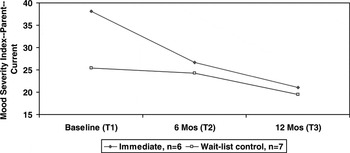
Children improved immediately following treatment, with gains continuing for 12 months post-IFP (see Figure 1, high scores = more symptom severity). Power calculations (Cohen, 1988) using α = .05 and power = .80 indicate that from baseline to 6 months, an effect size of .45 was detected, with 64 participants per cell needed to find significance in a larger sample. From baseline to 12 months, an effect size of .60 was detected, with 36 participants per cell needed to detect significance.

The parent report of current mood severity for children in individual-family psychoeducation versus wait-list control children.
Impact on family climate
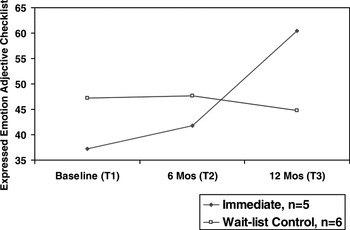
Changes in EEAC total score were significantly better for IMM families, F (2, 8) = 3.16, p < .10, see Figure 2; high scores = better family climate. Power calculations (Cohen, 1988) using α = .05, power = .80, and assuming a two-tailed alternative hypothesis indicate 37 participants per cell would be needed to find significance in a subsequent study.

The expressed emotion adjective checklist scores for children in individual-family psychoeducation versus wait-list control children.
Impact on treatment utilization
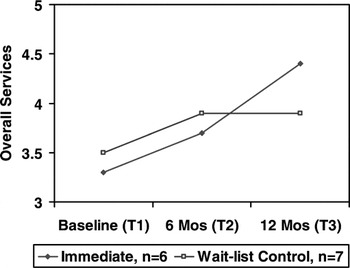
Overall service utilization improved in the IMM families to a nonsignficant degree (see Figure 3; high scores = better treatment utilization), F (2, 10) = 2.28, p = .15. Power calculations (Cohen, 1988) using α = .05, power = .80, and assuming a two-tailed alternative hypothesis indicate 114 participants per cell would be needed to find significance in a subsequent study.

The consensus conference rating of global service utilization for children in individual-family psychoeducation versus wait-list control children.
Consumer evaluation
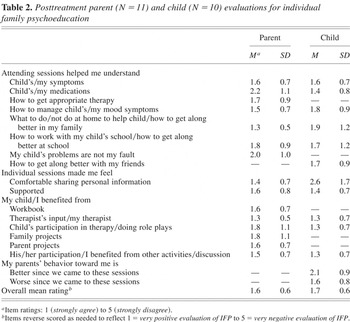
In addition to the seven study drop-outs, two mothers and three children did not complete and return treatment evaluations following their final therapy session. Thus, only 11 parent and 10 child evaluations were available for review. Evaluations were positive, as seen in Table 2.
Posttreatment parent (N = 11) and child (N = 10) evaluations for individual family psychoeducation

Summary
Multiple positive outcomes of IFP are suggested by this pilot study. Notably, changes begin to occur by the 6-month follow-up (i.e., shortly after treatment ended) but continue to accrue for the subsequent 6-month interval. Improvements in mood and family climate and possible improvements in treatment utilization all were most pronounced at the 12-month follow-up period. It may be that some changes resultant from psychoeducational approaches might take longer to become evident. We teach families how to become better consumers of mental health and school-based care as part of the intervention, but achieving meaningful alterations in treatment plans is often a slow and arduous process, such that the clinical benefit garnered from such alterations is slow in coming.
Expanded 24-session IFP
As with our MFPG pilot study, following IFP pilot study completion, we conducted a review of our treatment program. First, we examined anonymous posttreatment qualitative and quantitative feedback from parents and children. Second, we reviewed supervision notes from each therapy session to identify problem areas in treatment provision. As with MFPG, this review led to an increase in the number of IFP sessions from 16 to 24, thereby matching the amount of therapist “face time” with the family for IFP and MFPG. (i.e., two groups [parents, children], 90 min each, eight sessions is equivalent to 24 60-min sessions).
Our research group is currently conducting a pilot study on this extended 24-session IFP protocol. IFP-24 includes 20 set sessions and 4 in the bank sessions, to be used as needed to reinforce learning or manage crises. Compared to the original IFP, there are five new content sessions and three additional in the bank sessions. New session content includes an additional session for the parent and child to review symptoms and diagnoses, expansion of the one session for parents to learn about options in mental health services and school services into two sessions, an additional Healthy Habits session, a session for school professionals, and a session devoted to sibling issues. The study is nearly complete. Outcome data are still being collected, but preliminary findings suggest session format is acceptable to families (Davidson & Fristad, in press). In their final session, parents and children are asked to write “words of wisdom” for subsequent treatment families. Parents' sample words of wisdom include “Take a break when you need it, parents need time for themselves to regroup … Don't be embarrassed, it's no one's fault … Focus on the good things about your child,” whereas children's words of wisdom include our motto, “It's not your fault but it's your challenge.”
Summary
Data from studies of adults and adolescents with depression and BPD suggest the importance of concomitant psychosocial interventions to improve outcome. Our research team has developed, refined, and tested various psychosocial interventions for mood-disordered children. We have completed a pilot study of a group-based intervention, MFPG, in 35 children with mood disorders, are testing MFPG in a larger randomized clinical trial of 165 children with mood disorders (115 of whom have BPD), have completed a pilot study of IFP in 20 children with BPD, and are completing a small pilot study of an expanded 24-session version of IFP. Cumulatively, these clinical trials suggest a combination of support, psychoeducation, and skill-building are effective in increasing understanding of mood disorders, reducing mood symptom severity, enhancing family climate, and improving treatment utilization. In addition, parents and children find participating in psychoeducational interventions a positive experience.
There are potential advantages and disadvantages of both MFPG and IFP. MFPG is expected to increase social support, provide peer/adult feedback, in vivo practice and discussions with peers/other parents who experience similar problems. Although MFPG offers the very unique advantage of social support from adult and child peers, it will probably not be feasible to offer except in larger clinic settings, thereby depriving a large number of children and families from accessing this specialized care. IFP, on the other hand, is more readily provided regardless of community size, location, or treatment facility available for care. IFP is expected to offer numerous pragmatic advantages, such as ease in scheduling, the opportunity to individualize content to address specific needs of the child or family and, because not all families or treatment settings can utilize group treatment, increased transportability. Both MFPG and IFP are well received by parents and children.
Of note, there are many unanswered questions about potential mediating variables that may impact treatment outcome. Several of these are discussed in this article, including family concordance, children's social skills, parent and child hopelessness, and family stress. All of these are targeted by psychoeducational intervention, and may contribute to greater mood stability in children who show improvements in these areas. In this paper, we have reported findings from pilot studies of MFPG and IFP. A large-scale clinical trial of MFPG is nearing completion that should address questions of mediating (and moderating) variables for that treatment modality. A more rigorous evaluation of IFP's efficacy and documentation of variables that mediate and moderate its impact on children's mood severity is warranted.