One of the central goals of research on second language (L2) phonological acquisition is to model interlanguage development. This includes not only describing but importantly also explaining and predicting the relative difficulty learners of a given first language face when acquiring segments absent from or similar to those of their first language (L1). To date, most research in this vein has focused on intralinguistic difficulty, that is, the relative challenge of acquiring two or more new phonological structures in a given target language (TL), particularly sounds involved in an opposition (e.g., English /1/ and /ɹ/, e.g., Larson-Hall, Reference Larson-Hall2004; voiceless vs. voiced coda obstruents, e.g., Hancin-Bhatt, Reference Hancin-Bhatt2000). These accounts have made their predictions based principally on typological markedness (e.g., Carlisle, Reference Carlisle1998; Eckman, Reference Eckman1977), perceptual similarity (e.g., Flege, Reference Flege and Strange1995; Flege, McKay, & Meador, Reference Flege, MaKay and Meador1999), or similarities in the L1 and TL inventories (e.g., Brown, Reference Brown1998, Reference Brown and Archibald2000; LaCharité & Prévost, Reference LaCharité, Prévost, Greenhill, Littlefield and Tano1999). Such studies have argued that segments that are unmarked, perceptually distinct or whose representation involves features present in the L1 phonological inventory should be acquirable. In contrast, TL sounds that are typologically marked, which fall within the psychoacoustic space of existing L1 phones or that involve features not necessary for the representation of L1 phonemic contrasts will be difficult or even impossible to acquire.
Interlinguistic difficulty, in contrast, has received little attention. Indeed, studies rarely investigate the relative challenge that a given L1 group has when acquiring one or more similar or new segments in two different languages (but see Mah, Reference Mah2003).Footnote 1 Such research is not without interest, as it sheds light on the relative importance of transfer versus general typological, perceptual, or articulatory constraints on the development of L2 sound systems. In particular, whereas studies looking at a single L1–L2 pairing cannot always tease apart transfer and developmental effects, research on interlinguistic difficulty promises to allow for the distinguishing of patterns that can be attributed to transfer (and thus are language specific) from those that are the results of universal articulatory constraints. To contribute to our understanding of the extent to which different languages and specific structures within each language may pose distinct problems for a given group of learners, this paper analyzes the acquisition of French /ʁ/ and Spanish /ɾ/ by native speakers of North American English.
Each of these Romance rhotics poses different learning challenges for native English speakers. Phonologically, English and French are similar, with both languages having a sole rhotic in their inventory (English: voiced coronal approximant /ɹ/; French: voiced dorsal fricative /ʁ/).Footnote 2 Moroever, these rhotics have similar phonotactic properties: they may form part of singleton and complex onsets (e.g., English: red /ɹεd/, pray /pɹej/; French: raide /ʁεd/ “stiff,” pré /pʁe/ “meadow”) as well as codas (English: peer /pijɹ/, fort /fɔt/; French: pire /piʁ/ “worse,” forte /fʁt/ “strong” [FEM]). Spanish, in contrast, has two rhotics (voiced alveolar tap /ɾ/; voiced alveolar trill /r/), which are contrastive intervocalically (e.g., pero /peɾo/ “but,” perro /pero/ “dog”). In other environments, either only taps (complex onsets and codas) or trills (word-initial position and following /n,l,s/)Footnote 3 are found. Whereas the parallels between the English and French rhotics are primarily phonological, it is at the phonetic level that there exists similarity between English and Spanish. Indeed, the Spanish tap resembles the English flap, an allophone of alveolar stops in North American varieties (e.g., fatty /fætij/ → [fɶij]). The French rhotic, in contrast, is phonetically distinct from any English segment. Although English has voiced fricatives (e.g., themselves / εmsεlvz/), none are dorsal. It is the differences in phonological versus phonetic similarity that make the study of the acquisition of the French and Spanish rhotics by English-speaking learners well suited to an investigation of relative interlinguistic difficulty. The French <r> is a new sound for English learners, because there are no voiced dorsal fricatives in this language; nevertheless, both languages share the same number of rhotics. Phonetically, however, the articulation of /ʁ/ is difficult, as it involves the simultaneous mastery of voicing and manner in a dorsal fricative; previous research has shown that L2 learners of French have problems with voicing (Berri, Reference Berri1998). In contrast, the primary problem in acquiring the Spanish tap is phonological: /ɾ/ is an allophone in the learners’ L1 but a phoneme in their L2.Footnote 4 Moreover, the tap contrasts with another rhotic (i.e., the alveolar trill /r/) in Spanish. Phonetically, producing the tap is not problematic intervocalically, because its articulation is similar to that of the English flap. In word-medial and final codas, however, its mastery involves the acquisition of vowel epenthesis (see Predictions regarding the acquisition of French and Spanish rhotics integrating articulatory and preceptual constraints section for discussion) and variation in manner, because native speakers may produce either approximants or fricatives in this environment (Blecua, Reference Blecua2001).
Disentangling the complex interplay of phonetic and phonological differences constitutes a challenge for any model of L2 acquisition. This includes accounting for position-based differencesFootnote 5 commonly noticed in learner speech (e.g., Hancin-Bhatt & Bhatt, Reference Hancin-Bhatt and Bhatt1997; Stockman & Pluut, Reference Stockman and Pluut1992). We will argue here that the models most frequently used to predict relative difficulty of acquisition do not adequately integrate such position-based variation, in particular, because their predictions are derived either from typology or perception and thus do not sufficiently incorporate findings from speech production. The consequence of this is that not all patterns of L2 development can be predicted accurately. In summary, although the importance of the contribution of existing models to an explanatory and predictively adequate theory of the L2 acquisition of new segmental contrasts is uncontroversial, we will demonstrate here that a more comprehensive theory must integrate the contributions of phonetic theories of speech production.
In the remainder of this paper we expand on these assertions by discussing first the characteristics of typologically and perceptually based models as well as the predictions made based on the findings of phonetic production research. After outlining the phonetic and phonological characteristics of the French, Spanish, and English rhotics, we analyze the specific predictions that derive from both the typologically and perceptually based models and phonetic theory regarding the acquisition of the target structures by native English-speaking learners. We then present the methodology of our current study, followed by the results. Finally, we discuss our findings in detail and suggest a series of new factors that need to be incorporated into any model of the L2 acquisition of segmental structure, followed by a brief conclusion.
TYPOLOGICALLY AND PERCEPTUALLY BASED MODELS IN L2 PHONOLOGY
Despite the practical and theoretical implications of the comparative study proposed here, research on interlinguistic difficulty is not abundant. Consequently, we will first elaborate on the significant contribution that such work can make in revealing the relative importance of transfer versus general typological, perceptual, or articulatory constraints on the development of L2 phonologies.
To date, most research on the L2 acquisition of segmental phonology has either compared the perception and/or production of a given segment by learners of different L1s (e.g., Curtin, Goad, & Pater, Reference Curtin, Goad and Pater1998) or of multiple segments by a single L1 learner group (e.g., Aoyama, Flege, Guion, Akahane-Yamada, & Yamada, Reference Aoyama, Flege, Guion, Akahane-Yamada and Yamada2004). This type of research has allowed for the refining and testing of several theories that make specific predictions about the relative difficulty of acquiring phonological structures. Of these theories, we will review three that are often cited in the literature: Eckman's markedness differential hypothesis (MDH; Eckman, Reference Eckman1977), Flege's speech learning model (SLM; Flege, Reference Flege and Strange1995), and Brown's (Reference Brown1998, Reference Brown and Archibald2000) feature-based model of speech perception.
MDH
The MDH is arguably the first linguistic-theoretic model to attempt to explain and predict the relative degree of difficulty learners face when acquiring new TL structures. Building on the contrastive analysis hypothesis (Lado, Reference Lado1957), Eckman argues that it is possible to determine the relative ease of acquisition of two or more new structures by considering their typological markedness. On this proposal, only those TL structures that are absent from a learner's L1 and typologically marked should prove difficult to acquire. Moreover, the more marked a structure, the more difficult. Typological markedness is defined by implication: given two structures A and B, if languages having structure B always also have structure A but the reverse does not hold, B is said to be typologically marked. The specific prediction is that acquiring A should be relatively simpler than mastering B.
The MDH was subsequently replaced by the more easily falsifiable interlanguage structural conformity hypothesis (SCH; Eckman, Reference Eckman1991), which simply proposes that “the universal generalizations that hold for the primary languages hold also for interlanguages.” As Eckman (Reference Eckman2004, p. 532) states, the SCH can be conceived as a revised version of the MDH stipulating no role for L1–L2 differences. Both hypotheses claim that relative difficulty of acquisition can be predicted based on considerations of typological markedness. Despite the advent of the SCH, the MDH continues to motivate research (e.g., Cichocki, House, Kinloch, Lister, Reference Cichocki, House, Kinloch and Lister1997; Monroy Cassas, Reference Monroy Cassas2001). Its predictions will thus be investigated further here.
SLM
An equally influential framework is the SLM. This model proposes that an L2 learner's ability to acquire a new sound is based first on his/her ability to accurately perceive the sound, with perception being shaped by preexisting L1 allophonic categories. Two of the seven hypotheses of Flege's SLM are directly relevant to the prediction of relative difficulty:
H2 A new phonetic category can be established for an L2 sound that differs phonetically from the closest L1 sound if bilinguals discern at least some of the phonetic differences between the L1 and L2 sounds.
H3 The greater the perceived phonetic dissimilarity between an L2 sound and the closest L1 sound, the more likely it is that phonetic differences between the sounds will be discerned (1995, p. 239).
Based on these two hypotheses, it follows that the more perceptually distinct a TL sound is from preexisting L1 segments, the more easily and accurately it will be acquired.Footnote 6
Feature-based model of speech perception
Brown's (Reference Brown1998, Reference Brown and Archibald2000) perceptually based model of acquisition resembles the SLM in that its predictions are rooted in properties of the learner's L1. However, these two models differ in one important aspect: whereas the predictions of the SLM are based on phonetic similarity, those made by Brown focus on L1 phonemic features. Specifically, this model predicts that L2 learners may acquire TL segments whose representation involves phonological features present in the L1 inventory: when a feature necessary for the TL representation of a segmental contrast is absent, learners will be unable to perceive the contrast and acquire the segment's representation.Footnote 7
PHONETIC THEORIES OF SPEECH PRODUCTION AND L2 PHONOLOGY
One of the first phonetic theories used to account for nontarget-like production in L2 acquisition was the articulatory settings theory (AS; Honikman, Reference Honikman, Abercrombie, MacCarthy, Scott and Trim1964). This theory claims that differences observed between L2 learners’ and native speakers’ realization of target sounds can be attributed to differences in AS, which are shaped by the articulatory characteristics of the most frequent consonants in a speaker's L1.Footnote 8 A few experimental studies have applied the AS to the study of the L2 acquisition of consonants (Wenk, Reference Wenk1979, Reference Wenk1983). These studies have demonstrated that articulatory transfer is present at very advanced stages in the acquisition process, even after intensive training. In addition, L2 learners master new articulations in word-initial and intervocalic position first, whereas clusters are mastered subsequently.
More recent proposals and findings of phonetic theories of production of the last two decades offer much for building models of L2 phonological acquisition. A first relevant finding is that not all sounds are equally easy/difficult to produce (Diehl & Lindblom, Reference Diehl, Lindblom, Greenberg and Popper2000). Although “articulatory complexity” is not simple to define, production studies have allowed phoneticians to make generalizations about the relative difficulty involved in the articulation of different segments. For example, research on aerodynamic constraints on voicing has established that it is more difficult to initiate and maintain voicing in obstruents than in sonorants (e.g., Hoole, Reference Hoole, Hardcastle and Hewlett1999; Ohala, Reference Ohala and MacNeilage1993, Reference Ohala1997). Additional difficulties have been illustrated as concerns the interaction of voicing and place, namely, voicing is more difficult with constrictions located further back in the oral cavity, given the relatively smaller size of the cavity located behind the obstruction. Consequently, dorsals are more difficult to voice than coronals. As concerns manner, it has been shown that fricatives require greater articulatory precision than stops (Ladefoged & Maddieson, Reference Ladefoged and Maddieson1996, p. 137). In the case of rhotics, in particular, it has been demonstrated that trills are more difficult than approximants and fricatives, given that they are especially sensitive to small changes in intraoral pressure (e.g., Solé, Reference Solé2002a, Reference Solé, Gussenhoven and Warner2002b). All of these findings can be applied directly to the study of nonnative speech to both predict and explain relative difficulty of acquisition.
Phonetic production research also provides insights to the modeling of articulatory variability. It is widely recognized that interlanguage speech is characterized by a high degree of variation (e.g., Bayley & Preston, Reference Bayley, Preston, Bayley and Preston1996). However, its particular sources and the greater degree of variability observed vis-à-vis that of native speech are not necessarily well understood. We propose that Lindblom's (Reference Lindblom, Hardcastle and Marchal1989) hyper- and hypoarticulation (H&H) theory is particularly relevant. This theory predicts that speakers adjust the degree of articulatory precision according to context. In formal settings, they tend to hyperarticulate, whereas in informal ones, undershooting (or hypoarticulation) is more likely. More particularly in modeling L2 acquisition, these two tendencies are not only available in different communicational contexts but also in different prosodic domains (e.g., Diehl & Lindblom, Reference Diehl, Lindblom, Greenberg and Popper2000). Speakers hyperarticulate in strong positions (e.g., word-initial and stressed syllables) and hypoarticulate elsewhere. Colantoni and Steele (Reference Colantoni and Steele2007) have shown that these two tendencies are indeed present in L2 speech.
The claims of the H&H model are substantiated by other phonetic research demonstrating the role of prosodic context in conditioning phonetic variation. Sounds are overall easier to both perceive and to produce in word-initial or intervocalic position than in codas (e.g., Ohala & Kawasaki, Reference Ohala and Kawasaki1984; Strange, Reference Strange, Tohkura, Vatikiotis-Bateson and Sagisaka1992). This is consistent with the cross-linguistic tendency to allow a lesser range of segmental contrasts in the latter position. All of this research demonstrating the role of articulation in conditioning variation has a promising contribution to make to the explanation of the position-sensitive interlanguage variation mentioned earlier.Footnote 9
PHONETIC, PHONOLOGICAL, AND TYPOLOGICAL CHARACTERIZATION OF FRENCH, SPANISH, AND ENGLISH RHOTICS
Phonetic characterization of French, Spanish, and English rhotics
The French rhotic is most frequently realized as a voiced uvular fricative (Léon, Reference Léon1992; O'Shaughnessy, Reference O'Shaughnessy1982). Variation in manner is attested with realizations ranging from uvular trills to vocalizations in codas (Colantoni & Steele, Reference Colantoni and Steele2007; Sankoff & Blondeau, Reference Sankoff and Blondeau2007, Straka, Reference Straka and Straka1979).Footnote 10 Variation in voicing is documented as well; rhotics tend to be devoiced following a voiceless stop (e.g., Léon, Reference Léon1992; Tranel, Reference Tranel1987; Walker, Reference Walker2001).
Although Spanish has two rhotics that contrast in intervocalic position, we focus solely on the alveolar tap, because its distribution most closely resembles that of the English and French rhotics. Moreover, including the trill would require studying the acquisition of a rhotic contrast that does not exist in French, and, as such, would make the cross-linguistic comparison less direct. Phonetically, the Spanish tap consists of a short occlusion of approximately 25 ms, which is usually voiced (Quilis, Reference Quilis1993, p. 336; see also Blecua, Reference Blecua2001; Navarro Tomás, Reference Navarro Tomás1970; Recasens & Pallarès, Reference Recasens and Pallarès1999). Taps in codas are subject to some variation, including approximantization (Blecua, Reference Blecua2001) and fricativization (Navarro Tomás, Reference Navarro Tomás1970, section 114). Given their short duration, taps require the presence of a vowel to be perceived (Guirao & García Jurado, Reference Guirao and Jurado1991). Indeed, when not occurring in an underlying vowel–consonant–vowel (VCV) context, it has been reported that an epenthetic vowel usually breaks up Spanish obstruent–rhotic clusters (e.g., Colantoni & Steele, Reference Colantoni, Steele, Gess and Rubin2005; Navarro Tomás, Reference Navarro Tomás1970, section 113; Quilis, Reference Quilis1993, pp. 337–342), rhotic–obstruent clusters (Malmberg, Reference Malmberg1965; Navarro Tomás, Reference Navarro Tomás1970, section 113), and may also follow word-final rhotic codas (Gili y Gaya, Reference Gili y Gaya1921).
The English rhotic is an alveolar approximant articulated either with tongue retroflexion or bunching (Ladefoged, Reference Ladefoged2001), and is generally voiced except when adjacent to a voiceless obstruent. This rhotic is not the only English sound relevant to the present study. As mentioned earlier, the target Spanish tap is phonetically similar to the flap allophone of coronal stops (e.g., butter [bʌɾʴ]) found in the learners’ L1. This consonant may range in duration from 23 to 36 ms (see, e.g., Inouye, Reference Inouye1995, p. 8). Finally, it is important to point out that there is at least one distributional difference between the English flap and the Spanish tap, namely, the former does not occur in stressed syllables. As such, the two segments differ in their prosodic conditioning.Footnote 11
Phonological representation of French, Spanish, and English rhotics
Predictions made based on Brown's (Reference Brown1998, Reference Brown and Archibald2000) theory of segmental perception require a comparison of the L1 and L2 featural inventories particularly as concerns the representation of the segments to be acquired.
In French, /ʁ/ is phonologically a sonorant, as revealed by its identical distribution with the lateral /1/.Footnote 12 Both segments may occur as the second member of a bi- or triliteral cluster (e.g., pli /pli/ “fold,” prix /pʁi/ “prize” cloıtre /klwatʁ/ “cloister,” croıtre /kʁwatʁ/ “increase (INF)”); and as the first or second member of a word-final cluster (e.g., film /film/ “film,” firme /fiʁm/ “firm” gifle /jifl/ “slap,” givre /jiʁ/ “frost”). Although /ʁ/ is phonetically realized as a fricative in most contexts (see exceptions in the Phonetic characterization of French, Spanish, and English rhotics section above), no other French fricative patterns phonologically with /1/.
We follow Brown (Reference Brown1998, Reference Brown and Archibald2000) in assuming that the phonological representation of sonorants such as /1/ and /ʁ/ involves a sonorant voice (SV) node (Rice & Avery, Reference Rice and Avery1989; or Spontaneous Voice; Piggott, Reference Piggott1992) and that, in languages with two phonemic liquids (one lateral and one rhotic), the relevant difference in representation involves place and not SV structure.Footnote 13 As concerns the latter, /ʁ/ has less place structure than /l/ in French (Béland, Paradis, & Bois, Reference Béland, Paradis and Bois1993). Specifically, /l/ has the same amount of place structure as other coronals, that is, place-[coronal] as in Example 1. In contrast, we follow Goad and Rose (Reference Goad, Rose, Kager, Pater and Zonneveld2004) in assuming that /r/ is inherently placeless (i.e., bears no Place node). The relevant representations are given in Example 1.Footnote 14
1

On the assumption that languages with an /1/–/r/ contrast realize this opposition through differences in place, the phonological representations of the English lateral and rhotic would also be those in Example 1. Consequently, English-speaking learners possess all of the features present in the target French <r>’s repre-sentation.
In the case of Spanish, similar distributional arguments can be forwarded to argue that the tap is phonologically a sonorant. Spanish, however, has two rhotics that contrast in intervocalic position. The formalization of this contrast has been the object of much debate (e.g., Colantoni, Reference Colantoni2001; Harris, Reference Harris, King and Maley1983; Lipski, Reference Lipski1990; Núñez Cedeño, Reference Núñez Cedeño1989). This uncertainty constitutes a challenge for the formulation of hypotheses concerning English learners’ ability to acquire the Spanish tap based on Brown's model, as what is crucial are the features of the TL segment's representation. With the risk of oversimplifying the specifics of the individual proposals, the existing analyses can be divided into two basic groups: those that argue that there is only one underlying rhotic in Spanish and thus no additional features are needed (e.g., Lipski, Reference Lipski1990; Núñez Cedeño, Reference Núñez Cedeño1989) versus those that posit the need to incorporate an additional feature (i.e., [vibrant]) to capture the contrast within rhotics as well as with other voiced consonants in the system (Colantoni, Reference Colantoni2001). Ultimately, what is necessary for the present analysis to test the predictions of Brown's model is to determine whether the features necessary for the representation of the tap are present or not in English. As such, if we adopt the former proposal (i.e., one underlying rhotic), Spanish /ɾ/ would be represented as in Example 1b. English learners of Spanish should then have no problems acquiring the Spanish tap, given that all the features are present in their L1. On the contrary, if the representation of the Spanish tap involves a feature that is absent from English (i.e., [vibrant]), then the Spanish tap should prove impossible to acquire.
Cross-linguistic typology of rhotics
Given that markedness is central to the predictions of the MDH, one final aspect requires elaboration, namely, the cross-linguistic typology of rhotics. Our discussion here will be based on Maddieson (Reference Maddieson1984), a survey of 282 of the 316 languages of the UCLA Phonological Segment Inventory Database for which detailed description of the languages’ rhotics exist. In terms of manner, voiced trills and taps of the type found in Spanish are by far the most frequent rhotics (130 or 46.1% and 104 or 36.9%, respectively; 83% of total). Approximant rhotics including English /ɹ/ are few in number: only 28 or 9.9% of the languages included have such segments. Maddieson chooses not to include the 16 voiced uvular fricatives found in the UPSID among the rhotics; clearly, they are by far the least frequent. On the place dimension, <r> sounds are most commonly dental or alveolar (86.4%).
Establishing implicational relationships between rhotics is not easy given that only 19% of the languages have two or more such consonants. It is also the case that the types of rhotics observed in a given language are in large part dependent on its lateral inventory. Finally, Maddieson himself indicates that, for some of the languages for which descriptions exist, there is uncertainty in the specifics of the phonetic realization of the rhotic. For example, the distinction between approximants/taps and fricatives is not always made clear in the original sources consulted. This adds to the difficulty of establishing an implicational typology. Given this situation, we will return to frequency, a common criterion used alongside implicational relationships in determining relative markedness of segments (e.g., Batistella, Reference Batistella1990). Based on the typological facts outlined above, one can propose the rhotic markedness scale in Example 2, where “⊃” reads “is more marked than.”
2
TESTING THE PREDICTIONS OF TYPOLOGICAL-, PERCEPTUAL-, AND ARTICULATORY-BASED MODELS FOR THE ACQUISITION OF FRENCH AND SPANISH RHOTICS
In an earlier section, we forward and contrast the predictions of the typologically and perceptually based models discussed earlier with those made by a framework that incorporates findings from phonetic theory of speech production.
Specific predictions regarding the acquisition of French / ʁ/ and Spanish /ɾ/: Typologically and perceptually based models
The three theories mentioned in an earlier section make different predictions regarding the acquisition of the French rhotic by English speakers. According to the MDH, /ʁ/ should be more difficult than /ɾ/ to acquire, because the former is absent from the learners’ L1 and is typologically marked. The SLM makes the opposite prediction: the French rhotic is a new sound with no perceptual equivalent in English, and as such, should pose no problems for L2 learners. Brown's model similarly predicts learners’ success. Given that all of the features necessary for /ʁ/'s phonological representation exist in English, native English speakers should thus be able to perceive and acquire it.
In the case of Spanish, again, different hypotheses are generated by the three models. The MDH predicts that there should be no difficulty acquiring the Spanish tap as it is present as an allophone in the learners’ L1 and it is the least marked rhotic cross-linguistically. As we saw in the Phonological Representation of French, Spanish, and English Rhotics section, the predictions of Brown's model largely depend on the representations adopted. If we assume that the tap is the underlying rhotic and represented as a sonorant as in Example 1b, then learners should have no difficulties given that all features necessary for its representation are present in English. In contrast, if the feature [vibrant] is needed to account for the phonemic contrast between taps and trills in intervocalic position in Spanish, then English-speaking learners will not be able to perceive the tap–trill contrast, and thus should fail to acquire the target structure.Footnote 15 Finally, the SLM arguably makes two different predictions regarding the acquisition of the Spanish tap given that its hypotheses take into account allophonic distribution. In intervocalic position, the Spanish tap can be considered an old sound, because its acoustic properties are highly similar to those of the English flap. In codas, it can be analyzed as a similar sound, because it has a similar place of articulation to the English voiced alveolar stop, although phonetically different in manner and in phonotactics. As concerns the latter, the SLM's predictions are based on properties of allophones including position. Consequently, it should be more difficult to acquire in this context. This claim is also supported by an extensive literature in L2 phonology, which shows the difficulty of producing nativelike allophones in new environments (e.g., Eckman, Elreyes, & Iverson, Reference Eckman, Elreyes and Iverson2003; Hammerly, Reference Hammerly1982). In summary, the MDH makes clear predictions regarding the acquisition of the Spanish tap. Those of Brown's model largely depend on the feature inventory adopted. As for the SLM, the tap should pose no problems for learners in intervocalic position, but should be difficult to acquire in other environments.Footnote 16
Predictions regarding the acquisition of French and Spanish rhotics integrating articulatory and perceptual constraints
The nativelike acquisition of French and Spanish rhotics involves the simultaneous mastery of place, manner, and voicing parameters. Based on previous research (Colantoni & Steele, Reference Colantoni and Steele2007), we claim that L2 learners do not attemptFootnote 17 to master all of a segment's parameters at once. Rather, they often seek to be more accurate with one parameter at the expense of others. In particular, the simultaneous mastering of manner and voicing in rhotics, including in dorsal fricatives (French) and in short stops (Spanish), appears to be more problematic than the mastering of place, presumably because the place specifications are already present in their L1. Thus, we will focus our predictions on the role of voicing and manner in the acquisition of French and Spanish rhotics.
Given the lack of studies on the acquisition of French rhotic manner, we base our assumptions solely on general phonetic principles. French L2 learners have to acquire frication in dorsals, an articulatory pairing absent in English. For these speakers, it is assumed that frication will be a perceptually salient feature, and thus targeted first. Indeed, in general, it has been suggested that manner is more salient for speakers than other features including voicing (Steriade, Reference Steriade1999). As for production, manner itself should not pose a problem, given the presence of multiple fricatives in the learners’ L1. However, acquiring manner should be more difficult in word-medial and word-final codas than in intervocalic position according to the general perceptual and articulatory principles (Ohala & Kawasaki, Reference Ohala and Kawasaki1984, p. 117; Steriade, Reference Steriade1999) outlined below.
The Spanish tap is similar to the English flap. However, the latter is found only in intervocalic position; it is absent postconsonantally and in codas. Acquiring manner in these latter positions may pose a problem for learners for several reasons. First, as concerns word-medial codas, native Spanish rhotic–obstruent clusters may be broken up phonetically by an epenthetic vowel that facilitates their production (e.g., /seɾka/ t [seɾeka] “close”). Thus, learners need to master such epenthesis to accurately articulate the tap. Second, in codas, there is variation in native Spanish: speakers alternate between taps, approximants, and fricatives in this position. Finally, as already discussed, it has been widely documented that acquiring a new environment for an L1 allophone is problematic for L2 learners. Although the existing body of research on the acquisition of Spanish rhotics has not dealt with the mastering of individual phonetic parameters, two patterns previously documented support our predictions: even advanced learners have difficulty mastering the tap (Face, Reference Face, Klee and Face2006; Major, Reference Major1986) and mastery occurs first in intervocalic position (Waltmunson, Reference Waltmunson2005).
Whereas manner alone may not be problematic for French L2 learners, the simultaneous acquisition of manner and voicing should prove difficult. The French rhotic is doubly marked for voicing, because voicing is constrained both in fricatives (Maddieson, Reference Maddieson1984; Ohala, Reference Ohala1997; Pickett, Reference Pickett1999) and in dorsals (e.g., Ohala, Reference Ohala and MacNeilage1993, Reference Ohala1997). This is because, in order to produce frication, the vocal folds need to be slightly abducted. This setting, however, makes voicing difficult. In contrast, the Spanish tap is intrinsically voiced, given its short duration and the fact that it is articulated in intervocalic position.Footnote 18 Thus, if learners control manner, voicing should follow.
Consequently, building upon the predictions made by the SLM, we anticipate that both intermediate and advanced L2 French learners will be relatively successful in acquiring the rhotic and will not transfer their native <r>. However, we hypothesize that their success in acquiring the parameters of manner and voicing will be constrained by two interrelated factors: phonetic constraints (aerodynamic and elastoinertial constraints; Ohala, Reference Ohala, Breivik and Ernst1989) and contextual properties facilitating the production and perception of the segment. If some nonnative contrasts are easier to perceive than others (Beddor & Gottfried, Reference Beddor, Gottfried and Strange1995, p. 209; Strange, Reference Strange, Tohkura, Vatikiotis-Bateson and Sagisaka1992, p. 198), we expect manner to be a salient property, indeed probably the most salient property of the rhotic (Ohala & Kawasaki, Reference Ohala and Kawasaki1984, p. 116).Footnote 19 Consequently, we hypothesize that learners will target manner before voicing. In addition, building on previous findings on L2 production and especially on perception (e.g., Strange, Reference Strange, Tohkura, Vatikiotis-Bateson and Sagisaka1992), we predict that L2 French speakers will acquire the rhotic first in intervocalic position, followed by word-initial onsets, Finally, as concerns the acquisition of the Spanish tap, we predict that learners will not acquire the rhotic manner and voicing with equal ease in all contexts. Rather, we expect learners to acquire the segment first in intervocalic position (see Waltmunson, Reference Waltmunson2005); codas pose a problem, because learners have to master both manner and epenthesis patterns in this context (see Colantoni & Steele, Reference Colantoni, Steele, Klee and Face2006).Footnote 20 Word-medial codas will be particularly difficult as their realization involves two consecutive obstruents in the absence of epenthesis. As such, we expect to see more transfer in this environment, as well as lengthening and devoicing.
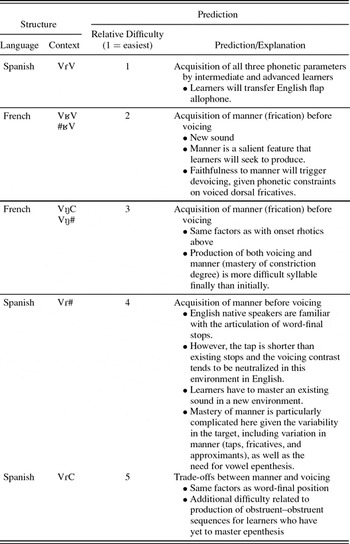
Based on the results of previous studies on L2 acquisition as well as on research on production and perception, we propose a hierarchy of increasing (1–4) relative difficulty as outlined in Table 1.
Hierarchy of acquisitional difficulty based on phonetic properties of French and Spanish rhotics

CURRENT STUDY
To verify the predictions of the typologically, perceptually, and production-based models, English-speaking learners were tested on their realization of French /ʁ/ and Spanish /ɾ/ via sentence and passage-reading tasks.
Subjects
Twenty L2 learners of French (10 intermediate, 10 advanced) and 19 learners of Spanish (9 intermediate, 10 advanced) participated in the study, along with 10 native-speaker controls for each language (5 each from Canada and Europe for French, 10 Argentines for Spanish). Subjects, who were recruited via posters placed in the local university community and by word of mouth, were remunerated for their participation.
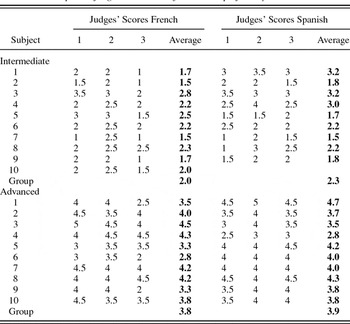
L2 proficiency was determined in two steps. First, during recruitment, learners were asked to identify themselves as being of intermediate or advanced proficiency.Footnote 21 Second, given that the interest of the current research is phonological and phonetic proficiency and that this does not necessarily correlate with general proficiency, a further criterion for classification was applied. A panel of three native-speaker judges for each language was assembled to evaluate the learners’ speech. None of the judges had any formal training in linguistics or language teaching, nor were they aware of the goals of the study. As part of the experiment, learners read the French or Spanish version of the Aesop fable ‘The Northwind and the Sun’ (see Appendix A for texts). After testing, the recordings of the learners’ readings as well as those of five native speakers were intermixed and randomized for each language. They were then presented to the judges individually, who were instructed to listen to each passage and assign a score ranging from 1 (clearly nonnative; very strong foreign accent) to 5 (clearly native; no foreign accent; see, e.g., Birdsong, Reference Birdsong2003, Bongaerts, Mennen, & Slik, Reference Bongaerts, Mennen and Slik2000, for earlier use of this method). Mean ratings were then calculated for each learner, which are presented in Table 2 along with the individual scores.
Native speaker judges’ evaluation of L2 learner proficiency

For both proficiency levels, there is no significant between-language difference in the group mean score as demonstrated by a one-way analysis of variance (ANOVA), intermediate: F (1, 17) = .93; p = .3479; advanced: F (1, 18) = .15; p = .7088); that is, for both proficiency levels, the linguistic ability of learners of French and Spanish was comparable. Further details concerning the learners’ L2 French and Spanish profiles can be found in Appendix B.
Finally, the learners reported little proficiency in other L2s that could have consequences for their L2 French or Spanish rhotics. Indeed, of the 39 subjects, 24 had no or only beginner oral proficiency (n = 12 for both) in these other L2s. Among the remaining 15 learners, 12 stated having intermediate and 9 advanced proficiency. However, only in three cases, namely, three of the advanced learners of French who had intermediate (n = 2) or advanced (n = 1) German, was the rhotic of the other nonnative language the same as that of the L2 on which they were being tested. In summary, as concerns cross-language transfer from languages other than English, extremely few possibilities existed.
Tasks and stimuli
The learners and controls performed two tasks. The first was a sentence-reading task in which the stimuli were embedded in a carrier sentence (French: “Je dis [TARGET] encore une fois” Spanish: “Digo [TARGET] otra vez” ‘I say [TARGET] again’) and presented in written form on note cards.Footnote 22 The second task was the reading passage discussed earlier. The L2 learners were also required to complete an English sentence-reading task included to test another set of hypotheses unrelated to the present research. Together, the sentence and passage reading generated 30 French words containing a singleton /ʁ/ versus 31 Spanish words involving a singleton /ɾ/ in various positions in the word (see Appendix C for the complete stimuli list).
In the sentence-reading task, each subject read all of the sentences three times in random order. Between each round, there was an approximate 5-min pause. During the first of these, the learners and controls were asked to fill out a linguistic background questionnaire. After the sentence-reading task, subjects were given a short period to familiarize themselves with the reading passage before reading it aloud. Finally, the L2 learners did the English sentence-reading task. Subjects were tested individually, with testing sessions being recorded in a quiet room with a portable Marantz CD recorder and a unidirectional condenser lavaliere microphone.
Data preparation and analysis
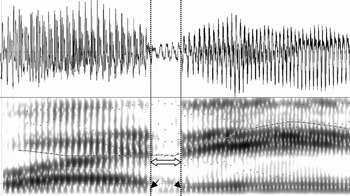
Sound files were downsampled (22,050 Hz, 16 bit) and target words containing singleton <r>s were extracted and coded. For each word, the rhotic's length (ms), voicing (ms), and manner were determined using Praat 4.0.41. The beginning of the <r> was determined by a drop in F1 and a change in intensity, whereas its offset was determined by an F1 increase and an increase in intensity (intervocalic position) or a decrease in intensity (word-final prepausal position). Voicing was measured in terms of the percentage of the rhotic's articulation involving the presence of F0 on the spectrogram (see Figure 1 for the illustration of the measurement of both parameters). Manner—fricative, trill, tap, approximant, vocalization, or realizations of mixed manner (e.g., initial approximantization followed by frication or vice versa)—was evaluated based on examination of periodicity and noisiness in the waveform and spectrogram. Once measurements were complete, the results were exported to a spreadsheet and statistics were calculated with SAS 8.12.
Waveform and spectrogram of the <r> of /aɾe/ in Spanish arena /aɾena/ “sand.” (⋅⋅⋅) the tap; ( ) the F1 transitions from the preceding and following vowels used for segmentation and measurement of duration; and (
 ) the presence of the F0 contour (i.e., voicing), which coincides here with the entire duration of the rhotic.

It is important to point out that the selection of these three parameters was motivated by findings in our previous research. Although it would have been possible to measure voicing alone, given that the acquisition of voicing is hindered by problems related to the controlling of the segment's duration, it is crucial to include measurements of length as well (see Colantoni & Steele, Reference Steele2006, Reference Colantoni and Steele2007). Finally, it was expected that acoustic measurement of these three parameters, as opposed to auditory transcriptions or an overall spectrographic examination of the segments, would allow us to establish in more detail the developmental paths followed by these learners.Footnote 23 In this way, we aim at capturing any trade-offs present in the acquisition of rhotics, that is, we should be able to determine whether learners acquire all the parameters at the same time or whether they target a specific parameter first.
RESULTS
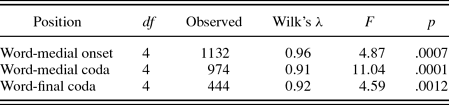
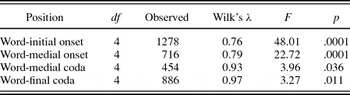
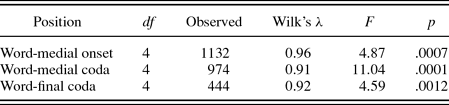
As mentioned in the Predictions Regarding the Acquisition of French and Spanish Rhotics Integrating Articulatory and Perceptual Constraints section, mastering the French and Spanish rhotics involves the acquisition of at least three phonetic parameters, namely, voicing, length, and manner. Although these three parameters are discussed separately to facilitate presentation and to allow the evaluation of the hypotheses, we will show that they all interact. Thus, for the first two parameters (voicing and length), we will present the results of one-way ANOVAs followed by post hoc Fisher's least significant difference (LSD) tests.Footnote 24 Results of a multivariate ANOVA (MANOVA), which evaluates the two parameters’ interaction, are given in Appendix E. The results for manner will be reported separately, given that, unlike voicing and length, this is a qualitative variable.
Before presenting the results, one final point of discussion is necessary. As will become obvious in the following sections, in testing the predictions made by all four models, we will adopt the strict criterion that voicing, duration, and manner have been acquired when there is no significant difference between a learner group's mean value and that of the native-speaker control group. This is a typical assumption in many L2 production studies (e.g., Flege, Reference Flege1987).
Voicing
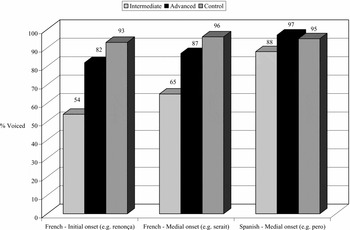
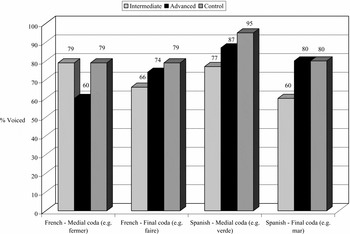
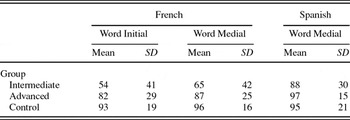
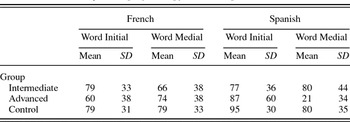
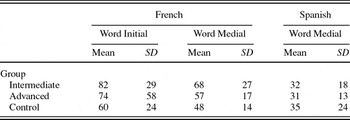
Results for voicing are presented in Figures 2 (onsets) and 3 (codas). In the case of Spanish, only rhotics in intervocalic position were included, because taps are not found in word-initial singleton onsets. In order to not overcomplicate the graphic presentation given the large number of values involved, standard deviations for all measures here and in the Manner section are presented in Appendix D.
The percentage of rhotic voicing in onsets: French and Spanish group means.

The percentage of rhotic voicing in codas: French and Spanish group means.

Results for French indicate that learners, particularly those of intermediate proficiency, had insufficiently voiced rhotics for the most part. In onsets, all learners differed significantly from the controls word initially, F (2, 641) = 97.52, p < .0001, and word medially, F (2, 360) = 37.93, p < .0001, although the rate of voicing increased with greater proficiency. In codas, there was more targetlike production. In this context, the intermediate learners matched the controls word medially, F (2, 230) = 7.62, p = .0006, whereas the advanced learners were targetlike word finally, F (2, 443) = 5.41, p = .0048.
It is interesting to observe that, in word-medial codas, the advanced group was outperformed by their intermediate counterparts. We will show later that the advanced learners’ devoicing is related to their greater accuracy with manner. Specifically, a portion of the intermediate learners’ realizations in codas included approximants and vocalizations that favor voicing. This greater targetlikeness in codas in both groups, however, was in part the result of devoicing in the control group; in onsets, the native speakers’ percentage of voicing was 93% (word-initial) and 96% (word-medial), whereas it was 79% in both syllable-final contexts. Final obstruent devoicing is a well-documented phenomenon cross-linguistically (e.g., Blevins, Reference Blevins2004; Smith, Reference Smith1997).
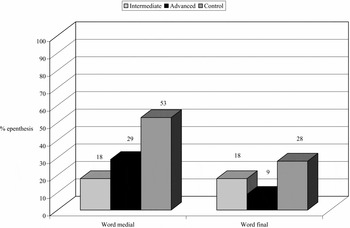
As for Spanish, voicing accuracy was greater in onsets than in codas. Indeed, in word-medial onsets the advanced learners did not differ significantly from the controls, F (2, 567) = 7.95, p = .0004, and the intermediate learners’ group mean approached the TL value; recall that this is the very context where flapping is found in the learners’ L1. These learners were thus the most proficient of the four nonnative groups as concerns their mastery of rhotic voicing. In contrast, in word-medial codas, all learners differed significantly from the controls; intermediate: 77%, advanced: 87%; F (2, 487) =13.64, p < .0001, who voice almost categorically (95%). This difference in the degree of voicing between the nonnative and native speakers may be attributed to the fact that the Spanish tap in word-medial codas is often followed by an epenthetic vowel. As outlined in the Phonetic Characterization of French, Spanish, and English Rhotics section, this vowel facilitates voicing by creating an intervocalic environment. However, as shown in Figure 4, the learners had yet to achieve nativelike rates of vowel-epenthesis word medially (intermediate: 18%; advanced: 29%; control: 53%),Footnote 25 and as such, voicing was more difficult.
The rate of epenthesis in Spanish rhotic–obstruent clusters: L2 learner and control group means.

In word-final codas (Figure 3, last group of columns), the Spanish controls exhibited more devoicing (voicing rate: 80%), which was also related to variation in manner. Indeed, vowel epenthesis decreased in the native speakers’ production in this context (word-medial: 53%; word-final: 28%) accompanied by an increase in the percentage of fricative realizations (see the Manner section). The lower rate of voicing in the target allowed the L2 learners, who also devoiced, to match the controls more closely. In the case of the advanced learners, they matched the native-speaker controls, F (2, 224) = 6.76, p = .0001; once again, these Spanish learners were the most accurate of the learner groups in terms of rhotic voicing.
Length
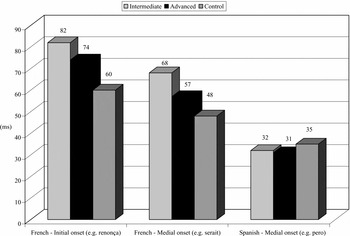
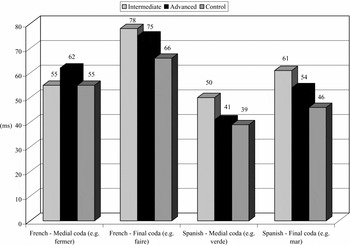
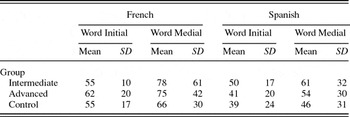
As shown in Figure 5, French learners produced overly long rhotics in onsets. Indeed, learners of both proficiency levels differed significantly from the controls; word initially: F (2, 641) = 17.77, p < .0001; word medially: F (2, 360) = 34.83, p < .0001. In contrast, the Spanish learners were once again accurate in onsets, where they essentially matched the native speakers, F (2, 567) = 1.74, p = ns. Recall from the Phonetic Characterization of French, Spanish, and English Rhotics section that values for the English flap are similar to those reported and observed for Spanish.
The length (ms) of onset rhotics: French and Spanish group means.

These differences in rhotic length had consequences for the segments’ overall realization, as voicing, length, and manner are intimately related. In terms of the interaction between length and voicing in particular, taps are intrinsically short, which favors voicing, whereas optimal fricatives are longer segments (e.g., Ladefoged & Maddieson, Reference Ladefoged and Maddieson1996; Ohala, Reference Ohala1997). Given that voicing is easier to maintain in shorter obstruents, the production of overly long fricatives leads to devoicing, which in part explains the French learners’ low rate of voicing discussed earlier. In contrast, the Spanish learners’ mastery of rhotic length facilitates the control of the segment's voicing.
In codas (Figure 6), we again note the parallels between the mastery of length and voicing. Word medially, the three French groups did not behave identically, F (2, 230) = 4.05, p = .01. However, a post hoc Fischer's LSD test revealed that the intermediate learners matched the controls’ mean length values. Word finally, it is the advanced learners who matched the native speakers, as was the case with voicing. This higher accuracy in codas may be attributed to the fact that the controls produced longer rhotics in this environment, where they too devoiced; and there was a trade-off between mastering length and manner/voicing.
The length (ms) of coda rhotics: French and Spanish group means.

In the case of the Spanish learners, in both word-medial and word-final codas, only the advanced learners matched the controls; medial: F (2, 487) = 12.4, p < .0001; final: F (2, 224) = 4.01, p = 0.01. The intermediate learners produced overly long rhotics in both environments. It is interesting to mention that, as opposed to French learners, advanced Spanish learners always outperformed their intermediate counterparts and resembled the controls more closely.
A comparison of French and Spanish learners revealed that the latter were more accurate in controlling length in intervocalic position where they did not differ significantly from controls. This environment, however, is the one where flapping occurs in English, and thus this higher accuracy can be attributed to L1 transfer.
Manner
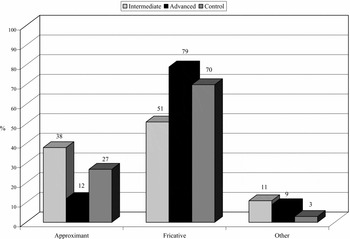
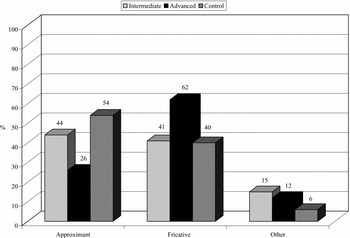
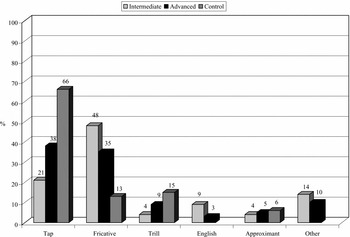
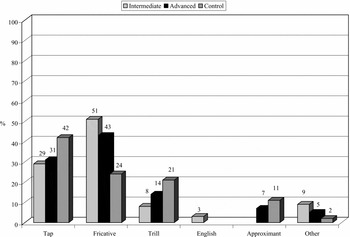
The last parameter under analysis is manner, which is highly variable both in French and Spanish. We present the results once again, grouping the data with reference to the position of the rhotic in the syllable (onsets in Figures 7–9, codas in Figures 10–13) and by language.
Manner in French word-initial onsets (group means).

Manner in French word-medial onsets (group means).

Manner in Spanish word-medial onsets (group means).

Manner in French word-medial codas (group means).

Manner in French word-final codas (group means).

Manner in Spanish word-medial codas (group means).

Manner in Spanish word-final codas (group means).

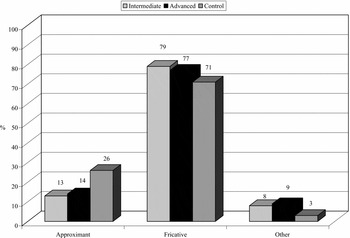
French learners proved to be very accurate in manner in word-initial onsets (Figure 7) where the percentage of fricatives was almost identical (79% for intermediates, 77% for advanced, 71% for native speakers). However, the relative proportion of approximants, fricatives, and other realizations (trills, mixes of approximants and fricatives) was nonetheless significantly different; Mantel–Haenszel: χ2 (1, 642) = 18.11, p < .0001.Footnote 26 This is particularly true in terms of the percentage of approximants. In stark contrast to learners of Spanish, no English-like approximants were produced. Moreover, as per Lindblom's H&H model discussed earlier, learners seemed to hyperarticulate slightly in this environment, because they produced more fricatives than the native speakers. This overshoot confirms the proposal that the frication of the French rhotic is a perceptually salient feature for these learners and that, consequently, they seek to produce noisy fricatives.
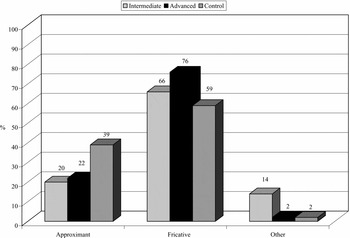
In word-medial onsets (Figure 8), learners of French produced a greater proportion of approximants. Once again there was a significant difference between the learners and controls in the overall relative proportions of approximants, fricatives and other realizations; Mantel–Haenszel: χ2 (1, 361) = 9.95, p = .0016.
Spanish learners were accurate in word-medial onsets (Figure 9), matching the native speakers; Mantel–Haenszel: χ2 (1, 1,340) = 3.5, p = ns). However, there were some instances of transfer from English among intermediate speakers, as well as other developmental errors including the production of trills. All of these error types have previously been reported in both Major (Reference Major1986) and Face (Reference Face, Klee and Face2006).
In word-medial codas (Figure 10), the French learners resembled the controls in their relative proportion of fricatives and approximants (i.e., in all groups fricatives were the most frequent variants followed by approximants); Mantel–Haenszel: χ2 (1, 231) = 1.3, p = ns. However, they were still different from the native speakers in the frequency of use of the specific variants. Intermediate speakers, in particular, seemed to have less control of the constriction degree, because they were the ones with the highest proportion of approximants. This had consequences for the rate of voicing, given that approximants are typically voiced. Here again, there were no instances of English-like rhotics, even though manner had not been fully mastered.
In word-final codas (Figure 11), the advanced French learners once again produced an insufficiently large number of approximants and an excess of fricatives; we propose here, too, that the greater number of fricatives is a consequence of hyperarticulation. However, the relative proportions were more targetlike than in word-medial position. In contrast, the intermediate learners resembled the control speakers more closely, as was the case with voicing in this context. As was discussed in the Voicing section, their larger percentage of approximants and lower percentage of fricatives allows for greater accuracy in voicing.
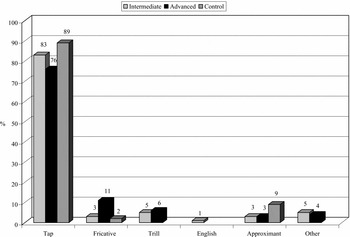
Spanish learners exhibited a higher degree of variability in codas (Figures 12 and 13) than in onsets, including the realization of nonnative-like segments by both intermediate (word-medial and word-final) and advanced speakers (word-medial only). As in previous studies (Face, Reference Face, Klee and Face2006; Major, Reference Major1986), transfer errors were found even among advanced speakers. However, the percentage of these errors was lower here than in those studies.Footnote 27 As opposed to the French learners, the Spanish L2 speakers exhibited different patterns in word-medial and word-final codas. In word-medial position (Figure 12), learners differed significantly from controls, Mantel–Haenszel: χ2 (1, 532) = 26.8, p < .0001, because the native speakers clearly used the tap as the preferred variant, whereas the learners tended to prefer the fricative; they also produced smaller percentages of taps, trills, and a variety of other realizations. Among intermediate speakers, fricatives were the most common realization, followed by taps, English-like rhotics, other (e.g., deletion followed by gemination), approximants, and trills. In contast, for the advanced learners the tap emerged as the most frequent realization, followed by fricatives, trills, and approximants. In word-final codas, the learners as a whole did not significantly differ from the controls, Mantel–Haenszel: χ2 (1, 234) = 1.4, ns); the advanced speakers showed no signs of direct transfer from English but they reversed the proportion of taps and fricative variants, with fricatives becoming the most frequent realization.
OVERALL COMPARISON AND DISCUSSION
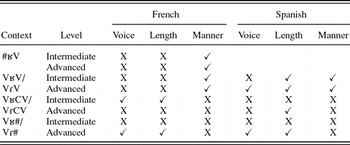
Table 3 summarizes the results presented in the previous sections, where “X” indicates that learners differed significantly from the native speaker controls and “✓“ that the parameter in question was mastered. As can be observed, learners did not master the target segments in all positions equally. Overall, Spanish learners were successful in intervocalic (VɾV) position, as was predicted in the acquisition hierarchy in Table 1. In this context, advanced Spanish learners acquired all properties of the rhotics; intermediate learners mastered length and manner but not voicing. However, the Spanish learners’ success can be attributed to transfer: the English flap exists in this position.
Overall comparison of the performance of French and Spanish learners in all contexts

Note: (X) learners differ significantly from the native speaker controls; (✓) the parameter in question was mastered.
The French learners, in contrast, have only acquired manner in onsets as per the hierarchy in Table 1. Indeed, it can be said that these latter learners hyperarticulated manner in the intervocalic position, because they produced more fricatives than the native French speakers. In word-internal (VʁCV; VɾCV) and word-final (Vʁ#; Vɾ#) codas, learners of both languages proved relatively unsuccessful. These were indeed predicted to be the most difficult contexts for learners of both languages. In word-medial codas, the intermediate French learners were relatively the most successful, mastering both rhotic voicing and length. In Spanish, only the advanced speakers have mastered any of the properties of the tap, namely, length. As concerns manner, French learners overall were better than their Spanish counterparts. Indeed, although there was a statistical difference in the relative proportion of approximants and fricatives, the relative frequency of the variants produced resembles that of the French controls. Moreover, unlike the Spanish learners, no L1 transferred approximants were attested. Finally, in word-final position, advanced learners of both languages mastered voicing and length but not manner. Such accuracy was facilitated by the lengthening and devoicing in the controls’ production. The intermediate learners, in contrast, were unsuccessful with all three parameters. In summary, it could be said that Spanish L2 speakers in codas and French L2 speakers in general had difficulties in mastering the properties of these rhotics simultaneously, and as such, the problem lied mostly in the coordination of the different articulatory gestures. Indeed, this is consistent with one of the central hypothesis of the dynamic system framework that “articulations seldom move in an isolated, independent fashion” (Kelso, Saltzman, & Tuller, Reference Kelso, Saltzman and Tuller1986, p. 30).
Based on this summary, none of the three typologically or perceptually based models discussed in the Typologically and Perceptually Based Models in L2 Phonology section makes entirely accurate predictions as concerns the acquisition of French and Spanish rhotics by native English speakers. Overall, all predictions of the three models elaborated earlier prove too general, because they do not take into account positionally conditioned variation or the complexity of the simultaneous mastering of different phonetic parameters (see also Archibald & Young-Scholten, Reference Archibald and Young-Scholten2003, p. 164, for similar claims). The MDH is only successful in capturing the acquisition of intervocalic Spanish taps, but fails to predict the onset-coda asymmetry in both languagesFootnote 28 and the targeting of manner before voicing in French as well. If we were correct in assuming that the SLM makes two opposite predictions re the acquisition of Spanish rhotics, then we can conclude that this model adequately accounts for the onset-coda asymmetry attested with L2 Spanish learners. This model, however, fails to predict the developmental pattern observed in the French learners, because these learners did not master all the phonetic parameters involved in the acquisition of the new sound at once. Finally, as concerns Brown's model, similar problems arise. Contrary to the predictions of this model, L2 learners of French were not completely successful at mastering all the properties of the rhotics in all environments.Footnote 29 As for learners of Spanish, independently of the representation adopted, the predictions come short. If we assume that Spanish and French share all the necessary features, we cannot account for the onset-coda asymmetries. If we assume that they differ, we can account for the problems in the acquisition of codas, but not for the relative success in onsets.
When the developmental patterns of both learners’ groups are compared several tendencies emerge. First, it is clear that the commonly attested onset-coda asymmetries also characterize the L2 acquisition of French and Spanish rhotics. In particular, codas posed a problem for all learners, especially those in word-medial position, where it is necessary to master coarticulatory consonant–consonant patterns. Although this is consistent with universal phonetic tendencies, this asymmetry is particularly interesting with learners whose L1 is English, which has a high percentage of closed syllables, even higher than that of Spanish. Second, transfer clearly accounts for the relative success in the English-speaking learners’ mastery of intervocalic taps; indeed, this is the only environment in which taps are found both in English and Spanish. Third and finally, the acquisition of new segments starts by targeting the most salient parameter in the most salient environment, as exemplified by the acquisition of rhotic manner by French L2 learners.
Results indeed reveal that, in the development of new categories in an L2, speakers did not master the target sounds in all positions equally. As demonstrated in previous L2 production and perception studies (e.g., Berri, Reference Berri1998; González, Reference González2007; Wenk, Reference Wenk1983, p. 60; Westmunson, Reference Waltmunson2005), learners targeted more salient properties in more salient positions. This is indeed consistent with phonetic and phonological research that has demonstrated that sounds are not equally perceived in all positions (Ohala & Kawasaki, Reference Ohala and Kawasaki1984, p. 115; Tobin, Reference Tobin1997; Wright, Reference Wright, Bruce, Kirchner and Steriade2004), and that there is an asymmetry between onsets and codas in terms of contrasts allowed as well as in terms of perceptual faithfulness to different features (Steriade, Reference Steriade1999).
The approach introduced here allows us to capture in detail a set of developmental sequences. For example, we have shown that French learners did not master all the rhotic properties at once; they started by controlling what could be considered the most salient property of the rhotic, that is, manner. Thus, by analyzing different parameters acoustically, we can individuate specific challenges that L2 learners face when acquiring a particular structure in a given language. It is interesting to point out that what we have observed here are developmental sequences in production. In the future, it will be important to determine the connection between production and perception of native likeness by native speakers of these languages. Indeed, it may be the case that some of the rhotics produced by these learners, even if they are not acoustically identical to the target, may be perceived as nativelike. As such, it would be relevant to determine how successful L2 learners are in manipulating articulatory parameters to produce nativelike percepts. It is possible that articulatory constraints alone do not determine the nature of learners’ production. Rather, learners’ production may also be shaped by their perception of the target.Footnote 30
Thus, we propose that in predicting the relative difficulty of two different structures in two or more different languages, it is crucial to supplement existing models with phonetic theories of speech production. First, we have shown that by incorporating findings from research on the aerodynamics of voicing, we can motivate the trade-offs found in the acquisition of French rhotics. Second, by adopting Lindblom's H&H (Reference Lindblom, Hardcastle and Marchal1989) theory, it is possible to predict and explain the onset-coda asymmetries observed in production, namely, as is the case in native speaker grammars, we see a tendency in L2 grammars to hyperarticulate in strong positions (e.g., onsets) and hypoarticulate in weak positions (e.g., codas). This explains the greater degree of variability attested syllable finally. Third and finally, as predicted by the AS framework, the L2 acquisition of articulatory patterns is more complex and challenging than what existing models alone can predict.
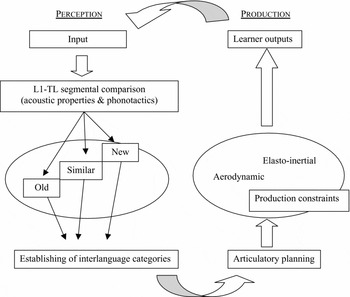
Figure 14 provides a hybrid model that integrates both perception and production. As schematized, the input is parsed by learners based on segmental categories using both acoustic and distributional information.Footnote 31 We assume that less proficient learners rely more on the former (Steele, Reference Steele, Do, Dominguez and Johansen2001, Reference Steele2006). Such comparison leads to a typology of the type proposed by the SLM: sounds are classified as “new,” “similar,” or “old.” The establishment of interlanguage representations involves the analysis of the differences and similarities in the L1–L2 phonotactics (old and similar sounds) and the degree of L1–L2 similarity in features (only for similar sounds). Based on such representations, the production component then plans the sequence of gestures necessary to realize the segment(s) in question, including position-based differences (i.e., allophones). Once again, we expect differences between less and more proficient learners, as mastery of distributional properties requires exposure to large quantities of native(-like) speech over time. Targetlike representations and accurate gestural planning does not guarantee targetlike outputs, as production is shaped by aerodynamic and elastoinertial constraints of the type discussed in this paper. Presumably, learners compare their outputs further to their perceived inputs. If no differences are noticed between the two, categories become fossilized.Footnote 32
A schematic representation of a perception–production model of L2 segmental acquisition.

CONCLUSION
This paper has shown that, in predicting relative difficulty in the acquisition of new and similar sounds in two different languages by speakers of the same language, existing models of L2 phonetics and phonology do not make fully empirically adequate predictions. Specifically, overall our data show that the MDH, the SLM, and Brown's phoneme-based theory of perception fail to account for the full range of variability and developmental sequences attested, as they do not take into account the interaction of the degree of difficulty and the position in the sequence. Moreover, none of the theories systematically incorporates phonetic production principles, such as aerodynamic constraints on the production of fricatives. Given that acquiring new or similar sounds involves the simultaneous mastery of different phonetic parameters, the individual consideration of such principles is necessary to predict learners’ overall success.
Thus, we propose that, to determine the relative difficulty of the acquisition of either new or existing segments, current models will benefit from incorporating findings from constraints on speech production. Moreover, we have shown here that to tease apart the role of universal phonetic principles versus transferred and thus language-specific articulatory patterns, it is important to expand our empirical coverage by studying the acquisition of different L2s by speakers of the same L1. On the one hand, these methodological and theoretical paths will supplement the findings of perception-based L2 studies and thus shed light on the perception–production relation in L2 acquisition. On the other hand, theories should increase explanatory power by predicting an interlanguage difficulty of acquisition hierarchy for speakers of a given L1. In future research, it will be of interest to examine whether the results of the current study hold with more naturalistic speech, where phonetic production constraints play a greater role in the absence of hyperarticulation.
APPENDIX A FRENCH AND SPANISH READING PASSAGES
French
La bise et le soleil se disputaient, chacun assurant qu'il était le plus fort. Quand ils ont vu un voyageur qui s'avançait, enveloppé dans son manteau, ils sont tombés d'accord que celui qui arriverait le premier à le lui faire ôter serait reconnu comme le plus fort. Alors, la bise s'est mise à souffler de toutes ses forces mais plus elle soufflait, plus le voyageur serrait son manteau autour de lui. Finalement, elle renonça à le lui faire ôter. Alors, le soleil commença à briller et au bout d'un moment le voyageur, réchauffé, ôta son manteau. Ainsi, la bise dut reconnaıtre que le soleil était le plus fort.
Spanish
El viento del norte y el sol discutían acerca de cuál de los dos sería el más fuerte, cuando, de repente, pasó un viajero envuelto en una amplia capa. Al verlo, convinieron en que el primero que consiguiera quitarle la capa sería el más fuerte. El viento del norte comenzó a soplar con mucha furia, pero, cuanto más soplaba, más se aferraba el viajante a su capa, hasta que el viento norte desistió. El sol brilló entonces con todo su esplendor, e inmediatamente, el viajante arrojó su capa. Así, el viento norte tuvo que reconocer la superioridad del sol.
APPENDIX B
L2 learners' linguistic background

APPENDIX C
French and Spanish stimuli

APPENDIX D DESCRIPTIVE STATISTICS FOR RHOTIC VOICING AND DURATION (GROUP MEANS)
Mean rhotic percentage of voicing for onsets (Fig. 2)

Mean rhotic percentage of voicing for codas (Fig. 3)

Mean rhotic length (ms) for onsets (Fig. 5)

Mean rhotic length (ms) for codas (Fig. 6)

APPENDIX E PARAMETRIC STATISTICS FOR INTERACTION OF VOICING AND LENGTH
MANOVA for interaction of voicing and length: French

MANOVA for interaction of voicing and length: Spanish