Total anomalous pulmonary venous connection is characterised by the interruption of normal connection between left atrium and all pulmonary veins and the drainage of all pulmonary venous return into the systemic venous circulation. Total anomalous pulmonary venous connection is a rare cyanotic CHD with a prevalance of 0.6–1.2 % among all CHDs. Reference Reller, Strickland and Riehle-Colarusso1 In the Darling classification, total anomalous pulmonary venous connection is classified into four anatomic forms depending upon the anomalous connections of pulmonary veins to the systemic veins: supra-cardiac, cardiac, infracardiac, and mixed type. Reference Craig, Darling and Rothney2 Supra-cardiac total anomalous pulmonary venous connection results from connections to the superior vena cava system via an anomalous vertical vein. Presentation and management of patients with total anomalous pulmonary venous connection may vary depending on whether there is obstruction or not in pulmonary veins or connections and whether there is a restriction in interatrial communication. Reference Kao, Hsieh and Cheng3 Surgery should be performed as soon as possible after diagnosis and the prognosis is poor without surgery. It is important to manage the pulmonary hypertension crisis for morbidity and mortality in the post-operative period. Reference Sinzobahamvya, Arenz and Brecher4 In selected cases, leaving vertical vein patency during surgical repair of total anomalous pulmonary venous connection may help to decrease the episodes of post-operative pulmonary hypertensive crises, low cardiac output syndrome, and mortality. In this study, we presented our post-operative transcatheter vertical vein closure experiences in five patients with repaired total anomalous pulmonary venous connection patients.
Methods
We performed a retrospective review of patients with an unligated vertical vein following repair of supra-cardiac total anomalous pulmonary venous connection and caused haemodynamically significant left-to-right shunting on follow-up between 2011 and 2018 at the Hacettepe University Medical Faculty, Pediatric Cardiology Unit. Patients characteristics, cardiac catheterisation findings, surgical and transcatheter procedural details were retrospectively analysed.
Procedure
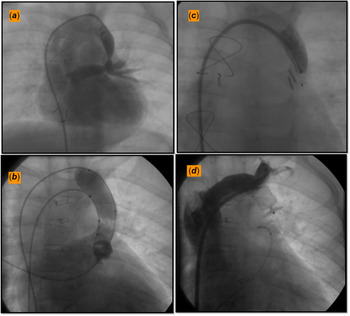
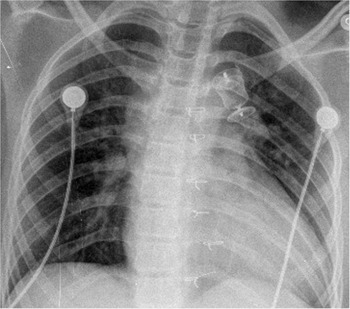
Among the all supra-cardiac total anomalous pulmonary venous connection patients who underwent surgery between 2011 and 2018 in our hospital, vertical vein was left open in five patients whose left ventricular echocardiographic findings were thought to be insufficient in compliance or vertical vein was closed temporarily during surgery but patient’s did not tolerate. In post-operative follow-up, due to the right heart volume loading detected by echocardiography, diagnostic cardiac catheterisation was performed in all patients (Fig 1a). After the haemodynamic and oximetric study, vertical vein was occluded in all patients with AmplatzerTM sizing balloon (AGA Medical corp., Golden Valley, MN, USA) or Tyshak II balloon (Numed inc., Hopkinton, NY, USA) in order to test (Fig 1b). After the occlusion of vertical vein, the pressure of the left atrium was taken immediately and 15–20 minutes later after post-balloon occlusion. At the end of the ballon occlusion test, those who did not have a significant elevation in left atrial pressure compared to basal values were considered suitable for transcatheter closure of the patent vertical vein. Balloon occlusion testing was also used to measure vertical vein diameter and landing zone. AmplatzerTM Duct Occluder II or AmplatzerTM vascular plug (AGA Medical corp., Golden Valley, MN, USA) were used to closure of vertical vein (Fig 1c, 1d). Acetylsalicylic acid was prescribed in all patients at an antiaggregant dose for 6 months after the procedure. Electrocardiography and transthoracic echocardiography were performed 24 hours after the procedure. Chest X-ray was performed for the device position (Fig 2). All patients were discharged on the second day of the procedure.
Cardiac catheterization after repair of supracardiac TAPVC with partial ligated vertical vein. (a) Cineangiogram is showing surgically banded vertical vein and the drainage of left upper pulmonary vein just below the congenitally stenotic area, b) Cine angiogram is showing balloon occlusion of the vertical vein and simultaneously left atrium injection using pigtail catheter, (c) Control injection after deployement of device (ADO II AS 4*2 mm) showing the well position of the device. (d) Contrast injection at the level of innominate vein showing complete occlusion and no impingement after device (Amplatzer Vascular Plug II) deployment.

Chest radiographs showing a normally positioned AmplatzerTM Vascular Plug in a patient with history of repair of supracardiac TAPVC with transcatheter closure of vertical vein.

Results
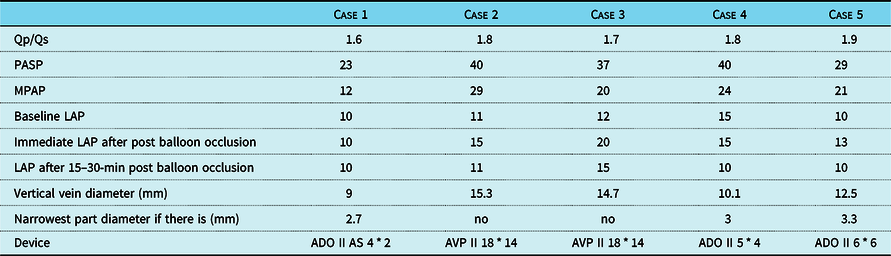
The general characteristics of the patients are summarised in Table 1. Median age of patients were 10.25 years (1.5–11.5 years) with median weight of 29 kg (11–40 kg). Surgery type was complete repair of anastomosis of all pulmonary veins with left atrium. In two patients, the vertical vein was ligated by the surgeon as a level of toleration by the patients during surgery. The intervention was performed after a mean of 4.5–7.5 years. All patients had left-to-right shunting with the findings of volume overloading of the right atrium and ventricle in their echocardiography. There were no other additional lesions nor any stenosis in the sac where the pulmonary veins were anastomosed to the left atrium. Interventional and haemodynamic characteristics of patients are shown in Table 2. Mean fluoroscopy time was 24.6 ± 11.9 min, and procedure time was 116 ± 23.6 min. Mean pulmonary artery pressure was 21.2 ± 6.2 mmHg. Pulmonary venous return and left atrial anastomosis region were evaluated with the return phase of the pulmonary artery injection applied to the patients before the closure of the vertical vein, and it was confirmed that there was no stenosis in the pulmonary veins or anastomosis region between left atrium and pulmonary artery. In all cases, the left atrial and ventricular compliance were evaluated by the temporary balloon occlusion test of the vertical vein. The pressure recordings remained stable during the test. During the intervention, we successfully occluded the vertical vein that drained into the innominate vein using Amplatzer ascular plug or duct occluder and redirecting pulmonary venous flow towards the left atrium in all cases. There were no major procedure-related complications. Chest X-ray showed the device in the appropriate position. All the patients were discharged on the second day after procedure. Echocardiography showed that the vertical vein was completely occluded at the first month follow-up. Median follow-up was 4 years (3–6 years). At the follow-up evaluation, transthoracic echocardiogram showed no evidence of residual shunt in all patients with the normal dimensions of right atrium and right ventricle, no pulmonary hypertension findings, no dislocation of device, and no obstruction in adjacent vascular or cardiac structures. There is no long-term complication of thrombus or vegetation.
Demographics characteristics of patients

m = . months, y. years, kg. kilograms, M. male, F. female.
Angiographic features of patients who underwent post-operative transcatheter vertical vein closure in repaired TAPVC patients

ADO = Amplatzer duct occluder; AS = additional sizes; AVP = Amplatzer vascular plug; LAP = left atrium pressure; MPAP = mean pulmonary artery pressure; PASP = pulmonary artery systolic pressure; Qp = pulmonary flow; Qs = systemic flow.
Discussion
The most common type is supra-cardiac total anomalous pulmonary venous connection. Reference Karamlou, Gurofsky and Al Sukhni5–Reference Files and Morray7 The choice of treatment in patients without pulmonary venous obstruction is total correction with surgery in infant period to let patient growth. Reference Files and Morray7–Reference Vanderlaan and Caldarone9 In the post-operative period, pulmonary arterial hypertension and low cardiac output may be seen and have difficulty in maintaining the cardiac output due to pulmonary hypertension and noncompliance of left ventricle. Reference Vanderlaan and Caldarone9,Reference Shaw and Chen10
The long-term results of total anomalous pulmonary venous connection have improved by developing techniques in surgery, supportive care in pre- and post-operative ICUs, and advancing prenatal and technological advances in diagnosis screening of CHD. Reference Sakamoto, Nagashima and Umezu11,Reference Shi, Zhu and Chen12 The vertical vein may be left unligated to decompress of left ventricle and to prevent pulmonary hypertensive crisis. Reference Vanderlaan and Caldarone9 When vertical vein is left open, the cardiopulmonary bypass time is shortened, and it helps to cope with the complications in the early post-operative period. Reference Ross, Joffe and Latham6 To leave the vertical vein unligated is an option to avoid morbidity and mortality in the post-operative period is still controversial. Traditionally, in cases where patients does not tolerate the closure of the vertical vein, it may be considered that leaving vertical vein unligated may be useful for adaptation to the new circulatory physiology. However, there is no specific criterions for candidate selection. The selective vertical vein patency in surgical repair of total anomalous pulmonary venous connection may lead to decrease the episodes of perioperative pulmonary hypertensive crises, post-operative low cardiac output syndrome, and mortality.
Unligated vertical vein is an opportunity for growth and adaptation of small and non-compliance left heart cavities in the post-operative period. Reference Chowdhury, Subramaniam and Joshi13 During the pulmonary hypertensive crisis, unligated vertical vein provides relief in the pressure of suprasystemic pulmonary artery. Chowdhuey et al found statistically significant that the rate of hospitalisation was lower, pulmonary crisis and low cardiac output was lower, and in-hospital mortality rate was lower in the unligated vertical vein group. Reference Chowdhury, Subramaniam and Joshi13 Saritaş et al showed that unligated vertical vein provides relief in the pressure of suprasystemic pulmonary artery. Reference Saritas, Celik and Tatar14
The important issues in deciding to close of the vertical vein after surgery are the amount of shunt, the direction of shunt, and pulmonary vascular resistance. The advantages of Amplatzer Vascular Plug devices are allowing total closure of vertical vein, low embolisation rate, easing of retrieval when device has been embolised, easily repositioning until releasing of device. In addition, since it is a lower profile device, Amplatzer vascular plug provides ease of use in directing delivery system and suite for tortiotic vessels. The size of transcatheter closure device of vertical vein largely depends upon vertical veins size, diameter, shape, and its length.
There have been only a few cases reported in the literature where the vertical vein closure is performed with the Amplatzer vascular plug or duct occluder. Reference Lombardi, Tagliente and Pirolo15–Reference Verma, Subramanian and Saileela20 Amoozgar et al. reported that vertical vein of two total anomalous pulmonary venous connection patients, whose vertical vein was left open due to high pulmonary artery pressures in the surgery, was closed with a vascular plug type 1 device with a size of 10 mm and 8 mm. Reference Amoozgar, Ahmadipoor and Amirghofran19 Verma et al. reported that they closed three unligated vertical vein of patients of two supracardiac total anomalous pulmonary venous connection and one mixed type total anomalous pulmonary venous connection with the device of 22 mm Cera vascular plug. They stated that they had some difficulty in one patient in positioning the device and developed protrussion of disc to the left pulmoner vein and progressed into left pulmonary vein stenosis because of the fact that Amplatzer vascular plug II is trilobed shaped. This device was replaced with Cera vascular plug. Reference Verma, Subramanian and Saileela20 In a patient with infracardiac total anomalous pulmonary venous connection surgery, the device of 10 mm Amplatzer vascular plug type 1 and a Gianturcu coil were used for percutaneous unligate vertical vein closure. Reference Kobayashi, Forbes and Delius17 In addition, unligated vertical veins of patients with supracardiac type of total anomalous pulmonary venous connection have also been closed with 12 or 18 mm Amplatzer vascular Plug II. Reference Lombardi, Tagliente and Pirolo15,Reference Devendran, Wilson and Jesudian16
In our article, we describe a case series of successful transcatheter closure of the unligated vertical vein using the Amplatzer vascular plug or duct occluder in patients who underwent surgery of supra-cardiac type of total anomalous pulmonary venous connection . The results of our study have shown that transcatheter closure of the vertical veins is well-tolerated and an effective method. Also due to low risk of complication, it is a rational alternative to surgery. Balloon occlusion test is an important pre-intervention procedure to evaluate the left heart haemodynamics. We performed balloon occlusion test to all of our patients before device implantation, and no patient had significant increased left atrial pressure. As a result, all of the patients had signs of right heart failure and one patient of mild pulmonary hypertension before the procedure due to left to right shunt during follow-up. In two patients, the vertical vein was ligated by the surgeon as a level of toleration by the patients during surgery. This partial ligation of vertical vein technique during the surgery provided us to perform a smaller device diameter and delivery system for transcatheter closure. It can also be said that there is less shunt ratio and mild or no pulmonary hypertension with a small vertical vein. When making the decision for the device selection, we used a device 1.2 to 1.3 times of the vertical vein after the diameter of occluded vertical vein. In the case of the closure with ADO II device, we avoided the oversizing of the device selection. Thus, procedure-related complications were not observed in any of our patients.
Conclusions
As an option, to leave the unligated vertical vein during the supra-cardiac type of total anomalous pulmonary venous connection correction may decrease perioperative pulmonary hypertensive crisis and provide adaptation to new circulatory physiology. There have been only a few cases reported in the literature. We describe a case series of successful transcatheter closure of the unligated vertical vein using the Amplatzer vascular plug or duct occluder. Transcatheter closure is an effective and well-tolerated alternative to the surgical approach.
Acknowledgement
We would like to record our appreciation to all people that involve in the writing this report.
Financial support
The authors received no funding for this study.
Conflict of interest
The authors disclose no conflicts interest related to this manuscript.
Ethical standards
The authors assert that all procedures contributing to this work comply with the ethical standards of the relevant national guidelines on human medical regulations and with Helsinki Declaration of 1975, as revised in 2008. Written informed consent was obtained from all patient’s parents.