Social anxiety in children and adolescents is a serious threat to the normal development of youths (García-López, Piqueras, Díaz-Castela, & Inglés, Reference García-López, Piqueras, Diaz-Castela and Inglés2008). Adolescents with social anxiety can manifest great interferences in their relationships with their classmates and with people of their same age (Blöte, Miers, Heyne, & Westenberg, Reference Blöte, Miers, Heyne, Westenberg, Ranta, La Greca, Garcia-Lopez and Marttunen2015; Inglés, Delgado, García-Fernández, Ruiz-Esteban, & Díaz-Herrero, Reference Inglés, Delgado, García-Fernández, Ruiz-Esteban and Díaz-Herrero2010; Tillfors, Persson, Willen, & Burk, Reference Tillfors, Persson, Willen and Burk2012).
Moreover, some effects of social anxiety on school performance have been reported. Thus, students with social anxiety show certain academic difficulties, have a lower academic, social, physical and emotional self-concept and a lower academic performance than students without social anxiety (Delgado, Inglés, & García-Fernández, Reference Delgado, Inglés and García-Fernández2013, Reference Delgado, Inglés and García-Fernández2014). In addition, students with social anxiety are involved in fewer extracurricular activities; they feel more stress towards academic tasks and exhibit greater school absenteeism (van Roy, Kristensen, Groholt, & Clench-Aas, Reference van Roy, Kristensen, Groholt and Clench-Aas2009).
Many reasons justify the study of social anxiety in adolescence. Firstly, it frequently appears at early ages of development and its course is usually chronic if untreated, which can lead to difficulties in children’s social functioning. In addition, the discomfort produced by social anxiety and its avoidance responses negatively impact on different functional areas in children. Thus, the low participation in class, the resistance to present schoolwork in the classroom or the tendency to avoid asking the teacher (Bernstein, Bernat, Victor, & Layne, Reference Bernstein, Bernat, Victor and Layne2008), can contribute to the student performing below his/her potential and even prematurely leaving the education system. Similarly, the avoidance of peer relationships generates isolation and low acceptance amongst the peer group (Inglés et al., Reference Inglés, Delgado, García-Fernández, Ruiz-Esteban and Díaz-Herrero2010).
Social anxiety and peer sociometric nomination
The probability of a subject developing social anxiety depends, among other factors, on the social relationships established with peers. The emotional ties and support that arise from the social interactions with peers exert a powerful effect on the psychosocial adjustment of adolescents (Martínez-González, Inglés, Piqueras, & Ramos, Reference Martínez-González, Inglés, Piqueras and Ramos2010). Conversely, low acceptance or rejection by peers is a risk factor for the development of psycho-emotional problems and low academic adjustment (Martínez-González et al., Reference Martínez-González, Inglés, Piqueras and Ramos2010).
The interest in the study of social interactions in the classroom, through sociometric methods, has grown in recent decades due, in part, to the improvement of the measures and statistics used, as well as to its contribution to the explanation of maladaptive behavioral patterns in school (Martínez-Arias, Martín, & Díaz-Aguado, Reference Martínez-Arias, Martín and Díaz-Aguado2009). Sociometric nomination measures have been used as tools to identify the degree of acceptance or preference, neglect and rejection in students with different styles of interpersonal relationships (prosocial, aggressive and inhibited/anxious).
The interpersonal relationships that adolescents maintain with their classmates impact on the degree of acceptance or rejection within their peer group (Erath, Flanagan, & Bierman, Reference Erath, Flanagan and Bierman2007). Peers perceive popular adolescents as being the most sociable and the least isolated and aggressive, whereas they perceive rejected adolescents as being the most aggressive and moderately isolated and the neglected adolescents as being the least sociable and aggressive and more isolated than popular adolescents, while controversial adolescents are perceived to be as aggressive but more sociable than rejected adolescents (Muñoz, Moreno, & Jiménez, Reference Muñoz, Moreno and Jiménez2008).
Rejected and neglected adolescents tend to exhibit greater levels of social anxiety than the rest of sociometric types, yet, neglected adolescents present greater social inhibition (Inderbitzen, Walters, & Bukowski, Reference Inderbitzen, Walters and Bukowski1997). A study carried out on Spanish pre-adolescents revealed that the reasons for rejecting a peer were centered around behaviors associated with aggression, such as arrogance, dominance, intimidation and verbal/physical aggression, rather than for reasons related to inhibition and social withdrawal (Monjas, Sureda, & García-Bacete, Reference Monjas, Sureda and García-Bacete2008).
A Chinese study on primary students from 3rd and 4th grade in three cohorts (1990, 1998, 2002) revealed, through multi-group invariance analyses, that the relations between the variables of adjustment, sociability and shyness varied in the different cohorts, while the ratio between aggression and adjustment remained unchanged (Chen, Cen, Li, & He, Reference Chen, Cen, Li and He2005). Thus, shyness was associated with academic achievement and social adjustment in 1990, whereas the relationship was weaker in 1998, and in 2002, shyness was associated with peer rejection, academic problems and depression.
A six year-long longitudinal study (Prinstein & La Greca, Reference Prinstein and La Greca2002) analyzed the peer crowd affiliation (Populars, Jocks, Brains, Burnouts, and Non-conformists) and social anxiety, self-concept, loneliness and depression in 246 American students. The analysis of variance indicated that adolescents elected by their peers as Populars or Jocks showed less social anxiety than those chosen as Brains.
Later, La Greca and Harrison (Reference La Greca and Harrison2005) examined the prediction of social anxiety and depression through interpersonal functioning of adolescents, including crowd affiliations and victimization in a group of 421 adolescents of the same country. They obtained a model that accounted for 27% of the explained variance of social anxiety according to sex (girls were at greater risk), protective factors, such as affiliation to a group with high or low status, having positive friendship relationships, and risk factors, such as having friendships based on criticism, exclusion and conflict.
Furthermore, van Roy et al. (Reference van Roy, Kristensen, Groholt and Clench-Aas2009) analyzed the social and academic performance of 16486 Norwegian primary and secondary school students. They found that students with social anxiety (as identified by their parents) were those most ignored and victimized by their peers. In addition, the oldest students with social anxiety (10–13 years) had fewer close friends and mingled with peers less frequently by phone, text message or email than those who did not suffer from social anxiety.
Zimmer-Gembeck, Walters, and Kindermann (Reference Zimmer-Gembeck, Waters and Kindermann2010) examined the level of peer acceptance through a rating scale and self-reported data on social anxiety, negative beliefs and depressive symptoms, across sexes, on a sample of 278 Australian pre-adolescents. They found that students with social fears were less accepted by their peers of the opposite gender, although when the sex interaction was controlled for, no significant relationships were found.
Conversely, the fact of being rejected by peers can be a risk factor for developing social anxiety. Similarly, London, Downey, Bonica, and Paltin (Reference London, Downey, Bonica and Paltin2007) analyzed the consequences of rejection through a longitudinal study at two points in time in the same academic year on a sample of 150 American primary students from 6th grade. The sociometric status was measured through a nomination test with three inter-gender choices. Rejection and low acceptance were positively and significantly related to social anxiety score for the first time point. However, they did not correlate with the social anxiety score at time 2. In addition, they found that students who expected to be rejected and had anxious tendencies at time 1 also had a higher risk of developing high levels of social anxiety or social withdrawal a few months later.
Social anxiety, teacher assessment and sociometric nomination
The interactions that occur between teacher and student are of great importance for the development of the student’s social and academic skills (Wentzel & Looney, Reference Wentzel, Looney, Grusec and Hastings2007).
The teacher’s assessment of his/her students is considered a key factor in the academic success of the students. In this sense, the behavioral assessment tests or rating scales have been used as adequate tools to analyze teacher assessments (Wentzel & Asher, Reference Wentzel and Asher1995), although their use has not been as widespread as that of sociometric tests.
Chen, Chen, and Kaspar’s (Reference Chen, Chen and Kaspar2001) study on a sample of 323 Chinese primary and secondary school students revealed that shyness and sensitivity were positively and significantly related to social preference, leadership, and academic competence as informed by the teacher. Furthermore, shy children were less likely to develop learning problems and had greater academic competence as assessed by the teacher.
Weeks, Coplan, and Kingsbury’s (Reference Weeks, Coplan and Kingsbury2009) study on a sample of 178 Canadian students aged 7 and 8 years analyzed the social behavior (anxious, prosocial and excluded) through the Child Behavior Scale, and the academic skills (reading, writing, math, science and reasoning) of students with social anxiety through the assessment of their teachers. Teachers indicated that socially anxious students had fewer academic skills than students without social anxiety. However, they did not consider them to be more anxious, more excluded by peers or less prosocial than students without social anxiety. The authors suggest that socially anxious students can be perceived by their teachers as less skilled due to their poor academic performance, or because socially anxious students not fit the profile of a participatory/cooperative student.
In line with the aforementioned results, Wentzel and Asher (Reference Wentzel and Asher1995) analyzed the differences in motivation, self-regulated learning and classroom behavior, evaluated through a teacher assessment scale in the popular, rejected, neglected and average/control sociometric groups. The sample consisted of 423 American students in their last year of primary school and first year of secondary school. Compared with the average students: a) popular students were evaluated as more prosocial and cooperative; b) rejected students were less popular and perceived as less secure in their tasks and more quarrelsome and c) neglected students were identified as being more motivated, independent, less impulsive, and showing more adapted behaviors in the classroom and they were also the most popular. As for the differences between the rejected-aggressive, the rejected-shy and the average/control students, the rejected-aggressive differed from the average/control group in that the teachers perceived them as less motivated, independent and cooperative and more impulsive and quarrelsome. However, the rejected-shy students did not differ from the average group in any of the aspects evaluated by the teacher.
In a later study, Wentzel (Reference Wentzel2003) analyzed the prediction of academic performance in different sociometric types by assessing the academic adjustment identified by teachers and by the subjects themselves, from a longitudinal design spanning over two years (from 6th grade of Primary to 2nd grade of Secondary Education) on a sample of 204 students. Compared with control students, the neglected students perceived less social support from their peers and rejected students were identified by teachers as less prosocial and more irresponsible.
The data obtained through the review of previous research on the relationship between social anxiety and sociometric nomination by peers and teachers revealed several limitations.
Firstly, previous studies have not taken into account the degree of agreement between peer and teacher nominations. Moreover, effect sizes or magnitude of the differences have not been included, which makes it impossible to interpret the theoretical and practical relevance of the results. Finally, no studies in Spanish have been found that consider the relationship between social anxiety and other behavioral categories (leadership, friendly, cooperative, quarrelsome, obedient and good student) that can appear in the classroom in addition to the commonly studied sociometric types.
Given these limitations, this present study has three objectives: a) to analyze whether students with high social anxiety are more significantly nominated by their classmates as being popular, rejected, neglected, leaders, friendly, cooperative, quarrelsome, obedient or as good students than students without high social anxiety, b) to examine whether students with high social anxiety are more significantly nominated by their teachers as leaders, friendly, cooperative, quarrelsome, obedient or as good students, and are less valued for their academic motivation, self-regulated learning, and their behavior in the classroom than students without high social anxiety and c) to determine whether the assessments of peers and teachers differ significantly for students with high social anxiety.
From the findings of previous research, we expect:
Hypothesis 1 (H1): students with high social anxiety will obtain a higher rate of rejection and neglect, and will be proportionately less nominated by their peers as being popular, leaders, friendly, cooperative, quarrelsome, obedient and good students, compared to peers with low anxiety social.
Hypothesis 2 (H2): students with high social anxiety will be proportionately less nominated by their teachers as leaders, friendly, cooperative, quarrelsome, obedient and good students, compared to students with low social anxiety.
Hypothesis 3 (H3): teachers will value more negatively the academic motivation (interest in homework or worry before exams), and self-regulated learning (independent work, security and effort in task performance) of students with high social anxiety (H3a); whereas their behavior in the classroom (cooperative, less conflictive, compliance with rules and passivity) will be evaluated as more positive by their teachers (H3b).
Hypothesis 4 (H4): this hypothesis is open to more empirical evidence as there are no previous studies comparing the sociometric nominations that both peers and teachers give to students with high social anxiety.
Method
Participants
Cluster random sampling was performed, with the geographical zones (center, north, south, east and west) of two Spanish provinces from two regions as the primary sampling units. The secondary units were the schools in each geographical area and, finally, the tertiary units were the classrooms. In order for all geographic regions to be represented, 20 centers (14 public and 6 private) in rural and urban areas were randomly selected. Each geographical area was represented by an average of two centers. Once the centers included in the study were determined, four classrooms per center were randomly selected, including approximately 120 participants per center.
The total number of selected participants was 2267, of which 116 (5.12%) were excluded due to errors or omissions in their answers or because they did not obtain a written informed consent from their parents to participate in this study. In addition, 129 (5.69%) participants were excluded from the study because they were foreigners with significant deficits in their use of the Spanish language.
The final sample consisted of 2022 students (1033 males and 989 females) within Compulsory Secondary Education (ESO), with ages ranging between 12 and 16 years (M = 13.81, SD = 1.35). The distribution of the sample per academic year was as follows: 1st grade of ESO (576; 309 males and 267 females), 2nd ESO (505; 251 males and 254 females), 3rd ESO (502; 260 males and 242 females) and 4th ESO (439; 213 males and 226 females). The chi-square test of homogeneity of the frequency distribution revealed no statistically significant differences between the eight Sex x Course groups (χ2 (3, 2022) = 3.16; p = .37). The ethnic composition of the sample was as follows: 88.9% Spanish, 6.34% Hispanic Americans, 3.37% rest of Europe, 0.75% Asians and 0.64% Arabs. A total of 78 teachers answered the sociometric test and the rating scale to assess the students.
Instruments
Social phobia and anxiety inventory (SPAI; Turner, Beidel, Dancu, & Stanley, Reference Turner, Beidel, Dancu and Stanley1989)
Social anxiety was assessed using the Social Phobia subscale of the questionnaire. The SPAI is a self-report measure, consisting of 32 items designed to assess cognitive, physiological and motor symptomatology of social anxiety in adolescence. Each item is scored on a seven-point Likert scale (1 = never, 7 = always).
The SPAI is one of the tools with the best psychometric guarantees to examine the social anxiety on English- and Spanish-speaking adolescent population (García-López, De Los Reyes, & Salvador, Reference García-López, De Los Reyes, Salvador, Ranta, La Greca, García-López and Marttunen2015; García-López, Olivares, Hidalgo, Beidel, & Turner, Reference García-López, Olivares, Hidalgo, Beidel and Turner2001; Inglés, Méndez, Hidalgo, Rosa, & Orgilés, Reference Inglés Saura, Méndez Carrillo, Hidalgo Montesinos, Rosa Alcázar and Orgilés Amorós2003). The Spanish adaptation of SPAI was performed by Olivares, García-López, Hidalgo, Turner, and Beidel (Reference Olivares, García-López, Hidalgo, Turner and Beidel1999) by translating and adapting the items for the adolescent population, for which they obtained evidence of reliability and validity of their scores. Subsequent studies have found satisfactory indexes of internal consistency (Inglés et al., Reference Inglés, Delgado, García-Fernández, Ruiz-Esteban and Díaz-Herrero2010) and temporal stability.
Sociometric nomination test
The sociometric method of nomination is based on Moreno’s (Reference Moreno1934) measures, attraction and repulsion, reflected in measures of choice and rejection, which are classified through the dimensions of social preference and social impact, proposed by Peery (Reference Peery1979). Given these two dimensions, subjects can be identified as popular, rejected, neglected, controversial and average.
This work focused on the analysis of popular, rejected and neglected subjects, since they represent the largest number of students (García-Bacete, Reference García-Bacete2007) and, in turn, represent the best (popular) and the worst social adjustment (rejected or neglected) within the academic context. In addition, the different behavioral categories that may appear within a social group were analyzed: leaders, friendly, obedient, cooperative, quarrelsome, and good students. Therefore, sociometric tests were composed of 8 items for the peers version (e.g., “write the name of three classmates with which you least like to interact”) and the teacher’s version (e.g., “write the name of three students in your class that you think are the most cooperative”). The probabilistic nomination procedure with three inter-gender choices, which is considered the most suitable for sociometric nomination tests (García-Bacete, Reference García-Bacete2007), was used.
The sociometric identification of the students was performed through the Socio Program (González, Reference González1990), which yields the lower and upper limits of the positive and negative nominations received for a group of students. This sociometric nomination procedure has reached high discriminant validity for 4th grade Primary students, finding an 80% agreement between the behavioral and the sociometric identification (García-Bacete, Reference García-Bacete2006).
Teacher rating scales (Wentzel & Asher, Reference Wentzel and Asher1995)
This test consists of 8 items in which each teacher performs an individual assessment of each student through a five-point Likert scale (1 = never to 5 = almost always) in which different aspects such as academic motivation (interest towards homework or worry before exams), self-regulated learning (independent work, security in performing tasks, impulsiveness), and behavior in the classroom (cooperative, aggressive or disruptive, compliance with rules and passivity) are evaluated.
As for the psychometric properties of the rating scales, the original authors found significant correlations between the items of each scale ranging between –.14 (security in performing tasks and impulsivity) and .67 (interest and worry over exams) (Wentzel & Asher, Reference Wentzel and Asher1995).
Procedure
An interview with the principals and the psychologists of the participating centers was held in order to expose the study’s objectives, describe the instruments, request the appropriate permissions and promote collaboration. Subsequently, a meeting was held with the parents to explain the basis of the study and request the active and informed written consent authorizing their children to participate in our research. Tests were answered by teachers and students collectively and anonymously in the classroom at the end of the school year. Researchers were present during the test administration to provide assistance if necessary and to verify that completion by the participants was independently carried out.
Statistical analyses
The identification of students with and without social anxiety was established from the cutoff point proposed by Olivares et al. (Reference Olivares, García-López, Hidalgo, La Greca, Turner and Beidel2002). Thus, the overall sample (N = 2022) was divided into two groups: a) subjects without high social anxiety: scores below 100 (n 1 = 1778; 87.94%) and; b) subjects with high social anxiety: scores equal to or above 100 (n 2 = 244; 12.06%).
To analyze the differences in the assessment carried out by peers and teachers across students with high and low social anxiety, the differences between proportions Z-test was applied. Due to the large sample size of the study, the Z-test may detect erroneous statistically significant differences. For this reason, the d index proposed by Cohen (Reference Cohen1988), which evaluates the effect size of the differences found, was also included. Its interpretation is simple: .20 ≤ d ≤ .50 is a small effect size, while .51 ≤ d ≤ .79 is moderate and d ≥ .80 is a large effect size. Finally, to analyze the agreement between peer and teacher nominations, the kappa coefficient, which measures the degree of agreement between two observers when evaluating a number of subjects or objects, was used. Aside from the statistical significance of the kappa coefficient, Landis and Koch (Reference Landis and Koch1977) indicated that, in most contexts, values above .80 usually reflect a very good agreement, while values between .80 and .60 represent a solid agreement; values between .60 and .40 indicate an average agreement, and values below .40 show a low agreement.
Results
Sociometric nomination of students with high and low social anxiety performed by peers
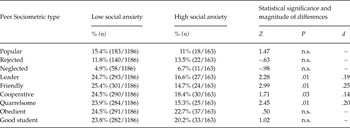
The Z-tests indicated that the prevalence in choosing popular, rejected, neglected, obedient and good students is similar for the groups of subjects with high and low social anxiety. However, the prevalence of students without high social anxiety chosen as friendly, cooperative and quarrelsome was significantly higher than the prevalence of these nominations in students with high social anxiety (see Table 1). The effect sizes ranged between .14 and .25, indicating that the magnitude of the differences was negligible in all cases.
Differences in the prevalescence of sociometric nominations performed by peers measured by the Sociometric Nomination Test in students with high and low social anxiety

Note: n.s. = non significant.
Sociometric nomination and assessment of students with high and low social anxiety performed by teachers
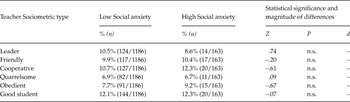
The Z-test indicated that the proportion of students nominated by teachers as leaders, friendly, cooperative, quarrelsome, obedient and good students is similar for the samples of students with high and low social anxiety, not finding statistically significant differences of proportion for any sociometric type (see Table 2).
Differences in the prevalescence of sociometric nominations performed by teachers measured by Sociometric Nomination Test in students with high and low social anxiety

Note: n.s. = non significant.
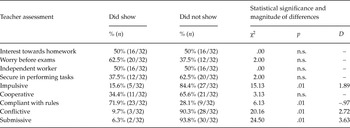
Furthermore, the results drawn from the teachers’ assessments revealed that the percentage of students with high social anxiety who are interested in homework, who worry about exams, who work independently and securely and who help peers, did not significantly differ from those students who are scarcely or not at all involved, concerned, independent, secure or prosocial. However, statistically significant differences were found for the prevalence of impulsive behavior, compliance with rules, conflictive and passive behaviors in the social interaction of subjects with high social anxiety (see Table 3). Specifically, teachers rated their students with high social anxiety as less impulsive, less conflictive, less passive and more compliant with the rules of the classroom. The differences in prevalence were of a high magnitude in all cases (d ≥ .80).
Differences in the prevalescence of social and academic behaviour rated by the teacher through the Teacher Rating Scales in students with high social anxiety

Note: n.s. = non significant.
Differences between peer and teacher nominations for students with high social anxiety
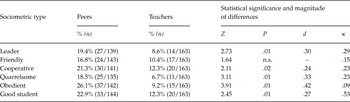
The Z-test analyzed the differences in proportions of the sociometric types in students with high social anxiety collected through two informants (peers and teachers). It detected statistically significant differences between all sociometric types except for friendly. Specifically, the results revealed that peers tended to nominate students with high social anxiety more as leaders, cooperative, quarrelsome, obedient and good students than teachers did. The magnitude of the differences found was small (d < .42) (see Table 4).
Differences in the prevalescence between peer and teacher nominations measured through the Sociometric Nomination Test in students with high social anxiety

Note: n.s. = non significant.
On the other hand, kappa coefficients reported that the degree of agreement between peer and teacher nominations was poor for most sociometric types, yielding values below .40 (Landis & Koch, Reference Landis and Koch1977). However, the degree of agreement between peers and teachers in choosing good students was adequate (k = .53).
Discussion
This study had three objectives: firstly, analyzing whether students with high social anxiety are chosen by their peers as rejected, neglected and popular, leaders, friendly, cooperative, quarrelsome, obedient and good students significantly more than students without high social anxiety; Secondly, to examine whether students with high social anxiety are nominated significantly more as leaders, friendly, cooperative, quarrelsome, obedient and good students, and are less valued for their academic motivation, self-regulated learning, and classroom behavior by their teachers, in comparison with students without high social anxiety; Thirdly, to determine whether peer and teacher assessments differ significantly for ESO students with high social anxiety.
Contrary to the first hypothesis (H1), students with high social anxiety were nominated by peers as popular, rejected and neglected with the same frequency as students without social anxiety. These unexpected findings may be due, first, to the comparison groups used in this study. Our objective was focused on comparing the rate of sociometric types between students with and without social anxiety, whereas previous studies have compared the sociometric status of aggressive, cooperative/prosocial and shy/socially anxious students (Monjas et al., Reference Monjas, Sureda and García-Bacete2008). These studies do report significant differences between groups. Specifically, Monjas et al. (Reference Monjas, Sureda and García-Bacete2008) noted that the reasons for rejecting a classmate were focused on behaviors associated with aggression, such as arrogance, dominance, intimidation and verbal/physical aggression, rather than for reasons related to the social inhibition and withdrawal. This aspect was addressed in a recent study (Inglés et al., Reference Inglés, Delgado, García-Fernández, Ruiz-Esteban and Díaz-Herrero2010), that noted that socially anxious students were the least popular amongst peers, they were less rejected than aggressive students and more neglected than prosocial students. Therefore, it is likely that the differences between groups become diluted when subjects who are socially cooperative or prosocial and those who are aggressive or those who exhibit disruptive behaviors are included within the group of students without social anxiety. Similarly, our estimation method differs from that used in other empirical studies to examine the degree of social preference or rejection (e.g., van Roy et al., Reference van Roy, Kristensen, Groholt and Clench-Aas2009), which can significantly change the values of the prevalence of sociometric acceptance and rejection.
On the other hand, it was expected that subjects with high social anxiety would be significantly less nominated by their peers within the six sociometric groups analyzed (leader, friendly, cooperative, quarrelsome, obedient and good student) than those without high social anxiety. According to previous empirical evidence on inhibited behavior in the classroom of students with social anxiety (Beidel et al., Reference Beidel, Turner, Young, Ammerman, Sallee and Crosby2007; van Roy et al., Reference van Roy, Kristensen, Groholt and Clench-Aas2009), the results indicate that they were proportionally less nominated by peers as leaders, friendly, cooperative, and quarrelsome students than those without high social anxiety. Firstly, the findings reveal that students with high social anxiety are more frequently unnoticed by their peers, as they are considered as non-influential figures within the group. This aspect could be due to the characteristic pattern of social interaction that adolescents with social anxiety exhibit. These students, while trying to avoid social situations that cause them discomfort, are more likely to be less visible and valued by their peers (Inderbitzen et al., Reference Inderbitzen, Walters and Bukowski1997). Secondly, students with high social anxiety tend to show more deficits in their social skills used to interact with their peers (Inglés, Hidalgo, & Méndez, Reference Inglés, Hidalgo and Méndez2005; Miers, Blöte, de Rooij, Bokhorst, & Westenberg, Reference Miers, Blöte, de Rooij, Bokhorst and Westenberg2013) and therefore, it is possible that they have greater difficulty in behaving prosocially in the classroom and that their peers consider them as less prosocial or cooperative.
Moreover, the results indicate that subjects with high social anxiety are chosen as good students with a similar frequency than subjects without high social anxiety. This evidence suggests that these students can be perceived by peers as academically proficient students. In this regard, a study carried out with university students noted that the perception of various characteristics of students with high social anxiety could be underestimated (e.g., attractiveness or personality), but not their ability to perform well academically as they were perceived to be as intelligent as subjects without social anxiety (Purdon, Antony, Monteiro, & Swinson, Reference Purdon, Antony, Monteiro and Swinson2001). Paradoxically, peers nominated students with high and low social anxiety with the same frequency as subjects who are obedient to the demands of peers. This result suggests that students, regardless of their social inhibition or withdrawal, are often influenced by the demands and opinions of the group, which is a characteristic feature of adolescence.
Subsequently, the differences in sociometric nomination by teachers were compared. In this regard, our second hypothesis (H2) was not confirmed as the rate of students nominated as leaders, friendly, cooperative, quarrelsome, obedient and good students did not differ significantly between subjects with high and low social anxiety. Therefore, teachers seem to value the socially anxious student’s status within the group in the same way as that of students without high social anxiety.
Finally, the findings of this study could not partially confirm the third (H3) and fourth hypothesis (H4). The results coincide with those found by Wentzel and Asher (Reference Wentzel and Asher1995) in which neglected students (profile associated with inhibited subjects) were nominated as less impulsive and having more adapted behaviors within the classroom, and rejected-shy students did not differ from average students in any of the aspects assessed by the teachers about motivation, self-regulated learning and behavior within the classroom.
However, Weeks et al. (Reference Weeks, Coplan and Kingsbury2009) suggested that teachers value academic skills more negatively across students with high social anxiety than across students without high social anxiety. It is possible that the differences with previous studies are due to the age of the students evaluated, as they compared 1st grade primary students (Weeks et al., Reference Weeks, Coplan and Kingsbury2009). In view of the findings, it is suggested that the behavioral inhibition of students with high social anxiety is favorably regarded by teachers, as the low rate of disruptive behaviors (lower impulsivity and high compliance with rules) can create a calmer climate, aiding the functioning of the class and the work of the teacher.
Regarding the fourth hypothesis, the results revealed that peers tended to nominate students with high social anxiety more as leaders, cooperative, quarrelsome, obedient and good students than the teachers (d < .42). This finding emphasizes the existence of a differential assessment of these behavioral profiles of students with high social anxiety according to the evaluation source (students vs. teachers). In addition, the agreement between the inter-source assessments was low in all cases, except for the good student profile, that is, the assessment of peers and teachers of students with high social anxiety only moderately coincides when these students are considered as good students.
This present study is not without limitations. Firstly, although the sampling method employed guarantees the representativeness of the recruited sample with respect to the target population, the results found in this study cannot be generalized to Spanish students of other educational levels (Kindergarten, Primary Education, Secondary Education and Third Level Education). Future research should confirm whether the results found for ESO (Secondary Education) differ or remain for other educational levels. Secondly, we consider it essential for a deeper understanding of the social status of students with high social anxiety that future research specifies within the set of non-anxious students those prosocial and aggressive adolescents, as well as distinguishing between purely anxious, anxious-prosocial and anxious-aggressive students. On the other hand, this study cannot refer to subjects as strictly “with” or “without” social anxiety, but rather as subjects with high or low social anxiety in the absence of a clinical diagnosis. Therefore, the high percentage of subjects that exceed the cutoff point (12%) is similar to that of other studies following administration of rating scales but significantly lower when clinical samples are considered (about 5%) (Knappe, Sagagawa, & Creswell, Reference Knappe, Sagagawa, Creswell, Ranta, La Greca, García-López and Marttunen2015). This may also explain some of the results found in relation to the absence of differences between groups. Finally, in future work, it would be advisable to use longitudinal designs to provide more conclusive data regarding the relations of influence between these variables.
On a practical level, the study of social anxiety in children could provide the keys necessary to generate new and effective preventive interventions in schools, in order to identify cases of social anxiety before they become chronic, to effectively intervene on the areas and functions affected and to improve the quality of life and group integration of inhibited students.
This research article has been financed through a predoctoral grant awarded by the Cajamurcia Foundation to the first author and through the SEJ 2004–07311/EDUC Project from the National Plan for Scientific Research, Development and Technological Innovation (MEC) awarded to the second author.