Introduction
The Fermi Paradox suggests that the timescales required for the development of an extraterrestrial civilization capable of interstellar colonization are short compared to either the age of the Earth or the age of the Galaxy. Consequently, it should be evident that the Galaxy is teeming with intelligent life forms. Their apparent absence, despite its high probability (by Fermi's reasoning) led to the question ‘where are they?’.
Numerous hypotheses have been developed to explain the Fermi Paradox. We will focus on a variant of the so-called Sustainability Solution (von Hoerner Reference von Hoerner1975; Haqq-Misra & Baum Reference Haqq-Misra and Baum2009), which argues that rapid interstellar colonization may not be sustainable, i.e. extraterrestrial civilizations that adopt a rapid colonization strategy will eventually fail. Alternatively, adopting a more sustainable approach to colonization leads to a much slower rate of interstellar colonization, if at all.
Determining the validity of the Sustainability Solution requires us to characterize the relationship between an intelligent technological civilization and its environment. While it is impossible to accurately predict the behaviour of other intelligent civilizations when we have no proof of their existence, we can adopt simple models based on known terrestrial ecology to investigate basic behavioural strategies which may be applicable.
In this paper, we demonstrate the potential utility of adapting biological and ecological theories to modelling interplanetary and interstellar colonization. This approach is speculative, and not intended as a comprehensive model of such colonization, but rather a simplified model (limited by various factors and assumptions) with the intention of demonstrating the utility of such an approach for future research. We feel that there is merit in using models of this type to frame and restrict speculation on our own species’ potential extra-terrestrial expansion as well as that of other species.
We construct our model from the following concepts: symbiosis, which describes inter-species relationships on Earth; r/K selection theory, which describes species–environment relationships in island biogeography; and the more controversial Gaian theories that model colonization of planets by life as an infectious/reproductive process occurring between pairs of super-organisms. The consideration of these three concepts leads us to a model in which intelligent civilizations pursue a symbiotic relationship with their host planet. The nature of this relationship will inform the colonization strategy. Furthermore, the Galactic population of stars and planets will have important environmental effects, rewarding and punishing certain strategies.
To this end, we have performed Monte Carlo Realization (MCR) simulations of the Milky Way, where civilizations grow and evolve from non-intelligent organisms in and among a population of stars and planets that are statistically representative. These civilizations are assigned a variety of colonization strategies, and subsequently display varying degrees of success in interplanetary and interstellar colonization. This will allow us to assess what conditions the civilizations will need to satisfy to be successful in the Milky Way (given the assumptions made in these simplified models). More specifically, we are interested in answering two key questions: What colonization strategies are more successful in the Milky Way? How is this result altered when the efficiency of interstellar colonization changes?
While the approach taken in this paper is necessarily dependent on a number of simplifications and assumptions, it does provide some useful insight into how extra-terrestrial colonization may be informed from theoretical ecology. Civilizations are no doubt much more complicated than was replicable in this exercise; our intention here has not been to illustrate a mechanistic approach to colonization, but to investigate what constraints may face colonization as well as indicating the choices that civilizations may have to make in relation to their ‘host’ planet. Also, note that we do not consider the consequences of unmanned exploration of the Galaxy, e.g. through the use of fleets of interstellar probes (Bjørk Reference Bjørk2007; Cotta & Morales Reference Cotta and Morales2009; Cartin Reference Cartin2013) or swarms of self-replicating probes (Freitas Reference Freitas1983; Wiley Reference Wiley2011, Nicholson and Forgan, submitted). While the growth of a population of entities via bifurcation has clear biological analogues, this is somewhat outside the scope of this investigation.
The paper is organized thus: in Section ‘Gaian reproduction, r/K selection and virulence’, we discuss the theories of Gaian reproduction, r/K selection and virulence; in section ‘Numerical methods’ we discuss the numerical apparatus employed in this work; in section ‘Results’ we present the results of our simulations, and in sections ‘Discussion and Conclusion’ we discuss the implications of these numerical results and draw our conclusions.
Gaian reproduction, r/K selection and virulence
According to the Gaia hypothesis (Lovelock Reference Lovelock2000) the Earth, with its biosphere, geosphere and atmosphere, is seen as a complex interacting system, similar in behaviour to a super-organism. The idea of Gaian Reproduction is a subset of this hypothesis, and argues that the Earth (or any similarly life-sustaining planet) could ‘reproduce’ through the transference of life from one planet to another. This could be achieved either through active space colonization by intelligent and technologically capable life, or through passive colonization, where microbial life is accidentally transported to another nearby planet through a meteorite impact and resulting debris, usually referred to as panspermia (e.g. Wallis & Wickramasinghe Reference Wallis and Wickramasinghe2004). Active colonization could take the form of either terraforming nearby suitable planetoids, or the discovery and settling of already habitable planets (or both).
Gaian reproduction theory espouses two reproduction strategies: the sprint and the marathon. Under a sprint approach, intelligent life pursues an unsustainable exploitation of the host planet's resources, using these resources to quickly develop the means to colonize new planets. This unsustainable exploitation could lead either to a collapse of the relevant civilization, or the collapse of the biosphere itself. Under the marathon approach, intelligent life develops an ecologically sustainable civilization. The result is a longer ‘gestation’ period before the civilization develops the capacity to colonize new hosts. It also allows for multiple waves of colonization and reduces the risk of host death (an eventuality now limited to either extra-solar events or the death of the host star).
The two reproductive approaches of sprint and marathon are related to that of r/K selection theory, developed by the field of island biogeography as a model of island colonizations by species. MacArthur & Wilson (Reference MacArthur and Wilson1967) studied the factors relating to the colonization of islands by species. In particular, they focused on the effects of the island's distance from the species source, and the rate of extinction for species on arriving to the island, which is itself a function of area, resources and carrying capacity. In the process of this theoretical work, they developed what is known today as r/K selection theory, which describes different life strategies of species, concerning a trade-off between quantity and quality of offspring.
Essentially, in r-strategy species the focus is on reproducing quickly and in the form of many offspring, but with a reduced metabolic investment (either in nutritional support or parental care), whereas K-strategy species have reduced levels of reproduction and offspring, but a greater metabolic investment, leading to a greater survival rate of individual offspring. K-strategy species out-compete r-strategy species under stable and predictable environments with limited resources and vice versa.
As such, the sprint strategy of Gaian reproduction is analogous with r-strategies and K-strategies with the marathon approach. It is important to note however that most species exhibit a continuum between r- and K-strategies, with some more adaptable species, such as humans, being historically able to adopt both strategies depending on the environmental situation.
We can make a third analogy with concepts related to virulence and symbiosis. Ultimately, symbiosis refers to a close and long-term interaction of different species, and can have, generally, three manifestations, that of parasitism, commensalism and mutualism (Boucher Reference Boucher1988; see also Odum & Barrett Reference Odum and Barrett2005, who specify eight in total, including neutralism, competition, protocooperation, amensalism and predation). The difference between these three manifestations is based on the benefit or detriment of the symbiotic relationship to the fitness of the species involved (Boucher Reference Boucher1988). These three forms of symbiosis are described below:
-
• Parasitism: one species (the parasite) benefits, while the other (the host) loses in fitness. This relationship is asymmetrical, with a benefit to the parasite involving a detriment to the host. An example of such a parasitic symbiosis would be fleas, who feed on the blood of its host, reducing its fitness.
-
• Commensalism: one species (the commensal) benefits while the other (the host) neither benefits nor is negatively affected by the relationship.
-
• Mutualism: both species, the symbiont and the host, benefit from the relationship. An example of a mutualism is that of corals and zooanthellae; the coral serves as a host to the zooanthellae, providing the symbiont with nutrients and shelter, while the symbiont provides the host with photosynthetic energy (Smith & Douglas 1987).
Virulence relates to the both the degree of damage (or loss of fitness) incurred to the host by the parasite in question, as well as the rate of infection from one host to another. The greater the damage a parasite causes its host, the greater the risk of the host dying as a result, and in the process, the lesser the chance of the parasite of infecting a new host. Only if there are multiple hosts, in close proximity, and the ability to transmit from one host to another is high, does a parasite benefit from an r strategy of virulence. If the number of potential hosts is small, or the ability to transmit to another host is low, then the optimal level of virulence for a parasite is to adopt a K strategy, leading to reduced damage to the host.
There exist a number of mathematical models for virulence, of which the below may be considered a general standard (Ebert & Herre Reference Ebert and Herre1996; Weiss Reference Weiss2002):
 $${\rm \Phi} = \displaystyle{{{\rm \beta} (N)} \over {{\rm \mu} + {\rm \alpha} + \nu}} $$
where Φ is the symbiont fitness, β the rate at which an infected host transmits the parasite, N the host density, μ the death rate of uninfected host, α the parasite induced mortality rate and ν the host recovery rate.
We will adopt this model of virulence, where intelligent civilizations are the ‘symbionts’ of their host planets. The civilizations’ behaviour is described as a continuum between mutualist and parasitic strategies (or equivalently between K and r strategies). We should therefore expect that if there are many available nearby planets as hosts, r strategies will be more successful, whereas K strategies will dominate if host planets are not in great supply. Exactly how these strategies are implemented in our numerical simulations is discussed in more detail below.
Numerical methods
To model the growth and evolution of intelligent civilizations in the Galaxy, we use the MCR techniques as described in Forgan (Reference Forgan2009), Forgan & Rice (Reference Forgan and Rice2010). In summary, the method generates a synthetic Galaxy of N stars stars, each with their own stellar properties randomly sampled from statistical distributions, such as mass (Miller & Scalo, Reference Miller and Scalo1979), age (Rocha-Pinto et al. 2000a), chemical composition (Rocha-Pinto et al. 2000b), location in the Galaxy (Ostlie & Carroll Reference Ostlie, Carroll, Ostlie and Carroll1996), etc. Planetary systems are then generated around some of these stars (depending on their chemical composition, see Wyatt et al. Reference Wyatt, Clarke and Greaves2007), and life is allowed to evolve in these planets according to some hypothesis of origin – for example, planets that exist within the continuous habitable zone of their parent star will be inhabited (more details of the continuous habitable zone can be found in Forgan & Rice Reference Forgan and Rice2010). This life is allowed to evolve using stochastic equations, which account for the possibility of ‘resetting events’ (such as asteroid impacts or local supernovae), which may impede or completely destroy life on any planet (cf. Annis Reference Annis1999; Vukotic & Cirkovic Reference Vukotic and Cirkovic2007). Life which survives to become intelligent undergoes a second phase of danger in which the civilization itself may be the architect of its demise. Civilizations which do not destroy themselves go on to colonize other planets (and in the case of this work, planets around other stars).
The end result is a mock Galaxy with billions of stars and planets, containing a population of intelligent civilizations, which is to some degree statistically representative of the Milky Way. To quantify random sampling errors, this process is repeated many times: this allows an estimation of the sample mean and sample standard deviation of the output variables obtained. Details of this sampling method can be found in (Forgan Reference Forgan2009).
Modelling civilization ‘virulence’
As we are now attempting to model the symbiotic relationship between intelligent civilizations and their host planets, we must make some modifications to the method. Firstly, each civilization is assigned a virulence parameter,
 ${\rm \tilde \alpha} $
, which is a normalized version of the α parameter discussed in the previous section.
 ${\rm \tilde \alpha} $
ranges from −1 to +1, −1 being a highly mutualist civilization and +1 being highly parasitic, with 0 representing commensalist civilizations.
Inhabited planets each possess their own intelligence timescale t
int (i.e. the time it takes for non-intelligent life to become an intelligent technological civilization), a maximum habitability timescale t
max (defined by taking the minimum of two timescales – the star's lifetime t
ms, and the timescale on which the planet moves out of the stellar habitable zone t
HZ), and a total number of resetting events the planet suffers, N
resets. We can use these variables to construct a normalized host recovery rate
 $\tilde \nu $
:
 $${\rm \tilde \nu} = \left( {\displaystyle{{t_{{\rm max}}} \over {t_{{\rm int}}}}} \right)N_{{\rm resets}} $$
As we model the extinguishing of life on planets without intelligence (see Forgan & Rice Reference Forgan and Rice2010 for details) we implicitly incorporate the ‘uninfected mortality rate’ into our calculations, hence we do not construct a corresponding
 ${\rm \tilde \mu} $
.
We assume that parasitic civilizations are more likely to be self-destructing in their early ‘fledgling’ stages (which occur before civilizations are sufficiently advanced to begin colonization). To this end, we assign a probability of self-destruction to each civilization:
 $$P_{{\rm destroy}} = {\rm MIN}\left( {\displaystyle{1 \over {{\rm \tilde \nu} (1 - {\rm \tilde \alpha} )}},1.0} \right)$$
Interplanetary colonization
If civilizations succeed in becoming advanced, they can attempt to colonize the planets in their system. The reproductive parameter
 ${\rm \tilde \beta} $
depends on the properties of the host planet and the planet to be colonized
 $${\rm \tilde \beta} = \displaystyle{{(1.0 + {\rm \tilde \alpha} )} \over {\Delta r\sqrt {M_{\,p,{\rm home}} M_{\,p,{\rm col}}}}} $$
Δr is the distance between the two planets and [M p,home,M p,col] are the masses of the civilization's home planet and destination planet, respectively. We are interested in the escape velocity of both planets, hence the square root dependence on planetary mass. This function is normalized by the maximum possible separation and planet mass allowed in the simulation (40 AU, corresponding to Pluto's orbit, and ten Jupiter masses, respectively).
The probability of reproduction, for a given planet-pair, is then
 $${\rm \tilde \Phi} = \displaystyle{{{\rm \tilde \beta}} \over {\tilde \nu + {\rm \tilde \alpha}}} $$
Using this, the code stochastically reproduces interplanetary colonization behaviour for every civilization. Reproduction will occur where the conditions are most favourable – i.e. the civilizations are more virulent, the host's recovery rate is rapid, and the planets are more easily accessible according to their escape velocity.
Interstellar colonization
We also model a limited form of interstellar colonization, using a form of revision. Consider the total civilization population over all time for one realization, without interstellar colonization. If we allow the parasitical civilizations (i.e. those with
 ${\rm \tilde \alpha} \gt 0$
) to send out colonizing parties into the Galaxy at some maximum fraction of lightspeed χ, where more virulent civilizations will travel at greater speed:
 $$v_{{\rm col}} = {\rm \tilde \alpha } \chi c$$
then we can calculate when parasites will arrive at planets inhabited by intelligent life. If they arrive before life has become intelligent, the planet can be colonized by the parasites. We assume for simplicity that if parasites arrive after intelligent life evolves on a planet, then the parasites will not attempt to colonize it. We also do not model the colonization of completely uninhabited worlds, or the subsequent secondary colonization that occurs when a colony decides to begin its own colonization missions (although this is obviously of interest for the future work).
By performing this revision in chronological order, we can see which worlds will eventually contain parasitical civilizations (even if they did not originally host them). We can also investigate what the minimum value of χ must be for parasitism to be the most favourable strategy for civilizations to adopt.
Results
To constrain the models correctly, we ran two separate tests, as the modelling process is better equipped to deal with relative differences than absolute values (Forgan & Rice Reference Forgan and Rice2010). The first (and main) simulation allows the value of
 ${\rm \tilde \alpha} $
to vary uniformly among all civilizations in the simulations. The second is a control simulation, where the stellar, planetary and biological parameters remain identical, but
 ${\rm \tilde \alpha} = 0$
and P
destroy=0.5 for all civilizations (i.e. we impose a neutral colonization strategy and we are ignorant of what causes self-destruction). This allows us to confirm what data depend on civilization behaviour, and what data depend on the stellar and planetary parameters of the mock Galaxy.
Interplanetary colonization only
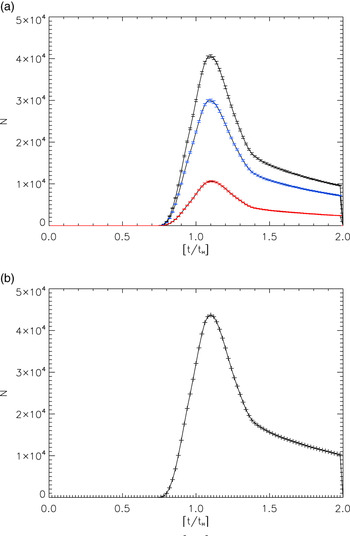
Figure 1 displays the number of intelligent (communicating) civilizations as a function of time for the main simulation and the control simulation. As we adopt the Biological Copernican Principle, and use Earth's biological history as a mean for other biological histories (see Forgan Reference Forgan2009) we self-consistently produce a ‘phase transition’ model, where the number of civilizations increases rapidly after sufficient cosmic time has elapsed. We see that in the absence of interstellar colonization, mutualism is the more successful strategy. The peak value of N occurs at t=1.1t H for all civilization types, and the trend of total civilization number is well represented in the control simulation also (although the peak N is slightly higher, due to the changed P destroy). All curves show a long tail due to interplanetary colonization extending the lifetime of the species to its maximum value (i.e. the appropriate main sequence lifetime). These results indicate that limiting the host population to the planets in one Solar System is too restrictive for parasitic species to operate as successfully as mutualists.
Comparing different civilization strategies. The top graph shows the number of civilizations of each type as a function of time, compared to the control simulation (bottom) where
 ${\rm \tilde \alpha} = 0$
for all civilizations. The parasitic civilizations are displayed in red, the mutualist in blue, and the black curve represents all civilizations. The time axis is displayed in units of the Hubble time t
H, which is equal to the current age of the Universe.

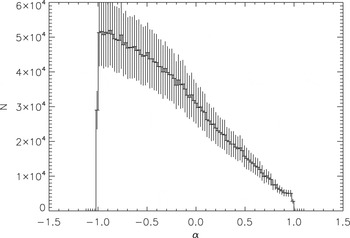
We can see this in Fig. 2. While the initial distribution of
 ${\rm \tilde \alpha }$
is even by construction, the parasitic civilizations are eventually punished for overexploiting their host's resources, and hence their total numbers are reduced due to self-destruction. Mutualists by comparison fare much better, with around five times as many extreme mutualists at
 ${\rm \tilde \alpha} = - 1$
exist compared to extreme parasites at
 ${\rm \tilde \alpha} = 1$
.
The distribution of civilization strategy in the Galaxy (without interstellar colonization). While initially there is a uniform distribution of
 ${\rm \tilde \alpha} $
among all civilizations, parasitic civilizations (
 ${\rm \tilde \alpha} \gt 0$
) are punished due to the dearth of available host planets – mutualistic civilizations (
 ${\rm \tilde \alpha} \lt 0$
) are preferred. The error bars indicate the sample standard deviation taken from 30 distinct realizations.

These results do not account for interstellar colonization, which would increase the population of available hosts. Will this increase tip the scales in favour of a parasitical strategy?
Interplanetary and interstellar colonization
We are free to modify the maximum velocity of colonization v max=χ c (where c is the speed of light in vacuo). For comparison, the Apollo 10 module holds the record for the fastest manned human vehicle, at 11 082 m s−1, corresponding to χ=3.7×10 −5. As for unmanned probes, Voyager I is currently travelling at a speed of approximately 17 062 m s−1 (χ=5.7×10 −5)Footnote 1 . It would be reasonable to assume that these are near the lower limit for interstellar speeds, as the length of the journey would allow for continued acceleration. Assuming that interstellar colonists are limited by the currently known laws of Nature, then χ=0.1 or higher becomes extremely difficult, and most likely unfeasible. The energy required to accelerate 1 tonne of matter to this velocity is at least 4.5×10¹⁷ J, around ten times the current global consumption of energyFootnote 2 . Assuming that colonization at this speed would require large ships with a self-contained population that can survive for many generations of individuals, the actual energy budget of colonization will be several orders of magnitude higher, limiting the maximum feasible velocity greatly.
As far as rocket-driven ships are concerned, a maximum velocity of χ=10 −4 is extremely difficult. The rocket equation has the following solution for the craft's fraction of mass which is fuel, γ:
 $${\rm \gamma} = 1 - {\rm exp}\left( {\displaystyle{{ - {\chi}} \over {{ \chi} _{\rm e}}}} \right)$$
where χ e is the effective exhaust velocity. To achieve speeds of χ=10 −4 with an effective exhaust velocity equal to that of the Saturn V rocket, the craft's available payload is only 0.004% of its total mass – i.e. the craft's mass will be almost entirely composed of fuel. This would suggest that in the absence of a propulsion system that does not require propellant to be stored aboard the craft, we should not expect χ to be much larger than χ=10 −4. This assumption is weakened by recent developments in solar sail technology, (e.g. IKAROS and NanoSail-D), which would not require propellant storage and would be able to use radiative pressure from nearby stars to accelerate and decelerate. However, it is unclear what the maximum feasible velocity of such an interstellar craft is. Also, judicious use of slingshot manoeuvres (Forgan et al. Reference Forgan, Papadogiannakis and Kitching2012) could help boost even quite slow craft to large speeds, but only if a large number of manoeuvres are available.
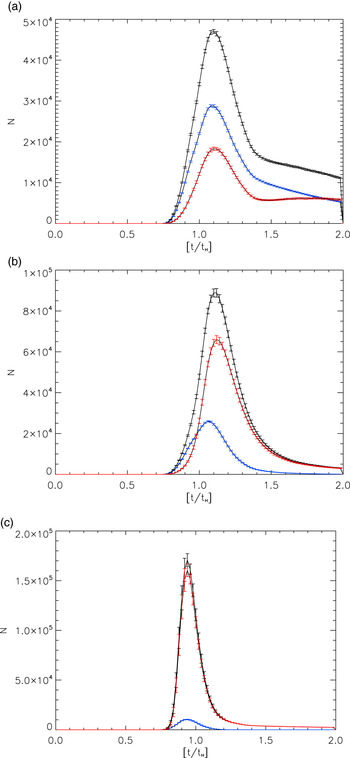
We therefore model three colonization scenarios, corresponding to χ=10 −5, 10 −4, 10 −3. The effect on the number of intelligent civilizations can be seen in Fig. 3. Even at low colonization speed, parasitism is markedly more successful, increasing its peak numbers by approximately a factor of two. The total number of civilizations also receives a boost to its peak, steepening the transition from low N to high N. The middle plot of Fig. 3 (where χ=10 −4) shows parasitism now the most numerous colonization strategy in the Galaxy. The curve becomes even narrower, suggesting that in a moderate-traffic Galaxy, the likelihood of large numbers of planets colonized by the same civilization grows. In the high-velocity case, parasites dominate and mutualism is reduced in peak value by a factor of three.
The effect of interstellar colonization speed on strategy success. As the colonization speed increases from χ=10 −5 (top), χ=10 −4 (middle) and χ=10 −3 (bottom), the parasitic strategy becomes more and more favourable, eventually dominating.

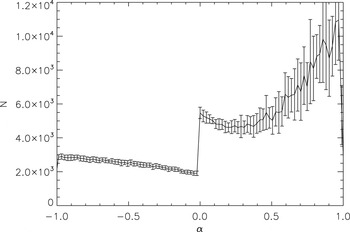
We can see this effect in the distribution of
 ${\rm \tilde \alpha} $
(Fig. 4, for the case χ=10
−4). As the colonization velocity increases with
 ${\rm \tilde \alpha} $
, more parasitic civilizations will have a better chance of succeeding at interstellar colonization, resulting in a heavy bias towards positive
 ${\rm \tilde \alpha} $
.
The effect of interstellar colonization on civilization strategy (in the case where χ=10
−4). More parasitic civilizations are more effective at colonization, so the distribution in
 ${\bi \tilde \alpha} $
becomes skewed towards more positive values. This effect increases with increasing χ.

Discussion
We note that the assumptions we have made regarding civilization behaviour are exactly that: assumptions. We selected the virulence paradigm as it is a set of self-consistent assumptions with a strong biological motivation with which to consider a highly speculative subject. We discuss our results presuming our model is correct, but we acknowledge its simplicity, and that there is no way to confirm its verisimilitude at this time.
In general, the models strongly suggest that a K-strategy (mutualism) is the preferred strategy for civilizations to engage in at an interplanetary scale, and that an r-strategy (parasitism) is only viable provided interstellar travel (at a minimum speed) is obtainable. If this minimum colonization speed is easily achieved, then parasitism should be the dominant model of extraterrestrial colonization and, all things being equal, would lead to a rapid colonization of the Galaxy.
Based on the above model, presuming our assumptions are correct, the results are potentially informative for solving the Fermi Paradox. That humanity has so far been unable to detect the presence of extraterrestrial civilizations suggests one of several possibilities:
-
1 Our assumptions about the evolution of extraterrestrial life and intelligence are wrong, or
-
2 Sufficiently rapid interstellar travel (such that a parasitical approach would rapidly colonize the Galaxy) is difficult to achieve, perhaps impossible.
-
3 Parasitic civilizations are unable to survive long enough to begin interstellar colonization.
If the models presented in this work are not predicated on incorrect assumptions, the indication is that the mutualistic approach is the norm. The energy budget for colonization ships to reach the critical velocity for successful parasitism is simply too high; civilizations in general will focus on the slow (but successful) colonization of its immediate Solar System and only rarely engage in interstellar colonization and ‘empire-building’ (Cirkovic Reference Cirkovic2008).
There is, of course, the need for further refinement of what is still a basic model. Assigning all civilizations a constant
 ${\rm \tilde \alpha }$
is almost certainly an oversimplification. The possible interactions between parasitical civilizations and mutualistic civilizations, or the interaction between rival parasitical civilizations are interesting questions that should also be addressed; and insight from immunology may be useful for modelling these in the future. The experience of invasion biology, in terrestrial systems, offers mixed insight here as well. In general, K-strategy species which have specialized for their environment (in a largely mutualist fashion) are resistant to invasion provided that the environment as a whole remains unchanged – Williamson (Reference Williamson1997) discusses various factors affecting the success of invasions (see also Allen Reference Allen2001 for an intriguing discussion on ecological resilience and invasion). Invasive species are unable to outcompete the established species, except in the event of disturbance (either natural, such as hurricances, or artificial, such as human-induced ecological degradation). To what degree this applies to interstellar colonization is an open question. In addition, we have not fully addressed the influence that terraforming capacities may have on colonization rates (with our current model being limited to the colonization of already habitable worlds, i.e. of naturally occurring hosts, as opposed to the conscious creation of hosts by the symbiont).
Also, we have restricted our discussion to one particular behavioural paradigm inspired by biological dynamics – many others could be viable as well. A good example is the spread of disease or fungal parasites among plant populations (Otten et al. Reference Otten, Bailey and Gilligan2004; Gibson et al. Reference Gibson, Otten, Filipe, Cook, Marion and Gilligan2006). Approaches based on percolation theory show that a critical threshold exists for widespread infection, and that this threshold depends on the properties of the system, including its spatial geometry. This is quite a similar finding to our own in this case – our analogous threshold is defined by the colonization velocity.
A further modelling problem relates to questions of ethics. While it is not possible to speculate on the cultural values that may develop in extraterrestrial civilizations, it is arguable that in order to develop sufficiently to the degree where interplanetary colonization is possible, societies might require a high degree of cooperation (de Sousa Ant´onio & Schulze-Makuch Reference de Sousa Ant´onio and Schulze-Makuch2010). The implications of the benefits of mutualism, within solely the interplanetary region, may mean that civilizations almost invariably adopt a mutualist phase before they are capable of engaging in interstellar colonization. It is not clear whether, having developed a mutualist civilization, the civilization will then enter into path dependency (and stay mutualist) or if the civilization may change to a more parasitical phase. Would a mutualist civilization even have an interest in pursuing interstellar colonization, with the exception of escaping its indigenous stellar collapse? If mutualist civilizations only rarely engage in interstellar colonization, and parasitical civilizations are unviable, would this explain the Fermi Paradox?
These findings – and the questions they raise – have direct relevance to the challenges currently facing humanity. Ceteris paribus, the findings of our model (cautiously) suggest that it is in humanity's interest to adopt a more mutualistic relationship with our host, the Earth (cf. Berenbaum Reference Berenbaum1999; Speth Reference Speth2009). For example, investing strongly in conservation biology and ecological restoration are important components of any mutualist approach, the fruits of which will be important for developing controlled terraforming techniques for our immediately reachable planets. In addition, investment in reversing human-induced climate change (and the associated social and economic changes required, as well as technological improvements) will be required; in short, the focus of humanity should be on realizing sustainable development; indeed, we believe the ‘civilization as symbiont’ model provides the groundwork on which to establish a scientifically measurable definition of ‘sustainable development’. While we are beginning to identify extrasolar planets in the habitable zone of their parent star (Batalha et al. Reference Batalha2013), the technology required to reach them is beyond our current capacity. Within our own Solar System there are no other fully habitable planets, although the potential for partially habitable zones in various locales exist, and there are a variety of niches from which humans could extract useful resources. For example, water is thought to exist in liquid form on Europa (Carr et al. Reference Carr1998) and Enceladus (Parkinson et al. Reference Parkinson, Liang, Hartman, Hansen, Tinetti, Meadows, Kirschvink and Yung2007; Spencer & Grinspoon Reference Spencer and Grinspoon2007), as well as ices in environments such as the lunar regolith (Anand Reference Anand2011). While not offering habitats for humanity, they may provide assistance and supply to space-borne habitats in orbit.
Finally, two important caveats must be noted:
-
1 Our calculation of the critical colonization velocity for parasite success is a sensitive function of the total number of civilizations in the Galaxy. While the stellar and planetary parameters of the simulations are reasonably well-constrained, the poorly constrained biological parameters will have a deleterious effect on the accuracy of the critical velocity.
-
2 It should be noted that absence of evidence is not evidence of absence – the lack of observed Extra-Terrestrial Intelligences (ETIs) developing unsustainably is not ironclad proof that this strategy is always unsuccessful.
Conclusions
We have conducted MCR simulations, adopting a ‘civilization as symbiont’ model to determine the fate of civilizations attempting interplanetary and interstellar colonization. Civilizations grow and evolve from non-intelligent organisms in a synthetic, statistically representative Milky Way, containing stars and planets with properties constrained by observations and theory. Each civilization is randomly assigned a set of parameters, which dictates their subsequent colonization strategy. Our aim was to study which colonization strategy is preferred: whether civilizations are more successful adopting a mutualist, K-strategy, or a parasitic, r-strategy (MacArthur & Wilson Reference MacArthur and Wilson1967).
Our results indicate that in the absence of efficient interstellar colonization, mutualist strategies are more successful than parasitic strategies, much in the same way that K-strategy species succeed over r-strategy species in isolated environments such as remote islands. However, if interstellar colonization can proceed at a sufficiently rapid rate, we find that parasitic species will eventually be favoured. The critical colonization velocity for parasites to dominate is close to the current velocity records established by humanity both with manned and unmanned spacecraft. This colonization velocity has an extremely high-energy budget per tonne of mass, suggesting that it is difficult to achieve. This would suggest therefore that mutualism is the dominant colonization strategy in the Galaxy, and therefore interstellar visitors to the Solar System are uncommon.
While this does not preclude radio signals travelling between inhabited worlds, we believe that our model offers a partial solution to the Fermi Paradox in respect of face-to-face contact. Our results are consistent with the findings of invasion biology (and to a lesser extent the colonial experiences of humanity). The simplicity of the model begs further refinement, and we believe later versions of the model will be able to fold in results from ecology, biogeography, symbiosis and immunology. While we acknowledge that the model presented in this paper is speculative, simplistic and dependent on a number of assumptions, we believe that its general approach, and insights, provides a means of framing speculation on broad trends in colonization behaviour. It is our hope that this research may provide the foundation for additional research in applying such insight from theoretical ecological modelling.
Acknowledgements
This work has made use of the resources provided by the Edinburgh Compute and Data Facility (ECDF, http://www.ecdf.ed.ac.uk/). The ECDF is partially supported by the eDIKT initiative (http://www.edikt.org.uk). We thank Dr Neil McRoberts of UC Davis for comments on an early version of the paper.