


The Queen can hardly now refuse a defeated minister the chance of a dissolution any more than she can dissolve in the time of an undefeated one, and without his consent. (Walter Bagehot, The English Constitution, 1872, 329)
[L]e droit de dissolution est une des prérogatives personnelles du Président de la République . . . ce droit s'exerce pratiquement sans limitation . . . (Maurice Duverger, La Cinquième République, 1959, 37–8)
A question of confidence, which is aimed at the dissolution of the Bundestag, is only constitutional . . . when a government, anchored in the parliament, has lost its ability to act. . . . Three constitutional organs—the Chancellor, the Bundestag and the President—each have it in their hands to forestall dissolution based on their own political judgement. This serves to establish that the government can reliably be assumed to have lost its parliamentary ability to act. (Bundesverfassungsgericht, 2005. Leitsätze zum Urteil vom 25, August 2005, translated by the authors)
Government termination marks the point at which policy choices change and the meaning of voter decisions is reinterpreted, or at which politicians may choose to appeal anew to the voters for a mandate. As Bagehot notes, “a change of government is a great result. It has a hundred ramifications; it runs through society; it gives hope to many, and it takes away hope from many” (Reference Bagehot1872, 92). Because government terminations are so very central to the workings of representative democracy, they have generated major scholarly interest and a substantial literature. Yet, in understanding why governments terminate or survive, the multiple paths to cabinet termination and the range of the actors involved continue to pose fundamental challenges.
The vast majority of European governments are terminated by the discretionary choice of politicians, who can achieve government change via one of two paths: early elections or nonelectoral replacement. The quotations that precede this introduction illustrate the diversity of the actors and conditions that govern access to just the first f these two paths: early elections. As Bagehot observes, in the UK, the decision to terminate governments by early elections can be controlled by the prime minister. This makes the strategic timing of elections to maximize the government's reelection chances “a key in the armory of the incumbent” (Smith Reference Smith2004, 11), and elections dominate the survival of UK governments comprehensively. In the French Fifth Republic, in contrast, the power to dissolve the assembly does not lie with the prime minister, but is the personal prerogative of the president, as Duverger (quoted previously) makes clear. Although presidents have used this power to address crises and to generate supportive assembly majorities, “in France, unlike Britain, premature dissolutions have been the exception rather than the rule” (Goldey Reference Goldey1998, 536). Early elections are even less frequent in Germany, where the constitution powerfully constrains the discretionary calling of elections, as the Federal Constitutional Court noted (quoted previously), when it ruled on Chancellor Gerhard Schröder's attempt to achieve an assembly dissolution by engineering his government's parliamentary defeat in 2005. As we see later in this article, additional variation characterizes the institutional rules that govern the nonelectoral replacement of cabinets. Our aim is to shed light on the most critical aspects of this institutional diversity, and to chart its effects on the durability of governments and the manner in which they terminate.
The diversity of the rules that regulate government termination in Europe's main types of democracies—constitutional monarchies, parliamentary republics, and semipresidential republics—reflects two major constitutional developments of the 20th century. First, the trend away from constitutional monarchies and toward the adoption of republican constitutions has progressively limited the discretion of governments to control the manner and timing of their own termination. Democratizing constitutional monarchies in the 19th and early 20th century were primarily concerned with transfering power from monarchs to parliaments and governments, and tended to leave wide discretion to prime ministers in managing the government's activities and departure. Newer republican constitutions, in contrast, tend to limit cabinet discretion by imposing constraints on a government's ability to call early elections and by inserting presidential heads of state into decisions to terminate governments. Second, with the democratic transitions of the 1990s, semipresidential republics, which combine a popularly elected fixed-term president with a prime minister and government responsible to the assembly (Elgie Reference Elgie and Elgie1999, 13), became the constitutional type of choice among the new democracies of Europe (Amorim Neto and Strøm Reference Amorim Neto and Strøm2006). The popularly elected presidents featured by these republics are often invested with much more extensive powers to influence government termination than monarchs or parliament-elected heads of state in parliamentary democracies. Today popularly elected presidents outnumber both monarchical and parliament-elected heads of state in Europe, and their influence on government durability and patterns of government termination is considerable.
We see the lacunae in the current work on government termination and survival in three areas. First, after decades of research on government durability, it is remarkable that only two controlled comparative studies (Saalfeld Reference Saalfeld, Müller, Strøm and Bergman2008; Strøm and Swindle Reference Strøm and Swindle2002) have begun to examine the striking constitutional variations in the rules that govern cabinet termination, including the difference that heads of state make to government survival. One of the most widely shared assumptions in the comparative literature on government survival is that all European democracies are parliamentary democracies, but they are not, and the proliferation of semipresidentialism in Europe during the 1990s puts the literature on cabinet survival increasingly at odds with the continent's constitutional realities. Second, although scholars working on semipresidentialism have long recognized the influence of presidents on government survival and argued that it is likely to diminish the longevity of cabinets (Linz Reference Linz, Linz and Valenzuela1994; Shugart and Carey Reference Shugart and Carey1992), this literature has to date remained divorced from the work on cabinet survival, and its propositions have yet to be systematically assessed in large-n controlled comparative work. Third, it is striking that 20 years after the transitions of the 1990s, none of the empirical work on government durability has yet integrated data on East European governments. This article seeks to redress the gaps in all three areas.
We do so by charting the tremendous variation in the constitutional rules that govern cabinet termination in Europe, and by synthesizing and testing for the first time the diverse elements of existing theory about its effects on government survival. Using the most extensive data set on European governments available, which combines the data assembled by Strøm, Müller, Bergman, and coauthors (www.pol.umu.se/ccpd/) on Western Europe with original data on cabinets in East European democracies, our results suggest that constitutional rules have strikingly powerful effects on government survival and the mode of government termination. These results alter the existing understanding of government durability and termination, and have implications for a wide range of issues of interest to political scientists. Among other things, we show that governmental discretion to time elections is significantly less common in Europe than scholars have assumed. This finding has ramifications for work on electoral accountability, endogenous election calling, and political business cycles.
VARIATION IN THE CONSTITUTIONAL RULES AND PATTERNS OF GOVERNMENT TERMINATION
When politicians terminate governments discretionarily, they either negotiate a nonelectoral replacement government for the remainder of the current interelection period, which must end when the next mandatory elections are due, or they opt for early elections, which give a mandate to govern for a full new interelectoral term. Constitutions typically regulate both types of early terminations. This section provides an overview of the constitutional variation across Europe, and shows that the degree of discretion, which constitutions give to governments to manage their termination, is correlated with the constitutional status of the head of state in constitutional monarchies, parliamentary republics, and semipresidential republics.
Table 1 details the constitutional rules and patterns of government termination in 31 parliamentary and semipresidential democracies in Western and Eastern Europe from 1945 (or the point at which the first government under a democratic constitution was formed) to the end of December 2004. Like Müller and Strøm (Reference Müller and Strøm2000, 12), we record a new government with each change of prime minister, each change of the parties in government, and after each general election. In all, the data include 542 cabinets, 163 in constitutional monarchies, 132 in parliamentary republics, and 247 in semipresidential republics.
Constitutional Rules and Frequency of Dissolution and Replacement Terminations by Country

* Norway is excluded because the constitution does not allow the dissolution of parliament.
** Dissolution in Sweden does not start a new parliamentary term. The newly elected parliament serves out the fixed term of its predecessor.
*** The president's power to dismiss the government was removed from the Ukrainian constitution in 2006.
Constitutional Monarchies
Europe's constitutional monarchies (top section of Table 1)—Sweden, Luxemburg, the Netherlands, Belgium, the UK, Denmark, and Spain—are parliamentary regimes, in which voters elect only one branch of power, parliament. As in other parliamentary regimes, the government, that is, “the Prime Minister and his or her cabinet are accountable to any majority of the members of parliament and can be voted out of office by the latter, through an ordinary or constructive vote of no confidence” (Müller, Bergman, and Strøm Reference Müller, Bergman, Strøm, Strøm, Müller and Bergman2003, 13). The defining feature of the monarchies is that they have a hereditary rather than a presidential head of state. Although monarchs often have constitutional prerogatives that are similar to those of powerful presidents, such as the power of government dismissal, their constitutional status ensures that they are in no position to use these powers (hence, the monarch's powers are bracketed in Table 1). This is because monarchs lack electoral legitimacy, and the agreements that marked their subordination to democratic government typically require them to exercise their powers on the advice of parliament and government, and constrain them to be nonpartisan figures. Monarchies therefore impose hardly any constraints on a government's ability to manage its demise, so that the mode and timing of government termination is powerfully structured by the governing parties’ interests, often as interpreted by the prime minister. The Danish case illustrates this well. Danish prime ministers can manage government terminations freely by calling strategically timed early elections. In November 2007, Denmark's Prime Minister Anders Fogh Rasmussen could therefore take advantage of high approval ratings and strong economic growth by calling a snap election that his center-right government won, securing a third consecutive term in office.
Parliamentary Republics
The newer constitutions of Europe's parliamentary republics (middle part of Table 1) tend not to give governments that level of discretion. Two parliamentary republics take control over dissolution out of the hands of government by granting unilateral powers to dissolve to the president (Italy and Greece up to 1985). Most of the remaining parliamentary republics constrain dissolution by allowing early elections only with overwhelming parliamentary support (by a supermajority), or in situations of government failure or severe gridlock and with presidential approval (exceptions are Greece since 1986, and Hungary). The majority of parliamentary republics therefore require agreement between multiple actors in order for assembly dissolution to occur. Although such constitutions do not rule out early elections, they make strategic election calling difficult, as the German Chancellor Helmut Kohl's attempt to secure an assembly dissolution in 1982/3 illustrates. The German Basic Law allows dissolution as a consequence of government failure, but the Kohl government had a clear majority when it formed in 1982 through the FDP's decision to switch its support from an SPD-led government to Kohl's CDU/CSU in the middle of a parliamentary term. The chancellor believed that he needed a popular mandate for this new coalition and thus “‘manufactured’ a defeat in a vote of confidence, with some government supporters abstaining in order to enable an early dissolution” (Saalfeld Reference Saalfeld, Strøm, Müller and Bergman2003, 357). Although the reluctant Federal President Carstens agreed to dissolve, Kohl's controversial manipulation of the Basic Law triggered the involvement of the Federal Constitutional Court (Pulzer Reference Pulzer2006, 561). Eventually, the Court's ruling ended two months of uncertainty and cleared the way to early elections. As this convoluted path to early elections illustrates, parliamentary republics tend to place significant obstacles in the way of governments that seek to manipulate election timing opportunistically.
Semipresidential Republics
Europe's semipresidential regimes tend to remove government termination even further from the control of the government. These regimes are defined by the existence of “a popularly elected, fixed term president . . . alongside a prime minister and cabinet who are responsible to parliament” (Elgie Reference Elgie and Elgie1999, 13),Footnote 1 and many of them give their popularly elected presidents significant powers over government termination. As Table 1 (bottom section) shows, about half of these regimes constrain dissolution like parliamentary republics. The main difference to parliamentary republics is that semipresidential regimes more frequently give the president the power to dissolve the assembly discretionarily, and even powers to dismiss the government (in addition to the assembly's ability to dismiss the government though a no confidence vote). For this reason, the head of state's interests often have a much greater influence on the mode and timing of government termination in the semipresidential republics than in parliamentary republics or monarchies. For instance, the Russian governments of prime ministers Chernomyrdin, Primakov, and Stepashin fell because they lost President Yeltsin's, not the assembly's confidence (Morgan-Jones and Schleiter Reference Morgan-Jones and Schleiter2004). The dissolution of the Portuguese assembly following the collapse of the Soares government (a coalition of Socialists and Social Democrats) in 1985 reflected presidential not government interests. In fact, the outgoing prime minister Soares had written to President Eanes, pledging his party's support for a nonsocialist government in order to avoid early elections. Yet, the president chose early elections in the expectation that they would benefit a new party, the PRD, which he was expected to lead after standing down as president (Lobo Reference Lobo2001, 191–2).
In addition to summarizing the rules that govern the termination of cabinets, Table 1 also reports the proportion of dissolution and replacement terminations by country. Clearly, there is considerable cross-country variation in the susceptibility of governments to early terminations. But despite that variation, two striking patterns emerge. First, only in constitutional monarchies—where governments have much broader discretion to decide their fates than in republics—are early elections more common as a mode of discretionary cabinet termination than nonelectoral replacements.Footnote 2 In republics that relationship is inverted, which correlates with the constitutional constraints that republican constitutions place on the government's discretion to dissolve. Second, the data are suggestive of a substitution effect between the two modes of government termination. When discretionary dissolution is an option, politicians tend to use it and nonelectoral replacements are less frequent. However, when the use of dissolution is constitutionally constrained, the frequency of replacements rises. In sum, Table 1 musters considerable prima facie evidence to suggest that constitutional rules have powerful effects on the frequency and type of early government termination. These patterns are clearly worth exploring, and we now turn to that challenge in the second part of the article.
CONSTITUTIONAL EFFECTS ON THE TWIN HAZARDS OF DISCRETIONARY GOVERNMENT TERMINATION
Scholars have made significant progress in understanding the decisions of politicians to terminate governments discretionarily (Baron Reference Baron1998; Laver and Shepsle Reference Laver and Shepsle1996; Lupia and Strøm Reference Lupia and Strøm1995; Strøm and Swindle Reference Strøm and Swindle2002). Lupia and Strøm's (Reference Lupia and Strøm1995) work proved seminal in this respect. On the one hand, it made clear that politicians choose between two mutually exclusive ways of ending a government early: assembly dissolution and new elections or nonelectoral replacement of the government. On the other hand, it provided the detailed reasoning to set out how politicians’ choices between these options are driven by their preferences, the attributes of the existing coalition, outside options, and exogenous shocks.
This work triggered two major developments in the study of cabinet survival. First, Diermeier and Stevenson (Reference Diermeier and Stevenson1999, Reference Diermeier and Stevenson2000) demonstrated that the twin risks of early government termination, which Lupia and Strøm (Reference Lupia and Strøm1995) outlined theoretically, are empirically distinguishable, and have distinct correlates. This transformed the study of cabinet survival into the study of two competing risks, dissolution and replacement, as opposed to a single generic risk of government termination. Second, the specification of an explicit bargaining model by Lupia and Strøm made it easy to see that the literature up to this point had not adequately captured how institutions structure bargaining about cabinet termination. As scholars began to probe the assumptions of the Lupia and Strøm model by asking which actors in fact have the power to influence government termination, the research focus shifted toward institutions (Baron Reference Baron1998; Druckman and Thies Reference Druckman and Thies2002; Saalfeld Reference Saalfeld, Müller, Strøm and Bergman2008; Strøm, Müller, and Bergman Reference Strøm, Müller and Bergman2003; Strøm and Swindle Reference Strøm and Swindle2002). Strøm and Swindle's (Reference Strøm and Swindle2002) work on assembly dissolution pushed further in this direction than any previous work had done because it marked the first attempt to detail the hazard-specific effects of institutional rules—in this case, the effect of dissolution rules on the hazard of dissolution and early assembly elections. This work was path-breaking, but had one major omission—it approached bargaining about early elections in isolation from the alternative available to politicians, nonelectoral government replacement. Yet, Lupia and Strøm (Reference Lupia and Strøm1995) made clear that these two risks of early government termination compete: politicians who might benefit from early elections will not inevitably call, but may instead deploy their bargaining power to extract advantages by nonelectoral means (655). This implies that the variation in the power to dissolve the assembly, which Strøm and Swindle identify, may structure not just the risk of assembly dissolutions, but also of discretionary nonelectoral cabinet replacements. Indeed, Table 1 strongly suggests that the two risks that governments face may be linked by the institutional rules that structure bargaining about cabinet termination.
The challenge now lies in charting how constitutional variation affects both risks of early government termination. Three literatures—studies of early election calling, nonelectoral government replacements, and semipresidentialism—generate expectations about the degree to which the different types of constitutional rules restrict or permit dissolution and replacements, and about the potential constitutional source of the substitution effects between the two modes of government termination that Table 1 suggests. This section draws from this work a set of hypotheses, which summarize the current understanding of constitutional effects on government termination. In doing so, we recognize, of course, that constitutions operate in the context of stochastic events such as economic shocks and scandals, which influence bargaining about government termination, as do the attributes of the current government itself, of parliament, and of the wider political system (Browne, Frendreis, and Gleiber Reference Browne, Frendreis and Gleiber1986; Diermeier and Stevenson Reference Diermeier and Stevenson2000; Druckman and Thies Reference Druckman and Thies2002; King et al. Reference King, Alt, Burns and Laver1990; Saalfeld Reference Saalfeld, Müller, Strøm and Bergman2008; Warwick Reference Warwick1994). These insights will guide our choice of a statistical model and our selection of control variables, but for now we focus on the effects of the constitutional rules.
Work on Early Election Calling
Constitutions can be more or less restrictive of early election calling, depending on where they place agenda and veto power and how they influence the costs and benefits of government termination to the relevant actors (Strøm and Swindle Reference Strøm and Swindle2002, 577–80). Attention to both aspects of constitutions figures prominently in work on early election calling, where scholars have particularly focused on the incentives for governments to cut short their own term by calling early elections. These incentives are well understood: a strategically timed election, such as one that coincides with an expanding economy, can boost the government's chances of reelection (Kayser Reference Kayser2005, 17), and the prize of victory is, of course, the ability to “reset the clock” and to start a full new term in office (Balke Reference Balke1990). Although Smith (Reference Smith2004) notes that early election calling signals to voters that the government anticipates a decline in its future performance, theoretical and empirical work suggests that the benefits of a strategically timed election can outweigh the loss of support among sophisticated voters that such a signal may trigger (Blais et al. Reference Blais, Gidengil, Nadeau and Nevitte2004; Lupia and Strøm Reference Lupia and Strøm1995, 655–6; Strøm and Swindle Reference Strøm and Swindle2002, 577–8). Consequently, governments seek to manage their terminations, and as their remaining months in office dwindle (decreasing the opportunity costs of calling elections early), they become increasingly likely to seize events that allow them to face the electorate under favorable circumstances (Diermeier and Stevenson Reference Diermeier and Stevenson2000; Lupia and Strøm Reference Lupia and Strøm1995, 656).
Most scholars assume that governments can discretionarily control the choice of calling early elections either via cabinet collectively or through their parliamentary majority (Balke Reference Balke1990; Laver Reference Laver, Weingast and Wittman2006, 124; Lupia and Strøm Reference Lupia and Strøm1995, 648; Warwick Reference Warwick1994). But as Strøm and Swindle (Reference Strøm and Swindle2002, 580) note, constitutional rules vary in where they place agenda and veto power, and thereby affect the ease with which politicians can access early elections. We focus here on the restrictiveness of three key variations in dissolution rules: prime ministerial control over dissolution, constrained dissolution, and presidential discretion to dissolve.
Prime ministerial discretion differs from majority (and cabinet)-controlled dissolution because the prime minister can dissolve unilaterally, without the agreement of any potential coalition partners in government and the assembly. The role of coalition partners as potential veto players in decisions to dissolve thus falls away. The implication is that dissolution can occur more easily (compare Strøm and Swindle Reference Strøm and Swindle2002, 581–2). The first hypothesis that arises from work on early election calling, then, is that
H1: Prime ministerial control of dissolution raises the risk of government termination by early elections compared to cabinet or majority-controlled dissolution.
In contrast, constitutions that constrain dissolution add veto players to the process of calling early elections compared to cabinet or assembly majority-controlled dissolution. Although the details of these constitutions vary, three common patterns emerge. First, constrained dissolution rules permit early elections only with overwhelming parliamentary support (by a supermajority), or as a consequence of a loss of assembly confidence in the government, government formation failure, or a gridlocked assembly. Second, most of these constitutions place the final decision to dissolve in the hands of the president, and as Lupia and Strøm note, “in the case where dissolution requires a . . . head of state's approval, dissolution is at least marginally more difficult to accomplish [than by a parliamentary majority on its own]” (Lupia and Strøm Reference Lupia and Strøm1995, 654). Third, many of these constitutions require repeated failures (e.g., three failed votes of investiture) before dissolution can occur. In sum, constitutions that constrain dissolution are generally more restrictive than majority- or cabinet-controlled dissolution because they require the preferences of more actors to be aligned, often at several points in time. Indeed, the consensus in the case-oriented literature is that countries that feature constrained dissolution powerfully limit early election calling (Kysela and Kuhn Reference Kysela and Kuhn2007, 98; Tanasescu Reference Tanasescu2008, 84–5). As Saalfeld (Reference Saalfeld, Strøm, Müller and Bergman2003) concludes with respect to the German constitution, “[d]e jure and de facto it is extremely difficult for the Chancellor to bring about an early dissolution of the Bundestag” (Reference Saalfeld, Strøm, Müller and Bergman357). The expectation that derives from work that comments on constrained dissolution, then, is that
H2: Constrained dissolution lowers the risk of government termination by early elections compared to cabinet- or majority-controlled dissolution.
Although constitutions that grant presidents discretion to dissolve appear similar to those that empower the prime minister because they allow a single actor to call unilaterally, the literature notes that a president's incentives to use this power differ from those of the prime minister (see Strøm and Swindle Reference Strøm and Swindle2002, 582). The reason for this is that the president's constitutional position and functions structure his or her benefits and costs from dissolution differently. Presidents originate through separate popular or indirect election, have a fixed term, and their constitutional role is that of a head of state with a degree of executive power. Unlike prime ministers, presidents can therefore never gain a new term in office by dissolving the assembly, but can only advantage their copartisans or disadvantage the opposition in parliament (Freire and Lobo Reference Freire and Lobo2006; Szarka Reference Szarka1997). Moreover, in doing so, they cut short the term of a popularly elected branch of power, and have to have regard for how voter perceptions of that decision affect their own popularity as presidents, their authority as head of state, and their support in the next presidential elections (Pasquino Reference Pasquino1999, 408). Indeed, the consensus in the case-oriented literature is that presidential assembly dissolutions, which voters perceive as opportunistic (rather than as a response to governance problems or voter choices in the presidential elections), inflict serious costs on the president. For instance, the literature notes that President Chirac's opportunistic assembly dissolution in 1997 not only cost him his assembly majority and damaged his authority as head of state, but also cleared the path for constitutional amendments that weakened the French presidency (Goldey Reference Goldey1998, 537; Hainsworth Reference Hainsworth1998, 72; Szarka Reference Szarka1997, 193). Such costs may help explain why Italian and Portuguese presidents in practice exercise restraint and only tend to recall parliaments that are perceived as unable to produce workable governments (Amorim Neto and Lobo Reference Amorim Neto and Lobo2009, 234–44; Bull and Newell Reference Bull and Newell2005, 129). In sum, the literature on early election calling by presidents makes clear that presidents risk incurring significant costs, and can never achieve a benefit that is equivalent to a prime ministers’ full new term in office by dissolving the assembly. The expectation arising from this work is that
H3: Presidential control of the power to dissolve lowers the risk of government termination by early elections compared to prime ministerial discretion to dissolve.
Work on Nonelectoral Replacement and the Power of Dissolution
Turning to the risk of early government termination by nonelectoral replacement, the intuition that control of dissolution affects a government's replacement hazard has a long history, and the key suggestion is that a government's ability to control dissolution gives it an important tool to manage and discipline the assembly. The origins of this view can be found in Bagehot, who notes “though the leaders of party no longer have the vast patronage of the last century with which to bribe, they can coerce by a threat far more potent than any allurement—they can dissolve. This is the secret which keeps parties together” (Reference Bagehot1872, 222). Laver, more recently, too, notes that a prime minister's control over the “doomsday device” of dissolution enables him or her to manage and limit parliamentary rebellions through the countervailing threat of dissolution (Reference Laver, Weingast and Wittman2006, 124–5). This, then, is potentially a constitutional source of the substitution effects between dissolution and replacements that Table 1 seems to document because the implication of Laver's analysis is that governments, which cannot invoke dissolution to manage the assembly, are more vulnerable to revolt and replacement. The expectation arising from this work is that
H4: Constitutions that constrain dissolution, or give the dissolution power to the president, raise the risk of early government termination by nonelectoral replacement compared to those that enable the government to invoke dissolution.
Work on Semipresidential Constitutions
Finally, we turn to constitutions that allow presidents to dismiss the government at will. This power has to date received no attention in the government duration literature, but has been a focal point for scholars of semipresidentialism in the debate about the benefits and drawbacks of the regime type. The expectation that constitutions with more powerful presidents, in particular those that have the power to dismiss the government, foster government instability compared to constitutions that make the government accountable to the assembly, only is widespread in the literature on semipresidentialism (Linz Reference Linz, Linz and Valenzuela1994; Roper Reference Roper2002; Shugart and Carey Reference Shugart and Carey1992, 118–21). Because president and assembly can topple the cabinet unilaterally as soon as they perceive it to be politically opportune, symmetrical cabinet dismissal powers can contribute to “the unstable pattern of appointment and dismissal that we see in Weimar, Cuba, Peru and Chile before 1925” (Shugart and Carey Reference Shugart and Carey1992, 121). Moreover, “[s]ymmetrical powers of cabinet dismissal ‘confuse’ the cabinet members. Especially when the president and parliament are at odds, the cabinet is confronted with the necessity to pursue contradictory and competing courses of actions advocated by its principals” (Protsyk Reference Protsyk, Rosenbaum and Nemec2006, 21). This diminishes the policy benefits that politicians can expect to derive from the cabinet and lowers its value to all actors concerned, so that they may be more inclined to terminate the government early either by replacing it or by opting for early elections. Cabinets that are subject to symmetrical accountability are therefore expected to face a higher risk of being terminated early—either by replacement or early elections—than those that are accountable to the assembly only. In sum, the hypothesis that arises from work on semipresidentialism is that
H5: The presidential power to dismiss the government raises both hazards of early government termination compared to constitutions that make the government accountable to the assembly only.
These five hypotheses summarize the expectations that scholars have formulated to date about constitutional effects on the two competing risks of early government termination. Testing these hypotheses in a competing risks framework enables us to trace how constitutional rules structure each of the twin hazards of early government termination and to examine the potential sources of the potential substitution effects between dissolution and nonelectoral government replacements that Table 1 suggests.
Variables and Operationalisation
In this section, we detail the operationalization of our dependent and explanatory variables and introduce the control variables (data sources for all variables are listed in the Appendix). Because we are interested in the effect of institutional rules on the durability of governments, our dependent variable is the Failure or Survival Time of a Government in days. Because we want to examine the risk of two types of early failure, dissolution and nonelectoral replacement, we record which type (if any) was suffered by a government. Discretionary dissolution is defined as a situation in which politicians choose to call a preterm assembly election and contrasts with constitutionally triggered early elections (e.g., following a constitutional amendment) and regular elections, which occur when a government's constitutional term expires. In operational terms, the distinction between early and regular elections is complicated by the fact that regular elections are frequently not held on the very last day of a government's term, but are often scheduled with some flexibility—to coincide with a particular weekday, to avoid public holidays, etc. To take account of that flexibility, we treat those elections that are held within a month of the expiry of a government's term as regular elections and those that are held before this threshold as early. Discretionary replacements are cabinet terminations that are precipitated by a change of the parties in government or a change of prime minister, which is not triggered by early elections or for some constitutional reason. When governments end for constitutional reasons or when their termination lies beyond the end date of our study, we record their survival time and the fact that they encountered no discretionary failure during the period of observation.
Explanatory Variables
Our explanatory variables—the Premier's Initiative to Dissolve, Constrained Dissolution, Presidential Discretion to Dissolve the Assembly, and a President's Power to Dismiss the Government—are indicator variables recorded on the basis of the constitutional texts (1 if the institutional rule is present, 0 otherwise).
Controls
Our selection of control variables includes presidential elections, as well as government, parliament, and polity attributes, and is informed by the literature on cabinet survival. This section spells out their operationalization and our expectations regarding their effects in a competing risks framework, because, with the exception of Saalfeld (Reference Saalfeld, Müller, Strøm and Bergman2008), the existing literature has only detailed expectations about their effects on a generic pooled termination hazard, or on the dissolution hazard alone (Strøm and Swindle Reference Strøm and Swindle2002).
Presidential Elections. We control for Popular and Indirect Presidential Elections to ensure that we do not attribute effects to the constitutional rules, which are in truth the result of fresh legitimation. Presidential elections can be expected to boost the bargaining power of presidents, thereby raising both hazards for governments. Because popular elections (in semipresidential republics) may have a greater effect empowering presidents than indirect elections (in parliamentary republics), we record separate indicators, which take value 1 from the day of the presidential election to the termination of the incumbent government.
Government-Specific Attributes. The attributes of a cabinet are believed to be strongly associated with the value that it has for politicians in terms of the office and policy benefits that it confers. To control for these effects, we include six government characteristics, five of those in the form of indicator variables (1 if the characteristic is present, 0 otherwise). The inclusion of the President's Party in Government can be expected to raise its value to the president, who may use any legislative and cabinet related powers he or she may have to promote the government's control of the legislative agenda and survival in office. Consequently, the dissolution and the replacement hazard of these governments ought to be lower than that of governments that exclude the president's party. In a similar way, inclusion of the Median Party in Government should raise the policy value of the cabinet to politicians and its life expectancy compared to cabinets that do not. The reason for this is that the government is likely to require the median legislator's support to pass legislation and to stay in office. Although policy spaces in practice are hardly ever unidimensional, the dimensions are usually correlated (Laver and Shepsle Reference Laver and Shepsle1996, 234–5, 279), so that cabinets, which contain the median legislator's party on a central policy dimensions, should face lower dissolution and replacement hazards. We identify the median party as the party of the median legislator on the comparative party manifestos project's left–right policy dimension. In a related way, Single-Party Government, which confers undivided office and policy benefits to the incumbent party, has a higher value to that party than a coalition. Hence, we would expect single-party government to reduce a cabinet's nonelectoral replacement hazard. However, as Strøm and Swindle (Reference Strøm and Swindle2002) show, single-party government is also likely to have a countervailing effect on dissolution because it concentrates decision-making power. As they put it, “when the prime minister has no coalition partner . . . there will never be a member of the cabinet with a partisan incentive to oppose the request for dissolution” (Strøm and Swindle Reference Strøm and Swindle2002, 582). The influence of single-party government on early election calling is likely to reflect both effects, so that any reductive impact on the dissolution hazard might be reduced or outweighed by the enabling effect on the prime minister.
In contrast, Minority Governments confer reduced policy benefits to politicians because they are “less capable of controlling the legislative agenda than others and, therefore, less likely to generate effective public policy” (Strøm and Swindle Reference Strøm and Swindle2002, 548). In addition, they are more vulnerable to opposition-inspired votes of no confidence. Similarly, Caretaker Governments have reduced value to politicians because they are temporary governments, installed as custodians of national affairs until the formation of a regular government or early elections, and often lack authority to initiate new policy. This limits the office and policy benefits that can be derived from caretaker governments. Both types of government should therefore face raised replacement and dissolution hazards compared to majority governments and regular cabinets.
The final government characteristic is Maximum Duration of the Government (in years) until the expiry of the constitutional interelection term measured at the time of government formation. As we noted previously, the expected office and policy benefits that can be derived from the continuation of the current government decrease as mandated elections approach (Balke Reference Balke1990, 202–3, Kayser Reference Kayser2005, 22, Lupia and Strøm Reference Lupia and Strøm1995, 656). Thus, the shorter a government's maximum duration, the higher the risk that it will be terminated early to allow strategically timed early elections. However, nonelectoral replacement should not become any more attractive as a government's term elapses. We therefore expect differential effects of a government's maximum term: as it shrinks, the dissolution hazard should rise, but the replacement hazard should remain unaffected.
Parliament-Specific Attributes. The attributes of the parliament, such as parliamentary fragmentation, polarization and the complexity of bargaining between coalitionable parties, have been linked by scholars to a government's prospect of legislative success and survival, and are believed to raise the overall hazard for governments, that is, both the replacement and dissolution risk (King et al. Reference King, Alt, Burns and Laver1990, 858, 863; Laver and Schofield Reference Laver and Schofield1990, 161). We measure Parliamentary Fragmentation by the effective number of parties in parliament using the Laakso-Taagepera Index, Ideological Polarization by the ideological distance between the leftmost and rightmost parties in parliament on the left–right dimension of their comparative manifesto data ratings, and Duration of Government Formation Negotiations (in days) by the complexity and depth of policy differences between coalitionable parties in the assembly.
Political System Attributes. We also control for attributes of the wider political system that might be believed to influence the survival prospects of governments. Although our explanatory variables capture the main rules that regulate government termination, it is possible that other institutional features such as Bicameralism, and whether a country is a Parliamentary or Semipresidential Republic, affect government survival by adding complexity to the legislative process. Because these institutional features add presidents or an upper house as potential veto players to the legislative process, they many be believed to lower the policy benefits to be gained from governing, and to raise the replacement and dissolution hazards for governments compared to unicameral systems and constitutional monarchies (Druckman and Thies Reference Druckman and Thies2002). Similarly, a positive Vote of Investiture, which requires legislators to endorse governments actively, rather than just tolerate them passively, is usually believed to increase the overall hazard for governments (King et al. Reference King, Alt, Burns and Laver1990; Warwick Reference Warwick1994). These three variables are recorded as indicator variables (1 if the feature is present; otherwise, 0). In addition, longer Constitutional Interelection Periods, recorded in years, are believed to raise the dissolution hazard (Strøm and Swindle Reference Strøm and Swindle2002), but not the replacement hazard. Finally, we include the Age of Democracy measured in years (logged) to capture the large differences in democratic experience between the countries that we examine. It is possible that governments face generally raised early termination hazards in the early years of democratic rule because actors may probe the limits of their constitutional powers and the rules of coalition bargaining may still be evolving. However, over time, as the constitution acquires a clearer interpretation and coalition bargaining procedures are agreed, the durability of governments may increase.
Empirical Design
A number of considerations guide our model choice. Because we want to examine the effect of our covariates on how long cabinets survive before politicians choose to terminate them by nonelectoral replacement or early elections, we use survival analysis. Specifically, we choose a semiparametric Cox proportional hazards model, which allows us to obtain estimates of the covariates of interest, while leaving the particular underlying distribution of cabinet failure times (the baseline hazard rate), which has been the subject of considerable debate in the literature on cabinet survival, unspecified (see Diermeier and Stevenson Reference Diermeier and Stevenson2000). Because we are interested in exploring separately the factors that structure each of the two risks that governments face (early elections and nonelectoral replacement), we use a competing risks framework (Diermeier and Stevenson Reference Diermeier and Stevenson1999), and implement it through a latent survivor time approach. This requires that two models be estimated, one for each risk, in which government failures due to the other risk are treated as unobserved (or censored in the language of survival analysis) (Box-Steffensmeier and Jones Reference Box-Steffensmeier and Jones2004, 169). One potential difficulty with the competing risks approach is that the alternatives that are practically available to estimate such models assume independence of the risks, but the risk of replacement may depend on the risk of dissolution and vice versa—indeed, Table 1 appears to suggest just that. However, one of the central arguments of this article is that the dependence between the two risks is institutionally conditioned, and our models explicitly set out to capture the variables that structure this dependence. Finally, we take account of the possibility that the durations of governments in each country may be correlated. Table 1 suggests that governments in some countries such as Italy and Belgium may be more short lived (or frail) than those of other countries, say, Luxemburg. We therefore estimate Cox models with shared, country-level frailties—the survival analysis equivalent of country-level random effects. The extent of the correlation is measured by θ, which is significant in our models.
Of our 542 governments, 122 are terminated by discretionary dissolution, 219 by discretionary replacement, and the remaining 201 governments terminate for constitutional reasons, or we cease to observe them because their termination dates lie beyond the end date of our study (December 31, 2004). Had it not been for the constitutional termination of these governments or the end of our study, these latter 201 governments would probably have been observed to last longer. In the analyses that follow, the terminations of these 201 governments are therefore treated as unobserved or censored.
Analysis
Table 2 presents the results of the competing risks analysis.Footnote 3 We report full and reduced models that chart the impact of institutional rules on the dissolution hazard (models 1a/b) and on the replacement hazard (models 2a/b). The reduced models exclude variables that do not reach statistical significance and make no significant contribution to the model's explanatory power, and therefore estimate the effects of the remaining parameters more efficiently than the full models.Footnote 4 In addition, we estimate a pooled model (model 3) and report its best fit version in order to explore the effects of our covariates on overall government stability, and to enable comparison of our results to earlier work, most of which has focused on a single generic hazard of early termination.
Constitutional Powers and Competing Risks of Government Termination (Cox Proportional Hazards Models with Shared Country-Level Frailties)

Note: *** p < .01, ** p < .05, * p < .10, based on standard errors conditioned on theta.
Table 2 reports hazard ratios that describe the multiplicative effect that a 1-unit change in a covariate has on the baseline hazard. A hazard ratio bigger than 1 indicates that a covariate raises the failure rate of governments, whereas a hazard ratio smaller than 1 is associated with lower failure rates, and a hazard of 1 corresponds to a coefficient equal to 0.
A central assumption of the Cox model is that the effect of the covariates on the hazard is proportional over time. Tests of that assumption revealed that the effects of two variables, the prime minister's power to initiate dissolution and single-party government, were not proportional over time. Both variables initially stabilize governments (although not significantly so), but after 250 days that effect inverts, and in the case of the prime minister's power to initiate dissolution, the effect changes again after government durations of 1050 days, after which it steeply increases the hazard. This nonproportionality is consistent with the results of previous studies regarding the accelerating resort to early elections as the end of the constitutional interelection period approaches, and the enabling effect of single-party government on prime ministers who seek to dissolve (Strøm and Swindle Reference Strøm and Swindle2002, 581–2, 586). To model the effects of these variables appropriately, we split the government records at 250 and 1050 days and coded an indicator for single-party government after 250 days, while splitting the prime minister's dissolution power into two indicator variables, one to cover periods from 250 to 1050 days into the life of a government and a separate indicator to cover periods beyond 1050 days.
Competing Risks of Early Government Termination
With the exception of the presidential power to dismiss the cabinet, the constitutional variables behave exactly as expected. They have strikingly powerful effects on cabinet survival, whose magnitude and significance rivals that of some of the most important and well-established government attributes that are known to affect government survival, such as single-party and minority status.
In all models, the effects of the constitutional rules captured by our hypotheses are compared to the omitted category, which are constitutions that place the initiative to dissolve in the hands of the government collectively or the assembly majority (simple or absolute), and do not give the head of state powers to initiate nonelectoral government replacements.Footnote 5
Hazard of Government Termination by Dissolution and Early Elections. The results of the best-fit model of the dissolution hazard (1b) are essentially the same as those of the full dissolution model 1a and indicate that placing the initiative to dissolve in the hands of the prime minister (H1) has, as expected, a large and significant effect in raising a government's risk of termination by early assembly elections after its first 250 days in office (by a factor of 2.46). This effect becomes even more powerful after 1050 days in office as governments approach the end of the constitutional interelection period, raising the dissolution hazard by a factor of 3.92. In contrast, and in conformity with hypothesis 2, constitutions that constrain dissolution significantly reduce a government's risk of terminating via early elections to only 17% of the dissolution hazard that governments otherwise face. The presidential power to dissolve the assembly (H3), as anticipated, does not raise a government's risk of termination by early elections in a manner that is equivalent to a prime minister's power to dissolve and drops out of the reduced model 1b. Finally, the presidential power to dismiss a government (H5) has, contrary to the expectations generated by work on semipresidentialism, no effect on the dissolution hazard that governments face. This, in a sense, is not surprising, given that government dismissal alone cannot trigger assembly dissolution: Once dissolution rules are controlled for, the president's power to dismiss the government appears to have no further independent effect on the risk of government termination by early elections.
Turning to the control variables, our analysis suggests that freshly elected presidents do not raise the dissolution risk of governments. In other words, even freshly legitimized presidents appear to tread cautiously in challenging the assembly's separate legitimacy.
The group of control variables with the most powerful effects on the dissolution hazard are government attributes. As anticipated, minority and caretaker governments face dissolution hazards that are significantly raised by factors of 2.32 and 25.42, respectively. In line with our expectations, a government's maximum duration affects its risk of being terminated by early elections: each year that is added to the potential maximum duration of a government at appointment more than halves its dissolution hazard (the hazard ratio is .44). Finally, single-party government, the inclusion of the median party, and inclusion of the president's party in cabinet have effects in the direction of reducing the dissolution hazard, but none of these variables reach statistical significance in model 1a or 1b. With respect to single-party government, this is consistent with Strøm and Swindle's (Reference Strøm and Swindle2002) argument that single-party governments are on the one hand more valuable to the party in power, but on the other hand enable the prime minister to dissolve more easily. The two effects appear to cancel each other so that single-party government drops out of the final dissolution model 1b.
Interestingly, none of the variables that relate to the attributes of the assembly have a significant effect on the risk of government termination by early elections, and all of them drop out of our best-fit model 1b. This lack of significance of the assembly's attributes is perhaps less surprising than it appears at first glance because, as we demonstrate in this article, assembly parties have much less control over early election calling than has often been assumed. We suspect that variation in the constitutional rules governing the influence of parties on cabinet termination may help explain why earlier studies, which have relied on data sets that cover slightly divergent groups of countries, have reached inconsistent findings with respect to parliamentary attributes (King et al. Reference King, Alt, Burns and Laver1990; Saalfeld Reference Saalfeld, Müller, Strøm and Bergman2008; Warwick Reference Warwick1994).
Finally, the controls that identify attributes of the political system, other than those captured by our hypotheses (parliamentarism, semipresidentialism, bicameralism, a positive vote of investiture, and length of the constitutional interelection period), prove to have no further significant impact on early government termination by dissolution. In other words, to the extent that the probability with which governments face early elections is institutionally structured, the rules that we identify in our hypotheses appear to capture that variation. At first glance, it appears surprising that age of democracy has no effect on the dissolution hazard, even though one might expect governments in young democracies to be less durable. The reason for the lack of an effect here is that the vast majority of Europe's young democracies are republics that constitutionally constrain the opportunities to terminate governments via early elections.
Hazard of Nonelectoral Government Replacement. As hypothesized, we find very different covariate patterns regarding the replacement hazard (models 2a and 2b), and again, the results of the full and reduced models are very similar. Here, constitutions appear to split into two groups, those that allow governments to manage parliament through the threat of dissolution, and those that do not. Constitutions that empower governments to dissolve (via their assembly majority, the cabinet, or the prime minister) do not differ significantly in the replacement hazards that governments face. But as would be expected if Bagehot and Laver were right (H4), taking control of dissolution out of the hands of governments appears to undermine their ability to manage parliament and very significantly raises their vulnerability to nonelectoral replacements. Thus, constraining dissolution raises the risk of nonelectoral government replacement by a factor of 3.34. Similarly, placing dissolution power in the hands of the president, rather than the government, raises the replacement hazard by a factor of 3.37. These results offer the first systematic evidence to suggest that constitutional rules do indeed give rise to some powerful substitution effects between early election calling and nonelectoral government replacements, as scholars had long suspected, but never yet demonstrated. Interestingly, the presidential power to dismiss governments unilaterally (H5) does not raise the replacement hazard of governments, again contrary to the expectations generated by the literature on semipresidentialism. A reason for this may be that presidents who can dismiss governments require parliamentary support or toleration to form a replacement government. Thus, although these presidents can determine the timing of bargaining about cabinet termination, their ability to achieve the desired nonelectoral government replacement is conditioned by parliament. Presidents may therefore refrain from using the power to dismiss in situations in which they cannot get parliamentary support for the replacement government they desire (Morgan-Jones and Schleiter Reference Morgan-Jones and Schleiter2004; Shugart Reference Shugart, Rhodes, Binder and Rockman2006).
Turning to the control variables, our analysis suggests that popular presidential elections enhance the bargaining power of presidents as expected and raise the risk of nonelectoral government change by a factor of 1.92 (model 2b). Although indirect presidential elections have an effect that goes in the same direction, they appear to do so too infrequently to allow this coefficient to reach statistical significance. The reason for this may be that the majority of indirect presidential elections are conducted by parliament itself rather than through electoral colleges, and therefore reflect the parliamentary balance of powers rather than changing it.
Again, the group of control variables with the most powerful effects are government attributes. As anticipated, inclusion of the median party in government and single-party government reduce the risk of nonelectoral replacements significantly. The inclusion of the president's party in government has an effect in the same direction, but does not reach statistical significance. Minority and caretaker governments face replacement risks that are significantly raised by factors of 1.84 and 5.58, respectively, as expected. Clearly, these governments yield reduced policy and office benefits for politicians and are therefore more likely to be terminated early than majority and regular governments. As we expected, the maximum duration of a government at appointment has no effect on its replacement risk.
As in the dissolution models, none of the variables that relate to the attributes of the assembly have a significant effect on the risk of replacement terminations. Again, we are not surprised because government powers to invoke the threat of dissolution give parties less leeway to rebel and achieve government replacements than much of the literature has assumed.
Among the polity attributes, institutional variation has again no further effect on the replacement hazard once the institutional rules that we capture in our hypotheses are taken into account. Only age of democracy has a significant effect, and as expected, governments that are formed in more established democracies face significantly lower risks of being replaced than their counterparts in young democracies.
Pooled Model. The pooled reduced model (3) estimates a single generic termination hazard. In a sense, the hazard ratios produced by this model are averages of the effects of each variable on dissolution and replacement terminations. At one level, this pooled model would appear to enable us to address the normative concern with government stability that has motivated much of the research on government survival. Which constitutional rules, then, are most conducive to overall government stability? Model 3 suggests that three basic constitutional features reduce the early termination risk of governments: (1) the lack of prime ministerial discretion to dissolve, (2) a government's ability to invoke the threat of dissolution (through cabinet as a whole or its assembly majority) to manage parliament (in contrast to constitutions that feature constrained dissolution or give that power to the president), and (3) a unicameral legislature. However, it does not follow that these are therefore intrinsically “better” constitutional designs.
The deficiency of a generic approach to government termination as a single, pooled phenomenon is, as Huber (Reference Huber1998) pointed out, that it identifies government terminations with little or no theoretical foundation. “Consequently, the events that are coded as government terminations are very diverse” (577) and have distinct causes, and the specific mechanisms through which they affect democratic performance vary tremendously. For example, the ability of a prime minister to call strategically timed early elections not only raises the risk of early government termination by assembly dissolution, which has implications for electoral accountability, but it also affects a government's ability to manage the assembly and to ward off threats of nonelectoral replacement, which is likely to have implications for its ability to govern. A generic approach to government termination as a single pooled phenomenon would conflate these two effects and fail to identify the different mechanisms through which prime ministerial control of dissolution is likely to affect democratic performance.
Only by incorporating the constitutional rules into a competing risks approach can we distinguish how different actors employ their powers to structure both hazards of early government termination. This is a necessary first step in understanding the causes and meaning of government stability and instability, and it paves the way for future work to explore the sources of bargaining power of these actors and the conditions that influence their choices. Moreover, our analysis of dissolution terminations and nonelectoral government replacements as separate and distinct choices makes it possible to connect our findings to other areas of comparative politics that have an intrinsic concern with democratic performance. For instance, our conclusions regarding early electoral government terminations have implications for work on opportunistic election calling as well as the literature on political business cycles. We outline these connections in more detail in the final section of this article, but before doing so, we briefly comment on the robustness of our results.
Robustness
We probe the specification of our final models in a number of ways. To test for nonlinearity in the specification of the regressors, we include the square of the risk score as a regressor in the model (link test). We also run global tests of the proportional hazards assumption on which the Cox model is based, using Schoenfeld residuals. The results of both sets of tests are reported at the bottom of Table 2, none of them give reason to reject any of the models, and multicollinearity (tests not reported) is not a problem. To examine the robustness of our central results from the competing risks analysis (models 1a/b and 2a/b) further, we proceed in two ways.
First, although we estimated all models with shared country-level frailties to account for unobserved sources of country-level variance, we examine further to what extent our results are robust to the casewise exclusion from the analysis of individual countries that might be viewed as anomalous. These countries include Iceland, Austria, and Ireland, whose classification as semipresidential and/or scope of presidential powers is sometimes disputed; Russia and Ukraine, which are often viewed as regimes with anomalously powerful presidencies; and Latvia and, again, Ukraine, which impose such restrictive conditions on dissolution that it is in practice very unlikely to be used. (Latvia enables presidents to propose assembly dissolution, but requires endorsement of that proposal in a referendum, and presidents must face elections themselves if voters reject their proposal. In Ukraine, dissolution can only occur if the assembly remains inquorate for a minimum of thirty days after a regular parliamentary session has begun.) The results regarding our institutional hypotheses are robust to these exclusions and never drop below the 90% confidence level.
Second, we examine whether postcommunist states, which experienced dual democratic and economic transitions, produced significantly more unstable governments than in other young democracies. Because postcommunism correlates with age of democracy and constrained dissolution (13 of the 15 East European countries constrain dissolution), we approach this question in two ways. First, we include an indicator for postcommunist countries in our replacement model (2a), which we substitute for age of democracy to avoid collinearity. In this alternative specification of the replacement model, the results regarding our institutional hypotheses remain robust, and postcommunist governments are as expected, significantly more likely to be replaced early than their West European counterparts. Second, to examine the effect of postcommunism on the dissolution hazard, we must relax the assumption that the dissolution hazard functions in West and East Europe have the same shape over time because of the constitutional features of these groups of democracies. Whereas dissolution hazards in Western Europe (where all prime ministers with initiative to dissolve are concentrated) are likely to rise increasingly steeply over time, this is unlikely in Eastern Europe, where constitutions overwhelmingly constrain dissolution. To accommodate these differences, we estimate a Cox model stratified by postcommunism, which allows the shape of the dissolution hazard functions to vary between these two groups. In this specification, our institutional hypotheses regarding the dissolution hazard are supported, and the dissolution hazard functions of the two groups of countries vary in shape as expected. In short, the institutional effects remain powerful and significant determinants of both early termination hazards once the differences between postcommunist and West European countries are taken into account.
Discussion
Our agenda in this article has been to chart the tremendous constitutional variation in the rules that govern the termination of European cabinets, and to synthesize and test for the first time the diverse elements of existing theory that seek to account for its effect on government survival and the mode of government termination. Our results, based on the most extensive government survival data set available, alter the discipline's understanding of government durability and termination in four respects.
First, we set out the most critical variations in the constitutional rules that regulate government termination and demonstrate that presidential influence on cabinet survival is more deeply ingrained than has previously been understood, in particular, in Europe's semipresidential republics. In charting this constitutional variation, the article overcomes an increasingly unjustifiable simplifying assumption that has characterized much of the work on government survival to date: The assumption that semipresidential regimes can in essence be subsumed with and treated as parliamentary regimes. By taking realistic stock of the constitutional status, powers, and involvement of heads of state in government termination, our work allows the study of government survival to catch up with the constitutional realities of 21st-century Europe, in which semipresidentialism is now the predominant regime type.
Second, we show that not only presidential influence, but also constitutional constraints on dissolution have very powerful effects on cabinet survival, the magnitude and significance of which matches the impact of some of the most important and well-understood determinants of government duration, such as minority status and single-party government. These results suggest that the discipline's long-standing view of government durability as discretionarily controlled by government and parliament has at best been partial, and vindicate more recent efforts by scholars to integrate the constitutional context within which governments operate into explanations of government survival (Druckman and Thies Reference Druckman and Thies2002; Saalfeld Reference Saalfeld, Müller, Strøm and Bergman2008; Strøm and Swindle Reference Strøm and Swindle2002). Constitutional variation appears to be much more critical in explaining the competing risks that governments face than has previously been understood. Although research into the constitutional effects on cabinet survival is still in its infancy, it seems to offer much promise for empirical and theoretical advancement.
Third, by employing a competing hazards approach the article is able to offer the first systematic evidence to suggest that some powerful substitution effects exist between early election calling and nonelectoral government replacements, which had previously gone entirely uncharted. Constitutions that take control over dissolution out of the hands of governments appear to undermine their ability to manage parliament and raise the vulnerability of governments to nonelectoral replacements. This finding is consistent with Lupia and Strøm's (Reference Lupia and Strøm1995) analysis, that the ability of political actors to dissolve affects not only the risk of dissolution, but also bargaining about nonelectoral replacements, and invites further work on the processes and conditions that drive these substitution effects.
Fourth, we find that an effect, which the literature on semipresidentialism nearly universally anticipates does not exist in Europe. By providing the first controlled, large-n empirical test of the proposition that the presidential power to dismiss the government engenders government instability, we find that this power neither raises the dissolution nor the replacement hazard significantly. In sum, our results alter and improve our understanding of government survival in Europe; they also have implications for work in several other areas of comparative politics, which we describe next.
Implications
Our results speak to work in three broad areas of comparative politics, including the advantages and drawbacks of different constitutional designs, opportunistic election calling, and political business cycles.
First, as far as the literature about the advantages and drawbacks of different constitutional formats is concerned, government durability is a central concern, and semipresidential constitutions in general are often believed to compromise it. In particular, semipresidential regimes that feature the unilateral presidential power to dismiss the government are thought to contribute to serious government instability, which is believed to raise the risk of democratic collapse (Linz Reference Linz, Linz and Valenzuela1994, 56; Moestrup Reference Moestrup, Elgie and Moestrup2007, 41; Protsyk Reference Protsyk2003, 1084–5; Shugart and Carey Reference Shugart and Carey1992, 118). However, our analysis suggests that controlling for government attributes and constitutional rules regarding assembly dissolution, etc. the presidential power to dismiss governments has in fact no significant effect on government survival in Europe, and there is no significant difference in the overall durability of the governments that semipresidential and parliamentary regimes produce. As a result, several normative and empirical questions about the merits or demerits of constitutional choices present themselves quite differently. What makes a difference to government survival is not so much the fact that a regime might be semipresidential or parliamentary, but rather two other sorts of constitutional choices. The first of these is the question of how a democracy integrates the head of state into decisions about early election calling. Specifically, placing the power to dissolve in the hands of the president (and taking control of dissolution away from the government) seems to be a powerful mechanism through which presidents can make governments more responsive to changes in public opinion, which has interesting implications for work on accountability. The second constitutional choice that has major implications for government survival concerns the level of constitutional discretion that is given to governments to manage their demise. As Strøm and Swindle aptly formulated the issue, “The question in constitutional design, then, is what price to pay in partisan opportunism for the flexibility that dissolution powers afford” (2002, 589).
Although a vivid interest in this price of political opportunism has animated the extensive literature on opportunistic election calling, our work shows that the willingness of constitution drafters in Europe to pay that price has steadily declined throughout the 20th century and has been much more limited than has previously been understood in that literature. Kayser (Reference Kayser2005, 18), for instance, argues that opportunistic election calling is only fully precluded in three countries which are part of the Organisation for Economic Cooperation and Development (OECD)—Norway, Switzerland, and the United States. However, our work demonstrates that in fully half of Europe's OECD members, the constitution either constrains dissolution, or places discretion to dissolve in the hands of the president and thereby makes opportunistic election timing by governments either difficult or impossible. In clarifying the extent and nature of these constraints, our work should lay the basis for more precise empirical evaluations of the effects of opportunistic election calling on electoral accountability by allowing scholars to take accurate account of the constitutional constraints that govern this option.
Finally and relatedly, our findings have implications for political economy work on political business cycles. Since Ito and Park, scholars have suggested that the power of governments to dissolve discretionarily, which allows them to “surf” waves of public support for partisan gain, may substitute for incentives to engage in politically motivated economic intervention to boost their reelection chances (Ito and Park Reference Ito and Park1988, 233; Kayser Reference Kayser2005, 18). Crucial to this work is an understanding of how different constitutional rules enable or limit a government's ability to manipulate election timing. However, the constitutional constraints on the ability of governments to “surf” waves of public support have not been sufficiently well understood in this literature to date. For instance, Alesina, Cohen, and Roubini's (Reference Alesina, Cohen and Roubini1993) empirical investigation of political business cycle effects in 14 OCED countries (1960–87) assumes that governments can time elections opportunistically in Finland, France, Germany, and Italy. However, as we make clear, the power to call early elections in Finland (up to 1991), France, and Italy lies with the president, whereas the German constitution constrains dissolution. The misconception that constitutions that make it possible for early elections to occur equate to rules that enable opportunistic election timing by governments is common, and may account for some of the contradictory conclusions that have characterized the literature on political business cycles (for excellent reviews of the literature, see Drazen Reference Drazen2000; Franzese Reference Franzese2002). Our work reinforces Franzese's conclusion that a contextualized understanding of these cycles is likely to be critical to further progress in this field (Reference Franzese2002, 371). In sum, our work has a range of implications, which should prove useful not only to students of government survival, but also to scholars in other areas of comparative politics.
APPENDIX: DATA SOURCES
Cabinets, their composition, formation and termination dates, and cabinet type:
• Data on Western Europe: Coalition Governments in Western Europe and Delegation and Accountability in Parliamentary Democracies data sets (July 2006 version) (Müller and Strøm Reference Müller and Strøm2000; Strøm, Müller, and Bergman Reference Strøm, Müller and Bergman2003), available from Parliamentary Democracy Data Archive (www.pol.umu.se/ccpd/Database.htm). We updated these data to December 2004 using European Journal of Political Research.
• Data on Eastern Europe: European Journal of Political Research, Keesing's Record of World Events, and the Current Digest of the Post-Soviet Press, complemented by (Woldendorp, Keman, and Budge Reference Woldendorp, Keman and Budge2000).
Constitutional rules (sources of constitutional texts):
• International Constitutional Law: www.oefre.unibe.ch/law/icl/
• Constitution Finder: http://confinder.richmond.edu/
• Constitution Act of Finland, 1919, translated into English by the Ministry of Foreign Affairs, Finland.
Composition of parliament, effective number of parliamentary parties, parliamentary and presidential election date, and party of president:
• Coalition Governments in Western Europe and Delegation and Accountability in Parliamentary Democracies data sets (July 2006 version) (Müller and Strøm Reference Müller and Strøm2000; Strøm, Müller, and Bergman Reference Strøm, Müller and Bergman2003).
• Political Transformation and the Electoral Process in Post-Communist Europe: www.essex.ac.uk/elections
• Lijphart Elections Archive: http://dodgson.ucsd.edu/lij/westeurope/
• Parties and Elections in Europe, 1997–2004: www.parties-and-elections.de
• Election Results Archive: http://cdp.binghamton.edu/era/elections
• Rulers: www.rulers.org
• Caramani, D. (1999). Elections in Western Europe since 1815. London: Macmillan.
• Michael Gallagher Election Indices: www.tcd.ie/Political_Science/staff/michael_gallagher/ElSystems/
Ideological polarization of the assembly and identity of the median party:
• Comparative Manifesto Project CMPr3: www.data-archive.ac.uk/
Age of democracy (uninterrupted polity score ≥1):
• Polity IV Project: www.cidcm.umd.edu/inscr/polity/
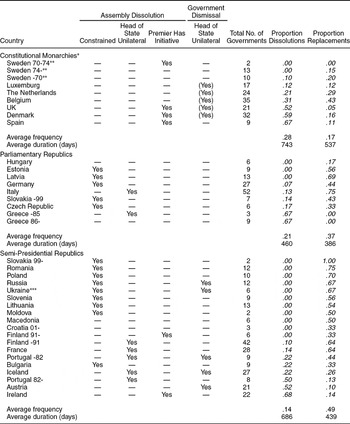
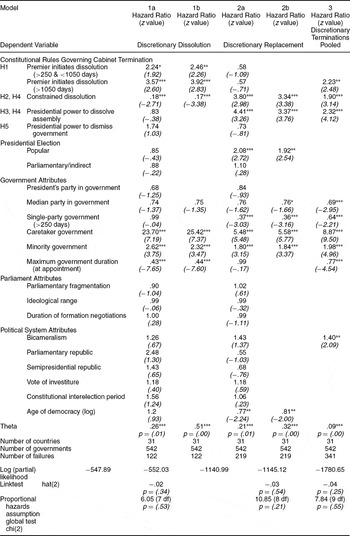



Comments
No Comments have been published for this article.