The facets of personality underlying undercontrolled or disinhibited behavior have long been identified as correlates of adolescent and young adult substance use, among other forms of externalizing psychopathology (Cooper, Wood, Orcutt, & Albino, Reference Cooper, Wood, Orcutt and Albino2003; Krueger et al., Reference Krueger, Hicks, Patrick, Carlson, Iacono and McGue2002; Sher & Trull, Reference Sher and Trull1994; Sher, Trull, Bartholow, & Vieth, Reference Sher, Trull, Bartholow, Vieth, Leonard and Blane1999). Although the exact nature and structure of undercontrolled personality continues to be a source of debate (e.g., Block & Block, Reference Block and Block2006; Cloninger, Przybeck, & Svrakic, Reference Cloninger, Przybeck and Svrakic1991; Cross, Copping, & Campbell, Reference Cross, Copping and Campbell2011; Kirby & Finch, Reference Kirby and Finch2010; Whiteside & Lynam, Reference Whiteside and Lynam2001; Zuckerman, Kuhlman, Joireman, Teta, & Kraft, Reference Zuckerman, Kuhlman, Joireman, Teta and Kraft1993), a broad literature nevertheless reveals a consistent distinction between two important, empirically and conceptually distinct facets: impulsivity, defined as a tendency to act without considering consequences, and sensation seeking, defined as a preference for varied, novel, and exciting experiences (Dawe, Gullo, & Loxton, Reference Dawe, Gullo and Loxton2004; Duckworth & Kern, Reference Duckworth and Kern2011; Gullo, Ward, Dawe, Powell, & Jackson, Reference Gullo, Ward, Dawe, Powell and Jackson2011; Kirby & Finch, Reference Kirby and Finch2010; Magid & Colder, Reference Magid and Colder2007; Magid, MacLean, & Colder, Reference Magid, MacLean and Colder2007; Smith et al., Reference Smith, Fischer, Cyders, Annus, Spillane and McCarthy2007). More impulsive and sensation-seeking adolescents are at greater risk for early use and abuse of a variety of substances (Iacono, Malone, & McGue, Reference Iacono, Malone and McGue2008). A breadth of research has found support for the role of impulsivity in adolescent and young adult alcohol use (Dick et al., Reference Dick, Smith, Olausson, Mitchell, Leeman and O'Malley2010) in addition to cigarette and illicit drug use (Elkins, King, McGue, & Iacono, Reference Elkins, King, McGue and Iacono2006). Sensation seeking has most commonly been studied in relation to alcohol use (Hittner & Swickert, Reference Hittner and Swickert2006), but some recent evidence also links sensation seeking to marijuana and cigarette use (Crawford, Pentz, Chou, Li, & Dwyer, Reference Crawford, Pentz, Chou, Li and Dwyer2003; Martin et al., Reference Martin, Kelly, Rayens, Brogli, Brenzel and Smith2002; Romer & Hennessy, Reference Romer and Hennessy2007).
Reflecting the long-held view that personality is broadly immutable and essentially fixed in young adulthood (McCrae & Costa, Reference McCrae and Costa1994), etiological models of alcohol and other substance use have often treated impulsivity and sensation seeking as relatively stable individual difference risk factors (e.g., Sher, Bartholow, & Wood, Reference Sher, Bartholow and Wood2000). These developmental models (i.e., “vulnerability models”; Roberts, Jackson, Burger, & Trautwein, Reference Roberts, Jackson, Burger and Trautwein2009) have typically conceptualized personality as helping to dictate risk for substance use early in life, with higher levels of impulsivity or sensation seeking leading to an earlier onset and more problematic, persistent course (Chassin, Pitts, & Prost, Reference Chassin, Pitts and Prost2002; Flory, Lynam, Milich, Leukefeld, & Clayton, Reference Flory, Lynam, Milich, Leukefeld and Clayton2004; Sher & Gotham, Reference Sher and Gotham1999; Zucker, Cicchetti, & Cohen, Reference Zucker, Cicchetti, Cohen, Cicchetti and Cohen2006). Complicating this view, however, contemporary research in personality has shown that virtually all aspects of personality change across the lifespan, in some cases quite dramatically (Caspi, Roberts, & Shiner, Reference Caspi, Roberts and Shiner2005). There are population-level trends in personality change that reflect normative patterns of development through adolescence, adulthood, and even old age (Roberts, Walton, & Viechtbauer, Reference Roberts, Walton and Viechtbauer2006). Consistent with Caspi and colleagues' (Reference Caspi, Roberts and Shiner2005) maturity principle, these patterns, including increased social dominance, agreeableness, and conscientiousness and decreased neuroticism, tend to promote psychosocial maturity and improved functioning with age.
Recent research on developmental changes in personality has suggested that impulsivity and sensation seeking show diverging patterns of age-related change across adolescence and early adulthood. Behavioral and self-report evidence from cross-sectional (Steinberg et al., Reference Steinberg, Albert, Cauffman, Banich, Graham and Woolard2008; Steinberg et al., Reference Steinberg, Graham, O'Brien, Woolard, Cauffman and Banich2009; Vaidya, Latzman, Markon, & Watson, Reference Vaidya, Latzman, Markon and Watson2010) and longitudinal (Harden & Tucker-Drob, Reference Harden and Tucker-Drob2011) research shows that impulsivity declines linearly from childhood until the third decade of life. In contrast, some of the same studies show that sensation seeking rises to a peak in midadolescence (approximately age 16) before declining into adulthood (Cauffman et al., Reference Cauffman, Shulman, Steinberg, Claus, Banich and Graham2010; Harden & Tucker-Drob, Reference Harden and Tucker-Drob2011; Romer & Hennessy, Reference Romer and Hennessy2007; Steinberg et al., Reference Steinberg, Albert, Cauffman, Banich, Graham and Woolard2008). As Steinberg (Reference Steinberg2008, Reference Steinberg2010) and others (Casey, Getz, & Galvan, Reference Casey, Getz and Galvan2008; Somerville, Jones, & Casey, Reference Somerville, Jones and Casey2010) have argued, mean increases in sensation seeking during early and middle adolescence, in conjunction with the gradual decrease in impulsivity, may help explain why substance use and other risk-taking behaviors emerge during adolescence. Whereas only 8% of 10th graders binge drink, that rate increases to 25% by the end of high school and 40% through age 24 (Bachman, Wadsworth, O'Malley, & Johnston, Reference Bachman, Wadsworth, O'Malley and Johnston1997; Johnston, O'Malley, Bachman, & Schulenberg, Reference Johnston, O'Malley, Bachman and Schulenberg2009a). Risk for the onset of alcohol dependence peaks at age 18, and more than 9% of those aged 18–29 meet criteria for an alcohol use disorder (Grant et al., Reference Grant, Dawson, Stinson, Chou, Dufour and Pickering2004; Li, Hewitt, & Grant, Reference Li, Hewitt and Grant2004). The use and abuse of other substances follows similar patterns. Among those aged 18–29, 11% used marijuana in the past year, with 4% meeting criteria for a marijuana use disorder (Compton, Grant, Colliver, Glantz, & Stinson, Reference Compton, Grant, Colliver, Glantz and Stinson2004), and the largest mean-level increases in tobacco use occur during late adolescence (Bachman et al., Reference Bachman, Wadsworth, O'Malley and Johnston1997; Johnston, O'Malley, Bachman, & Schulenberg, Reference Johnston, O'Malley, Bachman and Schulenberg2009a, Reference Johnston, O'Malley, Bachman and Schulenberg2009b). Thus, the emergence of substance use appears to coincide with the apex of mean-level personality risk.
Individual Differences in Personality Change and Substance Use
Missing from etiological theories derived from mean-level age trends, however, is an acknowledgement of individual differences in both substance use and personality. The adolescent emergence of substance use is far from universal across the population. As Romer (Reference Romer2010) has observed, although the prevalence of substance use, in addition to other forms of risk taking such as physical aggression, may be higher among adolescents relative to adults, only a fraction of adolescents actually engage in such behaviors. Data from recent Monitoring the Future surveys confirm that a sizable majority of adolescents and early adults do not smoke cigarettes or marijuana (Johnston et al., Reference Johnston, O'Malley, Bachman and Schulenberg2009a, Reference Johnston, O'Malley, Bachman and Schulenberg2009b). Even among college students, who drink more heavily than their peers who do not attend college, one in five abstains from alcohol use, and two in five drink at levels below the threshold for binge drinking (Wechsler, Dowdall, Maenner, Gledhill-Hoyt, & Lee, Reference Wechsler, Dowdall, Maenner, Gledhill-Hoyt and Lee1998).
Similarly, against the backdrop of normative maturational changes, there is substantial interindividual instability in personality over time (Roberts & DelVecchio, Reference Roberts and DelVecchio2000), and virtually all dimensions of personality are characterized by individual differences in change across adolescence and early adulthood (Donnellan, Conger, & Burzette, Reference Donnellan, Conger and Burzette2007; Neyer & Lehnart, Reference Neyer and Lehnart2007; Vaidya, Gray, Haig, Mroczek, & Watson, Reference Vaidya, Gray, Haig, Mroczek and Watson2008). These differential personality changes may be driven by both intrinsic differences and life experiences. Adolescence and early adulthood are rich with significant social-role transitions (e.g., leaving the parental home, joining the workforce, establishing romantic partnerships), and recent evidence suggests that personality changes and role demands are mutually reinforcing through the dual processes of social environment selection and socialization (Neyer & Lehnart, Reference Neyer and Lehnart2007; Roberts & Bogg, Reference Roberts and Bogg2004; Roberts, Walton, Bogg, & Caspi, Reference Roberts, Walton, Bogg and Caspi2006; Scollon & Diener, Reference Scollon and Diener2006; Vaidya, Gray, Haig, & Watson, Reference Vaidya, Gray, Haig and Watson2002). Relevant to the current investigation, the mean-level developmental trends in impulsivity and sensation seeking emphasized by recent etiological models belie meaningful individual differences in intraindividual change. Harden and Tucker-Drob (Reference Harden and Tucker-Drob2011) found significant variability in trajectories of impulsivity and sensation seeking between the ages of 12 and 24 years old: some adolescents demonstrate quite rapid declines in impulsivity and sensation seeking, whereas others demonstrate very slow declines.
An additional challenge for etiological theories of adolescent substance use derived from mean-level age trends in personality (e.g., Steinberg, Reference Steinberg2008, Reference Steinberg2010) has been that mean levels of substance use continue to increase into early adulthood, while decreases in both sensation seeking and impulsivity are typical after midadolescence (Harden & Tucker-Drob, Reference Harden and Tucker-Drob2011; Romer & Hennessy, Reference Romer and Hennessy2007; Steinberg et al., Reference Steinberg, Albert, Cauffman, Banich, Graham and Woolard2008). That is, the initiation of substance use may often occur at the normative apex of sensation seeking, but the continuation and escalation of use in the population coincides with declines in both sensation seeking and impulsivity. Although these mean-level patterns appear contradictory, the recognition that individuals differ not only in their initial levels of impulsivity and sensation seeking but also in their trajectories of personality change permits a more comprehensive understanding of how personality may impact changes in substance use. Just as greater impulsivity and sensation seeking at a given age predict greater substance use, individual-level deviations from normative age trends may put some adolescents and early adults at particularly elevated risk for changes in substance use. That is, it is possible that individual-level personality and substance use trajectories covary, with those adolescents who decline in impulsivity and sensation seeking most gradually also experiencing the steepest increases in substance use. In sum, whereas adolescence and early adulthood may be, on average, a period of increased propensity for substance use, this risk may be highest among those who decline in impulsivity and sensation seeking most gradually.
Differences in personality change trajectories have been implicated in a number of important life outcomes (Mroczek & Spiro, Reference Mroczek and Spiro2007; Roberts & Mroczek, Reference Roberts and Mroczek2008), but relatively little research has tested the impact of this interindividual variability on substance use. Littlefield and colleagues (Reference Littlefield, Sher and Wood2009, Reference Littlefield, Sher and Wood2010a, Reference Littlefield, Sher and Wood2010b) have found that more rapid declines in impulsivity are associated with declining alcohol involvement through young adulthood. In a separate study, greater increases in sensation seeking during middle school predicted increased marijuana use during high school (Crawford et al., Reference Crawford, Pentz, Chou, Li and Dwyer2003). Although substance use peaks during late adolescence and early adulthood, evidence for the roles of changing impulsivity and sensation seeking during this crucial developmental period is lacking. To our knowledge, no study has directly tested associations between changes in the use of multiple substances and these two personality constructs through adolescence and early adulthood.
Goals of the Present Study
In the current investigation, we used 12 years of longitudinal data from the offspring generation of the National Longitudinal Survey of Youth (CNLSY) to test the role of personality change in individual differences in substance use from adolescence to early adulthood. In particular, we tested whether variability in the development of impulsivity and sensation seeking related to variability in the development of alcohol, marijuana, and cigarette use across ages 15–26. Our analyses focused on three key research questions:
1. Are there individual differences in change in impulsivity and sensation seeking?
2. Are there individual differences in rates of change in alcohol, marijuana, and cigarette use?
3. Are individual differences in rates of change in substance use associated with change in impulsivity and sensation seeking?
Method
Participants and procedures
Mother generation: NLSY
The Bureau of Labor Statistics designed and funded the 1979 NLSY (NLSY79) in order to study workforce participation in the United States. A complex survey design was used to select a nationally representative sample of 3,000 households containing 6,111 youth aged 14–21 years as of December 31, 1978. An additional oversample of 3,652 African American and Hispanic youth was selected to overrepresent these racial/ethnic groups.Footnote 1 The response rate for the initial NLSY79 survey was over 90% of the eligible sample, and participants have been interviewed annually from 1979 to 1994 and biennially since 1994. Retention rates for follow-up assessments of the NLSY79 sample were greater than 90% for the first 16 waves and greater than 80% for subsequent waves.
Offspring generation: The NLSY79 children and young adults (CNLSY)
Beginning in 1986, the biological children of NLSY79 women were assessed biennially (Chase-Lansdale, Mott, Brooks-Gunn, & Phillips, Reference Chase-Lansdale, Mott, Brooks-Gunn and Phillips1991). The initial participation rate was 95%, and the average retention rate through 2006 was approximately 90%. Beginning in 1994, adolescent offspring who were age 15 by the end of the survey calendar year were administered a separate interview (the CNLSY “young adult” interview), which included measures of personality and substance use. As of 2006, 11,466 children were identified as having been born to 6,283 NLSY79 women. After weighting for sample selection, the average NLSY79 woman has had 1.9 children, which is more than 90% of their ultimate predicted childbearing.
The current project uses data from a subsample of 5,632 adolescents and young adults who reported on their impulsivity; sensation seeking; and alcohol, marijuana, and cigarette use at least once between the ages of 15 and 26. Although some participants may have initiated substance use prior to age 15, the young adult substance use assessments differed from the measures administered to participants under age 15, rendering the inclusion of younger children impossible. This CNLSY subsample is demographically diverse: 1,215 youth (21.6%) were Hispanic/Latino, 1,970 (35.0%) were African American, the remaining 2,447 (43.5%) were non-Hispanic White, and 49.1% were female. Because children were assessed biennially, all data were analyzed using six 2-year age groups: 15- to 16-year-olds, 17- to 18-year-olds, 19- to 20-year-olds, 21- to 22-year-olds, 23- to 24-year-olds, and 25- to 26-year-olds.
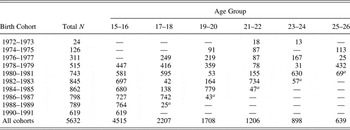
As displayed in greater detail in Table 1, of the 5,632 participants included in the present analyses, only a subset provided data at each age group. There are four sources of missingness in the CNLSY young adult interview data. First, the interviews began in 1994, excluding from the age 15–16 interviews the relatively small number of offspring born prior to 1978. Second, some of those eligible did not complete the age 15–16 interview; these individuals differed modestly from participants on maternal demographic variables.Footnote 2 Third, there was attrition following the age 15–16 interview, although attrition was largely independent of study variables.Footnote 3 Fourth and finally, less data are available for later cohorts of participants, who have had fewer opportunities to be assessed since the age of 15; 4,515 adolescents provided data at age 15–16, whereas 639 provided data at age 25–26.
Number of the National Longitudinal Survey of Youth participants by age group and birth cohort

Note: Cells without values signify that a particular birth cohort was not assessed during that age range.
aThe small number of participants represents “spillover” of the birth cohort into the subsequent age group because the interview date occurred after the participant's birthday.
This final source is a well-documented potential contributor of bias to the CNLSY sample: because not all NLSY79 mothers have completed their childbearing and not all offspring have completed adolescence, the current CNLSY data overrepresent the earliest cohort of participants, who were born to relatively young mothers (Turley, Reference Turley2003). Younger mothers, in turn, systematically differ from women who delay childbearing on socioeconomic and behavioral variables that may be relevant for personality and substance use in their offspring (Harden et al., Reference Harden, Lynch, Turkheimer, Emery, D'Onofrio and Slutske2007). To correct for this source of sampling bias, all analyses controlled for maternal age at first birth, as well as externalizing and internalizing symptoms and sociodemographic factors (including maternal education, socioeconomic status [SES], and race/ethnicity) that differ between older and younger mothers. This approach has been used to correct for sampling bias in previous studies of the CNLSY sample (D'Onofrio et al., Reference D'Onofrio, Van Hulle, Waldman, Rodgers, Harden and Rathouz2008; Harden et al., Reference Harden, D'Onofrio, Van Hulle, Turkheimer, Rodgers and Waldman2009; Mendle et al., Reference Mendle, Harden, Turkheimer, Van Hulle, D'Onofrio and Brooks-Gunn2009).
Measures
Maternal demographics
SES was measured using mother-reported total family income, including government support and food stamps but excluding income received by unmarried cohabitating partners, when the mother was 30 years old. The median annual family income was approximately $22,600 and ranged from $0 to $375,000. Maternal cognitive ability was measured in the 1980 assessment using the Armed Services Vocational Aptitude Battery test of knowledge and skill in 10 subject areas. Composite scores on this battery (based on the word knowledge, paragraph comprehension, math knowledge, and arithmetic reasoning subtests) were standardized and converted to a percentile score. Maternal education was measured using maternal report of the number of years of school completed (M = 13.32 years, SD = 2.40 years; approximately 9% of the sample reported 11 years or less). Finally, maternal age at first birth was calculated using the date of birth for the mother and her first child (M = 21.12, SD = 3.86, range = 13.17–34.60 years).
Maternal externalizing and internalizing symptoms
Mothers completed a version of the Self-Reported Delinquency Interview in the 1980 NLSY79 assessment, at which time they were 15–23 years old (Elliott & Huizinga, Reference Elliott and Huizinga1983). This commonly used, reliable, and valid measure included 12 items assessing the frequency with which respondents engaged in delinquent acts ranging from destroying property to attacking another person to selling hard drugs. As a measure of maternal internalizing symptoms, mothers completed the Center for Epidemiological Studies Depression Scale in 1992 at ages 27–35 (Radloff, Reference Radloff1977). This widely used measure comprises 20 items such as I felt hopeless, I felt sad, and I thought my life had been a failure. Respondents endorse each item on a scale ranging from 0 = rarely or none of the time to 3 = most or all of the time.
Personality
We used a latent variable approach to the measurement of impulsivity and sensation seeking. Impulsivity was assessed by youth self-report on three indicator items: I often get in a jam because I do things without thinking; I think that planning takes the fun out of things; and I have to use a lot of self-control to keep out of trouble. Sensation seeking was assessed by youth self-report on the following three indicator items: I enjoy taking risks; I enjoy new and exciting experiences, even if they are a little frightening or unusual; and life with no danger in it would be too dull for me. All impulsivity and sensation seeking items were rated on 4-point scales ranging from 0 = strongly disagree to 3 = strongly agree. Across all time points, average scores on the three impulsivity items were 1.40, 1.17, and 1.33, respectively (SDs = 0.66, 0.57, and 0.73; all ranges = 0.00–3.00). Average scores on the three sensation seeking items were 1.53, 1.96, and 1.52, respectively (SDs = 0.64, 0.54, and 0.67; all ranges = 0.00–3.00). Although impulsivity and sensation seeking were positively associated across all assessments (rs = .24–.26, p < .001), they were distinct from each other. In confirmatory factor analysis, a single-factor model of all six personality items fit the data poorly, χ2 (8) = 869.63, p < .001, comparative fit index (CFI) = 0.80, root mean square error of approximation (RMSEA) = 0.17, whereas a two-factor model fit the data significantly better, Δχ2 = 702.91, p < .001, CFI = 0.96, RMSEA = 0.07. As has been previously reported, the CNLSY measures of impulsivity and sensation seeking demonstrate strong validity. Consistent with previous research on these traits (Whiteside & Lynam, Reference Whiteside and Lynam2001), the impulsivity measure is moderately and negatively associated with the Big Five dimensions of conscientiousness and emotional stability, whereas sensation seeking is moderately and positively associated with extraversion and openness (Harden & Tucker-Drob, Reference Harden and Tucker-Drob2011).
Substance use
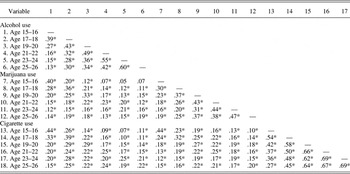
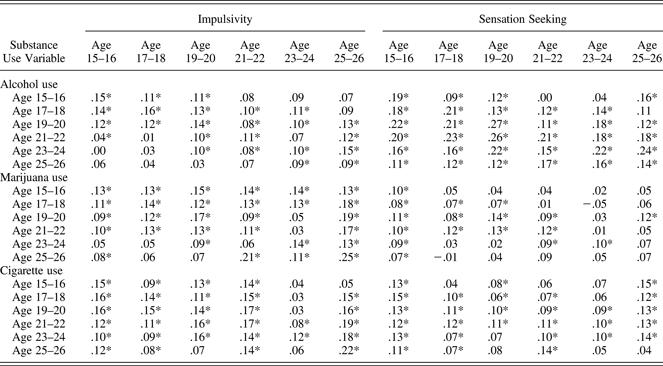
Substance use was measured using self-reported frequencies of alcohol, marijuana, and cigarette use, each of which was assessed at every assessment wave. Participants reported the frequency with which they drank alcohol in the past year on a 9-point scale ranging from 1 = did not drink to 9 = drank daily. Across all time points, alcohol use scores averaged 3.00 (SD = 1.81, range = 1.00– 9.00), corresponding to a total of 3–5 drinking days in the past 12 months. Alcohol abstainers comprised between 21.5% (age 23–24) and 64.3% (age 15–16) of included participants. Abstainers were coded as 1 (did not drink). Cigarette and marijuana use over the past 30 days was assessed using 6-point scales, with responses ranging from 0 = never to 5 = every day. Across all time points, marijuana use scores averaged 0.25 (SD = 0.69, range = 1.00–5.00), and cigarette use scores averaged 0.88 (SD = 1.50, range = 1.00–5.00), indicating that across ages 15–26 participants used marijuana and cigarettes on average less than once per week. Participants who had abstained over the past 30 days comprised between 87.1% (age 19–20) and 93.0% (age 15–16) of the sample for marijuana use and between 63.4% (age 25–26) and 83.7% (age 15–16) for cigarette use. Marijuana and cigarette abstainers were coded as 0 (never used). See Table 2 for correlations among substance use variables and Table 3 for correlations between personality and substance use variables.
Zero-order correlations among alcohol, marijuana, and cigarette use

*p < .05.
Zero-order correlations between personality and substance use
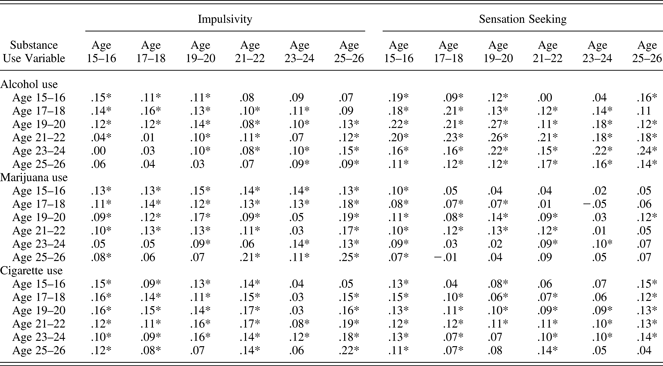
Note: Personality scores are means across the three items each for impulsivity and sensation seeking.
*p < .05.
Analytic Approach
In order to analyze both intraindividual change across time and interindividual differences in change, we estimated a series of latent growth curve models (LGMs; McArdle & Nesselroade, Reference McArdle, Nesselroade, Schinka and Velicer2003; Meredith & Tisak, Reference Meredith and Tisak1990) in Mplus version 5 (Muthén & Muthén, Reference Muthén and Muthén1998–2007). We analyzed all models using full information maximum likelihood to account for missing data (Schafer & Graham, Reference Schafer and Graham2002) and adjusted standard errors and model fit statistics for nonindependence of data from participants born to the same mother (Asparouhov & Muthén, Reference Asparouhov and Muthén2006). Following several recent studies (Brown, Catalano, Fleming, Haggerty, & Abbott, Reference Brown, Catalano, Fleming, Haggerty and Abbott2005; Flory et al., Reference Flory, Lynam, Milich, Leukefeld and Clayton2004; Littlefield et al., Reference Littlefield, Sher and Wood2009), we modeled substance use frequency as continuous but entered the impulsivity and sensation seeking indicators as ordered categorical variables.
Data were analyzed in three steps. First, we tested for measurement invariance of impulsivity and sensation seeking across ages 15–26 (Meredith, Horn, Collins, & Sayer, Reference Meredith, Horn, Collins, Sayer, Collins and Sayer2001). Second, we fit linear and nonlinear univariate models of change in each of the substance use outcomes and personality constructs in order to determine which model best represented the shape of change in each variable over time. Third, we tested for correlated changes among impulsivity, sensation seeking, and substance use in a series of three multivariate LGMs (one each for alcohol, marijuana, and cigarette use). To avoid redundancy, we report model parameters for the multivariate models only. Because the χ2 model fit can be overly sensitive with large samples, we followed the recommendations of Kline (Reference Kline2005) in also using the CFI, Tucker–Lewis index (TLI), and RMSEA to evaluate model fit. CFI and TLI values greater than 0.95 and RMSEA values less than 0.05 indicate good model fit. All models included adolescent gender and ethnicity, along with maternal SES, years of education, cognitive ability, age at first birth, delinquency, and depression, as exogenous covariates.
Results
Personality measurement invariance
An impulsivity model in which factor loadings and thresholds for each item were constrained to be equal across time (i.e., strong measurement invariance) fit the data well, χ2 (55) = 241.14, p < .001, CFI = 0.98, TLI = 0.94, RMSEA = 0.02. Permitting loadings, thresholds, and residual variances to vary across time separately or in conjunction significantly improved model fit as assessed by χ2 tests of difference (ps < .001). Given the sensitivity of this test in large sample sizes, however, we also examined change in other model fit indices. The CFI, TLI, and RMSEA values improved only marginally when parameters were unconstrained (maximum ΔCFI = 0.02, ΔTLI = 0.06, ΔRMSEA = 0.02). Inspection of parameter values suggested that measurement appeared relatively invariant across time. Standardized factor loadings for each item, for example, differed by less than 0.14. We therefore modeled impulsivity with strong measurement invariance in all subsequent analyses.Footnote 4
The strong measurement invariance model for sensation seeking similarly fit the data well, χ2 (55) = 356.11, p < .001, CFI = 0.99, TLI = 0.97, RMSEA = 0.03. Although permitting parameters to vary across time improved χ2 model fit significantly (ps < .001), CFI, TLI, and RMSEA values again improved only marginally (maximum ΔCFI = 0.01, ΔTLI = 0.02, ΔRMSEA = 0.01). Inspection of the unconstrained models suggested that measurement was largely similar across time, with standardized factor loadings varying by less than 0.07. We again selected the strong measurement invariance model for all subsequent sensation-seeking analyses.
Univariate growth curve models and demographic predictors of change
Our next analytic step was to model change over time in personality and substance use using univariate LGMs. LGMs serve the dual purpose of determining average patterns of change across time and estimating how much individuals' trajectories deviate from mean trends. A generic LGM equation for Y[t]n, the personality or substance use score for person n at age t, can be expressed algebraically as follows (McArdle & Nesselroade, Reference McArdle, Nesselroade, Schinka and Velicer2003):
 $$Y\lsqb t\rsqb _n = y_{\rm In} + A\lsqb t\rsqb + e\lsqb t\rsqb _n \cdot$$
In the LGM, y In, the latent intercept score representing the initial level (i.e., at age 15–16), and y Sn, the latent change score representing the magnitude of linear change over time, are assumed to be multivariate normal; A[t] is a vector of time-specific “basis” coefficients, which represent the shape of change over time; and e[t]n is a vector of time-specific residual errors. Hypotheses regarding the shape of change across time can be tested by constraining the values in vector A[t]. In order to determine which growth curve best explained the change in personality and substance use, we compared two models for each variable: a linear change model and a nonlinear, “latent basis” model. The nonlinear model does not constrain the model to a specific trajectory shape. Rather, after setting the first two vector values to 0 and 1 for scaling and identification purposes, the model estimates the values of A[t] (i.e., the shape of change across time) from the observed data, permitting a nonlinear estimated change trajectory that closely matches the shape of the observed data. In all models, we accounted for the effects of demographics by regressing the latent intercept and change factors onto exogenous covariates.
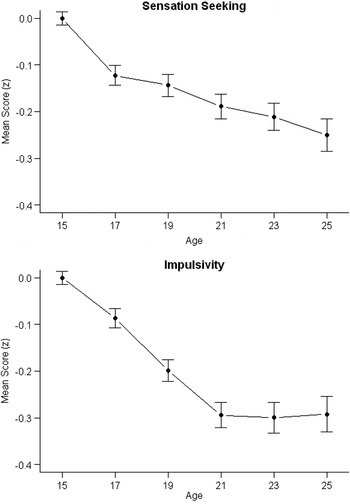
As shown in Figure 1, impulsivity, on average, descended linearly after age 15–16 before stabilizing in the early 20s. Sensation seeking, in contrast, descended most sharply following age 15–16 but then decreased gradually through age 25–26. These observed trends are consistent with previous literature suggesting that impulsivity declines linearly through adolescence before stabilizing in the early 20s (Casey et al., Reference Casey, Getz and Galvan2008; Steinberg, Reference Steinberg2008; Steinberg et al., Reference Steinberg, Albert, Cauffman, Banich, Graham and Woolard2008). Consequently, we constrained the nonlinear model of impulsivity to linear change through age 23–24 but permitted it to freely estimate the shape of change from 23–24 to 25–26. This model fit the data better than the linear model, χ2 (284) = 628.37, p < .001, CFI = 0.96, TLI = 0.96, RMSEA = 0.02, Δχ2 (1) = 4.51, p < .05. Similarly, we tested a nonlinear LGM for developmental change in sensation seeking, which fit the data better than did the linear model, χ2 (281) = 504.17, p < .001, CFI = 0.99, TLI = 0.99, RMSEA = 0.01, Δχ2 (4) = 11.19, p < .05.
Mean levels of sensation seeking and impulsivity, ages 15–16 to 25–26 years. Sum scores were transformed to standard deviation units based on sample statistics at ages 15–16.

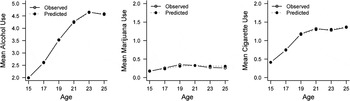
We next compared linear growth models to nonlinear growth models for substance use. The nonlinear models fit well for all three substances and were superior to the linear models for alcohol, χ2 (48) = 265.10, p < .001, CFI = 0.95, TLI = 0.92, RMSEA = 0.03, Δχ2 (4) = 248.33, p < .001; marijuana, χ2 (48) = 153.05, p < .001, CFI = 0.93, TLI = 0.90, RMSEA = 0.02, Δχ2 (4) = 26.80, p < .001; and cigarette use, χ2 (48) = 173.64, p < .001, CFI = 0.98, TLI = 0.97, RMSEA = 0.02, Δχ2 (4) = 256.21, p < .001. Figure 2 compares the observed means for substance use at each age (“Observed”) with the means implied by the nonlinear model (“Predicted”). The nonlinear models accurately estimated the mean-level trajectories for each substance. At the mean level, alcohol use increased sharply in adolescence before tapering off and peaking at age 23–24, whereas marijuana use increased gradually through age 23–24. On average, cigarette use increased sharply in the late teens and continued to increase through age 25–26.
Observed versus predicted age trends in frequency of alcohol, marijuana, and cigarette use. Predicted means implied by univariate latent growth curve models. Observed means calculated from observed data. For alcohol use, 2 = 1–2 days per year and 5 = 1–2 days per month. For cigarette and marijuana use, 0 = never, 1 = less than once per week, and 2 = 1–2 days per week.

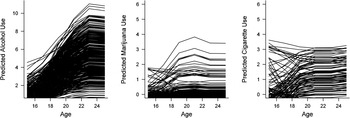
These trends, however, belied variability in both levels of use at age 15–16 and trajectories of change through adolescence and early adulthood. Some individuals reported greater substance use than others at age 15–16, and some individuals experienced steeper nonlinear increases in substance use from age 15–16 through early adulthood. All change factor variances were significantly greater than zero, ps < .001. Figure 3 displays the variability in estimated substance use trajectories across a randomly selected subset of 500 individual participants.
Estimated substance use trajectories of 500 randomly selected young adults across ages 15–26.

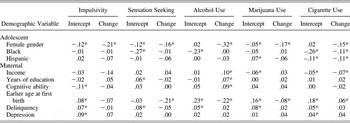
Demographic predictors from univariate models
There were significant demographic differences in intercept and change factors from the univariate models (see Table 4). Female participants demonstrated faster decreases in impulsivity and sensation seeking; slower increases in alcohol, marijuana, and cigarette use; and lower initial levels of impulsivity, sensation seeking, and marijuana use. Relative to White participants, African Americans increased their cigarette use more slowly and had lower initial levels of sensation seeking and alcohol and cigarette use, whereas Hispanic/Latino participants increased their cigarette use more slowly and demonstrated less frequent initial cigarette use but more frequent initial marijuana use.
Associations between demographic covariates and latent growth curve factors from univariate models

Note: Values are standardized regression coefficients.
*p < .05.
Maternal SES predicted faster increases in alcohol use, slower increases in cigarette use, and lower initial levels of marijuana and cigarette use. Maternal education predicted faster increases in alcohol use and higher initial levels of sensation seeking. Finally, maternal cognitive ability predicted greater increases in alcohol use and lower initial impulsivity.
Maternal behavioral problems were generally associated with less adaptive patterns of both personality and substance use. Early maternal age at first birth predicted faster increases in cigarette, along with higher initial levels of impulsivity and alcohol, marijuana, and cigarette use. However, adolescents born to younger mothers decreased in sensation seeking more and increased in alcohol and marijuana use less. Initially, adolescents of more delinquent mothers were more impulsive and sensation seeking, and they used alcohol, marijuana, and cigarettes more. Adolescents with more depressed mothers initially were more impulsive and smoked cigarettes more.
Multivariate models of change in impulsivity, sensation seeking, and substance use
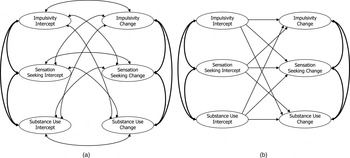
We estimated three multivariate LGMs to test whether changes in impulsivity and sensation seeking were associated with changes in use of each substance. In preliminary models, illustrated in Figure 4a, we permitted the intercept and change factors of impulsivity and sensation seeking to covary freely with each other and with the intercept and change factors of each of the three substance use outcomes. These associations tested whether impulsivity, sensation seeking, and each type of substance use were correlated at the beginning of the assessment period (correlated intercepts) and whether change in impulsivity, sensation seeking, and substance use was correlated across the assessment period (correlated change factors). We permitted all change factors to covary with all intercept factors. These covariances tested whether initial values in one variable were associated with differing patterns of growth in the other.
Examples of multivariate latent growth curve models of impulsivity, sensation seeking, and substance use across ages 15–26. (a) The model including freely estimated covariances among intercepts and changes, and (b) the model in which change factors are regressed onto intercept factors. Bold paths represent correlated changes. Demographic covariates are not shown.

A model in which all covariances among intercept and change factors are freely estimated is limited, however, because correlated changes are confounded by correlated intercept factors (Littlefield et al., Reference Littlefield, Sher and Wood2010b). That is, given the common finding of an association between individuals' initial levels and their rates of change over time, the pattern of associations among initial levels of personality and substance use could obscure an independent association between change in personality and change in substance use. Therefore, after estimating the preliminary multivariate models, we estimated a set of models in which all change factors were regressed onto all intercept factors, permitting a test of correlated changes controlling for their associations with intercept factors (see Figure 4b).
Preliminary models
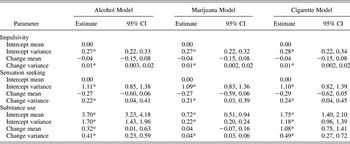
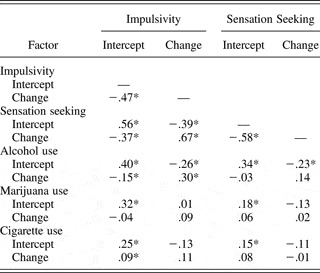
The impulsivity, sensation seeking, and alcohol use model fit well, χ2 (1123) = 2,478.94, p < .001, CFI = 0.97, TLI = 0.96, RMSEA = 0.02. As shown in Table 5, after accounting for the effects of demographic covariates, there was significant residual variance in the intercept and change factors for impulsivity, sensation seeking, and alcohol use. Table 6 presents correlations among intercept and change factors for impulsivity, sensation seeking, and alcohol use. Impulsivity and sensation seeking trajectories were closely aligned; the personality intercepts were positively and strongly associated, as were the personality change factors. The alcohol use intercept was also moderately associated with the impulsivity and sensation seeking intercepts. We found evidence for correlated changes in impulsivity and alcohol use, with a moderate association between the change factors. In contrast, change in sensation seeking was not significantly associated with change in alcohol use.
Unstandardized parameter estimates from multivariate latent growth curve models of impulsivity, sensation seeking, and substance use

Note: Because all models include demographic variables as exogenous covariates, the reported variances are residual variances. CI, confidence interval.
*p < .05.
Correlations among intercept and change factors from preliminary multivariate latent growth curve models

Note: Correlations between impulsivity and sensation seeking factors are taken from alcohol use models. Correlations from other substance use models did not differ from those reported here in significance and differed in magnitude by at most .03. Intercept–change correlations for alcohol use, marijuana use, and cigarette use were r = –.48, p < .001, r = –.33, p < .001, and r = –.27, p < .05, respectively.
*p < .05.
The preliminary marijuana use model also fit the data well, χ2 (1123) = 2,581.52, p < .001, CFI = 0.96, TLI = 0.96, RMSEA = 0.02, and there were significant individual differences in the impulsivity, sensation seeking, and marijuana use intercepts and change factors. There were small- to moderate-sized positive associations between the marijuana use intercept and the impulsivity and sensation seeking intercepts. However, change in marijuana use was not significantly associated with change in either impulsivity or sensation seeking.
Finally, the preliminary cigarette use model fit the data well, χ2 (1123) = 2,338.05, p < .001, CFI = 0.97, TLI = 0.96, RMSEA = 0.01, and intercepts and changes in impulsivity, sensation seeking, and cigarette use varied significantly between individuals after accounting for demographics. We again found small to moderate correlations among the impulsivity, sensation seeking, and cigarette use intercepts. However, change in cigarette use was not associated with change in either personality facet.
Models controlling for initial levels of personality and substance use
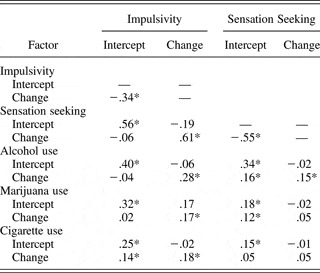
We next repeated the above three multivariate LGMs with all change factors regressed onto all intercept factors (see Figure 4b). Results of these models replicated key findings from the preliminary models, including significant residual variances in intercept and change factors for all constructs. Similar to the models above, we found significant, large correlations between the impulsivity and sensation seeking intercepts and change factors. The alcohol use model provided evidence of correlated changes in alcohol use and personality; individuals who decreased less steeply in impulsivity and sensation seeking increased more steeply in alcohol use. We also found moderate to large associations among intercept factors for alcohol use, impulsivity, and sensation seeking. Beyond these correlations, greater initial levels of sensation seeking predicted steeper increases in alcohol use, but there were no other associations across the personality and alcohol use intercept and change factors (see Table 7).
Factor correlations and regression coefficients from multivariate latent growth curve models controlling for initial levels of impulsivity, sensation seeking, and substance use

Note: Values are correlation coefficients (for correlated intercepts and changes) and standardized regression coefficients (for all other associations). Associations between impulsivity and sensation seeking factors are taken from alcohol use models; associations from other substance use models did not differ from those reported here in significance and differed in magnitude by .07 at most. Intercept–change associations for alcohol use, marijuana use, and cigarette use were β = −0.48, p < .001, β = −0.36, p < .001, and β = −0.32, p < .001, respectively.
*p < .05.
In the marijuana use model, we found a small to moderate correlation between change in marijuana use and change in impulsivity but not change in sensation seeking. Both personality facet intercepts were also positively associated with the marijuana use intercept. In addition, more sensation-seeking adolescents at the intercept increased their marijuana use to a greater extent, but there were no other associations across the personality and marijuana use intercept and change factors.
Finally, in the cigarette use model, we found evidence of correlated changes in cigarette use and impulsivity but not sensation seeking. In addition, there were small to moderate associations between the cigarette use intercept and the impulsivity and sensation seeking intercepts. Adolescents higher in impulsivity at the intercept increased their cigarette use more, but there were no other associations across the personality and cigarette use intercept and change factors.
Additional analyses: Frequency of substance use among nonabstainers
Given the large number of abstainers included in the analyses presented here, it is possible that our findings reflect an effect on the timing of substance use initiation rather than its progression. That is, rather than demonstrating correlated change with emerging and increasing use, change in impulsivity and sensation seeking may correspond with when adolescents first initiate substance use. In order to examine this possibility, we repeated our analyses with abstainers coded as missing. In these models, lifetime use of the substance), we largely replicated our substantive findings in both significance and magnitude. Briefly, among nonabstainers, there was significant variability in rates of change in alcohol, marijuana, and cigarette use, and we found correlated intercepts for all substances and both personality constructs. It is notable, however, that we found correlated changes between impulsivity and sensation seeking and between impulsivity and alcohol use but not in any other personality–substance use pair. In sum, whereas slower decreases in impulsivity may predict greater increases in alcohol use, they may be more strongly associated with the timing of marijuana and cigarette initiation than with the escalation of use. The complete results of the additional analyses are available upon request from the first author.
Discussion
This paper presented four key findings. First, consistent with an emerging body of research on personality change, there were significant individual differences in rates of age-related change in impulsivity and sensation seeking across adolescence and early adulthood. Second, consistent with previous longitudinal research (Harden & Tucker-Drob, Reference Harden and Tucker-Drob2011), we found evidence that impulsivity and sensation seeking develop as separate but related facets of personality. Although the two facets were distinct, declines in each were positively associated. Third, we found variability in rates of change in alcohol, marijuana, and cigarette use. This variability was partly explained by demographic differences, but significant individual differences in change remained after accounting for demographics and maternal behavioral problems. Fourth and most important, even after accounting for demographics, mothers' behavior problems, and cross-sectional associations at age 15–16, we found substantial support for correlated changes in personality and substance use: slower decreases in impulsivity were associated with greater increases in alcohol, marijuana, and cigarette use after accounting for initial levels of impulsivity and substance use. Similarly, a slower decrease in sensation seeking was associated with a greater increase in alcohol use. These correlations in rates of change were all small to moderate in magnitude. Additional analyses suggested that whereas impulsivity change was associated with change in the frequency of alcohol use, the other personality–substance use correlated changes may have reflected associations with the timing of substance use initiation.
The current findings expand upon recent models of the role of personality change in the etiology of substance use (Casey et al., Reference Casey, Getz and Galvan2008; Steinberg, Reference Steinberg2008). Whereas historically personality has been considered as a stable individual difference risk factor (e.g., Flory et al., Reference Flory, Lynam, Milich, Leukefeld and Clayton2004; Roberts et al., Reference Roberts, Jackson, Burger and Trautwein2009; Sher et al., Reference Sher, Bartholow and Wood2000; Sher & Trull, Reference Sher and Trull1994), contemporary models have incorporated mean differences between adolescents and adults in levels of impulsivity and sensation seeking. Consistent with this largely cross-sectional literature, we found that, on average, impulsivity and sensation seeking declined from adolescence to adulthood. Moreover, individual differences in change in impulsivity and, to a lesser extent, sensation seeking were moderately associated with individual differences in escalating substance use from midadolescence to early adulthood. These results suggest that there is meaningful heterogeneity in rates of change in these personality facets and that this heterogeneity may help explain variability in trajectories of increasing substance use. By integrating interindividual differences in intraindividual developmental changes, these results expand upon etiological models derived from mean-level changes. Although adolescence and early adulthood are generally times of increased risk for the initiation and progression of substance use, this risk may be most evident among those who decline slowly in impulsivity.
It is also important note that, although the period during which sensation seeking peaked (i.e., midadolescence) aligned with rising levels of substance use, the highest rates of use in this sample occurred later in early adulthood. That is, substance use was most common in the years following what has been proposed as the mean-level peak of personality risk (Steinberg, Reference Steinberg2008, Reference Steinberg2010). The current results suggest that a failure to decline in impulsivity and, to a lesser extent, sensation seeking may be responsible for this continued growth in substance use. Maintaining high levels of impulsivity through the end of adolescence may be particularly problematic in light of the many environmental transitions that characterize the transition to adulthood. For many adolescents, the completion of high school is followed by a departure from the parental home, reducing parental monitoring and support (Wetherill & Fromme, Reference Wetherill and Fromme2007). Over half of high school graduates enter college (Johnston et al., Reference Johnston, O'Malley, Bachman and Schulenberg2009b), and many enter the workforce and establish romantic partnerships. Across these transitions, a common theme is the increasing need for self-regulation in the pursuit of long-term goals. We speculate that as parental and familial influences fade in early adulthood (Arnett, Reference Arnett2000), those who decline more gradually with regard to impulsivity or sensation seeking may become increasingly susceptible to peer influences and personal temptations, and they may initiate or escalate their substance use.
The current results demonstrate that models that explain the emergence of substance use and other risk-taking behaviors in terms of personality developmental would benefit from further consideration of the role of individual differences in personality change. In addition, disentangling change in impulsivity and sensation seeking from postadolescent changes in social roles will be an important goal for future research on these models. Previous research has implicated, in particular, the transitions to college and marriage as important for the progression of substance use, and it is likely that personality change is relevant to these role changes as well (Bachman et al., Reference Bachman, Wadsworth, O'Malley and Johnston1997, Reference Bachman, O'Malley, Schulenberg, Johnston, Bryant and Merline2002; Neyer & Lehnart, Reference Neyer and Lehnart2007; Roberts & Bogg, Reference Roberts and Bogg2004; Scollon & Diener, Reference Scollon and Diener2006). There are at least three pathways by which the association between personality change and substance use change may dovetail with postadolescent social role transitions. First, role transitions may mediate the association between personality change and substance use via environment selection. Those early adults who decline in impulsivity more rapidly may be more likely, for example, to successfully maintain romantic relationships and establish long-term partnerships, which may then promote prosocial behavior and decreased substance use. Second, role socialization may affect change in personality, which might in turn influence substance use. Third, social role transitions may serve as third-variable confounds. The transition to adulthood may impact both impulsivity and substance use, meaning that the observed association between changes in impulsivity and substance use would be spurious. Distinguishing among these partially competing hypotheses will be an important undertaking and may require the use of quasiexperimental research designs. In particular, within-family studies, which can help rule out selection on the basis of family background factors, would be ideal for helping to distinguish among the selection, socialization, and confounding pathways (Johnson, Turkheimer, Gottesman, & Bouchard, Reference Johnson, Turkheimer, Gottesman and Bouchard2009; Rutter, Pickles, Murray, & Eaves, Reference Rutter, Pickles, Murray and Eaves2001).
In interpreting the current findings, an important consideration is that our analyses cannot definitely establish the direction of the longitudinal associations. An alternative explanation for our findings is that there may be transactional relations between substance use and personality change (Cheong, MacKinnon, & Khoo, Reference Cheong, MacKinnon and Khoo2003). Just as changes in impulsivity and sensation seeking might influence the emergence of substance use, the use of substances might also influence trajectories of change in personality. Quinn, Stappenbeck, and Fromme (Reference Quinn, Stappenbeck and Fromme2011) recently demonstrated that heavier drinking during the college years predicted increases in both impulsivity and sensation seeking. Similarly, Roberts and Bogg (Reference Roberts and Bogg2004) found that marijuana use among adult women predicted change in the Big Five conscientiousness facet of social responsibility (but see also Littlefield, Vergés, Wood, & Sher, in press). There is a need for future longitudinal research that examines reciprocal relations between personality and substance use.
Limitations and future directions
This investigation shares a number of strengths and weaknesses with other studies conducted using large, publicly available datasets. A key strength of the current study was the accelerated longitudinal design, which permitted the inclusion of longitudinal assessments spanning over a decade of adolescence and early adulthood. Previous investigations (e.g., Littlefield et al., Reference Littlefield, Sher and Wood2009) have identified the possibility of correlated changes in personality and substance use, but our findings capture the critical developmental period in which substance use emerges and peaks in prevalence. Furthermore, our analyses included a large, demographically and geographically diverse sample, which permitted us to assess the influence of demographic variables and maternal behavioral problems.
As a consequence of its scope, however, the CNLSY includes nontrivial missing data owing to assessment timing, participation refusal, and study attrition. To address this limitation, we used full-information/maximum-likelihood estimation procedures and included a breadth of maternal demographic and psychosocial covariates that predict study nonparticipation. Missing data and the oversample of African American and Hispanic/Latino mothers in the NLSY79 mean that the CNLSY sample cannot be considered perfectly representative of the US population. Nevertheless, it is a larger and more diverse sample than is represented in many published analyses of personality change.
A related limitation of the breadth of the CNSLY survey was the relatively brief measurement of key variables. Impulsivity and sensation seeking were assessed using three items each, and we assessed alcohol, marijuana, and cigarettes using single Likert-type frequency scales. In addition, we found some evidence suggesting possible measurement variance in personality. Variability in measurement may limit conclusions about change over time, although the alternative fit indices suggested that any measurement variance was minor. Nevertheless, replication of these findings with stronger measures is needed.
Some recent factor-analytic studies suggest that dispositional impulsivity can be disaggregated into four distinct but interrelated constructs: lack of premeditation, lack of perseverance, and positive and negative urgency (Cyders, Flory, Rainer, & Smith, Reference Cyders, Flory, Rainer and Smith2009; Cyders & Smith, Reference Cyders and Smith2008; Smith et al., Reference Smith, Fischer, Cyders, Annus, Spillane and McCarthy2007; Whiteside & Lynam, Reference Whiteside and Lynam2001). The measure of impulsivity used here shares features with the two facets most strongly associated with substance use and abuse (Lynam & Miller, Reference Lynam and Miller2004; Magid & Colder, Reference Magid and Colder2007; Miller, Flory, Lynam, & Leukefeld, Reference Miller, Flory, Lynam and Leukefeld2003; Smith et al., Reference Smith, Fischer, Cyders, Annus, Spillane and McCarthy2007): lack of premeditation (i.e., acting without thinking; Whiteside & Lynam, Reference Whiteside and Lynam2003) and urgency (i.e., “the tendency to commit rash or regrettable actions as a result of intense negative affect”; Whiteside & Lynam, Reference Whiteside and Lynam2001, p. 677). However, we could not distinguish among the four impulsivity facets in this study. Some models have distinguished among four facets (experience seeking, thrill and adventure seeking, boredom susceptibility, and disinhibition) of sensation seeking (Roberti, Storch, & Bravata, Reference Roberti, Storch and Bravata2003; Rowland & Franken, Reference Rowland and Franken1986; Zuckerman, Reference Zuckerman1994). Our measure of sensation seeking appears most similar to measures of the disinhibition and boredom susceptibility facets, although we note that other factor analytic studies have found evidence for a unidimensional sensation-seeking construct (Whiteside & Lynam, Reference Whiteside and Lynam2001).
The mean age trends in impulsivity, sensation seeking, and alcohol, marijuana, and cigarette use reported here are quite similar, if not identical, to those in other samples using more comprehensive measures (e.g., Bachman et al., Reference Bachman, Wadsworth, O'Malley and Johnston1997; Johnston et al., Reference Johnston, O'Malley, Bachman and Schulenberg2009b; Steinberg et al., Reference Steinberg, Albert, Cauffman, Banich, Graham and Woolard2008; but see Romer & Hennessy, Reference Romer and Hennessy2007, for a somewhat later peak in sensation seeking among men). Furthermore, demographic differences, such as the lower levels of impulsivity and sensation seeking among female participants and lower levels of alcohol use among African Americans, are also consistent with previous research (Bachman et al., Reference Bachman, Wadsworth, O'Malley and Johnston1997; Duckworth & Seligman, Reference Duckworth and Seligman2006; Flory et al., Reference Flory, Lynam, Milich, Leukefeld and Clayton2004; Paschall, Bersamin, & Flewelling, Reference Paschall, Bersamin and Flewelling2005; Romer & Hennessy, Reference Romer and Hennessy2007). These similarities increase our confidence in both the validity of the measures and the generalizability of the sample. However, further research with comprehensive measures of personality and substance use and related problems and a nationally representative sample would provide even stronger support for our conclusions. Although beyond the scope of the present investigation, future research should also attempt to determine whether the current results are moderated by demographic variables, including gender, and ethnicity.
Finally, we modeled abstinence as the lower end of a continuous substance-use dimension. Previous research has identified differing risk factors for initiation and progression of substance use, suggesting that each may result from distinct etiological processes, with initiation in particular reflecting shared environmental rather than genetic influences (Heath, Meyer, Jardine, & Martin, Reference Heath, Meyer, Jardine and Martin1991). Abstainers comprised a large proportion of our sample, and we replicated our results for impulsivity and alcohol but not marijuana or cigarette use when examining changes in frequency of use, suggesting that correlated changes in impulsivity and marijuana and cigarette use may reflect the timing of initiation. Because our investigation began at age 15–16 and therefore could not capture substance use initiation for all participants, however, further research is needed to determine the relative role of personality change in initiation versus progression of substance use.
Conclusions
Evidence accumulating over the past several decades has identified alcohol and other substance use as primarily a problem of youth and young adults (e.g., Sher & Gotham, Reference Sher and Gotham1999). More recently, emerging theories of change in personality and neurobiology have begun identifying the developmental processes that may underlie adolescents' increased propensity for substance use and other forms of risk taking. The present findings are among the first to provide longitudinal evidence that age-related changes in impulsivity and, to a lesser extent, sensation seeking may help account for variability in the etiology of substance use: Youth who decline later or more slowly in impulsivity escalate their substance use more rapidly. Although further evidence is needed to identify the specific mechanisms through which intraindividual changes in impulsivity and substance use are associated, this investigation demonstrated the value of using longitudinal methods to understand the role of personality development in the etiology of substance use.