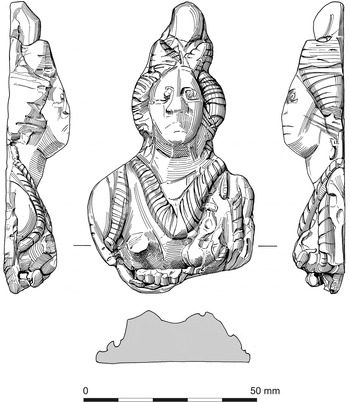
During the 2004 excavation at the Roman villa at Groundwell Ridge,Footnote 11 a lead bust was recovered by metal-detecting from the spoil heap of Trench 6. It is very likely that the object comes from a demolition layer in Room 4 (context 5082) of the bath suite. The bust is 86 mm high, 49 mm wide and shows head, shoulders and breasts of a female figure whose garment, probably sleeveless, is indicated by thick hemlines along the shoulders, below the breasts and along the V-shaped neckline (fig. 2). Her headgear consists of a crescent with a circular disk protruding from the centre, and her hair is modelled as if gathered into a bun at the back. The bust is generally very worn, but the facial features are the worst affected, although not deliberately erased.
Lead plaque depicting the goddess Isis, Groundwell Ridge, Swindon. Scale 1:1. (Drawn by Judith Dobie; © English Heritage) [A colour photo of the plaque is available online at www.journals.cambridge.org/bri]

The closest parallel for the headgear is to be seen in Hellenistic versions of the pshent (combined crowns of Upper and Lower Egypt) protruding from two lotus buds and this identifies the figurine as a representation of the Egyptian goddess Isis. Examples of this distinctive crown can be found, for instance, on the Isis statue from Laodicea in modern Turkey,Footnote 12 as well as on pipe clay busts of her infant son Harpocrates, examples of which are in the collections of the Ny Carlsberg Glyptothek, Copenhagen.Footnote 13 In contrast to many other representations of Isis,Footnote 14 there is no knot between the breasts of the Groundwell Ridge bust, although the hemlines mentioned above are probably reminiscent of a cape/mantle tied in a knot at the chest.
The flat back of the bust shows no obvious method of attachment, and for this reason it is suggested that it was attached/soldered to a metal fixture, perhaps a portable altar or a votive plaque; another possible interpretation could be that it served as a model to produce open moulds for the casting of bronze appliqués. A copper-alloy box cover found at Lambaesis (Algeria) exhibits such a plaque, depicting Harpocrates, between two snake-bodied fittings of his parents, Isis and Serapis.Footnote 15 On triangular-shaped votive plaquesFootnote 16 dedicated to Iupiter Dolichenus from Doliche (Turkey) the remains of the fixings for such a mount are still visible, while other triangles from the same site still retain the actual mount in that position.Footnote 17 A copper-alloy mount or fitting in the form of a bust of Diana, found in Lancaster and reported to the Portable Antiquities Scheme (PAS), has possible traces of solder in a slight hollow at the base of its otherwise flat back, thought to indicate that it may have been attached to a box or an item of furniture.Footnote 18
As queen of heaven, associated with the moon, Isis was essentially a mother goddess, concerned with family, fertility, fecundity and crop growth, among many other aspects of life, and together with Annubis she also accompanied the souls of the dead to the underworld and was a bestower of Eternal Life.Footnote 19 Her consort was Osiris and her son Horus, who — together with Isis herself — were introduced to the Roman world in their Hellenistic guises as Serapis and Harpocrates respectively. The mystery cult of Isis had been known in Rome from as early as the second century b.c., and during the first and second centuries a.d. it had become widespread throughout the Roman Empire, probably reaching Britain soon after the conquest.Footnote 20 Followers of this cult could be found amongst the highest ranks of society, for instance the emperors Caligula, Otho, Domitian, Hadrian and Commodus; Vespasian and Titus spent the night before the triumph over the Jews in the temple of Isis in Rome.Footnote 21 The ceremonies and processions of the Egyptian cults also seem to have played a role in the service of the Imperial cult,Footnote 22 and in the provinces the cult of Isis found supporters among merchants, legates, procurators and other officials, as well as the Romanised populations of towns, but to a lesser extent among the military.Footnote 23
There is only a small number of objects depicting Isis in Britain, but these can be augmented by items employed in activities associated with her cult.Footnote 24 A bronze figurine of Isis, possibly in her guise as Isis-Fortuna wearing the high atef crown and holding a cornucopia, was discovered by a metal-detectorist near the Romano-British temple at Thornborough, Bucks. The figurine was considered to be a local product on account of its mediocre workmanship.Footnote 25 A seated bronze figurine of Isis, previously identified as Demeter, was found in the Thames at London.Footnote 26 From Skeyton, Norfolk, comes a seated figurine of Isis suckling the infant Horus.Footnote 27 Much less certain is the identification of a worn, hollow-cast figurine from Dorchester, Dorset.Footnote 28 Steelyard weights depicting Isis are known from Cirencester, London and perhaps South Shields,Footnote 29 and a bone hairpin in the form of a hand holding a bust of the goddess comes from Moorgate Street in London.Footnote 30 A probable third-century bronze ring with glass intaglio apparently of Isis-Fortuna, with crescent headgear and holding a cornucopia, comes from London Wall,Footnote 31 and a female figure bearing fruit and corn on the bezel of a massive gold ring reportedly found at Silchester may also belong to this group.Footnote 32 A red jasper intaglio depicting Isis herself,Footnote 33 rather than a priestess of the goddess,Footnote 34 holding a situla and a sistrum, was found at Wroxeter. Three iron sistra are known from Moorgate Street, London,Footnote 35 and the fragment of a faience sistrum was discovered in Exeter in 1833.Footnote 36
A recently discovered copper-alloy figurine of Harpocrates from Oxford Road, Colchester, has been considered as evidence for Isiac worship there, reinforcing earlier assumptions which had been based on the discovery of falcon bones in a burial from a temple-mausoleum at Colchester Royal Grammar School.Footnote 37 Apart from Harpocrates’ association with the falcon, going back to his Egyptian origin as Horus, a silvered bronze figurine of the god from London shows him with a dog, a tortoise and a hawk.Footnote 38 Likewise, a copper-alloy figurine of a crocodile reported through the PAS from Fullerton, Hants., may have been part of an imported Nilotic group.Footnote 39
The rather scant evidence for the cult in Roman Britain is most convincingly demonstrated by the reference to temples of Isis and Serapis. A temple of Isis in London is mentioned on a jug of late first-century form inscribed with a graffito reading ‘Londini ad fanum Isidis’,Footnote 40 and in a third-century inscription on a stone altar found in Lower Thames Street, recording the restoration of a temple.Footnote 41 A Serapeum at York, probably founded before the visit to Britain of Septimius Severus, an enthusiastic devotee of the god, is attested by a dedicatory tablet found at Toft Green in 1770;Footnote 42 and a dedication to Jupiter and Serapis is known from a small altar at Kirkby Thore.Footnote 43 A second-century Portland limestone head of Serapis found at Silchester has been suggested as indicating the existence of a temple to the god.Footnote 44 A head of the god in Egyptian porphyry from Highworth, Wilts., only about 7 km to the north-east of Groundwell, has been identified as the work of a Mediterranean sculptor of the last quarter of the second century or slightly later, though some scholars have dismissed this as a recent import.Footnote 45 In this context it is worth remembering E. and J.R. Harris's point that ‘the “modern” importation of Egyptian antiquities by collectors dates from at least as early as the second quarter of the seventeenth century, and it is not surprising therefore that during rather more than three centuries some pieces should have been lost and found again’.Footnote 46 Furthermore, a number of bronze figurines and other objects originally part of the Brookes Collection, purportedly found at Avebury and including a bronze vessel attachment depicting Serapis, alert to the practice of providing credible but false origins for genuine objects bought by nineteenth-century antiquarians.Footnote 47 Apart from the possibility of modern imports, two large limestone scarabs found in Wiltshire in 1928, one near Stonehenge and the other at Ludgershall, have both been identified as modern forgeries.Footnote 48
Lead figurines are generally very rare finds and many of them show little artistic achievement.Footnote 49 The crude workmanship of the Groundwell Isis bust suggests a provincial, possibly even local origin. Its discovery from a modern excavation on the site of a villa may also indicate a local and Roman period rather than antiquarian context for the head of Serapis from Highworth and possibly other Isiac objects from the region. However, whether this is indicative of a pocket of real devotion to the deities in North Wiltshire or whether this interest in Egyptian religion was dictated by political considerations in the course of the visit of Septimius Severus and his family to Britain in the early decades of the third century has to remain a matter of speculation.Footnote 50
ACKNOWLEDGEMENTS
The lead bust was found by Pete Crisp of the Wyvern Historical and Detector Society. I am grateful to Anthony Beeson, Pat Witts and Martin Henig for helping with the identification of the figurine and providing references. Martin Henig has furthermore provided valuable comments on an earlier draft for which I am much indebted. The 2003–5 excavations at Groundwell Ridge were an English Heritage Beacon project undertaken in partnership with Swindon Borough Council who own the site. The illustration was prepared by Judith Dobie of the English Heritage Graphics Studio, Fort Cumberland, Portsmouth.