On 31 December 2005 operations officially ceased at controversial installations in Nevada and Arizona. A broad range of environmental campaigners had long sought the closure of the coal-fired Mohave Generating Station, near Laughlin, in southern Nevada, on the grounds that it was the source of dangerously high levels of industrial pollution. Southern California Edison and the co-owners of the plant decided to shut it down when faced with the prospect of retrofitting the power plant to satisfy rigorous new targets for sulphur dioxide emissions.Footnote 1 As a consequence the Peabody Western Coal Company stopped operating the Black Mesa Mine, on land jointly owned by the Navajo and Hopi nations in northeastern Arizona, because the Mohave Generating Station had been the sole recipient of coal mined at this location. In the process the 273-mile pipeline that supplied fuel to the power plant became obsolete. Its closure terminated the pumping by Peabody of 1.2 billion gallons of water annually from the Navajo Aquifer, which lies under the homelands of the Hopi and Navajo people. Over a forty-year period, vast amounts of pristine groundwater were used by Peabody to mix pounded coal into thick slurry that was transported through the pipeline to the Mohave Generating Station. In the process, the rate of flow from springs and seeps vital to the pursuit of horticulture on the Hopi reservation steadily declined.Footnote 2
A portrait of Victor Masayesva Jr. who identifies himself as more a farmer than an artist. Photograph reproduced by permission of IS Productions/Victor Masayesva Jr.

For Vernon Masayesva, executive director of the Black Mesa Trust, a Hopi environmental group that for two decades had campaigned for the closure of the power plant and the pipeline, this was a long -anticipated defeat of corporate interests and a victory for Indigenous sovereignty rights. In an article published in the Arizona Republic newspaper eight weeks before the closure date, Masayesva wrote,
On Dec. 31, our small Hopi grass-roots organization will have accomplished something quite extraordinary: We will have forced the world's largest coal company to end its plundering of our waters. When the pumps stop, a beautiful silence will descend upon our sacred land, and we will rejoice. In our small way, we changed history. Those who have and would continue to turn our ancestral homes into lands of national sacrifice were brought to a halt. Our voices were heard and, against all odds, the power of our teachings and our faith in our religion and science prevailed.Footnote 3
Acknowledging that the closure of Black Mesa Mine would cause the Hopi Nation to forsake valuable revenue derived from lease payments from Peabody, Masayesva was adamant that decommissioning the Mohave Generating Station and the coal slurry pipeline was nevertheless a victory for Hopi sovereignty. Masayesva, a former chairman of the Hopi Tribal Council, proposed a series of new measures promoting clean-energy initiatives that included constructing a new solar power plant located on Hopi and Navajo lands that would bring much-needed employment to the members of both tribes while boosting annual tribal revenues through land-lease agreements. In the same statement he announced that a group of Hopi runners would set out from the Hopi villages to run with a gourd of water collected from sacred springs located on the Hopi homeland to Mexico City in time for the Fourth World Water Forum. Putting forward a social and political vision of a global water commons, Masayesva stated, “We will tell the world government ministers that all waters are one, a singular life-sustaining living organism, the source of life for a living earth.”
Victor Masayesva Jr., the younger brother of Vernon and long a leading figure in Native American experimental media production, agreed to film the 1,650-mile relay run to Mexico City. Faced with the challenge of working with relatively meagre resources to create a visual document that conveyed the political and social significance of the run, Masayesva made Paatuwaqatsi – Water, Land and Life. The film received its world premiere at the Talking Stick Indigenous Film Festival in Santa Fe, New Mexico in June 2008. Whilst Masayesva's earlier films, particularly Itam Hakim Hopiit (1985) and Imagining Indians (1993), have received scholarly attention, Paatuwaqatsi has yet to be the subject of the critical discussion it deserves.Footnote 4 I have set about correcting this situation in several respects. In the first instance, it is important to establish the significance of water and running to Hopi culture. As Vernon Masayesva's words indicate, Hopi reverence for water has taken on an increasingly political dimension during the contemporary period. The Hopi Nation has sought to exercise its sovereignty rights to the fullest extent not merely by controlling the development of natural resources on tribal lands and but also by challenging the rights of other actors to exploit resources that lie beneath or in proximity to the reservation in a manner that is deemed either to infringe on Hopi legal rights or to be detrimental to the welfare of the Hopi people. The act of running, as I will explain shortly, also possesses spiritual and political dimensions and has been employed historically in the service of profound acts of resistance against European colonization. After making these contextualizing remarks I review Masayesva's filmmaking career and consider his idea of the indigenous aesthetic, a set of principles that have guided the practical decisions and artistic choices he has made in the course of over thirty years working as an independent media producer. I then discuss the ways in which Masayesva conveys Hopi understandings of water, running and place-centred cultural identity in Paatuwaqatsi. I conclude by noting, first, how Masayesva is not afraid to allude to internal divisions within Hopi society over issues of economic development and, second, how his film should be regarded within the larger context of ongoing drought and climate change in the Southwest.
HOPI HISTORY AND THE CULTURAL SIGNIFICANCE OF WATER
For centuries the Hopi have lived in the semi-arid environment of northeastern Arizona. The village of Oraibi was established around 1150 and is probably the oldest continually inhabited settlement in North America. Its foundation came some four hundred years before Spanish conquistadors first encountered Pueblo Indians in New Mexico and seven hundred years before the United States went to war with Mexico for possession of the territory known today as the Southwest. Archaeological evidence indicates a direct link between present-day Hopis and direct descendants who first inhabited the region between 1,500 and 1,600 years ago. Further evidence of human occupation of the region dates back at least 10,000 years.Footnote 5 According to their myths of origin and migration, Hopis have lived in their present location since time immemorial. Oral traditions tell of the emergence of the Hopi into the present “fourth world,” or “fourth way of life,” from a series of three previous worlds or cultural incarnations.Footnote 6 On arriving into their present environment by way of sipapuni, a point of emergence located along the course of the Little Colorado River near to its confluence with the Colorado River in the Grand Canyon, the people were organized into clans and dispersed to the north, east, south and west. Having travelled westward towards the Pacific Ocean, southward to Central America and eastward to create large-scale settlements at Chaco Canyon and Mesa Verde, the Hopi gathered again to begin settling the Hopi mesas that remain their present home.Footnote 7
The low rates of annual precipitation and periodic instances of drought in northern Arizona create particular challenges for the pursuit of horticulture and human community. Living in a location where there is only one continuously running source of water – the Moencopi wash – Hopis have relied for their day-to-day sustenance on the collection of water from springs and seeps located in the walls of the sandstone mesas on which most of their twelve villages are built. In addition, summer rains, often arriving in the form of impressive thunderstorms, sustain crops of corn, beans and squash, as well as apricots and peaches (which arrived with the Spanish) that form the staples of Hopi agriculture. During the twentieth century, traditional sources of water were supplemented through the construction of wells that facilitated greater crop production and increased ownership of livestock; only in the latter part of the century was piped water brought to homes. In spite of these developments, religious practices associated with water remain essential to Hopi culture.Footnote 8 The anthropologist Peter M. Whiteley provides an eloquent explanation of the central significance of water, in its physical state and symbolic dimensions, to Hopi society:
Paahu, “natural water” or “spring,” is absolutely central in Hopi social and environmental thought … Springs, water and rain are focal themes in ritual costumes, kiva iconography, mythological narratives, personal names, and many many songs, which call the cloud chiefs from the varicoloured directions to bear their fructifying essence back into the cycle of human, animal, and vegetal life. That essence – as clouds, rain, and other water forms – manifests the spirits of the dead. When people die, in part, they become clouds; songs call to the clouds as ascendant relatives. Arriving clouds are returning ancestors, their rain both communion with, and blessing of, the living. The waters of the earth (where Kachina spirits live) are, then, transubstantiated human life.Footnote 9
One of the ways in which Hopis articulate their understanding of their chosen way of life is through running. The Hopi historian Matthew Sakiestewa Gilbert notes that after their emergence into the fourth way of life, members of the Flute Clan who migrated eastwards to Chaco Canyon created extensive trails there. Gilbert explains, “Hopi clan runners who competed at Chaco Canyon did so to bring rain to their family's fields. When the Hopis returned to their original lands on and near the Hopi mesas, the Flute Clan continued its ceremonial races and established running in Hopi culture.”Footnote 10
For Hopis, running possesses a spiritual dimension and is motivated by communal needs rather than individualistic goals. The anthropologist Peter Nabokov observes that oral traditions in many North American indigenous cultures express the idea that running possesses a ritual dimension that puts into play “a link between worlds, a way of communicating with timeless spirits and powers.”Footnote 11 This view is supported by a story told to the Scottish ethnographer Alexander M. Stephen, who lived with the Hopis for around thirteen years before his death in 1894. Stephen recounts,
When the sand Chief takes the prayer feathers, to pray on them and leave them in the fields, he goes barefooted and without covering on limbs or body, that the Cloud chiefs may see he wants rain. He runs swiftly that the clouds may come swiftly, that his prayers be quickly answered.
He loosens his hair, and lets it hang over his shoulders, for thus the Cloud chiefs carry the rain clouds. He makes a far circuit on the first day, because the Cloud chiefs live far away. He goes to the northwest, southwest, northeast, and southeast, to call the attention of all the Cloud chiefs … on each succeeding day, he travels in a shorter radius. It is thus we want the rain clouds to come, nearer and nearer, until on the concluding day of the ceremony they shall have come overhead and poured down the heavy rain upon ourselves, our houses and all the surrounding lands, and we may see the arroyo full of running water and listen to its sweet sound.Footnote 12
Running for the Hopi people has served other purposes, too, including an important role in efforts to resist the imposition of Spanish colonialism. In his book Indian Running, Nabokov provides a firsthand account of a run between Taos Pueblo, in northern New Mexico, and the Hopi Cultural Center on Second Mesa that took place in early August 1980. The six-day, 375-mile run was undertaken by a group of Hopis and Pueblo Indians to commemorate the three-hundredth anniversary of the Pueblo Revolt, which began on 10 August 1680. Through this uprising Hopis and Pueblo Indians instigated a remarkably well-coordinated attack on the Spanish colonial population that succeeded in casting out of New Mexico colonial officials, military personnel and Franciscan missionaries for twelve years. As one historian puts it, “the Revolt delivered a severe blow to the prestige of the Spanish empire and stands as the most spectacular victory achieved by Indian arms within the present limits of the United States.”Footnote 13 Runners carrying messages between the seventy-odd groups involved in the resistance were essential to the success of the enterprise. The San Juan Pueblo leader Popé, or Po'pay, played a central role in the drama, sending messages to fellow participants in the Revolt first by way of pictographs drawn on deerskins that were carried by runners and then, as the day of reckoning approached, through distributing knotted yucca-fibre cords. As Nabokov notes, “Every village was to untie a knot each day until the cords were clear. That day they should grab hidden weapons and ‘burn the temples, break up the bells.’”Footnote 14
In later years, over two centuries after colonial Spain began to reassert its influence over indigenous nations through the reconquista, or reconquest, of New Mexico in 1692, American officials and anthropologists in residence at the Hopi mesas noted the running abilities of the local population.Footnote 15 The anthropologist Walter Hough, who conducted extensive fieldwork amongst the Hopi during the 1890s and 1910s, recollected the extraordinary endurance of one man who was sent by a government official based at the Hopi mesas to deliver a message to the members of an exploration team spending the night in Winslow, Arizona some sixty-five miles to the south. The Hopi runner set out from Orayvi, on Third Mesa, in the afternoon and arrived in Winslow at seven the following morning. Crossing terrain that was unfamiliar to him, the man ran until darkness set in and then resumed his journey in the moonlight. After delivering his message he began his return journey the same morning and arrived back at Orayvi during the afternoon. He had run 130 miles in less than twenty-four hours.Footnote 16 Hough also remarked that this man was not even the best runner in his home village, for another male resident there liked to practise for dawn races by running for thirty miles or so each morning. A further indication of the prowess of Hopi runners can be found in the experience of Louis Tewanima, who won the silver medal in the 10,000 metres at the 1912 Olympic Games in Stockholm, Sweden behind the great Finnish distance runner Hannes Kolehmainen, who also won gold medals in the 5,000 metres and the individual cross-country event. (The only American athlete to equal or better Tewanima's achievement in the Olympic 10,000 metres is the Lakota Billy Mills, who won the gold medal at the Tokyo Games in 1964.) At the time Tewanima was twenty-four years old and a student at the Carlisle Indian Industrial School in Pennsylvania, where he had been encouraged to run competitively. On returning home to the Hopi mesas, he found that men in their forties could run longer and faster than he could.Footnote 17
In early March 2006, almost a century after Tewanima received an Olympic medal, fifteen runners set out from the Hopi mesas with the conviction that their collective act of physical expenditure and right thinking was an act of affirmation of the Hopi way that provided a means of connection to their running forebears. They ran in relay form over a hundred miles a day, with a support team and vehicles to facilitate their travel, until they arrived in Mexico City. “Along the way,” explained Vernon Masayesva, “we will meet with tribal groups and elders who will add their spirit and blessing, their energy and hope, to our Run of Respect for Water and All Life.”Footnote 18 For Vernon Masayesva to help set in motion the Hopi run, and for his brother Victor to film the event, was an extension of the responsibilities associated with their membership of the Water Coyote clan. As the latter explained, his family has always had “a caretaker relationship” with water.Footnote 19
VICTOR MASAYESVA JR. AND THE INDIGENOUS AESTHETIC
Victor Masayesva Jr. is one of the most influential Indigenous filmmakers and photographers of his generation.Footnote 20 From his home in Hotvela, located on the third or most westerly of the three Hopis mesas, Masayesva has produced a wealth of creative work in film and photography. Since the late 1970s, when he returned to live full-time in Hotvela after pursuing his education at the Horace Mann Prep School in New York, Princeton University in New Jersey and the University of Arizona in Tucson, Masayesva has produced a series of varied and complex visual works. He initially worked in still photography and then quickly moved on to video, seeking a more dynamic visual medium in which to convey ideas central to Hopi consciousness. His early photography and video originated in local initiatives to strengthen the provision of Hopi-led teaching at the Hotevilla-Bacavi Community School. After completing the short experimental documentary Hopiit (1982), he was commissioned by the German television company ZDF to create the feature-length documentary Itam Hakim Hopiit (1985), thus gaining an international platform for his work.Footnote 21 Masayesva's succeeding films include Ritual Clowns (1988), which employs early-generation computer animation technology in an innovative exploration of the role of ritual clowning in Hopi culture, and Imagining Indians (1993), perhaps his best-known and most critically debated film. Engaging with the legacy of the quincentennial of Columbus's arrival in the Americas, Imagining Indians provides a powerful and often irreverent critique of the grounds on which non-Native outsiders have sought to represent Native Americans, primarily in the film images provided by Hollywood westerns but also in other media, including nineteenth-century portraiture by the artist George Catlin and a Marvel Comics story which features Hopi kachinas. The film features the testimony of Native people who have worked as extras on films such as Kevin Costner's Dances with Wolves (1991) and Michael Apted's Thunderheart (1992). It also documents the ways in which the Hopi community became internally divided over permitting a film adaptation of the popular Tony Hillerman novel The Evil Wind to be filmed on the reservation. Alongside these films – made using video, film and high-definition digital cameras – Masayesva has maintained a keen interest in still photography, creating images that range from semi-documentary-style black-and-white portraits of Hopi individuals in the late 1970s to richly coloured photographic collages employing paint and digital manipulation to mesmerizing effect that he has created since the early 1990s.Footnote 22
Throughout his career, Masayesva has pursued a set of core values expressed through his idea of “the indigenous aesthetic” in various essays and talks. He has employed the phrase in various ways. For example, he has deployed it to argue that Indigenous filmmakers should be “knowledgeable about and committed to working from and within the structures and conventions of traditional expression, including the use of the mother tongue as the narrative voice.”Footnote 23 He has also stated that “there is such a thing as an Indian aesthetic, and it begins in the sacred.”Footnote 24 Masayesva's first film, the experimental short Hopiit, evokes the seasonal cycle of the Hopi calendar year through a series of meditative images and accompanying fragments of oral stories told in voice-over. As Kathleen M. Sands and Allison Sekaquaptewa Lewis observe, “The language of the film is Hopi; the language of the images is Hopi. This is a Hopi film, made for a Hopi audience – no subtitles, no explanation, no interpretation.”Footnote 25 The art and media critic Steven Leuthold notes the “intensely local focus” of Masayesva's second film, Itam Hakim Hopiit, much of which consists of a telling by the Hopi elder Ross Macaya of the Hopi Emergence Myth and the story of the Bow Clan's migration.Footnote 26 The film provides a visual evocation of locations, themes and symbols associated with oral storytelling and ceremonial practices while also conveying the centrality of water and corn to the Hopi way of life.
Another way that Masayesva characterizes the indigenous aesthetic is by stressing the capacity of Native filmmakers to “subvert the colonizers' indoctrination and champion indigenous expression in the political landscape.”Footnote 27 He tells of how Hopi Ya-yat, traditional soothsayers, predicted around 1900 “that paper (tutuveni), or messages, would fly through the air and disorient the people.” Hopis, he explains, have accepted modern media “to the extent that we grab the paper out of the air and launch our own paper messages into the world so that we don't go crazy.”Footnote 28 Working creatively in visual media production has become a crucial means of presenting a persona to non-Hopis:
film and video are the chosen masks for the presentation of ourselves to the world. Out of the colors and sounds of our cultures we have shaped the image before you. Subsequently our best presentation and most effective performances come from complete absorption in and expression of the indigenous aesthetic.Footnote 29
There is a quiet ambiguity to these words as Masayesva moves from commenting on Hopi knowledge exclusively to referring to “our cultures” in the plural, suggesting that he is invoking the experiences of Indigenous communities more generally. Masayesva has worked in solidarity with other Indigenous people throughout his career and he is well aware of how the socially and politically empowering act of self-representation within a particular tribal community can also benefit the members of other Native groups.
Taken together, Masayesva's filmmaking practice and artistic outlook are instances of the ideology and practice of visual sovereignty. The visual historian Jolene Rickard (Tuscarora) states, “the appropriation of the term sovereignty was and remains a critical source of self-determination for Indigenous peoples globally.”Footnote 30 The literary and film scholar Michelle Raheja (Seneca) takes a similar line of argument when she argues that by “appealing to a mass, intergenerational, and transnational indigenous audience, visual sovereignty permits the flow of indigenous knowledge about such key issues as land rights, language acquisition, and preservation by narrativizing local and international struggles.”Footnote 31 Certainly Masayesva's stress upon the issue of autonomy in his own filmmaking experience is compatible with the claims that Rickard and Raheja make for visual sovereignty.Footnote 32 He has long campaigned for the right of Indigenous filmmakers to control the production, distribution and screening of their work.Footnote 33 For Masayesva, exercising this autonomy meant learning to edit footage and mix sound while continuing to work as a self-directing cameraman. This all-encompassing role as an independent filmmaker has been crucial to his realization of the indigenous aesthetic. As he put it to me: “How can you write about an aesthetic when you're only involved in part of it?”Footnote 34 Maintaining such a practice means that Masayesva has largely worked alone in meeting the challenge of developing assignments, generating funds and gathering the resources to make films and find appropriate venues for their dissemination. His emphasis on autonomy also explains in part why he has not worked on some of the more mainstream documentary film projects involving Native personnel that have emerged during the early twenty-first century, such as the PBS We Shall Remain series of five films viewing American history from a Native perspective that was broadcast on American television in 2009.Footnote 35 Whilst working independently makes great demands on the individual, it is precisely Masayesva's ability to work as a self-directing cameraman, editor and producer that made Paatuwaqatsi a viable project.
PAATUWAQATSI – WATER, LAND AND LIFE
The film begins with a scene recorded at dawn on 3 March 2006, the day that the runners set out from Munqapi (Moencopi). A young man wearing a hooded top and with his back to the camera makes an offering of corn just before sunrise. The camera cuts to the group of runners receiving blessings and watching as a line of corn pollen is laid over the ground immediately ahead. The words of a male elder heard on the soundtrack appear on the screen in translated English subtitles: “Let the runners go forth on the Sun's light respectfully. Go forth with no weakness.” A minute into the film, the camera focusses on a star, which appears to move through the dawn sky (an illusion conveyed by the movement of the camera). A voice-over in Hopi with translated English subtitles explains,
She observed that we were not all together. Yes I agreed we are not as one but maybe with our strength and sacrifice we can come together as one. Prayerfully, humbly she said to return to work on the springs, the water. Only in that way will these springs become active, and breathe again.
After forty-five seconds, this scene gives way to a striking sequence of shots of water that accompany the singing of a song associated with Wuwuchim, which marks the beginning of the Hopi year in November. A caption explains that this particular song dates from the early 1900s and prophesies the negative consequences to the Hopi of selling rain and snow water. Masayesva comments that “wuwuchim is a sensitive matter,” and explains that the song was included in the film in order “to use the most profound knowledge to claim our waters.”Footnote 36
The ninety-second sequence of water images that complements the song begins with a striking high-contrast close-up shot of silvery rainfall set against a black background. This is followed by a steady long shot of Oraivi and the edge of the mesa on which the village stands, and then a slow pan across the village buildings. Rain falls steadily. The film cuts to a medium shot of an eagle tethered to a rooftop, a shot quite similar to one that occurs in Masayesva's earlier film Itam Hakim Hopiit. Eagles, which are revered as spiritual beings by Hopis, are captured and sacrificed as part of ceremonial observances. There follows a series of shots of muddy rainwater running through the village and down the side of the mesa. After these close-up and medium shots appear, the camera focusses on a wash, ordinarily dry, which is now swollen with roiling red-brown water. The camera lingers on a tree branch being pushed along by the strong current. The film then cuts to a slowly moving time-lapse shot of gathering storm clouds. To this point the sequence of shots has been accompanied by the sounds of rainfall and flowing water, now there is calm. The camera cuts back to the eagle on the rooftop, focussing the viewer's attention by way of a medium shot and then an impressive close-up of the eagle captured in profile against a reddening sunset. The final shot in the sequence shows a small gourd in a woven net held by a string. Similar to the opening shot in this sequence, this is a high-contrast image in which the darkly coloured water vessel is isolated against a blank white sky. The gourd sways in the breeze and the shot is slowed down slightly. This is the vessel in which water collected from sacred springs at the Hopi homeland will be taken to Mexico City.
Through these first three sequences, Masayesva establishes the key coordinates of his film. A particular time and place is evoked through the opening shots of the runners and the use of a caption, and the great majority of the film documents the journey that is set in motion at this point. Significantly, Masayesva breaks away from the running narrative to evoke the social and political contexts in which it took place. The political context is clarified when, three and a half minutes into the film, Vernon Masayesva explains how the Black Mesa Trust has accomplished its mission to force the Peabody Western Coal Company “to stop its use of our pristine aquifer water” and that there is now a need to address “in a very aggressive way” the contamination of the Navajo Aquifer through Peabody's practices.Footnote 37 While he speaks, a shot appears of the front page of Hopi Tutuveni, the official newspaper of the Hopi Tribe, with the headline “Mohave Generating Station Closes.” The film cuts to a medium shot of coal plant machinery at work and then to a panning shot that surveys the coal slurry pipeline. Masayesva also explains in voice-over that the run is taking place as a means of forging links between present-day Hopis and their ancestral ties to Mexico and Central America because many Hopi clans trace their origin to that region. As he speaks these words, the film cuts to shots of the Mayan pyramid, Teotihuacán City, San Juan Teotihuacán, in Mexico, before cutting back to Vernon Masayesva, who sits by a stone wall in a Hopi village. The camera pans left to focus on a nearby dog contorting its body to scratch at fleabites; it is an idiosyncratic touch characteristic of Masayesva's camera work.
Masayesva captures the runners in various ways. At the outset of the film they are shown making a round of various villages and receiving the blessings of elders before they take to the road. Runners are also seen making prayer offerings at a water spring. In one striking sequence the camera tracks runners one at a time as they pass an ear of corn to one another as they each run a leg of ten seconds' or so duration. The smoothness of the shot matches the fluid actions of the runners, who run within themselves rather straining with effort. This shot lasts for forty seconds before dissolving through a water ripple effect into a brief shot of water splashing on a hard surface. A second dissolve returns viewers to the same scene of running against the backdrop of an orchard; however, now the runners pass a gourd rather than an ear of corn from one person to another. These shots are accompanied by the sounds of men singing and the shaking of rattles, along with the voice of a Hopi woman who speaks of how the activity of running enlivened her spiritual understanding of water.
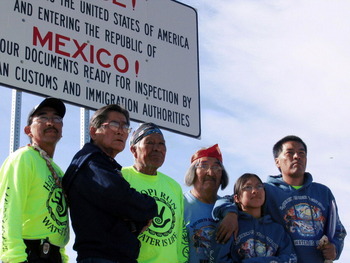
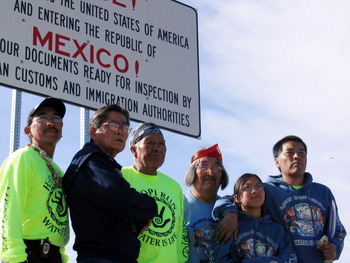
Hopi runners and support team members (including Vernon Masayesva, second to the left) are photographed prior to crossing the international border into Mexico. Photograph reproduced by permission of IS Productions/Victor Masayesva Jr.
The route taken by the Hopi runners involved travelling on Interstate-40 in New Mexico, crossing the international border at the busy El Paso/Ciudad Juárez station and taking the expressway south to Chihuahua and onward to Mexico City. Far from being a bucolic experience the Hopi runners had to contend with heavy vehicular traffic for much of their route. Even in these instances, Masayesva conveys a certain peacefulness that contrasts with the noise and proximity of vehicles. For example, in one scene filmed in the evening darkness in southern New Mexico he uses a zoom shot to show one silhouetted runner handing off to another in a scene lit by the headlights of passing cars and trucks. In the accompanying voice-over, a Hopi elder explains in English how the runners were directed to go to Mexico City in order “to send a prayer for peace, for brotherhood, for respect.” He continues, “And we've done that. Whether anyone has heard it or not, we don't know. But in the Hopi way, if one or two did, that's enough for us.” Masayesva keeps the sounds of passing vehicles low on the soundtrack while placing non-diegetic sounds of the elder's voice and a separate recording of drumming higher in the mix. Doing so effectively conveys the Hopi runners' ability to maintain their fixity of purpose in the midst of a cacophony of distracting noises.
As I have noted, the Hopis' run was timed to coincide with the meeting of the Fourth World Water Forum in Mexico City between 16 and 22 March 2006. The first World Water Forum was held in Marrakech, Morocco in 1997, one year after its organizing body, the World Water Council, was established. Today the council has a membership of over three hundred people drawn from sixty countries, while around 20,000 delegates representing 190 countries attended the 2009 World Water Forum in Istanbul, Turkey. According to its mission statement, the purpose of the World Water Council is
to promote awareness, build political commitment and trigger action on critical water issues at all levels, including the highest decision-making level, to facilitate the efficient conservation, protection, development, planning, management and use of water in all its dimensions on an environmentally sustainable basis for the benefit of all life on earth.Footnote 38
Maude Barlow, the Canadian environmental and social-justice campaigner, has called into question the remit of the World Water Council, accusing its leaders of prioritizing the corporate control of water resources throughout the world at a historical point of environmental crisis. Through the Council of Canadians, the NGO which she chairs, and her various books, including Blue Gold: The Fight to Stop the Corporate Theft of the World's Water (co-authored with Tony Clarke in 2002) and Blue Covenant: The Global Water Crisis and the Coming Battle for the Right to Water (2007), Barlow has campaigned for progressive changes to be made to the ways in which water resources are gathered, distributed and consumed across the globe. She argues that water should not be regarded as a commodity that can be exploited for commercial gain, but instead is “a human right and a public trust.”Footnote 39 Barlow's rhetoric echoes the language employed by Indigenous campaigners to convey the rights and responsibilities of Native people concerning water.Footnote 40
I have cited the criticisms made by Barlow and the Council of Canadians of the shortcomings of the World Water Council because they help to place the concerns of Hopis in North American and global contexts. When the Hopi runners set out on their long journey to Mexico City they did so wearing T-shirts on which these words appear:
Water sustains all Life. Her songs begin in the tiniest raindrops, transform to flowing rivers, travel by majestic oceans and thundering clouds, and back to earth, to begin again. When water is threatened, all living things are threatened.
These words form part of the “Indigenous Declaration on Water,” an eloquently expressed thousand-word document that was presented and endorsed at the International Conference on Water for People and Nature, organized by the Council of Canadians in July 2001.Footnote 41 A month later the statement was also endorsed by the seven hundred Indigenous delegates from Canada, the United States, Mexico and Central and South America who attended the 12th Indigenous Environmental Network Protecting Mother Earth Conference in the homelands of the Penticton Indian Band Okanagan Nation Territories in British Columbia, Canada, in early August 2001. There delegates discussed a wide range of environmental and social-justice issues affecting Native communities, including concerns relating to treaty rights, economic sustainability and water rights, as well as to the present and future impacts of globalization and climate change – all items of great concern to the Hopi too. A summary report on the conference noted,
Indigenous peoples – from the North to the South – historically and currently are experiencing poverty, economic dependency from federalism and industrial development, experiencing the symptoms of colonization – like internalized oppression – malnourishment and hunger. It was stressed that language is the foundation of Indigenous identity both to the natural world and to each other. When the connection to healthy and sustainable ecosystems is disturbed by loss of habitat, biodiversity and traditional foods, this affects the ability to pass on language that is closely linked to our environment, our foods, water and our relationship to the sacredness of our Mother Earth.Footnote 42
And so it can be seen how the relatively humble act of a group of Hopis setting out to run from their homes in northern Arizona to Mexico City spoke in their own way to the environmental, social and political concerns of Indigenous nations and communities throughout North America, and indeed throughout much of the world in the early twenty-first century. In so doing they sought neither media attention nor sponsorship, so the run “wouldn't be tainted by money.”Footnote 43 Bearing in mind this larger context of international human rights campaigning, it is no surprise to see that Masayesva makes a point of extensively documenting the vibrant scenes of cultural exchange that occurred as the runners congregated with Mexican Indigenous people in Mexico City at the conclusion of their run on 16 March 2006. The film culminates with a fitting scene of international Indigenous solidarity in which individual speakers testify to the power of water to bring people from diverse places together in common purpose. In a voice-over, one Hopi man speaks of the revitalizing effect of the run and of his hope for the future: “We have planted the seed. Many more events will sprout from this historic run. And hopefully the power and energy of the prayer feathers has resonated throughout the whole world.”
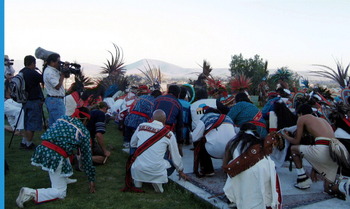
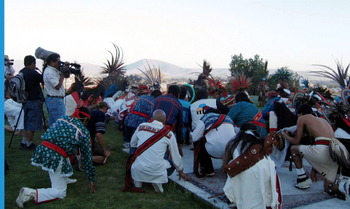
Victor Masayesva Jr. is photographed shooting an Aztec dance at Metemec, thirty-three miles to the west of Mexico City, Photograph reproduced by permission of IS Productions/Victor Masayesva Jr.
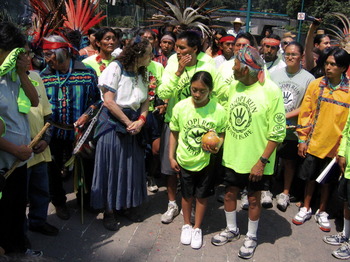
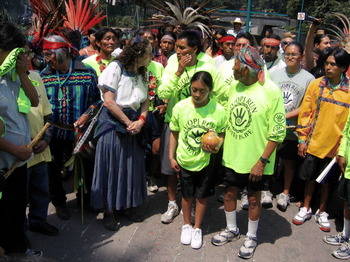
Hopi runners gather with the members of Mexican Indigenous nations at the culmination of their run in Mexico City. Early in the film, Vernon Masayesva explains that one of the missions of the run was to provide Hopis with the opportunity to reconnect with locations of origin and ancestral latives described in Hopi clan migration myths. Photograph reproduced by permission of IS Productions/Victor Masayesva Jr.
An array of offerings that includes ears of corn, gourds of water and macaw feathers is laid out at a shrine created in Mexico City to celebrate the coming together of the Hopi runners and their Indigenous relatives. Photograph reproduced by permission of IS Productions/Victor Masayesva Jr.

CONCLUSION
Towards the end of Paatuwaqatsi, a man explains in voice-over the positive signs that were shown to runners during their run to Mexico City. When the runners crossed the international border at El Paso/Ciudad Juárez snow started to fall for several days, thus breaking a 143-day drought in northern Arizona. The man explains that Hopi runners' collective act of sacrifice was responsible for this change: “In our Hopi way this was one of the blessings that was sent to us.” These words are overlaid with a shot of the screen of a mobile phone being held by one of the runners while in northern Mexico which shows a photograph of the heavy snowfall back home at Hopi. On arriving in Mexico City, the runners received further blessings when thousands of birds could be seen flying above in response to signs of nearby volcanic action. There runners also witnessed the rare sight of a lone eagle circling above the sprawling megacity. The same man states, “Our prayers were answered,” further explaining that these signs were all that Hopis wanted from the run.
Even though Paatuwaqatsi documents the positive outcomes of the Hopi run, it contains an undercurrent of caution. Throughout the film viewers hear the voices of runners expressing the view that in the modern period the Hopi people have experienced disunity and strayed from their true path. Looking back on the run and meeting Mexican Indigenous people, one man reflects,
People look to the Hopi but we are distracted. We don't respect or support one another. Our beliefs, our clans, we don't cherish. There we realized that as all clans we are connected to this one single Hopi life. We should be united but we are not. People look at us – our religion, language, life, subsistence – we have all that but we don't realize it.
Hopi viewers are almost certain to be aware of the tensions and divisions within their society that are alluded to in this statement through the mention of distraction and disunity. The causes of division within Hopi society are complex and investigating them is outside the province of this discussion. What I wish to emphasize is that Masayesva does not shy away from representing the tensions that mounted during the course of the run to Mexico City as members of the team disagreed on various issues, including core concerns over Hopi theology. He provides sufficient material to provide non-Hopis with a sense of the nature of these disagreements, but not enough information that they are likely to understand their exact substance. Put another way, the run is a performance of unity through difference and is thus representative of Hopi sovereignty in action.
Looking towards the future decades of the twenty-first century, Hopis are likely to face profound challenges as they seek to maintain their autonomy. For now, there is little prospect of Vernon Masayesva's vision of clean energy production initiatives being pursued on lands jointly owned by the Hopi and Navajo nations. Instead it is more likely that a sizeable proportion of the Southwest's voracious energy needs will continue to be satisfied through increased coal production at the Kayenta Mine, which lies adjacent to the suspended Black Mesa Mine.Footnote 44 Coal stripped from Peabody Energy's Kayenta Mine is transported eighty miles by rail to the Navajo Generating Station in Page, Arizona, which provides electricity for homes and businesses across the Southwest. The plant also supplies the power required by the Central Arizona Project to pump water to Phoenix, Tucson and other urban areas in the state. The Hopi people who hundreds of years ago learned to adapt to the environmental constraints placed on life in their homeland have witnessed the growth of a vast hydraulic society that has enabled spectacular urban growth in the Southwest.Footnote 45 The environmental historian William deBuys notes in his study of the effects of present and historical climate change on the Southwest that “continuous economic and demographic growth has a way of turning abundance into scarcity, and the hydraulic cornucopia of the late twentieth century now shrinks in the twenty-first.”Footnote 46
Today Hopis, as well as their Navajo neighbours, have become internally divided over the precise ways in which they should benefit economically from the water and mineral rights they possess.Footnote 47Paatuwaqatsi implicitly critiques the manner in which Arizona's water and mineral resources have been exhaustively exploited over the past hundred years. The film, which is primarily directed at a Hopi audience, provides non-Hopi viewers with a powerful evocation of the Hopi people's identification with the semi-arid environment of their homeland. The film communicates the ways in which Hopis' affective relationship with place is put into action through the acts of running, prayer and personal sacrifice, and it conveys the manner in which Hopi cultural identity can be strengthened through working in solidarity with other Native groups and NGOs to consolidate the Indigenous presence in the global political arena. Victor Masayesva, through his revival of a century-old Wuwuchim song concerning the cost to the Hopi people of selling water at a time of great unrest on Third Mesa, cautions against taking the view that achieving political sovereignty should come by way of economic benefits that compromise the integrity of the Hopi way.