Introduction
Television viewing is an important leisure activity for older adults. Research since the 1950s has consistently shown that older adults spend more time watching television than younger age groups (e.g. Harwood Reference Harwood2007: 179). Given the sharp rise of the ageing population and the societal value placed on successful ageing, it is relevant to ask how this media use plays a role in older adults' lives. Therefore, the aim of the current study is to provide an insight into the meanings of television in older adults' lives, by analysing change and continuity in their television viewing.
Change and continuity have been analysed in other research domains as well, for instance in personality development (e.g. Caspi, Roberts and Shiner Reference Caspi, Roberts and Shiner2005), friendship (e.g. Jerrome and Wenger Reference Jerrome and Wenger1999) and intelligence (e.g. Pushkar et al. Reference Pushkar, Andres, Etezadi, Arbuckle, Schwartzman and Chaikelson1995). Our study is particularly related to recent studies that pay attention to change and continuity in activities in later life (e.g. Nimrod Reference Nimrod2008; Nimrod and Kleiber Reference Nimrod and Kleiber2007; Pushkar et al. Reference Pushkar, Chaikelson, Conway, Etezadi, Giannopoulus, Li and Wrosch2010). Change in activities in later life is often thought of in terms of reduced levels of participation and the substitution of challenging activities with less challenging alternatives. Important characteristics of leisure in old age are a transition from physical activities to activities that demand less physical effort, and a transition from outdoor to indoor activities (seeNimrod Reference Nimrod2008: 832; Nimrod and Adoni Reference Nimrod and Adoni2006: 608). Television is readily available in most homes, which often leads to the expectation that watching television gains prominence when people shift their focus from challenging and outdoor activities to less challenging and indoor ones.
Continuity in activities has been studied too. Researchers (e.g. Nimrod Reference Nimrod2008; Nimrod and Kleiber Reference Nimrod and Kleiber2007; Pushkar et al. Reference Pushkar, Chaikelson, Conway, Etezadi, Giannopoulus, Li and Wrosch2010) typically refer to continuity theory (as advanced by Atchley) to explain why older adults are supposedly inclined towards constancy. Atchley (Reference Atchley1989) argues that individuals wish for stability in familiar and customary roles. Individuals tend to maintain psychological and social patterns adopted earlier in their lives (e.g. attitudes, opinions, preferences and behaviour) by developing stable activity patterns that help them preserve continuity (Nimrod Reference Nimrod2008: 832). According to this argument, continuity in television viewing is to be expected. Current cohorts of older adults have a long history of television viewing which can impact on their viewing experiences in later life. By focusing on both change and continuity in older adults' television viewing, we can provide rich insights in the meanings of television viewing for ageing individuals.
Previous research on older adults' television viewing
In this section, we discuss what previous research on older adults and watching television has shown about change and continuity in television viewing. Change in older adults' television viewing can be understood in the context of maturational or lifecourse explanations for media use, which propose that media use changes across the lifespan in response to an individual's development. The basic notion in lifecourse explanations is that media use is related to biological, cognitive and social development across the lifespan. Several authors (e.g. Dimmick, McCain and Bolton Reference Dimmick, McCain and Bolton1979; Rosengren and Windahl Reference Rosengren and Windahl1989) have described this process, stating that developmental events and processes create needs as well as resources (such as physical or material resources), and that subsequently these needs and resources bring about certain types of media use.
Previous research on older adults and television viewing has tested some maturational explanations, regarding both amount and functions of viewing. The most widespread answer to the question ‘why do older adults watch more television than younger age groups’ (e.g. Harwood Reference Harwood2007: 179) is that they have more time available (Robinson, Skill and Turner Reference Robinson, Skill, Turner, Nussbaum and Coupland2004) because of retirement, physical ageing and a decrease of social contacts (e.g. Doolittle Reference Doolittle1979; Meyersohn Reference Meyersohn and Kleemeier1961). To test these assumptions, Mares and Woodard (Reference Mares and Woodard2006) conducted a cohort analysis using the General Social Survey (1978–98). Their analysis provides some support for maturational explanations: older adults watched television slightly more than younger people, even after controlling for cohort, period, gender, and educational level, and some older people watched more television than younger adults because they did not have a paid job, and to a lesser extent because of poorer health or a lower income. In sum, the simplest answer to the question of why older people watch more television than younger people seems to be the best answer, namely that older adults have more time available, because they do not have to go to work (Mares and Woodard (Reference Mares and Woodard2006: 612).
Several authors have assumed that the social functions of television are especially important for older people, because they experience a decrease in social contacts (e.g. Doolittle Reference Doolittle1979; Meyersohn Reference Meyersohn and Kleemeier1961; Schramm Reference Schramm, Riley, Riley and Johnson1969). They have suggested that television can be a substitute for diminishing contacts (e.g. Bliese Reference Bliese, Gumpert and Cathcart1986; Graney Reference Graney1974). Empirical research has shown that part of the older audience watches television for company (e.g. Gauntlett and Hill Reference Gauntlett and Hill1999; Haddon Reference Haddon2000; Rubin and Rubin Reference Rubin and Rubin1982), sometimes in response to changes such as the loss of a spouse, but the few studies that compared older people with younger age groups did not uniformly support the idea that television viewing for company is more important for older people than for younger people (e.g. Mundorf and Brownell Reference Mundorf and Brownell1990; Ostman and Jeffers Reference Ostman and Jeffers1983).
Research has also shown that older adults differ from younger age-groups in their content preferences: they watch more news (e.g. Mares and Woodard Reference Mares and Woodard2006; Pew Research Center for the People and the Press 2008) and quiz shows (e.g. Robinson, Skill and Turner Reference Robinson, Skill, Turner, Nussbaum and Coupland2004) than younger people. Moreover, it has been suggested that older adults watch softer programmes (Gauntlett and Hill Reference Gauntlett and Hill1999 used the word ‘gentle’), i.e. programmes that do not contain much violence, sex or bad language, and that have light and pleasant themes, and that nostalgia has a special function for them (e.g. Gauntlett and Hill Reference Gauntlett and Hill1999). Mainly maturational explanations have been offered for these differences in content preferences. For example, some authors suggested that older people have a greater need for information than younger people because they miss the information that they received through their work or on the streets before they retired (e.g. Kubey Reference Kubey1980). In addition, cognitive stimulation is held to be more important to them, because they have less intellectual stimulation in their daily lives than younger people (Willis Reference Willis, Petrie and Willis1995). Older adults' content preferences have also been explained by pointing to their emotional development: older people focus more on spending their time in an agreeable manner, which leads to a heightened interest in heart-warming and uplifting content (e.g. Mares, Oliver and Cantor Reference Mares, Oliver and Cantor2009). Referring to Coleman (Reference Coleman and Dex1991), Gauntlett and Hill suggest that nostalgia has a special function for older adults, because reminiscence is important for identity development as people age.
In addition to change in television viewing, continuity can be expected too. Continuity in media use can be understood in the context of generational explanations that state that experiences during socialisation or during adolescence, the so-called formative years, leave long-lasting impressions on values and attitudes, and continue to influence behaviour in later stages of life (e.g. Elder Reference Elder1998; Peiser Reference Peiser1999). Therefore, people may adopt specific patterns of media use when they are young and remain faithful to them throughout the lifecourse (Hofmann and Schwender Reference Hofmann and Schwender2007; Mares and Woodard Reference Mares and Woodard2006). In their cohort analysis, Mares and Woodard (Reference Mares and Woodard2006) found that cohorts who were in their childhood and teens during the spread of television, i.e. who were born between the late 1940s and the 1960s, indeed watched more television than earlier and later cohorts. Also, a few researchers who have conducted qualitative studies explicitly reported continuity in older adults' television viewing. Vandebosch and Eggermont (Reference Vandebosch and Eggermont2002) described the ways in which respondents' experiences with societal evolutions influenced their current media behaviours and attitudes, and Hajjar (Reference Hajjar1998) mentioned continuity in older people's preferences for particular television content. Using Atchley's continuity theory, Hajjar suggested that this continuity can help people to preserve their sense of self while living in a long-term care facility. Other qualitative studies implicitly acknowledged continuity in older adults' content preferences. For example, an ethnographic study among older adults in England found that social class and moral values can have enduring effects on older adults' content preferences (Tulloch Reference Tulloch, Seiter, Borchers, Kreutzner and Warth1989).
With the current study we extend the line of qualitative research by explicitly paying attention to both change and continuity, and by studying how older people perceive such changes and continuities in television watching. We conducted a qualitative interview study in which interviewees were able to explain how they adjusted their television viewing in response to changes and developments in everyday life, and what they saw as stable in their television use. Unique for the current cohorts of older adults is that they have experience of more than 50 years of television. This extensive experience with the medium makes it possible to analyse how their earlier experiences influence their current use of television, alongside possible changes in their viewing as they age.
Method
Interviewees
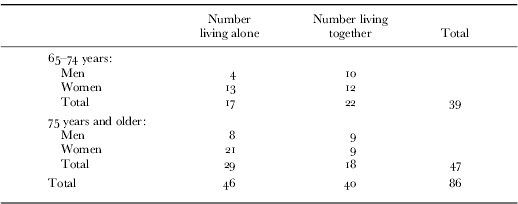
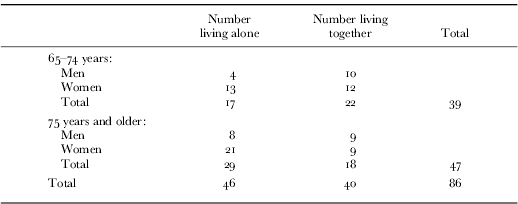
Persons aged 65 years and older were interviewed about their television viewing (N=86). We selected people aged 65 years and above because this is a common definition of the point at which ‘old age’ begins (Kite and Wagner Reference Kite, Wagner and Nelson2002; Thorson Reference Thorson2000: 1). To ensure variation in the sample, we used purposeful sampling (e.g. Coyne Reference Coyne1997; Patton Reference Patton2002) based on two criteria: gender and two age categories (65–74 years and 75 years and older; the oldest interviewee was 92 years). The analysis of change and continuity in viewing distinguished, in addition to age and gender, differences between people living alone and people living together (i.e. couples). Therefore, we added household composition as a third sampling criterion. Table 1 shows the composition of the sample regarding age, household composition and gender.
Composition of the sample
The majority of the sample did not have a paid job anymore; only three interviewees still had a job. Gender differences were apparent in career paths and former occupations. Male interviewees typically held jobs into their fifties or beyond; for many men this involved white-collar jobs such as business owner or manager (24 out of the 31 men), although blue-collar jobs such as car mechanic were also present. More than half of the female interviewees stopped paid work in their twenties or thirties (31 out of the 55 women), which was common at that time. Some of the women who worked into their fifties had white-collar jobs such as business owner or teacher (N=12), whereas others had blue-collar jobs such as cleaning or serving food (N=12). Most of the interviewees lived independently in their own homes, whereas seven interviews were held with people who lived in residential settings. Interviewees lived in different cities and villages in the Netherlands.
Data collection
The interviews were conducted by the first author, and by students who were trained in a research seminar on television and ageing (in 2006 and 2007). Interviewees were recruited through the social networks of the interviewers. Interviews took place in the homes of the interviewees, and lasted between half an hour and three hours. Interviews were held in Dutch, audio-taped and transcribed verbatim.
Interviewers used an interview guide (e.g. Patton Reference Patton2002). The guide contained two questions as starting points for talking about meanings of television viewing: ‘can you describe when your television is on, on an average day?’ and ‘what do you like to watch on television?’ The interviewers explored with the interviewees why they switched the television on, and why they chose particular programmes. In reaction to what the interviewee said, the interviewer asked retrospective questions in order to gain an insight into changes and continuity in television use: interviewers asked ‘since when’ or ‘for how long’ interviewees had used television in the ways they mentioned. In addition, interviewers asked whether interviewees had experienced changes in their television viewing when growing older. Subsequently, interviewers probed to learn how interviewees experienced the changes in viewing (if any).
Analysis
We derived guidelines for the analysis from qualitative methodological literature (e.g. Charmaz Reference Charmaz2006; Strauss and Corbin Reference Strauss and Corbin1998; Wester and Peters Reference Wester, Peters, Pole and Burgess2000). The first step was open coding (Strauss and Corbin Reference Strauss and Corbin1998; Wester and Peters Reference Wester, Peters, Pole and Burgess2000) or initial coding (Charmaz Reference Charmaz2006). The first author broke the interviews down into fragments, and assigned codes to them. The computer program Atlas.Ti was used in this phase of open coding. The coding was sensitive to the interviewees' formulations and to the meanings expressed by them. The interviewees' experiences were coded without putting their accounts in clear-cut a priori categories.
The second step is commonly referred to as focused coding (Charmaz Reference Charmaz2006). We made an inventory in which we noted for every interview the change in television viewing that the interviewee had mentioned (if any), the related change in life (if any), and how the interviewee evaluated the new role of television viewing. In this inventory, we also included the aspects of continuity that came to the fore in the interviews. Subsequently, we looked for possible categorisations within this inventory.
The third step was to specify the relationships between topics, concepts or variables (Strauss and Corbin Reference Strauss and Corbin1998; Wester and Peters Reference Wester, Peters, Pole and Burgess2000: 160). To understand the relation between change and continuity in television viewing, a schematic overview was made which reported what each interviewee had expressed about change as well as about continuity in viewing (the schematic overview and the inventories are shown in Van der Goot Reference Van der Goot2009). We took four measures to assure internal validity, i.e. the extent to which the findings correctly represent the phenomenon under study. The first measure was memo-writing (e.g. Charmaz Reference Charmaz2006). The first author wrote numerous memos during the study, which helped to detect biases and to reconstruct the data collection and analyses. The second measure was peer debriefing (e.g. Guba Reference Guba1981). The three authors discussed the coding and the categorisations, and the first author discussed the findings with other researchers who specialised in television and ageing (e.g. M. L. Mares) and changes in later life (e.g. N. Stevens; Stevens Reference Stevens1995). The third measure was member checks (e.g. Guba Reference Guba1981). Interviewers summarised interviewees' accounts so that interviewees could correct interviewers if they had misinterpreted stories. Also, an older person read a report of the study, wrote down what she recognised and added information about her television use and that of other people she knew. The fourth measure consisted of extensive engagement with the people under study. Researchers should have a prolonged engagement at a site to test their own biases and perceptions (Guba Reference Guba1981: 84). Therefore, the first author did volunteer work with older adults, conducted interviews with people who worked with older people, and established relations with a few older people.
Findings
We found that changes in television viewing could be divided into three main categories: changes in the amount of viewing in response to changes in other activities (e.g. in response to retirement); changes in television viewing in response to a loss in the interpersonal sphere, and changes in the meanings of television content. We also found that for some interviewees continuity occurred in the sense that the changes mentioned above were not present, and we saw two main categories of continuity: continuity in the status of viewing and continuity in content preferences. Inventories were made for each of these main categories separately, and these inventories formed the basis for the report of findings below.
How changes in the amount of viewing were experienced
The interviewees reported that they adjusted their amount of television viewing in response to three changes in their daily activities. The first change concerned available time. Typically, interviewees had more time available for television and other leisure than before, because they had to spend less time on obligations such as a paid job or primary care for children. This increased freedom meant that more than earlier in their lives, people needed to take initiative to have meaningful activities in everyday life. However, there were also new ‘obligations’ such as volunteer work, or taking care of grandchildren. Second, changes in health determined which activities were possible. The sample included interviewees who had physical problems as well as people who did not have limitations. Third, interviewees mentioned changes in the need for active and/or diverse activities. Some interviewees wanted more periods of rest than before and therefore they had fewer or less-demanding activities. These three changes in daily activities led to both increases and decreases in television watching, and an increase in viewing was experienced in diverse ways (as a positive choice, as a matter of fact, or for want of something better).
More television as a positive choice
A positive evaluation of an increase in viewing came from experiencing television viewing as a voluntary choice. Interviewees experienced the increased role of television after retirement as positive when they felt that now they had the freedom to choose what they wished to do, in contrast to when they were in employment. For instance, a woman (#76, 73 years) explained that when she had a job she did not switch on the television that much because she did not want to be distracted from work duties she needed to do at home (such as reading reports and preparing meetings). She said: ‘I am retired now and now I can nicely do what I personally find most fun and relaxing’.
Physical problems sometimes meant that interviewees were less able to go out and therefore they watched more television. Television viewing was one of the activities still possible for them. Interviewees were satisfied with the new role of television viewing when they felt that watching television was still a choice among several activities, and when they chose television because they liked it. This can be exemplified with the following story. One of the interviewed couples spent most of their time at home, mainly because of the poor health of the husband; the wife took care of him, which was a lot of work, and therefore she was confined to the home most of the time as well. The couple indicated that this was not an easy situation, but they tried to accept it and keep in good spirits. They explained how they were never bored: they liked to read, do crossword puzzles and work on the computer. Previously they had not been particularly television-minded, but because of their confinement they watched more television than before. The couple emphasised that they chose particular programmes, and they talked enthusiastically about these. The wife said, ‘We watch a bit more nowadays; actually I do like that’. In short, even when they were limited in the type of activities which they could participate in, some interviewees experienced television viewing as a positive choice.
More television as a matter of fact
Here, interviewees explained that their situation had changed, which just made it possible to watch more or to watch at daytime; they did not evaluate this increase as either a gain or a loss. These interviewees signalled that retirement or the decline of social contacts resulted in more spare time and therefore they automatically watched more television. An interviewee (#34, man, 67 years) explained that he had withdrawn from several functions in social life. He enjoyed his activities and television viewing had increased simply because he had more time available; he did not evaluate the increase as either good or bad: ‘You have 24 hours a day; of those 24 hours you sleep say eight hours, so you just get more time when something else stops. You fill that time, partly with television viewing’.
More television for want of something better
Interviewees considered the growing importance of television viewing in their lives as negative when they felt that the activities that they had previously done were more valuable. For these interviewees, their current situation was unsatisfactory. They focused on what they had had before, what they were not able to do anymore, and what they had lost. An example was a couple who lived in a nursing home that they did not like and who watched television out of boredom as the wife explains:
When we are bored, we turn the television on. We don't go anywhere. We do not have a car anymore. So we are completely dependent on the children and they are busy too. I don't go anywhere because I have trouble walking … sometimes when we are bored, we switch it on, because we do not have anything else to do. I can't read anymore … we have to pass the time, don't we. (#45, woman, 91 years)
In such cases, people felt trapped into watching and did not really enjoy it.
The changes in daily activities mentioned above led not only to an increase in television viewing, but in some cases to a decline. Some interviewees described how they were occupied more than before, which resulted in less time available for television, or how changes in their activities made television viewing less attractive. For these interviewees, new activities or obligations following retirement led to declines in television viewing. Sometimes, a decline in television viewing also followed a period of intense viewing because an interviewee (or their partner) was temporarily housebound. One interviewee explained a decrease in viewing after his retirement as follows:
Since I retired from work, I watch less television. Maybe before it was a form of relaxation or distraction. Now I watch a little bit, because during the day I have enough distraction in the form of cycling and walking and reading for example. So now I watch television more selectively than I did before. Back then, sometimes I was glued in front of the television the whole evening. (#55, man, 65 years)
This citation illustrates how retirement led to new activities and a decrease in viewing, which the interviewee experienced as positive.
Changes in meanings of television after a loss in the interpersonal sphere
The interviews showed three ways in which television viewing changed after a loss in the interpersonal sphere, i.e. after children left home, a divorce, or the loss of a spouse.
Television viewing in adaptation strategies
When interviewees utilised television in their adaptation strategies after a loss in the interpersonal sphere, it had the following functions: television provided company, it helped to pass the time, structure the day, and offered distraction from sadness. Regarding television as company, the interviews showed that television brought ‘people’ and sound inside the home. This can be especially helpful immediately after the loss of a spouse. A woman (#12, 77 years, widowed for 17 years) explained that in the period after her husband's death, she watched television from early in the morning until late at night: ‘At that time I really had the television on in the morning just to see people’.
People (both men and women) used television to pass the time when they had fewer activities outside the house because they lived alone, and when the evenings or days seemed long to them. One woman explained that after her husband had died she started to watch television at night to pass time (#28, 83 years, widowed for one year). She said that previously they were busy all day and the time flew by. Now she watched television to shorten time a little. Otherwise she would just be sitting there all night, and she felt that watching television was ‘kind of the only thing she could do’.
Television also helped to structure days. New routines often revolved around meal times; interviewees who were not comfortable with eating alone changed their schedule so they could eat in front of the television. Television also provided structure in other ways as is shown in the case of a woman (#14, 73 years, widowed for 10 years) who started to watch the 8 a.m. news after her husband died in order to bring regularity into her life. Following the hectic time after his death, she said to herself that she needed to have a routine in her life and that she should not stay in bed until she felt like getting up: ‘Just get up at a fixed time, quarter to eight [determined tone in her voice], the eight o'clock news and you move on like that: after that, get dressed, eat something’. Thus, the 8 a.m. news became a starting point for her day.
Another function television provided was a distraction from sadness; in some cases particularly humorous programmes fulfilled this function. An example comes from a man (#33, 84 years, widowed for 2.5 years) who did not really like television and who did not watch it much, but since his wife died he sometimes watched particular programmes that helped to relieve his sadness. When sadness overwhelmed him, watching particular comedy series improved his mood.
Avoiding television
Television was not always helpful in dealing with loss. On the contrary, some interviewees avoided television because it did not fit in with their feelings elicited by the loss. They felt too restless or too sensitive to watch it, or television reminded them too much of shared experiences from the past. A woman (#20, 87 years, widow for one year) indicated that she avoided certain content. Because her daughter had died of cancer and her husband's death was sudden she became distressed when listening to music or watching particular DVDs and movies and so she had stopped these activities. She also said that she did not watch soap series anymore because they ‘are always full of hatred and malice: that does not cheer me up at all. And when you are alone, like me now, you're very sensitive to that’.
Freedom to make individual television choices
The third change in television viewing occurred when interviewees who had experienced the loss of their partner had the opportunity for the first time to make their own individual television choices. This freedom led to new habits of television viewing. Some watched more than before or new programmes (that their partner had not liked); others watched less television or did not watch programmes anymore that they had mainly watched because of their spouses' preferences. This increased freedom to make individual television choices was sometimes explicitly experienced as a gain.
Changes in the meanings of television content
The changes in television viewing described above led people to watch new content. Increased viewing, the use of television in adaptation strategies after a social loss or the increased possibility of (individual) choices led to watching new types of programmes. For instance, the woman (#12, 77 years, widowed for 17 years) who started to watch television all day long after her husband died, in order to have ‘people’ around her, watched so much television that she had to turn to genres that she had not watched before, such as snooker. The new types of programmes that people chose were not of one specific type. For example, the use of television viewing in adaptation strategies after a loss in the interpersonal sphere included people turning to programmes that were cheerful, upbeat and optimistic, although other uses of television after a loss were determined more by the time of day and did not involve a specific kind of television content.
In addition, other changes in meanings of television content were apparent. In some cases television content came to serve new functions and thus became more important, whereas in other cases television content became less attractive or important. Television content gained importance when it was a substitute for input that interviewees had previously obtained from other activities. Television gave them information which they had previously gained from going to places themselves. Some of the interviewees saw this process as negative insofar as they had to rely on television. For example, a woman (#16, 89 years) said that she depended on television to participate in society. She followed all kinds of current affairs and interview programmes. In the past, she had participated more actively in society, for example by serving on the board of a museum. She said it was logical that her previous, more active, engagement had been a more pleasant activity than watching television. Also, television content provided cognitive stimulation, which interviewees had gained in the past from other activities. Moreover, television content was a substitute for activities previously conducted by interviewees themselves, such as going to church, outdoor activities or dancing.
For some interviewees, watching television to keep the brain active became more important as they grew older. The focus on keeping the brain active appeared to come from fear of forgetfulness and fear of dementia. Troubles with remembering names or words and fear of dementia triggered their motivation to keep their brain active with the help of television. They also referred to doctors and the media who hinted at the importance for older people to train their cognitive abilities. Therefore they watched quiz shows or programmes in foreign languages to test themselves and keep their mind active.
There were several reasons why certain television content became less attractive. First, changes in activities led to a decrease in the importance of particular content. Here, interviewees indicated that information obtained from television was less necessary in their current everyday lives than it had been in the past. A man (#1, 71 years) who was still interested in the news explained that strictly speaking news items had been more necessary for him when he was working with the trade unions and he needed the information for his job.
Second, growing older meant that interviewees did not take things on television as seriously as they had done when they were younger. For example, one interviewee was a supporter of a sports team and he indicated that in the past he could get very excited when watching sport. He still watched sport, but he was less moved by it now. Growing older, he saw things in a more relative light. He felt that his family was important to him, whereas football may not be that essential after all:
Important to me, are my wife, my children, my grandchildren … and the rest is less important. I think that is a kind of development, because of my age, that I find fewer and fewer things important. … there are more important things in life, and that is not always soccer or sports. (#34, man, 67 years)
Third, interviewees pointed out that they had become more sensitive as they grew older, which led to stronger reactions to emotional television content or to avoidance of such content. A woman (#76, 73 years) said that she avoided emotional programmes, because she did not want to be distressed. She related this avoidance to growing older and to her age. In her younger years she had experienced sadness too, but now that she was older she had gone through sadness more often and more consciously, and therefore she felt more emotional.
Continuity
First it is relevant to note that continuity simply occurred in the sense that the changes mentioned above in circumstances and/or television viewing applied to only part of the sample. There were interviewees who still had paid jobs and were in good health for whom television viewing behaviour had not changed, as well as interviewees who had experienced these life changes but had not altered their television viewing habits. Television viewing behaviour also did not change for some interviewees who had not experienced changes in their household composition, or who did go through such changes but did not change their viewing consequently. In addition, continuity in the status of television viewing and continuity in content preferences were the two most prominent aspects of continuity.
Continuity in status of television viewing
Continuity in the status of television viewing was apparent when interviewees indicated that they had always been critical towards television viewing or when they said that they had always been enthusiastic about it. A low status of watching television meant that people considered watching (too much) television as a waste of time, which was a reason why these interviewees stressed that they did not watch that much television, that they also conducted other activities, and/or that they did not watch more than before. An example came from an interviewee who explained that retirement could have led to an increase in television viewing, but that because of the low status of viewing (in his eyes) he chose other activities:
When you go into retirement, you think: now I have an enormous amount of time. But it has occurred to me that I actually always have too little time. And how is that? Because you see it coming: well, I do not have a regulated job anymore; I have to make sure I stay active. There are a great many things I have jumped into. Among others: [lists several activities]. So the whole day I have work to do. And I would also feel a bit guilty when I watched that stupid thing [television]. Like, don't you have something more useful to do? (#69, man, 75 years)
Another example was an interviewee (#39, man, 81 years) who had severe health problems and almost never left his house. He said that he and his family had always looked down on television viewing. Even though he spent most of the time at home, he only watched a few particular programmes that he thought were valuable and focused on things that he appreciated more, such as reading.
Continuity in content preferences
Continuity was visible when it was linked to an interest in content. These interviewees explicitly indicated that they had particular interests since they were young. They said things like ‘it has always been in me’ or ‘it is innate’. Learning and keeping abreast with the times were regularly mentioned this way. In relation to watching quiz shows, interviewees indicated they had always been interested in learning. Another example came from a woman (#4, 74 years) who enjoyed watching programmes in which the police asked viewers for help in solving crimes. She saw continuity in her preference for sensational programmes, and related this to her passion for sensation in everyday life. She described how as a child she was standing right next to an accident: ‘there was a child completely run over; her whole head was open; the brains …’ And she stood there and watched because she wanted to see it. For her, this incident illustrated that already at a young age she was drawn to watching dramatic and sensational events. Other interviewees saw continuity in interests in particular topics, such as history, languages or medical issues.
Some of these lifelong or decades-long interests had roots in specific events in interviewees' lives. For example, playing a sport when one was young or going to matches with a parent led to a lifelong interest in a particular sport or a sports team, or collecting pictures of princesses when one was a child was the start of a lifelong enthusiasm for the royal family.
Personal experiences not only led to lifelong interests, but also to lifelong aversions. For some interviewees, personal experiences with the Second World War led to a lifelong interest in information about the war and an interest in politics, whereas other interviewees did not want to be confronted with war and violence anymore because of such experiences: ‘In the war I was deported by the Germans. Well, I have seen so much misery and blood there that such things don't interest me anymore’ (#45, man, 89 years).
In addition to continuity in such thematic interests, continuity in preferences for specific television genres was apparent too. In some cases, these genres were still available in contemporary television programmes. Particularly, the news was a genre that interviewees had ‘always’ watched. In other cases, the genres were not available anymore; this particularly came to the fore when interviewees still wanted to see the kind of cabaret, shows or plays that were broadcast in the period roughly between the 1950s and 1980s.
Interestingly, continuity in content preferences remained important when interviewees increased their viewing or when they adjusted their viewing in response to losses in the interpersonal sphere. When they watched more than before, they tried to find programmes in line with their previous preferences. Even interviewees who had changed their television viewing drastically, such as a man (#3, 72 years) who watched television all day because he did not have other meaningful activities, and a woman (#32, 66 years) who was confined to television because of a lung disease, reported continuity in particular content preferences such as nature programmes. Also, the finding that television content is used as a substitute implies that there is continuity in interests. For instance when interviewees watched church services on television as a substitute for going to services themselves, they increased their viewing and became more dependent on television, although obviously there was continuity in what they were interested in.
Discussion
The aim of this paper was to provide insight in the meanings of television in older adults' lives, by analysing change and continuity in their television viewing. The interviews show that television has a variety of meanings as people age. The meanings of television viewing sometimes change in response to changes in everyday life, but this does not happen unidirectionally. Retirement, physical changes and changes in household composition lead to increases as well as decreases in television viewing. Watching more television is experienced in both positive and negative ways. After a loss in the interpersonal sphere, television viewing can play a valuable role in adaptation processes, but it can also be experienced as an activity that needs to be avoided. With regard to television content, we found that some programmes gain importance when people age, whereas others become less important or attractive.
These findings on the changing meanings of television are helpful in interpreting results from previous research on older adults and television viewing. Earlier in this paper, we noted that a cohort analysis (Mares and Woodard Reference Mares and Woodard2006) provided some support for maturational explanations: older adults watched slightly more television than younger people, even after controlling for cohort, period, gender and educational level. Some older people watched more than younger adults because they did not have a paid job, and to a lesser extent because of poorer health or a lower income. The current qualitative study adds to these insights by describing how older people experience such an increase in viewing in various ways. Furthermore, Mares and Woodard found these maturational differences, but noted that they were more complex than simplistic descriptions suggest. They also reported that widowhood and other variables concerning social contacts did not have an effect on differences between age groups in amount of television viewing. Their findings are logical in view of the variety of television-viewing behaviour found in the current interview study: in response to retirement, physical changes and the loss of their partner, some interviewees increased their viewing, whereas others diminished it.
Both previous literature on older adults' television viewing and the current interview study show that it is easier to focus on change than on continuity. Changes in television viewing are relatively salient events in people's lives (because these changes are the visible deviation from the norm), whereas continuity in television-viewing behaviour and preferences is less easily detected. However, we found that television viewing has meaning for older adults because television provides opportunities for experiencing continuity. The interviews show that some people do not change their television-viewing behaviour in response to changes in their lives, and that they experience continuity in the status of viewing and in their content preferences.
Several of our findings about the meanings of television viewing are understandable in light of recent research on ageing. First, one of our findings is that an increase in viewing is experienced in contrasting ways. On the one hand, television viewing is seen as a positive choice even in the light of its limitations; on the other hand, some people feel confined to television, regret the loss of activities and emphasise what they are not able to do anymore. These findings echo responses to leisure constraints that have been reported in other studies: on the one hand, people can accept a constraint and try not to resist it, even feeling gratitude, whereas on the other hand they can feel frustration (Kleiber and Nimrod Reference Kleiber and Nimrod2009; Kleiber et al. Reference Kleiber, McGuire, Aybar-Damali and Norman2008). How people experience their less active lifestyle including increased television viewing seems to depend on the extent to which they accept their limitations.
Our study also describes the ways in which television viewing is used in adaptation strategies following changes in everyday life. These findings concur with findings on how leisure serves as a coping tool (e.g. Hutchinson et al. Reference Hutchinson, Loy, Kleiber and Dattilo2003, Reference Hutchinson, Yarnal, Staffordson and Kerstetter2008; Janke, Nimrod and Kleiber Reference Janke, Nimrod and Kleiber2008). Kleiber, Reel and Hutchinson (Reference Kleiber, Reel and Hutchinson2008) review this research and write that leisure assists in adjusting to negative life events among others by being distracting, by generating optimism and giving an emotional uplift. Similarly, our interview study shows that television offers distraction from sadness and an emotional uplift, particularly after a loss in the interpersonal sphere. In addition, Kleiber, Reel and Hutchinson point out that leisure can serve as a coping tool by restoring aspects of the self through continuity and the resumption of familiar activities. Continuity in activities and interests has been analysed particularly in continuity theory (Atchley Reference Atchley1989). A central premise of continuity theory is that, in making adaptive choices, middle-aged and older adults attempt to preserve and maintain existing internal and external structures; they use continuity as a primary adaptive strategy when dealing with changes associated with normal ageing. Possibly, the continuity that older people experience in their viewing behaviour (e.g. watching television with their spouse), status of viewing and their content preferences functions as an adaptive strategy and a way of preserving their sense of self.
Our findings on how people use television in response to developments in everyday life also reflect the adaptation strategies selection and compensation central to the Selective Optimization with Compensation (SOC) model (Baltes and Baltes Reference Baltes, Baltes, Baltes and Baltes1990) and the model of Optimization by Selection and Compensation (Heckhausen and Schulz Reference Heckhausen and Schulz1993). The interviews show that television is part of a selection strategy when people choose television viewing over other activities in order to reach goals that are important to them (see alsoVan der Goot, Beentjes and Van Selm Reference Van der Goot2006). For instance, they turn to cheerful television programmes because they wish to improve their mood. We have also seen that television functions as compensation, for example when information on television serves as a substitute for information that one previously obtained through more active participation in society.
A specific instance of selectivity in our study is that some of our interviewees reported that they became more sensitive as they grew older, which led to stronger reactions to emotional television content or to avoidance of such content. This is understandable in light of Cartstensen's socioemotional selectivity theory with states that optimisation of emotional experience is prioritised in later life, typically resulting in the adoption of ‘feel good behaviours’ (e.g. Carstensen, Fung and Charles Reference Carstensen, Fung and Charles2003). Therefore it makes sense that older people seek out television content that makes them feel good and avoid content that makes them become too emotional.
As far as further research is concerned, one of the questions to be answered is how these findings apply to the use of newer media, particularly the internet. Obviously, television is only one component of a more varied mix of media that older people use and it will be important to study the similarities and differences between the meanings of television viewing and internet use. Similarities can be expected. Our study shows the ways in which television serves as a coping tool. Similarly, it has been suggested that internet use and particularly online communities are used as a tool that helps older adults to cope with stress, losses and negative events (Nimrod Reference Heckhausen and Schulz2009). Both television and the internet can be a substitute when other activities diminish (e.g. McMellon and Schiffman Reference McMellon and Schiffman2002; Nimrod Reference Nimrod2010; Wright Reference Wright2000). Also, in line with our observations about continuity in older adults' content preferences, McMellon and Schiffman (Reference McMellon and Schiffman2000) suggest that older people use the internet to meet their continuous need for information, entertainment and social contact. However, for current cohorts of older adults, differences between the meanings of television viewing and internet use are expected too. Current generations of older people have known television for about 50 years, whereas internet became widespread when these adults were in their 50s and older. The effort needed to learn how to use the internet can be experienced as a hindrance, but as a benefit too. Whereas many people seem to look down on watching television, the use of the internet has more status: the accomplishment of becoming internet literate can provide individuals with a sense of control (McMellon and Schiffman Reference McMellon and Schiffman2002).
A limitation of our study is that it relies on interviews with retrospective questions. The interviews focused on later life, and did not aim to map out full media biographies. In order to gain more insight in both continuity and change in media use, information about media use of several generations from childhood to old age is necessary. In other words, longitudinal studies that offer an insight into media biographies would be useful. Also, quantitative research is necessary to study the extent to which the aspects of change and continuity described in the present study occur in a representative sample of the older television audience.
In summary, our interview study shows how an analysis in terms of change and continuity can shed light on the diverse meanings television viewing has as people age. The meaning of television viewing changes in response to changes in everyday life, but not as unidirectional as one may expect: television plays a valuable part in adaptation strategies, but is also experienced as something that needs to be avoided. Furthermore, continuity in the status of television viewing and in content preferences is also part of older adults' television viewing.
Acknowledgements
We would like to thank the editors and two reviewers for their elaborate and thorough comments, and we also thank all interviewees for telling us their personal stories.