Introduction
Health-related quality of life (HRQOL) is important in modern medicine and is defined as the combination of a person's physical health and psychological health in relation to disease (Andersen et al., Reference Andersen, Wittrup-Jensen, Lolk, Andersen and Kragh-Sorensen2004). HRQOL in patients with chronic diseases is an important issue (Bullinger and Ravens-Sieberer, Reference Bullinger and Ravens-Sieberer2006; Lehmann et al., Reference Lehmann, Burkert, Daig, Glaesmer and Brahler2011; Bullinger et al., Reference Bullinger2015).
The interest in issues pertaining to Mild Cognitive Impairment (MCI) and Alzheimer's Disease (AD) and HRQOL has also grown significantly in recent years. Studying HRQOL in patients with MCI or AD is important, because it is known that cognitive impairment is distressing and may lead to psychosocial consequences. Cognitive impairments due to neurodegenerative processes have been found to restrict social functioning and HRQOL in an early study (Ready et al., 2004). A recent study found differences between the self-appraisal of patients with MCI compared to the HRQOL of AD patients (Bruvik et al., Reference Bruvik, Ulstein, Ranhoff and Engedal2012), whereas other authors found no differences (Logsdon et al., Reference Logsdon, Gibbons, Mccurry and Teri2002). Comparing MCI patients to healthy controls, it has been shown that patients with MCI report reduced HRQOL (Seidemann et al., Reference Seidemann, Franke, Salewski and Morfeld2010; Teng et al., Reference Teng, Tassniyom and Lu2012).
Factors influencing HRQOL in patients with MCI and AD have not been investigated to a large degree. A recent systematic review found that there are no clear or consistent associations between socio-demographic variables and HRQL. There is no convincing evidence that lower cognition or greater activity limitation is associated with lower HRQL. There is a strong suggestion that depression is consistently associated with decreased HRQL in dementia. However, the magnitude of the associations observed is moderate only and the proportion of variance explained is low suggesting that depression and HRQL are different constructs (Banerjee et al., Reference Banerjee2009).
To our knowledge, no data exist regarding HRQOL in patients with subjective cognitive decline (SCD). Patients with SCD report cognitive impairment but show unimpaired performance on cognitive tests. This group of patients has recently become the focus of research because there is increased evidence that clinical symptoms of SCD may be first symptomatic manifestations of AD (Jessen et al., Reference Jessen2014a, Jessen et al., Reference Jessen2014b). We were interested whether there is a decline of HRQOL in SCD. This knowledge is important in order to understand the evolution of HRQOL from prodromal to clinical stages of the disease. Furthermore, this knowledge will help to improve treatment options in patients with prodromal stages of dementia. Previously, our study group has already shown that the presence of depressive symptoms increases subjective memory complaints in several patient groups with cognitive decline including SCD (Lehrner et al., Reference Lehrner2014). Thus, we tackled the question whether depressive symptoms and HRQOL are related in SCD.
The purpose of this study was to investigate HRQOL in patients with different states of cognitive decline. We hypothesized that patients with SCD, patients with MCI, and patients with AD will show reduced HRQOL compared to elderly controls. Thus, we examined if reduced HRQOL is present in SCD patients, non-amnestic MCI (naMCI), amnestic MCI (aMCI), as well as AD patients when compared to cognitively unimpaired controls. Furthermore, we hypothesized that there is a negative association between depressive symptoms and HRQOL scores. As depressive symptoms seem to be a major confounder of HRQOL we controlled for depressive symptoms in our analyses. Additionally, we correlated HRQOL scores with depressive symptoms across patients groups.
Method
Participants and design
The current data are part of a larger research project, the Vienna Conversion to Dementia Study (VCD-Study). The VCD is a prospective cohort study encompassing consecutive, community dwelling patients complaining of cognitive problems who come to the memory outpatient clinic for assessment of a possible cognitive disorder. The study protocol has been approved by the Ethical Committee of the Medical University of Vienna and written informed patient consent to perform this study has been received. All patients received a complete neurological examination, standard laboratory blood tests, and psychometric testing. In most cases, a magnetic resonance imaging (MRI) scan of the brain was obtained. In determining significant cerebrovascular disease, both neuroimaging and clinical patient features were used. All participants were subjected to the Neuropsychological Test Battery Vienna (NTBV) that included attention, executive functioning, language, and memory domains with corresponding domain z-scores (Lehrner et al., Reference Lehrner, Maly, Gliess, Auff and Dal-Bianco2007). Inclusion and exclusion criteria were similar to other studies. Patients were excluded from the study if any of the following conditions applied: (i) evidence of stroke as determined by neuroradiological and clinical examination, (ii) history of severe head injury, (iii) current psychiatric diagnosis according to ICD-10 (Dilling et al., Reference Dilling, Mombour and Schmidt2000), however, patients with (sub-) depressive symptoms were included because (sub-) depressive symptoms often occur in elderly patients, (iv) any medical condition that leads to severe cognitive deterioration including renal, respiratory, cardiac, and hepatic disease. The diagnosis of AD was determined by the decision of a consensus committee including a neuropsychologist, a neurologist, and other study personal involved in the evaluation of the patients’ cognitive status and was diagnosed according to the NINCDS-ADRDA (Mckhann et al., Reference Mckhann, Drachman, Folstein, Katzman, Price and Stadlan1984) and DSM-IV criteria (Saß et al., Reference Saß, Wittchen, Zaudig and Houben2003).
Diagnosis of MCI was determined according to the Peterson criteria (Petersen, Reference Petersen2005) and the cut-off score used was 1.5 standard deviations (SD) below age- and education-corrected norms using a normative sample of cognitively healthy controls. For this purpose, the flexible GAMLSS (Generalized Additive Models for Location, Scale, and Shape) model class was used (Stasinopoulus and Rigby, Reference Stasinopoulus and Rigby2007). The mean mode of MCI classification was used and patients were divided into three groups of patients based on cognitive features as follows: SCD, aMCI, and naMCI. SCD classification required the presence of subjective memory deterioration as manifested by the seeking of medical help for memory problems and by the concurrent absence of any objectively, measurable cognitive deficits (mean z-score of each domain greater than −1.5 SD). aMCI was determined by a mean z-score of the memory domain being below −1.5 SD and naMCI was determined by mean z-scores of at least one domain other than the memory domain being below −1.5 SD (Pusswald et al., Reference Pusswald2013). Cognitively healthy control paticipants were recruited by means of advertisements. They underwent a rigorous screening evaluation using a standardized clinical interview and cognitive screening. Imaging procedures, neurological examination, standard laboratory blood tests, and informant reports were not included in the evaluation. They were assessed as being in good health. Criteria for healthy function were identified as being similar to those in the Mayo research studies (Greenaway et al., Reference Greenaway, Smith, Tangalos, Geda and Ivnik2009): (i) no active neurological or psychiatric disease, (ii) no psychotropic medications, and (iii) the participants may have medical disorders but neither they nor their treatment compromise cognitive function. Cognitive status was given special attention and cognitively healthy control participants were screened for intact cognition using two dementia screening measures. They were required to have an MMSE (Folstein et al., Reference Folstein, Folstein and McHugh1975) score greater than or equal to 27 and a MOCA (Nasreddine et al., Reference Nasreddine2005) score greater than or equal to 26 after adjusting for education. From the overall data, pool acquired by the VCD-Study, 317 controls, 110 SCD patients, 297 naMCI patients, 224 aMCI, and 51 AD patients were included. Demographic, clinical, and cognitive characteristics of the patients groups are reported in Tables 1 and 2.
Participants’ characteristics shown are number of patients (n); medians with quartiles (given in parenthesis) for age, education, MMSE, BDI-II; percentages for male/female

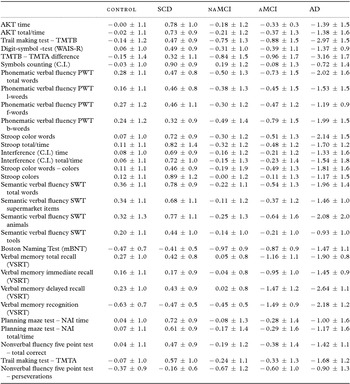
Neuropsychological test z-scores across control group, SCD group, naMCI group, aMCI group, and AD group (means +/− SD)

Abbreviations: AKT, alters-konzentrations-test; WAIS-R, wechsler adult intelligence scale – revised; TMTA, trail making test version A; TMTB, trail making test version B; NAI, nürnberger alters inventar; C.I., cerebral insufficiency test; VSRT, verbal selective reminding test; mBNT, modified Boston naming test.
Assessment of health-related quality of life (HRQOL)
The SF-36 was used for the assessment of HRQOL (Ware and Sherbourne, Reference Ware and Sherbourne1992). The SF-36 is a multi-purpose, short-form health self-inventory with 36 questions. The SF-36 is a generic measure, as opposed to one that targets a specific age, disease, or treatment group. The scores range from 0–100, with lower scores reflecting poorer subjective quality of life (Bullinger, Reference Bullinger2006). It yields an 8-scale profile of functional health and well-being. The 8-scale scores are grouped into a corresponding Physical Health Component Score (PHCS) and a corresponding Mental Health Component Score (MHCS). The scoring for PHCS includes physical functioning, role-physical, bodily pain, general health, and vitality scales. The scoring for MHCS includes vitality, social functioning, role-emotional, and emotional well-being. A recent study found reliable and valid data for a broad spectrum of patients with dementia and concluded that the SF-36 is suitable for dementia (Geschke et al., Reference Geschke, Fellgiebel, Laux, Schermuly and Scheurich2013). In the current study, the patients filled in the SF-36 questionnaire.
Assessment of depressive symptoms (DS)
Depressive symptomatology was measured via the Beck Depression Inventory (Hautzinger et al., Reference Hautzinger, Keller and Kühner2006). The Beck Depression Inventory (BDI-II), a 21-item instrument to detect depressive symptoms in adults was used. Participants answer several questions about how they felt during the last two weeks by selecting an answer to each question, one of four statements arranged in increasing severity. The total score takes values between 0–63. A score above 13 is indicative of clinical relevant depressive symptoms (Hautzinger et al., Reference Hautzinger, Keller and Kühner2006). A recent study found that patients with MCI and patients with AD report mood symptoms relatively similarly to younger and midlife adults. This supports the validity of self-reported depressive symptoms in patients with MCI and patients with AD (Carvalho et al., Reference Carvalho, Tan, Springate and Davis2013).
Data analysis
Demographic variables and BDI-II scores are described as medians and quartiles due to the skewed distribution of most of these variables. z-scores of the neuropsychological test variables are described by means and SD. BDI-II scores were compared between groups using a Kruskal–Wallis test with post hoc tests using the Dwass–Steel–Critchlow–Fligner method to correct for multiple comparisons. The influence of depressive symptoms on the dependent variables PHCS and MHCS was investigated in two separate ANOVA models with factors BDI-II (≤13 vs. >13) and cognitive status (controls, SCD group, naMCI group, aMCI group, AD group), using sex, age, squared age, and years of schooling as adjustment variables. The interaction of BDI-II and cognitive status group was used to test the group specific depression effect on PHCS and MHCS. Sub-group specific estimates of PHCS and MHCS are reported as least square means and Tukey adjusted 95% confidence intervals.
Associations between SF-36 scores and other variables are quantified using Spearman's correlation coefficients. Two-sided p-values ≤ 0.05 were considered to indicate statistical significance. All computations were performed using SAS software Version 9.4 (SAS Institute Inc., Cary, NC, USA, 2002–2012).
Results
The study population was categorized into a control group, an SCD group, an naMCI group, an aMCI group, and an AD group as described in the methods section. Our analysis revealed a statistically significant difference for BDI-II between the five cognitive status groups (depressive symptoms in 43% of the SCD group, 42.4% of the naMCI group, 47.5% of the aMCI group, and 39.2% of the AD group, and 17.4. of the controls) (p < 0.001). Pairwise post hoc comparisons detected significant differences for pair-wise comparisons between controls and all other groups. No other group differences were significant (see Table 1).
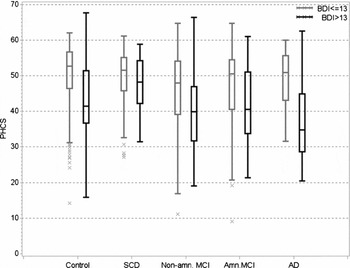
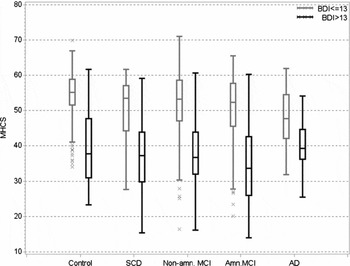
In our main analysis, we investigated whether depressive status (BDI-II score ≤13 vs. BDI-II score>13) and cognitive status (control group vs. SCD group vs. naMCI group vs. aMCI group vs. AD group) had an impact on PHCS and MHCS. The raw data are depicted in Figures 1 and 2. For the dependent variable of PHCS, BDI-II as well as cognitive status were significant (p < 0.001, adjusted for sex, age, and years of schooling), whereas their interaction was not (p = 0.27). The latter result means that there is a main effect of depression that explains some of the variance in PHCS score and that an interaction term does not increase explanatory power above that.
Comparison of the PHCS between depressive and non-depressive patients across groups (boxplots of raw data).

Comparison of the MHCS between depressive and non-depressive patients across groups (boxplots of raw data).

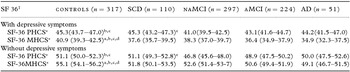
In a next step, we performed post hoc pairwise group comparisons separately for the five cognitive groups with depressive symptoms (BDI score > 13) and without depressive symptoms (BDI score ≤13). Pairwise post hoc comparisons for cognitive groups with depressive symptoms detected significant differences between control group and naMCI group, control group and aMCI group and SCD group and naMCI group, respectively. No other group differences were significant. Pairwise post hoc comparisons for cognitive groups without depressive symptoms detected significant differences between control group and naMCI group, control group and aMCI group and SCD group and naMCI group, respectively. No other group differences were significant.
For the dependent variable of MHCS, BDI-II as well as cognitive status were significant (p < 0.001), whereas their interaction was not (p = 0.15). This means that the depression effect on MHCS is not significantly different between the five cognitive groups. In a next step, we performed post hoc pairwise group comparisons separately for the five cognitive groups with depressive symptoms (BDI score > 13) and without depressive symptoms (BDI score ≤13). Pairwise post hoc comparisons for cognitive groups with depressive symptoms detected significant differences between controls and all other groups. No other group differences were significant. Pairwise post hoc comparisons for cognitive groups without depressive symptoms detected significant differences between controls and all other groups and between naMCI group and aMCI group, respectively. No other group differences were significant (see Table 3).
Least square means and Tukey-adjusted 95% confidence limits for SF 36 (PHCS; MHCS) subscales across groups

Notes: 1SF-36 high values represent high HRQOL (Range: 1–100).
* Significant differences between five groups (p ≤ 0.001).
a Control versus SCD (Tukey-adjusted p ≤ 0.05).
b Control versus naMCI (Tukey-adjusted p ≤ 0.05).
c Control versus aMCI (Tukey-adjusted p ≤ 0.05).
d Control versus AD (Tukey-adjusted p ≤ 0.05).
e SCD versus naMCI (Tukey-adjusted p ≤ 0.05).
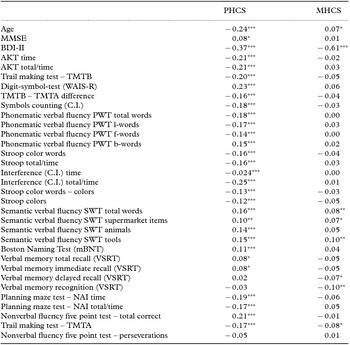
Finally, for the total group (n = 999), we studied the associations of HRQOL (PHCS and MHCS) with age, education, MMSE, BDI-II score, and neuropsychological test scores. This analysis revealed no associations except for BDI-II, which exhibits a low correlation with PHCS (r = −0.37) and a moderate correlation with MHCS (r = −0.61). Interestingly, PHCS showed a stronger correlation with neuropsychological tests than MHCS and neuropsychological tests (see Table 4 for details).
Spearman correlation coefficients for the total group partialized for the five diagnostic groups, between SF-36 scores (PHCS; MHCS) and MMSE, BDI-II, neuropsychological test scores

Abbreviations: PHCS, physical health component score; MHCS, mental health component score; AKT, alters-konzentrations-test; WAIS-R, wechsler adult intelligence scale – revised; TMTA, trail making test version A; TMTB, trail making test version B; NAI, nürnberger alters inventar; C.I., cerebral insufficiency test; VSRT, verbal selective reminding test; mBNT, modified Boston naming test, *p < 0.05, **p < 0.01, ***p < 0.001.
Discussion
The main goal of this study was to investigate impairments in HRQOL across a wide range of cognitive functioning in elderly patients, namely, SCD patients, naMCI patients, aMCI patients, and AD patients, respectively. We further examined whether there is an association between HRQOL and factors like age, depressive symptoms, and cognitive functions across groups with and without cognitive decline.
The main result of the present study is that depressive symptoms have a strong influence on HRQOL. All investigated cognitive groups showed, independently of group status, reduced HRQOL when also reporting a clinical relevant degree of depressive symptoms. Thus, depressive symptoms are strongly associated with HRQOL. Our results also hold true for both physical HRQOL as well as mental HRQOL. As far as we know this work is the first report suggesting such an association in patients with SCD, MCI, and AD. In community-dwelling older adults, a similar impact of subjective memory complaints on quality of life has been found (Maki et al., Reference Maki2014).
Mental HRQOL differed significantly between the control group and all other groups investigated for both patients with and without depressive symptoms. In patients without depressive symptoms, there was also a group difference between naMCI group and aMCI group. Thus, all clinical groups reported restrictions in terms of mental HRQOL when compared to healthy controls. This result also applies for patients with and without depressive symptoms. This means that individuals with SCD tend to be more affected by the decline in mental HRQOL than their healthy counterparts, although they do not show any clinical symptoms. Similar findings have been reported recently (Pusswald et al., Reference Pusswald2015).
When delineating single group differences, we found significant differences between physical HRQOL of healthy participants and naMCI group and the MCI group, respectively. Furthermore, between the SCD group and the naMCI group, respectively. This result was obtained both in patients with and without depressive symptoms. From our data, it appears that physical HRQOL is less reduced than mental HRQOL. However, this finding has to be replicated in future studies. In addition, these results support the notion that the true burden of the disease concerns the mental changes rather than the physical changes (Shrestha et al., Reference Shrestha2015).
When looking at the correlational analyses, it is interesting to note that cognitive variables were more strongly associated with the physical aspects of HRQOL, whereas depressive symptoms were more strongly related with the mental aspects of HRQOL and not vice versa. Our finding that depressive symptoms constitute a strong predictor of impaired HRQOL independently of parfticipants’ cognitive status corroborates prior reports. The relation between depression and cognitive decline has often been debated, with some reports supporting depression as a risk or prodromal factor of cognitive decline, and others supporting depression as a consequence of realization of cognitive decline (Lehrner et al., Reference Lehrner2014).
When looking at aMCI and AD patients, we found mixed results. Whereas, aMCI and AD patients reported limitations regarding mental HRQOL, naMCI patients reported most pronounced limitations regarding physical HRQOL. This effect might be due to impaired awareness (agnosia) and should be studied in more detail in future studies. Reduced awareness for memory problems has been reported earlier (Lehrner et al., Reference Lehrner2015). Neuropsychiatric symptoms such as depression and anosognosia have been found to influence the perceived quality of life of AD patients with neuropsychiatric symptoms having a negative effect on the HRQOL ratings, whereas anosognosia had a positive effect for AD patients (Conde-Sala et al., Reference Conde-Sala2016).
Within all five cognitive subgroups, patients with depressive symptoms reported more difficulties in HRQOL in comparison to patients without depressive symptoms. Moreover, depressive symptoms were definitely shown to be common in SCD patients. Roughly half of the SCD group showed significant depressive symptoms. The association of SCD with self-focused attention and depressive symptomatology has been described previously (Lehrner et al., Reference Lehrner2014). This so called functional memory disorder was found to be more common in an above-average educational attainment.
For a better understanding of the relationship between cognitive impairment and quality of life, the knowledge of the influence of functional impairment is important. Presumably, HRQOL in MCI is decreased by limitations of condition and functionality (Ready et al., 2004). A link between cognition and HRQOL has been found earlier (Bullinger, Reference Bullinger2006).
The study has some limitations: The setting in which patients were recruited in our study was a medical-help-seeking rather than a population-based sample, which might have biased selection of patients in the direction of over-reporting of cognitive impairment. This assumption might be underlined by the observation that SCD patients seemed to perform, on average, even better than healthy controls in neuropsychological subtests (see Table 2). We did not carry out personality trait interviews, but one might suggest that the examined SCD population is, at least in part, a cognitively well, self-focused-attention group. However, there is evidence from longitudinal data supporting SCD as a risk factor for future cognitive decline (Reid and Maclullich, Reference Reid and Maclullich2006) as well as from cross-sectional biomarker studies showing an increased prevalence of preclinical AD in patients with SCD (Erk et al., Reference Erk, Spottke, Meisen, Wagner, Walter and Jessen2011; Scheef et al., Reference Scheef2012). As personality traits could be an important factor in reporting SCD, they should also be examined in future studies. Another limitation in analyzing the data is the very large variability in MHCS and PHCS. Furthermore, because causality cannot be determined from this cross-sectional study long-term longitudinal studies are needed in order to show causal effects.
In conclusion, patients with cognitive impairment reported a decline in HRQOL. Depressive symptoms had a strong effect on HRQOL. Prevention of or early intervention for depression is recommended as depression has such a big impact on HRQOL. With respect to our finding of reduced HRQOL in patients with MCI and AD and its association with depressive symptoms, there is a need to improve HRQOL and treat depressive symptoms. Pharmacological and/or psychological treatment options in the clinical setting may be used. Therefore, it is of great importance to assess patients with subjective impairment carefully in terms of depressive symptoms and provide early medical help in order to improve quality of life. Medical and psychological treatment options are available (Regan and Varanelli, Reference Regan and Varanelli2013; Morimoto et al., Reference Morimoto, Kanellopoulos, Manning and Alexopoulos2015).
Conflict of interest
None.
Description of authors’ roles
G. Pusswald assisted with formulating the research question and wrote the paper. D Moser, M Pflüger E. Stögmann, P. Dal-Bianco assisted with collecting the data. A Gleiss was responsible for the statistical design and carried out the statistical analysis. E. Auff assisted with writing the paper. J. Lehrner designed the study, supervised the data collection, and assisted with writing the paper.