Hypertension is, by definition, a haemodynamic disorder. To be more accurate, according to NICE (National Institute for Health and Clinical Excellence in the UK) guidance, hypertension was defined as persistently raised blood pressure over 140 mmHg on systolic pressure and 90 mmHg on diastolic pressure. Hypertension is a major risk factor for stroke, coronary events, and renal failure.Reference Chobanian, Bakris and Black 1 – Reference Mancia, Laurent and Agabiti-Rosei 3 Approximately one billion adults worldwide have hypertension.Reference Wolf-Maier, Cooper and Kramer 4 , Reference Sarafidis and Bakris 5 Hypertension in children and adolescents is more complicated and defined as the average office systolic blood pressure and/or diastolic blood pressure ≥95th percentile for gender, age, and height on at least three occasions. 6 Historically, hypertension in children, particularly in the younger age group, was thought to be rare and secondary in origin. However, recent reports suggested an increased prevalence of childhood hypertension, also known as primary hypertension.Reference Din-Dzietham, Liu, Bielo and Shamsa 7 Nevertheless, in this article we are focusing on elevated blood pressure in adolescents rather than adolescent hypertension, as there is strong evidence from systematic review that elevated blood pressure from childhood maybe carried over into adult age and that children with higher blood pressure values are more likely to develop hypertension in later life.Reference Chen and Wang 8 Moreover, elevated blood pressure in adolescents, regardless of its aetiology, results in significant end-organ damage, which in turn may lead to significant cardiovascular morbidity and mortality in later life. A timely diagnosis and proper management of childhood hypertension may therefore prevent hypertension-related complications in adulthood.Reference Feber and Ahmed 9 Elevated blood pressure results from the complex interplay of environmental and genetic factors lead to activation or suppression of one or more of a host of physiological systems involved in blood pressure regulation.Reference Sever and Messerli 10 Therefore, overweight/obesity, salt intake, insulin resistance, genetic background, inflammation, and physical exercises are all important factors in maintaining blood pressure level.Reference Stabouli, Papakatsika and Kotsis 11 Apart from that, psychological factors such as stress also play a crucial role in the development of hypertension.Reference Mustacchi 12 However, quantifying stress and then linking it to the extent of elevated blood pressure would be ambitious. Most people undergo some kind of stress at some periods in their life. Waldstein et alReference Waldstein Shari, Ryan Christopher, Manuck Stephen, Parkinson David and Bromet Evelyn 13 reported that learning itself can induce blood pressure elevation through stress in male adults. Whereas job strain can lead to high blood pressure in adults, studying towards obtaining excellent exam results might be a psychological factor in children that might lead to adolescent hypertension.Reference Schnall, Schwartz, Landsbergis, Warren and Pickering 14 In this article, we investigated the connection of elevated blood pressure in adolescents with academic grades, which might be due to learning pressure.
Methodology
A total of 730 students from 15 classes in three schools, in Chang Du, Tibet, were enroled between March and June, 2011, including 356 boys and 374 girls in the age group of 14–18 years. According to their average exam ranking, they were divided into four groups: (group 1: ranking at top 5%, n = 41; group 2: ranking from 6% to 50%, n = 313; group 3: ranking from 51% to 95%, n = 332; group 4: ranking in the bottom 5%, n = 44). The academic ranking was reported from students themselves as the mean exam results. For each student, blood pressure was measured three times using a sphygmomanometer, while those with an abnormal reading received another reading to confirm. Abnormal reading was defined as blood pressure over 120/80 mmHg according to paediatric guidelines in China in 2010.Reference Liu, Wu and Zhu 15 The readings in our results are the mean data between three and four readings. Statistical analysis was performed using SPSS 13.0 software and we employed analysis of covariance to analyse age, height, weight, body mass index, and the effect of exam ranking on students’ blood pressure and to compare ranking effect among the different genders. Gender was examed by χ2 test.
Results
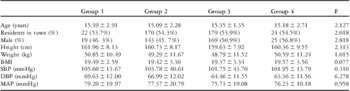
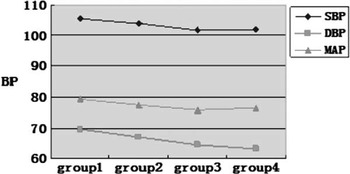
There is no significant difference in gender, age, body mass index, and family background, which is indicated by their living condition – town or countryside (Table 1). Systolic blood pressure and mean arterial blood pressure increased with school performance, but the change is not significant (p > 0.05 between any two groups). By contrast, diastolic blood pressure increases according to school performance as well, but significantly. Prominent differences can be found between groups 1 and 3 (p < 0.001), between groups 2 and 3 (p < 0.05), and between groups 1 and 4 (p < 0.001), whereas the differences between other groups are not significant (p = 0.06 between groups 1 and 2; p = 0.06 between groups 2 and 4; and p = 0.561 between groups 3 and 4) (Table 1 and Fig 1).
Baseline between four groups.

BMI = body mass index; DBP = diastolic blood pressure; MAP = mean arterial blood pressure; SBP = systolic blood pressure
Correlation between blood pressure and school performance. SBP = systolic blood pressure; DBP = diastolic blood pressure; MAP = mean arterial blood pressure.

As shown in Table 2, significant differences were observed in diastolic blood pressure between groups 1 and 3 (p < 0.001), between groups 2 and 3 (p < 0.05), and between groups 1 and 4 (p < 0.001), but not between other groups in boys, which is consistent with the overall data that include both genders. (p = 0.066 between groups 1 and 2; p = 0.327 between groups 2 and 4; and p = 0.886 between groups 3 and 4). On the other hand, no meaningful difference was observed between any two groups among girls (p > 0.05; Table 3).
Correlation of blood pressure and school performance in boys using F-test (mean ± standard deviation).

BMI = body mass index; DBP = diastolic blood pressure; MAP = mean arterial blood pressure; SBP = systolic blood pressure
Correlation of blood pressure and school performance in girls using F-test (mean ± standard deviation).

BMI = body mass index; DBP = diastolic blood pressure; MAP = mean arterial blood pressure; SBP = systolic blood pressure
Discussion
In this article, we report the correlation of blood pressure with school performance. We found that elevated blood pressure was related to better school performance, mainly in boys. Both high systolic and high diastolic pressures are related to severe cardiovascular diseases such as myocardial infarction. In the elderly, isolated systolic hypertension is more common and is associated with profoundly increased cardiovascular morbidity and mortality. 16 By contrast, isolated systolic hypertension is rarely found in young individuals; instead, isolated diastolic hypertension and combined systolic and diastolic hypertension are more common.Reference Kannel, Gordon and Schwartz 17 There was a study that showed that hypertensive young people with isolated diastolic hypertension had less physiological abnormality and better prognosis after treatment compared with those people having combined systolic and diastolic hypertension.Reference Fang, Madhavan, Cohen and Alderman 18
There was a survey showing that among all stressors for students 38% were intrapersonal, 28% were environmental, 19% were interpersonal, and 15% were academic.Reference Ross, Niebling and Heckert 19 Although stress does not cause hypertension directly, it affects development through stimulation of the nervous system, producing large amounts of vasoconstricting hormones resulting in increased blood pressure.Reference Kulkarni, O'Farrell, Erasi and Kochar 20 Hypothalamic–pituitary–adrenocortical axis and hypothalamus-autonomic nervous system were reported to be involved in academic stress response. It was shown that plasma levels of cortisol, adrenocorticotropic hormone, neuropeptide Y, adrenomedullin, nitrite, and nitrate increased during times of academic stress compared with baseline levels.Reference Al-Ayadhi 21 Activation of the hypothalamic–pituitary–adrenocortical axis is controlled by a relatively small set of parvocellular neurons located in the paraventricular nucleus of the hypothalamus (PVN). When stress is over certain threshold, these neurons release neurotransmitters, such as corticotrophin-releasing hormone and arginine vasopressin, into the hypophyseal portal circulation. The arrival of these factors to the anterior pituitary leads to the release of the adrenocorticotropic hormone and then causes synthesis and secretion of glucocorticoids by the adrenal cortex.Reference de Kloet, Vreugdenhil, Oitzl and Joels 22 Although research in individuals with already established hypertension failed to show consistent abnormalities in the adrenocortical output, excessive and prolonged stress-induced cortisol exposure is greater and more persistent in persons at high risk for hypertension relative to low-risk normotensives.Reference al'Absi and Arnett 23 Moreover, stress was known to be involved in atherosclerosis probably through expression of pro- and anti-inflammatory cytokines by stress hormones, such as catecholamines and corticosteroids.Reference Gu, Tang and Yang 24 Factors affecting blood pressure through stress include white coat hypertension, job strain, race, social environment, emotional distress, etc.
In this article, we report that school performance is another factor affecting blood pressure through stress in young people. We found that blood pressure increases with better school performance, as shown by examination results. In fact, this elevated blood pressure might be due to learning itself,Reference Waldstein Shari, Ryan Christopher, Manuck Stephen, Parkinson David and Bromet Evelyn 13 as it is logical that the more you have learnt the better your examination result would be. By contrast, Micozzi et alReference Micozzi 25 reported that the prevalence of elevated blood pressure was increased in those Philippine children who had lower academic ranks repeatedly throughout schooling. They claimed that lower academic rank might have a deleterious effect on children in cultures such as the Philippine society, which is oriented towards higher education and highly motivated towards academic achievement. Our survey was performed in Tibet, where the competition in school towards higher rank is not particularly expected by parents. Therefore, the elevated blood pressure values in our study might be due to intrapersonal factors such as learning itself rather than because of interpersonal or environment factors. Moreover, in general, boys will undergo more learning stress than girls, which is consistent with our findings in blood pressure.Reference Maric-Bilkan and Manigrasso 26 Although the role of the sex hormones estradiol and testosterone was not conclusive, female hormone is beneficial in blood pressure regulation, as women exhibit lower blood pressure before menopause compared with their age-matched male counterparts.Reference Boschitsch, Mayerhofer and Magometschnigg 27 , Reference Marras, Bassareo and Ruscazio 28 It will be interesting to further investigate how much time and intensity each group of students have put in to prepare for their exams and develop a methodology to quantify their stress. An elaborate follow-up of cardiovascular incidents between the groups will be informative and instructional with regard to whether an intervention should be conducted with regard to the assessment system of student performance in schools.
One limitation of our study is that average exam ranking alone is not an impeccable parameter to measure performance in adolescent students, nor their stress in schools. Factors such as bullying, supports from school, safety, and assessment level at school might all contribute to student performance or stress in school. Moreover, there could be potential bias in the mean exam results reported by the students themselves, as some students might report their exam results insincerely. In addition, a lot of factors other than stress will contribute to the changes in blood pressure. Level of physical exercise, salt intake, lack of sleep, and noisy environment might all have a role in developing elevated blood pressure among children. In our study, we cannot rule out the fact that the higher blood pressure in students with better school performance was not due to determinants other than the stress of learning. Students who performed better in exams might have had a greater intake of caffeine beverages or might have had fewer hours of sleep compared with their peers.
Conclusion
According to the blood pressure data we collected from 730 students, we found that superior school performance was positively correlated with diastolic blood pressure but not systolic blood pressure or mean arterial blood pressure, mainly in boys.
Acknowledgement
The authors thank the contribution and support from Tibet Chang Du people's Hospital and the first and second middle school in Chang Du on whom they undertook their survey from.