Tetralogy of Fallot is the most common congenital cyanotic cardiac defect, accounting for 3.5–8% of all congenital heart defects.Reference Apitz, Webb and Redington 1 , Reference Pradat, Francannet, Harris and Robert 2 Surgical and medical treatments have improved substantially throughout the last decades, and long-term survival is currently higher than 90%.Reference Hickey, Veldtman and Bradley 3 Children between the age of 10 and 20 years born with tetralogy of Fallot report good quality of life.Reference Larsen, McCrindle, Jacobsen, Johnsen, Emmertsen and Hjortdal 4 The population of adult patients who have undergone repair of tetralogy of Fallot is increasing; in Denmark, it by far outnumbers the population of children with tetralogy of Fallot. In this group of adults, there are patients dealing with cardiac issues such as pulmonary regurgitation, pulmonary stenosis, residual ventricular septal defect, arrhythmias, and cardiac failure. These factors may have an impact on life conditions such as family situation, education and employment status, and general well-being. However, knowledge in this area is sparse.
We have previously found that women operated for tetralogy of Fallot have normal fertility, but they have a lower reproduction rate compared with the background female population and a higher frequency of congenital heart disease among the offspring.Reference Pedersen, Pedersen, Ravn and Hjortdal 5 Comparable knowledge in men is missing.
The SF-36 is the most extensively validated and used health survey tool for assessment of quality of life, providing information on basic human values.Reference Garratt, Schmidt, Mackintosh and Fitzpatrick 6 Through this short form, general physical and mental functioning and well-being are assessed, yielding scores in eight important health concepts.
Materials and methods
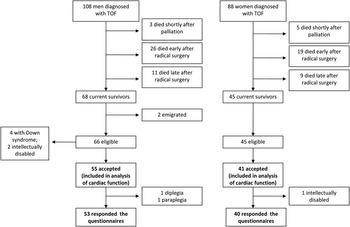
Through surgical registries, we identified 108 men operated for tetralogy of Fallot at Aarhus University Hospital in the period 1 April, 1971 to 31 December, 1991. Details on cardiac anatomy, haemodynamics, and type and timing of surgical interventions were obtained from medical records. Pre- and post-operative status was assessed through hospital notes, electrocardiograms, echocardiograms, and reports of catheterisation. Of the 108 operated, 68 are current survivors; however, only 66 could be contacted, as two emigrated. The median age at the operation for this group was 4.5 (0.5–33.5) years. They were asked to fill a questionnaire containing questions about educational level, employment status, symptoms influencing their daily activities, whether or not they had children, and whether any of these children had cardiac disease. In all, 55 accepted study participation; the median age was 32.2 (18.4–60.0) years.
For assessment of quality of life, the SF-36 health survey was used. This questionnaire consists of eight scaled categories subdivided into physical and mental domains. The physical domain includes the categories physical functioning, role physical, bodily pain, and general health. Physical functioning refers to the ability to perform physical activities or limitations to do so due to health. Role physical is the impact of physical health on the range and extent of physical activities one is able to perform. Bodily pain refers to the severity of pain and its impact on daily activities. General health is a rating of one's own health, a comparison with others’ health and proneness to illness. The mental domain includes social functioning, role emotional, vitality, and mental health. Social functioning refers to the impact of physical and emotional health on the ability to perform normal social activities. Role emotional is the impact of the emotional status on the range and extent of activities one can perform. Vitality refers to how energetic or tired a person felt. Mental health refers to the degree of nervousness or calmness, happiness or sadness.Reference Ware and Sherbourne 7 The answers to the SF-36 questionnaire among adult men operated for tetralogy of Fallot were compared with a group of healthy Danish men of similar age and with women operated for tetralogy of Fallot in the same period.
Data on family situation, education, and employment status were compared with data from the male Danish population of similar age from Statistics Denmark.
For comparison of quality of life, two other groups were asked to fill the SF-36 health questionnaire: healthy men of similar age from the local area and women operated for tetralogy of Fallot in the same time period. The median age for the healthy men was 33.5 (19.9–57.1) years, similar to that of the male group with tetralogy of Fallot (p = 0.954). For the female patients with tetralogy of Fallot, the median age was 38.6 (19.3–62.9) years, also similar to that of the male patients (p = 0.364).
This study was approved by the Danish Data Protection Agency.
Statistical analysis
Nominal data were presented as percentages. Continuous data were presented as mean plus or minus standard deviation and medians with total range as appropriate. Student's t-test was used to test the means for normally distributed data; otherwise, the Mann–Whitney–Wilcoxon test was used. p-Value less than or equal to 0.05 was considered statistically significant. Scores from the SF-36 health survey were converted to norm-based scores, using norms from the United States of America, 1998. Data were analysed using Graph Pad PRISM version 5 and STATA® software version 10 (Stata Corporation, Texas, United States of America).
Results
Demographics
Surgical history and outcomes of the cohort of 108 men and 88 women operated for tetralogy of Fallot are shown in Figure 1.
Flow chart showing the surgical history and progress of the male and female cohorts.

Men operated for tetralogy of Fallot
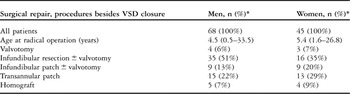
Of the 108 men operated for tetralogy of Fallot, 40 died at different stages. All patients have at some point undergone corrective surgery (Table 1) except for three who died within 1 day after palliation. In all, 24 patients had altogether 29 reoperations or interventions; that is, pulmonary valve replacement in 17, closure of a residual ventricular septal defect in seven, stenting of the pulmonary artery in three, aortic valve replacement in one, and heart transplantation in one. Of these, four had Down's syndrome and two others had intellectual disability, and thus not eligible for participation in the study; one had diplegia and another tetraplegia, and they were included, with the exception of the SF-36 analysis. The five who did not respond [median age at operation 6.3 years (3.3–7.0)] did not differ from the responders in terms of demographic data. There were three patients who were diagnosed with DiGeorge syndrome.
Surgical repair and associated procedures among male (n = 68) and female (n = 45) patients operated for tetralogy of Fallot.

VSD = ventricular septal defect
*Continuous variables are presented as median and total range; nominal variables as total number and percentage
Healthy male controls
A total of 32 healthy men of similar age from the local area were included as controls.
Women operated for tetralogy of Fallot
Of 88 women operated for tetralogy of Fallot at our institution between 1972 and 1992, 45 are current survivors,Reference Pedersen, Pedersen, Ravn and Hjortdal 5 as shown in Figure 1. All underwent complete repair at some point. In all, 28 of them have associated cardiac abnormalities as described previously.Reference Pedersen, Pedersen, Ravn and Hjortdal 5
Health-based quality of life: SF-36 survey
Out of the potential group of 60 men operated for tetralogy of Fallot, 55 answered the survey. The two with diplegia or tetraplegia were excluded from the SF-36 analysis, as it would be difficult to differentiate between limitations caused by their disability and limitations caused by the heart condition.
All 32 healthy controls answered the SF-36 survey.
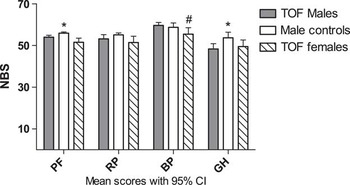
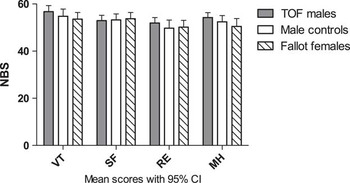
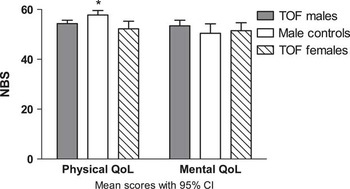
Of the 45 women who are current survivors after operation for tetralogy of Fallot, four did not fill in the SF-36 questionnaire and one was intellectually disabled and therefore excluded from this specific analysis. Male patients had statistically significantly lower scores than healthy Danish men in the categories physical functioning (54 plus or minus 3 versus 56 plus or minus 2, p = 0.004) and general health (48 plus or minus 9 versus 54 plus or minus 7, p = 0.007), as well as in the physical component summary (54 plus or minus 5 versus 58 plus or minus 5, p = 0.002). No statistically significant differences were found in role physical (p = 0.507), bodily pain (p = 0.403), vitality (p = 0.334), social functioning (p = 0.865), role emotional (p = 0.149), mental health (p = 0.292), or in the mental component summary (p = 0.404) between male patients and controls (Figs 2, 3 and 4). The inclusion of SF-36 scores from the two patients with diplegia or tetraplegia did not affect the results.
Physical components of SF-36. TOF = tetralogy of Fallot. *Statistically significant difference between male patients operated for tetralogy and controls. Statistically significant difference between male and female patients operated for tetralogy. BP = bodily pain; GH = general health; NBS = norm-based scores; PF = physical functioning; RP = role physical.

Mental components of SF-36. TOF = tetralogy of Fallot. No statistically significant differences were found. MH = mental health; NBS = norm-based scores; RE = role emotional; SF = social functioning; VT = vitality.

Summary scales of SF-36. TOF = tetralogy of Fallot; QoL = quality of life. *Statistically significant difference between males with tetralogy and male controls. NBS = norm-based scores.

No differences were found between the norm-based scores between men and women operated for tetralogy of Fallot in the SF-36 survey, with the exception of a lower score in bodily pain among women (55 plus or minus 10 versus 60 plus or minus 5, p = 0.038; Figs 2, 3 and 4).
New York Heart Association functional class
Data regarding cardiac function were obtained from all the responders, including those with syndromes, mental retardation, and diplegia/tetraplegia.
Of the 55 men operated for tetralogy of Fallot, 46 were in New York Heart Association functional class I, and nine in class II. All controls were in class I. Among the 41 operated women, 39 were in class I and two in class II.
Patients in New York Heart Association functional class II had lower norm-based scores than patients in class I on physical functioning (51 (43–55) versus 55 (38–57), p = 0.013), role physical (46 plus or minus 12 versus 53 plus or minus 7, p = 0.019), and physical component summary (52 (33–56) versus 55 (31–65), p = 0.039) categories. No other differences were found in the remaining norm-based scores according to the New York Heart Association functional class.
Family situation, education, and employment
All 55 male patients responded to this specific questionnaire. In all, 17 men (31%) had altogether 36 children and two men and their partners were expecting children at the time of the study. Of the 36 children, three (8.3%) were born with a congenital heart disease, including two of them with tetralogy of Fallot. On average, the men in our cohort had 0.65 children per man compared with an average of 1.02 in the Danish male population at 33 years of age 8 (p = 0.01). The three patients with DiGeorge syndrome and one patient with tetraplegia were in the group without children. The fertility rate among women operated for tetralogy of Fallot was 0.88 children per woman compared with 1.84 in the Danish female background population.
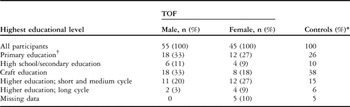
Results regarding education status for men and women operated for tetralogy of Fallot, as well as the male control population, are summarised in Table 2. The male patients had an educational level similar to men of similar age in the general Danish population (Table 2).
Highest educational level for patients operated for tetralogy of Fallot 20 years of age or older.

TOF = tetralogy of Fallot
*Calculated on the basis of information about the male age corresponding Danish population from Statistics Denmark, and weighted by the age composition in the TOF cohort
†Two (4%) male patients operated for tetralogy of Fallot have their basic schooling from special schools
Among the male patients, 66% were currently working; 13% were students; 3% were unemployed; and 18% were retired, in rehabilitation, or receiving social benefits. In comparison, 84% of men in the same age group in the general Danish population in 2008 were employed, 17% were students; 9% were retired, in rehabilitation, or receiving social benefits; and 2% were unemployed. Owing to the fact that some people fall into two categories – that is, unemployed and studying at the same time – these percentages do not add up to 100%. Of the three patients with DiGeorge syndrome, two were in sheltered jobs and the third was a student. The patient with tetraplegia received social benefits.
Discussion
In this population-based study, we have follow-up information on almost 100% of the cohort through medical registries, with only two patients lost to follow-up because of emigration. Furthermore, we have a response rate close to 90%. Our data show that men who survived an operation for tetralogy of Fallot in Denmark 18–38 years ago are doing reasonably well in terms of quality of life and educational status. However, fewer are employed compared with the general population. Many have started a family. Nevertheless, their reproduction rate is somewhat lower than that of the general male population, but somewhat higher than that of the female group operated for tetralogy of Fallot compared with the general female population. Their risk of having a child with congenital heart disease is higher than in the normal population and higher than the average patient with other congenital heart defects.Reference Burn, Brennan and Little 9 The increased risk is similar to what we have described in women with tetralogy of Fallot.Reference Pedersen, Pedersen, Ravn and Hjortdal 5 Issues that might influence reproduction rates in adults with congenital heart disease are concerns about heritability of cardiac disease, impaired body image, fear of not being able to experience one's children growing up, and fear of death during sex.Reference Hargrove, Penny and Sawyer 10 , Reference Vigl, Hager and Bauer 11
Total fertility rate refers to the number of children throughout the fertile age in 1000 men or women, estimated by adding together the age-specific fertility rates for each age group. The comparable general total fertility rate was estimated by adding up the age-specific fertility rates from age 16 to 33 years. 8 The total fertility rate at age 33 is 1022, equal to an average of 1.02 children per man; this is higher than the average of 0.66 children per man in our cohort. Women born with tetralogy of Fallot had a fertility rate of 0.88, which is also lower than that of the general population.
Despite having an educational level similar to the general population, fewer are employed and more are retired, in rehabilitation, or receiving social benefits. The explanation for this phenomenon is probably multifactorial. Some of the patients are physically impaired. Several of the patients have haemodynamic manifestations of chronic pulmonary regurgitation, recurrent or residual pulmonary stenosis, but declare themselves as being asymptomatic. Some of our patients have lived with cyanosis and an impaired heart function for years. Previous studies have shown a persistent effect of cyanosis in cognitive and academic performance, which may influence these patients’ abilities to be employed.Reference Wray and Sensky 12 Others have shown that older age at surgery is associated with higher rates of long-term mortalityReference Murphy, Gersh and Mair 13 and supraventricular tachyarrhythmia,Reference Gatzoulis, Balaji and Webber 14 and age at operation might also have an impact in other areas. Another aspect is that tetralogy of Fallot is frequently associated with 22q11 deletions and other chromosomal abnormalities. Up to one-fifth of patients with tetralogy of Fallot with pulmonary stenosis, and two-fifths of patients with tetralogy of Fallot and pulmonary atresia, have this deletion.Reference Bailliard and Anderson 15 In our cohort, only three patients were diagnosed with DiGeorge syndrome. If all were tested, the 22q11 deletion would likely be found in more patients. Their answers in the SF-36 survey were similar to the overall group, but these patients may have learning disabilities, immunologic deficiencies, and other physical impairments, which may cause difficulties in relation to being employed. Low cardiac output, hypoxia, and acidosis in the context of heart surgery may also have an impact on intellectual capacities. Looking at the self-reported physical, psychosocial, and educational status of our cohort, physical rather than mental impairment seems to have the largest impact on work abilities. Nevertheless, it should be taken into consideration that our cohort is small, and therefore only large differences can be detected.
All psychosocial aspects of quality of life were similar in patients and controls. This includes how their emotions affect their daily activities both at work and in social relations, as well as their mental health and vitality.
Physical functioning is assessed by abilities and limitations in activities such as strolling, climbing stairs, lifting or carrying items, and participating in sports. The term general health refers to patients’ own view of their current general health status, how they compare their own health with that of others, and what expectations they have concerning their future health.
The patients’ good psychosocial quality of life and educational level indicate that they cope well with life, have good mental health and complete education in the same way as their healthy peers. At the same time, several of our patients have been granted early retirement, and there is a moderate impairment in their physical health. This underlines the fact that these patients should be followed up in the health-care system, and that even though surgical repair has radically changed short- and long-term outcome for this patient group they still need special attention in adulthood. Their lowered general health score may indicate that their present health status, or fear of impaired health in the future, make them more insecure or anxious about their future life.
Moons et alReference Moons, Van, De, Gewillig and Budts 16 showed that the severity of congenital heart disease was only marginally associated with quality of life. In their study, functional status – New York Heart Association functional classification and ability index – was more closely associated with quality of life than initial diagnosis. In accordance, we found lower self-reported quality of life in the somatic categories among patients in New York Heart Association class II compared with those in class I. Furthermore, our results confirm the findings from van Rijen et al,Reference van Rijen, Utens and Roos-Hesselink 17 who reported lower self-perceived physical functioning but an overall good quality of life, and in some areas better than the reference group. The authors suggest that good coping strategies developed early in life make these patients capable of managing physical limitations and emotional challenges well. They emphasise that it is difficult to distinguish between adequate coping, in other words not being overly bothered by physical and/or emotional problems, as opposed to overcompensation and denial of problems associated with their cardiac malformation. Owing to the fact that the patients report a poorer physical functioning than others, wishful thinking and exaggerations of positive outcome are not likely explanations to why these patients have a good quality of life in general.
Specific coping strategies developed in young years are also the hypothetical explanation for better quality of life in patients with tetralogy of Fallot compared with patients with atrial septal defect. Ternestedt et alReference Ternestedt, Wall, Oddsson, Riesenfeld, Groth and Schollin 18 refer to patients with tetralogy of Fallot as “high achievers”, and describe them as more purposeful and with more willpower than patients with atrial septal defects. Moons et alReference Moons, Van and De 19 found that patients with tetralogy of Fallot had a better quality of life than their healthy peers. Their results are not directly comparable to ours, as they used linear analogue scales, the Satisfaction with Life Scale and Quality of Life Scale, for patients with congenital heart disease.
In a study of 564 patients with congenital heart disease, including 17% with tetralogy of Fallot, results from cardiopulmonary exercise tests and SF-36 scores were compared.Reference Gratz, Hess and Hager 20 Despite several limitations at exercise, patients only reported reduction in health-related quality of life concerning physical functioning and general health, and not in psychosocial aspects. This was confirmed in all diagnostic subgroups. Comparison of exercise test results with self-reported physical functioning revealed an overestimation of physical functioning in most patients. This is likely to have occurred in this study, where patients reported that they were asymptomatic or minimally symptomatic, despite some of them having some level of haemodynamic impairment. The results from these studies on general health and quality of life in adults with tetralogy of Fallot and other congenital heart diseases indicate a good overall self-perceived health status despite some reduction in physical function.
Study limitations
Even though the terms quality of life and health-related quality of life are widely used as outcomes in most medical fields, there is no consensus about their definition. An individual with poor health can have a good quality of life, even though the terms health and quality of life are often used interchangeably.
We studied a relatively small cohort, but they comprise all patients in the western part of Denmark. Despite being a strong tool in testing of health-related quality of life, the SF-36 health survey does not unveil complex problems related to congenital heart disease, or psychosocial problems specific to adults with congenital heart diseases. We did not look at marital and cohabiting status, which would have given more insight into the family situation than the number of children alone.
Owing to missing SF-36 norm-based scores for the subpopulation groups of specific age and gender in Denmark, we compared the norm-based scores of this cohort with scores from the American population.
We did not compare data from female patients with repaired tetralogy with those from healthy age-matched women from the general population. This study was mainly focused on describing long-term psychosocial, educational, and professional outcomes in the male group with repaired tetralogy of Fallot.
In conclusion, men operated for tetralogy of Fallot up to nearly 40 years ago are doing reasonably well in terms of quality of life and educational status. Even though many are employed or are full-time students, the prevalence of early retirement and rehabilitation is higher than in the control population. They start a family, although their reproduction rate is two-thirds that of the general population, but somewhat higher than that of women with tetralogy of Fallot. The risk of congenital heart disease in offspring is 8.3%, and thus higher than the normal population and as high as in women born with tetralogy of Fallot.
Acknowledgements
Research nurse Vibeke Laursen is thanked for help with the SF-36 survey. Dorte Hindby and Jette Breiner, secretaries at the Department of Cardiothoracic and Vascular Surgery, are thanked for secretarial help.