In the past 40 years an extensive literature has grown up around aggregate political economy models of elections, but few articles have focused on the German case. Initially, Kirchgässner (Reference Kirchgässner1977; Reference Kirchgässner1991), developed vote-popularity (VP) functions, with the unemployment rate as the dominant economic variable predicting the German ruling parties' performance. Thereafter, using vote functions (VF) from 1961 to 1994, Jérôme, Jérôme-Speziari, and Lewis-Beck (Reference Jérôme, Jérôme-Speziari and Lewis-Beck2001) tested the “yardstick” competition existing between French and German economic votes.
Using these VP functions to predict German studies seldom has been done. Jérôme, Jérôme-Speziari, and Lewis-Beck (Reference Jérôme, Jérôme-Speziari and Lewis-Beck1998) initially developed a vote function model using the rate of unemployment and the popularity of the Free Democratic Party (FDP) as the main predictors (see table 1). This first model correctly forecasted the Christian Democratic Union (CDU)/Christian Social Union CDU/CSU-FDP defeat. Using this same model, experiments were run in forecasting three subsequent German elections (Jérôme, Jérôme-Speziari, and Lewis-Beck Reference Jérôme, Jérôme-Speziari and Lewis-Beck2002, Reference Jérôme-Speziari2005, Reference Jérôme, Jérôme-Speziari and Lewis-Beck2009; see Pollyvote website at www.pollyvote.com). About the same time, Norpoth and Gschwend (Reference Gschwend, Norpoth, Klein, Jagodzinski, Mochmann and Ohr2000, Reference Norpoth and Gschwend2003) built a forecasting model where one of the main party's desire to provide the Chancellor predicts the election result. This model is known as the “Chancellor Model” (Norpoth and Gschwend Reference Norpoth and Gschwend2010).
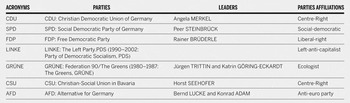
Parties Cited in the Text

POLITICAL AND ECONOMIC PERFORMANCE
The various vote functions used for these forecasts are based on the two pillars of an accountable democratic government (Key Reference Key1966): political and economic performance. In regard to the voter time horizon, the model of Jérôme, Jérôme-Speziari, and Lewis-Beck is rather retrospective, because their unemployment variable is measured two quarters before an election. Norpoth and Gschwend's Chancellor Model is mainly prospective because it is based on surveys openly asking “With a view to the next elections, which candidate between Mr. (Mrs.) X and Mrs. (Mr.) Y would you prefer to be your Chancellor?” Nevertheless, whatever their assumptions, both models forecasted well during the 2009 German legislative elections, including the building of a CDU/CSU-FDP coalition led by A. Merkel. In this “spotlight” symposium, the two models are run again to provide a forecast for the 2013 German elections to be held in September 2013. The political economy model is updated adopting a seemingly unrelated regression (SUR) method.
IMPLICATIONS OF THIS GERMAN ELECTION
The outcome of the next German election is politically important for a number of reasons. Thus, if Angela Merkel cannot rule again with the FDP and has to rebuild a grand coalition with the SPD (or the Greens), the coordination of the economic policies in the EU should be significantly modified in three ways: (1) less budgetary discipline and a little more economic-stimulus inside the EU; (2) a modification of the politico-economic balance of power between France and Germany; and (3) a slight redesign of the political equilibrium between the European Central Bank and the European Council of Heads of State or Governments. All these elements could not pass without having some implications on the bilateral trade relations between the United States and Europe.
CONTRIBUTORS
Thomas Gschwend is professor for quantitative methods in the social sciences at University of Mannheim. He is particularly interested in the processes by which institutions pre-structure an individual's decision-making process and its consequences for voters, party strategies, and election outcomes. His most recent English books are Research Design in Political Science: How to Practice What They Preach (2007; co-edited with Frank Schimmelfennig), and Strategic Voting in Mixed-Electoral Systems (2004). He can be reached at gschwend@uni-mannheim.de.
Bruno Jérôme is an associate professor in the department of economics at the University of Paris 2 and member of the Law and Economics Center of Paris 2. His interests are political economy, public economics, election forecasting, European economics and institutions. His most recent books are Analyse Economique des Elections (Economica); (2010 co-authored with Veronique Jerome-Speziari) and Les élections municipales françaises. Paris : Presses de Sciences Po (Forthcoming, 2013 co-authored with Richard Nadeau, Véronique Jérôme-Spéziari and Martial Foucault). He can be reached at bruno.jerome@gmail.com.
Véronique Jérôme-Speziari is an associate professor in the department of management at the University of Paris Sud 11 and member of the Paris 2 Laboratory of Management. Her interests are political economy, public economics, election forecasting, political marketing, and nonverbal communication. Her most recent books are Analyse Economique des Elections (Economica); (2010, co-authored with Bruno Jerome) and Les élections municipales françaises. Paris : Presses de Sciences. She can be reached at veronique.jerome@gmail.com.
Michael S. Lewis-Beck is F. Wendell Miller Distinguished Professor of Political Science at the University of Iowa. His interests are comparative elections, election forecasting, political economy, and quantitative methodology. Lewis-Beck has authored or co-authored more than 220 articles and books. He has served as editor of the American Journal of Political Science and of the Sage QASS series (the green monographs) in quantitative methods. He can be reached at michael-lewis-beck@uiowa.edu.
Helmut Norpoth is a professor of political science at Stony Brook University. He is coauthor of The American Voter Revisited and has published widely on topics of electoral behavior. His current research focuses on public opinion in wartime. He can be reached at helmut.norpoth@sunysb.edu.