1 Introduction
Ditransitive verbs such as to give, to send, or to sell and their complementation pattern(s) in Present-day English (as well as in other languages) have been studied extensively and are frequently drawn on to assess models of argument structure and the interrelations between syntax and semantics (Colleman & De Clerck Reference Colleman and De Clerck2011: 186). The history of these verbs and the construction(s) available to them in English has, however, only rather recently received more attention (with the exception of Cassidy Reference Cassidy1938; Visser Reference Visser1963; see, among others, Allen Reference Allen1995; McFadden Reference McFadden and Lightfoot2002; De Cuypere Reference De Cuypere2010, Reference De Cuypere2015a, Reference De Cuypere2015b; Colleman Reference Colleman2011; Colleman & De Clerck Reference Colleman and De Clerck2011; Wolk et al. Reference Wolk, Bresnan, Rosenbach and Szmrecsanyi2013; Gerwin Reference Gerwin2014; Yáñez-Bouza & Denison Reference Yáñez-Bouza and Denison2015). A number of issues, such as the range of verb classes used in ditransitive constructions in various periods, remain to be dealt with on the basis of empirical data. The present article aims to tackle these shortcomings by means of an investigation of the forms in a corpus of Middle English, and to thereby extend our understanding of the constructions’ development.
1.1 Terminology and introduction
Since there is great variety in terminology concerning ditransitive complementation patterns, a few comments on the terms used in this article are in order before diving deeper into the subject: I use ‘ditransitive’ as a superordinate term for constructions involving a verb and two non-agent participant roles, namely a theme argument (TH) and a recipient-like argument (REC). The latter constituent can be expressed either by an NP or by a PP. Furthermore, it is not restricted to prototypical recipients (especially in the earlier periods), but can encode a relatively broad category of semantic roles. This includes, among others, addressees of communicative events, affectees of benefactive or malefactive actions, or deprivees in cases of dispossession.
The term ‘double object construction’ (DOC) is, in contrast, used only for an argument structure construction with an NP recipient (1).Footnote 2 The prepositional paraphrases of the double object construction, which feature a recipient-argument marked by a preposition, are then labelled ‘prepositional object constructions’ (POC). If the specific type of preposition involved is relevant, it is simply added to the label; for instance, example (2a) illustrates a to-POC, while (2b) represents a for-POC.
-
(1) John gave Mary REC an appleTH.
-
(2)
-
(a) John gave an appleTH to Mary REC.
-
(b) John baked a cake TH for Mary REC.Footnote 3
-
In Present-day English (PDE), the DOC and the to-POC together form the well-known ‘dative alternation’, whereas the relation between DOC and for-POC is commonly referred to as the ‘benefactive alternation’. The emergence of this dative alternation in the history of English (and to a lesser extent, that of the benefactive alternation) constitutes one of the major foci of this article.
Although I take the association between the members of the PDE alternation to be very strong, highly systematic, and therefore special, it is nevertheless important to note that prepositional constructions with prepositions other than to and for are also present in today's English – an even greater range of prepositional periphrases was available in earlier periods; cf. the sentences in (3a–b), which instantiate at- and of-POCs (Colleman & De Clerck Reference Colleman and De Clerck2009: 6; also Herriman Reference Herriman1995). In many cases, among them verbs of dispossession, the PP-patterns have in fact ousted their NP-counterparts (3c).
-
(3)
-
(a) John cast Mary REC a glanceTH – John cast a glanceTH at MaryREC.
-
(b) John asked Mary REC a favourTH – John asked a favourTH of Mary REC.
-
(c) John stole a book TH from Mary REC.
-
This loss of certain verb classes from the DOC in fact represents the second key focus of the present article, as will be pointed out in more detail below.
1.2 Ditransitives in the history of English
The history of English ditransitives is characterised by two crucial sets of changes: first, there are a number of developments concerning the morphosyntactic options for ditransitive verbs, including the emergence of the alternation as such. More specifically, we can observe a rise in structural variation, as POCs became available and were increasingly frequently used as alternatives to the DOC. Eventually, this led to a tight link between the double object construction and one particular prepositional pattern, namely the to-POC. The beginning of this process is thought to lie in Old English already; nevertheless, the main locus of change appears to have been the Middle English period (De Cuypere Reference De Cuypere2013, Reference De Cuypere2015b). This has caused many linguists to assume a connection between the rise of the dative alternation and other important changes that took place around the same time, such as the loss of morphological case marking (see e.g. Fischer Reference Fischer and Blake1992; Allen Reference Allen1995; McFadden Reference McFadden and Lightfoot2002). Moreover, ditransitives also seem to have been affected by the general move towards fixed word order observable from late Old English onwards. While earlier, the object arguments could occur in any order (REC-TH or TH-REC) in both the DOC and the prepositional patterns, the two constructions have become increasingly associated with one particular order over time. That is, in standard PDE the theme typically follows the recipient in the double object construction, but near-categorically precedes it in the to- and for-pattern, as illustrated in examples (1)–(2) above.
Second, the semantics of the DOC has been shown to change between Old and Present-day English: in earlier times, a broad range of verbs was found in the construction, and it expressed a comparatively schematic meaning of ‘indirect affectedness’. Apart from transfer and transfer-related meanings, this abstract sense also subsumed meanings such as dispossession (4), or pure benefaction/malefaction. Over time, however, the notion of transfer has been foregrounded, and several senses more peripheral to this core meaning have been lost. This means that there was a reduction in the range of verb classes associated with the DOC, which has led to the semantics of the construction becoming narrower or more specialised (see e.g. Goldberg Reference Goldberg1995; Rohdenburg Reference Rohdenburg1995; Barðdal Reference Barðdal2007; Barðdal, Kristoffersen & Sveen Reference Barðdal, Kristoffersen and Sveen2011; Colleman & De Clerck Reference Colleman and De Clerck2011).
-
(4) For dronkenesse bireveth hym REC the discrecioun of his witTH
‘for drunkenness robs him of the discretion of his wit’
(CMCTPARS,316.C2.1212)
The main aim of this article now is to assess whether there is a correlation or even a causal relationship between these sets of changes, i.e. on the one hand, the rise of prepositional competitors and specifically the emergence of the dative alternation, and on the other hand, the narrowing of the DOC. I attempt to answer these questions by drawing on quantitative data gained from a diachronically layered study of the Penn–Helsinki Parsed Corpus of Middle English, 2nd edition (PPCME2). Concerning theoretical framework, the study takes a (diachronic) construction grammar approach to the issues involved (see e.g. Goldberg Reference Goldberg1995; Barðdal Reference Barðdal2007; Rostila Reference Rostila2007; Barðdal; Kristoffersen & Sveen Reference Barðdal, Kristoffersen and Sveen2011; Colleman & De Clerck Reference Colleman and De Clerck2011; Traugott & Trousdale Reference Traugott and Trousdale2013; Barðdal et al. Reference Barðdal, Smirnova, Sommerer and Gildea2015).
The article is structured as follows: in section 2, a more detailed outline of the history of ditransitives is given, with a particular focus on the two main phenomena in question. Section 3 will briefly report on the methodology employed in the corpus study, followed by a presentation of the main results of the investigation (section 4). In section 5, the implications of these results on the research questions of the article will be discussed. Section 6 provides a summary of the main findings, and possible conclusions.
2 Background
2.1 The emergence of the dative alternation (and changes connected to it)
The history of ditransitive complementation patterns in English is characterised by (or connected to) a number of striking changes. Beginning with an overview of ditransitives in Old English, we find that although the DOC is in general certainly still dominant with ditransitive verbs at this stage, prepositional periphrases can already be found as well. For instance, verbs of communication (tell, say) as well as verbs of caused motion such as bring or send are frequently found in to-POCs; in fact, prepositional patterns in these cases even seem to have superseded the DOC (see De Cuypere Reference De Cuypere2015b, also Cassidy Reference Cassidy1938). In contrast, verbs of dispossession are often paraphrased by from- or of-POCs. These patterns are typically taken to originate in more spatial uses of the prepositions, having become reanalysed in ambiguous bridging contexts; in this respect, the development of the POCs corresponds to the general increasing extension of prepositions to new contexts from Old English onwards. Despite the availability of alternative constructions for some ditransitive verb classes, however, prepositional paraphrases were not yet used across the board with all ditransitive verbs: most importantly, unambiguous instances of transfer verbs such as give in any type of POC are still absent from Old English (see De Cuypere Reference De Cuypere2015b).
With regard to the morphosyntactic features of the constructions, the relative order of recipient and theme arguments in both DOCs and POCs was flexible in Old English, consistent with the overall still comparatively free word order at this stage. More specifically, both [(prep)REC-TH] (5a) and [TH-(prep)REC] (5b) orders occurred in a relatively balanced distribution, although the prepositional patterns showed a tendency towards the latter, i.e. PP-late position (see Koopman Reference Koopman1991–3; Allen Reference Allen1995; De Cuypere Reference De Cuypere2015a, Reference De Cuypere2015b).
-
(5)
-
(a) Se Halga Gast hie REC æghwylc god TH lærde,
‘The holy spirit taught them every good thing’
(Blickl. Homl. 12: 13121.1613; De Cuypere Reference De Cuypere2015a: 233)
-
(b) dældon heora æhta ealle TH þearfum REC
‘distributed all their belongings to the poor’
(coaelive, ÆLS_[Basil]:54.479; De Cuypere Reference De Cuypere2015a: 231)
-
The fact that the morphological case system was still more or less intact in Old English is reflected in the marking of the arguments of the DOC and POCs, as with both constructions a variety of different combinations of cases on the NPs involved are found. Regarding the DOC, a total of five ‘case frames’, joining dative- or accusative-bearing recipients with dative, accusative or genitive themes, were used (Allen Reference Allen1995: 29). Among these patterns, [DATREC-ACCTH] was clearly prevalent (both in terms of type and of token frequency; see Visser Reference Visser1963: 606–46; Allen Reference Allen1995: 29; De Cuypere Reference De Cuypere2015a: 231). Incidentally, the combination of DATREC and ACCTH was also the preferred option for to-POCs at this stage; however, other case frames presumably predominated with other POCs (see De Cuypere Reference De Cuypere2015b).
As for the semantics of the DOC and its associated case constructions, it is important to note that even though some semantic motivation behind the choice of case construction seems to be discernible, there is no clear correspondence between individual case frames and meaning. Rather, we find a large semantic overlap between the subconstructions, and substantial variation in that many verbs could readily alternate between different frames (see Mitchell Reference Mitchell1985: 453; De Cuypere Reference De Cuypere2015a: 231). As I will therefore argue below, we can posit an abstract DOC (unspecified with regard to case marking) with a meaning of ‘indirect affectedness’ in Old English.
At the transition from Old to Middle English and during the period of Middle English and beyond, several (possibly interrelated) developments took place: most importantly, the prepositional alternatives increased in relative frequency and extended to previously non-alternating verb classes. This included transfer verbs, which were used more and more often in to-POCs instead of being restricted to the DOC; therefore, Middle English is commonly mentioned as the point of introduction of the dative alternation proper (see e.g. Mustanoja Reference Mustanoja1960: 97, 348; Mitchell Reference Mitchell1985: 512).
Concerning constituent order within the constructions, the arguments of both members of the dative alternation became increasingly fixed to certain positions in the course of the Middle English period. While the DOC became primarily associated with [REC-TH] order, the to-POC showed a growing restriction to [TH-toREC] ordering (see McFadden Reference McFadden and Lightfoot2002, among others). Essentially, this led to the PDE dative alternation as we know it today, although the canonical orders are still subject to change (e.g. due to issues like heavy-noun shift) and regional variation (Gast Reference Gast2007; Gerwin Reference Gerwin2014; Yáñez-Bouza & Denison Reference Yáñez-Bouza and Denison2015).
Finally, both constructions were affected by the broad erosion of the inflectional system that took place in late Old English/early Middle English, with the various case frames merging into one non-marked pattern – in the case of the DOC this meant the emergence of a construction involving two ‘bare’ NP arguments, whereas in the case of POCs the resulting pattern comprised a bare NP theme and a PP recipient (governing a likewise unmarked NP).
As is well known, a connection is often made between the loss of case marking, the fixation of word order and the rise of prepositional (more analytic) means of expression as alternatives to the resident (more synthetic) constructions; whether there really was a causal influence between these changes – and if so, which direction it took – is still debated, and will also not be addressed in more detail in this article (see e.g. Mustanoja Reference Mustanoja1960: 66–8, 95; Visser Reference Visser1963: 622; Mitchell Reference Mitchell1985: 512; Fischer Reference Fischer and Blake1992: 233; Traugott Reference Traugott and Hogg1992: 285; Allen Reference Allen1995: 158; Barðdal Reference Barðdal, Barðdal and Chelliah2009; Barðdal & Kulikov Reference Barðdal, Kulikov, Malchukov and Spencer2009; Detges Reference Detges2009).Footnote 4
2.2 On the semantic specialisation of the DOC
Apart from the morphosyntactic features of the constructions, the semantics of the double object construction in Present-day English, i.e. the set of verb classes associated with the construction, has received a fair amount of attention in linguistic research so far. Most commonly, it is claimed here that a sense of transfer is highly salient with the PDE construction – observable in the fact that verbs like give and send are among those most frequently found in the DOC, and are furthermore acquired earliest with this construction by children (see e.g. Stefanowitsch & Gries Reference Stefanowitsch and Gries2003; Goldberg Reference Goldberg2006). The centrality of transfer to the construction is also prominently reflected in constructionist accounts of the DOC such as Goldberg (Reference Goldberg1995), who proposes that the basic or most prototypical sense of the DOC is ‘X successfully causes Y to receive Z’. Moreover, most subsenses she identifies are closely connected to the concept of transfer; for example, Joe promised Bob a car expresses the subsense of intended or future transfer. Despite some idiosyncrasies, the DOC in PDE thus clearly represents a construction with relatively transparent semantics (Goldberg Reference Goldberg1995: 32–9, 75, 132; see also Pinker Reference Pinker1989; Croft Reference Croft, Cuyckens, Berg, Dirven and Panther2003; Rappaport Hovav & Levin Reference Rappaport Hovav and Levin2008).
However, it appears that this was not always the case; on the contrary, it has been shown that in earlier periods the double object construction was used to express a sense of ‘indirect affectedness’ rather than transfer in the narrow sense. In this, the earlier DOC corresponds to ditransitives in other Germanic and non-Germanic languages such as German, Icelandic or Polish (Dąbrowska Reference Dąbrowska1997: 17; see also Newman Reference Newman1996; Kittilä Reference Kittilä2006). More precisely, Colleman & De Clerck (Reference Colleman and De Clerck2011) demonstrate that subsenses like dispossession or pure benefaction/malefaction were still present in earlier stages of English, but were subsequently lost from the construction (see also Rohdenburg Reference Rohdenburg1995; Hoffmann & Mukherjee Reference Hoffmann and Mukherjee2007). This is illustrated by the examples from Middle English in (6a–c) below, encoding a dispossession event and scenes of benefaction and malefaction, respectively.
These verb classes did not, of course, fall out of use when ousted from the DOC, but speakers resorted to other means of expression. Verbs of dispossession, for example, usually occur in a from- or of-POC today (7a), while benefactive verbs are used in a for-POC (7b), and malefactive verbs now involve genitive phrases to indicate the affected person (7c).
-
(6)
-
(a) For dronkenesse bireveth hym the discrecioun of his wit .
‘for drunkenness robs him of the discretion of his wit’
(CMCTPARS,316.C2.1212)
-
(b) softe me mi sar.
‘soften/alleviate me my pain (lit.)’
(CMMARGA,62.120)
-
(c) Ich habbe iblend men & ibroken ham þe schuldren.
‘I have blinded men and broken them the shoulders (lit.)’
(CMJULIA,114.303)
-
-
(7)
-
(a) John stole a book from Mary.
-
(b) John opened the door for Mary.
-
(c) John broke Mary's shoulder.
-
A comparison with other Germanic languages (and their earlier stages) confirms the assumption that the semantic scope of the DOC was considerably wider at some point (Colleman Reference Colleman, Geeraerts, Kristiansen and Peirsman2010; Lambert Reference Lambert2010; Barðdal Reference Barðdal2007; Barðdal, Kristoffersen & Sveen Reference Barðdal, Kristoffersen and Sveen2011). What can be concluded from this then is that the English DOC moved from denoting a more general sense of indirect affectedness to being used with a rather limited set of verb classes expressing possessional transfer and events related to this. With Colleman & De Clerck (Reference Colleman and De Clerck2011: 183), I take this reduction of the range of verb classes associated with the DOC over time as representing a case of constructional semantic narrowing or specialisation (Colleman & De Clerck Reference Colleman and De Clerck2011: 183; also Geeraerts Reference Geeraerts1997).
Interestingly enough, this specialisation seems to correlate temporally with a semantic widening in the case of the POCs, which see an expansion in contexts (from more concrete spatial senses to including more abstract meanings such as that of ‘recipient’). That is, a connection between the rise of prepositional paraphrases and the resulting emergence of the dative alternation, on the one hand, and the semantic development of the DOC, on the other hand, presents itself. Indeed, this has been suggested in various places in the literature (Colleman & De Clerck Reference Colleman and De Clerck2011: 201–2; also Barðdal Reference Barðdal2007; Colleman Reference Colleman, Geeraerts, Kristiansen and Peirsman2010; Barðdal, Kristoffersen & Sveen Reference Barðdal, Kristoffersen and Sveen2011). Despite the intuitive plausibility of this proposal, the issue has, however, not been addressed in more detail or on the basis of any empirical investigation so far, which is what this article now aims to provide. In the following, the methodology as well as the results of the present study will be presented, followed by a discussion of these results and their implications for the argument.
3 Data/Methodology
The Penn–Helsinki Parsed Corpus of Middle English, 2nd edition (Kroch & Taylor Reference Kroch and Taylor2000), compiled by researchers at the University of Pennsylvania and the University of Helsinki, is part of the Penn Corpora of Historical English. The texts of the corpus are divided into four main groups according to their dates of composition and manuscript creation (M1-M4). The first period (M1) includes texts from 1150 to 1250, M2 ranges from 1250 to 1350, whereas M3 and M4 cover the time span from 1350 to 1420 and 1420 to 1500, respectively. Five extra sets of texts (Mx1-Mx4) were excluded from the present study, since their status in the chronological development of Middle English is unclear and they therefore do not fit the article's focus on diachronic change. This limited the investigation to 43 texts from five dialect areas, and a total word-count of N = 935,603.
A number of steps were then performed to extract the relevant data from the corpus. First, tokens of the DOC, i.e. ditransitive verbs with two overtly realised NP-arguments, were searched for, using CorpusSearch (Randall Reference Randall2009). The queries were here kept as broad as possible, extending the search to instances where the arguments did not appear in immediate sequence. The data thus retrieved were then filtered manually, excluding for example by-products such as passive DOCs (8a) as well as DOCs with clausal TH-arguments (8b), because the search strategy used did not guarantee that all such instances would be found.
-
(8)
-
(a) & hit TH schal beo for ȝeue þe REC
‘and it shall be forgiven you’
(CMANCRIW-1,II.102.1233)
-
(b) no-man may be so bold to aske þe REC: ‘Why dust þu so?' TH
‘Nobody may be so bold as to ask you: “Why do you do this?”’
(CMAELR3,43.512)
-
In a second step, a list of 214 types of ditransitive verbs was compiled from this database of DOCs. By means of AntConc (Anthony Reference Anthony2014), and drawing on information about spelling variation in the Electronic Middle English Dictionary (University of Michigan Regents 2013), occurrences of these verbs selecting for a PP-recipient and an NP-theme, which were regarded as potential paraphrases of the DOC, were then searched for. The prepositional paraphrases taken into account were importantly not limited to to and for, but involved a range of different prepositions; for example, from-POCs or at-POCs were included as well. Among the patterns excluded from the PP-database were, for example, locatives/spatial uses as in (9a–b), resultatives (9c), as well as object complement constructions (9d); see also De Cuypere (Reference De Cuypere2015b).
-
(9)
-
(a) if eny man sette hande oppon him
‘if any man lay hands on him’
(CMBRUT3,24.700)
-
(b) and sent him into Normandye
‘and sent him into Normandy’
(CMCAPCHR,101.2140)
-
(c) And fynally broughte man to reste & blysse
‘and finally brought man to rest and bliss’
(CMFITZJA,B6V.225)
-
(d) wið mine halend Criste, ðe ihc cheas to lauerde
‘with my saviour Christ, who I chose as my lord’
(CMVICES1,23.240)
-
In order to reduce the skewedness towards DOCs that this strategy entails, only verbs that were truly alternating between the DOC and the prepositional patterns, i.e. attested in both constructions within the whole corpus, were kept in the end, resulting in a final number of N = 2,535 for the DOC, N = 2,886 for the POC and thus a total number of N = 5,421 of ditransitive instances (M1: 1,251/ M2: 612/ M3: 1,997/ M4: 1,561).
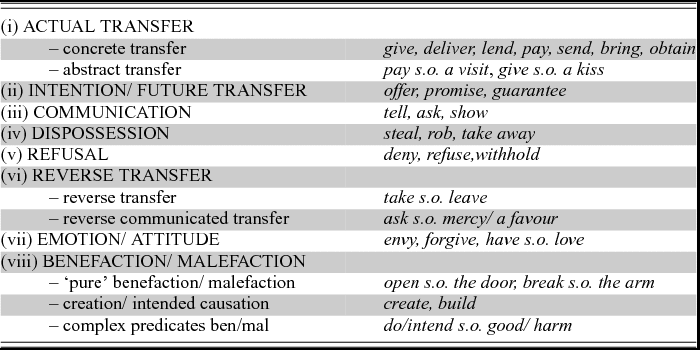
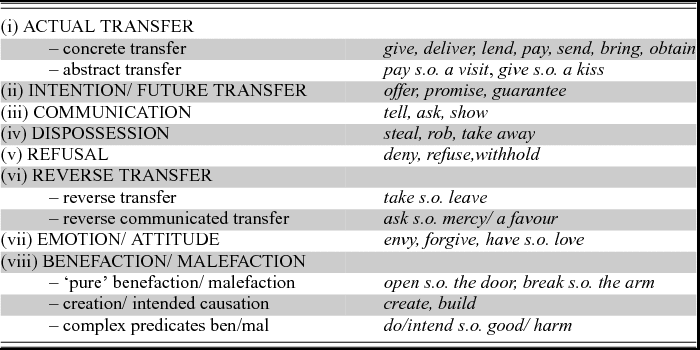
In a last step, the tokens in the ditransitives database were annotated with regard to type of construction (DOC vs POC) – and, in the case of the latter, type of preposition – as well as semantic verb class. Table 1 presents the eight main verb classes distinguished in the classification scheme, together with selected example verbs (see Barðdal Reference Barðdal2007; Barðdal, Kristoffersen & Sveen Reference Barðdal, Kristoffersen and Sveen2011: 65; Colleman Reference Colleman2011: 404; Colleman & De Clerck Reference Colleman and De Clerck2011: 191–7).
Classification scheme for verb classes (with sample verbs)
The statistical analysis of the data was carried out by means of R (R Development Core Team 2014). For pairwise comparisons of proportions (typically those of two subperiods), 2-by-2 chi-square tests of independence were calculated. As a measure of effect size, Cohen's ϕ-coefficient was determined for each test, assuming the conventional classification of 0.1 = small effect size, 0.3 = medium effect size, 0.5 = large effect size. A problematic issue concerning this method is that it does not indicate directionality of change (but only whether the change is significant). Unfortunately, however, the very low number of data points (= 4) obtained in the study impeded the use of other measures such as Kendall's tau (see e.g. Gries Reference Gries, Sánchez Pérez and Sánchez2010: 279–80). The direction of change can in most cases easily be established on the basis of the visual representations (and by checking the figures), though. For comparisons of two (or more) values within one subperiod, chi-square goodness-of-fit tests were performed; in these cases, the measure of effect size used was Cramer's V. Finally, a Bonferroni correction of the resulting p-values was carried out in order to dispel any concerns relating to the problem of multiple comparisons beforehand (e.g. Aaron et al. Reference Aaron, Aron and Coups2009: 336).
In the next section, the main results of the analysis will be presented, starting with findings on the rise of the prepositional competitors in general, and the to-POC in particular. Afterwards, the behaviour of individual verb classes will be dealt with; this will also enable us to draw conclusions about the semantic development of the DOC.
4 Results
4.1 Results on the development of the DOC in relation to its prepositional paraphrases
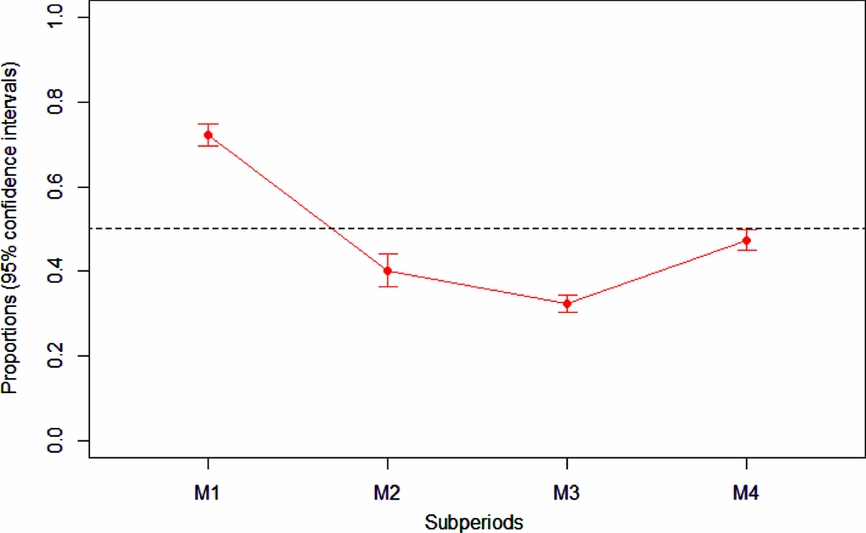
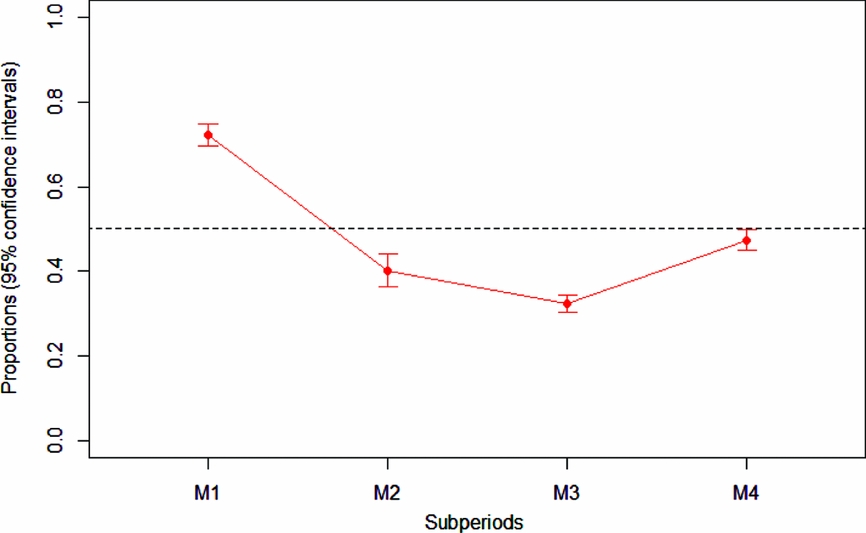
Comparing the respective fractions of DOCs and POCs in the total of ditransitive tokens in the four subperiods of the PPCME2 (figure 1), we see that there is a significant decrease in the proportional frequency of DOCs from the first to the second period (M1-M2). However, although a decrease is also confirmed for the overall period (M1-M4), the development appears to level off after this initial point of change – in spite of the still significant difference between the proportional frequencies in M2 and M3, the effect size is considerably smaller at approximately 0.1 – and the trend even reverses towards the end of the period.Footnote 5 While the difference in fractions taken up by DOCs and POCs, respectively, is significant in the earlier periods, this is not the case in M4, where the two patterns occur in a roughly equal distribution.Footnote 6
Proportional distribution of verbs in DOC (vs POC)
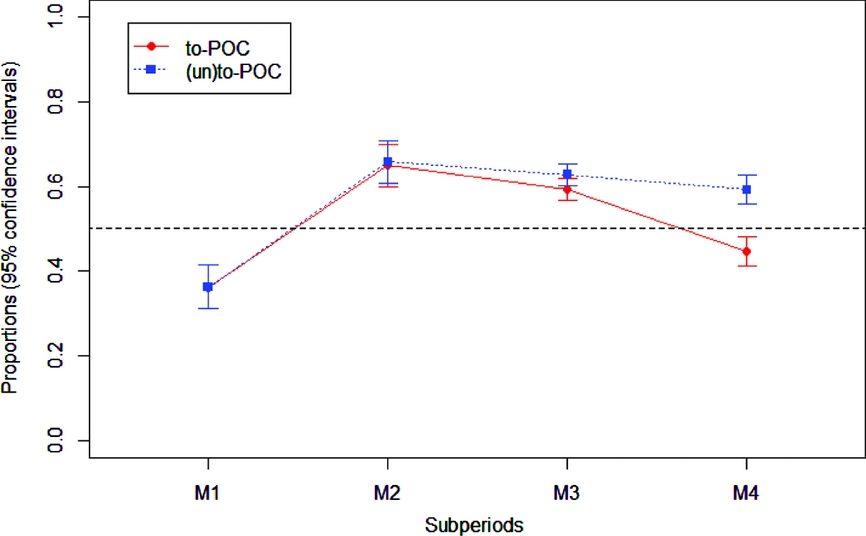
Taking a closer look at the specific role of to among the prepositional competitors, the data indicate that a large percentage of all POC tokens features to already at the beginning of the period, and to-POCs also increase in relative frequency over time (figure 2). Interestingly enough, while there is a rapid initial growth in to-patterns as compared to POCs including all other prepositions, the proportions drop again in the later subperiods. Nevertheless, the overall change during the period is significant, and to-POCs still make up a considerably large part of POCs in M4 (approx. 45 per cent).Footnote 7 It is furthermore worth noting that from M3 onwards, the preposition combinations un-to and on-to came into existence (see e.g. Mustanoja Reference Mustanoja1960: 415). These can be assumed to correspond closely to to since they appear in the same texts as well as contexts, and with the same verbs as the simple preposition (10a–b).
-
(10)
-
(a) he ʒaf þe londe TH to þe Saxones REC
‘he gave the land to the Saxons’
(CMBRUT3,95.2879)
-
(b) when he hade conquerede Engeland, & it TH ʒaf vnto Saxonus REC
‘when he had conquered England, and gave it to the Saxons’
(CMBRUT3,111.3350)
-
Proportional distribution of (un)to in total of POCs
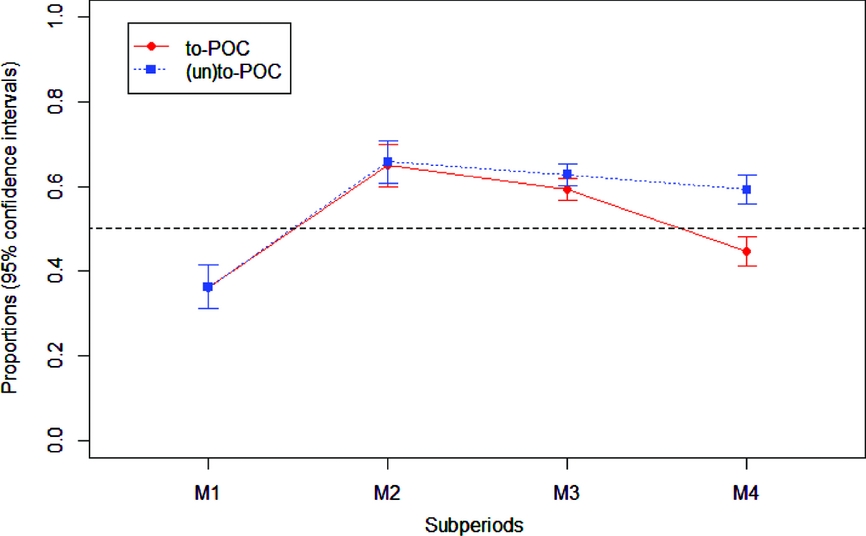
Taking these complex prepositions into account, there is then an even more marked significant increase of (un)to-POCs in the total of POCs during the course of the period.Footnote 8
As will be pointed out below, (un)to-POCs also seem to have had a predilection for certain verb classes, most noticeably those expressing transfer(-related) events. That is, transfer verbs are more frequently paraphrased by an (un)to-POC than by other POCs in all subperiods, and the majority of (un)to-POCS is used with this verb class, with both trends increasing over time.Footnote 9 The association between the two patterns of ‘transfer’-DOCs and to-POCs was therefore presumably relatively strong in early Middle English already, and became even stronger towards the end.
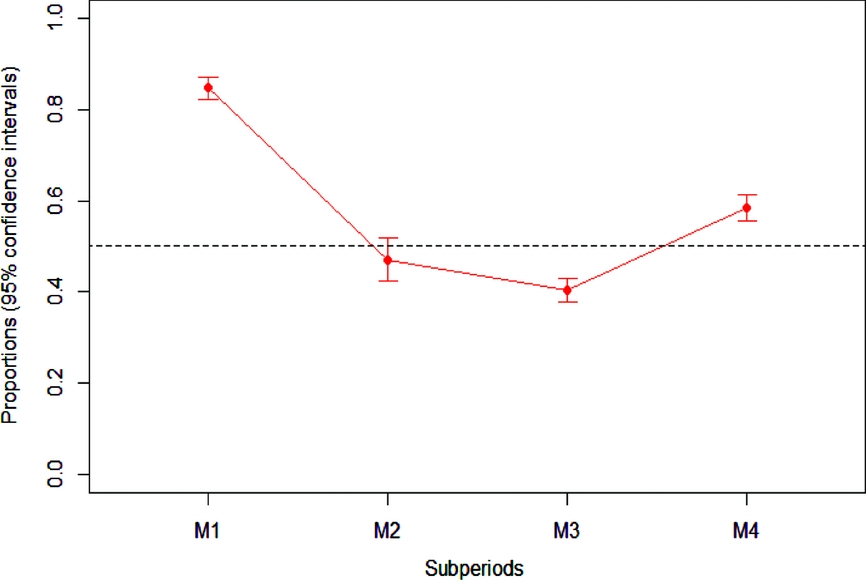
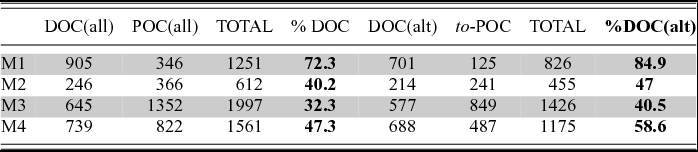
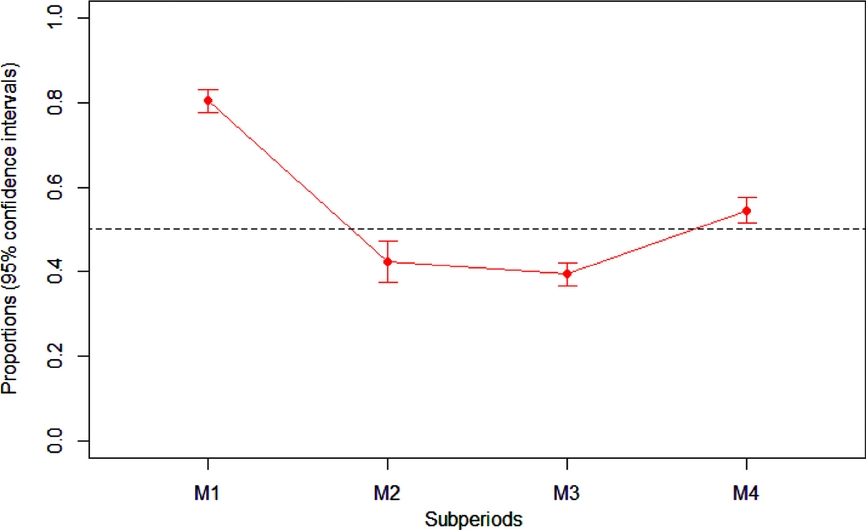
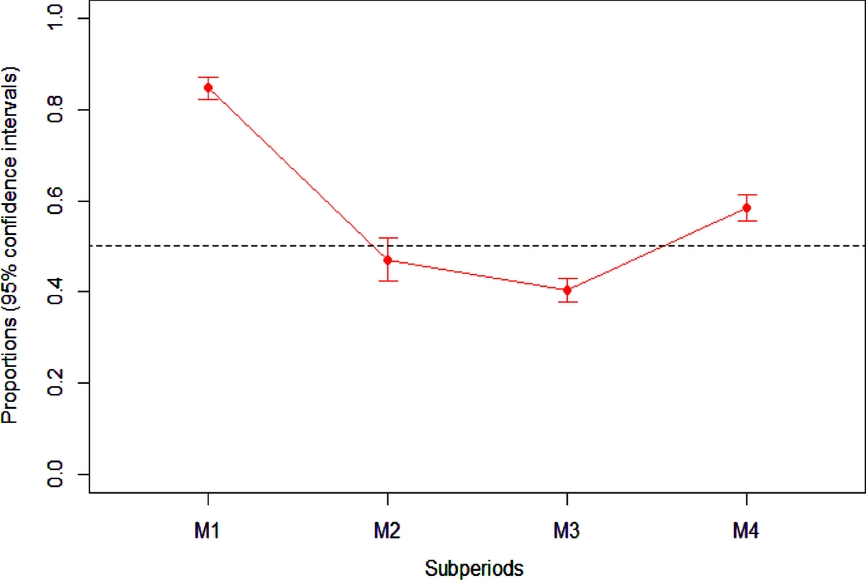
Focusing on (un)to-POCs in relation to those DOCs that alternate with this particular type (labelled ‘DOC(alt)’ here), figure 3 shows that the difference in the distribution of the competing patterns in this case is much larger in early Middle English (M1), with over 80 per cent of tokens found in the DOC(alt). Also, the drop in frequency of the DOC(alt) between M1-M2 is sharper. Most importantly, however, in contrast to the overall development of DOC and POC, which arrive at a 50/50 distribution in M4, the initial decrease of the DOC(alt) is followed by a renewed and greater increase of this pattern towards the end of the period, until the construction in fact comes to supersede its prepositional paraphrase again. In M4, the DOC(alt) accounts for almost 60 per cent of all ditransitive instances; this means that the U-turn trend seen with the DOC is even more pronounced in the case of DOC(alt).Footnote 10 A comparison of both sets of patterns and their relative distribution in the respective subperiods is provided in table 2.
Proportional frequency distribution of verbs in DOC (vs to-POC); only alternating verbs included
Raw/proportional figures for the distribution of DOC/POC and DOC(alt)/to-POC

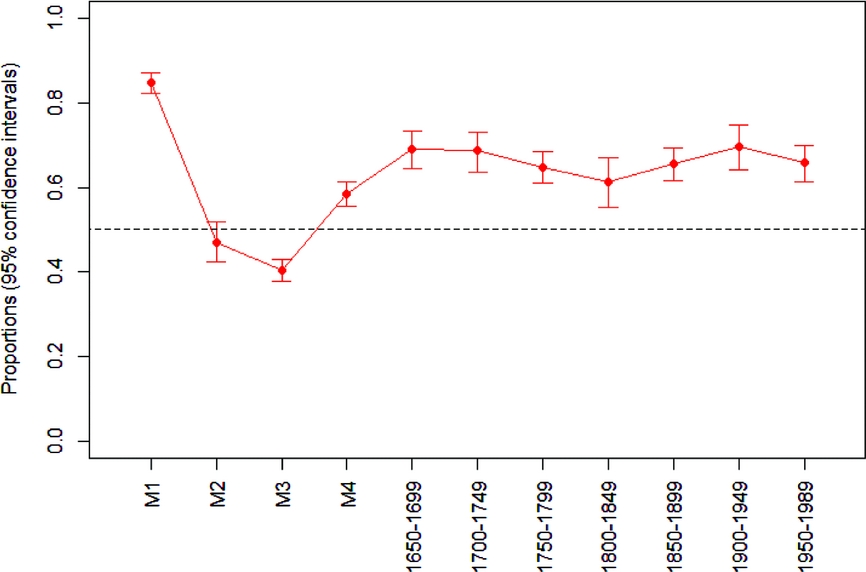
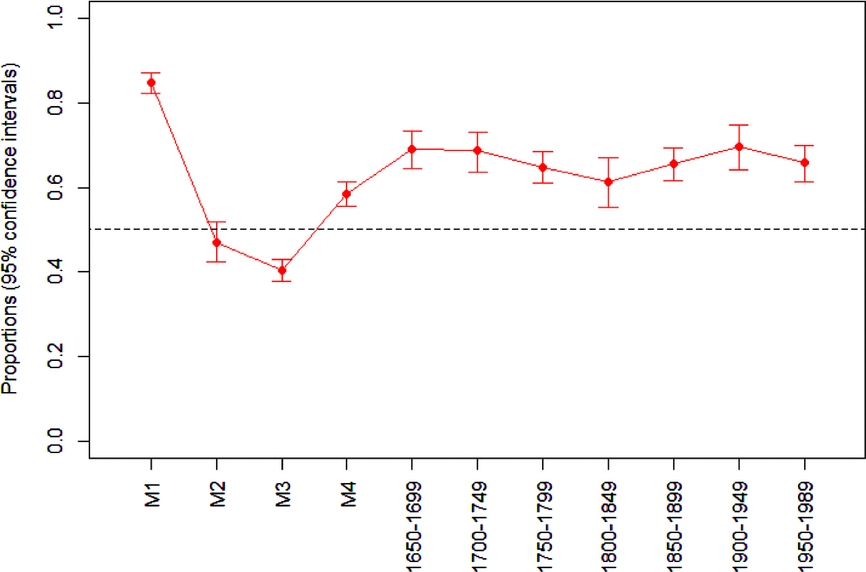
The clear reversing trend visible towards the end of the period in the alternation between DOC and (un)to-POC is surprising, even though we know from PDE evidence that rather than being completely ousted, the DOC survived alongside its paraphrase. The development is especially interesting because data on the alternation from Early and Modern English (drawn from Wolk et al.’s Reference Wolk, Bresnan, Rosenbach and Szmrecsanyi2013 investigation of ARCHER= A Representative Corpus of Historical English Registers, covering the time span from 1650 to 1989) show that there was little actual change after Middle English with regard to the proportional distribution of the constructions. More precisely, we again see a significant yet not very strong increase between M4 (1420–1500) and the period of 1650–99; from the early eighteenth century onwards, however, no significant changes take place (figure 4).Footnote 11 Middle English therefore appears to play a crucial role in the establishment of the paradigmatic relation that is the dative alternation, in which the DOC assumes the role of the stronger variant (taking up about 65–70 per cent of tokens), and the to-POC covers around 30–35 per cent as the weak variant.
Proportional frequency distribution of verbs in DOC (vs to-POC) from 1150 to 1989 (Early and Late Modern English data from Wolk et al. Reference Wolk, Bresnan, Rosenbach and Szmrecsanyi2013 = ARCHER)
In sum, the results presented in this section suggest that prepositional patterns rose substantially at the expense of the previously dominant DOC from early Middle English onwards, but later retracted. Among the POCs, (un)to played a central role already at the beginning, but became even more central over time and thereby established itself as the prepositional alternative to the DOC. Since the relative frequencies did not change much after this period, I argue that Middle English (or Middle English/early Early Modern English) can safely be assumed as the point of ‘birth’ of the dative alternation proper.
4.2 Results on the development of individual verb classes
Changing the focus to the types of verb classes associated with the construction and their development with respect to the choice between DOC and POC, I will in the following briefly discuss the classes, or rather, the three groups they can essentially be divided into, in turn. Observed frequencies for the individual verb classes (in both constructions) can be found in the appendix.
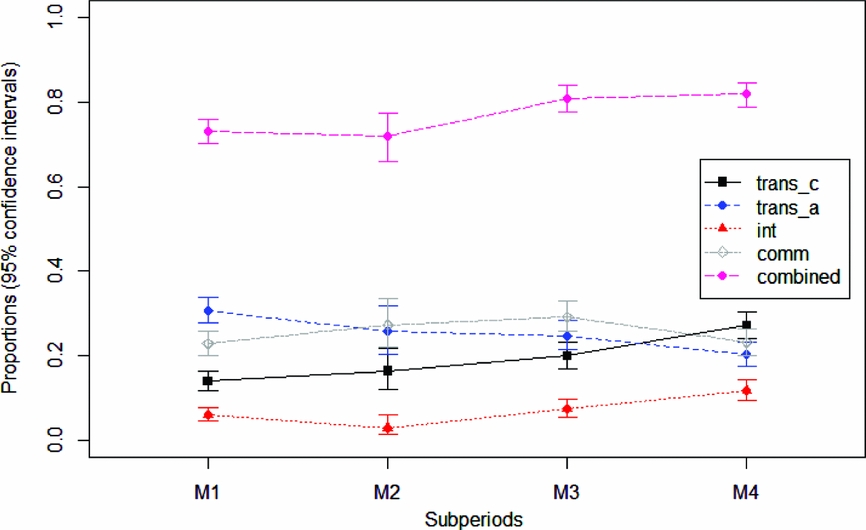
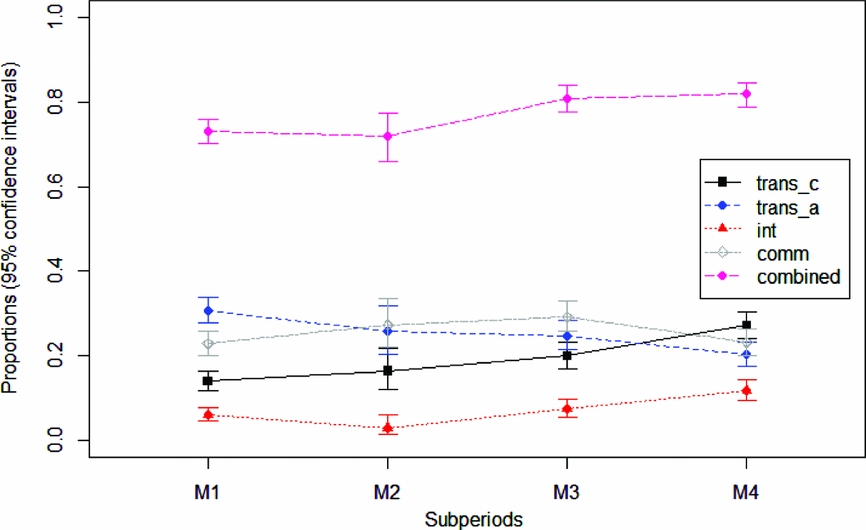
First, it is evident that transfer-related classes, that is, actual (concrete and abstract) transfer, intended transfer, and communicated transfer (classes i–iii), are highly predominant in early Middle English already, taking up more than 70 per cent of all DOC tokens in M1 (figure 5). Over the course of the period, this percentage increases significantly, which suggests that transfer-related senses are foregrounded in the semantic range of the DOC.Footnote 12 This rise is mainly caused by verbs of concrete transfer and intended/future transfer, the former of which almost double in proportional frequency between M1 and M4 (from 14 to over 27 per cent of all DOCs). Verbs of abstract transfer, by contrast, decrease over time, while communication verbs show no significant change. Although this might seem strange at first glance, it is taken to in fact support the assumption of a move towards more basic giving-semantics, since the sense of concrete, physical transfer is strengthened at the expense of verbs and verb constructions denoting abstract events (such as to pay s.o. a visit), where the notion of transfer is comparatively opaque.
Proportional distribution of transfer-related verbs in total of DOCs
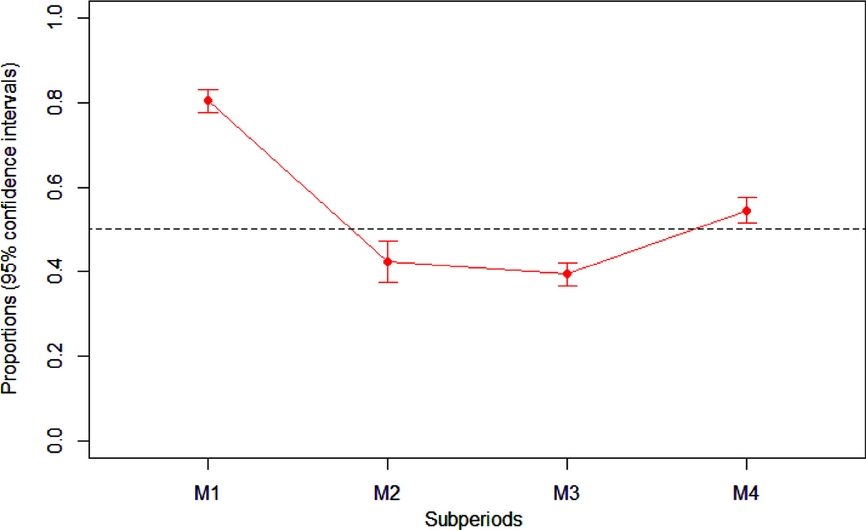
As to the behaviour of transfer-related verbs in respect to prepositional patterns, the results closely mirror those of the DOC and DOC(alt) above – while there is a clear initial drop in proportional frequency, a U-turn development can again be observed, with the DOC gaining in strength towards the end of the period (figure 6).Footnote 13 As already mentioned, the most frequent of the POC types involved in this case is (un)to; these POCs rise over time, indicating that by M4, the association between transfer verbs and (un)to has become very strong, and the DOC and (un)to-POC have entered into a balanced equilibrium with this class.
Proportional distribution of transfer-related verbs in DOC (vs POC)
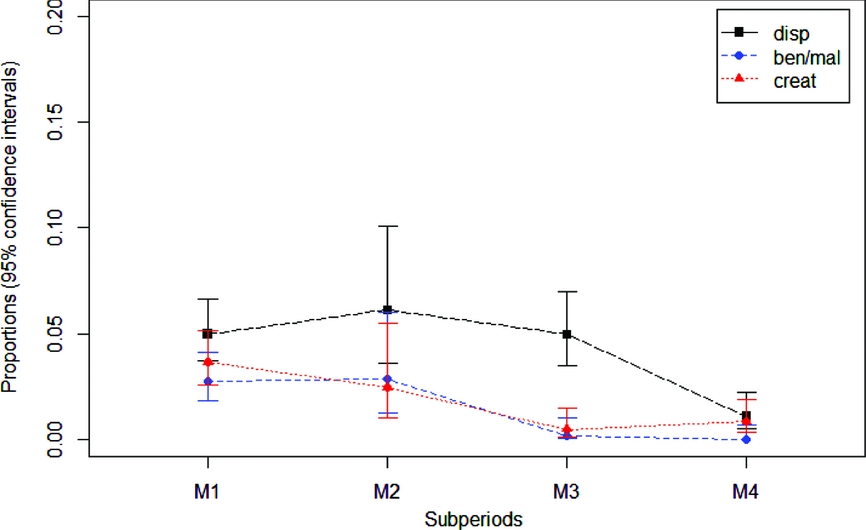
The second main group includes verbs of dispossession, as well as verbs of pure benefaction and malefaction (exclusive of light verb combinations such as do s.o. harm), and verbs of creation (classes iv and viii). As seen in figure 7, these classes show a diametrically opposed development to transfer verbs over the course of the period, in that they drop in proportional frequency in the total of DOC instances between M1 and M4. Highly infrequent already in the earliest period – accounting for 5 per cent and less of all DOC tokens in M1 – they move towards zero in the later periods. For example, only eight tokens of dispossession verbs and zero of verbs of pure benefaction and malefaction are found in M4.Footnote 14 That verbs of creation (such as bake or build) should show this development is, from a PDE perspective, of course unexpected, as they are present and also productive in the DOC today. Although this cannot be proven on the basis of my database, it appears that they were reintroduced to the construction at a later point.
Proportional distribution of dispossession verbs in total of DOCs
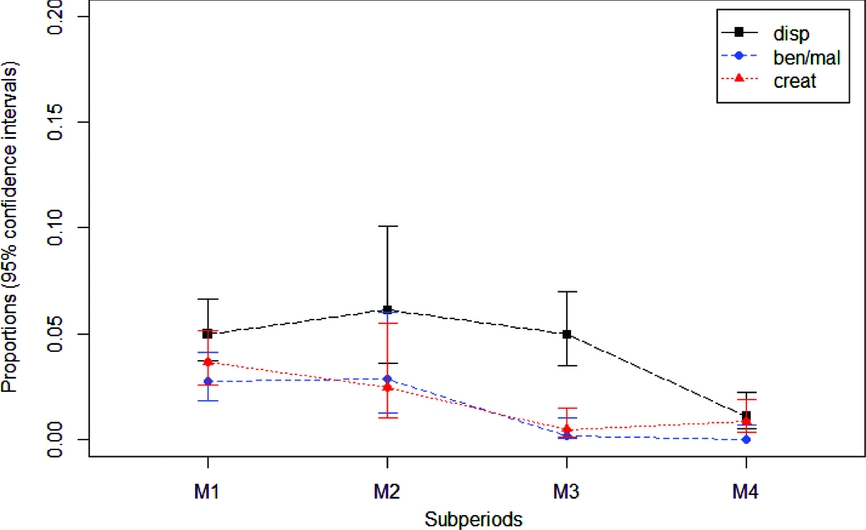
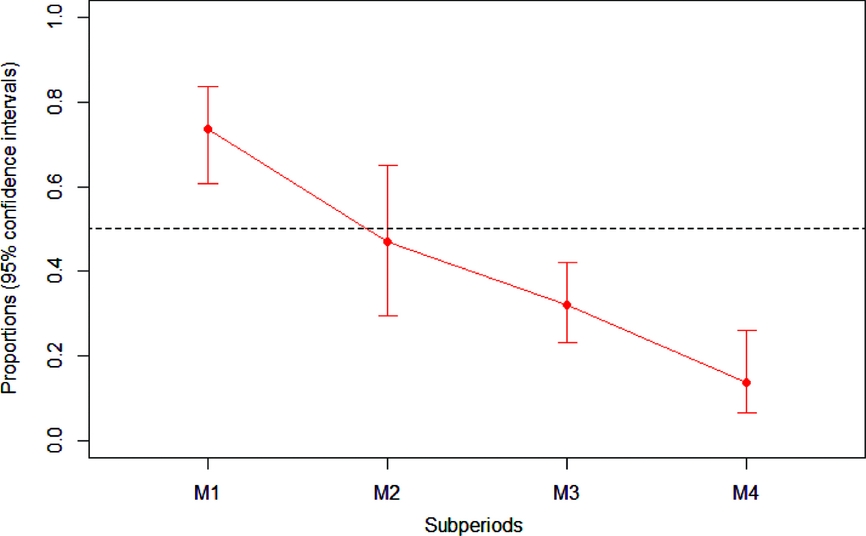
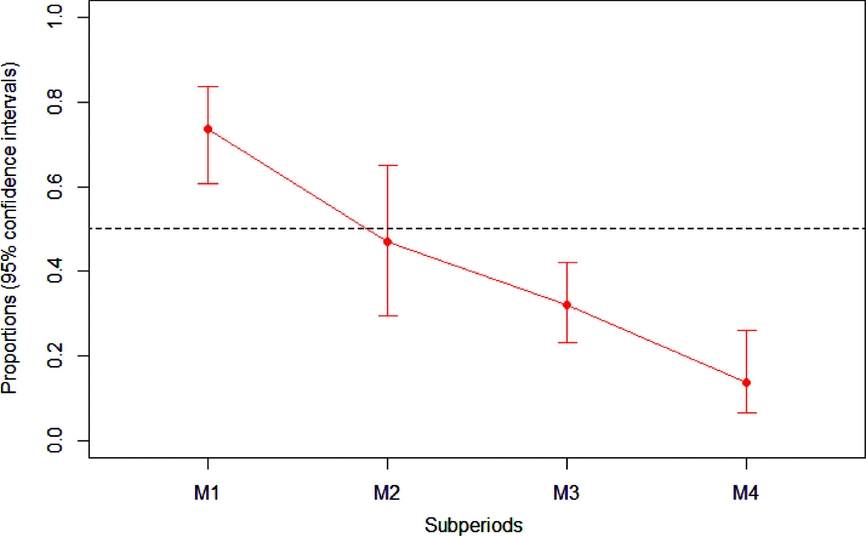
Compensating for their dropping out of use from the DOC, verbs of dispossession are increasingly frequently found in POCs (typically including from or of). While more than 70 per cent of dispossession verbs occur in the DOC in M1, this number falls to about 10 per cent in M4 (see figure 8, indicating that there is a significant decrease in the proportional frequency of DOCs and a corresponding significant increase of POCs between M1-M4; p ≈ 0.001; ϕ ≈ 0.6).
Proportional distribution of DOC (vs POC) in dispossession verbs
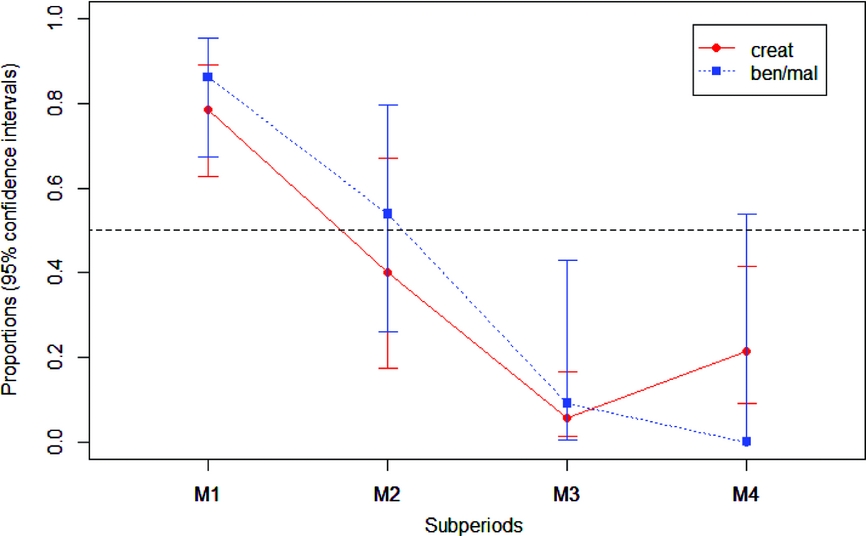
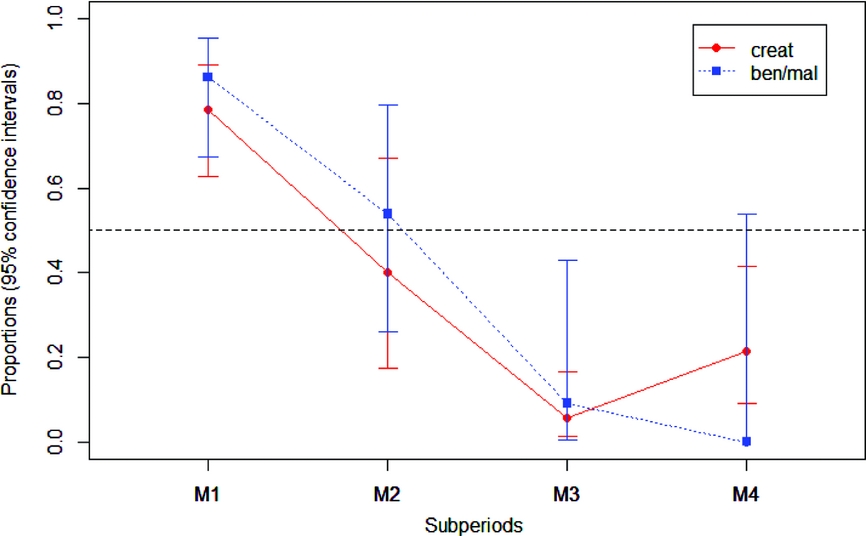
A similar process is seen with the other two verb classes in question, which see a proportional increase in prepositional patterns in relation to DOC uses (figure 9). Note, however, that the numbers in these cases are very low; furthermore, we know from PDE that malefactive verbs resorted to constructions other than POCs (e.g. John broke Mary's shoulder), which means the results presented here are not entirely representative of the class's development.Footnote 15
Proportional distribution of DOC (vs POC) in benefactive/malefactive and creation verbs
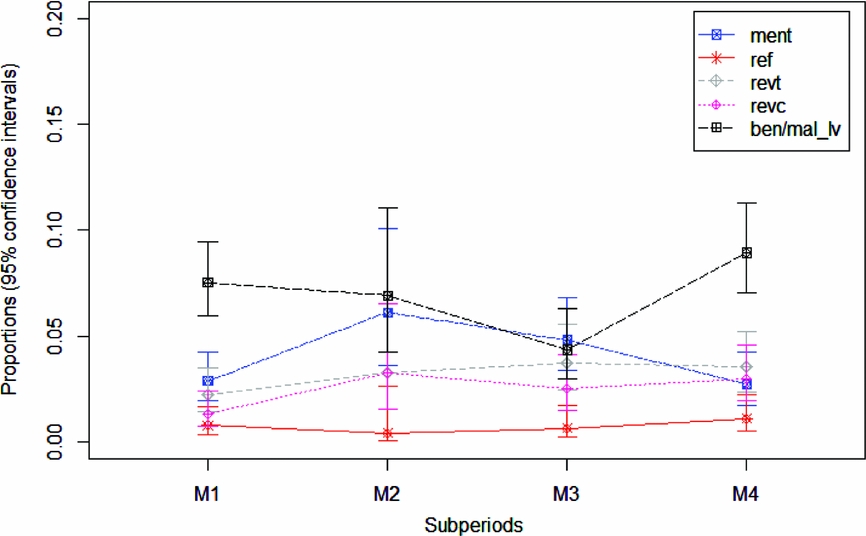
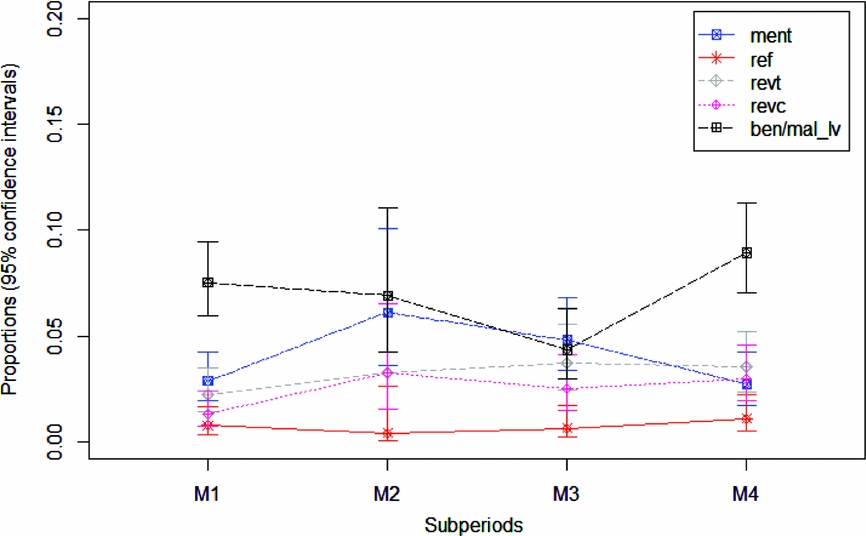
Finally, there is a third, rather inhomogeneous, group, a more detailed discussion of which will unfortunately be outside the scope of this article. As indicated in figure 10, the verb classes in this group are characterised by the fact that they are in general relatively infrequent, and that their fraction within the total of DOCs does not really change over the course of the period. Incidentally, many of the verbs concerned are still present in the PDE DOC, but constitute somewhat idiosyncratic uses that are comparatively peripheral to the core notion of transfer. For instance, this includes verbs of emotion/attitude (e.g. forgive, envy; ment), verbs of refusal (e.g. deny; ref), as well as complex predicates such as do/intend s.o. harm/do s.o. a favour (ben/mal_lv) and verbs of reverse communicated transfer such as ask s.o. a favour/the time (revc). These verbs are furthermore special in that they do not enter the dative alternation in PDE, either being largely restricted to the DOC or opting for a different prepositional pattern (e.g. ask a favour of s.o.). Other verbs and verb classes comprised by this group are, for example, verbs of reverse transfer (revt) and a subgroup of verbs of emotion/attitude (ment), namely complex predicates of the type have s.o. love/envy – these uses are almost exclusively associated with POCs in Old English, and although they briefly turn up in DOCs in Middle English, they presumably dropped out of use in this construction again shortly after Middle English (see also Brinton & Akimoto Reference Brinton and Akimoto1999).
Proportional distribution of DOC (vs POC) in remaining verb classes
To sum up, what has been shown in this section is that the DOC indeed moved towards more basic transfer semantics within Middle English. Verb classes not encoding transfer events, such as verbs of dispossession or pure benefaction/malefaction, were accordingly lost from the construction. While with the former set of verb classes the DOC came to form a ‘shared workload’ relationship with its prepositional paraphrases, most importantly and most strongly with the to-POC, in the case of the latter classes the POC (and other constructions) eventually took over entirely. These processes are taken to have continued beyond Middle English, and to still be in progress today, with uses further removed from the core meaning being marginalised, and resorting to other means of expression (see e.g. Goldberg Reference Goldberg1995 on forgive and envy). The two main changes of interest to this article, namely the emergence of the dative alternation and the semantic narrowing of the DOC, have therefore been shown to overlap in time. The following section will now discuss to what extent the phenomena might also be causally connected.
5 Discussion
5.1 A proposed scenario
On the basis of the results presented in the preceding section, I argue that the spread of the to-POC as the prototypical alternative to DOCs indeed constituted a key factor in the increasingly close association of the DOC with transfer relations, and vice versa. The precise scenario proposed is as follows.
In Old English, different case frames are available for ditransitive verbs. Already at this stage, the most common of these case frames is [DAT-ACC], i.e. a combination of a dative object denoting the recipient and a theme marked with accusative case (Visser Reference Visser1963: 606–46; De Cuypere Reference De Cuypere2015a: 230–3). This pattern most frequently and as a consequence most prototypically expresses transfer situations, which are instantiated by ‘giving’ verbs. However, the case-constructions are not bi-uniquely linked to specific verb classes; instead, they overlap in their semantic scope to a large extent, and are therefore prone to merging (see Croft Reference Croft2000: 121–4; Barðdal Reference Barðdal, Barðdal and Chelliah2009; Torrent Reference Torrent2015).
At the same time, a number of prepositional paraphrases can already be found in Old English; importantly, however, these are restricted to particular verb classes. That is, links to POCs are only present on a relatively low level, and are formed on a one-(verb class)-to-one (POC type) basis. In the case of the to-POC, this means that the preposition has extended its scope to cover events of communication involving a more abstract addressee–participant role rather than a spatial goal, but no expansion to (concrete and abstract) recipients has taken place yet (see Mustanoja Reference Mustanoja1960; Fischer Reference Fischer and Blake1992; Allen Reference Allen1995; McFadden Reference McFadden and Lightfoot2002; De Cuypere Reference De Cuypere2010, Reference De Cuypere2015b).
Possibly aided by phonetic reduction processes, and triggered by the semantic overlap between the OE case frames, at the transition to early Middle English the case constructions coalesce into one underspecified, general ditransitive pattern. In early Middle English we are therefore left with one single, comparatively schematic double object super-constructional type of the form [V NP NP]. The order of the arguments is not yet fixed at this point, and the different patterns may represent surface epiphenomena of a generally freer word order rather than different micro-constructions. Corresponding to the underspecification of the structural side of the pairing, the meaning/function of the construction (and its components) is relatively schematic as well, with the early Middle English DOC encoding a wide range of meaning relations loosely connected to the concept of ‘indirect affectedness’. Even if subtle semantic distinctions between the case frames were present before, these are now blurred.
Concomitant to this change, developments in the prepositional paraphrase take place, with those POCs that were already available in OE expanding into new contexts. Furthermore, new POCs form by analogy with the earlier ones, and the frequency of POCs in general increases at the expense of DOC uses; the greater success of the POCs probably results from their greater explicitness over the early Middle English ‘bare NP’ double object construction.
The most prominent and most frequent of the Middle English POCs is the pattern involving to, due to its originally spatial/allative meaning corresponding most adequately to the ‘transfer’ semantics of a large majority of ditransitive verbs, i.e. of the verbs most frequently used in the DOC. The success of the to-POC is furthermore aided by the fact that the preposition is relatively advanced in its semantic widening in Old English, and is therefore more flexible than other POCs involving goal prepositions such as towards or till. Also, its shortness and thus greater economy in relation to these other preposition types might have played a role.
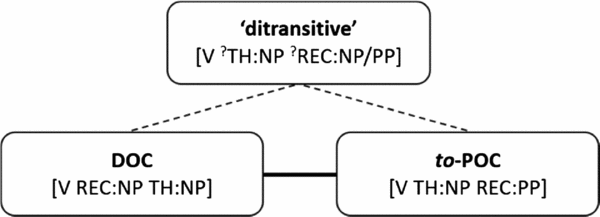
In the course of Middle English, an increasingly stronger link between the to-POC and the schematic (non-verb-class specific) DOC develops due to the former's prevalence and high frequency – the patterns thus enter into a closer and closer associative relationship, until [V NP to-NP] is perceived as the analytic alternative to the DOC, meaning that the two constructions are interpreted as two ways of expressing approximately the same meaning. A preferential association between two linked patterns thereby develops into a near-categorical association. This progressively stronger (horizontal, or paradigmatic) link between the constructions – observable in the data presented above – is arguably followed by the emergence of a new, highly schematic alternation-based generalisation over the constructions, which, although different in form, encode very similar categories of events. In line with Perek (Reference Perek2015) and Cappelle (Reference Cappelle and Schönefeld2006), this ditransitive ‘constructeme’ consists of a form [V ?TH:NP ?REC:NP/PP], meaning that neither the linear order of the arguments, nor the precise phrase type of the recipient argument is specified. The process of a horizontal link between the two patterns leading to the establishment of a higher-order abstraction spelling out only the commonalities of the allostructions is illustrated in figure 11 (see also Van de Velde Reference Van de Velde, Boogaart, Colleman and Rutten2014 on the issue of horizontal links, and Torrent Reference Torrent2015 on the emergence of new links in constructional networks).
Emerging constructional network of the ‘dative alternation’ (based on Perek Reference Perek2015/Van de Velde Reference Van de Velde, Boogaart, Colleman and Rutten2014)

A consequence of the closer link between the ‘allostructions’ DOC and to-POC and the development of a more schematic generalisation is that the individual constructions come to fully specify their syntactic structure, and furthermore get associated with particular discourse-pragmatic features and richer semantic detail in the course of Middle English. More precisely, I argue that with the establishment of a close relationship between the constructions, their lower-level subpatterns, i.e. [V REC:NP TH:NP] and [V TH:NP REC:NP] of the DOC, and [V REC:PP TH:NP] and [V TH:NP REC:PP] of the to-POC, enter into competition with each other. Due to the fact that the prepositional patterns show a predilection for PP-clause late position in Old English already (see De Cuypere Reference De Cuypere2015b), it is the last of these [V TH:NP REC:PP] that ultimately sticks, in turn driving the DOC to settle on a canonical [REC-TH] order (at least in Standard PDE). This development goes hand in hand with the constructions diverging functionally and developing complementary, ‘cooperative’ discourse-pragmatic features (see De Cuypere Reference De Cuypere2015a: 227 for an overview of the various factors found to play a role in the alternation).
The constructeme approach to alternations as advocated by Cappelle (Reference Cappelle and Schönefeld2006) and Perek (Reference Perek2015) differs from other constructionist accounts such as Goldberg (Reference Goldberg1995, Reference Goldberg2006) in that the cross-alternant generalisation (and thus the alternation as such) has an independent theoretical status in this case, being mentally represented in addition to the variants and the (synonymy) link between them (see Perek Reference Perek2015: chs.6-7). Evidence for this assumption comes from sorting tasks as well as priming experiments, which indicate that the allostructions prime each other (Goldwater et al. 2011). Furthermore, the phenomenon of alternation-based productivity has been shown to hold for the dative alternation, meaning that verbs found in one of the members of the alternation are often coerced into occurring in the other variant as well (Perek Reference Perek2015). For example, PDE provide is, while previously only found in to- or for-POCs, now at least acceptable (if not highly frequently used) in the DOC in American English. On the other side, certain verb classes that do not clearly match the semantics encoded by to, such as verbs of refusal, do occur in the to-POC (see Quirk et al. Reference Quirk, Greenbaum, Leech and Svartvik1985: 1210; Mukherjee Reference Mukherjee2001: 299, Reference Mukherjee2005: 13; Colleman & De Clerck Reference Colleman and De Clerck2011; De Clerck, Delorge & Simon-Vandenbergen Reference De Clerck, Delorge and Simon-Vandenbergen2011). The apparent presence of productivity and priming effects between the alternants is moreover taken to support the argument brought forward here, namely that the constructions, which started out as competitors, have entered into a cooperative relationship, in which they mutually benefit from being associated with each other.
Returning to the history of the patterns, I assume that in the course of Middle English and beyond this stage, ‘the rich get richer, the poor get poorer’: concomitant with the closer association between DOC and to-POC and the emergence of the alternation, verbs with corresponding paraphrases that include prepositions other than to (e.g. from or of), are increasingly marginalised from the DOC and eventually ousted completely. Not compatible anymore with the DOC, whose meaning is increasingly narrowed to encoding ‘transfer’ events, these verbs (e.g. verbs of dispossession) resort and become restricted to the prepositional patterns. As suggested in Goldberg (Reference Goldberg1995), for instance, this process is by no means completed at the end of the Middle English period, but is still ongoing to this day. For example, verbs of mental activity such as forgive or envy are increasingly falling out of use in the DOC due to their incompatibility with a transfer meaning, and instead often occur with a theme marked by for, as in John forgave Mary for her actions (see Goldberg Reference Goldberg1995: 132; Colleman & De Clerck Reference Colleman and De Clerck2008: 193–8). It is furthermore noticeable that those verb classes that have survived in the DOC despite being more peripheral to the core meaning of transfer are typically unproductive (see verbs of refusal such as deny).
It should be noted at this point that the account put forward here is of course considerably simplified, and the situation is not as straightforward as one would wish. Apart from the fact that verbs such as cost, deny and refuse are still used in the DOC, and the development of the verb classes of the third group presented above in general being somewhat problematic, the benefactive alternation has been pretty much ignored entirely in this article. The main reason for this is that this second alternation (involving verbs of creation such as build or buy) is strikingly absent from ME, which is unexpected given the PDE situation. While all these issues can be accounted for in various ways, this is unfortunately outside the scope of the present study.
5.2 Correlation, causality and co-evolution
The scenario just proposed can now be assessed in two ways concerning the main question of this article, namely whether there is a causal relationship between the two phenomena, i.e. the establishment of the dative alternation and the semantic narrowing of the DOC. On the one hand, the data support, or are at least compatible with, the assumption of a causal effect of one change on the other, although temporal correlation of course does not yet necessitate causation (cf. the well-known ‘cum/post hoc ergo propter hoc fallacy’). On the other hand, however, it is difficult to glean in which direction this causal impact should have gone on the basis of the results presented. Furthermore, it can be argued that a clear progression from one discrete change to the next is not very realistic. Instead, what I propose is that a series of micro-steps took place in both constructions, which could eventually accumulate into larger changes (see also e.g. Bybee Reference Bybee2010; Hilpert Reference Hilpert2013; Traugott & Trousdale Reference Traugott and Trousdale2013).
The development of ditransitives in the history of English would consequently represent a story of co-evolution of grammatical structures, in which the two constructions, DOC and (to-)POC, developed a mutually adaptive relationship characterised by small, gradual changes to both sides, with a change to one construction triggering a response in the other (see Dercole & Rinaldi Reference Dercole and Rinaldi2008: 13). What this means precisely for our case is that the increasing semantic widening of the to-POC and the following emergence and strengthening of a link between it and the DOC correlates with the semantic narrowing of the latter: the establishment of the alternation on the one hand has a direct effect on the DOC, whose meaning is narrowed to transfer-related senses, i.e. senses that are compatible with the relations expressed by to. Verbs not expressing such senses, and thus not licensed to enter into the alternation, are increasingly prevented from being used in the DOC. At the same time, that the alternation should come into being in the first place is made possible by the fact that transfer senses were very prominent and possibly even on the increase within the DOC in Old English already. A more conclusive account would therefore have to include earlier data and attempt to identify the step-wise adaptations on both sides; nevertheless, determining which process came first, and which construction ‘took the first step’ on the basis of the available data might be difficult if not impossible.
6 Conclusion
The main aim of this article has been to assess the plausibility of a causal relationship between two major changes in the history of English ditransitives, namely between the rise of the to-POC and the semantic narrowing observed with the DOC. As has been shown, the results of the corpus study of Middle English data confirm that there is a strong correlation between these changes, and are compatible with postulating either a causal impact of one process on the other, or a co-evolutionary scenario, in which the constructions involved gradually adapted to each other.
To sum up, I have assumed that with the erosion of the case marking system, the Old English case frames available for ditransitive verbs converged into the DOC proper, while at the same time, prepositional competitors (which were to some extent present before) increased in frequency and extended to new contexts. Among the competing patterns, to-POCs fared best (due to their corresponding most adequately to the transfer semantics of the verbs that were highly frequent among the DOCs), which resulted in an increasingly stronger horizontal association between the DOC and these to-patterns, and culminated in the establishment of a higher-level ‘ditransitive constructeme’, i.e. a generalisation over the formally distinct patterns. At the same time as these processes took place, the DOC's meaning narrowed and it specialised to verbs of basic possessional transfer situations. Uses at the periphery of the (new) core meaning, which is to say, uses that did not correspond to the semantic relations expressed by to, were accordingly ousted from the construction, and became restricted to alternative options.
As a more general conclusion, I hope to have shown that when discussing ditransitives in the history of English it is highly important to take into consideration competitors involving prepositions other than to in order to arrive at a more conclusive picture of the forms’ development. This concerns not only unto or onto in the later subperiods of the PPCME2, but also, for example, of and from as in the case of dispossession verbs. The role of these other prepositional paraphrases for PDE DOCs, although taken to be less pertinent than the one of to (and for), is not to be undervalued.
Appendix
Observed frequencies of individual verb classes in DOC/POC