Introduction
Recent estimates suggest that depression will become the second leading medical cause of disability in the world by 2020 (WHO, 2001), and that the prevalence rate is rising among young people (Collishaw et al. Reference Collishaw, Maughan, Goodman and Pickles2004). There is also evidence highlighting increasing rates of antisocial behavior problems among children and adolescents internationally (Ford, Reference Ford2008). An important factor linked to explaining rising rates of psychopathology across all ages is that of intergenerational transmission, such that elevated symptom problems among parents serve as a predisposition for elevated symptom problems among offspring. Children of depressed parents are at elevated risk for depression (Tully et al. Reference Tully, Iacono and McGue2008), whereas children of parents who evidence high rates of antisocial behavior are at risk for concomitant behavioral problems (Van Goozen et al. Reference Van Goozen, Fairchild, Snoek and Harold2007). Examining the relative role of genetic and family environmental factors in explaining the intergenerational transmission of psychopathology has served as a focus of past research (D'Onofrio & Singh, unpublished observations; Silberg et al. Reference Silberg, Maes and Eaves2010).
Although recent advances in the area of molecular genetics, specifically in identifying susceptibility genes for complex traits and disorders, have helped to elucidate how specific family environmental factors interact with genetic factors to explain variation in offspring depression (Gibb et al. Reference Gibb, Uhrlass, Grassia, Benas and McGeary2009) and antisocial behavior (Caspi et al. Reference Caspi, Langley, Craig, Milne, Moffitt, O'Donovan, Owen, Polo Tomas, Poulton, Rutter, Taylor, Williams and Thapar2008), disentangling the relative role of genetic and environmental influences on the intergenerational transmission of depression and antisocial behavior has historically been examined using extended twin and adoption research designs. Findings from such studies suggest that inherited factors, psychosocial adversity, and gene–environment interplay contribute to antisocial behavior and that negative parenting is an important mediator of risk (Plomin, Reference Plomin1990; Collins et al. Reference Collins, Maccoby, Steinberg, Hetherington and Bornstein2000; Rutter, Reference Rutter2006). However, traditional epidemiological studies of family risk on children are hampered by an important methodological confound. That is, in examining the relative role of genetic and environmental factors in offspring mental health, genes may also affect the rearing environment that children experience. This overlap of influence has been defined as gene–environment correlation (r GE). Two primary configurations of r GE have been highlighted, evocative r GE and passive r GE. Evocative r GE suggests that genetically influenced child characteristics may evoke patterned responses such as negativity from a parent (Ge et al. Reference Ge, Conger, Cadoret, Neiderhiser, Yates, Troughton and Stewart1996). Passive r GE suggests that associations between parent and child characteristics may result from common underlying genetic factors that simultaneously influence the trait in both parent and child (Rutter, Reference Rutter2006).
Using research designs that allow the relative role of genetic and environmental factors to be examined, while controlling for the confounding influence of r GE, is therefore imperative if environmental factors that exert ‘causal’ effects on offspring outcomes are to be reliably identified. A range of studies have suggested family risk factors as having important effects on child psychopathology that are not entirely attributable to shared genetic influences. For instance, in an extended twin model, Meyer et al. (Reference Meyer, Rutter, Silberg, Maes, Simonoff, Shillady, Pickles, Hewitt and Eaves2000) reported that family dysfunction was a shared environmental factor involved in the intergenerational transmission of antisocial behavior. Less is known about risk factors and mechanisms that contribute to the intergenerational transmission of depression, although several studies suggest an important contribution of environmental influences. For example, Tully et al. (Reference Tully, Iacono and McGue2008) used an adoption design that allowed a direct test of the extent to which there is an environmental effect (i.e. distinct from genetic influences) of parental major depressive disorder on adolescent depression. Findings suggest that risk for depression among children living with a depressed mother, but not father, was elevated among genetically related (non-adopted) and genetically unrelated (adopted) children, suggesting an environmental mechanism underlying this association. The environmental influences of parental depression have also been found at the symptom level (Leve et al. Reference Leve, Kerr, Shaw, Ge, Neiderhiser, Reid, Scaramella, Conger and Reiss2010). An extended twin study of depressive symptoms suggested both genetic and environmental influences on intergenerational transmission (Rice et al. Reference Rice, Harold and Thapar2005), with a recent children of twins study (Silberg et al. Reference Silberg, Maes and Eaves2010) suggesting evidence of environmental influences on transmission of depression symptoms. Finally, treatment trials of maternal depression (Weissman et al. Reference Weissman, Pilowsky, Wickramaratne, Talati, Wisniewski, Fava, Hughes, Garber, Malloy, King, Cerda, Sood, Alpert, Trivedi and Rush2006; Foster et al. Reference Foster, Webster, Weissman, Pilowsky, Wickramaratne, Talati, Rush, Hughes, Garber, Mally, Cerda, Kornstein, Alpert, Wisniewski, Trivedi, Fava and King2008) also suggest direct environmental effects of maternal depression on children's psychopathology.
We offer a methodology that allows examination of the relative influences of genetic and environmental influences on children's mental health symptoms using a sample of parents and children conceived through assisted reproductive technologies. Assisted reproductive technologies are an increasingly common means of conception (Anderson et al. Reference Anderson, Gianaroli, Felberbaum, de Mouzon and Nygren2006). Children conceived by these methods may be genetically related to both parents [homologous in vitro fertilization (IVF)], the mother only (sperm donation), the father only (egg donation), or neither parent (embryo donation). A further category exists where both parents are genetically related to the child but the intra-uterine environment is provided by a genetically unrelated surrogate (gestational surrogacy). By comparing the association between two theoretically relevant variables between parents and children that are genetically related (mothers: homologous IVF, sperm donation, surrogacy; fathers: homologous IVF, egg donation, surrogacy) and genetically unrelated (mothers: egg and embryo donation; fathers: sperm and embryo donation), it is possible to determine whether the magnitude of any association between parent and child is primarily genetically mediated, environmentally mediated or a combination of the two. For example, where an association is noted between parent symptoms and child symptoms among genetically related parent and child groupings, but not between genetically unrelated parent and child groupings, the association is attributable to genetic mediation. Where the association is present among genetically related and genetically unrelated groupings, the association cannot be entirely genetically mediated. Furthermore, where significant associations are found among genetically unrelated family members (in which passive gene–environment correlation is absent), the primacy of environmental mechanisms underlying any such association is apparent, thereby offering opportunity to target specific environmental factors underlying links between parent and child psychopathology in the context of intervention studies.
The present study
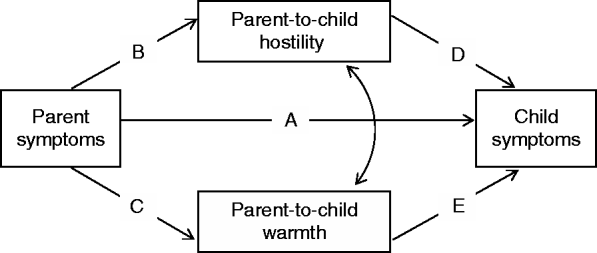
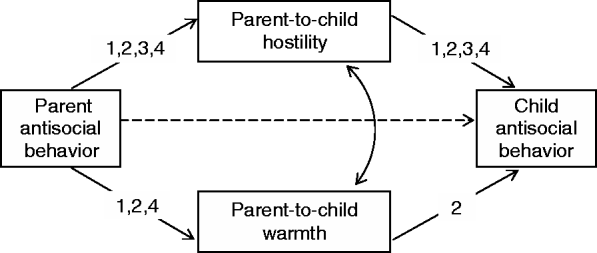
In the present study we examined the role of positive and negative dimensions of parenting (warmth versus hostility) as measured family factors that may underlie links between parent psychopathology and child psychopathology among genetically related and genetically unrelated parent–child pairs (see Fig. 1). Analyses were conducted separately by parent gender to allow examination of the pathways that are both common and unique to mother–child and father–child associations, and to add to the dearth of evidence examining associations between paternal psychopathology, paternal parenting and child psychopathology (Ramchandani & Psychogiou, Reference Ramchandani and Psychogiou2009).
The proposed theoretical model.

Method
Participants
The sample included parents and children who had complete information across the study variables of interest (mother genetically related, n=434; mother genetically unrelated, n=127; father genetically related, n=403; father genetically unrelated, n=156). Parents reported for an approximately even proportion of boys (46.9%) and girls (52.7%) who were aged between 4 and 10 years (mean=6.23 years, s.d.=1.23). Parent age at the birth of the child ranged from 21 to 54 years for mothers (mean=35.21 years, s.d.=4.77) and from 23 to 71 years for fathers (mean= 38.13 years, s.d.=6.22). The number of families in each conception group was: 444 homologous IVF, 210 IVF with sperm donation, 175 IVF with egg donation, 36 IVF with embryo donation, and 23 IVF with gestational surrogacy. Comparisons between the present sample and UK national norms suggest minimal differences in mean levels of behavior (Shelton et al. Reference Shelton, Rice, Harold, Boivin, van den Bree, Hay and Thapar2009). Furthermore, no appreciable differences were noted between the IVF subgroups for parent-rated adjustment problems.
Procedure
Families who had a live birth between 1994 and 2002 (child aged 4–10 years) following successful artificial reproductive treatment from any of the five conception groups were recruited from 18 UK clinics and one US clinic (Thapar et al. Reference Thapar, Harold, Rice, Ge, Boivin, Hay, van den Bree and Lewis2007). We required that gamete donors and surrogates were unrelated to either rearing parent. All data were collected by postal questionnaires, sent to families by each participating clinic. Questionnaires assessed sociodemographic information, pregnancy information (mothers only), parents' physical and psychological health, couple relationship quality, parent–child relationships, children's life events, and children's psychological well-being.
Measures
Parent depressive symptoms
The depression subscale of the Hospital Anxiety and Depression Scales (Zigmond & Snaith, Reference Zigmond and Snaith1983; item scale range=0–3) assessed mothers' and fathers' depressive symptoms. Internal consistency estimates were good (mothers: α=0.85; fathers: α=0.87).
Parent antisocial behavior
Parental antisocial behavior was assessed using the Symptom Checklist-90-R (SCL-90-R) Hostility subscale (Derogatis, Reference Derogatis1994; item scale range=0–4). Internal consistency estimates were good (mothers: α=0.82; fathers: α=0.84).
Parenting behavior
The Warmth and Hostility subscales of the Iowa Youth and Families Project Family Interaction Rating Scales (Melby et al. Reference Melby, Conger, Book, Rueter, Lucy, Repinski, Ahrens, Black, Huck, Mutchler, Rogers, Ross and Stavros1993; item scale range=1–7) assessed parents' positive and negative behaviors expressed towards their child. Internal consistency estimates were good for mothers and fathers respectively (hostility, α=0.81 and 0.83; warmth, α=0.88 and 0.89).
Child depressive symptoms
The short version of the Mood and Feelings Questionnaire (Costello & Angold, Reference Costello and Angold1988; item scale range=0–2) was administered to mothers and fathers to assess children's depressive symptoms. This instrument has been shown to be a useful screening measure for depressive disorder in community populations. Internal consistency was good (mothers: α=0.83; fathers: α=0.85).
Child antisocial behavior
Mothers and fathers reported on children's conduct problems and oppositional disorder using the Strengths and Difficulties Questionnaire (Goodman, Reference Goodman1997; item scale range=0–2). The two scales were summed to create a child antisocial construct (r=0.69 and 0.54 for mothers and fathers respectively). Internal consistency was good (mothers: α=0.67; fathers: α=0.66).
Statistical analyses
Path analysis using structural equation modeling (SEM; Joreskog & Sorbom, Reference Joreskog and Sorbom1996) was used to conduct all primary statistical analysis. All relevant statistical assumptions inherent to the application of SEM (e.g. multivariate normalcy) were examined and affirmed in preliminary analyses. Correlations between primary theoretical constructs were initially examined across genetically related and unrelated mother–child and father–child groupings for each index of psychopathology. Mothers and fathers provided information on their own symptoms of psychopathology and their own parenting behavior, but the other parent provided information on child psychopathology. This approach was used to remedy reliance on a single reporter across each theoretical domain, potentially leading to inflated correlations as a result of self-report bias (Harold & Conger, Reference Harold and Conger1997).
Results
Correlational analysis
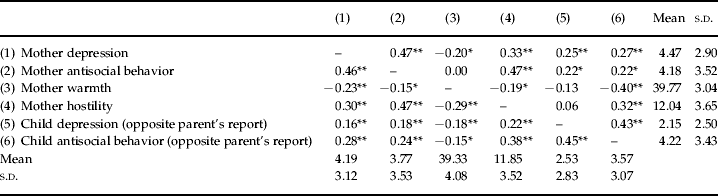
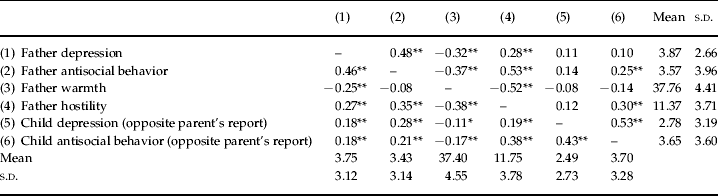
Intercorrelations, means, and standard deviations are presented for genetically related and genetically unrelated mother–child (Table 1) and father–child (Table 2) pairs. Significant associations were apparent between both mothers' and fathers' depression and their antisocial symptoms with child depression and antisocial behavior, respectively, across genetically related and unrelated groups with the exception of the association between father and child depression among genetically unrelated dyads. For genetically related parent–child dyads, indices of parent psychopathology were significantly inversely correlated with parental warmth and significantly positively correlated with parental hostility, which in turn were associated with each index of child psychopathology. Parental hostility was correlated with child antisocial behavior for both mothers and fathers. Maternal but not paternal warmth was inversely correlated with child antisocial behavior across genetically unrelated parent–child groupings. For the unrelated parent–child pairs, significant associations were not apparent between dimensions of parenting and children's depressive symptoms. Comparing the magnitude of correlations across genetically related and unrelated parent–child pairs showed some significant differences. For example, the negative correlation between maternal antisocial behavior and warmth toward child was significantly stronger for genetically related (r=−0.15, p<0.05) compared to genetically unrelated (r=0.00) mother–child pairs, with the association between maternal warmth and child depression also stronger for genetically related (r=−0.18, p<0.01) versus genetically unrelated (r=−0.13, p>0.10) mother–child pairs. For fathers, a stronger negative association was noted between fathers' antisocial behavior and warmth toward child for genetically unrelated fathers (r=−0.37, p<0.01) compared to genetically related fathers (r=−0.08, p>0.10). Conversely, a significantly stronger association was noted between father depression and child depression among genetically related (r=0.18, p<0.01) compared to genetically unrelated (r=0.11, p>0.10) father–child pairs. This differential pattern of results was examined further in tests of the proposed theoretical model.
Intercorrelations, means and standard deviations (s.d.) among constructs for genetically related (lower diagonal, n=434) and genetically unrelated (upper diagonal, n=127) mothers and children

* p<0.05, ** p<0.01.
Intercorrelations, means and standard deviations (s.d.) among constructs for genetically related (lower diagonal, n=403) and genetically unrelated (upper diagonal, n=156) fathers and children

* p<0.05, ** p<0.01.
Path analysis
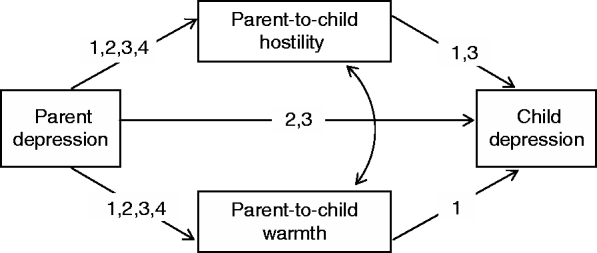
Path analysis was used to examine the pattern of association linking maternal and paternal psychopathology, parental warmth and hostility, and child psychopathology. As shown in Fig. 1, parental warmth and hostility were used as directly measured indices of family environment in examining direct and indirect pathways underlying links between each respective index of parent and child psychopathology. The results of model tests are presented separately for genetically related and genetically unrelated mother–child and father–child models, with the pattern of effects described for parent–child depression first (see Fig. 2, Table 3), followed by parent–child antisocial behavior (see Fig. 3, Table 3).
Significant paths for depression for mothers and fathers across genetically related and genetically unrelated groups on child depression. 1=Genetically related mothers; 2=genetically unrelated mothers; 3=genetically related fathers; 4=genetically unrelated fathers. Synopsis of pathways: for genetically related mothers, maternal depression is significantly related to both parental warmth and hostility, which in turn are related to child depression (see numeric value 1 located across all paths). The absence of the numeric value 1 along the direct pathway from parent depression to child depression infers that this effect is fully mediated (i.e. initially significant association reduced to non-significance; see Baron & Kenny, Reference Baron and Kenny1986) when measures of parental warmth and hostility are controlled. For genetically related fathers, a significant indirect effect is present through paternal hostility, but not warmth (see numeric value 3 located across relevant paths). A significant direct effect between paternal depression and child depression remains even when paternal hostility is controlled, suggesting partial but not full mediation (see Baron & Kenny, Reference Baron and Kenny1986). For genetically unrelated mothers, a significant direct effect between maternal depression and child depression is apparent, even when maternal warmth and hostility are controlled (see numeric value 2).

Significant paths for antisocial behavior for mothers and fathers across genetically related and genetically unrelated groups on child antisocial behavior. 1=Genetically related mothers; 2=genetically unrelated mothers; 3=genetically related fathers; 4=genetically unrelated fathers. Synopsis of pathways: for genetically related and unrelated mothers and fathers, parents' antisocial behavior affects child antisocial behavior through parent-to-child hostility (see numeric values 1, 2, 3, 4), thereby mediating initially significant effects between parent antisocial problems and child antisocial problems. In the case of parental warmth, a significant indirect pathway is apparent only for genetically unrelated mothers' antisocial behavior through maternal warmth to offspring antisocial behavior (see numeric value 2), suggesting combined mediation for this group through maternal warmth and hostility.

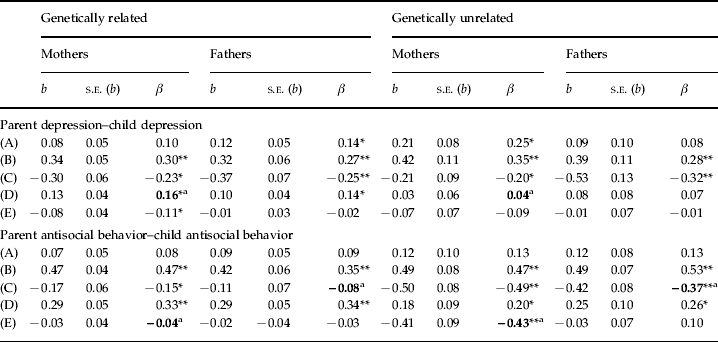
Results of path analysis for the proposed theoretical model (see Fig. 1)

s.e., Standard error.
a Statistically significant parameter difference between genetically related and genetically unrelated mother–child and father–child pairs.
* p<0.05, ** p<0.01.
Parent depression–child depression
Fig. 2 illustrates the significant paths for (1) genetically related mothers, (2) genetically unrelated mothers, (3) genetically related fathers and (4) genetically unrelated fathers. For genetically related mothers and children, significant paths were found between maternal depressive symptoms and each index of parenting (hostility, β=0.30, p<0.01; warmth, β=−0.23, p<0.05), with mothers' warmth and hostility in turn also significantly associated with children's symptoms of depression (hostility, β=0.16, p<0.05; warmth, β=−0.11, p<0.05). The direct path linking maternal depression and child depression was not significant for this group (β=0.10, p>0.10). Thus, there was no direct path from maternal depression to child depression but an indirect path through parenting was observed. Among genetically unrelated mothers and children, significant paths were again apparent between maternal symptoms of depression and both hostility (β=0.35, p<0.01) and warmth (β=−0.20, p<0.05). However, significant associations between each index of parenting and children's symptoms of depression were not apparent (β=0.04 and −0.09). The direct path linking maternal depression and child depression was significant for this group (β=0.25, p<0.05), suggesting that maternal warmth and hostility do not explain (mediate) the association between maternal symptoms and child symptoms for this group. In additional tests to examine whether significant differences between paths were apparent across groups (Joreskog & Sorbom, Reference Joreskog and Sorbom1996), it was noted that the path linking maternal hostility to child symptoms was significantly stronger for genetically related, compared to genetically unrelated, mothers and children (p<0.05).
For both genetically related and unrelated fathers, significant paths were present between father depression and father hostility (β=0.27 and 0.28, p<0.01) and father warmth (β=−0.25 and −0.32, p<0.01) respectively. The path linking father hostility to children's depressive symptoms (but not warmth) was significant for genetically related (β=0.14, p<0.05) but not genetically unrelated fathers (β=0.07, p>0.10). For fathers, a significant direct path was present for genetically related fathers and child depressive symptoms (β=0.14, p<0.05) but not for genetically unrelated fathers and child depressive symptoms (β=−0.08, p<0.10). Thus, father depression did not directly influence child depression in the unrelated group.
Parent antisocial behavior–child antisocial behavior
Figure 3 illustrates the significant paths for (1) genetically related mothers, (2) genetically unrelated mothers, (3) genetically related fathers and (4) genetically unrelated fathers for the antisocial behavior model. Given that the initial bivariate association (correlation) between parent and child antisocial behavior was statistically significant for all groups, this direct path may be considered to be statistically mediated in the presence of parental warmth and/or hostility (see Baron & Kenny, Reference Baron and Kenny1986). For genetically related mothers, significant paths were present between maternal antisocial behavior and each index of family environment (hostility, β=0.47, p<0.01; warmth, β=−0.15, p<0.05), and between maternal hostility and children's antisocial behavior (β=0.33, p<0.01), but not maternal warmth and child antisocial behavior (β=−0.04, p<0.10). Therefore, there was an indirect effect of maternal antisocial behavior through mother–child hostility. For genetically unrelated mothers, associations were present between maternal antisocial behavior and each index of family environment (hostility, β=0.47, p<0.01; warmth, β=−0.49, p<0.01) and between each index of family environment and children's antisocial behavior (hostility, β=0.20, p<0.05; warmth, β=−0.43, p<0.01). Thus, as in the related group, maternal antisocial behavior showed indirect effects on child antisocial behavior through hostility but an additional path through reduced warmth was observed in the unrelated mother–child groups. The negative path between maternal warmth and children's symptoms was also significantly stronger for genetically unrelated mothers compared to genetically related mothers (p<0.05). Across all groups, a significant direct effect between parent antisocial behavior and child antisocial behavior was not apparent when each index of parenting was considered.
For fathers, a significant path between antisocial behavior and father hostility was present for genetically related (β=0.35, p<0.01) and genetically unrelated (β=0.53, p<0.01) fathers, and between father hostility and children's antisocial behavior for both groups (related, β=0.34, p<0.01; unrelated, β=0.26, p<0.05). Of note, a significant negative path was also present between antisocial behavior and paternal warmth among genetically unrelated fathers (β=−0.37, p<0.01), but not between genetically related fathers and their children (β=−0.08, p<0.6). This path was also significantly stronger for genetically unrelated father–child pairs (p<0.05). Across all groups, a significant direct effect between parent antisocial behavior and child antisocial behavior was not apparent when each family environmental measure was included in the analysis.
Discussion
The present study used an IVF research design to examine the intergenerational transmission of parent to child psychopathology among genetically related and genetically unrelated mother–child and father–child pairs. In addition to the unique conclusions facilitated by comparisons between genetically related and genetically unrelated parent–child dyads using this design, prior work was advanced in two important ways. First, the relative roles of parent warmth and hostility to child were examined as measured family indices in examining mediating processes underlying links between parent and child psychopathology. Second, separate models tested associations between father–child psychopathology and mother–child psychopathology across genetically related and unrelated groupings. Taken together, the results suggest differences in the mechanisms of risk underlying pathways of intergenerational continuity of depressive symptoms versus antisocial behavior based on genetic relatedness. In addition, different mechanisms of transmission may operate for mother–child versus father–child pairs.
Mechanisms underlying the intergenerational transmission of depression
The present analyses replicated the pattern of findings reported by Tully et al. (Reference Tully, Iacono and McGue2008) in an adoption study of depressive disorder and those of Silberg et al. (Reference Silberg, Maes and Eaves2010) and suggest that non-inherited factors contribute to the intergenerational transmission of depressive symptoms. There does not seem to be a strong genetic contribution to intergenerational transmission in this sample, although this may have resulted in part from the young age of the children. Previous studies have indicated that inherited factors become more important for depression in adolescents, whereas in childhood, shared environment/family adversity seems to be especially important (Harrington et al. Reference Harrington, Rutter, Weissman and Fudge1997; Rice et al. Reference Rice, Harold and Thapar2003; Thapar & Rice, Reference Thapar and Rice2006). The results also suggest that there are specific circumstances under which the associations between parental depression and child depression become attenuated. In genetically related dyads, associations between mother depression and child depression became non-significant when parent-to-child hostility and parent-to-child warmth were included in the model. Taken together, these results suggest that maternal warmth and hostility serve as measured mediators of the association between maternal depression and child depression when mothers and children are genetically related but not when they are genetically unrelated. Although unmeasured mediators may account for this association in the latter group, these same (or other) unmeasured factors may also account for the associations between maternal symptoms and each index of parenting and child symptoms, as passive gene–environment interplay cannot be excluded as an explanation of these associations. That is, passive gene–environment correlation is presumed to be removed when genetically unrelated parents provide the rearing environment for a child (e.g. Rutter, Reference Rutter2006). Conversely, in genetically unrelated families, the association between maternal depression and child depression remained statistically significant, even when maternal warmth and hostility were included in the model. As the association between maternal and child symptoms in this instance cannot be explained by common genetic factors, environmental transmission remains the only viable transmission mechanism underlying this association. However, maternal hostility and warmth may be excluded as measured environmental mediators in the context of the present study.
For fathers, a significant path between paternal depression and child depression was evident for genetically related father–child dyads, as was a significant indirect path through hostility, but not warmth. Neither measured index of parenting therefore fully mediated the initial association between paternal depression and child depression, with partial mediation of this association operating through paternal hostility but not paternal warmth. Passive gene–environment correlation also cannot be discounted as a possible explanation of these associations, as was the case for genetically related mother–child dyads.
In contrast to the models for genetically unrelated mothers, the models for genetically unrelated fathers suggest an absence of significant associations between father and child depression, and between father hostility and warmth to child depression. The significant path between parent and child depression among unrelated mothers but not unrelated fathers suggests that environmental mechanisms of intergenerational transmission of risk for depression may operate more strongly for mothers than for fathers. This result is consistent with prior adoption studies that have found associations between maternal depression and child outcomes, but not between paternal depression and child outcomes, among genetically unrelated family members (Tully et al. Reference Tully, Iacono and McGue2008; Leve et al. Reference Leve, Kerr, Shaw, Ge, Neiderhiser, Reid, Scaramella, Conger and Reiss2010), and is in accord with complementary evidence from treatment studies suggesting the role of maternal depression on child outcomes (Weissman et al. Reference Weissman, Pilowsky, Wickramaratne, Talati, Wisniewski, Fava, Hughes, Garber, Malloy, King, Cerda, Sood, Alpert, Trivedi and Rush2006). It is also in agreement with results from a meta-analysis by Connell & Goodman (Reference Connell and Goodman2002) suggesting stronger links between maternal depression and child internalizing problems than between paternal depression and child internalizing problems.
Mechanisms underlying the intergenerational transmission of antisocial behavior
The models examining the intergenerational transmission of antisocial behavior also suggest the presence of mediated pathways underlying initial parent and child associations, with pathways primarily evidencing environmental mediation. Specifically, in the mother–child models, mother-to-child hostility fully mediated the association between maternal antisocial behavior and child antisocial behavior. That is, the association between maternal antisocial behavior and child antisocial behavior became non-significant when mother-to-child hostility was considered, and significant paths were noted from maternal antisocial behavior to mother–child hostility, and from mother–child hostility to child antisocial behavior. Because this indirect (mediating) pattern of effects was significant for both genetically related and genetically unrelated dyads, environmental mechanisms are indicated. This is in contrast to the models for child depression, where the mediated pathways involving parent–child hostility cannot discount the possible presence of a gene–environment correlation underlying direct and indirect associations for genetically related parent–child dyads. The fully mediated pathway from parental antisocial behavior to parent-to-child hostility to child antisocial behavior was replicated for genetically related and genetically unrelated father–child dyads, suggesting the robustness of this environmentally driven mediating mechanism in the case of children's antisocial behavior problems. This conclusion is consistent with findings from adoption studies (Ge et al. Reference Ge, Conger, Cadoret, Neiderhiser, Yates, Troughton and Stewart1996; O'Connor et al. Reference O'Connor, Deater-Deckard, Fulker, Rutter and Plomin1998) and complementary intervention studies (Scott, Reference Scott2005; Shaw et al. Reference Shaw, Dishion, Connell, Wilson and Gardner2009) suggesting that there are true environmentally mediated risk effects of negative parenting on children's antisocial behavior problems.
Analyses predicting child antisocial behavior also indicated a mediated pathway involving mother-to-child warmth but not father-to-child warmth. For mothers, environmental mediation was present for genetically unrelated dyads only: maternal antisocial behavior was associated with mother–child warmth, which in turn was associated with child antisocial behavior. The paths between mother–child warmth and child antisocial behavior were significantly different between the genetically related and genetically unrelated groups (with only the path for genetically unrelated dyads evidencing significance). For fathers, the path between father antisocial behavior and father–child warmth was also significant for the genetically unrelated group only, although no significant associations were noted for either group between father warmth and child antisocial behavior. These results suggest that mother-to-child warmth might be an important environmental mediator of child outcomes. The absence of mother-to-child warmth as a mediator for the genetically related groups suggests the likely presence of additional, unmeasured mediators (i.e. maternal involvement), or unmeasured associations resulting from passive gene–environment correlation, that could be examined in future research. A fundamental advantage offered by the present research design is the opportunity to parse genetic from measured environmental influences underlying the link between parent and child psychopathology, thereby offering a unique opportunity to identify and target specific environmental influences that may serve as mediators of family risk in the context of future intervention studies.
Limitations and recommendations for future research
Although the present study offers several noteworthy advantages in examining relative genetic and environmental mediation of links between parent and child symptoms of depression and antisocial behavior, several limitations also merit mention. First, reliance on parent-only reports of each primary theoretical construct would ordinarily limit conclusions relating to the observed magnitude of association across constructs. However, a cross-rater approach was used such that mothers and fathers reported on their own symptoms and parenting behavior with the opposite parent's report of child symptoms in each instance. Second, cross-sectional data were used in the present study and the subjects are young and so have not passed through recognized clinical risk periods that might be relevant in the intergenerational transmission of depression and antisocial behavior. Estimation of the pattern of associations using a longitudinal research design would substantively advance insight into the hypothesized direction of effects across genetically related and unrelated groupings. It will also be important to undertake analyses in older offspring given that there are important developmental changes in the prevalence and etiology of depression and antisocial behavior across childhood and adolescence. Another limitation, as is the case for all genetically informative designs (including twin and adoption studies), is that relationships between family variables and psychopathology may differ for low-risk groups. However, greater confidence is achieved when there is convergence of findings across studies using a complement of research designs (Rutter et al. Reference Rutter2007). As with adoption studies, however, potential age-related differences in the expression or measurement of phenotypes between parents and offspring may be a potential limitation of this research design.
Finally, an examination of additional mediators theorized to be associated with child psychopathology would augment the current study. The results suggest the presence of unmeasured environmental mediators, as evidenced by significant paths for the unrelated group as compared to the related group (e.g. mother–child depression). Additional insight into underlying mediating processes could be gained from future studies that make use of other possible factors as mediators of the association between parent psychopathology and child psychopathology (e.g. interparental discord).
These limitations notwithstanding, the present study illustrates the strength of the IVF design in disentangling genetic and environment influences on child psychopathology, the utility of including measures of specific parenting behaviors in testing mediating processes between parent psychopathology and child psychopathology, and the advantage of separately examining father–child and mother–child associations in studying the intergenerational transmission of psychopathology.
Acknowledgments
This project was funded by a Wellcome Trust Showcase Award and a Wellcome Trust Project grant. We thank V. Russell for administrative support and A. Lewis for collecting antenatal data. Thanks also to X. Ge for initial contributions to the study design. We are extremely grateful to our collaborators at the following fertility centers: Assisted Reproduction Unit, Aberdeen University; Boston IVF, Boston, USA; Bourn Hall Clinic; Bridgewater Hospital, Manchester; Cardiff Assisted Reproduction Unit; CARE at Sheffield Fertility Centre; Centre for Reproductive Medicine, University of Bristol; Centre for Reproductive Medicine, Walsgrave Hospital, Coventry; Childlessness Overcome Through Surrogacy; Clarendon Wing, Leeds General Infirmary; Assisted Conception Unit, St James Hospital, Leeds; Cromwell IVF and Fertility Centre, London; Edinburgh Royal Infirmary; The Hewitt Centre for Reproductive Medicine Unit, Liverpool Women's Hospital; London Fertility and Gynaecology Centre; London Women's Clinic; Midland Fertility Services; St Mary's Hospital Regional IVF and DI Unit, Manchester. In addition, we thank all the families who have generously participated in this study.
Declaration of Interest
None.