

For many, romantic relationships are failing. A quick glance at the literature can explain a great deal about the initial stages of a relationship (Hall, Carter, Cody, & Albright, Reference Hall, Carter, Cody and Albright2010). However, there is a gap in the knowledge regarding why individuals who have been successful at initiating romantic relationships are not able to maintain long-term engagements and embark upon the path to what appears to be a destined break-up (Rusk & Rothbaum, Reference Rusk and Rothbaum2010). The concept of self-handicapping or self-sabotage might explain this phenomenon; however, no empirical research exists using either terms in the context of romantic relationships. The existing evidence is limited to self-handicapping in the context of education and sporting activities. In these contexts, theory development is primarily based on self-concept research. Regarding relationships, a theoretical model exists which proposes that insecure attachment leads to a pattern of employing defensive strategies in romantic engagements, which in turn might lead to relationship break-up.
Defining Self-Handicapping
Self-handicapping is defined as the action of implementing a handicap or barrier to impede success or withdraw effort and justify failure. More specifically, it is a cognitive strategy employed with the overall aim of self-protection, and it primarily serves the function of self-esteem and self-image safeguard (Berglas & Jones, Reference Berglas and Jones1978; Rhodewalt, Reference Rhodewalt, Higgins, Snyder and Berglas1990; Smith, Snyder, & Handelsman, Reference Smith, Snyder and Handelsman1982). Jones and Berglas (Reference Jones and Berglas1978) first explained how when an individual faces a situation that presents threat to their self-concept they might act to manipulate the outcome of events in order to guarantee self-protection. After the event, different attributions are made in the face of success and failure to guarantee a win-win outcome for the self-handicapper. For instance, if faced with failure, the individual can justify the outcome as due to the handicap itself (i.e., an external cause), whereas if faced with success, the individual can emphasise their ability to withstand the barriers of handicap (i.e., an internal cause).
Although the initial premise of self-handicapping is still irrefutable (Jones & Berglas, Reference Jones and Berglas1978), it is now maintained that specific personality traits are important influences for why and how people use this strategy (Rhodewalt, Reference Rhodewalt, Higgins, Snyder and Berglas1990; Strube, Reference Strube1986). More recent evidence (Arndt, Schimel, Greenberg, & Pyszczynski, Reference Arndt, Schimel, Greenberg and Pyszczynski2002; Ferradás, Freire, Rodríguez-Martínez, & Piñeiro-Aguín, Reference Ferradás, Freire, Rodríguez-Martínez and Piñeiro-Aguín2018; Schwinger, Wirthwein, Lemmer, & Steinmayr, Reference Schwinger, Wirthwein, Lemmer and Steinmayr2014) suggests that individuals who are prone to self-protect using self-handicapping also display traits such as low self-esteem, and high feelings of defensiveness and helplessness. The theory has evolved to the understanding that some individuals might resort to self-handicapping prior to experiencing accidental success (Török, Szabó, & Tóth, Reference Török, Szabó and Tóth2018), which contrasts with Jones and Berglas’ (Reference Jones and Berglas1978) original prediction. Thus, it is possible individuals who have a negative self-concept hold the belief that they are not able to perform in the first place.
The Influence of Negative Self-Concept
Self-concepts that are socially validated have a greater chance to influence the practice of self-handicapping, based on two relational schemas (Rhodewalt, Reference Rhodewalt2008). On the one hand, individuals might attribute their self-conceptions to a history of accidental successes (Jones & Berglas, Reference Jones and Berglas1978). On the other hand, individuals might have the belief that their abilities are fixed and cannot be improved, regardless of their performance (Rhodewalt, Reference Rhodewalt2008). Overall, working models based on both social interactions and self-reflections are challenging to modify because people tend to assimilate new information in order to protect their existing schemas (Fraley & Shaver, Reference Fraley and Shaver2000; Pietromonaco & Barrett, Reference Pietromonaco and Barrett2000). Consequently, as explained by Hewitt et al. (Reference Hewitt, Flett, Sherry, Habke, Parkin, Lam and Ediger2003), individuals who are motivated intrapersonally (i.e., based on themselves) and interpersonally (i.e., based on interactions with others) to maintain and enhance self-esteem and self-presentation might choose to self-handicap.
Self-esteem is a self-concept that is highly dependent on social validation. This is found to be especially true when in association with self-handicapping practices. In general terms, both low and high self-esteem individuals might experience the need to self-handicap. While low self-esteem individuals might self-handicap to protect against failure, high self-esteem individuals might self-handicap to enhance implications of success. Further, Feick and Rhodewalt (Reference Feick and Rhodewalt1997) proposed self-handicappers, compared to non-self-handicappers, experience less decline in self-esteem when exposed to failure and an increase in self-esteem when exposed to success. Overall, the practice of self-handicapping can momentarily bolster self-esteem, reinforcing its use and dependability (Rhodewalt, Reference Rhodewalt2008).
Self-presentation is another self-concept that is highly influenced by perception guided by social interactions. Strube (Reference Strube1986) found that increased awareness of private self-presentation is not always correlated with increased awareness of public self-presentation, which suggests that the element of self-protection encompassed in self-handicapping might be more influenced by others’ evaluation of the self. Further, Strube (Reference Strube1986) originally explained that concern for self-image can lead the individual to form inaccurate representations of the self and others. This finding was later elaborated in Hewitt et al.’s (Reference Hewitt, Flett, Sherry, Habke, Parkin, Lam and Ediger2003) study, which found that individuals who displayed a perfectionist approach to self-presentation were more likely to be socially anxious and to self-handicap. In accordance with Strube's (Reference Strube1986) prediction, self-handicapping tendencies appear to occur primarily due to a concern for the evaluation of others, highly attenuated by low self-esteem and self-regard. Thus, perfectionistic self-promotion and non-display of imperfection are defensive strategies that possibly lead to self-defeating behaviours (Hewitt et al., Reference Hewitt, Flett, Sherry, Habke, Parkin, Lam and Ediger2003). Conclusively, whether individuals strive to maintain self-presentation or avoid negative representations, their goal of self-protection is the same.
Self-Handicapping or Self-Sabotage?
Self-handicapping is arguably the most commonly used strategy for self-protection in the educational and sporting contexts (Martin & Marsh, Reference Martin and Marsh2003; Török et al., Reference Török, Szabó and Tóth2018). In the context of romantic relationships, the terms ‘self-handicapping’ and ‘self-sabotage’ are often used interchangeably. The main reason why no one conceptual definition exists for self-defeating patterns of behaviours in romantic relationships is a lack of theory development, insufficient testing, and empirical evidence. The existing literature demonstrates that the term self-handicapping is not fully encompassing of complex intrinsic behaviours commonly observed in the dissolution of romantic engagements (e.g., fear of intimacy and rejection sensitivity). Further, the concept of self-handicapping is limited to mainly physical barriers employed to explicitly hinder performance-driven activities. As an example, the self-handicapping scale (Strube, Reference Strube1986) measures high levels of the trait as a function of excessive drinking or eating, constantly feeling sick, or feeling easily distracted while reading. Thus, to measure self-defeating behaviours in romantic relationships using the self-handicapping scale would not expose the unique behaviours characteristic of dissolving romantic engagements.
The Way Forward: Merging Attachment and Goal Orientation Theory
A need exists for a scale to be developed specifically to test self-sabotage in romantic relationships. However, this phenomenon remains loosely defined and misunderstood. Post (Reference Post1988) originally proposed that the term ‘self-sabotage’ can be used to explain behavioural expressions of individuals dealing with intrapersonal and interpersonal struggles. These struggles are possibly resultant of an insecure attachment style and conflicting goals. Thus, an approach merging attachment and goal-orientation frameworks might explain how self-defeating behaviours lead to relationship dissolution.
In the context of relationships, attachment is expressed as a goal-oriented task to attract proximity and avoid separation with a significant other (Bowlby, Reference Bowlby1969, Reference Bowlby1973, Reference Bowlby1980). Achieving a secure attachment can be a source of strength for individuals facing threat or danger. However, individuals who have not been successful at forming secure close bonds with others cannot trust that these attachments will protect them against possible threats, which in turn means they might have a competing goal to self-protect. Further, research has shown that individuals who are insecurely attached are typically focused in their sense of self-worth as characteristic of their relationship with others (i.e., acceptance vs. rejection), or define their level of comfort in a relationship with others as a function of intimacy and interdependence with others (Collins, Ford, Guichard, & Allard, Reference Collins, Ford, Guichard and Allard2006).
Rusk and Rothbaum (Reference Rusk and Rothbaum2010) merged attachment and goal-orientation frameworks to theoretically explain how patterns of insecure attachment and insecure relationship views can trigger defensive functioning in individuals and lead to relationship dissolution. The authors explained that stressful moments in the relationship will activate the individual's attachment system, which in turn will determine how they respond to situations and set goals. Therefore, if the individual has a secure attachment system, they might resort to an adaptive response and set learning goals informed by constructive strategies. An example of a learning goal would be to improve communication to deal with relationships stressors. However, if the attachment system is not secure, the individual might resort to a maladaptive response and set self-validation goals informed by defensive strategies. An example of a self-validation goal would be to avoid new relationships to prevent from getting hurt. Overall, Rusk and Rothbaum's (Reference Rusk and Rothbaum2010) model proposes a possible path to explain self-sabotage in romantic relationships.
The vast majority of research conducted to explain behavioural representations of insecure attachment styles have focused on defensive behaviours such as rejection sensitivity (i.e., anxious expectation of rejection in situations involving significant others; Downey & Feldman, Reference Downey and Feldman1996) and fear of intimacy (i.e., the lack of ability to exchange feelings or thoughts with significant others; Descutner & Thelen, Reference Descutner and Thelen1991). It is proposed that people who are insecurely attached might expect, readily perceive, and overreact to the possibility of being rejected. Also, they tend to deny and suppress a desire for romantic engagement (Feeney & Noller, Reference Feeney and Noller1990; Hazan & Shaver, Reference Hazan and Shaver1987; Wei & Ku, Reference Wei and Ku2007; Wei, Russell, Mallinckrodt, & Vogel, Reference Wei, Russell, Mallinckrodt and Vogel2007). Altogether, the evidence points to the conclusion that self-sabotage in romantic relationships is possibly enacted through goal-oriented defensive strategies to protect self-worth. In other words, defensive strategies can become self-defeating and consequently hinder the individual's chances at a successful relationship. This premise is supported by previous research. For instance, Kammrath and Dweck (Reference Kammrath and Dweck2006) found insecure individuals who expected the relationship to fail were less likely to express their concerns and engage in strategies to resolve problems with their partners. Similarly, Murray, Holmes, and Collins (Reference Murray, Holmes and Collins2006) and Cavallo, Fitzsimons, and Holmes (Reference Cavallo, Fitzsimons and Holmes2010) found individuals will set self-protective goals as opposed to connectedness goals in the face of threat within the romantic relationship to manage potentially hurtful outcomes. Thus, it is possible that patterns of relationship behaviours resultant from individual differences might be contributing to a cycle of romantic self-sabotage where some individuals would be likely to continually destroy every relationships they have.
The Current Study
Some compelling research has been conducted to explain individual differences that possibly contribute to self-sabotaging tendencies. Altogether, the existing evidence might explain intrinsic motivations to sabotage love; however, a major gap in the literature still exists, as no studies to date have provided conclusive evidence to (1) define relationship self-sabotage and (2) identify which behaviours are symptomatic of self-sabotage in romantic relationships.
The first step towards defining a new phenomenon is to explore how it is presented qualitatively (Creswell, Reference Creswell2014). Consequently, the current study explored the theme of self-sabotage in romantic relationships with semistructured qualitative interviews devised for experts in the field of relationship counselling. The overall aim of the current study was to investigate how self-sabotage is presented in the counselling context and understood by practising psychologists towards defining the phenomenon with possible accounts for individual motivation and representative self-sabotaging behaviours. The current study is also the first of a series of studies that will be conducted to develop and test a relationship self-sabotage scale.
Method
Participants
A sample limited to practising psychologists was deliberately chosen to ensure all participants had an equivalent level of education and training. Further, to be considered an expert in relationship counselling, participants would have had to be exposed to relevant training and clientele, either at work (e.g., through training at Relationships Australia) or through postgraduate qualifications (e.g., Master of Couple and Relationship Counselling).
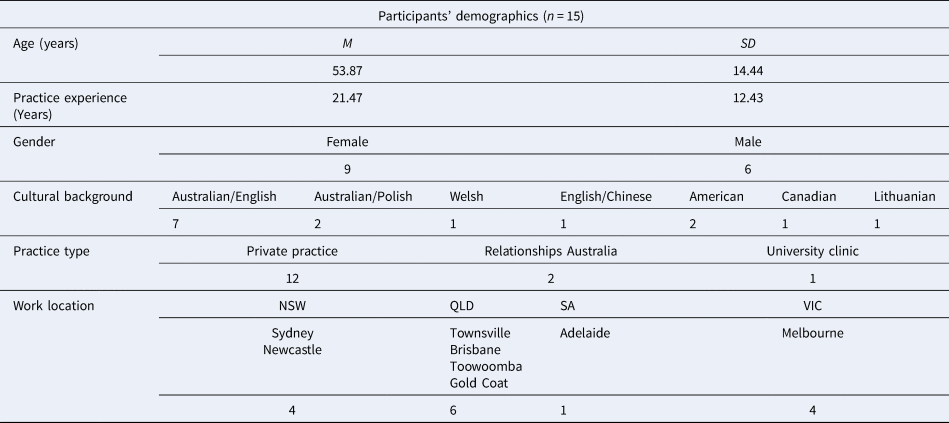
A total of 15 psychologists (6 males, 9 females) from four Australian states — New South Wales (NSW), Queensland (QLD), South Australia (SA) and Victoria (VIC) — were interviewed. Participants were recruited until data were saturated and no further meaningful contributions were gathered. Therefore, 15 participants were deemed acceptable as per the guidelines of qualitative research (Creswell, Reference Creswell2014). Participants’ workplace included private practices (12), Relationships Australia (2), and a university clinic (1). Private practices and the university clinic are not identified to protect the anonymity of participants.
Only the two psychologists working for Relationships Australia reported that their primary focus in counselling was individuals or couples experiencing relationship difficulties (these included family relationships, parenting relationships, peer relationships and romantic relationships). The remaining psychologists interviewed reported working with relationship difficulties as well as a broad range of issues, such as depression, anxiety, stress, adjustment difficulties, eating disorders, behavioural difficulties, social difficulties, anger management, personality disorders, post-traumatic stress disorder, trauma, grief and bereavement, self-harm and suicide, substance use, addiction, chronic health conditions, sleep disturbances, workplace difficulties, child and adolescent counselling, autism spectrum disorders, and obsessive compulsive disorder. Participants’ ages ranged between 32 and 76 years (M = 53.87, SD = 14.44). A culturally diverse sample of participants included Australian, English, Polish, Welsh, Chinese, American, Canadian, and Lithuanian backgrounds. See Table 1 for the distribution of participants by professional categories, age, gender, background, years of training, practice type, and practice location.
Participants’ Demographics
Material
A semistructured interview protocol was developed by all authors. Questions sought to explore practising psychologists’ perceptions of what self-sabotage is and how it is presented in relationships. More specifically, the interview guide included questions regarding the reason why clients might be self-sabotaging; for example, ‘Why do you think some people regularly start and end relationships?’ and ‘What are the behaviours that drive these [self-destructive] patterns?’ Questions also explored how clients might be sabotaging their relationships: ‘What are some common behaviours presented by clients who feel they are in a romantic relationship that is not working?’, ‘How do clients protect themselves from getting hurt in romantic relationships?’ and ‘What are some of the protective behaviours people use?’ Some specific questions regarding the pattern of self-sabotage were also asked; for example, ‘Would you say clients’ romantic relationship patterns become self-fulfilling?’
Procedure
Ethics approval was obtained from the Human Ethics Committee at James Cook University (H7162). Recruitment for this study was done by invitations to the Australian Psychological Society Psychology of Relationships Interest Group members and asking participants to share the study information with other potential participants (also referred to as snowball recruitment). Interviews were taped, transcribed verbatim, and analysed using thematic analysis (Braun & Clarke, Reference Braun and Clarke2006; Guest, MacQueen, & Namey, Reference Guest, MacQueen and Namey2012) with the QSR N-Vivo software (QSR International Pty Ltd, 2015).
Data Analysis
Conducting a thematic analysis involved six phases (see Braun & Clarke, Reference Braun and Clarke2006; Nowell, Norris, White, & Moules, Reference Nowell, Norris, White and Moules2017): (1) getting familiar with the data (i.e., transcribing interviews, reading transcriptions, drafting a code book, and documenting theoretical and reflective thoughts); (2) generating initial codes (i.e., systematically organising the information from the data into categories and debriefing with members of the research team); (3) searching for common themes (i.e., identifying similarities and discrepancies in participants’ comments where commonalities are classified under an umbrella term and diagramming themes to explore connections); (4) reviewing themes (i.e., ensuring each theme is unique and accurately classifies similar ideas together for single and across multiple cases — this processes involved vetting themes and subthemes and testing for referential adequacy by returning to raw data); (5) naming and defining themes (i.e., interpreting the overall meaning of each theme and ensuring the name given summarises comments categorised together to represent one main idea — the overall idea should also be in alignment with existing research and evidence relevant to the context investigated); and (6) producing a report (i.e., describing the process of coding, theme generation and analysis in sufficient details with illustrative text descriptions to create context and reporting reasons for theoretical, methodological and analytical choices throughout the entire study). Further, authors adopted a three-level approach to strengthen the analytical process (see Fossey, Harvey, McDermott, & Davidson, Reference Fossey, Harvey, McDermott and Davidson2002). First, initial coding was revised using shared coding sessions and theme generation by two authors (RP, NC), with consensus used to resolve discrepancies. Second, all authors were consulted to establish the integrity of coding and themes. Third, final main themes and subthemes were systematically determined and verified by all authors.
Verbatim illustrative quotes were selected from transcriptions and included in this report to illustrate extracted themes and subthemes. Further, unclear words (e.g., ‘this’ and ‘that’) were replaced in this report with a word that approximates what the participant intended to say based on the context of the quote (e.g., question asked, or a word commonly used in the participant's speech). Replaced words are indicated in square brackets on each side. The decision to replace words was made to ensure the comprehension of the representative quotes is not impacted, which is in accordance with McLellan, MacQueen, and Neidig's (Reference McLellan, MacQueen and Neidig2003) recommendation.
Results
Self-Sabotaging Behaviours
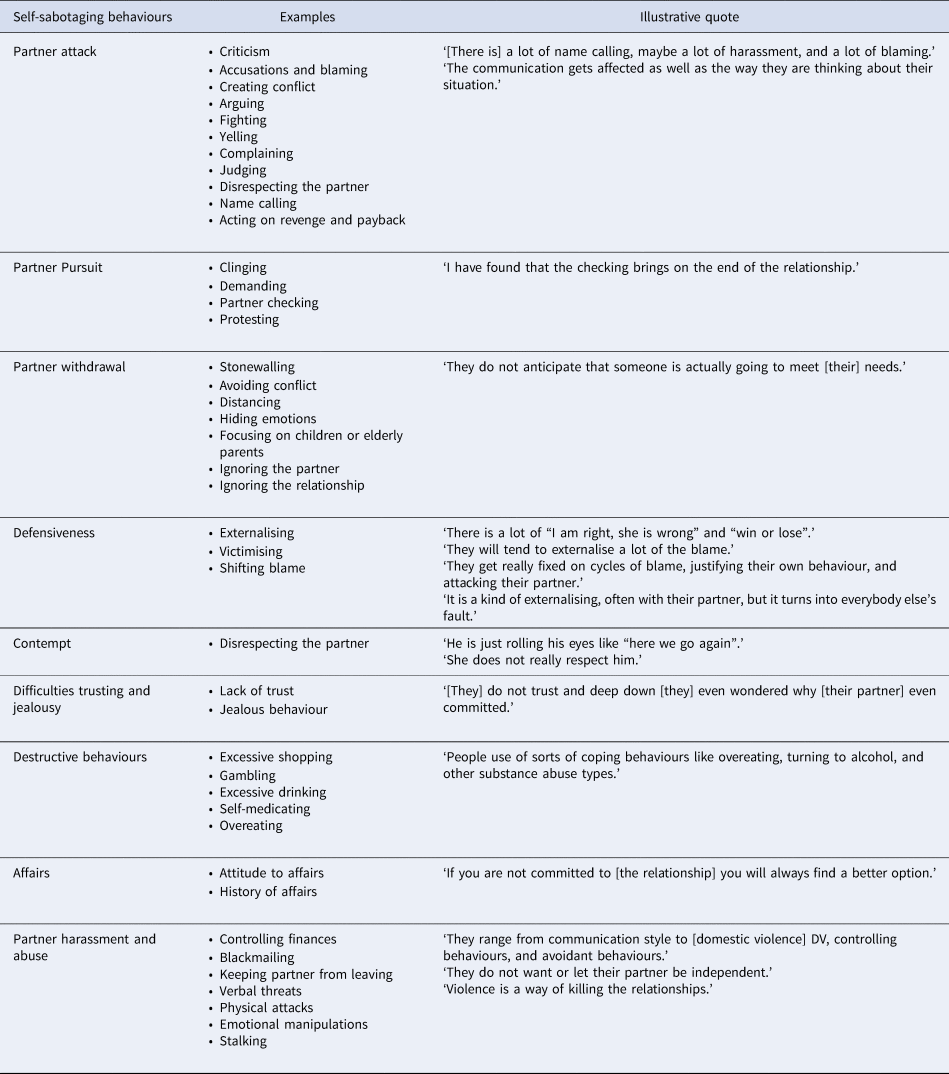
Psychologists have described a series of behaviours that contribute to the dissolution of romantic engagements. These include: Partner Attack (e.g., criticism); Partner Pursuit (e.g., partner checking); Partner Withdrawal (e.g., stonewalling); Defensiveness (e.g., externalising); Contempt (e.g., disrespecting the partner); Difficulties Trusting and Jealousy (e.g., lack of trust or jealous behaviour); Destructive Behaviours (e.g., excessive shopping); Affairs (e.g., attitude to affairs or history of affairs); and Partner Harassment and Abuse (e.g., controlling finances).
It is understood that clients often find themselves in the same destructive patterns as they move from one relationship to the next. As explained by one psychologist: ‘[They] find that they have replicated the very pattern they were escaping from.’ However, it is also understood that these behaviours might not be always clearly expressed. One psychologist described self-sabotaging behaviours as ‘nicely complicated and multilayered and not easily spotted’. Another psychologist provided an example: ‘[For] some clients their defence is a form of attack.’ Despite which self-destructive behaviours are seen in romantic relationships, they can be understood as manifestations of the ‘different ways [people] try to protect themselves’. See Table 2 for examples of each identified category of self-sabotage behaviour with representative quotes.
Self-Sabotaging Behaviours
Reasons Why People Self-Sabotage
Several reasons for why clients might be self-sabotaging were identified. These were coded into six main themes: (1) Motivation to self-protect and fear of getting hurt; (2) Insecure attachment styles; (3) Difficulties with self-esteem and negative self-concept; (4) Relationship beliefs, views, and expectations; (5) Difficulty coping with relationship issues; and (6) Avoiding relationship commitment.
Motivation to self-protect and fear of getting hurt
All psychologists agreed ‘consciously or unconsciously, [people] self-sabotage the relationship or withdraw from it’ because they are afraid of getting hurt and ‘scared and too uncomfortable to make [themselves] vulnerable’. One psychologist explained fear is ‘a deep anxiety about being abandoned by our intimate partner’. The same psychologist also explained fear can ‘overshadow everything’. For instance, Another psychologist explained although clients might be self-sabotaging with anger outbursts, fear is a driving motivator — ‘often what they are feeling right down deep beneath the surface is fear’. Generally, clients are protecting themselves against the hurt that their current relationship or previous relationships have caused them.
Insecure attachment styles
The theme of attachment was well documented in all interviews. One psychologist explained these behaviours are ‘expressions of how the relationship is not working in terms of manifest, but underneath that is attachment’. Another psychologist added ‘it is all about connection, but the way we respond when we are disconnected is either we get angry or withdrawn’. Further, one psychologist explained ‘people engage in self-sabotage behaviours because of a historical pattern’. Another psychologist elaborated on the idea that attachment is ‘how [clients] learn about expressed emotions’. All psychologists agreed learning about attachment occurs in childhood or previous relationships. Further, one psychologist explained ‘it is a preoccupation with the relationship and a preoccupation with the history of [the] relationship’. However, it might also be that the attachment is ‘context dependent’ as attachment is not necessarily ‘one trait’ and it can be ‘malleable’. As a result, it is agreed that clients might ‘internalise experiences’ and behave in unique ways, which are tailored by prior experiences.
Difficulties with self-esteem and negative self-concept
Another explanation for clients’ behaviour might be related to difficulties with self-esteem. One psychologist explained ‘[clients] do not think they are worthy and they are critical of themselves’. This negative view of themselves might be translated into how clients deal with others in their life. Another psychologist gave an example from a client who said: ‘She makes me feel like whatever I do is not good enough.’ Consequently, for some clients it might be easier to be defensive and conclude they are not worthy: ‘I am going to flail around, but I know it is not going to make any difference to anyone.’ This other psychologist explained clients ‘see themselves as hopeless and helpless more often than not’. Further, it is understood that negative self-view can be translated into poor expectations of their partners and the relationship: ‘People self-protect by displacing uncomfortable feelings on their partner.’
Relationship beliefs, views, and expectations
Some clients hold negative views of relationships and assume failure. Two examples are given from psychologists who reported clients expecting that ‘[things are] never going to get any better’ and ‘this is as good as [it] will get’. Alternatively, clients might have unrealistic views and expectations of their partners and relationships. One psychologist reported ‘the most common [expectation] is that my partner should know what I am thinking’. Another psychologist explained ‘a lot of people are very uneducated about relationships — what is normal and what is not normal and what works and what does not work’. Fairytales have also been mentioned to influence clients’ relationship views: ‘In general people know that the fairytale is just a fairytale, but they influence us in subtle ways.’ Also, it might be that some people simply ‘do not know how to do it’, or ‘they have not had good role models’, or ‘they do not know what a good relationship looks like’. Further, another psychologist explained these unrealistic behaviours are also a consequence of attachment and learning: ‘[these are] well-worn patterns of behaviours or patterns of expectations of what people should do or how people will respond’. The same psychologist explained people will act on these expectations without ‘reality testing it’. Alternatively, clients might be projecting their own insecurities and discomfort on their partner and relationship. Some psychologists explained clients might also be inflexible to change. It might be that ‘they stick to their own interpretation’ or ‘their world view is governed by their individual perspective and they forget that they are in a coupled relationship’.
Difficulty coping with relationship issues
Self-sabotaging behaviours might also leave clients unprepared to deal with relationship issues. One psychologist explained ‘they might find it more difficult to cope with some of the challenges that might come up’. Psychologists described this as a lack of ‘resilience’ or ‘self-efficacy’. Another psychologist gave the example ‘when there is conflict it is very difficult for them to regulate and think clearly’. Further, clients might not understand that challenges are normal in relationships. Another psychologist explained ‘[there is] a lack of acceptance of conflict as being a normal part of the relationship’. Also, social norms, traditions, and culture might influence how clients understand relationships. For instance, one psychologist explained some clients believe ‘you are not supposed to fight’ in relationships.
Avoiding relationship commitment
People might also start and stop relationships regularly as a way to protect themselves. One psychologist quoted their client who said: ‘If I never get too close to anyone, and never let anybody in, then I am never going to get hurt and it could just be fun all the time.’ Another psychologist explained sometimes clients will fall into a pattern of ‘ending relationships even when they still want to be in them’. It is also possible that difficulties with relationship commitment are reinforced by social search mobile apps. This other psychologist explained with the introduction of apps such as Tinder it makes it easier for people to jump from one relationship to the next. A client was described as someone who would ‘go on Tinder dates and while she was with that person at the bar [she] would be swapping and looking at who else she could be with’. Further, another psychologist explained dating sites have made it possible for people to ‘try many different options and meet many different people’.
Discussion
Self-Sabotaging Behaviours
Psychologists interviewed described self-sabotaging behaviours that are well understood to be maladaptive in romantic relationships. Some are also closely aligned with Susan Johnson's (Greenberg, Warwar, & Malcolm, Reference Greenberg, Warwar and Malcolm2010; Johnson & Lebow, Reference Johnson and Lebow2000; Lebow, Chambers, Christensen, & Johnson, Reference Lebow, Chambers, Christensen and Johnson2012) destructive dynamics of engagements in relationships (i.e., attack-attack, attack-withdraw, withdraw-withdraw) and John Gottman's (Gottman & Levenson, Reference Gottman and Levenson1999; Gottman & Levenson, Reference Gottman and Levenson2002; Shapiro & Gottman, Reference Shapiro and Gottman2005) predictors of marriage dissolution and the Four Horseman of the Apocalypse (i.e., criticism, defensiveness, contempt, and stonewalling). However, it is also understood that these behaviours are not always clearly expressed by clients. Peel, Caltabiano, Buckby, and McBain (Reference Peel, Caltabiano, Buckby and McBain2018) found that professionals and clients alike find it difficult to differentiate between core and surface issues in the counselling context. Consequently, understanding the different motives or reasons why people might seek self-protection (sometimes at the cost of breaking up or not forming attachment bonds), and in turn, self-sabotage is an important step to help identify these self-defeating behaviours empirically and in practice.
Motivation to Self-Protect
The phenomenon of self-protection was largely documented in the interviews. This was an expected outcome based on evidence from the self-handicapping and attachment theories. It seems that insecure individuals are more motivated to self-protect than form close affectional bonds. This is further complicated by the fact that self-protection can lead individuals to form patterns of maladaptive behaviours in relationships with others (Rusk & Rothbaum, Reference Rusk and Rothbaum2010). Further, these patterns are difficult to escape, which in turn means individuals might be stuck in a cycle to self-sabotage. Overall, self-protection is a highly enticing exercise as it offers the individual a feeling of control over their environment by moderating the effects of painful experiences (Jones & Berglas, Reference Jones and Berglas1978; Rhodewalt, Reference Rhodewalt, Higgins, Snyder and Berglas1990).
The Influence of Insecure Attachment
Psychologists interviewed for the current study unanimously agreed that patterns of behaviours characteristic of insecurely attached adults might inevitably lead to the dissolution of romantic engagements. This premise is in accordance with previous literature. Individuals’ ‘internalised experiences’ resulting from their relationship history with parents, peers and other romantic partners might be informing how they understand present interactions in their relationships. Insecure individuals in romantic relationships will typically behave in two different ways: (1) they might fall in love frequently, experience extreme self-doubt, excessive need for approval, and distress when others are unavailable or unresponsive; or (2) they might not believe in love, repress feelings of insecurity, are reluctant to engage in self-disclosure, express an excessive need for self-reliance, and avoid commitment (Harper, Dickson, & Welsh, Reference Harper, Dickson and Welsh2006; Hazan & Shaver, Reference Hazan and Shaver1987). Overall, it is suggested that self-sabotaging can be demonstrated in insecurely attached individuals who hold avoidance goals for their relationship (Elliot & Reis, Reference Elliot and Reis2003; Locke, Reference Locke2008). Specifically, insecure attachment can predict self-defeating goals to avoid intimacy and achieve self-reliance, control, and distance from others (Mikulincer, Orbach, & Iavnieli, Reference Mikulincer, Orbach and Iavnieli1998; Rom & Mikulincer, Reference Rom and Mikulincer2003).
Difficulties With Self-Esteem and Negative Self-Concept
The attachment theory literature alone has contributed to a strong explanation for how several affective, cognitive and behavioural expressions might predict the eventual dissolution of romantic partnerships. However, determining the fate of a relationship requires a complex evaluation of the different attachment styles as well as factors unique to the individual and the dyad engagement. More specifically, and similarly to what was found in the current study, Wei and Ku (Reference Wei and Ku2007) observed that people with negative self-concept displayed higher levels of self-defeating patterns and interpersonal distress. Further, Weisskirch (Reference Weisskirch2017) found that a high sense of self-efficacy in maintaining romantic relationships had a direct effect on individuals’ wellbeing. Thus, it is possible to suggest that maladaptive thought patterns and resultant behaviours may in fact be sabotaging an individual's chances of engaging or maintaining a long-term relationship (Descutner & Thelen, Reference Descutner and Thelen1991; Downey & Feldman, Reference Downey and Feldman1996; Feeney & Noller, Reference Feeney and Noller1990; Wei & Ku, Reference Wei and Ku2007). Taken together, the evidence shows that compared with secure individuals, insecure individuals are more likely to understand their partner's behaviour as negative due to their own negative self-view.
Relationship Beliefs, Views, and Expectations
Relationship views are often a product of working models of behaviours learned from positive and negative views of the self and interactions with others (Feeney & Noller, Reference Feeney and Noller1990; Hazan & Shaver, Reference Hazan and Shaver1987; Pietromonaco & Barrett, Reference Pietromonaco and Barrett2000). Originally, Hazan and Shaver (Reference Hazan and Shaver1987) explained that schemas derived from working models of the self and others can in turn place insecure individuals in a ‘vicious cycle’ (p. 321), where previous experiences affect beliefs leading to predicted outcomes (Collins et al., Reference Collins, Ford, Guichard and Allard2006). Alternatively, Knee (Reference Knee1998) explained that individuals who believe in a destined relationship (also understood as a belief in fairytales; Knee, Patrick, Vietor, & Neighbors, Reference Knee, Patrick, Vietor and Neighbors2004) tend to assess their romantic engagements early and quickly, and as a result they also tend to give up easily on the relationship. Furthermore, individuals who believe that their relationship is destined also tend to believe that the outcome of their romantic life is out of their control (Knee et al., Reference Knee, Patrick, Vietor and Neighbors2004). Taken altogether, the working model and the destiny belief theories provide a strong explanation for how individuals might be setting goals for their current and subsequent romantic engagements and why maintenance and longevity is so hard to achieve. Additionally, psychologists interviewed in the current study identified an added complication, which has been previously addressed in the flirting literature (Hall et al., Reference Hall, Carter, Cody and Albright2010) — it seems that some individuals do not hold realistic expectations of relationships and do not understand what a healthy relationship might look like.
Difficulty with Relationship Issues and Commitment
Conflicting goals previously identified in the literature are similar to the ones described in the current study. Some examples are seeking intimacy and independence (Pietromonaco & Barrett, Reference Pietromonaco and Barrett2000) or seeking intimacy and avoiding rejection (Cavallo et al., Reference Cavallo, Fitzsimons and Holmes2010). A meta-analysis conducted by Le, Dove, Agnew, Korn, and Mutso (Reference Le, Dove, Agnew, Korn and Mutso2010) confirms that individual factors such as insecure attachment styles and relationship factors such as commitment issues, dissatisfaction, conflict and lack of trust can contribute to the dissolution of a romantic relationship. Further, it is understood that one of the main obstacles in maintaining relationships is risk regulation and balance between relationship stressors (Le et al., Reference Le, Dove, Agnew, Korn and Mutso2010) and conflicting goals. Altogether, insecure beliefs and conflicting goals might lead individuals to a defensive response to stressful situations (Rusk & Rothbaum, Reference Rusk and Rothbaum2010). Further, modern online dating dynamics allow for an element of control over how the self is presented (Whitty, Reference Whitty2008) and how the romantic engagement unfolds (Corriero & Tong, Reference Corriero and Tong2015; Fitzpatrick & Birnholtz, Reference Fitzpatrick and Birnholtz2017). This is particularly enticing for individuals wishing to self-protect by avoiding intimacy and commitment.
Self-Sabotage in Romantic Relationships
Using a similar logic to self-handicapping, a self-saboteur who seeks a romantic relationship is equally committed to portraying a win-win outcome. Theoretically, it could be argued that self-saboteurs hold insecure views of romantic relationships, and although he or she might be doing all they can to maintain the relationship (Ayduk, Downey, & Kim, Reference Ayduk, Downey and Kim2001), failure is an expected outcome (Rusk & Rothbaum, Reference Rusk and Rothbaum2010). Therefore, in the context of romantic relationships, the individual guarantees a win if the engagement survives despite the employed defensive strategies or if the engagement fails, in which case their insecure beliefs are validated. Similarly, self-sabotaging behaviours in romantic relationships can be expressed as impeding success or withdrawing effort and justifying failure. Altogether, the evidence from the current study aids in differentiating between motivations to self-sabotage and how self-sabotage might be enacted in romantic relationships.
Study Limitations
The scope of the present study was restricted to practice in Australia. Additionally, this study was limited to counselling practised by psychologists. Different interpretations might be offered if interviews were conducted with other mental health professionals who practise talk therapy, such as counsellors, social workers and psychiatrists. Further, differences across gender and age have not yet been explored. Finally, the current study does not report on data collected from people in relationships. A more in-depth discussion of the phenomenon of self-sabotage will be made possible once data collected from practising psychologists and people in relationships is taken into account.
Future Studies
A follow-up study is currently in progression to test items created from these interviews to measure self-sabotage in individuals who are or have been in romantic relationships and have experienced difficulties or relationship dissolution. The aim of this future study will be to develop a scale to empirically test self-sabotaging behaviours. Other future studies arising from this research will need to test how individuals engage in self-sabotage longitudinally, across their multiple relationships and their lifespan. Also, age, gender and sex orientation differences will need to be addressed.
Conclusion
Most of the research undertaken regarding the practice of self-handicapping has been conducted in the context of education and sporting activities. This phenomenon is less explored in other contexts. The existing evidence suggested the term ‘self-handicapping’ does not fully encompass complex intrinsic behaviours observed in the dissolution of romantic engagements and is limited mainly to physical handicaps or barriers. Thus, the term ‘self-sabotage’ is proposed as an alternative. The aim of the present study was to investigate the notion of self-sabotage within the confines of romantic relationships and to explore how psychologists in practice understand this phenomenon. A repertoire of self-sabotaging behaviours was identified by practitioners with possible reasons why this occurs. Overall, it seems motivations for self-handicapping or self-sabotage are the same across different contexts — people use self-defeating behaviours to ‘control the environment’ and to self-protect. However, these self-defeating behaviours are context dependent. In the context of intimate relationships, the literature on attachment and goal orientation is better equipped to explain the intrinsic self-defeating behaviours contributing to the dissolution of romantic engagements. For instance, factors such as negative self-concept and other resultant individual characteristics derived from insecure attachment (e.g., rejection sensitivity and fear of intimacy) are possibly the reasons why people self-sabotage relationships. However, the existing literature does not empirically address which behaviours are sabotaging individual's chances of maintaining long-term relationships. Behaviours such as the ones described by Gottman as contributors of relationship dissolution are possibly how relationships are sabotaged. Nevertheless, this premise is yet to be confirmed. The present study was the first step to empirically define and explore self-sabotage in romantic relationships by gathering evidence from practicing psychologists. Future studies need to be conducted to further develop theory and test a relationship self-sabotage scale.
Financial support
This research received no specific grant from any funding agency, commercial, or not-for-profit sectors.
Conflict of interest
None.
Ethical standards
The authors assert that all procedures contributing to this work comply with the ethical standards of the relevant national and institutional commitments on human experimentation and with Helsinki Declaration of 1975, as revised in 2008.



