

In Canada, as in many Anglo-American democracies, election campaigns occur at once at the national and local level. Media attention is typically focused on national campaigns (Mendelsohn, Reference Mendelsohn1993; Trimble and Sampert, Reference Trimble and Sampert2004), which have become increasingly leader-driven. Nonetheless, candidates running in single member plurality districts operate locally run campaigns with at least some autonomy (Carty, Reference Carty2002; Carty and Young, Reference Carty and Young2012; Coletto et al., Reference Coletto, Jansen and Young2011; for an American example, see Enos and Hersh, Reference Enos and Hersh2015) and are, at least to some degree, elected to represent local interests in the House of Commons. This raises an important empirical question: to what degree do local candidates matter in Canadian federal elections?Footnote 1 Existing literature provides contradictory results on the effects of local candidates. At least some of this is likely attributable to a lack of detailed data on voters’ actual views of local candidates (Blais and Daoust, Reference Blais and Daoust2017; Blais et al., Reference Blais, Gidengil, Dobrzynska, Nevitte and Nadeau2003; Roy and Alcantara, Reference Roy and Alcantara2015; Simpson, Reference Simpson2002).
This paper builds on previous work in two important ways. First, we employ novel data from the 2015 Canadian federal election (Loewen et al., Reference Loewen, Daniel Rubenson and Koop2018).Footnote 2 Our dataset consists of a much larger sample of respondents than typical election studies. It also contains a direct measure of voters’ evaluations of local candidates. These two factors allow for better powered analysis. Second, we present three estimates of local candidate effects rather than a single estimate. In the first approach, we estimate the share of voters for whom a local candidate rating was decisive. In the second approach, we estimate the number of ridings in which candidate effects appeared decisive and caused a seat to change hands. In the third approach, we estimate riding-level variation in local candidate effects, demonstrating that local candidates in fact have large effects on the vote but in a small number of constituencies. As the existing literature mostly uses the first approach, we introduce two additional estimates of local candidate effects. We show that the importance of local candidates (or “the local candidate effect”) can be measured in different ways, both at the level of individual vote choice, as well as for riding-level election outcomes. All three estimates return broadly similar results, strengthening our conclusion as to the positive but limited effect of local candidates.
We conclude the following. Evaluations of local candidates are decisive for approximately 4 per cent of voters (3.7% outside Quebec and 6.1% inside Quebec). Evaluations of local candidates prove decisive for the outcome of approximately 10.4 per cent of constituency contests (9.3% outside Quebec and 14.1% inside Quebec). When considered on a riding-by-riding basis, there is an impressive range in the size of local candidate effects, but they only appear statistically significant in a minority of constituencies: in 122 of 325 constituencies, at least one candidate from the three major parties had a significant effect on vote choice.Footnote 3 Taken together, these results largely confirm previous work on the important but limited effect of local candidates.
Our paper proceeds as follows. We first review the existing literature on local candidate effects and situate our paper within this line of research. We next describe our data and estimation strategies. We then present our results and conclude.
Local Candidate Effects in Canadian Elections
Political parties have adjusted to Canada's geographically diverse electoral landscape by decentralizing their campaigns, providing a substantial degree of autonomy to local candidates and allowing local candidates to adapt their strategies and tactics to local contexts (Carty, Reference Carty2002; Carty and Young, Reference Carty and Young2012; Coletto et al., Reference Coletto, Jansen and Young2011; Loewen et al., Reference Loewen, de Miguel and Heroux-Legault2015). Furthermore, the vast majority of official party candidates are chosen by local party members, increasing the link between local candidates and their constituents. Within such a decentralized context, it might thus be expected that local candidates and their campaigns exert an important influence on electoral outcomes in Canada. Various scholars have sought to determine the size of this local candidate effect, but results have been mixed. Clarke and colleagues (Reference Clarke, LeDuc, Jenson and Pammett1979) and Irvine (Reference Irvine1982), for example, concluded that local candidate effects in Canadian elections were minimal. Other research, however, has found positive evidence of candidate effects. Cunningham (Reference Cunningham1971) argues for instance that 10 per cent of voters in the 1968 federal election cast their votes based on their personal affinity for local candidates. Blais and colleagues (Reference Blais, Gidengil, Dobrzynska, Nevitte and Nadeau2003) find that 44 per cent of Canadian voters expressed a distinct preference for local candidates in the 2000 elections. The authors estimate that the quality of local candidates was the decisive factor for 5 per cent of all voters on election day. More recently, Roy and Alcantara (Reference Roy and Alcantara2015) present experimental results showing that strong local candidates can yield a 10 percentage point boost in local races. In looking at the 2015 federal election, Blais and Daoust (Reference Blais and Daoust2017) study candidate effects across British Columbia, Ontario and Quebec, and find that 48 per cent of voters in those provinces expressed a preference for a particular candidate. Of those voters, 9 per cent held incongruent preferences, such that their preferred party and candidate did not align. Approximately 40 per cent of those voters voted for the candidate over the party, suggesting that, for a small group of voters, candidates were more important than parties or national leaders.Footnote 4
In addition to establishing that local candidates exert an effect on election outcomes, researchers have also sought to determine what qualities of local candidates are most likely to increase their share of the vote. In other words, what makes for a “strong” local candidate? In the Canadian context, Roy and Alcantara (Reference Roy and Alcantara2015) find that voters are more likely to support so-called “strong” local candidates after learning more about their personal backgrounds, while Krashinsky and Milne (Reference Krashinsky and Milne1983, Reference Krashinsky and Milne1985, Reference Krashinsky and Milne1986) have shown that incumbent members of Parliament tend to receive a five percentage point boost on election day. In research that extends beyond the Canadian context, three additional performance-boosting candidate characteristics have been identified: political experience (Krebs, Reference Krebs2001; Marsh, Reference Marsh1987; Shugart et al., Reference Shugart, Valdini and Suominen2005; Tavits, Reference Tavits2010), the candidate's residential proximity to the constituency (Arzheimer and Evans, Reference Arzheimer and Evans2012, Reference Arzheimer and Evans2014; Evans et al., Reference Evans, Arzheimer, Campbell and Cowley2017), and personal qualities, such as occupation or appearance (Ahler et al., Reference Ahler, Citrin, Dougal and Lenz2017; Campbell and Cowley, Reference Campbell and Cowley2014; Keeter, Reference Keeter1987; Schoen and Schumann, Reference Schoen and Schumann2007).
Apart from candidate characteristics, the importance of a strong local campaign has also been emphasized, especially in the US context (Clarke et al., Reference Clarke, Sanders, Stewart and Whiteley2004; Eldersveld, Reference Eldersveld1964; Huckfeldt and Sprague, Reference Huckfeldt and Sprague1995; Wielhouwer and Lockerbie, Reference Wielhouwer and Lockerbie1994). Fundraising, volunteer recruitment and spending levels are key determinants of local candidate success (Heintzman, Reference Heintzman1991; Johnston, Reference Johnston1987; Johnston et al., Reference Johnston, Pattie and Johnston1989; Johnston et al., Reference Johnston, Pattie, Cutts, Fieldhouse and Fisher2011; Pattie et al., Reference Pattie, Johnston and Fieldhouse1995). Local volunteer recruitment enhances candidates’ vote shares: local canvassing, door knocking and flyer distribution are critical in both vote choice (Barton et al., Reference Barton, Castillo and Petrie2014; Eagles, Reference Eagles1993; Denver et al., Reference Denver, Hands and MacAllister2004; Dewan et al., Reference Dewan, Humphreys and Rubenson2014; Marsh, Reference Marsh2004; Pattie and Johnston, Reference Pattie and Johnston2003; Whiteley and Seyd, Reference Whiteley and Seyd2003) and turnout (Gerber and Green, Reference Gerber and Green2000; Karp and Banducci, Reference Karp and Banducci2007; Karp et al., Reference Karp, Banducci and Bowler2008). Although evidence therefore exists to suggest that local candidates matter in shaping Canadian electoral outcomes, most studies find modest effects—ranging between five and ten percentage points—across various measures.
In this paper we explore the effect of local candidates on the 2015 federal election and thus provide an up-to-date analysis of local candidate effects in Canadian elections. The 2015 election is a particularly interesting case study, as the nature of political campaigns has changed significantly over the last few decades. Contemporary election campaigns are characterized by high levels of media attention, with a particular focus on television and modern forms of social media. High levels of media attention have encouraged a greater focus on national party leaders. For example, Mendelsohn (Reference Mendelsohn1996) and Gidengil and colleagues (Reference Gidengil, Blais, Nevitte and Nadeau2002) report evidence that individuals more exposed to media coverage of the election put greater emphasis on leaders. Ohr (Reference Ohr, Aarts, Blais and Schmitt2011) argues that changing patterns in political communication have resulted in leaders mattering more for vote choice not only in leader-centric systems such as the United States, but also in parliamentary systems. Leaders may have been especially focal in the 2015 Canadian federal election. Both the Liberals and New Democrats had rookie leaders—Justin Trudeau and Thomas Mulcair—and many saw the election as a referendum on the leadership of Stephen Harper. The increased levels of attention to national party leaders may suggest that local candidate effects might be expected to be much smaller in 2015 compared to past Canadian elections (Blais et al., Reference Blais, Gidengil, Dobrzynska, Nevitte and Nadeau2003; Roy and Alcantara, Reference Roy and Alcantara2015). On the other hand, the 2015 election resulted in a change in government and saw an especially large number of new MPs elected to office. The large turnover of individual MPs may suggest that the quality and appeal of local candidates were important to individual-level vote choice and to which candidates were elected.
Data
In order to estimate the effect of local candidates in the 2015 Canadian election, we rely on a novel dataset, the Local Parliament Project. The Local Parliament Project, fielded over the course of the 2015 federal election, is the largest ever election survey of Canadians. The study was conducted online with an average of 622 respondents per day. Respondents were provided by a large online sampling firm (full details are available in online Appendix B). The sample was designed to be nationally representative over a three-day window. Among other things, respondents were asked about their vote choice, likelihood of going to the polls, past turnout and votes, their partisan identification, their positions on more than thirty major issues, and their expectations of the likely victor in their riding and at the national level.
The total effective size of the Local Parliament Project survey is substantial: 20,115 respondents with an indicated vote choice, with a riding-level average of 56.1 (sd = 22.3).Footnote 5 This allows us to not only estimate the effect of local candidates at the aggregate level but also to estimate the constituency-level consequences of these candidate effects. What is more, previous studies on local candidate effects rely on survey questions such as “Is there a local candidate that you particularly like in your riding?” (Blais and Daoust, Reference Blais and Daoust2017; Blais et al. Reference Blais, Gidengil, Dobrzynska, Nevitte and Nadeau2003). This limits analysis of effects to a single candidate, and perhaps only to candidates who are liked much more, rather than only marginally more, than others. In contrast, the Local Parliament Project survey asked respondents how they feel about each of the major party candidates in their riding. Respondents were asked to rate candidates from all parties (Conservatives, Liberals, Greens, New Democrats and, in Quebec, the Bloc Québécois) on a scale from zero to 100. The names of the local candidates in the respondent's riding were used in the question. In addition, for a randomly selected share of respondents (~50%), the study included the candidate's party in addition to the candidate's name. By using candidates’ names, we obtain a more accurate measure of respondents’ attitudes toward their local candidates. Whereas Blais and colleagues (Reference Blais, Gidengil, Dobrzynska, Nevitte and Nadeau2003) find that 44 per cent of voters indicate that there is one local candidate they particularly preferred, we find substantially more variation in preferences for local candidates. Following Tables A1 and A2 in online Appendix A, we find that at least three-quarters of respondents are able or willing to provide evaluations of at least one candidate. While not all respondents hold strong preferences, the vast majority can express some differences in their evaluations across candidates. Moreover, the modal respondent in both Quebec and the rest of Canada provides evaluations of all candidates presented to them.Footnote 6
Estimation Strategy
Our work has three major empirical objectives. First, we want to determine the extent to which local candidates had an impact on the 2015 election at the individual level (following Blais et al., Reference Blais, Gidengil, Dobrzynska, Nevitte and Nadeau2003). Second, we extend this to the constituency level. Third, we seek to ascertain the variation in individual-level local candidate effects across constituencies. Although the existing literature focuses mostly on objective 1, we argue that the “local candidate effect” can be conceptualized in more ways than one. Local candidate evaluations may matter for individuals as part of their vote decision (estimate 1), but local candidates may also matter in the sense that they can prove decisive in causing a seat to change hands (estimate 2). Finally, we estimate the number of ridings in which local candidates exerted a statistically significant effect in models estimated within each constituency (estimate 3). We thus provide three different estimates of the local candidate effect, which, as we shall show, all support the same conclusion.
Our approach to answering the first question follows closely from Blais and colleagues (Reference Blais, Gidengil, Dobrzynska, Nevitte and Nadeau2003). We first estimate a multinomial logit model in which the dependent variable is vote choice for one of the five major parties. Our key variables are feeling thermometer evaluations of the local candidates, ranging from 0–100, which is recoded to range between −1 and +1 with a neutral mid-point of zero. We add as controls leadership ratings and party identification, as well as incumbency status of the candidates and policy preferences on taxation, social policy, and foreign affairs. We likewise control for respondent age, income, and gender. A full description of every variable is available in online Appendix B.Footnote 7 Finally, to capture regional variation in the baseline of support for each party, we add in fixed effects for provinces. While such models are not parsimonious (Achen, Reference Achen2002), they do allow us to plausibly demonstrate that the net effects of candidate ratings are not merely a stand in for other variables.Footnote 8 Our models correctly classify the votes of 86.7 per cent of our respondents outside of Quebec and 84.0 per cent of respondents in Quebec, for an average correct classification of 85.9 per cent.Footnote 9
After this model is estimated, we first post-estimate predicted likelihoods of voting for each party with all variables at their observed levels. We classify an individual as voting for the party with the highest predicted likelihood. We then set the observed value of candidate ratings to zero (the midpoint of the scale) and generate new estimates of the predicted likelihoods of voting for each party. Individuals are again classified as voting for the party with the highest predicted likelihood. After assigning this counterfactual vote, we compare the predicted vote under the two scenarios. The share of voters whose predicted vote changes is equivalent to an estimate of the share of voters for whom the local candidates were decisive. This follows the essential logic of Blais and colleagues (Reference Blais, Gidengil, Dobrzynska, Nevitte and Nadeau2003).
We provide an extension on this method. The size of our dataset affords us an average of 56.1 effective respondents per constituency.Footnote 10 Accordingly, we go a step further by aggregating the predicted votes for each party within each riding. By identifying the party with the most predicted votes in a constituency, we can also identify a predicted winner in each constituency. If we compare our predicted winners using this method to the reported vote choice of survey respondents, we find that we accurately predict 86.3 per cent of ridings. Following this, we once again zero out the local candidate effects and generate new predictions for votes, which are then aggregated up into new riding-level predictions. Identifying the raw number of predicted seats that would change hands in the absence of candidate effects gives us another estimate of the importance of local candidates.
Our approach to answering the final question—to what extent does the size of candidate effects vary across constituencies—is as follows. First, we re-estimate our vote choice model separately in every riding for each of the three major parties, which generates 975 estimates. For computational ease and efficiency, these are estimated as linear probability models. Each model includes all of the control variables presented in Table 1. We then characterize the range of local candidate effects, primarily by examining the distributions of both effect sizes and statistical significance across ridings for the candidate rating associated with the dependent variable (for example, the effect of the Conservative candidate rating for the Conservative candidate). Taken together, these results allow us to examine how much local candidate effects vary and how often they matter statistically across constituencies.
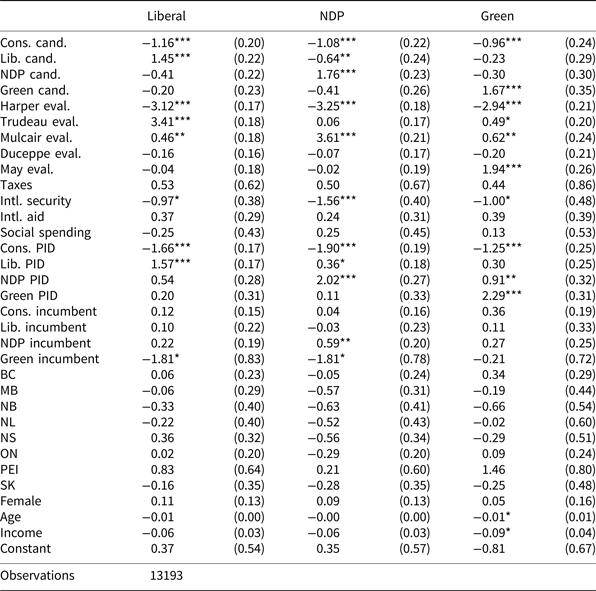
Multinomial logit model of vote choice, outside Quebec

Robust standard errors in parentheses.
Conservative vote choice is the base outcome of the dependent variable. Alberta is the reference category for province. None/Don't know is the reference category for party ID.
Candidate ratings are a decisive factor for 3.7% of voters. See online appendix for details on variables included in the model.
* p < 0.05, ** p < 0.01, *** p < 0.001.
Results
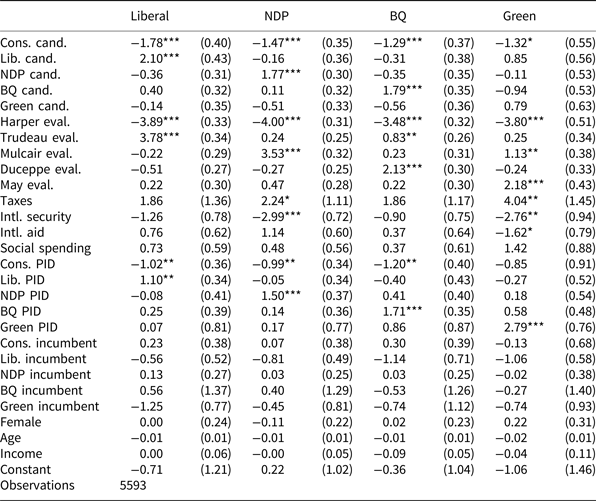
Our results begin in Table 1, which presents estimates of a multinomial logistic regression of vote choice for the four major parties outside of Quebec. The incumbent Conservative party is the reference group. We find that evaluations of the three main party leaders—Harper, Trudeau and Mulcair—exerted a significant effect on vote choice in the expected direction. Likewise, partisan identification exerts a significant effect on vote choice. Interestingly, we only find minimal effects of issue positions. Only views on international security (a scale including views on terrorism and military spending) seem to have been important to voters in deciding which party to vote for. We find incumbency effects for the NDP and the Green party, but not for the Conservative or Liberal parties. None of our provincial fixed effects are significant. The same is largely true for the model in Quebec (Table 2), although here positions on taxes also mattered to vote choice and incumbency status has no effect. Also, as expected, evaluations of Bloc Québécois leader Gilles Duceppe positively affected vote choice for the BQ in Quebec.
Multinomial logit model of vote choice, inside Quebec.

Robust standard errors in parentheses.
Conservative vote choice is the base outcome of the dependent variable. None/ Don't know is the reference category for party ID.
Candidate ratings are a decisive factor for 6.1% of voters. See online appendix for details on variables included in the model.
* p < 0.05, ** p < 0.01, *** p < 0.001.
Inspection of the four candidate assessments across three vote choice comparisons suggests that they significantly affect vote choice in seven of twelve cases. The five non-significant cases are either the effect of Green candidate assessments (in two of three comparisons), the effect of other candidate assessments on the likelihood of voting for the Green candidate or, in one case, the effect of NDP candidate evaluations on Liberal versus Conservative vote choice. Results are less consistent in the Quebec case, as presented in Table 2. In that instance, our five candidate ratings across four pairwise comparisons generate twenty coefficients. We find significant candidate results in seven of twenty cases. As others have observed (for example, Blais et al., Reference Blais, Gidengil, Dobrzynska, Nevitte and Nadeau2003: 662), local factors perhaps matter less in Quebec.
Moving beyond a visual inspection of our models, our first formal test is to consider how many individuals would hold a different counterfactual vote if the effect of local candidates was set to zero. According to the models presented in Tables 1 and 2, the percentage of individuals whose vote would differ in the absence of local candidate effects is 3.7 per cent in Canada outside of Quebec and 6.1 per cent in Quebec. We note that these results are largely consistent under various specifications of our key variables (see Tables A5 and A6 in online Appendix A) and under different sample restrictions (see Tables A7 through A12 in online Appendix A). Results are also robust to the inclusion of data on campaign spending by local candidates (Tables A15 and A16 in online Appendix A). These results are largely in line with Blais and colleagues (Reference Blais, Gidengil, Dobrzynska, Nevitte and Nadeau2003). After performing a similar analysis, Blais and colleagues (Reference Blais, Gidengil, Dobrzynska, Nevitte and Nadeau2003) find that the local candidate was a decisive factor for 5 per cent of voters.
Our second estimation occurs at the level of constituencies. We observe the distribution of predicted votes from the models discussed above and identify the winning candidate in each constituency. We then observe the distribution of votes within constituencies once local candidate effects are set to zero and identify the winning candidate in each constituency. When we compare these two distributions, we find that 10.4 per cent of constituencies would have elected a different MP in the absence of local candidate effects.Footnote 11 This provides important context to the first estimate presented above, as well as to the estimate of Blais and colleagues (Reference Blais, Gidengil, Dobrzynska, Nevitte and Nadeau2003) that local candidates are a decisive factor for approximately 5 per cent of voters. To establish that evaluations of local candidates matter to 5 per cent of voters does not inform us as to the importance of local candidates to the actual outcome and seat share of an election. After all, the percentage of voters for whom local candidates are decisive may live in non-competitive seats or they may be clustered in particular ridings. Our second estimate therefore provides important additional insights and suggests that local candidates were decisive in approximately 10 per cent of ridings.
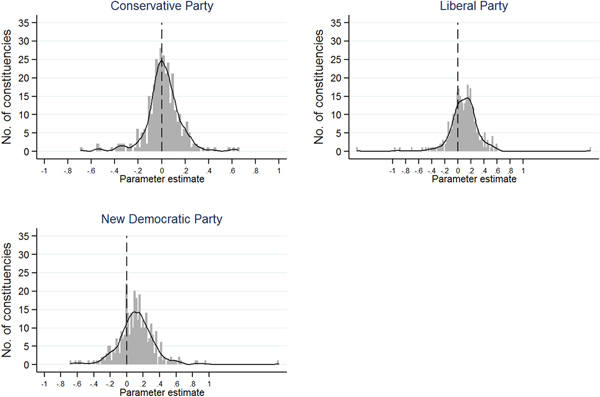
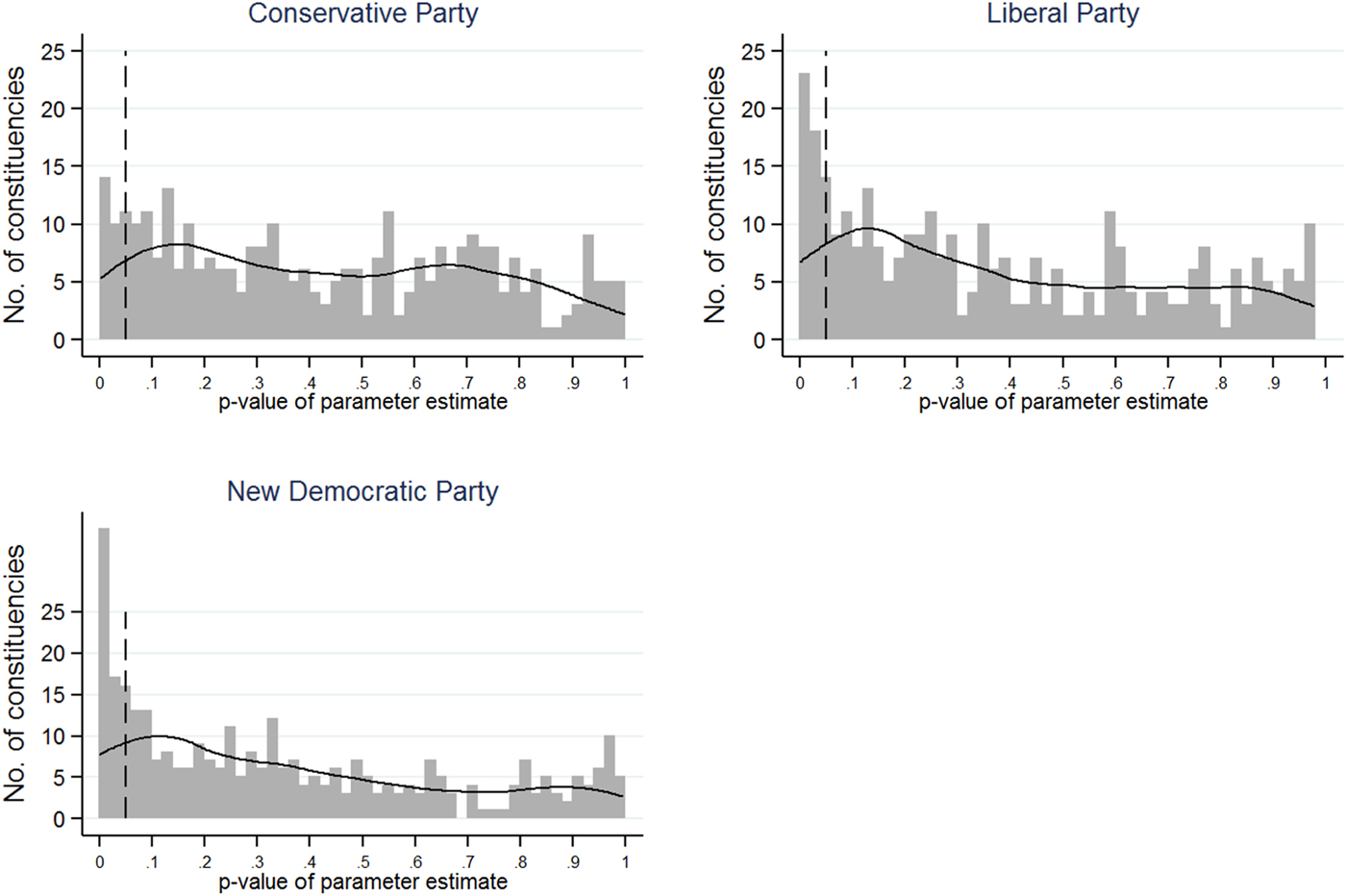
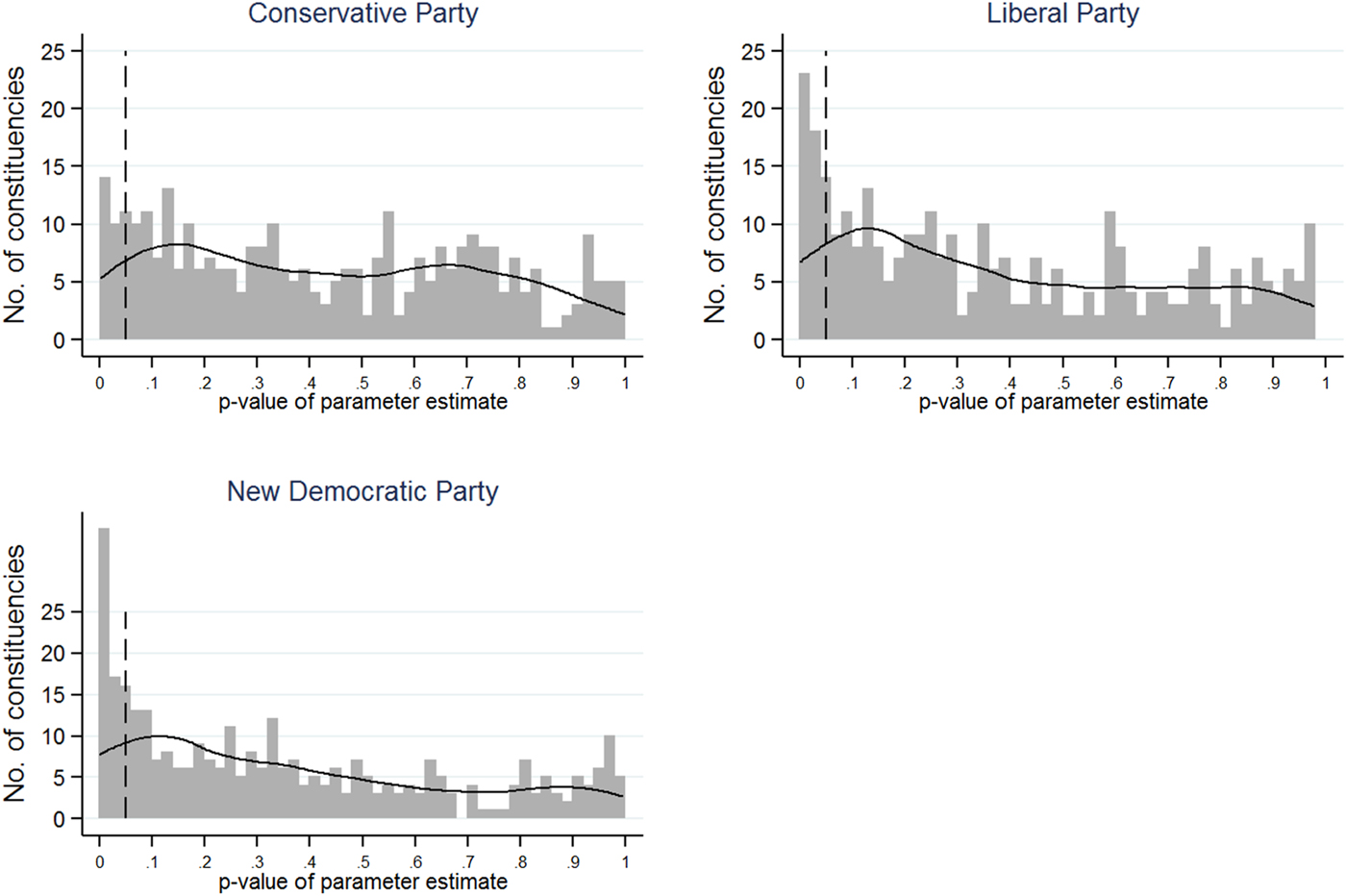
Finally, we consider the heterogeneity of local candidate effects across constituencies. Figure 1 presents the distribution of candidate effects from linear probability models of vote choice for a particular party. Two effects are of note. First, the average candidate effect hovers near zero, though it is more likely to be positive than negative. Second, there are nevertheless some constituencies that have sizeable effects. For example, when we identify the constituency effects for each party that are in the 80th percentile or higher, we find substantively impressive effects. For the top 20 per cent of Conservative, Liberal and NDP coefficients, the estimated effect of moving from neutrality to the highest candidate rating is a 21, 37, and 43 percentage point increase respectively in the likelihood of voting for the candidate. Since these are linear probability models and our candidate ratings range between −1 and +1 the reverse substantive decline would occur if individuals shift from neutral ratings to the most negative candidate rating. Figure 2 considers the statistical significance of these various effects. For each party, we show the distribution of p-values for the estimated local candidate effect. Almost 10 per cent (9.8%) of Conservative candidate ratings exercised a statistically significant effect on the vote. For Liberals, the share is 15.1 per cent. For New Democrats, it is 18.8 per cent. At the constituency level, this means that in 122 out of 325 ridings, at least one candidate from these parties had a significant effect.
Distribution of candidate effects on vote for their party

Distribution of p-values of candidate effects on vote for their party
Conclusion
In this paper, we use a uniquely large dataset to assess the effects of local candidates in a single Canadian parliamentary election. We present three different estimates of the local candidate effect. Across these three broadly different measures we have found consistent if sometimes modest effects attributable to local candidate evaluations. Local candidates matter decisively for about 4 per cent of voters and are decisive in between 10 per cent and 14 per cent of constituencies, whether we are considering their effects on seats or on the statistical importance of candidate ratings. Moreover, we have also shown substantial variation in just how much local candidate evaluations matter. Thus, while scholars are right in suggesting that the impact of local candidates can be decisive, this is likely not true in some or even most places.
When and where, then, do local candidates matter? Greater attention needs to be paid to better understanding the factors that contribute to the efficacy of local candidates. We think there are three promising avenues for this research. First, scholars could better understand how campaigns—especially candidate resources, partisan spending and volunteer engagement—condition local candidate effects. Second, scholars could search for naturally occurring experiments—for example, variation in exposure to candidates generated by redistricting—to obtain better causal identification of candidate effects. Third, scholars could work to better understand how much variation in candidate effects is conditioned by other factors, such as party issue positions and leader ratings. The objective here is not to consider local candidate effects in isolation, but to better understand how candidate effects vary with other factors and if the effects of candidate ratings act as a substitute for the effects of issue positions or party leaders. Ultimately, this might offer us a chance to classify different types of constituency races according to the importance of these factors.
Finally, our work raises important normative questions about the role and influence of members of Parliament. If local candidates do not matter much or often—if they are the proverbial nobodies 50 yards from Parliament Hill—what are the implications of this for the quality of local representation and influence in Parliament? While there do exist models that allow for substantial influence in Parliament for MPs absent a strong local power base, it is still important to consider the question of the value of locally contested elections if the local contestants do not matter all that much or all that often.
Supplementary material
To view supplementary material for this article, please visit https://doi.org/10.1017/S0008423918000367
Acknowledgements
This research was made possible by a SSHRC Insight Grant for the Local Parliament Project. The authors thank Maxime Héroux-Legault for research assistance and Eve Bourgeois for translation services.
The first six authors are listed in alphabetical order. Loewen and Rubenson are the principal investigators of the Local Parliament Project.