Introduction
On December 31, 2019, health authorities in Wuhan, China, reported a cluster of atypical pneumonia cases. Reference Cortes-Alvarez, Pineiro-Lamas and Vuelvas-Olmos1 Shortly after, the highly contagious causal agent, the severe acute respiratory syndrome coronavirus 2 (SARS-CoV-2), quickly spread in mainland China and overseas. On March 11, 2020, the World Health Organization (WHO) declared the coronavirus disease (COVID-19) a pandemic. Reference Krishnamoorthy, Nagarajan, Saya and Menon2 Experience from previous viral outbreaks has shown that the prevalence of mental health consequences tends to be higher than in normal circumstances. Reference Contreras, Burcescu and Dang3 Studies performed on different populations, report that frontline healthcare workers (FHCWs) attending COVID-19 patients experience increased depression, anxiety, and sleep disturbance, as well as post-traumatic stress symptoms. Reference Krishnamoorthy, Nagarajan, Saya and Menon2,Reference Lai, Ma and Wang4–Reference Robles, Rodriguez and Vega-Ramirez6
In Mexico, the first COVID-19 cases were confirmed on February 28, 2020. Reference Cortes-Alvarez, Pineiro-Lamas and Vuelvas-Olmos1,Reference Ibarra-Nava, Cardenas-de la Garza and Ruiz-Lozano7 By November 2022, the country topped the rankings among overall confirmed COVID-19 deaths (5th place). Studies report that Mexican FHCWs have experienced significant psychological distress. Reference Robles, Rodriguez and Vega-Ramirez6,Reference Cortes-Alvarez and Vuelvas-Olmos8–Reference Chapa-Koloffon, Jean-Tron and Avila-Hernandez10 This is of no surprise since Mexico ranks top among FHCWs confirmed deaths worldwide, with a mortality of 0.9 per 100000. Reference Erdem and Lucey11,Reference Dominguez-Varela12 Moreover, the deficit of FHCWs in Mexico, the innumerable shortages of medical supplies to face the pandemic, and the poor response by their government which has constantly downplayed the pandemic and has been harshly criticized due to lack of transparency about the actual data of confirmed COVID-19 cases and deaths, significantly increases the risk of psychological distress among Mexican FHCWs. Reference Ibarra-Nava, Cardenas-de la Garza and Ruiz-Lozano7
Two Mexican studies performed during the first (April to May, 2020) and second (May to August, 2020) phases of the COVID-19 pandemic reported high rates of depression, anxiety, and post-traumatic stress amidst HCWs. Gender (women), youth (≤ 39 years), being a FHCW, and a positive COVID-19 personal status, among others, were significantly associated with developing mental health symptoms in Mexican HCWs providing care to COVID-19 patients. Reference Robles, Morales-Chaine and Bosch5,Reference Robles, Rodriguez and Vega-Ramirez6 Other studies report that, among FHCWs, nurses, and medical residents are at an increased risk of developing mental health issues compared to attending physicians. Reference Hu, Kong and Li13,Reference Mendonca, Steil and Gois14 Thus, engaging the mental health needs of Mexican FHCWs is necessary.
This study aims to evaluate the prevalence and associated factors, including gender, age, and working position, as well as marital status, drug use, type of transportation, and depressive symptoms. Other factors evaluated include anxiety, post-traumatic stress, and insomnia symptoms among FHCWs in a third-level care hospital attending COVID-19 patients.
Methods
Study design
This was an observational, cross-sectional, and descriptive study conducted in the Centro Medico Zambrano-Hellion (CMZH), a third-level care hospital attending COVID-19 patients in northeast Mexico.
As of July 2020, a month before participants were recruited for the present study, Mexico topped the rankings among confirmed COVID-19 cases and deaths. Reference Cortes-Alvarez, Pineiro-Lamas and Vuelvas-Olmos1 At that time, instead of massive testing for COVID-19 within the population, Mexico implemented a sentinel surveillance system that counted and reported confirmed cases. Thus, Mexico had 1 of the lowest testing rates globally. This contrasts with the strategy implemented by other countries that were eventually considered successful in managing the pandemic. Moreover, the Mexican government accused medical doctors of wanting to profit from providing their services instead of trying to help people. The latter caused discontent among the population, leading to violence against FHCWs. Reference Ibarra-Nava, Cardenas-de la Garza and Ruiz-Lozano7 In April 2020, Aspera-Campos et al. reported that 48% of medical personnel experienced verbal or physical abuse, with women and nurses being at an increased risk. Reference Aspera-Campos, Hernandez-Carranco and Gutierrez-Barrera15 To make the situation worse, the excessive workload, intense working schedule, and underpayment, as well as supply shortages (i.e., personal protective equipment) significantly increase the mental health problems among FHCWs.
An email inviting people to join an online survey was sent to all the medical staff, which included nurses, attending physicians, and medical residents/fellows aged ≥ 18 years providing direct care to hospitalized patients infected with COVID-19 at the CMZH. Participants were recruited from August 28 (6 months after the first COVID-19 cases were confirmed in Mexico), Reference Ibarra-Nava, Cardenas-de la Garza and Ruiz-Lozano7 to November 30, 2020 (when participants either completed the survey or declined to participate). All participants had been providing care to COVID-19 patients during this timeframe. Within the platform, subjects had to read and sign an electronic informed consent to gain access to the online survey. After informed consent was signed, participants had to use their institutional email address to register, and the exact address could not be used more than once. Participants were inquired about any prior or current diagnosis and treatment for any psychiatric condition. Regardless of the answer provided, participants were allowed to complete the survey. All the information collected was anonymized. Participants who scored above the cut-off value in any questionnaire (described below) were referred to a mental health specialist for further workup. For final analyses, participants who did not sign the informed consent, those with a prior or current diagnosis and treatment for any psychiatric condition, and those with missing responses in any survey were excluded.
The Ethics (License No. P000392-SaludMental_COVID19-CEIC-CR003) and Research (License No. P000392-SaludMental_COVID19-CI-CR003) committees of our institution (License No. CONBIOETICA 19 CEI 011-2016-10-17 and COFEPRIS 20 CI 19 039 002, respectively) previously approved the study following the tenets of the Declaration of Helsinki.
Measurements
The online survey included questions about gender, age in years, marital status, and transportation mode, as well as use of non-medical drugs, occupation (attending physician, resident/fellow, or nurse), and daily working hours. The scores obtained from the 4 scales assessing depression, anxiety, distress, and insomnia symptoms, as well as the number of symptoms (scales above cut-off values) were also recorded.
Patient health questionnaire (PHQ-9)
The PHQ-9 is a self-report questionnaire to assess major depressive disorder. The scale corresponds to the 9 items in the Diagnostic and Statistical Manual of Mental Disorders (DSM-IV) for major depressive disorder in the last 2 weeks. Reference Arrieta, Aguerrebere and Raviola16 Items are rated on a 4-point Likert scale ranging from 0 (not at all) to 3 (nearly every day), for a total score ranging from 0 (lack of depressive symptoms) to 27 points (severe depressive symptoms). Reference Arrieta, Aguerrebere and Raviola16 According to a systematic review, a score of ≥10 yields an 88% sensitivity and specificity for depression and, thus, was considered the cut-off value for depression in this study. Reference Kroenke, Spitzer and Williams17 The PHQ-9 is validated in the Spanish language and tested in Mexicans with an internal consistency of 0.89. Reference Familiar, Ortiz-Panozo and Hall18
Generalized anxiety disorder (GAD)-7
The GAD-7 questionnaire is a self-report administered scale designed to evaluate the presence of generalized anxiety disorder symptoms, as listed in the DSM-IV. Scores for all 7 items range from 0 (not at all) to 3 (nearly every day); thus, the total score ranges from 0 to 21. The original study uses the following cutoff values for anxiety: minimal (0 – 4), mild (5 – 9), moderate (10 – 14), and severe (> 14). The Spanish version of GAD-7 reports a cut-off score of ≥ 10, yields sensitivity and specificity for anxiety of 86.8% and 93.4%, respectively. Reference Garcia-Campayo, Zamorano and Ruiz19 The questionnaire is validated in Spanish with an excellent internal consistency (0.936). Reference Garcia-Campayo, Zamorano and Ruiz19
Impact of the event scale-revised (IES-R)
The IES-R is a self-report scale used to assess the response to a stressful life event. The event considered for this questionnaire was the COVID-19 pandemic in the present study. A cut-off value of ≥ 33 has a 91% sensitivity and 82% specificity for post-traumatic stress disorder. Reference Creamer, Bell and Failla20 The IES-R is validated in the Spanish language with an internal consistency of 0.98. Reference Caamano, Fuentes, Gonzalez, Melipillan, Sepulveda and Valenzuela21
Insomnia severity index (ISI)
The ISI is a 7-item self-administered report that evaluates the severity of initial, middle, and late insomnia. Items are rated on a 5-point Likert scale ranging from 0 to 4 for a total score of 28. A cut-off value of ≥ 10 renders an 86.1% sensitivity and 87.7% for detecting insomnia. Reference Morin, Belleville, Belanger and Ivers22 The ISI is validated in the Spanish language with an internal consistency of 0.82. Reference Fernandez-Mendoza, Rodriguez-Munoz and Vela-Bueno23
Statistical analysis
Data were entered into an Excel spreadsheet (v. 365, 2020) (Microsoft Corporation, Redmond, WA, USA) and analyzed using IBM Statistical Package for Social Sciences (SPSS version 23) (IBM Inc., Armonk, NY, USA). Normality was evaluated with the Shapiro-Wilks test. Normally distributed data were described with means and standard deviations, while skewed data were described with medians and interquartile ranges. Categorical variables were presented in terms of frequencies and percentages. Comparisons between groups of participants that endorsed symptoms vs. participants that did not endorse symptoms of each mental health outcome were performed concerning variables of interest including gender, age, working position, and marital status, as well as type of transport used, recreational drug use, and number of working hours. These were analyzed with the chi-squared test. Binary logistic regression models were used to calculate unadjusted and adjusted odds ratios (ORs) and 95% confidence intervals (CIs) between potential risk factors associated with the development of each mental health outcome. The Hosmer-Lemeshow goodness-of-fit measure was estimated for the model. A P - value < 0.05 was considered statistically significant.
Results
A total of 325 FHCWs, including attending physicians, residents or fellows, and nurses, worked at our hospital during the study period. Thus, they were invited to participate in the electronic survey. Of those, 129 declined to participate by either not signing the informed consent or not entering the survey at all, 41 reported a personal history of a psychiatric condition, and 24 had missing responses. The total sample consisted of 131 participants, 83 (63%) women, and 48 (37%) men. The mean age of the population was 33.9 ± 8.2 years (range: 21 – 71 years). 57 (43%) participants were attending physicians, 26 (20%) were residents or fellows, and 48 (37%) were nurses. Most participants (n = 87, 66%) had work shifts of 12 or more hours per day (Table 1). 73 (56%) participants had no symptoms, whereas 24 (18%) had 3 or 4 symptoms. Figure 1 shows the number of symptoms (scales above cut-off values) for attending physicians, residents/fellows, and nurses.
Sociodemographic characteristics

a Symptoms include depression (PHQ-9 ≥ 10), anxiety (GAD-7 ≥ 10), distress (IES-R ≥ 33), and insomnia (ISI ≥ 10).
Note: *PHQ-9, Patient Health Questionnaire-9; GAD-7, Generalized Anxiety Disorder-7; IES-R, Impact of Event-Scale Revised; ISI, Insomnia Severity Index; Mild-Mod, mild to moderate; AP, attending physician.
Percentage of attending physicians, residents/fellows, and nurses reporting positive (> cut-off values) symptoms in 1, 2, 3, or all 4 scales.

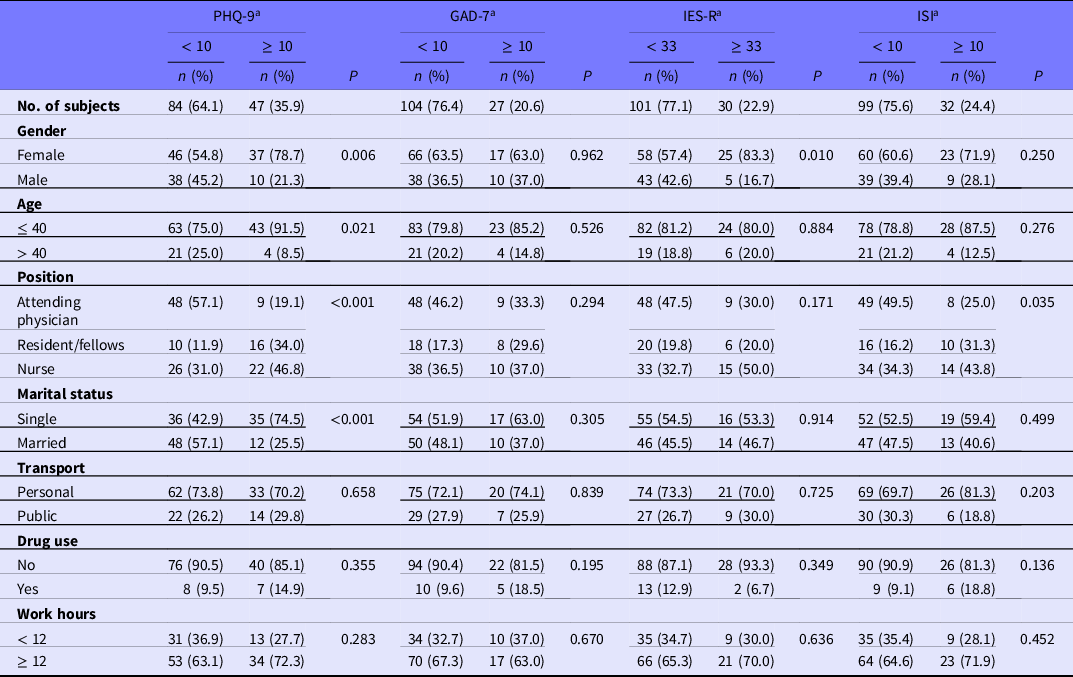
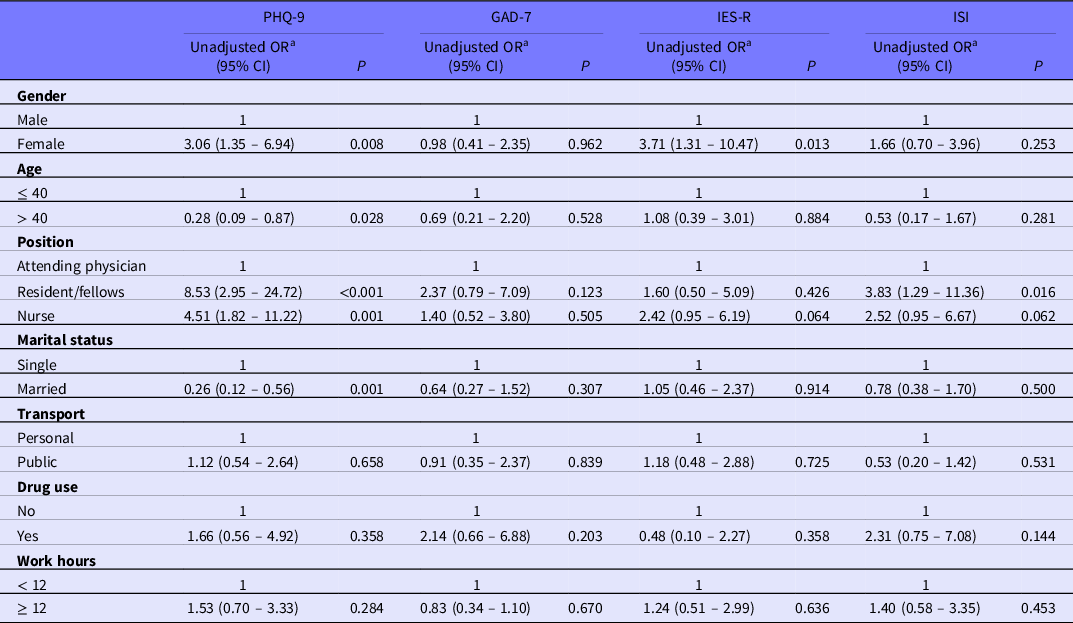
The prevalence of depression, anxiety, post-traumatic stress, and insomnia was 35.9%, 20.6%, 22.9%, and 24.4%, respectively (Table 2). Significantly more women reported depression (79% vs. 21%, P = 0.006) and post-traumatic stress (83% vs. 17%, P = 0.010) compared with men. Depression was also more prevalent among FHCWs who were single (75% vs. 25%, P < 0.001) and under 40 years of age (92% vs. 8%, P = 0.021). Among single FHCWs, most of them were women (72% vs. 28%, P = 0.029) and under 40 years of age (93% vs. 7%, P < 0.001). Table 3 depicts the unadjusted ORs estimating the association between potential risk factors and each mental health symptom (depression, anxiety, post-traumatic stress, and insomnia). Multivariable analysis (adjusted ORs) revealed that residents/fellows (OR 7.64, 95% CI 2.30 – 25.35, P = 0.001) and nurses (OR 2.93, 95% CI 1.09 – 7.87, P = 0.033) reported severe levels of depression compared to attending physicians. Also, married (OR 0.38, 95% CI 0.16 – 0.90, P = 0.028) participants reported less severe levels of depression (Table 4). The Hosmer-Lemeshow goodness-of-fit model yielded a χ Reference Krishnamoorthy, Nagarajan, Saya and Menon2 = 4.546, df = 7, P = 0.715, which means that the multivariable PHQ-9 model analysis fitted adequately for our purposes.
Comparison between groups of participants that endorsed symptoms vs participants that do not endorse symptoms of each mental health outcome

Note: aAll comparisons were made with the chi-square test.
*PHQ-9, Patient Health Questionnaire-9; GAD-7, Generalized Anxiety Disorder-7; IES-R, Impact of Event-Scale Revised; ISI, Insomnia Severity Index.
Potential risk factors associated with the development of each mental health outcome in front-line healthcare workers

Note: aUnadjusted OR = odds ratio (95% CI = 95% confidence interval) for univariate analyses of individual exposure variables of interest.
PHQ-9, Patient Health Questionnaire-9; GAD-7, Generalized Anxiety Disorder-7; IES-R, Impact of Event-Scale Revised; ISI, Insomnia Severity Index.
Multivariate logistic regression models for depression (PHQ-9) in front-line healthcare workers

Note: *PHQ-9, Patient Health Questionnaire-9; HL-GOF, Hosmer-Lemeshow goodness-of-fit.
Finally, we performed a sub-analysis estimating the association of potential risk factors for developing mental health symptoms between residents/fellows (n = 26) and nurses (n = 48). Although not significant, univariate analysis revealed nurses were more likely to experience less severe levels of depression (OR 0.53, 95% CI 0.20 – 1.40, P = 0.199), anxiety (OR 0.59, 95% CI 0.20 – 1.75, P = 0.344), post-traumatic stress (OR 1.52, 95% CI 0.51 – 4.54, P = 0.458), and insomnia (OR 0.66, 95% CI 0.24 – 1.80, P = 0.416) compared with residents/fellows.
Limitations
Limitations of our study include the cross-sectional design, sample size, and the absence of a control group. Our analysis was performed in a private hospital providing care to COVID-19 patients, where a shortage of medical supplies and personal protective equipment was not an issue, making results difficult to extrapolate to public institutions. We did not perform a sub-analysis of participants based on different medical specialties or working areas (i.e., intensive care unit). The small sample size, however, and the fact that the hospital was converted to provide service exclusively to COVID-19 patients, the medical staff was constantly changed between areas, making sub-analysis difficult. Also, due to the lack of sufficient healthcare personnel, the working shift of FHCWs constantly changed between day and night shifts. Thus, a sub-analysis comparing the risk of developing mental health outcomes between FHCWs with day and night shifts was impossible. The study’s strengths include that, to our knowledge, this is the first study evaluating mental health symptoms of FHCWs providing care at a private hospital in Mexico. Also, we excluded FHCWs with prior or current mental health disorders or those using psychiatric drugs.
Discussion
This study evaluated the psychological impact of COVID-19 in a Mexican sample of FHCWs attending COVID-19 patients. Our findings showed that the prevalence of depression, generalized anxiety, post-traumatic stress, and insomnia symptoms were 36%, 21%, 23%, and 24%, respectively. In multivariate analysis, women, residents/fellows and nurses, and being married were significant risk factors for depression. Although not significant, residents/fellows were more likely to experience any symptom compared with nurses.
A month after the first COVID-19 cases were reported in Wuhan (January 29 to February 3, 2020), Lai et al. performed a survey-based study evaluating the mental health outcomes among Chinese frontline- and non - FHCWs exposed to COVID-19 patients. Reference Lai, Ma and Wang4 Compared to our study, the authors reported a lower prevalence of depression (18% vs. 36%), anxiety (16% vs. 21%), and insomnia (12% vs. 24%) among FHCWs. However, the prevalence of post-traumatic stress was higher (42% vs. 23%). Reference Lai, Ma and Wang4 The timing of participant recruitment (early vs. second wave) might explain these results. Several repeated cross-sectional studies report that the prevalence of depression consistently increased from the first to the second wave of the pandemic. In contrast, other mental health symptoms, including anxiety, insomnia, and post-traumatic stress, showed variable changes between each wave of the COVID-19 pandemic. Reference Magnavita, Soave and Antonelli24–Reference Obeidat, Dodin and Hawari26 The type of occupational adversities faced by FHCWs varied during the pandemic course. The uncertainty associated with the management of COVID-19 patients, the lack of readiness and safety measures, Reference Magnavita, Soave and Antonelli24 fear of infection and stigma, Reference Lai, Ma and Wang4 and separation from families were prevalent during the early stages of the pandemic. In contrast, the death of relatives, colleagues, and patients and the prolonged workload and isolation were everyday stressors during later stages. Reference Jáuregui Renaud, Cooper-Bribiesca and Martínez-Pichardo25
Robles et al. performed a multicenter cross-sectional study to evaluate mental health problems among Mexican FHCWs providing care to patients in COVID-19 and non-COVID-19 centers. Reference Robles, Rodriguez and Vega-Ramirez6 This study was conducted during the first phase (April 17 to May 7, 2020) of the pandemic in Mexico, defined by the WHO as the time interval when a country experiences cases related to well-defined clusters associated with everyday exposure, geographical location, and time. Reference Robles, Morales-Chaine and Bosch5 A second study was conducted by the same group by the second phase (May 8), described by the Mexican Undersecretary as the community-spread stage in Mexico, and August 18, 2020, when according to the Undersecretary, the situation in the country was ‘dreadful.’ Reference Robles, Morales-Chaine and Bosch5 Between the first and second study, the prevalence of depression significantly increased (38% vs. 43%), whereas the rates of anxiety (16% vs. 15%) and post-traumatic stress (38% vs. 40%) did not significantly change. Reference Robles, Morales-Chaine and Bosch5,Reference Robles, Rodriguez and Vega-Ramirez6 After analyzing the mental health outcomes among FHCWs recruited after the previous studies (August and November, 2020), we report a somewhat lower rate of depression (36%), a higher rate of anxiety (21%), but a significantly lower rate of post-traumatic stress (23%). The fact that different scales and cut-off values were used to measure mental health symptoms between both studies and that participants in our study were all providing care at a converted-to-COVID-19-hospital with all the safety measures required, might have led to lower rates of depression and post-traumatic stress.
A meta-analysis including Asian studies performed by Pappa et al. reported that women and nurses providing care to COVID-19 patients exhibited higher rates of depression, anxiety, and insomnia than men and medical staff, respectively. Reference Pappa, Ntella and Giannakas27 These results are supported by a systematic review of the psychological impact of the COVID-19 pandemic on Western FHCWs. Reference Danet Danet28 Nevertheless, most studies did not perform a sub-analysis comparing the prevalence of symptoms between residents and attending (or primary) physicians. Reference Pappa, Ntella and Giannakas27,Reference Danet Danet28 In the United States, Schecter et al. also reported a higher prevalence of mental health symptoms among nurses compared to attending physicians, residents, and fellows. Reference Shechter, Diaz and Moise29 Contrariwise, both studies performed in Mexican HCWs by Robles et al., report lower psychiatric symptoms among nurses and attending physicians compared with medical residents and general practitioners. Reference Robles, Morales-Chaine and Bosch5,Reference Robles, Rodriguez and Vega-Ramirez6
In this study, we found that nurses and residents/fellows experienced significantly more depression and insomnia compared to attending physicians. The prevalence of depression among nurses was 46%. This is similar to the 44% prevalence of depression reported by Hu et al. among nurses providing care to COVID-19 patients in China. Reference Hu, Kong and Li13 Studies suggest that the intense nature of the nurse-patient relationship might result in the high prevalence of burnout and mental health issues among nurses. Reference Chou, Li and Hu30 Gray-Toft and Anderson propose 7 stressors among nurses, including excessive workload, conflict with other nurses, and lack of social support, as well as uncertainty concerning treatment administered, inadequate preparation, conflict with physicians, and death and dying of patients. Reference Gray-Toft and Anderson31 Lou et al. reported that nurses experienced significantly more distress, burnout, and maladaptive coping strategies than physicians during the COVID-19 pandemic, including substance use, denial, behavioral disengagement, and self-blame. Reference Lou, Montreuil and Feldman32 An integrative review by Sastrawan et al. reported that nurses experience less mental health issues by establishing a culture of fostering mutual support among colleagues, promoting teamwork and empowerment, and using coping strategies to preserve integrity, including self-preservation, accepting limitations, and compensation. Reference Sastrawan, Newton and Malik33 Thus, providing psychological and social support services endorsing adaptive coping strategies is necessary to prepare nurses for future public health crises. Reference Lou, Montreuil and Feldman32,Reference Dobson, Malpas and Burrell34
Even before the COVID-19 pandemic, multiple studies correlate medical residency with the development of psychiatric comorbidities among residents and fellows. Reference Mendonca, Steil and Gois14 Pre-pandemic studies on Mexican residents report a lower prevalence of depressive and anxiety symptoms ranging from 25 - 80% and 39 - 70%, respectively. Reference Dávila-Valero, Alfaro-Mejía and Padilla-Ochoa35,Reference Jimenez-Lopez, Arenas-Osuna and Depression36 Such a finding contrasts with a 2015 meta-analysis by Mata et al., reporting a lower pooled prevalence of depressive symptoms of 29% among resident physicians. Reference Mata, Ramos and Bansal37 In the present study, we did not find any significant risk factors associated with endorsing mental health symptoms among residents and fellows. We propose several hypotheses as to why residents from Mexico experience more psychiatric symptoms both before and during the COVID-19 pandemic. First, mistreatment among medical residents in Mexico is highly prevalent. A study performed in Mexico revealed that 84% of medical residents experienced some form of abuse during their residency, mainly from residents of higher hierarchy and attending physicians. Reference Derive, Martínez and Vera38 Second, a significant number of residents (58%) in our study reported working daily shifts of > 12 hours. Toral-Villanueva et al. reported that working > 12 hours per day tripled the risk of burnout in a study performed on Mexican residents. Reference Toral-Villanueva, Aguilar-Madrid and Juarez-Perez39 Moreover, as reported by Derive et al., 64% of Mexican residents in their study report work overload as a form of punishment. Reference Derive, Martínez and Vera38 Also, residents in Mexico earn 4 times less than US residents, which may eventually lead to emotional distress, mainly depression. Reference Collier, McCue, Markus and Smith40 Finally, as of September 2020, Mexico topped the worldwide rank of COVID-19-related deaths among HCWs. At least 1320 Mexican HCWs died due to COVID-19, representing 1.8% of the total death toll reported at that time. Reference Dominguez-Varela12 As it is obvious, the increased risk of contracting COVID-19 while at work, fear of transmitting the disease to family, and the social stigma among HCWs increased stress levels among medical personnel. Reference Chu, Lee and Stotts41
In the present sample, women, being single, and of young age (≤ 40 years) were deemed as significant risk factors for developing depression among FHCWs providing care to COVID-19 patients. This is consistent with the studies by Robles and coworkers reporting significantly increased depression, insomnia, and post-traumatic stress disorder in Mexican FHCWs who are single, women, and under 40 years of age. Reference Robles, Morales-Chaine and Bosch5,Reference Robles, Rodriguez and Vega-Ramirez6 Hormonal influences and genetic, environmental, and social factors may contribute to the increased prevalence of mental health disorders in women compared to men. Reference Kuehner42 Aside from their professional role as FHCWs, women are usually the primary caregivers within their families and, thus, experience more significant concerns than men about the health of their relatives. Reference Rabbani, Khan, Piryani, Khan and Abid43 Moreover, evidence suggests women also experienced an increased workload related to attending to childcare needs, which in many countries is conducted by women in response to school closures. Reference Borrescio-Higa and Valenzuela44 Therefore, we believe that sociocultural expectations could at least partially explain the increased prevalence of mental health symptoms in women. For future pandemics, we argue in favor of policies that alleviate financial stress, provide psychological support, and attend to the needs of women to reduce the risk of developing mental health problems. Reference Borrescio-Higa and Valenzuela44
Marital status also seems to play a role in developing psychological issues among FHCWs. We found a higher prevalence of depression among non-partnered FHCWs. Interestingly, most single FHCWs were women (72%) and under 40 years of age (93%). These findings were also reported in Mexico during the H1N1 pandemic (2009), where there was a higher risk of depression, anxiety, and stress among women and single people. Reference Elizarraras-Rivas, Vargas-Mendoza and Mayoral-Garcia45 Teng et al. reported that marriage was significantly associated with severe depression among men FHCWs, whereas being single was related to severe mental health problems in women. Reference Teng, Su and Chen46 Marital satisfaction enhances self-satisfaction and mental well-being in women and men, leading to less depression, anxiety, and stress. Reference Abbas, Aqeel and Abbas47 However, women with distressing emotions are more likely to experience comfort from their children or the love of their spouses. Reference Teng, Su and Chen46
The experience of the previous SARS pandemic in 2005 showed that vulnerability and loss of control, the human-to-human transmissibility of the virus, self-health and health of others, and changes in work, as well as being isolated are potential sources of distress among HCWs. Reference Wong, Yau and Chan48 Although the COVID-19 pandemic seems to be over, at least in many countries, mental health disorders developed during the pandemic among FHCWs continue to cause havoc. A large multicenter prospective cohort, the COVID-19 Health care wOrkErs (HEROES) study, which recruited over 34000 HCWs from 26 countries in Latin America, Europe, Africa, and the Middle-East, as well as Asia, aims to describe and track longitudinal trajectories of psychiatric symptoms and disorders among HCWs at different phases of the COVID-19 pandemic. Reference Mascayano, van der Ven and Moro49 The study is ongoing, and countries are currently collecting data. Hopefully, this study will provide valuable information that allows healthcare systems and policymakers to develop evidence-based interventions to improve the mental health of HCWs. Reference Melnyk, Kelly and Stephens50
Conclusions
In this Mexican population of FHCWs providing care to COVID-19 patients at a private hospital, the prevalence of depressive, anxiety, post-traumatic stress, and insomnia symptoms was documented in 36%, 21%, 23%, and 24% of participants, respectively. While residents/fellows and nurses experienced more depression and insomnia, men and being married were associated with less post-traumatic stress and depression, respectively. Health authorities must address psychiatric symptoms among FHCWs, particularly in medical residents and fellows. Timely detection and management by a mental health specialist could reduce the risk of developing mental health problems among FHCWs.
Acknowledgments
The authors would like to thank Dr. Jesus Alberto Cardenas de la Garza for his advice during the development of this manuscript.
Author contribution
Conceptualization (ALS, CAAG, DESM); Methodology (ALS, RERL, JJGC); Validation (MFMR, GTA); Formal Analysis (RERL, JJGC); Investigation (ALS, CAAG, DESM, MFMR); Resources (CAAG, DESM, MFMR, GTA); Data Curation (ALS, RERL, JJGC); Writing – Original Draft (ALS, RERL); Writing – Review & Editing (ALS, CAAG, DESM, RERL, MDMR, JJGC, GTA); Visualization (ALS, RERL, JJGC); Supervision (CAAG, DESM, MFMR, GTA); Project Administration (ALS, CAAG, DESM, MFMR, GTA)
Competing interests
The author(s) declare no potential conflicts of interest concerning this article’s research, authorship, and publication.
Abbreviations
CMZH, Centro Medico Zambrano-Hellion; COVID-19, Coronavirus Disease; DSM-IV, Diagnostic and Statistical Manual of Mental Disorders; FHCWs, Frontline Healthcare Workers; GAD-7, Generalized Anxiety Disorder-7; HEROES, COVID-19 Health care wOrkErs study; IES-R, Impact of the Event Scale-Revised; ISI, Insomnia Severity Index; PHQ-9, Patient Health Questionnaire-9; SARS-CoV-2, Severe Acute Respiratory Syndrome Coronavirus 2; WHO, World Health Organization