Introduction
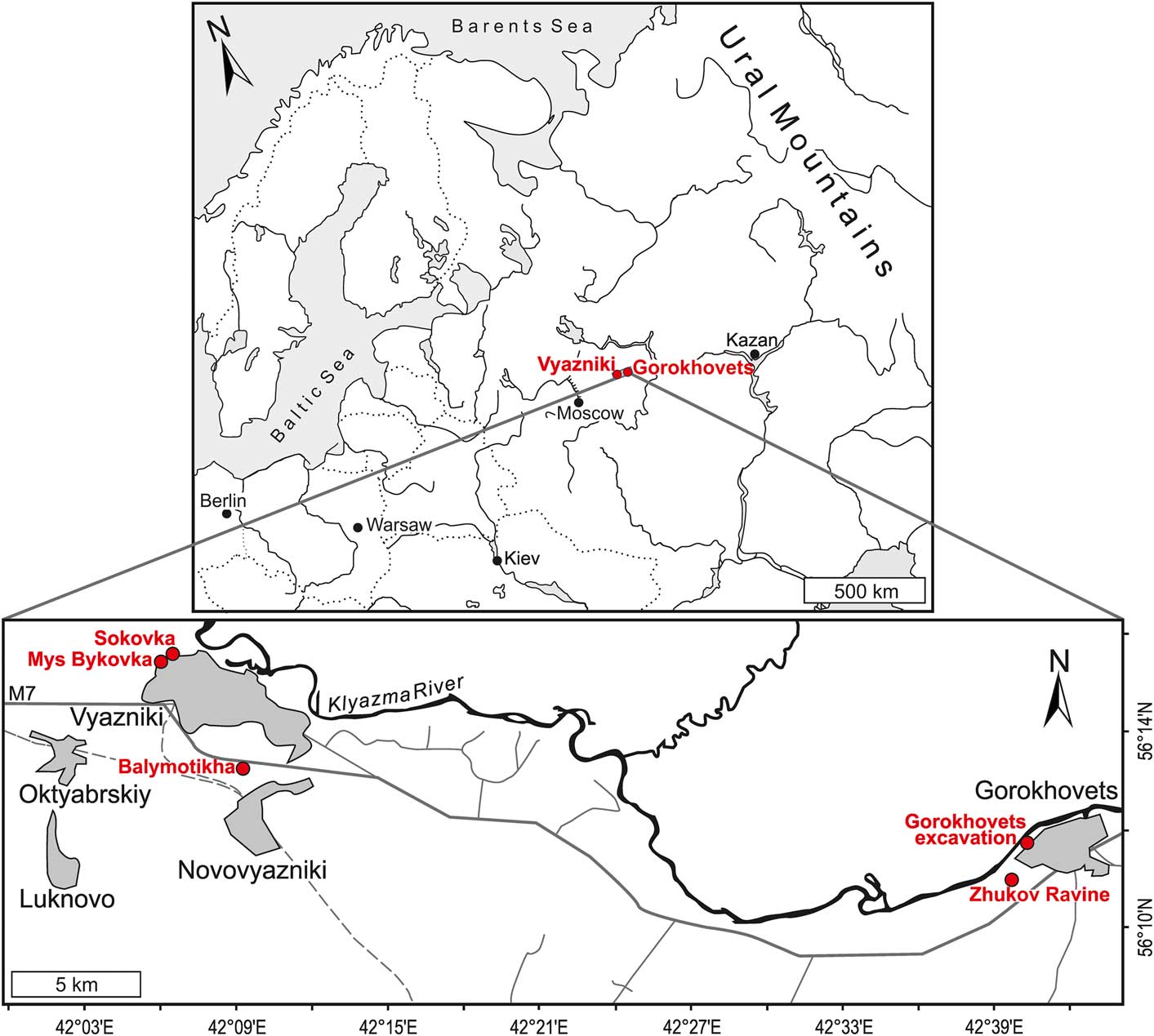
To better understand the processes in continental environments associated with the end-Permian mass extinction, which is known from the marine realm as the severest of the “Big Five” mass extinctions in Earth’s history (e.g., Benton, Reference Benton1995, Reference Benton2003), the late Permian–Early Triassic transition in continental sections is currently studied in several regions. These include key sections in the Karoo Basin of South Africa (e.g., Smith and Botha-Brink, Reference Smith and Botha-Brink2014; Gastaldo et al., Reference Gastaldo, Kamo, Neveling, Geissman, Bamford and Looy2015, Reference Gastaldo, Neveling, Looy, Bamford, Kamo and Geissman2017; Neveling et al., Reference Neveling, Gastaldo, Kamo, Geissman, Looy and Bamford2016), the Junggar Basin in Northwest China (e.g., Cao et al., Reference Cao, Wang, Liu, Shen and Summons2008; Thomas et al., Reference Thomas, Tabor, Yang, Myers, Yang and Wang2011; Wan et al., Reference Wan, Yang, Liu and Wang2017), the Yangtze Platform in South China (e.g., Peng and Shi, Reference Peng and Shi2009; Shen et al., Reference Shen, Crowley, Wang, Bowring, Erwin, Sadler, Cao, Rothman, Henderson, Ramezani, Zhang, Shen, Wang, Wang, Mu, Li, Tang, Liu, Liu, Zeng, Jiang and Jin2011; Chu et al., Reference Chu, Yu, Tong, Benton, Song, Huang, Song and Tian2016; Zhang et al., Reference Zhang, Cao, Liu, Mu, Zheng, Liu, Xiang, Liu and Shen2016), the Central European Basin in the Netherlands, Poland, and Germany (e.g., Szurlies et al., Reference Szurlies, Geluk, Krijgsman and Kürschner2012; Becker and Nawrocki, Reference Becker and Nawrocki2014; Scholze et al., Reference Scholze, Schneider and Werneburg2016, Reference Scholze, Wang, Kirscher, Kraft, Schneider, Götz, Joachimski and Bachtadse2017a), several basins in Siberia (e.g., Reichow et al., Reference Reichow2009; Sadovnikov, Reference Sadovnikov2015; Stordal et al., Reference Stordal, Svensen, Aarnes and Roscher2017), and the East European Platform in the European part of Russia (e.g., Taylor et al., Reference Taylor, Tucker, Twichett, Kearsey, Benton, Newell, Surkov and Tverdokhlebov2009; Newell et al., Reference Newell, Benton, Kearsey, Taylor, Twitchett and Tverdokhlebov2012; Sennikov and Golubev, Reference Sennikov and Golubev2012, Reference Sennikov and Golubev2017; Aref’ev et al., Reference Aref’ev, Kuleshov and Pokrovskii2015). Among these, the key sections of the late Permian–Early Triassic continental deposits of the Moscow Syneclise near the towns of Vyazniki and Gorokhovets (Vladimir Region, European Russia) (Fig. 1) have been increasingly studied for sedimentology (e.g., Newell et al., Reference Newell, Sennikov, Benton, Molostovskaya, Golubev, Minikh and Minikh2010), lithostratigraphy (Golubev et al., Reference Golubev, Sennikov, Minikh, Minikh, Kukhtinov, Balabanov and Silantiev2012a, Reference Golubev, Minikh, Balabanov, Kukhtinov, Sennikov and Minikhb), magnetostratigraphy (Balabanov et al., Reference Balabanov, Fetisova, Golubev and Sennikov2016), paleobotany (e.g., Naugolnykh, Reference Naugolnykh2005; Krassilov and Karasev, Reference Krassilov and Karasev2008, Reference Krassilov and Karasev2009; Karasev, Reference Karasev2013), insects (e.g., Aristov et al., Reference Aristov2013), ostracods (e.g., Lozovsky and Kukhtinov, Reference Lozovsky and Kukhtinov2007; Kukhtinov et al., Reference Kukhtinov, Lozovsky, Afonin and Voronkova2008; Molostovskaya, Reference Molostovskaya2010; Voronkova, Reference Voronkova2014), conchostracans (e.g., Scholze et al., Reference Scholze, Golubev, Niedźwiedzki, Sennikov, Schneider and Silantiev2015), bivalves (Silantiev, Reference Silantiev2014, Reference Silantiev2016), fishes (Minikh et al., Reference Minikh, Minikh and Andrushkevich2014, Reference Minikh, Arefiev and Golubev2015a, Reference Minikh, Minikh, Sennikov, Golubev and Koganb; Lebedev et al., Reference Lebedev, Sennikov, Golubev, Krupina, Niedzwiedzki and Sulej2015), and tetrapods (e.g., Sennikov and Golubev, Reference Sennikov and Golubev2005, Reference Sennikov and Golubev2006, Reference Sennikov and Golubev2012), including vertebrate coprolites (e.g., Owocki et al., Reference Owocki, Niedźwiedzki, Sennikov, Golubev, Janiszewska and Sulej2012; Bajdek et al., Reference Bajdek, Qvarnström, Owocki, Sulej, Sennikov, Golubev and Niedźwiedzki2016, Reference Bajdek, Owocki, Sennikov, Golubev and Niedźwiedzki2017; Niedźwiedzki et al., Reference Niedźwiedzki, Bajdek, Qvarnström, Sulej, Sennikov and Golubev2016; Sennikov, Reference Sennikov2017).
Geographic positions of the studied sections near the towns Vyazniki and Gorokhovets in the Vladimir region, European Russia (maps after Scholze et al., Reference Scholze, Golubev, Niedźwiedzki, Sennikov, Schneider and Silantiev2015).

Our present focus is on an objective and reproducible taxonomical description of the conchostracans (Crustacea, Branchiopoda) of the Moscow Syneclise to improve their utility in biostratigraphy. The conchostracans from the Permian intervals of the studied sections are described herein for the first time. The present work was motivated by a long tradition of studies of Permian–Triassic conchostracans from other sections in Russia (e.g., Lutkevich, Reference Lutkevich1937, Reference Lutkevich1938; Novozhilov, Reference Novozhilov1946, Reference Novozhilov1970; Molin and Novozhilov, Reference Molin and Novozhilov1965; Lipatova and Lopato, Reference Lipatova and Lopato2000; Orlova and Sadovnikov, Reference Orlova and Sadovnikov2009). Occurrences of late Permian and Early Triassic conchostracans have been reported with increasing frequency from numerous other regions, such as Argentina (e.g., Tassi et al., Reference Tassi, Monti, Gallego, Zavattieri and Lara2013), Brazil (Ferreira-Oliveira and Rohn, Reference Ferreira-Oliveira and Rohn2010), Madagascar (Shen et al., Reference Shen, Garassino and Teruzzi2002), Kenya (Shen, Reference Shen2006), Jordan (Scholze et al., Reference Scholze, Abu Hamad, Schneider, Golubev, Sennikov, Voigt and Uhl2017b), India (e.g., Ghosh, Reference Ghosh2012), North China (e.g., Zhang et al., Reference Zhang, Niu, Tian, Xing, Su, Cao and Wang2012), South China (e.g., Chu et al., Reference Chu, Tong, Yu, Song and Tian2013, Reference Chu, Yu, Tong, Benton, Song, Huang, Song and Tian2016), Poland (e.g., Ptaszyński and Niedźwiedzki, Reference Ptaszyński and Niedźwiedzki2004, Reference Ptaszyński and Niedźwiedzki2006), and Germany (e.g., Kozur and Seidel, Reference Kozur and Seidel1983; Scholze et al., Reference Scholze, Schneider and Werneburg2016). Because of their wide paleogeographic distribution, conchostracans are becoming an important tool for the fine-scale biostratigraphy of continental sedimentary deposits (Schneider and Scholze, Reference Schneider and Scholze2016). It is hoped that the conchostracan biostratigraphic framework proposed here may serve as a basis for future studies of the regional paleoenvironmental processes associated with the end-Permian mass extinction (i.e., its causes and effects in the continental realm) and will strengthen the correlation between marine and nonmarine sections.
Geologic setting
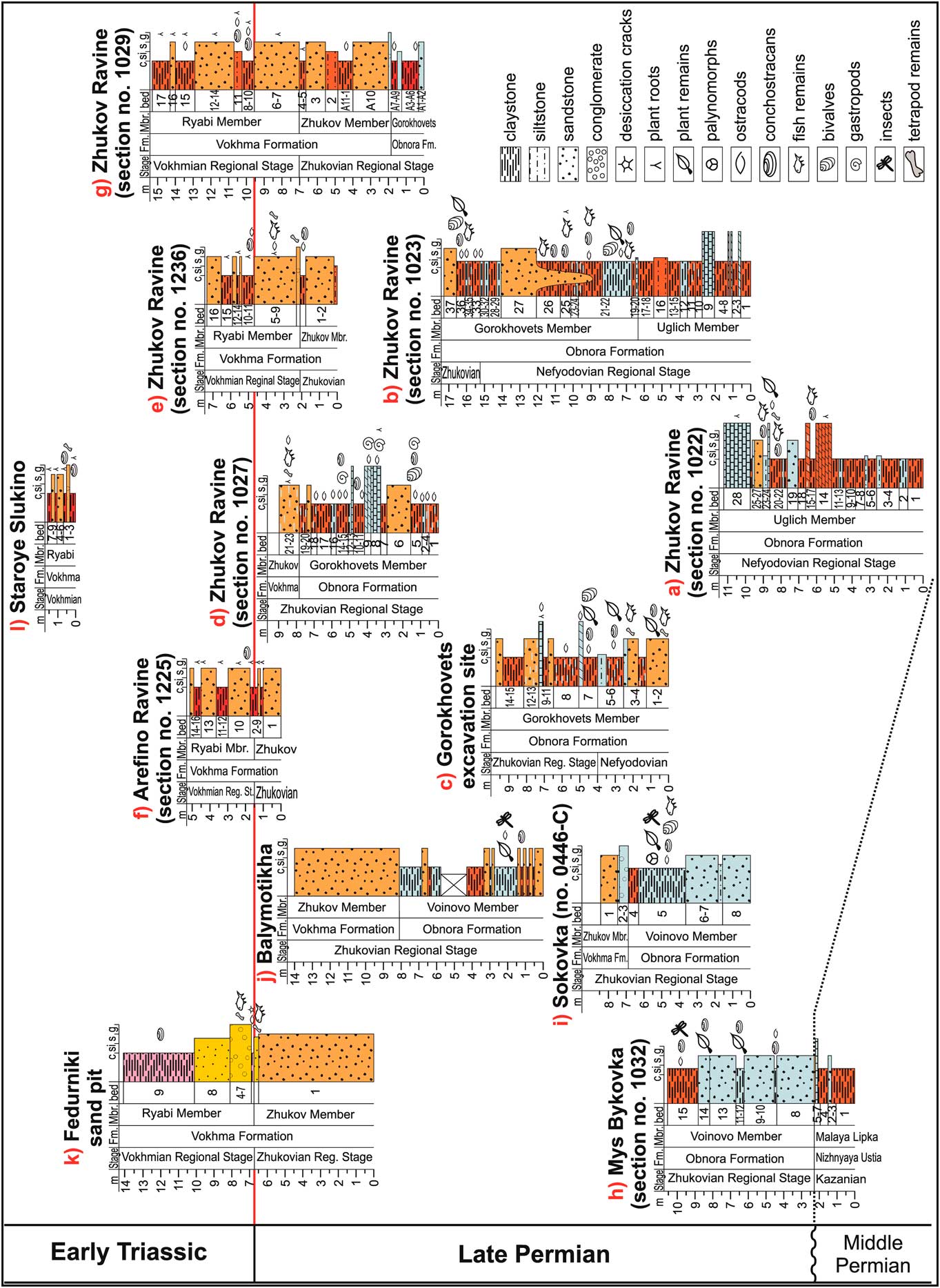
The late Permian to Early Triassic sections around Vyazniki and Gorokhovets span an interval from the 35–40 m thick Obnora Formation to the 35–45 m thick Vokhma Formation (Fig. 2). According to the lithostratigraphic subdivision of Golubev et al. (Reference Golubev, Sennikov, Minikh, Minikh, Kukhtinov, Balabanov and Silantiev2012a, Reference Golubev, Minikh, Balabanov, Kukhtinov, Sennikov and Minikhb), Lebedev et al. (Reference Lebedev, Sennikov, Golubev, Krupina, Niedzwiedzki and Sulej2015), and Scholze et al. (Reference Scholze, Golubev, Niedźwiedzki, Sennikov, Schneider and Silantiev2015), the Obnora Formation is subdivided into three units (Voinovo, Uglich, Gorokhovets members), and the overlying Vokhma Formation is subdivided into two units (Zhukov and Ryabi members). Depending on the geographic position, members of both formations can locally be absent because of local facies changes or due to temporary erosion (Lebedev et al., Reference Lebedev, Sennikov, Golubev, Krupina, Niedzwiedzki and Sulej2015, p. 1117). In general, the sedimentary succession of both formations record fine clastic alluvial plain and lake deposits, which were abruptly overlain by sand-grade major channel deposits near the Permian-Triassic boundary (Strok et al., Reference Strok, Gorbatkina and Lozovsky1984; Newell et al., Reference Newell, Sennikov, Benton, Molostovskaya, Golubev, Minikh and Minikh2010). According to Newell et al. (Reference Newell, Sennikov, Benton, Molostovskaya, Golubev, Minikh and Minikh2010), the study area represents part of a distal fluvial distributary system in the west of the Ural Mountains. More specifically, this paleoenvironment was discussed by Sennikov and Golubev (Reference Sennikov and Golubev2012, p. 317) as “an extensive river lowland with a system of channels of constant and temporary streams alternating with sandy and marshy oozy banks and somewhat elevated areas.” Details of both lithology and lithofacies of the study area (i.e., sections at the Zhukov Ravine, Bykovka, Sokovka, Balymotikha, Fedurniki sand pit, Arefino Ravine, and Staroe Slukino) were repeatedly described in recent publications (e.g., Newell et al., Reference Newell, Sennikov, Benton, Molostovskaya, Golubev, Minikh and Minikh2010; Golubev et al., Reference Golubev, Sennikov, Minikh, Minikh, Kukhtinov, Balabanov and Silantiev2012a, Reference Golubev, Minikh, Balabanov, Kukhtinov, Sennikov and Minikhb; Owocki et al., Reference Owocki, Niedźwiedzki, Sennikov, Golubev, Janiszewska and Sulej2012; Sennikov and Golubev, Reference Sennikov and Golubev2012; Lebedev et al., Reference Lebedev, Sennikov, Golubev, Krupina, Niedzwiedzki and Sulej2015; Scholze et al., Reference Scholze, Golubev, Niedźwiedzki, Sennikov, Schneider and Silantiev2015; Bajdek et al., Reference Bajdek, Qvarnström, Owocki, Sulej, Sennikov, Golubev and Niedźwiedzki2016; Niedźwiedzki et al., Reference Niedźwiedzki, Bajdek, Qvarnström, Sulej, Sennikov and Golubev2016) and therefore are only briefly summarized here.
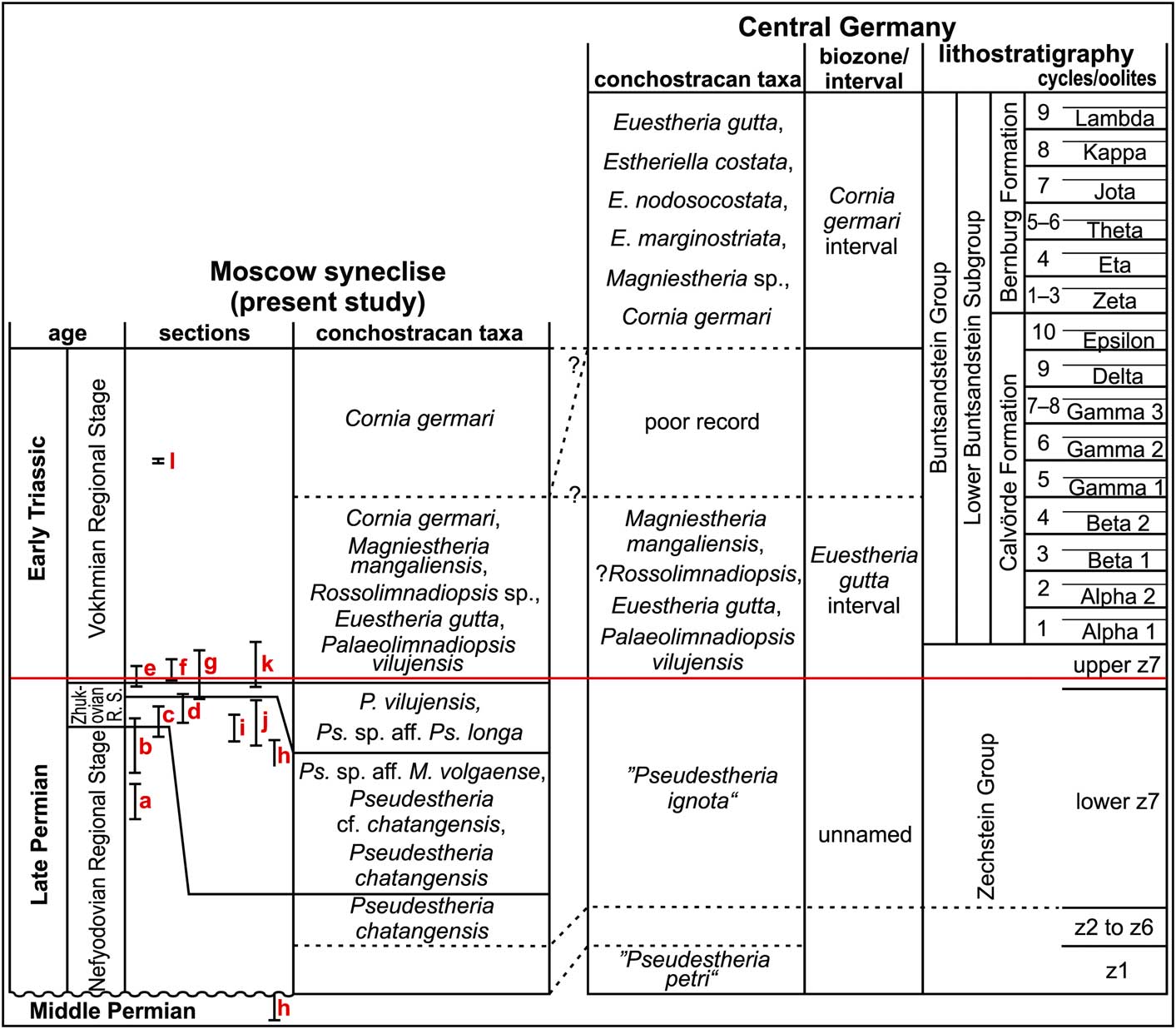
Stratigraphy, lithology, and fossil content of the studied late Permian–Early Triassic sections near the towns Vyazniki and Gorokhovets in the Moscow Syneclise, European Russia. Lithological profiles were simplified from Newell et al. (Reference Newell, Sennikov, Benton, Molostovskaya, Golubev, Minikh and Minikh2010), Golubev et al. (Reference Golubev, Sennikov, Minikh, Minikh, Kukhtinov, Balabanov and Silantiev2012a, Reference Golubev, Minikh, Balabanov, Kukhtinov, Sennikov and Minikhb), Lebedev et al. (Reference Lebedev, Sennikov, Golubev, Krupina, Niedzwiedzki and Sulej2015), Minikh et al. (Reference Minikh, Minikh, Sennikov, Golubev and Kogan2015b), and Scholze et al. (Reference Scholze, Golubev, Niedźwiedzki, Sennikov, Schneider and Silantiev2015). Section designations in red refer to the sections shown in Figure 13.

The Uglich Member (Nefyodovian Regional Stage, late Permian) and the Gorokhovets Member (Nefyodovian Regional Stage and Zhukovian Regional Stage, late Permian) of the Obnora Formation consist predominantly of claystones of flood plain overbank and lake deposits as well as polymictic silt- to sandstones of fluvial channels (Golubev et al., Reference Golubev, Sennikov, Minikh, Minikh, Kukhtinov, Balabanov and Silantiev2012a, Reference Golubev, Minikh, Balabanov, Kukhtinov, Sennikov and Minikhb), while the Voinovo Member (Zhukovian Regional Stage, late Permian) of the Obnora Formation is composed of massive or horizontally laminated, fine-grained quartz sand of yellow, gray, brown, beige, and red color (Lebedev et al., Reference Lebedev, Sennikov, Golubev, Krupina, Niedzwiedzki and Sulej2015). Lacustrine limestones occurring in the Uglich Member and more rarely in the Gorokhovets Member are used for lithostratigraphic correlations of outcrop sections (e.g., Sennikov and Golubev, Reference Sennikov and Golubev2012; Scholze et al., Reference Scholze, Golubev, Niedźwiedzki, Sennikov, Schneider and Silantiev2015). The studied section intervals of the Nefyodovian Regional Stage and Zhukovian Regional Stage (late Permian) contain a diverse fauna including conchostracans, ostracods, bivalves, gastropods, insects, fishes, tetrapods (e.g., Golubev et al., Reference Golubev, Sennikov, Minikh, Minikh, Kukhtinov, Balabanov and Silantiev2012a, Reference Golubev, Minikh, Balabanov, Kukhtinov, Sennikov and Minikhb), and rich vertebrate coprolite assemblages (e.g., Niedźwiedzki et al., Reference Niedźwiedzki, Bajdek, Qvarnström, Sulej, Sennikov and Golubev2016) (Fig. 2).
The overlying Zhukov Member (late Permian) of the Vokhma Formation consists of fluvial polymictic, fine- to coarse-grained sands and sandstones with brown and reddish-brown color (Lebedev et al., Reference Lebedev, Sennikov, Golubev, Krupina, Niedzwiedzki and Sulej2015). Lenses of intraformational conglomerates with rare extraformational flint gravel occur locally in the Zhukov Member, which contains remains of latest Permian tetrapods, plants, fishes, insects, bivalves, and plant roots (paleosoil layers) (e.g., Sennikov and Golubev, Reference Sennikov and Golubev2006; Lebedev et al., Reference Lebedev, Sennikov, Golubev, Krupina, Niedzwiedzki and Sulej2015). The Ryabi Member (Early Triassic) of the Vokhma Formation consists of coarse-grained sandstones of fluvial channel deposits with intercalations of flood plain clay- to siltstones containing conchostracans, ostracods, and plant roots (paleosoil layers) (e.g., Golubev et al., Reference Golubev, Sennikov, Minikh, Minikh, Kukhtinov, Balabanov and Silantiev2012a, Reference Golubev, Minikh, Balabanov, Kukhtinov, Sennikov and Minikhb; Scholze et al., Reference Scholze, Golubev, Niedźwiedzki, Sennikov, Schneider and Silantiev2015). In addition, vertebral fragments of Tupilakosaurus Nielsen, Reference Nielsen1954 and other bones as well as poor vertebrate coprolite assemblages occur in the sandstones at the base of the Ryabi Member (e.g., Sennikov and Golubev, Reference Sennikov and Golubev2012; Pindakiewicz et al., Reference Pindakiewicz, Tałanda, Sennikov, Niedźwiedzki and Sulej2015; Scholze et al., Reference Scholze, Golubev, Niedźwiedzki, Sennikov, Schneider and Silantiev2015, Niedźwiedzki et al., Reference Niedźwiedzki, Bajdek, Qvarnström, Sulej, Sennikov and Golubev2016).
A controversy exists regarding whether there is a hiatus (e.g., Lozovsky et al., Reference Lozovsky, Balabanov, Karasev, Novikov, Ponomarenko and Yaroshenko2016) or continuity (e.g., Golubev et al., Reference Golubev, Sennikov, Minikh, Minikh, Kukhtinov, Balabanov and Silantiev2012a, Reference Golubev, Minikh, Balabanov, Kukhtinov, Sennikov and Minikhb, Reference Golubev, Kotlyar, Silantiev, Arefiev, Balabanov, Naumcheva, Molostovskaya, Minikh and Minikh2015; Golubev, Reference Golubev2017a) in the latest Permian–earliest Triassic geologic record in the study area. While there is no doubt about the presence of various (diachronic) locally developed stratigraphic gaps around the Permian-Triassic boundary in the Moscow Syneclise (e.g., Lozovsky, Reference Lozovsky1992, Reference Lozovsky1997; Lozovsky et al., Reference Lozovsky, Balabanov, Karasev, Novikov, Ponomarenko and Yaroshenko2016), the studied sections located around the towns of Vyazniki and Gorokhovets expose a continuous late Permian (Zhukovian Regional Stage) to Early Triassic (Vokhmian Regional Stage) profile (e.g., Golubev et al., Reference Golubev, Sennikov, Minikh, Minikh, Kukhtinov, Balabanov and Silantiev2012a, Reference Golubev, Minikh, Balabanov, Kukhtinov, Sennikov and Minikhb). Regardless of these controversial discussions, neither the Zhukovian Regional Stage nor the Vokhmian Regional Stage are, so far, directly correlated to the marine Standard Global Chronostratigraphic Scale. Indeed, the search for volcanic ash beds (potentially useful for U-Pb isotope age determination of zircon grains) is a challenging activity of the International Nonmarine-Marine Correlation Working Group and is a current task for other regions with purely continental sedimentary deposits (e.g., Schneider et al., Reference Schneider2014a, Reference Schneider2017; Schneider and Lucas, Reference Schneider and Lucas2015). Moreover, involving new paleomagnetic and δ13Ccarb data might contribute to interregional stratigraphic correlations between the continental sections in the study area and the marine Standard Global Chronostratigraphic Scale (Golubev, Reference Golubev2017a, Reference Golubevb).
At present, the position of the Permian-Triassic boundary in the lowermost part of the Vokhmian Regional Stage in the study area refers to the regional European Russian stratigraphic scale. Mass occurrences of Tupilakosaurus remains are used to determine the Tupilakosaurus wetlugensis Assemblage Zone, which is regionally biostratigraphically correlated with the basal Early Triassic (e.g., Golubev et al., Reference Golubev, Sennikov, Minikh, Minikh, Kukhtinov, Balabanov and Silantiev2012a, Reference Golubev, Minikh, Balabanov, Kukhtinov, Sennikov and Minikhb; Sennikov and Golubev, Reference Sennikov and Golubev2012, Reference Sennikov and Golubev2017; Novikov, Reference Novikov2015; Scholze et al., Reference Scholze, Golubev, Niedźwiedzki, Sennikov, Schneider and Silantiev2015). This is supported by occurrences of Tupilakosaurus in sections from East Greenland (Nielsen, Reference Nielsen1954) ranging from the Hypophiceras (=Glyptophiceras) martini and Ophiceras commune to the Bukkenites (=Proptychites) rosenkrantzi zones (Shishkin et al., Reference Shishkin, Ochev, Lozovskii and Novikov2000, p. 128; Novikov, Reference Novikov2015; Bjerager et al., Reference Bjerager, Seidler, Stemmerik and Surlyk2006), which are classically correlated in the biozonation of boreal ammonoids to an earliest Triassic (early Induan, Griesbachian) age (Gradstein et al., Reference Gradstein, Ogg, Schmitz and Ogg2012, fig. 25.5; Bjerager et al., Reference Bjerager, Seidler, Stemmerik and Surlyk2006, fig. 6). The H. martini Zone from East Greenland can probably be correlated with the Otoceras concavum Zone of Arctic Canada and northeast Siberia but was recognized in the Greenlandic sections many tens of metres below the level with abundant Otoceras boreale (see Bjerager et al., Reference Bjerager, Seidler, Stemmerik and Surlyk2006). Yin et al. (Reference Yin, Zhang, Tong, Yang and Wu2001, table 1) referred the H. martini Zone to the latest Permian. According to Bjerager et al. (Reference Bjerager, Seidler, Stemmerik and Surlyk2006), most or all of the H. martini Zone belongs to the earliest Triassic. The correlation of the Boreal sections that are rich in ammonoids with the conodont-based Permian-Triassic boundary GSSP section at Meishan is still unclear.
Further reports of occurrences of the genus Thabanchuia of the family Tupilakosauridae in the Lystrosaurus Assemblage Zone in South Africa (e.g., Warren, Reference Warren1999) indicate the wide paleogeographic distribution of tupilakosaurids in the Early Triassic. Although a single find of a tupilakosaurid vertebral column was reported from the late Permian of the Lodève Basin in Southern France (Werneburg et al., Reference Werneburg, Steyer, Sommer, Gand, Schneider and Vianey-Liaud2007), neither in the Moscow Syneclise nor in the Cis-Urals were occurrences of tupilakosaurids ever recorded in the late Permian tetrapod faunas. Instead, there, the first records of Tupilakosaurus form widespread mass occurrences, directly at the beginning of the Early Triassic, where typical Permian tetrapod taxa are absent (e.g., Sennikov and Golubev, Reference Sennikov and Golubev2012, Reference Sennikov and Golubev2017; Novikov, Reference Novikov2015; Pindakiewicz et al., Reference Pindakiewicz, Tałanda, Sennikov, Niedźwiedzki and Sulej2015). Together, these are used to define the base of the Triassic on the East European Platform at the base of the Tupilakosaurus wetlugensis Assemblage Zone.
Materials and methods
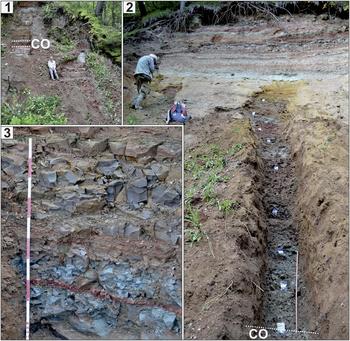
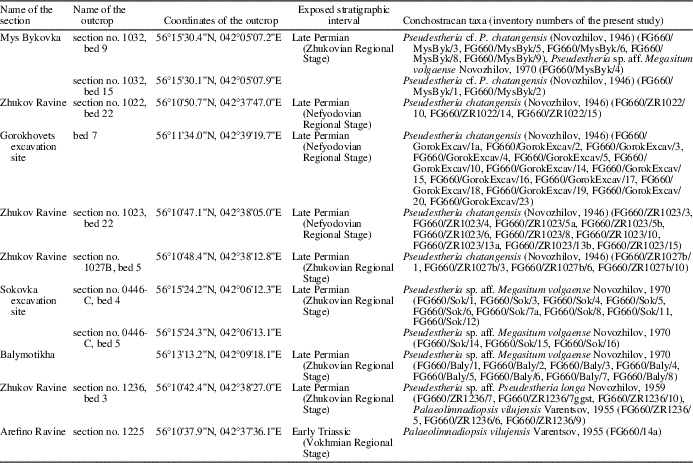
Hand-dug trenches (Fig. 3) in late Permian and Early Triassic sections around the towns of Vyazniki and Gorokhovets in the Vladimir region, European Russia, were sampled bed by bed for conchostracans during joint Russian-Polish and Russian-German field campaigns in 2008–2015. The numbering of productive beds refers to the lithological profile documentations by Golubev et al. (Reference Golubev, Sennikov, Minikh, Minikh, Kukhtinov, Balabanov and Silantiev2012a, Reference Golubev, Minikh, Balabanov, Kukhtinov, Sennikov and Minikhb), Lebedev et al. (Reference Lebedev, Sennikov, Golubev, Krupina, Niedzwiedzki and Sulej2015), Scholze et al. (Reference Scholze, Golubev, Niedźwiedzki, Sennikov, Schneider and Silantiev2015), and Niedźwiedzki et al. (Reference Niedźwiedzki, Bajdek, Qvarnström, Sulej, Sennikov and Golubev2016) (Fig. 2). The fossil material was obtained from lacustrine and fluvial clay- and siltstones of the Obnora Formation and the Vokhma Formation spanning the Permian-Triassic boundary. Recently, the conchostracan fauna of the Ryabi Member (Vokhma Formation; Vokhmian Regional Stage, Early Triassic) was published by Scholze et al. (Reference Scholze, Golubev, Niedźwiedzki, Sennikov, Schneider and Silantiev2015, Reference Scholze, Abu Hamad, Schneider, Golubev, Sennikov, Voigt and Uhl2017b), whereas the present study focuses on the late Permian (Zhukovian Regional Stage) conchostracan specimens from the Voinovo Member, the Uglich Member, the Gorokhovets Member (all Obnora Formation), and the Zhukov Member (Vokhma Formation). Coordinates (measured with a GPS using the WGS 84 datum) of the studied sections are given in Table 1.
Late Permian continental deposits near the towns Vyazniki and Gorokhovets in the Moscow Syneclise, European Russia. The outcrops consist of hand-dug trenches as well as natural exposures on the valley slopes. “CO” marks intervals of conchostracan occurrences. (1) Zhukov Ravine section no. 1022; lower part of the Uglich Member, Obnora Formation; Nefyodovian Regional Stage (late Permian). (2) Zhukov Ravine section no. 1023; lower part of the Gorokhovets Member, Obnora Formation; Nefyodovian Regional Stage (late Permian); scale bar=1 m. (3) Variously colored, horizontally laminated clay- and siltstones, Sokovka section no. 0446-C; Voinovo Member, Obnora Formation; Zhukovian Regional Stage (late Permian); scale bar=1 m.

Name, coordinates, stratigraphy, and conchostracan taxa of the studied late Permian–Early Triassic sections in the Moscow Syneclise, Russia.

The best-preserved specimens were drawn and photographed by using stereomicroscopes equipped with a mirror tube and a motorized focus stacking camera system. A set of objective and reproducible quantitative carapace measurements as proposed by Scholze and Schneider (Reference Scholze and Schneider2015) was used for the description of the conchostracan valve morphology. The taxonomic determination was made by comparison with conchostracan data from literature, including both original diagnosis (e.g., Novozhilov, Reference Novozhilov1946, Reference Novozhilov1958a, Reference Novozhilovb; Molin and Novozhilov, Reference Molin and Novozhilov1965) and taxonomic revisions. The revisions were detailed in a doctoral thesis by Goretzki (Reference Goretzki2003), who restudied the conchostracan collections of Nestor I. Novozhilov and other Russian conchostracan workers, which are stored in the Paleontological Institute (PIN) of the Russian Academy of Sciences, Moscow.
Ornaments of conchostracan carapace valves have been photographed using a JEOL JSM 7001F scanning electron microscope (SEM) at the Geological Institute of the TU Bergakademie Freiberg. The specimens were coated with a mixture of gold and palladium. For the SEM processing, an accelerating voltage of 3 kV was used.
Repository and institutional abbreviation
All specimens of the present study, as well as the previous studies by Scholze et al. (Reference Scholze, Golubev, Niedźwiedzki, Sennikov, Schneider and Silantiev2015, Reference Scholze, Abu Hamad, Schneider, Golubev, Sennikov, Voigt and Uhl2017b), are permanently stored in the Geological Institute of the TU Bergakademie Freiberg under the inventory numbers “FG 660/…”.
Systematic paleontology
Although conchostracans are currently treated as a paraphyletic group combining the monophyletic Spinicaudata, Cyclestherida, and Laevicaudata, for convenience, we use the traditional term ‘Conchostraca’ since it is in common use by other geoscientists (e.g., Gallego, Reference Gallego2005; Kozur and Weems, Reference Kozur and Weems2010; Ghosh, Reference Ghosh2011; Weems and Lucas, Reference Weems and Lucas2015). However, it should be mentioned that there are also workers preferring to use the terms ‘clam shrimps’ (e.g., Li and Matsuoka, Reference Li and Matsuoka2012; Pan et al., Reference Pan, Wang, Sha and Liao2015), ‘Spinicaudata’ (e.g., Orr et al., Reference Orr, Briggs and Kearns2008; Stigall et al., Reference Stigall, Hembree, Gierlowski-Kordesch and Weismiller2014), or a mixture of both ‘Spinicaudata’ and ‘Conchostraca’ (e.g., Astrop and Hegna, Reference Astrop and Hegna2015; Morton et al., Reference Morton, Whiteside, Hethke and Benton2017).
Class Branchiopoda Latreille, Reference Latreille1817
Order Spinicaudata Linder, Reference Linder1945
Family Lioestheriidae Raymond, Reference Raymond1946
Genus Pseudestheria Raymond, Reference Raymond1946
Type species
Pseudestheria brevis Raymond, Reference Raymond1946.
Diagnosis
Small to very large valves; oval to round shape; straight to slightly curved dorsal margin; umbo convexely curved, position of the umbo submedian to anterior and inframarginal to supramarginal; larval valve very small to small; variable number of growth lines; pitted ornaments.
Remarks
Pseudestheria is one of the most common late Paleozoic conchostracan genera and has high biostratigraphic value, particularly in the Permian (e.g., Martens, Reference Martens1983; Schneider and Scholze, Reference Schneider and Scholze2016). Its type species, Pseudestheria brevis, from the early Permian (early Artinskian) Wellington Formation in Noble County, Oklahoma, was described by Raymond (Reference Raymond1946, p. 243) as showing an oval carapace, concentric “lirae or costellae” and “no sculpture except punctuation.” The genus diagnosis was emended by Holub and Kozur (Reference Holub and Kozur1981, p. 49) according to its morphology: medium-sized valve; straight dorsal margin, distinctly separated from the posterior margin; variable number of growth lines, which reach up to the umbo; umbo not, or only slightly, overtopping the dorsal margin; anterior margin slightly curved, posterior margin more strongly curved; surface of the valve always finely pitted. Later, an emendation of Pseudestheria by Martens (Reference Martens1983, p. 14) included further details: slightly curved dorsal margin; umbo convexly curved and reaching up to or above the dorsal margin of the larval valve; α (angle between the posterior margin and a prolongation of the dorsal margin) less than 90°; growth bands and larval valve more or less sculptured, but a characteristic ornamentation of the growth bands is missing.
According to Holub and Kozur (Reference Holub and Kozur1981), Pseudestheria possibly derived from Lioestheria Depéret and Mazeran, Reference Depéret and Mazeran1912. Morphologically, these genera are similar and therefore have occasionally been synonymized by previous workers (e.g., Kobayashi, Reference Kobayashi1954). However, according to Holub and Kozur (Reference Holub and Kozur1981, p. 47), they can be taxonomically distinguished since only Lioestheria shows a morphologically variable (conical- to pillar-shaped or especially oval- to elongate-shaped) node located on the external surface of the umbo or the larval valve. Although developments toward decreased sizes of the umbonal area of Lioestheria can result in a reduction or complete invisibility of this nodular sculpture (Holub and Kozur, Reference Holub and Kozur1981, p. 47), it turned out to be practicable to separate the two species by convention (Holub and Kozur, Reference Holub and Kozur1981; Kozur and Sittig, Reference Kozur and Sittig1981): forms with a larval valve smaller than one-third of the total valve length belong to Pseudestheria, while those with the larval valve larger than one-third of the valve length belong to Lioestheria. However, it should be noted that Tasch (Reference Tasch1987, p. 135–137) mentioned additional morphological details of Lioestheria such as the presence of growth lines on the umbo, which formerly resulted in a differentiation between ‘Lioestheria emended’ (in the sense of Kozur et al., Reference Kozur, Martens and Pacaud1981) and ‘Lioestheria, sensu stricto’ (in the sense of Tasch, Reference Tasch1987, p. 135).
The present study follows the stricter differentiation between Pseudestheria and Lioestheria proposed by H. Kozur and his co-authors (e.g., Holub and Kozur, Reference Holub and Kozur1981; Kozur and Sittig, Reference Kozur and Sittig1981). On the contrary, an emendated diagnosis was provided by Martens (Reference Martens1983, p. 14), in which Pseudestheria differed from Lioestheria depending on the respective morphology of the growth lines bending across the dorsal margin at the contact between the left and the right valve. However, the latter would require, for each individual, not only exceptional positioning on the bedding plane that provides a top view on the dorsal margin, but also three-dimensional preservation of its dorsal margin. This is inappropriate for the material of the present study.
In its shape and size, Pseudestheria strongly resembles Polygrapta Novozhilov, Reference Novozhilov1946. The latter was first introduced by Novozhilov (Reference Novozhilov1946, p. 174) as a subgenus of ‘Estheria’, but later (e.g., Molin and Novozhilov, Reference Molin and Novozhilov1965) it was elevated to genus rank. The genus Polygrapta was interpreted differently depending on respective workers. For example, it was listed by Kobayashi (Reference Kobayashi1954, p. 131) as a synonym of Euestheria Deperét and Mazeran, Reference Depéret and Mazeran1912. Since then, an emended diagnosis of Polygrapta was proposed by Kozur and Seidel (Reference Kozur and Seidel1983, p. 334) in their redescription of ‘Polygrapta’ rybinskensis (=Pseudestheria rybinskensis in Novozhilov, Reference Novozhilov1959, Reference Novozhilov1960; Goretzki, Reference Goretzki2003), which was later changed to Magniestheria rybinskensis (e.g., by Bachmann and Kozur, Reference Bachmann and Kozur2004; Kozur and Weems, Reference Kozur and Weems2010; Hauschke, Reference Hauschke2014) (for discussions see Kozur and Hauschke, Reference Kozur and Hauschke2008). This emended diagnosis for Polygrapta of Kozur and Seidel (Reference Kozur and Seidel1983) included the following characteristics: medium- to large-sized valves of weak to moderate convexity, low convexity of the umbo not overtopping the dorsal margin, a long, straight dorsal margin sharply separated from the posterior margin, and a small free umbo. Obviously, these characteristics match the taxonomic range of the genus Pseudestheria described above. However, in contrast to Pseudestheria, Polygrapta (in the sense of Novozhilov, Reference Novozhilov1946) was defined by ornamentation comprising radial lirae or striated reticulation (e.g., Liu, Reference Liu1985), which are, however, neither visible nor developed in each species of Polygrapta (Kozur and Seidel, Reference Kozur and Seidel1983). If the presence or absence of ornamentation is a consequence of preservation, the two genera could be synonyms. Alternatively, if the ornamentation depends on a primary morphological interspecific variability, Pseudestheria and Polygrapta could be two different genera. Therefore, Martens (Reference Martens1983) noted that this problem can only be solved after future taxonomical revisions of the type material of these genera. The present study follows a proposal by Martens (Reference Martens1983, p. 15), who suggested giving priority to Pseudestheria Raymond, Reference Raymond1946. This priority is supported by paragraphs 21.3.2 and 24.1 of the International Code of Zoological Nomenclature because Pseudestheria Raymond, Reference Raymond1946 was defined as a genus in June 1946 whereas Polygrapta Novozhilov, Reference Novozhilov1946 was defined as a subgenus without information on the month of publication in 1946.
It is very difficult to distinguish between Pseudestheria and the morphologically similar genus Euestheria Depéret and Mazeran, Reference Depéret and Mazeran1912. The argument of Kozur and Seidel (Reference Kozur and Seidel1983) that the two genera can be distinguished by the umbo, which in Euestheria overtops the dorsal margin more than it does in Pseudestheria (Kozur and Seidel, Reference Kozur and Seidel1983), seems to be only practicable for well-preserved specimens. Due to compaction, the umbos of specimens of both genera can be deformed so they rise above the dorsal margin to varying degrees and should not, therefore, be used for taxonomic differentiation. These two genera can be separated in well-preserved, less-compacted individuals by the convexity of the valve and the convexity of the umbonal area, which are both much stronger in Euestheria. In addition, well-preserved specimens of the genus Pseudestheria can show growth lines, wherein each growth line comprises paired fine lines, which are not present in the genus Euestheria.
Pseudestheria chatangensis (Novozhilov, Reference Novozhilov1946)
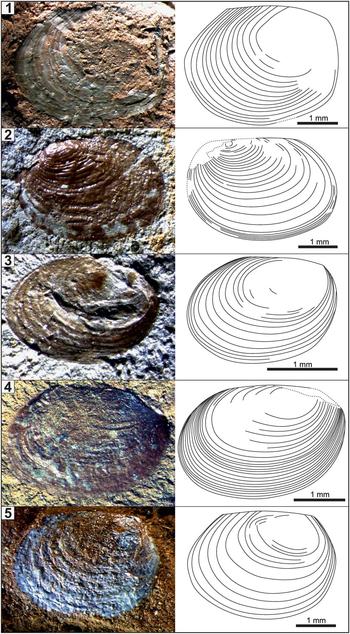
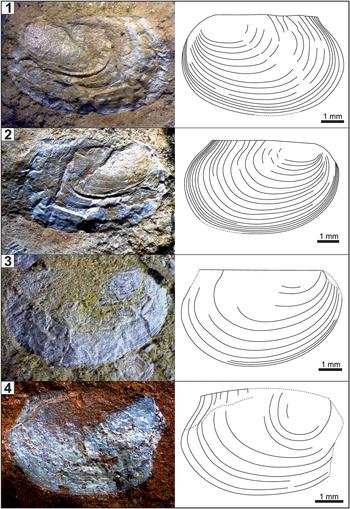
Pseudestheria chatangensis (Novozhilov, Reference Novozhilov1946) from the Nefyodovian Regional Stage and Zhukovian Regional Stage (late Permian, Changhsingian) in the Moscow Syneclise. The valves are partially preserved as shell substance. (1) Cast of a right valve; Zhukov Ravine (section no. 1022, bed 22); Uglich Member, Obnora Formation; Nefyodovian Regional Stage; FG660/ZR1022/10. (2) Cast of a left valve; Zhukov Ravine (section no. 1023, bed 22); Gorokhovets Member, Obnora Formation; Nefyodovian Regional Stage; FG660/ZR1023/5a. (3) Cast of a right valve; Zhukov Ravine (section no. 1023, bed 22); Gorokhovets Member, Obnora Formation; Nefyodovian Regional Stage; FG660/ZR1023/10. (4) Cast of a right valve; Zhukov Ravine (section no. 1027b, bed 5); Gorokhovets Member, Obnora Formation; Zhukovian Regional Stage; FG660/ZR1027b/1. (5) Cast of a right valve; Gorokhovets excavation site (section of Sennikov et al., Reference Sennikov, Gubin, Golubev, Bulanov, Ivakhenko and Kurkin2003); Gorokhovets Member, Obnora Formation; Nefyodovian Regional Stage; FG660/GorokExcav/4.

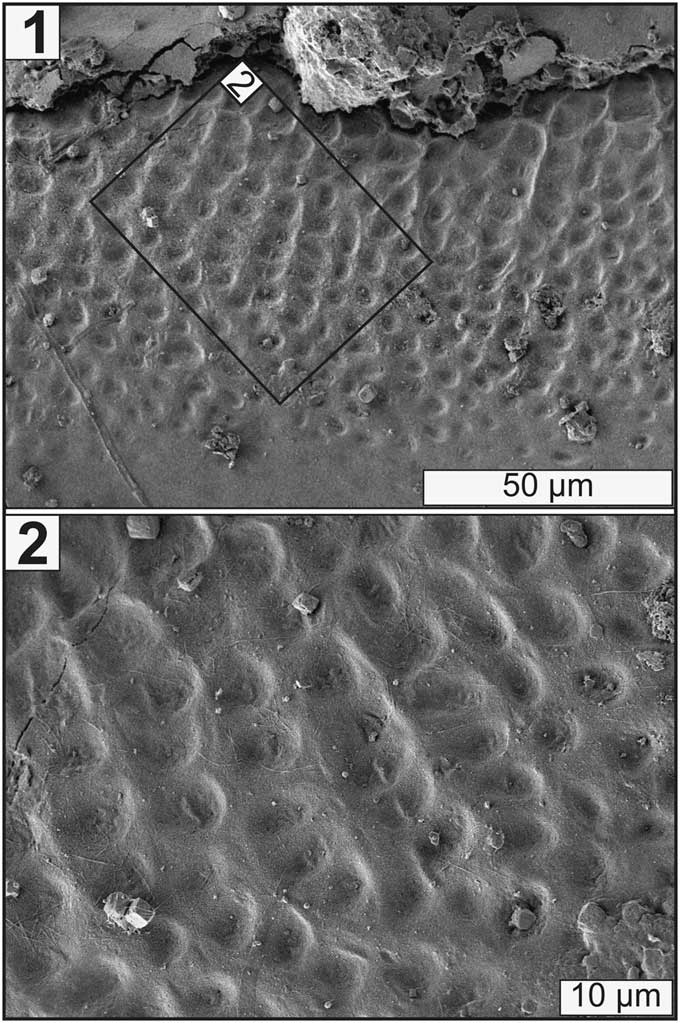
SEM images of Pseudestheria chatangensis (Novozhilov, Reference Novozhilov1946) from the Zhukov Ravine (section no. 1022, bed 22), Moscow Syneclise, European Russia; Uglich Member, Obnora Formation, Nefyodovian Regional Stage (late Permian); FG660/ZR1022/10. (1) Ornamentation of the growth band at the ventral margin on the external side of the valve. (2) Close-up view showing finely pitted ornaments.

1946 Estheria (Polygrapta) chatangensis Reference NovozhilovNovozhilov, p. 174, pl. 1, figs. 1–3.
1946 Polygrapta chatangensis; Reference NovozhilovNovozhilov, p. 195, pl. 1, figs. 1–3 (non pl. 1, fig. 4).
1958a Polygrapta chatangensis; Reference NovozhilovNovozhilov, p. 20, figs. 4, 5, pl. 1, figs. 1a–c, 1–4.
1965 Polygrapta chatangensis; Reference Defretin-LefrancDefretin-Lefranc, p. 30, fig. 10, pl. 2, figs. 1, 2, 5.
1965 Polygrapta chatangensis; Reference Molin and NovozhilovMolin and Novozhilov, p. 9, fig. 7.
2003 Polygrapta chatangensis; Reference GoretzkiGoretzki, p. 173, pl. 43, figs. 1–7 [cum syn.].
Holotype
Right valve (PIN 401/7) from middle–late Permian deposits on Cape Ilia, northern Siberia (Novozhilov, Reference Novozhilov1946, pl. 1, fig. 1; Goretzki, Reference Goretzki2003, pl. 43, fig. 2).
Occurrence
The species Pseudestheria chatangensis was first described as Polygrapta chatangensis from drill cores on Cape Ilia on the southern shore of the Khatanga gulf, Tatarian Stage (middle–late Permian; Novozhilov, Reference Novozhilov1946; Defretin-Lefranc, Reference Defretin-Lefranc1965), Permian–Triassic (Goretzki, Reference Goretzki2003), or Misailap Formation, Kazanian Stage (middle Permian; Cuvelier et al., Reference Cuvelier, Hennion, Gallego and Vachard2015).
Further occurrences of this species are from the Duwa section in the southern Tarim Basin of NW-China, Pusige Formation to Duwa Formation, Permian (Gilder et al., Reference Gilder, Zhao, Coe, Meng, Courtillot and Besse1996, p. 22018 and references cited therein); as ‘Polygrapta aff. P. chatangensis’ from the Samara Belt of the East European Platform, Malaya Kinel Formation, Severodvinian Stage (Gorsky et al., Reference Gorsky, Gusseva, Crasquin-Soleau and Broutin2003, p. 552); and as Polygrapta chatangensis from the Junggar Basin, NW-China, Guodikeng Formation (Foster et al., Reference Foster, Stephenson, Marshall, Logan and Greenwood2002, p. 49).
Description
Small to large carapace (valve length 2.2–4.1 mm) and oval to round shape (valve height/length ratio values 0.63–0.80); dorsal margin very short to short and often straight to occasionally slightly curved; position of the umbo submedial and inframarginal to slightly marginal; larval valve very small, but often apparently large due to reduced preservation of growth lines in the umbonal area; up to 30 growth lines; in well-preserved parts of the valves growth bands can be bounded by paired fine lines instead of a single growth line; concentric ribs on the growth bands are often not developed or rarely show a weak relief; sharply to very sharply curved anterior margin, very sharply curved posterior margin; point of maximal curvature of the anterior margin median-dorsal, at the posterior margin slightly median-dorsal to slightly median-ventral, at the ventral margin median to median-posterior.
Materials
Thirty-one well-preserved specimens (for their inventory numbers see Table 1) and more than 11 additional specimens in various preservational stages. Zhukov Ravine, section no. 1022, bed 22, Uglich Member, Obnora Formation, Nefyodovian Regional Stage (late Permian) (Fig. 4.1); Zhukov Ravine, section no. 1023, bed 22, Gorokhovets Member, Obnora Formation, Nefyodovian Regional Stage (late Permian) (Fig. 4.2, 4.3); Zhukov Ravine, section no. 1027b, bed 5, Gorokhovets Member, Obnora Formation, Zhukovian Regional Stage (late Permian) (Fig. 4.4); Gorokhovets section (excavation site of Sennikov et al., Reference Sennikov, Gubin, Golubev, Bulanov, Ivakhenko and Kurkin2003), Gorokhovets Member, Obnora Formation, Nefyodovian Regional Stage (late Permian) (Fig. 4.5).
Remarks
The morphology of Pseudestheria chatangensis is very similar to that of Pseudestheria ignota (=Polygrapta ignota in Novozhilov, Reference Novozhilov1946). According to the drawings and descriptions of the type material of these two species figured by Goretzki (Reference Goretzki2003, pls. 43–44), Pseudestheria chatangensis has an umbo in a submedial and inframarginal to marginal position, while the umbo of Pseudestheria ignota is located more anteriorly in a marginal to supramarginal position. In addition, the total size of the valve of Pseudestheria chatangensis was mentioned by Goretzki (Reference Goretzki2003, p. 175) as being smaller than that of Pseudestheria ignota. A knot- or bean-shaped sculpture on the larval valve, mentioned by Goretzki (Reference Goretzki2003) in the descriptions of Pseudestheria chatangensis, corresponds to a very small larval valve as shown in the figures of the type material by Novozhilov (Reference Novozhilov1946, pl. 1, figs. 1–3).
The Pseudestheria chatangensis valves described here are morphologically similar to valves previously described as both Bipemphigus gennisi sp. nov. in Molin and Novozhilov (Reference Molin and Novozhilov1965) and Rhodendorfium (Bipemphigus) gennisi by Orlova (Reference Orlova1990) from the basins of the Nizhnyaya Tunguska, Kureyka, Maymecha, and Anabar rivers; Early Triassic (Molin and Novozhilov, Reference Molin and Novozhilov1965) or middle–late Permian (Orlova, Reference Orlova1990). This accounts for the height/length ratio values and the positions of points of maximal curvatures of the outer margins of the valve. Orlova (Reference Orlova1990) explicitly described a striate-costate ornamentation of Rhodendorfium (Bipemphigus) gennisi, which cannot be seen in the specimens of the present study.
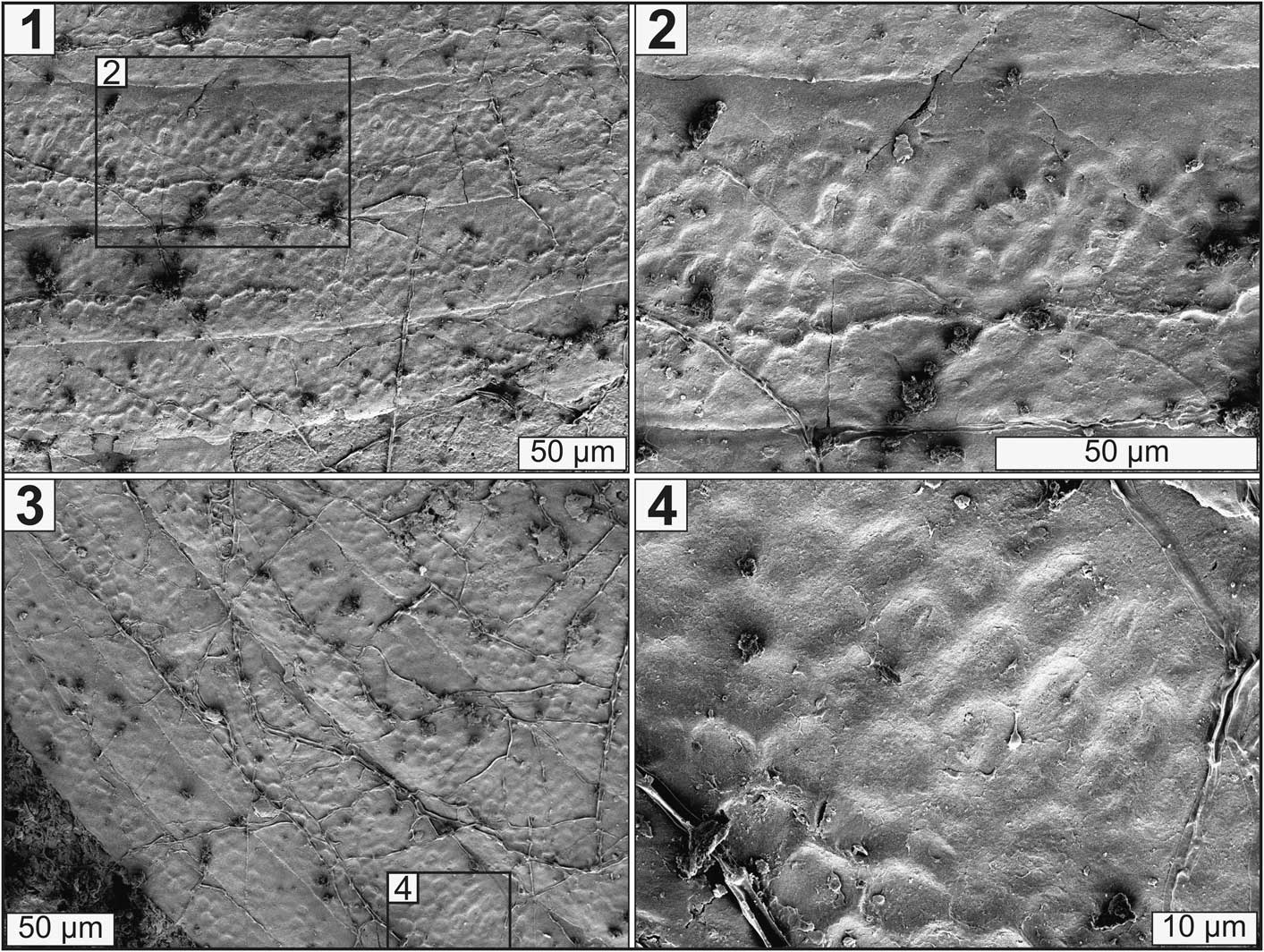
The type material of Pseudestheria chatangensis was taxonomically revised by Goretzki (Reference Goretzki2003), but without providing information on the ornamentation. Pseudestheria chatangensis of the present study shows finely pitted ornaments (Fig. 5).
Pseudestheria cf. P. chatangensis (Novozhilov, Reference Novozhilov1946)
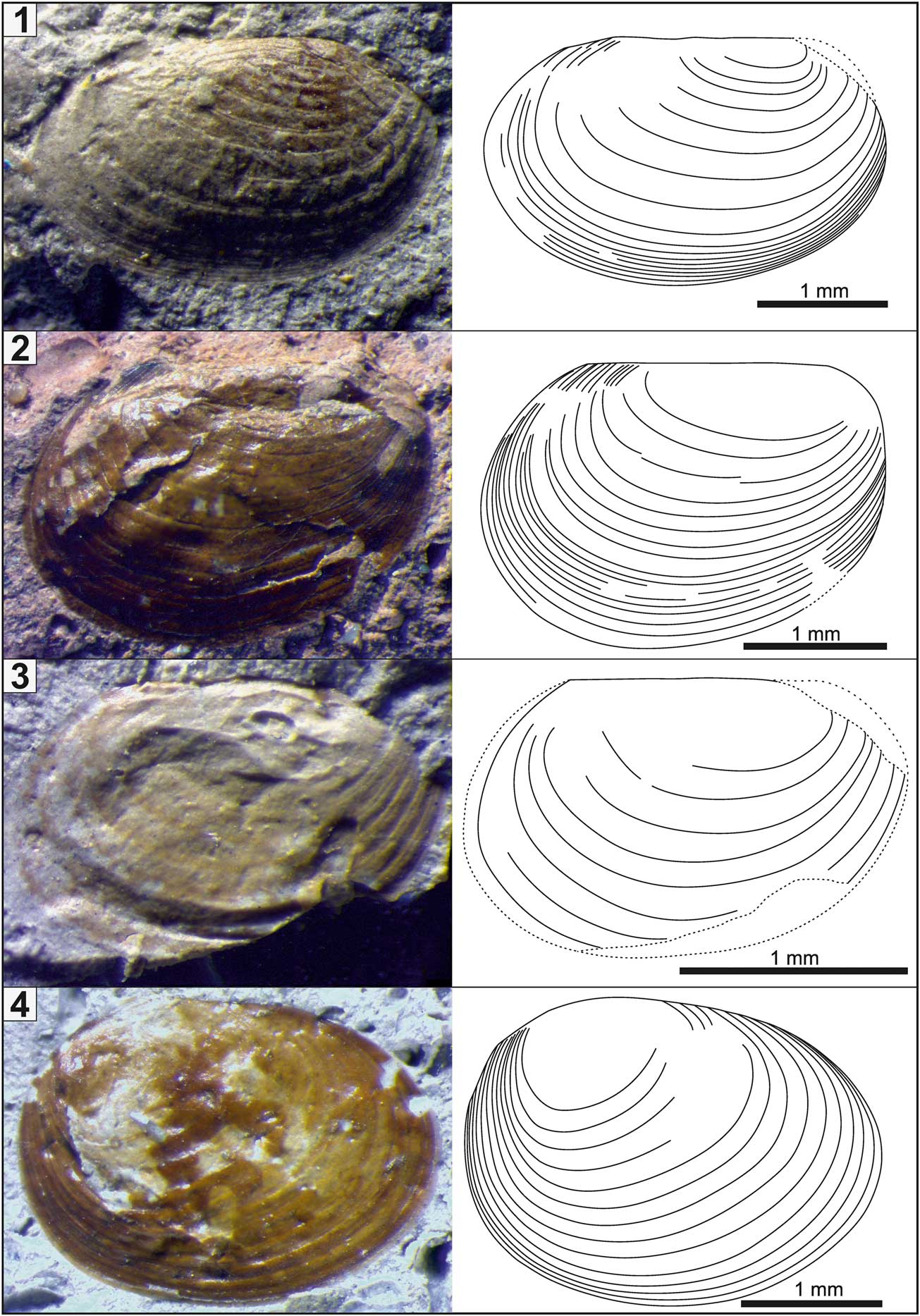
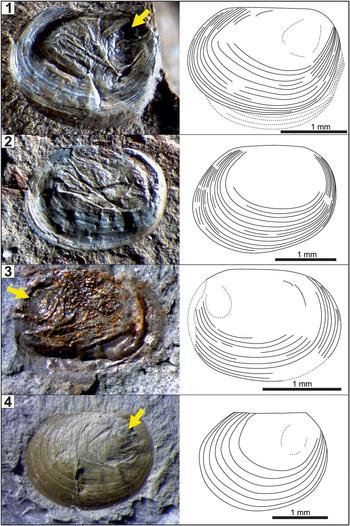
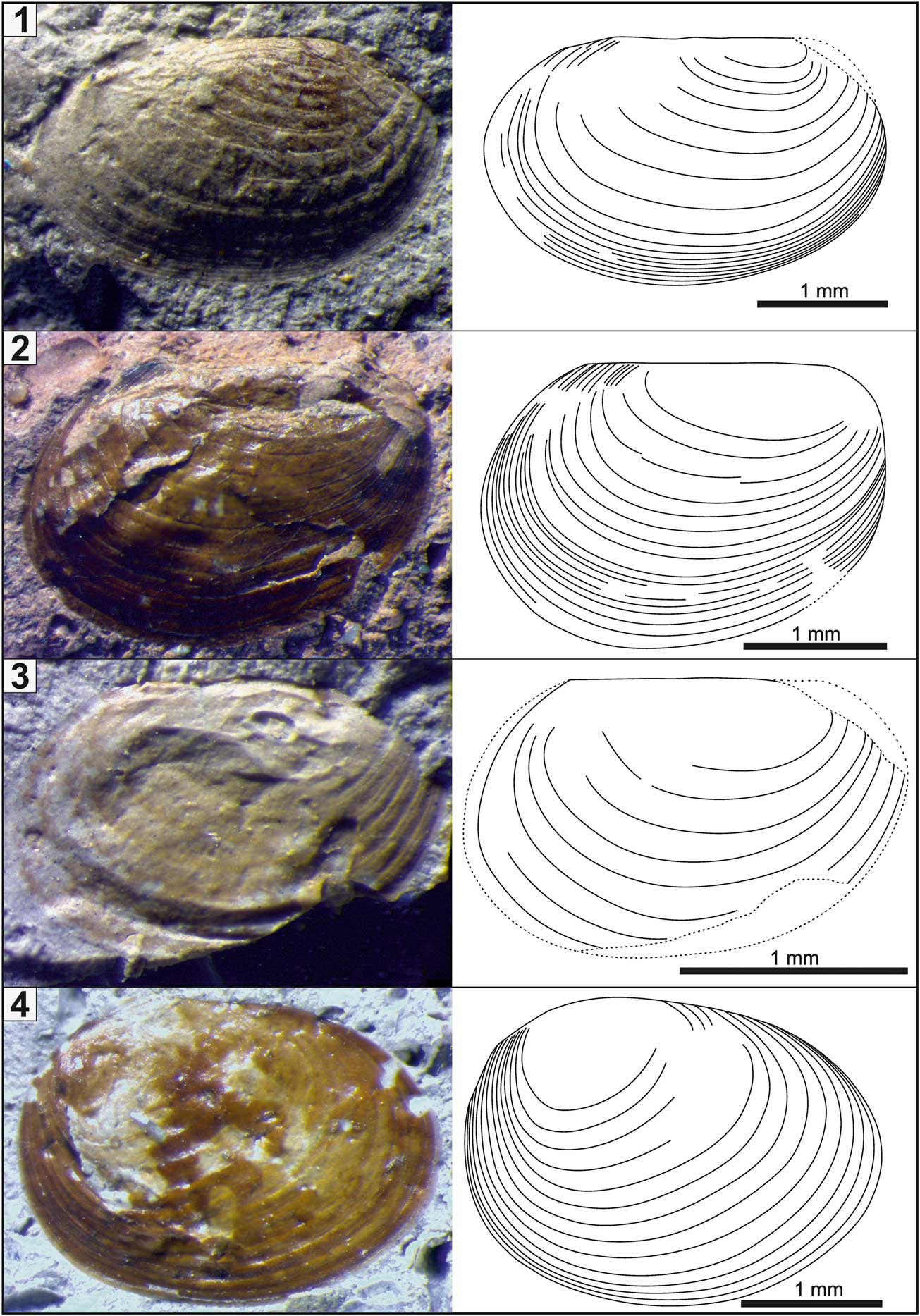
Pseudestheria cf. P. chatangensis (Novozhilov, Reference Novozhilov1946) from Mys Bykovka, section no. 1032, Moscow Syneclise, European Russia; Voinovo Member, Obnora Formation, Zhukovian Regional Stage (late Permian). (1) Cast of a right valve; FG660/MysByk/2. (2) Cast of a right valve with preservation of shell substance; FG660/MysByk/9. (3) Cast of a right valve with partially preserved shell substance; FG660/MysByk/6. (4) Cast of a left valve with preserved shell substance; the higher value of its height/length ratio corresponds to a stout morphotype of Pseudestheria cf. P. chatangensis; FG660/MysByk/8.
Description
Small- to medium-sized carapace (valve length 1.9–3.2 mm) and oval to round shape (valve height/length ratio values 0.63–0.78); dorsal margin short and straight; position of the umbo submedial and inframarginal to slightly marginal; larval valve very small to small; up to 18 growth lines of variable preservation; concentric ribs on the growth bands are often not developed or rarely show a weak relief (in particular at the anterior-median part of the valve); sharply to very sharply curved anterior margin, very sharply curved posterior margin; point of maximal curvature of the anterior margin median-dorsal, at the posterior margin median-ventral to slightly median-dorsal, at the ventral margin median to median-posterior.
Materials
Seven well-preserved specimens (for their inventory numbers see Table 1) and more than six additional specimens in various preservational stages. Mys Bykovka, section no. 1032 (beds 9 and 15, according to the profile documentation of Lebedev et al., Reference Lebedev, Sennikov, Golubev, Krupina, Niedzwiedzki and Sulej2015, fig. 4), Voinovo Member, Obnora Formation, Zhukovian Regional Stage (late Permian) (Fig. 6.1–6.4).
Remarks
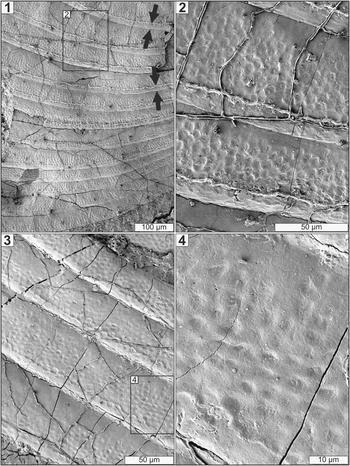
The form Pseudestheria cf. P. chatangensis shows finely pitted ornaments (Fig. 7), which is similar to the ornamentation of Pseudestheria chatangensis (Fig. 5). Pseudestheria cf. P. chatangensis from the Mys Bykovka section (Fig. 6) differs from the Pseudestheria chatangensis described in the preceding by showing a higher degree of morphological variability. The variable height/length ratio values (0.63–0.78) of Pseudestheria cf. P. chatangensis might be indicative of a differentiation between slender (about 0.63–0.69) and stout (0.74–0.78) morphotypes. In addition, a high degree of preservational variability is expressed in the growth lines. Well-preserved parts of the valve have growth lines, which consist of paired, fine lines (e.g., in the anteriorventral part of the specimen shown in Fig. 6.3) corresponding to the paired, fine growth lines of a drawing of Polygrapta chatangensis by Novozhilov (Reference Novozhilov1958a, fig. 4). Valves with a morphology similar to Pseudestheria cf. P. chatangensis from Mys Bykovka as well as with partially preserved paired fine growth lines can also be seen in the drawing of ‘Eulimnadia lima’ (Novozhilov, Reference Novozhilov1970, fig. 98), which was collected from a drill core in the northern Ural foreland of the ?Severodvinian Regional Stage (?middle–late Permian) (Novozhilov, Reference Novozhilov1970, p. 118–119). Most likely the two species are synonyms.
SEM images of Pseudestheria cf. P. chatangensis (Novozhilov, Reference Novozhilov1946) from Mys Bykovka, section no. 1032, Moscow Syneclise, European Russia; Voinovo Member, Obnora Formation, Zhukovian Regional Stage (late Permian); FG660/MysByk/9. (1) Ornamentation in the anterior-median part on the external side of the valve. The arrows indicate growth lines consisting of two fine lines almost without ornaments. (2) Close-up view showing finely pitted ornaments. (3) Ornamentation at the posterodorsal margin on the external side of the valve. (4) Close-up view of finely pitted ornaments.

Pseudestheria sp. aff. Megasitum volgaense Novozhilov, Reference Novozhilov1970
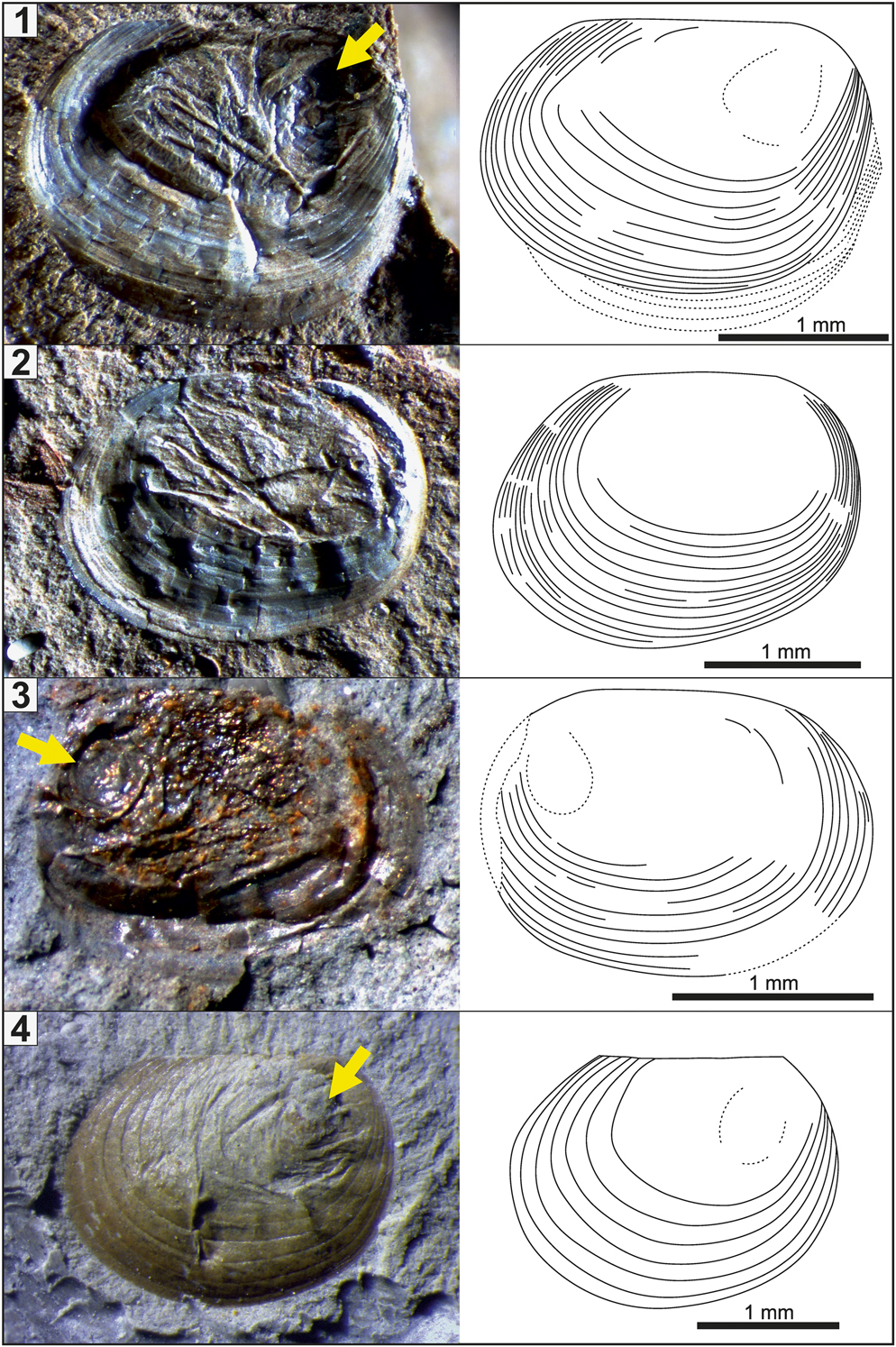
Pseudestheria sp. aff. Megasitum volgaense Novozhilov, Reference Novozhilov1970 from the Moscow Syneclise, Russia; Voinovo Member, Obnora Formation, Zhukovian Regional Stage (late Permian). The valves are partially preserved as shell substance. (1) Fragment of a cast of a right valve; Sokovka excavation site (section no. 0446-C); FG660/Soko/4. (2) Imprint of a left valve; Sokovka excavation site (section no. 0446-C); FG660/Soko/3. (3) Compacted cast of a left valve; eggs are preserved as reddish, spherical structures; Sokovka excavation site (section no. 0446-C); FG660/Soko/1. (4) Cast of a right valve; Mys Bykovka (section no. 1032); FG660/MysByk/4. The arrows indicate the knob-like to droplet-shaped, convex sculpture on the external side of the larval valve.
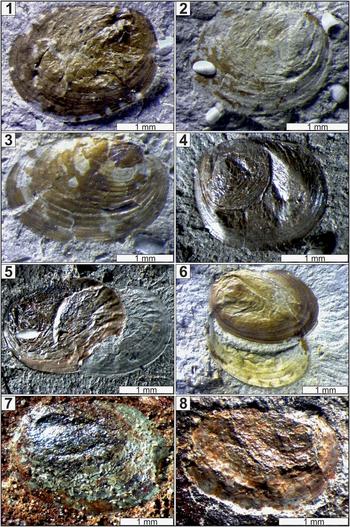
Different types of preservation of Pseudestheria sp. aff. Megasitum volgaense Novozhilov, Reference Novozhilov1970 from the Moscow Syneclise, European Russia; Voinovo Member, Obnora Formation; Zhukovian Regional Stage (late Permian). (1) Well-preserved right valve covered with shell substance; Sokovka excavation site (section no. 0446-C); FG660/Sok/14. (2) Well-preserved cast of a right valve with remnants of shell substance; the conchostracan valve is associated with ostracods; Sokovka excavation site (section no. 0446-C); FG660/Sok/15. (3) Right valve preserved as shell substance; the umbonal area is deformed and overlapping the dorsal margin; Sokovka excavation site (section no. 0446-C); FG660/Sok/13. (4) Left valve preserved as shell substance; the umbonal area is deformed and overlaps the dorsal margin; Sokovka excavation site (section no. 0446-C); FG660/Sok/6. (5) Left valve preserved as shell substance in combination with the underlying internal side of the right valve; both valves are shifted relative to each other; Sokovka excavation site (section no. 0446-C); FG660/Sok/8. (6) Left valve and underlying internal side of the right valve are shifted relative to each other; both valves preserved as shell substance; Sokovka excavation site (section no. 0446-C); FG660/Sok/16. (7) Cast of a left valve preserved in a silty sandstone; shell substance is partially preserved; Balymotikha section; FG660/Baly/1. (8) Internal view on a left valve preserved in a silty sandstone; Balymotikha section; FG660/Baly/5.

Occurrence
The holotype of the species Megasitum volgaense Novozhilov, Reference Novozhilov1970 was collected from the middle–late Permian Luptyug drill core section in the Moscow Syneclise (Novozhilov, Reference Novozhilov1970; Goretzki, Reference Goretzki2003). Megasitum volgaense Novozhilov, Reference Novozhilov1970 was, together with 11 other species, listed by Goretzki (Reference Goretzki2003) as a younger synonym of Limnadia angulidorsa Novozhilov, Reference Novozhilov1970, whereby occurrences of the latter were reported by Gorsky et al. (Reference Gorsky, Gusseva, Crasquin-Soleau and Broutin2003, table 8) from the Vyatkian Stage (late Permian) in the Southern Cis-Ural region. However, the holotype of Limnadia angulidorsa is badly preserved and “very strongly deformed” (Goretzki, Reference Goretzki2003, p. 103); therefore this species is not used in the present study.
According to Kozur and Sittig (Reference Kozur and Sittig1981, p. 12), a drawing of the paratype of Megasitum volgaense (see Novozhilov, Reference Novozhilov1970, fig. 180) cannot be differentiated from Megasitum tenellum (Bronn, Reference Bronn1850) emend. Kozur and Sittig, Reference Kozur and Sittig1981, which was described from the early Permian interval of the middle Nahe Subgroup of the Sulzbach section in the Baden-Baden depression, SW-Germany. In addition, relationships between Megasitum volgaense and the early Permian species Lioestheria pseudotenella Martens, Reference Martens1983 (=Lioestheria extuberata [Jones and Woodward, Reference Jones and Woodward1899] in the sense of Schneider and Scholze, Reference Schneider and Scholze2016) were mentioned by Martens (Reference Martens1983, p. 39).
Description
Small- to medium-sized carapace (valve length 1.6–2.8 mm) and oval to round shape (valve height/length ratio values 0.65–0.81); dorsal margin short to long and straight; position of the umbo submedial and inframarginal to marginal; larval valve apparently very large, partially covered by pitted ornaments; variably preserved knob-like to droplet-shaped, convex sculpture on the external side of the larval valve; up to 18 growth lines; decreased preservation of growth lines toward the umbonal area; concentric ribs on the growth bands are often weakly developed; sharply to very sharply curved anterior margin, very sharply curved posterior margin; point of maximal curvature of the anterior margin median-dorsal, at the posterior margin median or median-ventral to slightly median-dorsal, at the ventral margin median-posterior to slightly median-anterior; ornaments at the ventral and posteroventral margins of the valve are pitted and shallow (Fig. 10).
SEM images of Pseudestheria sp. aff. Megasitum volgaense Novozhilov, Reference Novozhilov1970 from the Sokovka excavation site (section no. 0446-C) in the Moscow Syneclise, European Russia; Voinovo Member, Obnora Formation, Zhukovian Regional Stage (late Permian); FG660/Sok/14. (1) Ornamentation in the ventral-median part on the external side of the valve. (2) Close-up view showing shallowly pitted ornaments. (3) Ornamentation at the posterodorsal margin on the external side of the valve. (4) Close-up view of shallowly pitted ornaments.

Materials
Twenty-one well-preserved specimens (for their inventory numbers see Table 1) and more than eight additional specimens in various preservational stages. Sokovka excavation site (section no. 0446-C according to Lebedev et al., Reference Lebedev, Sennikov, Golubev, Krupina, Niedzwiedzki and Sulej2015; or section ‘Vyazniki-2’ according to Sennikov and Golubev, Reference Sennikov and Golubev2006); Voinovo Member, Obnora Formation; Zhukovian Regional Stage (late Permian) (Figs. 8.1–8.3, 9.1–9.6). Mys Bykovka, section no. 1032 (bed 9, according to the profile documentation of Lebedev et al., Reference Lebedev, Sennikov, Golubev, Krupina, Niedzwiedzki and Sulej2015, fig. 4), Voinovo Member, Obnora Formation, Zhukovian Regional Stage (late Permian) (Fig. 8.4). Balymotikha section; Voinovo Member, Obnora Formation; Zhukovian Regional Stage (late Permian) (Fig. 9.7, 9.8).
Remarks
Since the morphologically similar forms of Megasitum tenellum and Megasitum volgaense mentioned here were reported from the early Permian to late Permian, the utility for fine-scale biostratigraphy of Pseudestheria sp. aff. Megasitum volgaense described here remains uncertain.
The genus Megasitum was first defined by Novozhilov (Reference Novozhilov1970) and included 16 new species of middle–late Permian, Early Triassic, and Late Triassic age. A large, convex, knob-like sculpture on the larval valve was described by Novozhilov (Reference Novozhilov1970) as the taxonomic criteria of Megasitum. According to the respective drawings of the 16 species of Megasitum provided by Novozhilov (Reference Novozhilov1970, figs. 171–189), the convex sculpture on the larval valve has a circle- to droplet-like shape. Among further characteristics of the genus Megasitum, Novozhilov (Reference Novozhilov1970) mentioned a variable size of the larval valve of 29%–80% and 21%–70% of the total valve length and height, respectively, broad or narrow growth bands, 5–30 growth lines, and small, cellular pitted ornaments. The 16 species of Megasitum were mentioned by Astrop and Hegna (Reference Astrop and Hegna2015) as an excellent example of the over-splitting of species by Novozhilov (Reference Novozhilov1970). Problematically, studies of the taxonomic relevance of Megasitum with focus on the circle- to droplet-shaped sculptures on the larval valve of Megasitum in the sense of Novozhilov (Reference Novozhilov1970) are, so far, missing. According to first observations in the present study, both the sculptures on the larval valve and the growth lines on the umbo show a high degree of preservational variability. The presence or absence of circle- to droplet-shaped sculptures on the larval valves of Pseudestheria sp. aff. Megasitum volgaense (Fig. 8) are, so far, best explained by deformation (i.e., compaction) of the valve. This can result in the presence of both apparent sculptures and indistinctly preserved growth lines on the larval and umbonal areas. Specimens in which the circular- to droplet-shaped sculptures are not preserved cannot be differentiated from Pseudestheria. Therefore, the forms described here from the Mys Bykovka section are preliminary assigned to the genus Pseudestheria with open nomenclature at the species level.
The question of whether Megasitum differs from Lioestheria was raised by Kozur and Sittig (Reference Kozur and Sittig1981, p. 11), who mentioned the necessity of further investigations. Megasitum was also mentioned, but not figured, by Kozur and Weems (Reference Kozur and Weems2010, Reference Kozur and Weems2011) to have late Permian occurrences in a section at Dalongkou, NW-China. However, the real taxonomic range of Megasitum requires more detailed restudy of the type material with particular focus on both the taphonomy of the larval and umbonal areas and the preservational variability of the sculpture on the larval valve.
Pseudestheria sp. aff. Pseudestheria longa Novozhilov, Reference Novozhilov1959
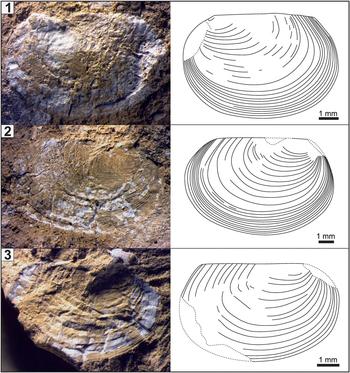
Pseudestheria sp. aff. Pseudestheria longa Novozhilov, Reference Novozhilov1959 from the Zhukov Ravine (section no. 1236, bed 3), Moscow Syneclise, European Russia; Zhukov Member, Vokhma Formation, Zhukovian Regional Stage (late Permian). (1) Cast of a left valve partially preserved as shell substance; FG660/ZR1236/7. (2) Counterpart of the same individual showing the imprint of the left valve; FG660/ZR1236/7ggst. (3) Imprint of a left valve partially covered by remnants of the shell substance; FG660/ZR1236/10.

Occurrence
The holotype of Pseudestheria longa was collected from a late Permian section near the village of Domanovitchi in the Dnepr-Donetsk Basin, southeastern Belorussia (Novozhilov, Reference Novozhilov1959, p. 89).
Description
Very large carapace (valve length 7.5–10.0 mm) and oval shape (valve height/length ratio values 0.60–0.66); dorsal margin long and straight; position of the umbo anterior and inframarginal; larval valve very small; up to 23 growth lines; growth bands without concentric ribs; sharply to very sharply curved anterior and posterior margins; points of maximal curvatures of the anterior and posterior margins median-dorsal, at the ventral margin median.
Materials
Three well-preserved specimens (for their inventory numbers see Table 1). Zhukov Ravine (section no. 1236, bed 3); Zhukov Member, Vokhma Formation; Zhukovian Regional Stage (late Permian) (Fig. 11.1–11.3).
Remarks
Goretzki (Reference Goretzki2003) listed Pseudestheria longa Novozhilov, Reference Novozhilov1959 as a younger synonym of Polygrapta sibirica Novozhilov, Reference Novozhilov1958a, which was collected from the middle–late Permian (Novozhilov, Reference Novozhilov1958a) or middle Permian–Early Triassic (Goretzki, Reference Goretzki2003) Korvunchana Formation in the Krasnoyarsk area of the Nizhnyaya Tunguska Basin on the Siberian Platform. In contrast to Pseudestheria longa, the specimens collected from the Zhukov Member of the Vokhma Formation (Zhukovian Regional Stage; late Permian) in the Zhukov Ravine (section no. 1236) are characterized by the maximal curvature of the posterior margin located in a higher position. Therefore, an open taxonomy is used here for the species level. Its real taxonomic range will be determined in future studies, when more material will be available from this section.
The forms Polygrapta sibirica and Pseudestheria longa as well as Pseudestheria sp. aff. Pseudestheria longa are morphologically very similar to Magniestheria mangaliensis (Jones, Reference Jones1862), which is known from Early Triassic sections in the Moscow Syneclise, the Central European Basin, and other regions (e.g., Scholze et al., Reference Scholze, Golubev, Niedźwiedzki, Sennikov, Schneider and Silantiev2015, Reference Scholze, Schneider and Werneburg2016). The latter species has a highly variable valve morphology and comprises both a slender and a stout morphotype (e.g., Kozur and Seidel, Reference Kozur and Seidel1983; Scholze et al., Reference Scholze, Golubev, Niedźwiedzki, Sennikov, Schneider and Silantiev2015, Reference Scholze, Schneider and Werneburg2016). The size (total valve length) of the these forms corresponds to the size of the slender morphotype of Magniestheria mangaliensis, but their shape (based on the height/length ratio of the valve) is transitional between the slender and the stout morphotypes of Magniestheria mangaliensis.
Superfamily Palaeolimnadiopseoidea Defretin-Lefranc, Reference Defretin-Lefranc1965 [nom. transl. Kobayashi, Reference Kobayashi1973 (ex Palaeolimnadiopseidae Defretin-Lefranc, Reference Defretin-Lefranc1965)]
Family Palaeolimnadiopseidae Defretin-Lefranc, Reference Defretin-Lefranc1965 [nom. transl. Kobayashi, Reference Kobayashi1973 (ex Palaeolimnadiopseinae Defretin-Lefranc, Reference Defretin-Lefranc1965)]
Genus Palaeolimnadiopsis Raymond, Reference Raymond1946
Type species
Palaeolimnadiopsis carpenteri Raymond, Reference Raymond1946.
Remarks
The genus Palaeolimnadiopsis is known from the Devonian to the Cretaceous (e.g., Webb, Reference Webb1978; Shen, Reference Shen1985; Gallego, Reference Gallego2005; Carbonaro et al., Reference Carbonaro, Rohn and Ghilardi2013). Its principal morphological character is a concave recurvation of the growth lines at the dorsal margin (e.g., Raymond, Reference Raymond1946). The type species Palaeolimnadiopsis carpenteri from the late early Permian (Leonardian) of Oklahoma is extremely large (42 mm in length; Raymond, Reference Raymond1946). The convex recurvation of the upper posterior margin and the large to extremely large size are the characteristics of the genus.
Palaeolimnadiopsis vilujensis Varentsov, Reference Varentsov1955
Palaeolimnadiopsis vilujensis Varentsov, Reference Varentsov1955 from the Moscow Syneclise, European Russia; Zhukovian Regional Stage (late Permian) to Vokhmian Regional Stage (Early Triassic). The valves show partial preservation of shell substance. (1) Cast of a left valve; Zhukov Ravine (section no. 1236, bed 3); Zhukov Member, Vokhma Formation; Zhukovian Regional Stage (late Permian); FG660/ZR1236/5. (2) Counterpart of the same individual showing the imprint of the left valve; FG660/ZR1236/9. (3) Cast of a right valve; Zhukov Ravine (section no. 1236, bed 3); Zhukov Member, Vokhma Formation; Zhukovian Regional Stage (late Permian); FG660/ZR1236/6. (4) Deformed cast of a right valve resembling Palaeolimnadiopsis vilujensis Varentsov, Reference Varentsov1955; Arefino Ravine (section no. 1225, 1.15 m above base of bed 8); Ryabi Member, Vokhma Formation; Vokhmian Regional Stage (Early Triassic); FG660/14a.

1955 Palaeolimnadiopsis vilujensis Reference VarentsovVarentsov, p. 310, pl. 1, figs. 7–9.
1958b Palaeolimnadiopsis vilujensis; Reference NovozhilovNovozhilov, p. 99, fig. 5, pl. 1, figs. 2–4.
?1983 Falsisca eotriassica postera Kozur and Reference Kozur and SeidelSeidel, p. 297, pl. 2, figs. 5–8, pl. 3, figs. 1–5, 8.
2003 Palaeolimnadiopsis vilujensis; Reference GoretzkiGoretzki, p. 161, pl. 38a, fig. 1, pl. 38b, fig. 1.
2014b Palaeolimnadiopsis vilujensis; Reference Schneider, Rössler, Werneburg, Scholze and VoigtScholze in Schneider et al., fig. 64.
2015 Palaeolimnadiopsis vilujensis; Scholze et alReference Scholze, Golubev, Niedźwiedzki, Sennikov, Schneider and Silantiev., p. 31, figs. 13A–D, 14A, B.
2015 Palaeolimnadiopsis vilujensis; Scholze and Reference Scholze and SchneiderSchneider, fig. 2.
2016 Palaeolimnadiopsis vilujensis; Scholze et alReference Scholze, Schneider and Werneburg., p. 179, fig. 6A–C.
2016 Palaeolimnadiopsis vilujensis; Schneider and Reference Schneider and ScholzeScholze, fig. 3h.
2017b Palaeolimnadiopsis vilujensis; Reference Scholze, Abu Hamad, Schneider, Golubev, Sennikov, Voigt and UhlScholze et al., fig. 9E.
2017 Palaeolimnadiopsis vilujensis; Reference Chu, Tong, Benton, Yu and HuangChu et al., fig. 9E–F.
Holotype
Left valve (PIN 985/1) from Permian or Triassic deposits at the Vilyuychan river, 2.2 km downstream from the river mouth of Atyr-Yuryakh, Yakutia (Varentsov, Reference Varentsov1955, pl. 1, fig. 7).
Occurrence
The age of the type locality of Palaeolimnadiopsis vilujensis at the Vilyuychan river in Yakutia, Siberia, was first described by Varentsov (Reference Varentsov1955, p. 311) as Permian–Triassic, underlain by Silurian strata. In successive studies, Palaeolimnadiopsis vilujensis was redescribed and illustrated by Novozhilov (Reference Novozhilov1958b) and Goretzki (Reference Goretzki2003). Since then, Scholze et al. (Reference Scholze, Golubev, Niedźwiedzki, Sennikov, Schneider and Silantiev2015, Reference Scholze, Schneider and Werneburg2016) described Early Triassic (Induan) occurrences of this species in the Vokhma Formation (Vokhmian Regional Stage) and in the Upper Fulda Formation to Calvörde Formation (uppermost Zechstein Group to Lower Buntsandstein Subgroup) of the Moscow Syneclise and the Central European Basin, respectively. More recently, new occurrences of this species were reported by Scholze et al. (Reference Scholze, Abu Hamad, Schneider, Golubev, Sennikov, Voigt and Uhl2017b, fig. 9E) from the Zhukov Member of the Vokhma Formation in the Zhukov Ravine (section no. 1236, bed 3), which were correlated with the late Zhukovian Regional Stage, late Permian. Its late Permian occurrence is confirmed by new data of the present study (Fig. 12.1–12.3), which supports its Permian–Triassic range as initially reported by Varentsov (Reference Varentsov1955).
Description
Very large carapace (valve length 3.8–7.6 mm) and elongated oval to oval shape (valve height/length ratio values 0.54–0.69); dorsal margin straight and long to very long; larval valve small, but often apparently large due to reduced preservation of growth lines in the umbonal area; position of the umbo submedial and inframarginal; up to 20 growth lines; decreased preservation of growth lines toward the posterodorsal transition; well-preserved subadult to adult individuals show a concave recurvation of the uppermost posterior growth lines below the dorsal margin as well as growth lines consisting of two separate lines; anterior and posterior margins curved to sharply curved; points of maximal curvatures of the anterior and posterior margins located median-dorsal, at the ventral margin median-anterior to median-posterior.
Materials
Four well-preserved specimens (for their inventory numbers see Table 1) and five additional specimens in various preservational stages published by Scholze et al. (Reference Scholze, Golubev, Niedźwiedzki, Sennikov, Schneider and Silantiev2015, Reference Scholze, Abu Hamad, Schneider, Golubev, Sennikov, Voigt and Uhl2017b). Zhukov Ravine (section no. 1236); Zhukov Member and Ryabi Member, Vokhma Formation; Zhukovian Regional Stage (late Permian) (bed 3 of section 1236) to Vokhmian Regional Stage (Early Triassic) (bed 10 of section 1236) (Fig. 12.1–12.3). Arefino Ravine (section no. 1225, bed 8, according to the profile of Scholze et al., Reference Scholze, Golubev, Niedźwiedzki, Sennikov, Schneider and Silantiev2015); Ryabi Member, Vokhma Formation; Vokhmian Regional Stage (Early Triassic) (Fig. 12.4).
Remarks
Palaeolimnadiopsis vilujensis has a high morphological variability resulting in both oval (Varentsov, Reference Varentsov1955, pl. 1, figs. 7, 8) and elongated (Varentsov, Reference Varentsov1955, pl. 1, fig. 9) valve shapes. Scholze et al. (Reference Scholze, Golubev, Niedźwiedzki, Sennikov, Schneider and Silantiev2015, Reference Scholze, Schneider and Werneburg2016) demonstrated that its high degree of variability also accounts for the total length of the valve and the number of growth lines. In addition, this species shows different types of preservation, whereby well-preserved valves can show either partial or complete preservation of shell substance and single growth lines consisting of paired fine lines (e.g., Scholze et al., Reference Scholze, Golubev, Niedźwiedzki, Sennikov, Schneider and Silantiev2015). Often, if the shell substance (or its pseudomorph) is missing, it can be observed that the imprints are increasingly badly preserved toward the outer margins of the valve. This can result in indistinct preservation of the recurvation at the posterior margin below the dorsal margin (Scholze et al., Reference Scholze, Schneider and Werneburg2016).
As discussed by Scholze et al. (Reference Scholze, Schneider and Werneburg2016) Palaeolimnadiopsis dictyonata (Reible, Reference Reible1962, pl. 10, figs. 1–3) from the Upper Buntsandstein Subgroup (early Middle Triassic) in eastern France and Palaeolimnadiopsis kouznetskensis (Defretin-Lefranc, Reference Defretin-Lefranc1965, pl. 3, figs. 1, 2; Molin and Novozhilov, Reference Molin and Novozhilov1965, pl. 9, fig. 7) from the Maltsevo Formation (Early Triassic) of the Babiy Kamen section in the Kuznetsk Basin in Siberia are similar to Palaeolimnadiopsis vilujensis but differ in having large reticulated ornamentation and a more concave recurvation at the posterodorsal margin, respectively. Previously described Palaeolimnadiopsis albertii (in the sense of Novozhilov, Reference Novozhilov1958b) from the Maltsevo Formation of the Babiy Kamen section are synonyms of Palaeolimnadiopsis kouznetskensis but were redescribed as Palaeolimnadiopsis kouznetskensis Defretin-Lefranc, Reference Defretin-Lefranc1965 in successive studies by Defretin-Lefranc (Reference Defretin-Lefranc1965) and Molin and Novozhilov (Reference Molin and Novozhilov1965). An intraspecific differentiation into forms with an oval or an elongated valve shape can also be observed in Palaeolimnadiopsis albertii (Novozhilov, Reference Novozhilov1958b, pl. 1, figs. 9–11), which is similar to the mentioned shape variation of Palaeolimnadiopsis vilujensis and supports the observed high degree of morphological variability.
A paratype of ‘Megasitum salebriprolixum’ (Novozhilov, Reference Novozhilov1970, pl. 9, fig. 3) from the Andreevo section in the Moscow Syneclise, Anisimovo Member, Vokhma Formation, Vokhmian Regional Stage (Vetlugian Group, Early Triassic; Goretzki, Reference Goretzki2003) is very similar to Palaeolimnadiopsis vilujensis from the Upper Fulda Formation (Scholze et al., Reference Scholze, Schneider and Werneburg2016, fig. 6) and the basal Calvörde Formation (Scholze et al., Reference Scholze, Golubev, Niedźwiedzki, Sennikov, Schneider and Silantiev2015, fig. 14). According to Goretzki (Reference Goretzki2003), ‘Megasitum salebriprolixum’ Novozhilov, Reference Novozhilov1970 was taxonomically revised as a younger synonym of ‘Wetlugites pronus’ Novozhilov, Reference Novozhilov1958c. However, this revision only accounts for the badly preserved holotype of ‘Megasitum salebriprolixum’ (Novozhilov, Reference Novozhilov1970, pl. 9, fig. 2; Goretzki, Reference Goretzki2003, text-fig. 3.16, pl. 1, fig. 20), while the mentioned paratype occurs on a different slab and possibly represents a different taxon that has not been revised.
Palaeolimnadiopsis subalata (Reed, Reference Reed1929), which occurs in the Permian Passa Dois Series in Southern Brazil (Mendes, Reference Mendes1954; Ferreira-Oliveira and Rohn, Reference Ferreira-Oliveira and Rohn2008), is morphologically similar to Palaeolimnadiopsis vilujensis in regard to the shape of its valve and the concave recurvation of the posterodorsal growth lines. According to the height (6 mm) and length (9 mm) values of Palaeolimnadiopsis subalata as given by Reed (Reference Reed1929, p. 8), its valves are slightly larger than those of Palaeolimnadiopsis vilujensis. The figures of Palaeolimnadiopsis subalata (Reed, Reference Reed1929, figs. 9–11) show a marginal and transitional anterior-submedial position of the umbo, while the umbo of Palaeolimnadiopsis vilujensis is located inframarginally and more submedially. Due to the size of its valve and the marginal position of the umbo, Palaeolimnadiopsis subalata seems more similar to the Palaeolimnadiopsis form Rhinow (Schneider and Scholze, Reference Schneider and Scholze2016, figs. 2/28, 3g) from the Hannover Formation (early Wuchiapingian, late Permian) in the NW-German part of the Southern Permian Basin. The specimen of Palaeolimnadiopsis subalata from the Permian Passa Dois Series in southern Brazil, described and figured by Mendes (Reference Mendes1954), is even larger (length 10.5 mm, height 6.8 mm) and shows a median-dorsal position of the point of maximal curvature at the posterior margin, which is higher than the maximal posterior curvature of Palaeolimnadiopsis vilujensis. In addition, a retouched photograph in the study of Mendes (Reference Mendes1954, pl. 13, fig. 5) shows an individual with an umbo overtopping the dorsal margin. Therefore, it is probably a species different from Palaeolimnadiopsis vilujensis.
In the Central European Basin, occurrences of Palaeolimnadiopsis vilujensis and Euestheria gutta were used to define a biostratigraphically distinct faunal assemblage of an Early Triassic age ranging from the lower part of the Upper Fulda Formation (uppermost Zechstein Group) to the upper part of the Calvörde Formation (Lower Buntsandstein Subgroup) (Scholze et al., Reference Scholze, Schneider and Werneburg2016). However, the real stratigraphic range of Palaeolimnadiopsis vilujensis in the Central German part of the Central European Basin should be handled with caution due to the poor fossil record in the siliciclastic sabkha facies of the Zechstein Group deposits at the basin border. Forms previously reported from occurrences in Central Germany, such as ‘Falsisca postera’ (=Falsisca eotriassica postera n. subsp. Kozur and Seidel, Reference Kozur and Seidel1983) are morphologically similar to Palaeolimnadiopsis vilujensis. However, the species ‘Falsisca postera’ should not be used because of taxonomic problems with its genus and species levels as discussed by Scholze et al. (Reference Scholze, Schneider and Werneburg2016). According to Schneider and Scholze (Reference Schneider and Scholze2016), ‘Falsisca postera’ is probably a younger synonym of Palaeolimnadiopsis vilujensis because of both similar valve morphology and an overlapping stratigraphic range in the Central European Basin. Unfortunately, the holotype of ‘Falsisca postera’, as well as all the other specimens figured by Kozur and Seidel (Reference Kozur and Seidel1983), are still missing (Scholze et al., Reference Scholze, Schneider and Werneburg2016). Therefore, a more detailed taxonomic revision of ‘Falsisca postera’ was, so far, impossible.
Preservation of conchostracans
The best-preserved conchostracan carapace valves were collected from clay- and siltstones (Fig. 9.1–9.6) because sandstones provide considerably lower potential for their preservation (Fig. 9.7, 9.8). Fine-grained siliciclastics with internal horizontal lamination are indicative of deposition under low-energy conditions, where the sediment settled out of suspension. This agrees with the known preferences of conchostracans for inhabiting small, quiet inland water bodies (e.g., Tasch, Reference Tasch1969; Schneider et al., Reference Schneider, Lucas, Trümper, Stanulla and Krainer2016) and fits with the sedimentological observations of the Early Triassic conchostracan occurrences in the study area (Scholze et al., Reference Scholze, Golubev, Niedźwiedzki, Sennikov, Schneider and Silantiev2015). The sedimentological indications of a low-energy environment are indicative of an autochthonous deposition of the conchostracan valves, which is also supported by the fact that the majority of the specimens show no mechanical damage to their valves.
The conchostracans from the late Permian–Early Triassic sections around Vyazniki and Gorokhovets are preserved as either casts or imprints of the valves (Fig. 9). The majority of the valves are partially or completely covered by the primary shell substance or by a pseudomorphosis usually varying in color from brownish to whitish, but slightly translucent or variously colored shells were also observed (Fig. 9.1, 9.3, 9.6, 9.7). The white pseudomorphs are composed of carbonate. All specimens are more or less affected by compaction, resulting in a morphological range that varies between almost three-dimensional preservation and complete flattening as discussed by Scholze et al. (Reference Scholze, Golubev, Niedźwiedzki, Sennikov, Schneider and Silantiev2015).
A wide spectrum of preservational variability applies to the umbonal area of the valve. Some specimens show plastic deformation of the umbo due to compaction of the valve, which can result in both overlapping of the umbo with the dorsal margin and apparent convex curving of the dorsal margins (Fig. 9.3, 9.4). Primary convex sculptures, such as circular or droplet-shaped nodules on the external side of the larval valve of Pseudestheria sp. aff. Megasitum volgaense, may be present in various diameters (Fig. 9.2, 9.4, 9.6) or may apparently be absent due to deformation. In addition, the deformation of umbonal areas might result in the presence of multiple, secondarily caused, apparent sculptures. This increases the risk of subjective taxonomical interpretations, depending on the respective worker. For example, genera such as ‘Bipemphigus’, ‘Tripemphigus’, and ‘Trisitum’, which were formerly defined by N. I. Novozhilov (e.g., in Molin and Novozhilov, Reference Molin and Novozhilov1965; Novozhilov, Reference Novozhilov1970) are very similar to ‘Megasitum’ but differ from the latter in the number of nodular sculptures on their larval valves. Novozhilov has been repeatedly criticized for his taxonomic over-splitting (e.g., Tasch, Reference Tasch1958; Kozur and Seidel, Reference Kozur and Seidel1983; Goretzki, Reference Goretzki2003; Astrop and Hegna, Reference Astrop and Hegna2015), and therefore his taxonomic studies were considered with caution by Scholze et al. (Reference Scholze, Golubev, Niedźwiedzki, Sennikov, Schneider and Silantiev2015) and in the present study. To reduce the risk of taxonomic misinterpretations, the present study attempted to use samples from bedding planes containing several individuals of monospecific populations to better understand the full spectrum of the preservational variability.
Discussion
Current problems on late Permian conchostracan studies
The pseudestheriid conchostracan valves of the Nefyodovian Regional Stage and Zhukovian Regional Stage (late Permian) in the study area show a high degree of morphological variability. This is similar to previous results by Orlova (Reference Orlova1990), who documented that the late Permian species Rhodendorfium (Bipemphigus) gennisi shows pronounced variabilities of the shapes of the valves, the total valve sizes, the lengths of the dorsal margins, the sizes of the larval valves, and the positions of points of maximal curvatures of the posterior margins. Such a high degree of morphological variability increases the risk of subjective, strongly author-dependent taxonomic determinations and makes the taxonomic determination of late Permian conchostracans difficult. In addition, determinations at both the genus and the species levels of late Permian conchostracans from the East European Platform and Siberia are hampered by the large numbers of taxonomic synonyms in the literature. To avoid taxonomic misinterpretations, the present study partially used an open nomenclature at the species level, such as for Pseudestheria sp. aff. Megasitum volgaense and Pseudestheria sp. aff. Pseudestheria longa. Their preliminary determination follows a methodological approach discussed by Schneider and Scholze (Reference Schneider and Scholze2016), which aims to avoid the description of further synonymous species.
The size, shape, and curvatures of the valve margins of Pseudestheria cf. P. chatangensis, Pseudestheria sp. aff. Megasitum volgaense, and Pseudestheria sp. aff. Pseudestheria longa are morphologically similar to Pseudestheria chatangensis. However, they differ, more or less, from each other by the sculptures on the external side of the larval valve and the development of their concentric ribs. So far, it seems difficult to assess whether such morphological differences were the result of preservational variability, intraspecific variability, or a combination of both. To better understand their real taxonomic ranges, an extensive taxonomical revision of the type material of these ‘species’ would be necessary.
In the present study, the high degree of morphological variability of the conchostracan valves accounts for the presence or absence of convex sculptures on the external side of the larval valve. Genera known from the literature such as ‘Bipemphigus’, ‘Tripemphigus’, ‘Megasitum’, and ‘Trisitum’ are morphologically similar but seemingly differ from each other in the number of these sculptures on their larval valves. Most problematically, the larval valve and the umbonal area of fossil conchostracan carapaces are, almost without exception, affected by different types of preservation due to diagenetic processes (i.e., compaction). Judging from the observations of the present study, these processes can result in various types of deformation of transitional primary to secondary (diagenetically induced) sculptures. Problematically, the question of whether these sculptures represent primary taxonomic characters often remains subjective, while forms without such sculpture cannot be differentiated from the Permian genus Pseudestheria.
Earliest Triassic conchostracan biostratigraphy
The earliest Triassic (Induan) conchostracan fauna recently described from the Moscow Syneclise (e.g., Scholze et al., Reference Scholze, Golubev, Niedźwiedzki, Sennikov, Schneider and Silantiev2015), consisting of Euestheria, Palaeolimnadiopsis, Magniestheria, Cornia, and Rossolimnadiopsis, is taxonomically more diverse than the preliminarily determined late Permian conchostracan fauna of the present study. The earliest Triassic conchostracan faunas of the respective section intervals of both the Moscow Syneclise and the German part of the Central European Basin show similar taxonomic composition (Fig. 13). The earliest Triassic (Induan) age of the fauna from the Moscow Syneclise is primarily based on the regional occurrence of Tupilakosaurus bone fragments, which are stratigraphically restricted to the Tupilakosaurus wetlugensis Assemblage Zone of the Vokhmian Regional Stage (e.g., Golubev et al., Reference Golubev, Sennikov, Minikh, Minikh, Kukhtinov, Balabanov and Silantiev2012a, Reference Golubev, Minikh, Balabanov, Kukhtinov, Sennikov and Minikhb; Sennikov and Golubev, Reference Sennikov and Golubev2012; Scholze et al., Reference Scholze, Golubev, Niedźwiedzki, Sennikov, Schneider and Silantiev2015). The assumed Early Triassic age is supported by paleomagnetic and δ13Ccarb data (Novikov, Reference Novikov2015; Golubev, Reference Golubev2017a, Reference Golubevb) as well as interregional biostratigraphic correlations of certain conchostracan species such as Magniestheria mangaliensis and Euestheria gutta, known from mixed marine-continental sections in southern and northern China (e.g., Liu and He, Reference Liu and He2000; Chu et al., Reference Chu, Tong, Yu, Song and Tian2013, Reference Chu, Yu, Tong, Benton, Song, Huang, Song and Tian2016), which are controversially propounded to be of Early Triassic or transitional late Permian–Early Triassic age (Scholze et al., Reference Scholze, Wang, Kirscher, Kraft, Schneider, Götz, Joachimski and Bachtadse2017a, p. 132).
Summarized stratigraphic ranges of the continental late Permian–Early Triassic sections based on results of the present study and Scholze et al. (Reference Scholze, Golubev, Niedźwiedzki, Sennikov, Schneider and Silantiev2015). Taxonomically similar compositions of Early Triassic conchostracan faunas are proposed for biostratigraphic correlations between the studied sections in the Moscow Syneclise and the Central European Basin. Conchostracan data of the Zechstein and Buntsandstein Groups are obtained from Schneider and Scholze (Reference Schneider and Scholze2016) and Scholze et al. (Reference Scholze, Schneider and Werneburg2016, Reference Scholze, Wang, Kirscher, Kraft, Schneider, Götz, Joachimski and Bachtadse2017a). Key for the studied sections: a=Zhukov Ravine (section no. 1022); b=Zhukov Ravine (section no. 1023); c=Gorokhovets excavation site; d=Zhukov Ravine (section no. 1027B); e=Zhukov Ravine (section no. 1236); f=Arefino Ravine (section no. 1225); g=Zhukov Ravine (section no. 1029); h=Mys Bykovka (section no. 1032); i=Sokovka (section no. 0446-C); j=Balymotikha; k=Fedurniki sand pit; l=Staroe Slukino. Data on conchostracan taxa from a–e and h–j refer to the present study; f, g, k, and l refer to results of Scholze et al. (Reference Scholze, Golubev, Niedźwiedzki, Sennikov, Schneider and Silantiev2015).

Paleoenvironment
Previous to the present study, the late Permian sedimentary environments near Vyazniki and Gorokhovets were described as mudrock-dominated successions, which were “deposited in a broad range of fluvial and lacustrine environments that ranged from ephemeral to perennial and saline to freshwater” (Newell et al., Reference Newell, Sennikov, Benton, Molostovskaya, Golubev, Minikh and Minikh2010, p. 710). These mudrocks were interpreted as “probably deposited in ephemeral lake or fluvial floodplain environments” (Newell et al., Reference Newell, Sennikov, Benton, Molostovskaya, Golubev, Minikh and Minikh2010, p. 710). In agreement with previous observations on the Early Triassic conchostracan fauna of the study area (Scholze et al., Reference Scholze, Golubev, Niedźwiedzki, Sennikov, Schneider and Silantiev2015), the fine-grained lithology of the late Permian conchostracan occurrences indicates shallow, quiet water conditions where sediment settled down from suspension. The conchostracan occurrences in internally laminated clay- to siltstones point to deposition under low-energy conditions. This corresponds to habitat preferences known from modern conchostracans, which were recorded in small freshwater bodies such as inland pools and ponds (e.g., Tasch, Reference Tasch1969; Frank, Reference Frank1988).
Occurrences of fossil conchostracans usually serve as a freshwater indicator, a fact that is supported by their occurrence in Paleozoic to Cenozoic lake and pond deposits (e.g., Olempska, Reference Olempska2004; Martens and Lucas, Reference Martens and Lucas2005; Shen et al., Reference Shen, Gallego, Buchheim and Biaggi2006; Schneider et al., Reference Schneider, Lucas, Trümper, Stanulla and Krainer2016). Triassic conchostracans from brackish to shallow, marginal marine deposits have been mentioned occasionally by previous workers (e.g., Tintori, Reference Tintori1990; Shen et al., Reference Shen, Garassino and Teruzzi2002; Kozur and Weems, Reference Kozur and Weems2010), and in some occurrences they were recorded together with lingulid brachiopods or pectinid bivalves (e.g., Liu and He, Reference Liu and He2000; Scholze et al., Reference Scholze, Abu Hamad, Schneider, Golubev, Sennikov, Voigt and Uhl2017b; Soussi et al., Reference Soussi, Niedźwiedzki, Tałanda, Dróżdż, Sulej, Boukhalfa, Mermer and Błażejowski2017; Chu et al., Reference Chu, Tong, Benton, Yu and Huang2017). These may result from transport processes, whereby freshwater organisms were transported to nearby marine environments during rainy seasons (Tintori, Reference Tintori1990). Alternatively, Scholze et al. (Reference Scholze, Abu Hamad, Schneider, Golubev, Sennikov, Voigt and Uhl2017b) interpreted assemblages of conchostracans and lingulid brachiopods as lacustrine occurrences on coastal plains, where an input of marine waters could have occurred during storm surges from a nearby sea. This suggests that certain fossil conchostracan taxa might have developed higher tolerances to elevated salinity. Similar exceptions are known from recent species, such as Caenestheriella setosa (Pearse, Reference Pearse1912) and Limnadia lenticularis (Linnaeus, Reference Linnaeus1761), which were mentioned by Webb (Reference Webb1979, p. 260–261) to withstand salt concentrations of up to 6‰.
Conclusion
The late Permian–Early Triassic transition in continental sections near the towns of Vyazniki and Gorokhovets in the Moscow Syneclise have been sampled, bed by bed, for conchostracans. A predominantly pseudestheriid fauna including Pseudestheria chatangensis (Novozhilov, Reference Novozhilov1946), Pseudestheria cf. P. chatangensis (Novozhilov, Reference Novozhilov1946), Pseudestheria sp. aff. Megasitum volgaense Novozhilov, Reference Novozhilov1970, and Pseudestheria sp. aff. Pseudestheria longa Novozhilov, Reference Novozhilov1959 was preliminarily recorded in the section intervals of the Nefyodovian Regional Stage and Zhukovian Regional Stage, late Permian. The valves of these species are characterized by a high degree of morphological variability; therefore, an open nomenclature was used at the species level. With respect to their taxonomic determination at the genus level, the apparent presence or absence of variable sculptures on the external side of the larval valve should be handled with caution due to a higher susceptibility of the larval and umbonal areas to deformation during diagenesis.
The conchostracan fauna of the overlying Vokhmian Regional Stage, earliest Triassic, in the study area consist of Cornia germari (Beyrich, Reference Beyrich1857), Euestheria gutta (Lutkevich, Reference Lutkevich1937), Magniestheria mangaliensis (Jones, Reference Jones1862), and Rossolimnadiopsis sp. (Scholze et al., Reference Scholze, Golubev, Niedźwiedzki, Sennikov, Schneider and Silantiev2015). The species Palaeolimnadiopsis vilujensis Varentsov, Reference Varentsov1955 was recorded in the Zhukovian Regional Stage and the Vokhmian Regional Stage, latest Permian–earliest Triassic. The Early Triassic species Magniestheria mangaliensis shows differentiation into various morphotypes (Scholze et al., Reference Scholze, Golubev, Niedźwiedzki, Sennikov, Schneider and Silantiev2015) similar to the present observations on the high morphological variability of the pseudestheriid fauna of late Permian age. The difficulties resulting from the potential risk of subjective taxonomic misinterpretations demonstrate the overdue need to standardize the morphometric analysis of conchostracan valves.
According to paleomagnetic and isotopic data, together with paleontological data, the Permian-Triassic boundary is located in the lowermost part of Vokhmian Regional Stage. The regional first occurrence of Tupilakosaurus bone fragments in the Vokhmian Regional Stage is traditionally used as a biostratigraphic indicator for the base of the Early Triassic on the East European platform. The mass occurrences of Tupilakosaurus fragments support an earliest Triassic (Induan) age of the co-occurring conchostracan taxa in this region.
Acknowledgments
F. Scholze and J.W. Schneider thank the German Research Foundation (grant number SCHN408/22-1). V.K. Golubev and A.G. Sennikov were funded by RFBR according to the research project nos. 16-04-01062, 16-05-00711, 16-05-00706, 17-04-00410, 17-04-01937, and by the Program of Basic Research of the Presidium of the RAS no. 30 ‘The evolution of the organic world and planetary processes’. This study was financially supported by the Russian Government to support the program ‘Competitive Growth of Kazan Federal University among World’s Leading Academic Centers’. The fossil-bearing deposits from Vyazniki were examined during fieldwork in 2008, 2010, and 2013 organized by the Institute of Paleobiology, Polish Academy of Sciences, Poland, Faculty of Biology, University of Warsaw, Poland, and Borissiak Paleontological Institute, Russian Academy of Sciences. The Russian-Polish field study at Vyazniki was supported by a grant from the Polish Ministry of Science and Higher Education (no. 7986/B/2011/40 to T. Sulej). This project aims to contribute to IGCP 630 ‘Permian–Triassic climatic and environmental extremes and biotic response’ and to the tasks of the ‘Nonmarine–Marine Correlation Working Group’ of the Subcommissions on Carboniferous Stratigraphy (SCCS), on Permian Stratigraphy (SPS), and on Triassic Stratigraphy (STS). L.F. Rinehart is thanked for the improvement of the English and valuable hints. We thank the reviewers G. Li and O.F. Gallego and the editor T. Hegna for comments and suggestions improving this paper.