

Introduction
Substances that increase milk supply are known as galactagogues, which comes from the Greek words meaning ‘milk’ and ‘leading’, and which induce milk secretion. A number of traditional herbal medicines are believed to act as galactagogues for example, milk thistle (Silybum marianum) fenugreek (Trigonella foenum-graecum; Zapantis et al., Reference Zapantis, Steinberg and Schilit2012) and anise (Pimpinella anisum; Shojaii and Adbollahi, Reference Shojaii and Adbollahi2012). Ixbut (Euphorbia lancifolia), a plant from Guatemala (Rosengarten, Reference Rosengarten1982), and Linum usitatissimum in India has been reportedly used to increase cow's milk yield (Kumar and Bharati, Reference Kumar and Bharati2013). Extracts from cooked banana flower (Musa x paradisiacal) increased milk yield by 25% and 18% in rats when extracted in water and petroleum respectively (Mahmood et al., Reference Mahmood, Omar and Ngah2012). Water or ethanol extracts from the seeds of black fennel (Nigella sativa) increased rat milk yield by 31% and 38% respectively (Hosseinzadeh et al., Reference Hosseinzadeh, Tafaghodi, Mosavi and Teghiabedi2013).
This study was conducted to determine if other natural products, manuka honey and Aloe vera, which have been related to various benefits in animals, could produce similar effects on milk yield, specifically in cows. Aloe vera is a herb which has been successfully used in multiple veterinary situations (Urch, Reference Urch2006; Coats et al., Reference Coats, Holland and Ahola1985). For dermatitis it is topically applied externally to the affected areas. Regarding active components, saponins and tannin levels are currently considered to be likely candidates. Although both were found in Aloe vera, the levels were at the low end of the herb plant range (Sirohi et al., Reference Sirohi, Pandey, Goel, Singh, Mohini, Pandey and Chaudhry2009). Aloe vera has been found to be anti-bacterial, possibly anti-viral (Sierra-García, Reference Sierra-García, Castro-Ríos, González-Horta, Lara-Arias and Chávez-Montes2014), and to have milk antifungal activity (Doddanna, Reference Doddanna, Patel, Sundarrao and Veerabhadrappa2013). Due to its ability to change micro-organism growth, the extract may alter rumen flora in a way that is independent of the tannin or saponin compounds.
Plants high in tannins have been specifically studied for their effect on lactation. Hydrolysable tannins are formed around a carbohydrate molecule and phenolic groups, forming either partially or totally esterified branches of the carbohydrate. Condensed tannins (CT), on the other hand, have multiple flavone moieties with no carbohydrate fraction. CT can bind to proteins and protect them from degradation in the rumen, especially when the pH is low. These conditions occur in the rumen when feed is low in fibre and higher in sugar and/or starch, which act as a substrate for and encourages growth of acid producing micro-organisms. These combined compounds can then dissociate in the abomasum and anterior duodenum, releasing protein and enabling an increase in the bio-availability of the proteins for ileal digestion, thus enabling more to become available for transfer into milk (Dey and De, Reference Dey and De2014). It must be noted however that this is only useful when the amino acid pattern of the intake protein is better than microbial protein.
Increases in milk yield have been shown for Albizia saman, a flowering tree from the pea family (Anantasook et al., Reference Anantasook, Wanapat, Cherdthong and Gunun2014) and Ficus benghalensis, commonly known as the Indian banyan tree (Dey and De, Reference Dey and De2014). In other trials, changing feed from alfalfa (Medicago sativa) to red clover (Trifolium pretense) or birdsfoot trefoil (Lotus corniculatus) silage while maintaining the same protein and energy intake, resulted in increased milk yield. There was a corresponding drop in nitrogen lost via urine, suggesting that birdsfoot trefoil silage resulted in more effective utilisation of nitrogen in the rumen (Hymes-Fecht, 2012).
Tannins isolated from acacia and chestnut trees resulted in a 40% decrease in methane production (Hassanat and Benchaar, Reference Hassanat and Benchaar2013). Waste grape pressings, which are high in tannins and sourced as a waste by-product from the wine industry, resulted in more nitrogen passing into the faeces (Greenwood, Reference Greenwood, Edwards and Harrison2012). Thus, introducing feed that is high in tannins may change how protein behaves in the rumen, potentially allowing different quantities of amino acids to be metabolised by the cow.
Not all studies have shown a positive effect of increasing milk yield with tannin supplementation. For example, Dschaak et al., (Reference Dschaak, Williams, Holt, Eun, Young and Min2001) found no change in milk yield.
Saponins are soap-like substances found in certain plants. It is thought that part of their biological role is to decrease palatability of feed and/or reduce digestion of feed so that the plant is less likely to be eaten by herbivores. Feeding saponins has been shown to reduce greenhouse emissions from cattle (Hess et al., Reference Hess, Kreuzer, Díaz, Lascano, Carulla, Soliva and Machmüller2003). In sheep, a high saponin diet caused a significant decrease in rumen protozoa levels (Diaz et al., Reference Diaz, Avendano and Escobar1993), which may be linked to changes in protein digestion. The relatively low level in Aloe vera may or may not have an impact on palatability and digestion in cows.
Manuka honey has been shown to have anti-microbial properties that are far superior to other honeys, and is marketed as a human health product in many countries. Antibacterial properties of honey were first described by van Ketel in 1892 (cited in Dustmann, Reference Dustmann1979), which has long been associated with its osmotic effect due its sugar content, i.e. drying wounds to limit activity of infection vectors. Other research has demonstrated that manuka honey has disinfectant properties against some gram positive and gram negative bacteria (Kumar et al., Reference Kumar, Kalluru, Ahmed, Abhilashini, Jayaprakash, Garlapati, Sowmya and Reddy2014), prevents biofilm production (Hammond et al. Reference Hammond, Donkor and Brown2014), and may have inhibitory activity against viruses (Watanabe, Reference Watanabe, Rahmasari, Matsunaga, Haruyama and Kobayashi2014). Honey contains hydrogen peroxide at levels associated with antimicrobial activity, without promoting the inflammation commonly associated with this compound due to the sequestering products in honey that mitigate inflammation typically associated with normal hydrogen peroxide applications. There is evidence of immune stimulation from honey, although this is concerned with topical wound application rather than oral supplementation (Tonks et al., Reference Tonks, Dudley, Porter, Parton, Brazier, Smith and Tonks2007).
Trials against common gut pathogens have revealed that manuka honey has a minimum inhibitory concentration (MIC) at levels of 5–10%, with Enterobacteriacea requiring up to 17% for control (Lin et al., Reference Lin, Molan and Cursons2011). This can control the colonisation of pathogens at a gut level when used as a nutritional supplement. The same researchers found that manuka honey was effective at controlling Camplyobacter spp. at a concentration of 1% volume per volume (v/v) (Lin et al., 2008). This latter bacteria is present in farm drinking water sources and is ubiquitous in the environment, being responsible for many sub-clinical disease which cause loss in performance in production animals.
One of the confounding factors in natural products is their bioactivity; the type and amount of active compounds, enzymes or other molecules in the product which produce the beneficial effect. In many cases, the combination of active compounds is key to delivering the benefits required in animals. In addition, extraction methods (oil or water for example) and processing must be optimised to ensure the effect in the animal. Although specific data is scarce regarding the precise mode of action of honey and aloe on milk yield, it appears there may be benefits in using such a mixture as a feed supplement for dairy cows.
Commercial trials are useful for supplying ‘real world’ data for end users and for demonstrating what results can be achieved in a practical farm situation with a large group of animal. However, there are major limitations regarding control and available data compared to research trials, which are conducted with fewer animals under tightly regulated conditions. The following feeding trial study investigated the effects of supplementing commercial New Zealand dairy cows with a proprietary Aloe vera and manuka honey concentrate (Cow and Calf Formula (CCF), Dairycare Ltd, NZ) measuring its effect on milk yield in a commercial dairy herd.
Materials and methods
A commercial herd numbering over 1000 cows and maintained under New Zealand's mainly pasture-based dairying system was used for the trial. The cows were mixed and cross breeds, as commonly found in NZ herds, and with varying parities and breeding value. Cows gave birth starting in July, with the majority of parturition occurring in August and early September. Due to the spread of calving, milk data was analysed from August onwards to give maximum cow numbers for the trial. The herd was milked and then dried off completely by May, hence data was collected up to and including the month of April.
NZ National database analysis determined that the herd was a mixture of Holstein-Friesian, Jersey, Ayrshire and unknown genetic lineage. Genetics of the cows between both feed groups were randomly assigned. Covariate analysis using individual cow ID number showed no significant differences in yield between the groups, establishing that any increases were not due to a few individuals. Calving date was randomly dispersed throughout the CCF test and control groups, as was breeding worth, cow age (categories as 2, 3, 4 or 5+ years) and lactation number.
At parturition, the control group consisted of approximately 600 cows and the CCF group 400 cows. Cows suffering from ailments such as mastitis were excluded from the trial during the period they were affected, and so numbers within both groups varied over time – with an average of 39% receiving the supplement throughout the trial (Table 1).
Numbers of cows in test and control group for each month.

All cows were maintained on a predominantly pasture based system and palm kernel extract fed via an automated process on the rotary milking platform. Other supplementary feeding, including silage, was made available to the cows when out in the paddock. As it was not within the scope of a commercial trial to measure individual feed intakes, all cows were offered the same forages and feeds in the field and within the milking shed. When the automatic ID (HerdSense, Dairy Automation Ltd PO Box 20306, Hamilton 3241, New Zealand) system detected a treatment group cow, 5 ml of CCF, diluted in water to make up 50 ml of fluid was dispensed on top of the palm kernel supplement.
Milk yields were measured at each milking via YieldSense (Dairy Automation Ltd PO Box 20306, Hamilton 3241, New Zealand) milk meter, and automatically recorded in the farm's herd management database (Jantec Systems, Unit 3, 22 Apparel Close, Breakwater, 3219 Victoria, Australia). The YieldSense sensors were installed on each stall in the rotary milking shed.
The trial protocol was devised to meet standard MPI Ethical Guidelines with guidance from AgResearch NZ Ltd. Data was analysed using the GLM procedure ANOVA in Unistat 5.5 (Unistat Ltd, Maida Vale, London, UK), with dietary treatment (with/out CCF added at 5 ml per day) as the treatment factor.
Results
As this was a commercial trial, there were changes to cow numbers over the duration of the study, e.g. due to either calving time or mastitis treatment where milk was not collected for sale. Thus, there were fluctuations in test and control group numbers, but over the whole trial period 39% of the herd received the supplement (Table 1). Lactation was finished by May, hence the last complete month for milk analysis was April.
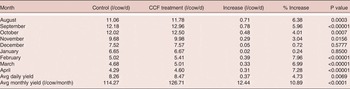
Milk volume produced per milking was calculated by the herd management software and meter. The mean of this data per day and totals per calendar month for both the control and trial group were calculated and submitted for statistical analysis (Table 2).
Effect of and aloe and manuka honey supplement on milk yields from dairy cows

Overall the average milk increase over the whole trial period (August-April) for cows fed the CCF was 4.7%. However, during peak lactation (August to October) significant 5.5% increases for cows receiving CCF were recorded (11.76 litres per day versus 12.41 litres per day for control and CCF treated cows respectively; P < 0.001).
The cost for a diluted 50 ml CCF dose was NZ$0.12. The average NZ cow produced 4196 litres of milk for this particular season (2014) and 371 kg of milk solids over 266 days (LIC and DairyNZ, 2014). From this commercial trial data, supplementing cows with CCF could provide an increase of approximately 197 litres and 17.4 kg of milk solids per cow (calculated from NZ averages) worth NZ$85.84 (2015 average value per kg milk solids) for an investment cost of NZ$31.92 per cow, representing a 2.7:1 return on investment.
Discussion
There was a significant increase in total milk yield due to the Aloe vera and manuka honey-based CCF supplementation in feed over the test season. This has implications for herd productivity, without major changes to feed inputs. Although the Aloe vera was relatively low in tannin and saponin content, it may be that these two compounds contributed to the observed milk increase, however this requires further research to elucidate modes of action. Previous work has determined a protective effect on protein by condensed tannins in the rumen, preventing its digestion and utilisation by bacteria, which can increase its expression in milk solids (Dey and De, Reference Dey and De2014). As Aloe vera has antibacterial (Sierra-García, Reference Sierra-García, Castro-Ríos, González-Horta, Lara-Arias and Chávez-Montes2014) and antifungal activity (Doddanna, Reference Doddanna, Patel, Sundarrao and Veerabhadrappa2013) and manuka honey has a wide range of antimicrobial activity (Lin et al., 2008; Reference Lin, Molan and Cursons2011), it may be that milk yield increased due to the ability of these products to moderate and stabilise the rumen flora. This change may protect protein and make it more available for absorption in the small intestine and therefore more utilisable by the host animal for milk production.
The recorded milk yield increases had a seasonal component. The difference between the control and treatment groups was larger in the early stages of lactation, then reduced to no significant differences for December and January, and increased again in February, and stayed high for the remainder of the season. One hypothesis to explain the seasonal effect is differences in feed utilisation. Due to the seasonal nature of NZ dairy farming, the start of the season corresponds to the high levels of young grass growth, and feed was plentiful. However, local drought conditions occurred in summer, and by January there was no grass growth. Due to high milk prices the farmer decided that supplementary feeding was economically feasible, and feeding out of silage and other feed supplements occurred at that period, although within the constraints of a commercial trial, individual cow feeding intakes could not be monitored. This may have resulted in increased availability of feed, so milk yield would increase.
Conclusions
Although the mode of action of Aloe vera or manuka honey in ruminants is unclear, this commercial farm study demonstrated that there was a definite, statistical improvement in milk yields from dairy cows fed this combination as a supplement on top of their regular feed. This may be due to changes in rumen activity due to the Aloe vera and manuka honey within the CCF treatment, although further research is required to verify such effects. Nevertheless, there was an economic payback from using such a feed supplement at the prices for that season, as the increase in yield during lactation, especially at peak and end of lactation (although this may be related to forage feed availability) resulted in increased payment for the farmer, at minimal extra cost per cow.
Acknowledgements
Thanks to Gustavo Garza, Shaun Killalea and Milli Naidoo at Dairy Automation Ltd (DAL), also Mike Peters, Tania Tarver and staff at Kahikatea Dairy Farms and Joshua Lawrence for assistance with statistical analysis. This project was funded by DairyCare Ltd, New Zealand. The authors would like to thank AgResearch NZ for assistance in obtaining ethical approval for the trial.
Declaration of interest
K. Sharma is an employee of DairyCare Ltd, New Zealand.