1. Introduction
The number of practitioners and researchers engaged in integrating and researching virtual exchange (VE) projects is constantly growing and supported by organisations such as Erasmus + Virtual Exchange, UNICollaboration, and the Stevens Initiative. VE, or telecollaboration, refers to “the sustained engagement of groups of learners in online intercultural interaction and collaboration projects with partners from other cultural contexts or geographical locations as an integrated part of their educational programmes” (O’Dowd, Sauro & Spector-Cohen, Reference O’Dowd, Sauro and Spector-Cohen2020: 146–147). The aim of VE projects is to help develop participants’ intercultural and pragmatic competence, digital literacies and their foreign language skills (Canto & Jauregi Ondarra, Reference Canto and Jauregi Ondarra2017; O’Dowd & Dooly, Reference O’Dowd and Dooly2022; O’Dowd & O’Rourke, Reference O’Dowd and O’Rourke2019).
To create spaces for synchronous VE projects, videoconferencing tools such as Zoom are traditionally employed. Using high-immersion virtual reality (VR) for synchronous VE projects, which involves using head-mounted displays, offers a high level of immersion (Jauregi-Ondarra, Canto & Melchor-Couto, Reference Jauregi-Ondarra, Canto, Melchor-Couto, Ziegler and Gonzalez-Lloret2022; Kaplan-Rakowski & Gruber, Reference Kaplan-Rakowski and Gruber2019) and an authentic experience (Kaplan-Rakowski & Gruber, Reference Kaplan-Rakowski, Gruber, Lan and Grant2021). Scholars have been exploring the effect of using high-immersion VR on different aspects of language learning. However, to our knowledge, the use of high-immersion VR in the context of international and intercultural VE projects is understudied. Two pilot studies by Jauregi-Ondarra, Gruber and Canto (Reference Jauregi-Ondarra, Gruber, Canto, Frederiksen, Larsen, Bradley and Thouësny2020, Reference Jauregi-Ondarra, Gruber, Canto, Zoghlami, Brudermann, Sarré, Grosbois, Bradley and Thouësny2021) investigated the use of VR headsets with international groups of university students completing tasks collaboratively in different VR spaces, namely Bigscreen and AltspaceVR. The 2020 study focused on English as a lingua franca at an intermediate to advanced level, and the 2021 study dealt with beginner Spanish as a lingua franca. The results suggested that the students’ degree of enjoyment in VR varied, but overall, meeting their partners in VR was enjoyable and sociable. Based on Jauregi-Ondarra et al. (Reference Jauregi-Ondarra, Gruber, Canto, Frederiksen, Larsen, Bradley and Thouësny2020), this article reports on several aspects of using VR for VE activities: students’ levels of presence and engagement in a VE-VR context, and their perceptions of VR as an environment for VE compared to the traditional computer-mediated communication tools used for such encounters. We also report on the influence of VR on students’ topic choice and interaction.
2. Background research
2.1 High-immersion VR and language learning in VE
High-immersion VR can be defined as a computer-generated 360° virtual space that can be perceived as being spatially realistic, due to the high immersion afforded by a head-mounted device (Kaplan-Rakowski & Gruber, Reference Kaplan-Rakowski and Gruber2019). For language education, a major benefit of VR is the possibility to carry out real-life-like interaction in an authentic way (Lan, Reference Lan2020). Moreover, VR offers kinaesthetic language learning – that is, language learning through physical activity, for instance, when learning relevant vocabulary while cooking a dish in a virtual kitchen (Vázquez, Xia, Aikawa & Maes, Reference Vázquez, Xia, Aikawa and Maes2018).
Research on high-immersion VR for language learning has been on the rise (see the most recent systematic review by Dhimolea, Kaplan-Rakowski & Lin, Reference Dhimolea, Kaplan-Rakowski and Lin2022), and has shown benefits in developing foreign language skills, including vocabulary learning (Legault et al., Reference Legault, Zhao, Chi, Chen, Klippel and Li2019). Studies on interactions between learners (e.g. Liaw, Reference Liaw2019) and between learner and tutor (Kaplan-Rakowski & Gruber, Reference Kaplan-Rakowski, Gruber, Lan and Grant2021) have shown VR’s benefit in terms of stimulating learner agency and motivation and a positive effect on levels of foreign language anxiety (e.g. Gruber & Kaplan-Rakowski, Reference Gruber, Kaplan-Rakowski and Zheng2020; Thrasher, Reference Thrasher2022).
Therefore, VR has the potential to support foreign language learning processes. Sociocultural and interactionist perspectives hold that conversational interaction is crucial for language development (Gass, Reference Gass2018; Lantolf & Thorne, Reference Lantolf and Thorne2006). Practising in social VR applications is potentially conducive to language learning because social VR applications allow multi-users to interact online, embodied in their own avatars in a multidimensional space and in real-life-like situations. Such opportunities for authentic language practice are also conducive to situated learning in a community of practice, as postulated by Lave and Wenger (Reference Lave and Wenger1991).
If social VR applications are used for VE projects with pedagogically sound tasks, they have the potential to facilitate learners’ intercultural communicative competence development when collaborating with learners from different cultural backgrounds. Moreover, intercultural encounters in virtual environments might offer a level playing field in that the space may be (un)familiar to the same degree to the users and that this is an opportunity for users to “communally and transculturally appropriate and ‘inhabit’ this new space together” (Senkbeil, Reference Senkbeil2021: 9).
Meeting other learners in VR in the context of student-centred foreign language activities might lead to affective states similar to students’ experiences in meeting unknown fellow students on site with whom they converse and collaborate in a foreign language. However, the use of personalised avatars in VR encounters can help learners feel less anxious given “the ‘faceless’ anonymity of the interaction” (Harbord & Dempster, Reference Harbord, Dempster, van der Spek, Göbel, Do, Clua and Hauge2019: 413). Vocal cues typically come from the interlocutors’ real-life voice through the avatar embodiment, which takes away some of the anonymity. In Bigscreen, the application used for this study, users’ head and hand movements are tracked and conveyed by the users’ avatars in real time. The head and hand gestures offer an additional non-verbal communication channel and add to the perceived realism of the environment (Marks, Windsor & Wünsche, Reference Marks, Windsor and Wünsche2012).
2.2 Presence
In the context of VR, a sense of presence, which is a subjective experience (Diemer, Alpers, Peperkorn, Shiban & Mühlberger, Reference Diemer, Alpers, Peperkorn, Shiban and Mühlberger2015), has been described as “the illusion of being there, notwithstanding that you know for sure that you are not” (Slater, Reference Slater2018: 432). Users can feel as if they have been transported to the VR environment (Servotte et al., Reference Servotte, Goosse, Campbell, Dardenne, Pilote, Simoneau, Guillaume, Bragard and Ghuysen2020). This feeling of presence is referred to as spatial presence and is closely related to social and self-presence (Barreda-Ángeles & Hartmann, Reference Barreda-Ángeles and Hartmann2022; Lee, Reference Lee2004). Users feeling physically co-located and socially connected with others is referred to as social presence (Oh, Bailenson & Welch, Reference Oh, Bailenson and Welch2018). Self-presence denotes users’ perception of their virtual body as their actual body (Kilteni, Groten & Slater, Reference Kilteni, Groten and Slater2012). A realistic environment in VR enhances the sense of being there (Slater, Reference Slater2009). Other factors influencing the sense of presence include the degree of attention to the apparatus used (Weech, Kenny & Barnett-Cowan, Reference Weech, Kenny and Barnett-Cowan2019), and personality traits (Weibel, Wissmath & Mast, Reference Weibel, Wissmath and Mast2010). Diemer et al. (Reference Diemer, Alpers, Peperkorn, Shiban and Mühlberger2015) showed that participants who feel emotionally affected give a higher presence rating than participants in calm or serene emotional states. In this study, we focus on spatial and social presence during the VE project.
2.3 Engagement
Engagement refers to the effort students make when they perform a learning activity and is “a state of heightened attention and involvement, in which participation is reflected not only in the cognitive dimension, but in social, behavioral, and affective dimensions as well” (Philp & Duchesne, Reference Philp and Duchesne2016: 51). Cognitive engagement refers to the students’ mental effort to attend to learning; it includes indications of attention and effort, and cognitive and metacognitive strategy use. Affective engagement relates to the emotional sensations students experience while learning. These can be positive (enjoyment or satisfaction) or negative (boredom, frustration or confusion). In the latter case, the negative experiences are indicators of disengagement. Behavioural engagement involves student participation and spending time on task. The amount of involvement, effort and persistence indicates the degree and quality of students’ behavioural engagement when performing a learning task. Finally, Philp and Duchesne (Reference Philp and Duchesne2016) describe social engagement as the relationship established during collaborative work with peers, such as reacting or providing feedback to each other. Episodes of mutuality and reciprocity reflect learners’ social engagement.
Although many scholars to date have followed this engagement model comprising four dimensions, Gijsen (Reference Gijsen2021) advocates for a three-dimensional approach to engagement when students perform social interaction tasks in dyads or small groups. Gijsen analysed task engagement in student interactions performed in low-immersion VR as part of a virtual exchange experience. According to Gijsen, the “social” permeates the interaction task and is present in all three engagement dimensions: cognitive, behavioural and affective. In the present paper, we will be following this three-dimensional approach to engagement.
Scholars agree that engagement involves some kind of action (Lawson & Lawson, Reference Lawson and Lawson2013). This action or active involvement is key to understanding the difference between engagement and motivation, the latter term implying a desire or intention to act. It refers to a state of mind (Mercer, Reference Mercer and Gao2019). In this sense, students may be very motivated to learn but not engaged in learning; once they get actively involved, we can conclude that there is some level of engagement. When carrying out an online interaction task, the quality of engagement would depend on a myriad of factors, such as the task itself, the technology, the partner, the language level or the students’ willingness to communicate, among others (for further description, see Gijsen, Reference Gijsen2021). Accordingly, when analysing engagement in VE, attention should be given to key contextual elements of online interaction, such as the task, the relationship with the interlocutor, the application used, students’ language level and their willingness to communicate.
3. Method
3.1 Research questions
The purpose of our case study was to investigate the influence of VR on students’ levels of presence and engagement and on students’ communication in the context of a VE project. We also investigated students’ views on using VR for intercultural encounters compared to traditional videoconferencing tools. The study addressed the following research questions: (1) How does VR influence students’ levels of presence and engagement in a virtual exchange project? (2) How does a VR environment influence communication in virtual exchange encounters? (3) What are the students’ perceptions regarding the use of VR compared to traditional videoconferencing tools for intercultural encounters?
3.2 Participants
A total of 27 students from two universities in Germany and in the Netherlands aged between 18 and 24 participated in this study in February 2020. In Germany, 14 students (nine males and five females) volunteered to take part in the study. To recruit the participants, an email invitation was sent to an estimated 700 students at the university on several occasions. The participants were enrolled in different bachelor’s and master’s programmes, ranging from mechanical engineering to business informatics. In the Netherlands, 13 (four males and nine females) students participated in the study. The students in the Netherlands were mainly enrolled in an educational sciences bachelor programme, and they were all registered in a course titled Language Education and ICT. Although all tasks were compulsory for the course, participation in the study was voluntary. Only three participants had tried VR before and none used VR headsets for playing video games. All participants signed an informed consent form, granting permission to use the data anonymously for research purposes. The sample size was limited due to resource constraints (i.e. the number of VR headsets available in Germany) and the COVID-19 pandemic. To increase robustness, we applied statistical measures for small sample sizes. It was deemed worthwhile to conduct the current study because, overall, the research approach was designed to provide insights and rich details on unexplored questions in the VR literature, serving as a foundation for larger studies.
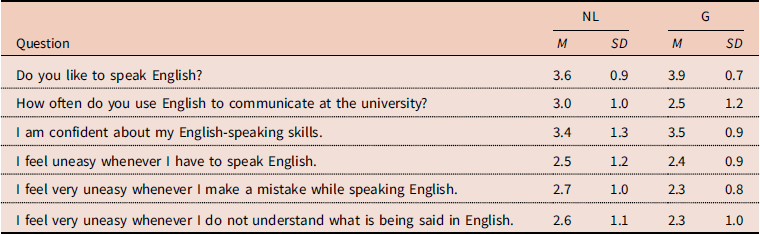
The participants in the Netherlands used Oculus Quest headsets and the participants in Germany were given Oculus Go headsets. The language of communication was English as a lingua franca. English was the participants’ second or third foreign language. Participants’ level of proficiency ranged from B1 to C1 on the Common European Framework of Reference for Languages, and was established informally based on the researchers’ teaching experience. Table 1 gives more information on the participants’ English skills.
Participants’ English skills

Note. NL = Dutch students; G = German students. 5-point Likert-scale responses (1 = “strongly disagree” to 5 = “strongly agree”).
3.3 Setting
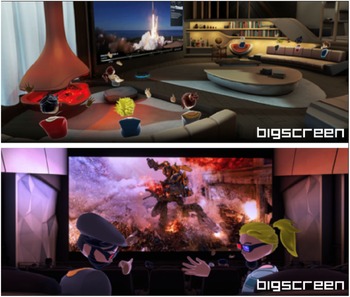
All participants received instructions on how to use the Oculus headsets for their task-based conversations in VR. Students worked in allocated dyads or triads to complete the assigned tasks outside of class time. For their VR sessions, participants entered virtual destinations in Bigscreen (Figure 1). The suggested time frame per task was 20 to 30 minutes. Participants communicated in private rooms, which they created themselves, and they could teleport themselves (i.e. their avatar) within the room.
Example of virtual reality environment in Bigscreen with avatars

3.4 Tasks
The task design was based on simulating real-life scenarios with a focus on intercultural aspects. Students received information on all three tasks to be carried out in VR before the first session. Task 1 served as an icebreaker where students introduced themselves and exchanged information about their cultural backgrounds. Prompted by written questions from the researchers, students also discussed their views of the other culture, including stereotypes. Before the second meeting, students watched a VR film (Girl Icon) with their Oculus headset. The film dealt with girls’ societal roles in Indian rural society. In the VR sessions, students exchanged their thoughts and impressions about the film and discussed questions provided by the researchers, prompting the students to discuss their experience with diversity and multiculturalism. Task 3 was created by the students in the Netherlands as part of their assignments in the course Language Education and ICT. The main objective of the course was for students to gain pedagogical competencies on how to enhance linguaculture learning using digital tools. Students were responsible for designing and piloting adequate tasks for VE.
3.5 Data collection and analysis
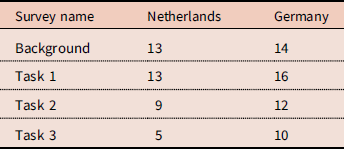
The three VR sessions took place during a four-week implementation period. At the beginning of the project, students completed a background information survey. Participants filled out a questionnaire after each task, containing 5-point Likert scales and open-ended questions to capture their experience. The surveys had been piloted and used in previous research studies (Jauregi & Melchor-Couto, Reference Jauregi, Melchor-Couto, Taalas, Jalkanen, Bradley and Thouësny2018; Jauregi-Ondarra et al., Reference Jauregi-Ondarra, Gruber, Canto, Frederiksen, Larsen, Bradley and Thouësny2020). The post-task questionnaires focused on the technological quality, students’ engagement and perceptions during the tasks, and their preferences and likes concerning the experience with their partners in VR. The questionnaires contained items directly associated with spatial presence (“I felt I was in the same place with my partner in the VR environment”) and social presence (“I enjoyed communicating with a student from another country in this VR environment”). The questionnaires for Tasks 1 and 2 were identical, whereas the questionnaire administered after Task 3 differed slightly to capture the students’ overall impression of the experience. All the responses were submitted via Google Forms. Table 2 shows the number of responses per survey per country.
Number of responses per survey

In addition, participants added entries in their confidential electronic reflective journals after every meeting. Six Dutch participants completed all three reflection journals, five Dutch students completed one, three did not complete any, and one student completed two journal entries. In Germany, all participants completed all three reflective journals. Participants were prompted to give their general impressions of the VR experience and the task, on how the communication with their partners went, and on their intercultural learning. To enable students to choose the language they felt most comfortable with, they were asked to write their entries in English, German, Dutch or Spanish.
At the end of the project, six participants in Germany were interviewed individually in person. The choice of participants depended on logistical factors. The interviews were semi-structured, conducted in German or English depending on the students’ preference and were audio-recorded. The participants in the Netherlands discussed the project in focus groups with one of the researchers in Dutch. The interviews in both countries were transcribed. Although it is generally desirable to employ a single data collection modality, focus groups and individual interviews can yield unique items for a simple free-listing task in a manner that is comparable (Guest, Namey, Taylor, Eley & McKenna, Reference Guest, Namey, Taylor, Eley and McKenna2017).
Participants’ responses to the Likert-scale questions were analysed to establish their agreement with the statements and intra- and international differences. All analyses were carried out using SPSS Version 25. For the qualitative analysis (open-ended questions in surveys, reflection journals and interviews), the three researchers analysed the participants’ answers individually and qualitatively and then agreed on recurring themes for in-depth analysis (Saldaña, Reference Saldaña2013) focusing on presence, engagement and the influence of VR on communication processes. A template of analysis with key topic categories was created and shared in Drive to facilitate researchers’ collaboration in the analysis process. As to the interaction analysis, the recordings with good audio quality were selected and analysed according to the themes identified.
4. Results
4.1 Quantitative analysis
Descriptive statistics were generated for all questionnaire results (see supplementary material). Non-parametric tests were used to determine the differences in responses between participants in the Netherlands and Germany. The analysis of the background questionnaire responses asked participants (N = 27) about their use of English – the frequency of use for communication in general and in video games, and their previous experiences with VR. There was no statistically significant difference between the two groups (n = 13 in the Netherlands, n = 14 in Germany). A Mann–Whitney U test was calculated to determine if there were any differences regarding gender. There was a statistically significant difference regarding playing video games (U = 142.000, Z = 2.612, p = .012, r = 0.5026) between males (Mdn = 3.00) and females (Mdn = 2.99); online video games (U = 161.500, Z = 3.774, p = .000, r = 0.72630) between males (Mdn = 4.00) and females (Mdn = 2.00); and use of English while playing video games (U = 151.000, Z = 3.017, p = .003, r = 0.111740) between males (Mdn = 4.00) and females (Mdn = 1.00). A reliability analysis was carried out on the three items and Cronbach’s alpha reached acceptable reliability of α = 0.83.
For Task 1 responses, an independent t-test with bootstrapping was performed using the bias-corrected and accelerated (BCa) method. Footnote 1 Bootstrapping was applied to increase robustness. The t-test performed showed that for the participants in Germany, starting the tool was easier (M = 3.69) compared to the group in the Netherlands (M = 2.77). Overall, a highly significant correlation between “It was easy to start the tool” and “It was easy to use the tool” was found (Spearman’s r = .699, p < .001). Similarly, “easy to use” correlated significantly with “I like to communicate in a VR environment” (Spearman’s r = .589, p < .001). Participants who liked to be avatars in VR also liked to communicate with avatars in VR (Spearman’s r = .826, p < .001). A high correlation was also found between “I was able to learn something about the other student’s views, life and culture” and “Communication in English through VR is fun” (Spearman’s r = .486, p < .001). The item “I like to communicate in this VR environment” highly correlated with “I like to meet students from other countries in this VR environment” (Spearman’s r = .765, p < .001). As expected, “I felt nervous when talking in English” correlated highly with “I was worried of making mistakes in English” (Spearman’s r = .923, p < .001).
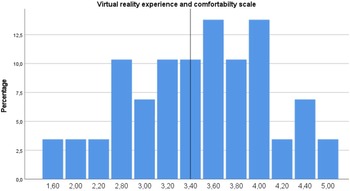
Thirty items relating to the students’ immersion experience and level of comfortability in VR were factor analysed using principal components analysis with varimax rotation. Five items met the requirements: (1) “I was completely captivated by the VR environment,” (2) “The VR environment felt very real to me,” (3) “I could concentrate well when interacting in the VR environment,” (4) “I felt comfortable interacting in English in the VR environment,” and (5) “I felt comfortable during the VR session.” Kaiser–Meyer–Olkin measure of sampling adequacy was 0.669, within the commonly recommended value of .6, and Bartlett’s test of sphericity was significant, χ2(10) = 46.116, p < .001. Using both the scree plot and eigenvalues > 1 to determine the underlying components, the analysis yielded one factor explaining a total of 53.185% of the variance in the data. This factor can be characterised with the term immersion factor as a latent dimension. The variables were used to establish a VR immersion experience and comfortability scale (Figure 2). Internal consistency and reliability of the scale yielded a Cronbach’s alpha coefficient of α = 0.781. There is a range from 1.6 to 5.0 – that is, the scale width is almost completely exhausted. The scale direction ranges from “strongly disagree” (1) to “strongly agree” (5). There was no significant difference between the two groups. The scale was established for Task 1 only because of the lower number of responses from Tasks 2 and 3.
Virtual reality experience and comfortability scale

For Task 2, the distributional requirement for the t-test was not met and therefore the Mann–Whitney U test was run. It revealed a statistically significant difference between the groups on one item, namely “I like to meet students from other countries in this VR environment.” The German participants (Mdn = 13.00) agreed significantly more with this statement than the Dutch participants (Mdn = 7.44). For Task 3, the Mann–Whitney U test revealed no statistically significant difference between the groups on any item.
4.2 Qualitative analysis
In the following section, we report on the qualitative findings from the reflective journals, and the audio or video recordings and interviews.
4.2.1 Presence and engagement
To examine the influence of VR on students’ levels of presence and engagement (Research Question 1), we analysed their responses to prompts in the reflective journal.
In line with the quantitative results, the qualitative analysis suggests that students’ sense of presence in VR was mixed. G2 noted in their reflective journal, “The environment helped you to feel like you are talking to someone in the same room. So it gave you kind of security.” D13 remarked, “You really have the idea of being in a room with another person, so the distance between them seems very small.” D9 suggested that the avatars are responsible for a high sense of presence: “[…] it feels like you’re really in the world with the other people. The other avatars also talk to you normally, so it feels like you’re really in a room with other people.” D11 commented favourably on the space and its effect on presence by stating, “I think the space has contributed to a more ‘relaxed atmosphere’ because it makes contact more personal. You really have the idea of being in a room with another person, so the distance between them seems very small.” G12 felt that their high level of sense of immersion made it easier to interact with their partner: “I did feel immersed in the same room as my partner, and because of this, conversation was made easily.” G13 felt that “there were some scenes where you had the feeling to have eye contact with someone in the video.”
There were accounts of students not feeling a (high level of) spatial presence. For instance, G13 commented: “I didn’t really have the feeling to be in the same room with my partner.” D9 said, “No, it didn’t feel like I was in the same room. But at the same time, you do look at the avatar when you are talking, as you normally do in a conversation.” The latter comment suggests a degree of social presence felt by the participant despite not feeling spatially present.
Regarding affective, behavioural and cognitive engagement, participants reported a high level of engagement when watching the VR video in Task 2. G1 stated that “the 3D video was cool, but there was too much to focus on (voice, movie) [sic] but good to [delve] deep into the topic,” which suggests behavioural and cognitive engagement, but also cognitive overload. The following excerpt shows an example of how students were emotionally, behaviourally and cognitively engaged during their conversations as avatars in a virtual living room.Footnote 2
D2: Um, so the other point of this assignment is exchanging views on cultures and globalisation. Um, what do you think that the positive aspects of multicultural society are?
G3: Positive aspects?
D2: Yeah, so the positive aspects. What is your point of view?
G3: Um, I think it’s a positive aspect, globalisation, but, um, during the globalisation of the society today you can learn a new tradition, new friends from other cultures like our society. You can … you can learn from people of colour […] about the culture and tradition. And we can learn something about the whole world and different cultures, traditions. And I think it’s very important for our education outside of the school. Do you think so?
D2: Yeah, yes. Yeah. I share the same point of view, uh, there, because you get in contact with people with different ideas and cultures and it also allows us to broaden our horizons, you know, so we, um, we can learn from them as much as they can learn from us.
The next example shows two students’ emotional, behavioural and cognitive (meta-analytical) engagement during their interaction. The excerpt also shows G9’s spatial and social presence when teleporting himself closer to his partner.
G9: OK. And let me just jump over to you.
[teleports to a chair facing the partner’s avatar]
The view from the side is a bit …
D8: Oh, it’s funny because you sound further away!
G9: Yeah, you too. I find it funny because, somehow, I think I need to talk like Yoda, but I can’t.
D8: Can I jump on the vacuum cleaner?
G9: No, I think Rumba is the product name, but I don’t know if they have the legal rights to it, but probably Facebook doesn’t care.
D8: Hahaha
G9: Let’s see …
In addition, this excerpt shows how the specific scenario in the virtual environment affects the choices of conversational topic. The influence of VR on students’ communication will be explored more in depth in section 4.2.2.
4.2.2 Influence of VR on students’ communication
To answer Research Question 2, recordings from the students’ encounters were analysed. The results showed that the VR environment influenced the way students communicated. For example, some dyads thematised the virtual environment in their very first meeting at the start of the conversation to break the ice.
D1: Hello!
G2: Hello, how are you?
D1: I’m fine, how are you?
G2: Yeah, also fine, thanks.
[7 seconds of silence]
D1: So, have you used this before, VR?
G2: Um, yes, but, two or three times …
Thematising VR may have helped participants to overcome or ease their nervousness when meeting their partners for the first time. Talking about the technology interrupted some conversations. In the following example, one participant pressed her controller and caused her avatar to hover in the air, which interrupted their discussion about differences in university systems.
G3: I love talking about the differences [of university systems]. So, I know actually some people who go to Utrecht University.
D4: OK, yeah, cool! [Loud noise] Oh, I don’t know what’s happening! [laughs] I think I’m above you, but I don’t know how to get down. [laughs]
G3: With your remote, err, if you like, hold it … like, the big circle …
Some dyads discussed their avatars’ appearances. For instance:
G3: I’m just fixing my avatar.
D4: Oh wow! Is this true to how you really look? Because mine isn’t.
G3: I somewhat try. I’m blonde, so the only option was, like, bright yellow. It’s ridiculous.
Similarly, the technology drew two participants away from their discussion about multicultural exchanges:
D5: And it’s very easy to, uh, connect with other countries in other cultures and to learn from their experiences and their views.
G6: Did your controller just hang around your wrist for a moment? Yeah, it looks like your hands got severed. Hahaha!
Such glitches can be perceived as disruptive but, on the other hand, might help the interlocutors construct their social relationship with the underlying humorous situation, which potentially brings the interlocutors together. Glitches may also push students to use vocabulary in the target language that they do not usually need.
Discussing technical aspects was also part of the interaction for some students. For instance:
D6: I see that you have, like, a sort of joystick.
G7: Yeah, I don’t have the controller for the hands. It’s just another version of the Oculus.
D6: Oh OK. But I can see that you are like sort of waving, right? That’s what you do.
[G7 waves his hands]
Yeah. Yeah, exactly. So, but you can see my hands, right?
G7: Yeah, I was able to see before.
D6: Oh, yeah, well, now, you can’t, yeah, well, I’m waving. [laughs]
From a language learning perspective, the application and the headset had an impact on how students dealt with gaps in their vocabulary. One participant reported that they took their headset off, looked up the word they needed and put the headset back on. Removing the VR headset to look up words is possibly a disruptive strategy in that it affects the flow of the conversation. Moreover, some participants’ anxiety might increase if they do not have immediate access to the resources they are used to (e.g. Google Translate). However, VE in VR can potentially push learners to rely more on strategies, such as circumlocution, they would not necessarily use if the VE was carried out via videoconferencing, where they can access the reference material more easily.
Generally, the interaction between the students and the VR environment allowed for more initiative taking and spontaneous discourse samples, instead of just relying on the information provided by the task. The interaction with the environment’s spatial elements permitted the participants to become part of that environment. Communication was mediated not only by the target language and the other participants but also by the tasks, the virtual environment and its tools. The examples presented here show the close connection between communication and contextual setting, as communication does not take place in a vacuum; it is always situated in a given context, and this context reshapes communication processes.
4.2.3 Comparing VR and videoconferencing for interactions
To answer Research Question 3, participants were prompted in the interviews and focus groups to compare interacting in VR with conversations using videoconferencing tools, such as Skype. Students showed mixed preferences. Three students commented that meeting partners in VR was relaxing compared to videoconferencing with other students because you do not see each other, whereas with a web camera, there is a feeling of insecurity. This is in line with findings that the web camera can put foreign language learners in a face-threatening context (van der Zwaard & Bannink, Reference van der Zwaard and Bannink2014). One participant stated that if one does not seem confident over the web camera, the worst-case scenario is that one might get bullied, which is why they prefer the VR setting. Another participant preferred the VR environment because “you kind of feel more free compared to Skype.”
In contrast, several participants felt that the VR tool was restrictive in that it forced them to focus on the meeting. A student pointed out that getting distracted in VR and doing work on the side was impossible because of the VR headset. Another student compared wearing a VR headset less favourably to using videoconferencing tools, because with the latter “you are free from any devices that impair your vision, and you can move freely without the risk of running against something.”
Positive aspects of wearing a VR headset mentioned by students were that it ensured that they focused on the task at hand and that they could not check the time. However, one participant pointed out that “you don’t know what happened in real life and in your location where you are using virtual reality.” Another participant mentioned that he felt cut off from reality in VR and that Skype allows for more flexibility. One suggested that with Skype, “you can grab things around you or send a file,” making Skype more useful for collaborating online with a partner than VR.
Apart from practical considerations, one student pointed out that, unlike with videoconferencing with VR, interlocutors are less likely to have prejudices based on their partners’ appearance. Another mentioned habit and facial expressions as the reason for favouring Skype: “I do think I prefer interacting with Skype because you are used to it, can see facial expressions and it feels more like ‘real’ contact to me.” Similarly, another student stated that, in VR, “it is difficult to know when the other person is done talking, as you don’t have any facial cues and can’t read each other’s emotions.”
In contrast, one participant suggested that meeting in VR “is less static than a Skype conversation. In my opinion, that is the added value. Difficult is that you cannot write or read documents in the environment. We both liked the environment and seemed real, so the communication seemed more real instead of calling or Skype.”
Some participants found being shielded by their avatar to be beneficial. One pointed out that students who are inhibited when speaking a foreign language or have a heavy foreign accent are likely to feel comfortable in VR. Another participant stated that “it’s more relaxing than a Skype call to practice a foreign language because of the fact that you don’t see each other and because you are less distracted than in a Skype conversation.”
5. Discussion and pedagogical implications
The VR immersion experience and comfortability scale based on the data shows that the participants’ experience in VR was mixed. Students who liked to be an avatar also liked to communicate with avatars in VR, and it indicates the importance of the individual’s attitude towards features of VR technology. Their attitudes and experiences are likely to be influenced by the design of avatars (Pakanen, Alavesa, van Berkel, Koskela & Ojala, Reference Pakanen, Alavesa, van Berkel, Koskela and Ojala2022) and VR spaces, which underscore the importance of optimal VR design. Positive attitudes towards communicating in the VR environment correlated strongly (Spearman’s r = .765, p < .001) with positive attitudes towards meeting students from other countries in the VR environment.
The VR environment had an impact on participants’ interactions when they chose to discuss the features in the social VR application, such as the robot vacuum cleaner whizzing around the virtual living room, their avatars, technical issues or other VR particularities. The study results suggest that addressing features of the social VR application used can help students (for instance, in their first meeting) to find a starting point for interaction, to maintain a flow of conversation and to construct their social relationship. VR space has been called a spatium francium, in analogy to lingua franca, in that VR-specific interactional patterns and norms may develop and influence each other (Ahlers, Lazović, Schweiger & Senkbeil, Reference Ahlers, Lazović, Schweiger and Senkbeil2020).
The study results indicate that using a VR application with avatars as opposed to traditional videoconferencing tools is advantageous for some students. The VR headsets block the perception of the real environment and could help some learners to fully concentrate on their speaking contribution and the tasks at hand. They may thus feel less under pressure or conscious about their language skills or accent, as VR offers a degree of anonymity through avatars.
In traditional VE using videoconferencing tools, participants often get to see their partners and their non-verbal behaviour and get a glimpse of their partner’s immediate surrounding and experience, which may or may not be culture specific. In the VR environment used for this VE project, participants did not see their partner’s face, and the number of paralinguistic cues was limited, which can be a disadvantage from a language learning point of view (Gruber & Kaplan-Rakowski, Reference Gruber, Kaplan-Rakowski, Arnbjörnsdóttir, Bédi, Bradley, Friðriksdóttir, Garðarsdóttir, Thouësny and Whelpton2022). From an intercultural learning perspective, exposure to visible cultural practices and products adds to the learners’ experience, especially if it sparks a discussion during the interaction. Some VR environments allow users to customise their virtual home, including personal photos, which may be advisable for use in VE projects and could be integrated into tasks. This way, learners can draw attention to and discuss cultural artefacts and their significance for their cultural practices.
In the study, some students commented on the increased cognitive load in the VR environment. The cognitive effort that VR environments demand of their users can be a challenge in practising a foreign language in a VE-VR setting. This is likely to be especially taxing for users with lower levels of proficiency because they concentrate more on the cognitive processes of speech production and need to deal with the cognitive load in VR. However, a VR environment may be a useful preparation for real-life situations, such as meetings in an in-person environment unknown to the foreign language speaker.
In terms of research design, a digital literacy survey and an attitude survey before an intervention in VR would add valuable information about the participants. A comparison of the results of interviews with those of journals and surveys to construct case studies is a desideratum for future studies. It cannot be ruled out that there were self-selective bias effects. A replication or follow-up study could focus on the questions in the survey and explore them both qualitatively and quantitatively in depth.
Furthermore, the impact of the anonymity afforded by avatars in potentially face-threatening conversations, for example, about stereotypes and clichés or sensitive topics, such as politics, needs to be explored. Further research could investigate the effect of the VR environment on the students’ intercultural learning. Researchers and practitioners need to jointly investigate what kind of language learning activities in VR can lead to what level of agency and motivation. This is a complex endeavour due to the number of variables (e.g. individual differences), but the results could inform practitioners when making pedagogical choices. In future studies, the VR experience and comfortability scale for foreign language speakers established in this study should be verified with a bigger sample size and could also be tested with first language speakers. Moreover, further research is needed to explore how learners’ proficiency and language anxiety level impact their experience in a VE-VR setting. A future study investigating the relationship between proficiency and motivation to interact in VR would be valuable.
6. Conclusion
The current study found that the levels of presence and engagement and preferences of social VR compared to videoconferencing for intercultural encounters depended on students individually. Their communication and topics of conversation were sometimes influenced by different aspects of the technology used, for instance, features of the virtual space, which required relevant lexical choices. Discussing such aspects seemed to help some learners move the conversation forward or was used to explore their space together, which may have facilitated connecting socially.
Barreda-Ángeles and Hartmann (Reference Barreda-Ángeles and Hartmann2022) point out that social VR technology may play an important role in favouring social connectivity where options such as on-site contact are not possible. In a VE context, such social connectivity may be achieved more easily with social VR rather than with a videoconferencing tool, which needs to be explored in further research.
High-immersion VR is expected to increasingly impact foreign language education in the future. Learning processes in VR are enhanced by students experiencing events in immersive scenarios, as learners take action, collaborate and communicate with others, and become fully engaged in performing meaningful tasks. Therefore, social VR applications are suitable as immersive social interaction opportunities to stimulate language learning in a relaxed environment. The current study suggests that many language learners perceive VR as a safe space. (Future) Teachers should be encouraged, trained and coached in the creative discovery process of new immersive technologies that open new pedagogical venues to enrich students’ learning processes.
Supplementary material
To view supplementary material referred to in this article, please visit https://doi.org/10.1017/S0958344023000125
Ethical statement and competing interests
All participants in this paper were either unpaid volunteers or students enrolled in a university course who had the choice to participate in one of two options. Participants completed a consent form that informed them of how their data would be collected, stored and used. The study was carried out in line with ethics policies at both universities. The authors declare no competing interests.
About the authors
Alice Gruber, PhD (University of Reading, UK) is a Professor of Business English at Augsburg University of Applied Sciences, Germany. She conducts research on technology-enhanced language learning (virtual and augmented reality), virtual exchanges and English as a lingua franca.
Silvia Canto is an assistant professor at Utrecht University and a member of the Dutch National Expertise Team on Foreign Language Pedagogy. Her research focuses on task design for virtual exchanges and their value in promoting intercultural communication in language curricula.
Kristi Jauregi-Ondarra is an associate professor at Utrecht University. Her research focuses on the role virtual exchanges play in language learning processes, the development of intercultural competences and changes on teachers’ pedagogical methodologies. Her recent research explores the affordances of immersive virtual reality for linguacultural learning.
Author ORCIDs
Alice Gruber, https://orcid.org/0000-0003-1558-673X
Silvia Canto, https://orcid.org/0000-0003-4044-2439
Kristi Jauregi-Ondarra, https://orcid.org/0000-0002-9096-9450