Introduction
Patients consulting general practitioners (GPs) with medically unexplained symptoms (MUS) are less likely to talk about psychological symptoms than other patients (Bridges et al. Reference Bridges, Goldberg, Evans and Sharpe1991; Kirmayer & Robbins, Reference Kirmayer and Robbins1996). However, many patients with MUS give psychological cues that GPs often ignore (Salmon et al. Reference Salmon, Dowrick, Ring and Humprhis2004). If both the patient and the GP discuss psychosocial issues in the consultation, the likelihood of somatic intervention decreases (Salmon et al. Reference Salmon, Humphris, Ring, Davies and Dowrick2007). Patients with MUS can be very costly in terms of unnecessary prescriptions, investigations and referrals (Barsky et al. Reference Barsky, Orav and Bates2005) but interventions for MUS given by GPs have shown limited evidence of effectiveness (Huibers et al. Reference Huibers, Beurskens, Bleijenberg and van Schayck2007).
There is a need for a simple effective intervention that GPs could use on a routine basis for patients with MUS that would reduce unnecessary prescriptions, investigations and referrals, perhaps by increasing psychosocial discussion by the patient and GP. Reattribution is designed to structure a routine consultation between a GP and a patient with MUS (Goldberg et al. Reference Goldberg, Gask and O'Dowd1989) to collect psychosocial and physical information to negotiate a simple explanation linking psychosocial problems to the patient's MUS. Reattribution training (RT) has provided mixed effects on patient outcome (Morriss et al. Reference Morriss, Gask, Ronalds, Downes-Grainger, Thompson, Leese and Goldberg1998, Reference Morriss, Gask, Ronalds, Downes-Grainger, Thompson and Goldberg1999; Blankenstein, Reference Blankenstein2001; Morriss & Gask, Reference Morriss and Gask2002; Larisch et al. Reference Larisch, Schweickhardt, Wirsching and Fritzsche2004; Frostholm et al. Reference Frostholm, Fink, Oernboel, Christensen, Toft and Olesen2005; Rosendal et al. Reference Rosendal, Bro, Sokolowski, Fink, Toft and Olesen2005, Reference Rosendal, Olesen, Fink, Toft, Sokolowski and Bro2007), including our recently conducted randomized controlled trial (RCT), which failed to demonstrate improved patient outcome, and in fact resulted in increased patient concern about their health, despite evidence that GPs had applied the reattribution model directly and successfully in consultations (Morriss et al. Reference Morriss, Dowrick, Salmon, Peters, Dunn, Rogers, Lewis, Charles-Jones, Hogg, Clifford, Rigby and Gask2007). One reason for these mixed results may be that reattribution is effective only when MUS patients give psychosocial cues spontaneously (Blankenstein, Reference Blankenstein2001; Rosendal et al. Reference Rosendal, Olesen, Fink, Toft, Sokolowski and Bro2007; van Ravesteijn et al. Reference van Ravesteijn, Lucassen and olde Hartmann2008).
We have carried out a further secondary analysis of doctor–patient communication to examine in detail the number and type of utterances concerning psychosocial information by both patients and doctors in the consultation (Ring et al. Reference Ring, Dowrick, Humphris, Davies and Salmon2005) to explore what effects RT had on discussion of psychosocial issues and somatic interventions. Such an analysis might inform the development of further interventions for MUS. Our hypothesis was that RT should increase both GP and MUS patient discussion of psychosocial information and reduce GPs' suggestions of somatic intervention.
Method
Study design
We conducted a cluster RCT using the practice as the unit of randomization but the primary outcome measure is doctor–patient communication. Practice and patient recruitment, method and rationale for the study design, uptake and acceptability of the training intervention, and other outcome measures have been reported previously (Morriss et al. Reference Morriss, Dowrick, Salmon, Peters, Rogers and Dunn2006, Reference Morriss, Dowrick, Salmon, Peters, Dunn, Rogers, Lewis, Charles-Jones, Hogg, Clifford, Rigby and Gask2007). In summary, 16 practices were recruited in the North West of England from four areas with similar sociodemographic characteristics: East Lancashire, Greater Manchester, Liverpool and Wirral. Eight practices were randomized by G.D. using a computer-generated sequence to RT and eight were control practices, stratified so that two practices from each of the four areas were randomized to RT and two practices to the control group. The randomization sequence was communicated to the trial coordinator and trainers by telephone and to no other member of the research team until all patients had completed the follow-up. Once RT was completed, patients were recruited and consented by a researcher screening consecutive patients attending a surgery in the waiting room. The consultation between the GP and the patient was audio-recorded. Patients were interviewed again at 1 month to obtain diagnostic information and to ensure that patients were still willing to give full written informed consent to the study. A postal questionnaire was sent to each patient at 3 months including a measure of the patient's health-related quality of life (EuroQol Group, 1990). Health records for each patient were examined at 1 month and at the end of the study. The study received ethics approval from the North West multi-centre ethics committee.
Inclusion/exclusion criteria
Practices were included if all GP principals were willing to attend RT and be randomized to either arm of the study. Practices were excluded if one or more GP had received RT previously. Patients were included if: (1) the primary reason for consultation was a physical symptom(s) of ⩾3 months' duration; (2) they were ⩾18 years of age; (3) an independent research GP, on the basis of the history obtained by the research assistant 1 month after the baseline consultation, and all the information recorded in the practice notes including any examination and investigations ordered by the GP at the consultation, decided that the physical symptom and/or the impairment associated with the physical symptom were not explained by physical pathology. Patients were excluded if: (1) they refused to give written informed consent to data collection for the study; (2) they were already receiving psychological treatment or had been prescribed a new psychotropic drug in the preceding 3 months; (3) their GP or the research GP stated that they had definite physical pathology that explained the presence of the symptom and the impairment associated with it. Patients were recruited from January 2004 to July 2005.
Training intervention
Three nurses and a psychologist with professional experience in primary care or liaison psychiatry, who had never received RT, were trained by an expert (L.G.) to deliver 6 h of training (2 h on three occasions) to each practice (Morriss et al. Reference Morriss, Dowrick, Salmon, Peters, Rogers and Dunn2006). Any GP missing a training session was trained individually. The training involved viewing a DVD explaining and modelling reattribution in clinical practice, followed by role play and video feedback of the microskills. All eligible GPs and one nurse practitioner in the eight practices allocated to RT completed it.
Outcome measures
The primary outcome data were the audio-recorded and transcribed index consultations between the GP and the patient. All names and places were removed from the transcript so that the coder (A.R.) was blinded to the intervention group. We have developed a method of categorizing each utterance of conversation by doctors and patients with MUS based on previous detailed qualitative analyses of these conversations (Ring et al. Reference Ring, Dowrick, Humphris, Davies and Salmon2005). This specific method of analysis of doctor–patient verbal communication, known as the Liverpool Clinical Interaction Analysis Scheme (LCIAS), has never been used before in an RCT but has been used in a naturalistic study of GP–MUS patient communication (Ring et al. Reference Ring, Dowrick, Humphris, Davies and Salmon2005; Salmon et al. Reference Salmon, Humphris, Ring, Davies and Dowrick2006, Reference Salmon, Humphris, Ring, Davies and Dowrick2007). The coder was experienced in using the LCIAS coding system, having performed the coding in previously published work (Ring et al. Reference Ring, Dowrick, Humphris, Davies and Salmon2005; Salmon et al. Reference Salmon, Humphris, Ring, Davies and Dowrick2006, Reference Salmon, Humphris, Ring, Davies and Dowrick2007). Detailed descriptions of how the coding system was derived empirically, all 55 code definitions and its inter-rater reliability have been reported previously (Ring et al. Reference Ring, Dowrick, Humphris, Davies and Salmon2005). The unit of coding is the ‘utterance’, defined pragmatically as a piece of speech that has sufficient meaning to be coded. Codes were linked to each turn of speech numbered sequentially from the start of the consultation. Every turn of speech received at least one code and codes were mutually exclusive. The scheme was implemented in a Microsoft Access database as a relational model. The user interface was a set of connected forms, with a main form for each interview, an embedded subform for each turn and a further subform between turns and mnemonics.
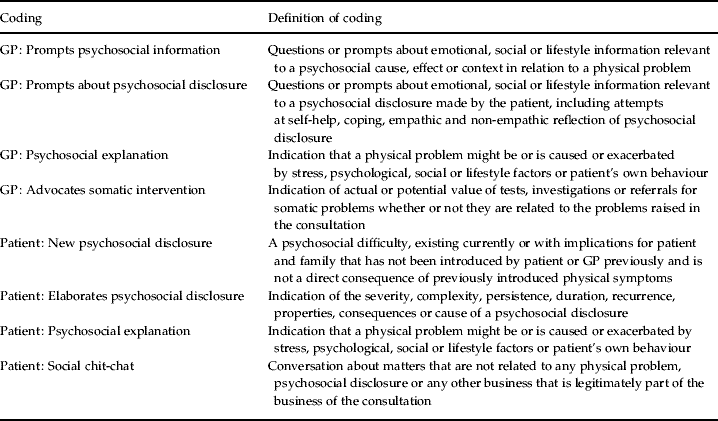
In LCIAS, psychosocial problems (including emotional distress) are tracked separately from physical symptoms, and patient talk is coded independently of doctor talk. To reduce the possibility of type 1 error, we restricted our analysis to eight codes of patient and doctor communication that were directly relevant to our hypotheses: patient codes for disclosure of new psychosocial problems, elaborating previously disclosed psychosocial problems, psychosocial explanation of physical symptoms, and social chit-chat; and doctor codes for prompts for psychosocial information about physical symptoms, prompts for more information about psychosocial problems, psychosocial explanation for physical symptoms, and doctor advocating any somatic intervention. The inclusion of the item patient social chit-chat was intended to determine whether RT increased non-medical conversation rather than discussion specifically of psychosocial information. Table 1 provides a definition of these eight outcome variables.
Definition of LCIAS codings of patient and general practitioner (GP) communication

LCIAS, Liverpool Clinical Interaction Analysis Scheme.
Sample size and statistical analysis
The study was powered to examine communication outcomes. Assuming communication behaviour consistent with reattribution in 70% consultations after training (Blankenstein, Reference Blankenstein2001) and 30% in the control group (Kaaya et al. Reference Kaaya, Goldberg and Gask1992; Morriss et al. Reference Morriss, Gask, Ronalds, Downes-Grainger, Thompson and Goldberg1999), 65 consultations were required (90% power, 5% significance level, two-tailed χ2 test). A correction factor for clustering of two (Morriss et al. Reference Morriss, Dowrick, Salmon, Peters, Rogers and Dunn2006) doubled the sample size to 130 consultations. A total of 140 consultations were required to allow for technical failures in audio-recording and transcribing in 5–10% consultations.
All statistical analyses were carried out on an intention-to-treat basis using Stata version 8 (StataCorp, 2003). Each code was considered as a count, with a minimum value of zero. Most data of primary interest were positively skewed so relative rate ratios using log-linear models were examined. As there was between-consultation variability in the counts, an overdispersed Poisson model was appropriate for the data and a negative binominal regression was applied. Treatment effects were estimated using Stata's xtnbreg command to allow for clustering by practice and the patient's age and gender were entered as covariates. Any missing data were assumed to be missing at random (MAR); that is, the probability of a missing value is independent of actual outcome given fixed and random effects specified by the model. Rate ratios and their 95% confidence intervals (CIs) are reported. The analysis was repeated allowing for clustering by GP as well, with little difference to any of the results.
Results
Practice and patient characteristics
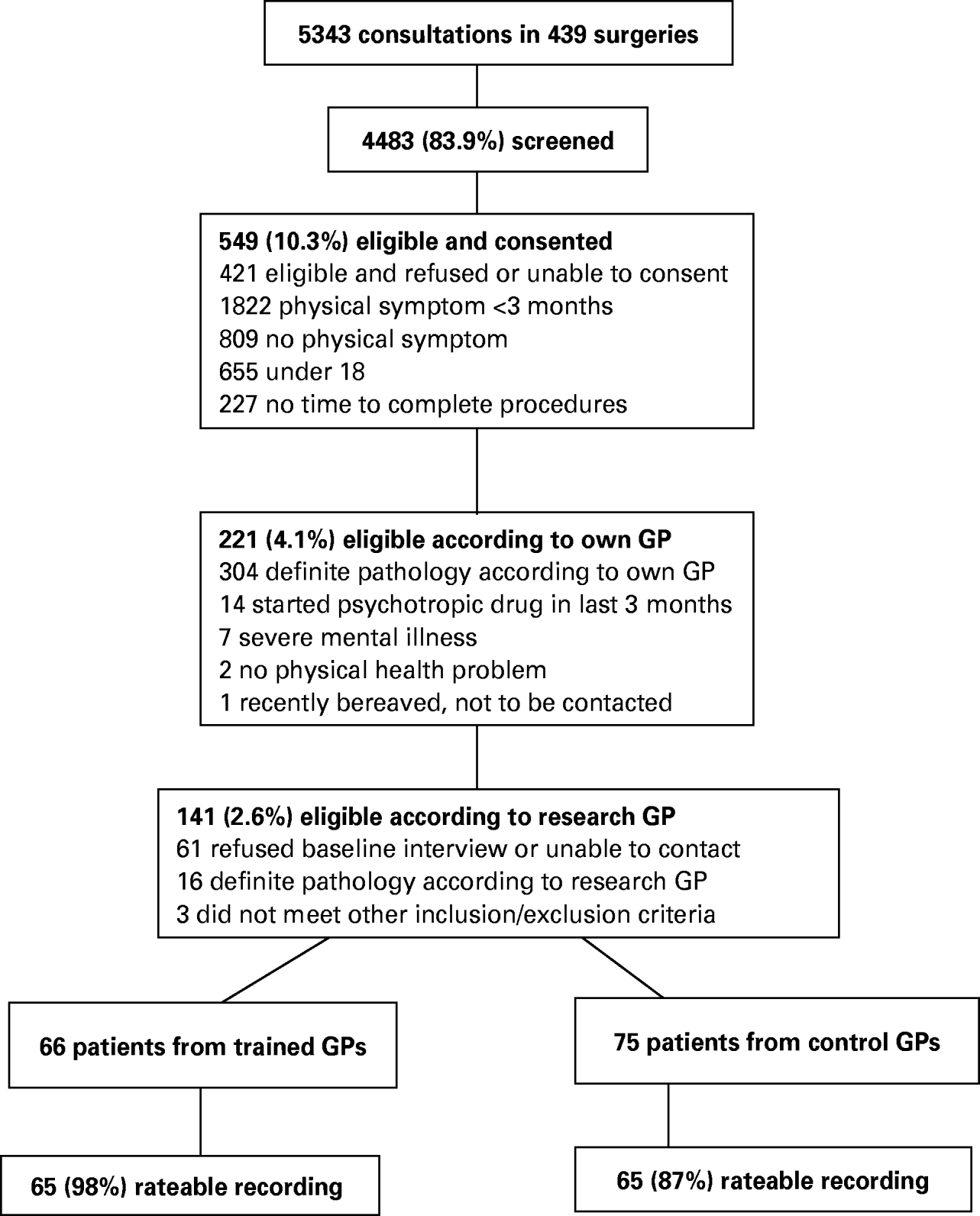
Patient recruitment and flow into the study are shown in Fig. 1. There were 141 recruited patients with MUS, 66 in the RT group and 75 in the control group. In the 141 recruited patients, the mean (s.d.) age of the patients differed between the RT and control groups [53.9 (11.9) v. 48.9 (13.8) years respectively, t=2.29, df=139, p=0.024]. There were no other differences between the groups in terms of demographic or clinical characteristics. Ninety-five patients (67%) were female. The main presenting MUS of the patients were pain (n=80, 57%), bowel problems (n=13, 9%) and fatigue (n=10, 7%), with a wide range of other MUS. Multiple presenting MUS were offered by 32 (23%) patients and 78 (55%) had a duration of MUS >1 year. A physical causal attribution for MUS was endorsed by 71 (50%) patients, 62 (44%) stated they did not know the cause of their MUS and 30 (21%) believed that stress played at least some part in the cause of their MUS. Eighty-five (60%) patients thought they had moderate or extreme problems with anxiety or depression whereas 92 (65%) reported moderate or extreme problems with carrying out their usual daily activities. Patients who entered the trial did not differ from patients who attended the surgeries run by the GPs in terms of age but there were 10% more females in the study than attenders at the consultations.
Patient flow into the medically unexplained symptoms (MUST) randomized controlled trial (RCT).

Sixty-five consultations in each group were recorded (92% of the total); 11 recordings were not made because of technical failure. All the missing consultation data were from female patients but there were no differences in age or clinical characteristics between patients whose consultations were recorded successfully and those that were not. Codings were complete for all 130 consultations that were recorded.
Practices had a median of four (range 2–10) GPs. Three practices served an inner city population, one a rural population and the remaining 12 practices an urban population that may include some inner city areas. The GPs were mostly aged 35–50 years (n=45, 60%), with 10 (13%) <35 years and 19 (25%) >50 years old. Thirty-eight (51%) GPs were male. There were no differences between the training groups in terms of GP or practice characteristics.
Coding results
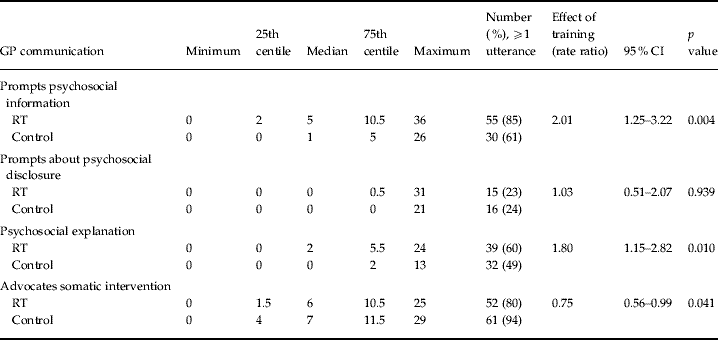
Table 2 shows the effects of RT on GP communication. RT did not increase GP prompts for patients to say more about psychosocial problems that they had disclosed (p=0.94). By contrast, RT substantially increased GP prompts for psychosocial information concerning patients' symptoms (p=0.004) and such prompts were made in 85% of patients with MUS. RT also increased GPs' provision of psychosocial explanation (p=0.010) so that it occurred in 60% of consultations. RT decreased GPs' advocacy of a somatic intervention (p=0.041). However, after RT, GPs' speech still included, on average, six utterances concerning the appropriateness of a somatic intervention and only two utterances of psychosocial explanation.
Effects of reattribution training (RT) on general practitioner (GP) discussion of psychosocial information and somatic management

CI, Confidence interval.
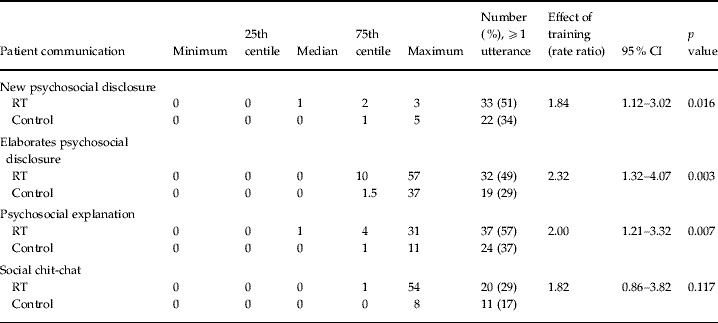
Table 3 shows the effects of RT on patient communication. RT specifically increased patients' disclosures of psychosocial problems (p=0.016), their further speech elaborating these problems (p=0.003) and psychosocial symptom explanation by the patient (p=0.007) but not social chit-chat by the patient (p=0.117). Half the patients disclosed a new psychosocial problem after RT compared to one-third in the usual-treatment group. In some patients the amount of psychosocial discussion after RT was increased substantially: 25% of MUS patients in the RT group provided two or more utterances disclosing psychosocial problems, 10 or more utterances elaborating these problems, and four or more utterances of psychosocial explanation for their MUS. Thirty per cent of patients with MUS provided no psychosocial information at all, even though half of these were asked directly for such information by their GP.
Effects of reattribution training (RT) on patient discussion of psychosocial information

CI, Confidence interval.
Discussion
We have shown previously that RT was feasible when it was delivered by health facilitators in GP practices; it improved GPs' communication with MUS patients in line with theory about reattribution but there were no improvements in clinical outcomes by 3 months (Morriss et al. Reference Morriss, Dowrick, Salmon, Peters, Rogers and Dunn2006, Reference Morriss, Dowrick, Salmon, Peters, Dunn, Rogers, Lewis, Charles-Jones, Hogg, Clifford, Rigby and Gask2007). The current paper extends these findings by generating hypotheses for the lack of benefit following RT on clinical outcomes through detailed exploration of doctor and patient discussion of psychosocial information and somatic interventions in the index consultation. Furthermore, our latest findings are theoretically important because they demonstrate that improved care for most MUS patients requires more than training GPs to ask for more psychosocial information and to give a simple explanation linking such psychosocial information to physical symptoms.
However, the study is not sufficiently powered to explore the effect of specific GP communication behaviour after RT on patient outcome. Therefore, the study cannot explain how specific aspects of GP communication after RT might relate to better or worse patient outcome. However, the analysis in this paper generates testable hypotheses relating specific aspects of GP communication behaviour to clinical management that may in turn influence patient outcome. These hypotheses could be explored in future prospective observation and treatment studies.
The reattribution model requires the GP to enquire specifically for psychosocial information and our data confirm that, after RT, GPs did this in the majority of cases. Half the MUS patients responded by disclosing at least one psychosocial problem and some patients substantially increased the amount of psychosocial information they discussed, offering much elaboration of their psychosocial problems and also offering psychosocial explanations for their MUS. However, RT-trained GPs did not prompt patients for any further information about psychosocial disclosures that they had made. It seems that patients are disclosing problems to GPs who they thought were more interested in their psychosocial problems generally, but who were really more interested in linking psychosocial problems to symptoms. Therefore, RT increased instrumental discussion of psychosocial problems that could readily be linked to MUS rather than deeper probing of psychosocial problems in their own right. Such deeper probing might have revealed underlying psychosocial difficulties that are concerns for patients and associated with MUS, and a focus for further psychosocial treatment.
RT did not change the amount of social ‘chit-chat’ by the patient. Therefore, RT seemed to have specific effects on psychosocial communication in the consultation. RT considerably increased the giving of psychosocial information and the discussion of both GP and patient explanations linking physical symptoms to psychosocial problems in some patients. However, it is worth noting that, after RT, half of all patients had either a very limited or no discussion of psychosocial information even though GPs asked these patients for psychosocial information. A qualitative study performed in the patients taking part in the current study revealed that MUS patients had privately considered a psychosocial explanation for their symptoms (Peters et al. Reference Peters, Rogers, Salmon, Gask, Dowrick, Towey, Clifford and Morriss2009). However, many patients did not trust their GPs with discussion of the emotional aspects of their problems. Often patients feared that, once such discussion took place, their GP would not adequately consider the physical health basis of any symptoms they may present with. Sometimes patients withheld psychosocial information because they feared the GP would give them treatments for emotional problems that they did not want, such as antidepressants, or they considered psychosocial issues to be a private matter.
In line with naturalistic observation that increased discussion of psychosocial information in the consultation decreased the likelihood of somatic intervention by the GP (Salmon et al. Reference Salmon, Humphris, Ring, Davies and Dowrick2007), RT reduced the number of times that GPs suggested somatic interventions such as prescriptions, investigations and referrals. However, closer inspection of our results shows that, even after RT, GPs advocated numerous somatic interventions such as prescriptions, investigations and referrals even in patients who received psychosocial explanations from the GP or offered psychosocial explanations themselves. Many of these patients had several medically explained and unexplained symptoms so the high rates of GP advocacy for somatic intervention and prescription may reflect the fact that patients store up several active and ongoing problems for the GP to consider in a single consultation. Our impression is that many GPs give a psychosocial explanation for MUS and also advocate somatic intervention, possibly because they believe the approach to be more acceptable to the patient. There is a danger that, after RT, patients might have received more mixed messages in the same consultation: on the one hand, the GP is saying on average twice in each consultation that some of the physical symptoms may be related to psychosocial problems but, on the other hand, the patient is told by the GP on average six times in the same intervention that a somatically orientated investigation, prescription or referral could help. Previous research has highlighted that when patients are given such mixed messages, they are disinclined to believe psychosocial explanations and reassurance that nothing is seriously wrong, and become more concerned about their physical health (Coia & Morley, Reference Coia and Morley1998). There is some suggestion of this in our RCT given that, compared to the control group, MUS patients perceived their health to be worse after RT (Morriss et al. Reference Morriss, Dowrick, Salmon, Peters, Dunn, Rogers, Lewis, Charles-Jones, Hogg, Clifford, Rigby and Gask2007).
There are some limitations of the study, although the training process itself seemed to work well. RT was completed in all GPs in all practices, with positive feedback from all but a few GPs. All GPs found the health facilitators knowledgeable about MUS and primary care. The first stage of reattribution was completed by GPs in over 70% consultations. Therefore, RT delivered by health facilitators seemed to be feasible, acceptable and effective in changing GPs' communication behaviour. A limitation might be the patient sample that was recruited. Only 2.6% of consecutive attenders were recruited in MUST whereas some surveys have suggested that up to 20% of attenders have MUS (Peveler et al. Reference Peveler, Kilkenny and Kinmonth1997). Of the patients diagnosed with MUS in the study, 83% had consulted their GP at least twice in the previous 3 months and 50% had consulted three or more times, with no difference between the intervention groups. Therefore, the majority of our sample belongs to a group of patients who frequently consult primary care and have MUS. It is possible that RT may be more effective in MUS patients who have not previously or rarely consulted with MUS. In MUST, consecutive attenders were screened in the waiting room before the index consultation and were only recruited after a final decision about the inclusion or exclusion of the patient by an independent research GP. Therefore, selection bias was largely avoided in MUST and the design, involving the training of all GPs in a practice, limited the possibility of contamination between the intervention groups.
The current study used an empirically derived method of communication analysis (the LCIAS). It has some potential limitations. The analysis of communication using the LCIAS does not explore non-verbal aspects of communication that might be important in conveying meaning in the consultation. However, the majority of the information that is required to assess information gathering and explanation is verbal, and audio-recording is less intrusive to the consultation and less likely to bias the consultation behaviour of the GP and patient. We did not examine the entire range of communication codes in LCIAS. We selected the codes that were most relevant to the research question we asked in this study and wanted to minimize the risk of false-positive results. However, our analysis of the communication data is post hoc and there were multiple outcomes so our findings require replication.
Overall, the results suggest that reattribution may have a place in the management of MUS patients who give psychosocial cues to the GP with little prompting because RT substantially increased psychosocial discussion in these patients. Differences in patient outcome between studies of RT may be related to the proportion of MUS patients who recognize the possibility of a psychosocial explanation for their MUS and their willingness to discuss this information with their GP. However, RT does not seem to be a suitable intervention for all MUS patients, who may require a period of preparation before they are ready to discuss psychosocial information. It is notable that the best results from a reattribution intervention were obtained when the GP delivered reattribution more slowly over several consultations (Blankenstein, Reference Blankenstein2001). Further research is required to understand how GPs might help patients with MUS to recognize and discuss psychosocial issues with the GP when these psychosocial issues are relevant to presentations to the doctor with MUS. Moreover, when interventions designed to promote psychsocial talk such as RT are used, GPs may need to actively seek the disclosure of underlying psychosocial problems when the patient does not offer such disclosure spontaneously, to reinforce positive coping with psychosocial problems. The results suggest that when giving psychosocial explanation to patients with MUS, it is important to give clear, unambiguous messages to the patient by advocating only psychosocial explanation and interventions rather than a combination of somatic intervention and psychosocial explanation.
Acknowledgements
We thank the following practices and their patients who took part in the study: Bousfield Health Centre; Brownhill Surgery; Brownlow Group Practice; Ellesmere Medical Centre; Heaton Medical Centre; Manor Health Centre; Moore Street Surgery; Pendleside Medical Practice; Primrose Bank Medical Centre; Roe Lee Surgery; Somerville Group Practice; Stonehill Medical Centre; Unsworth Medical Centre; Victoria Park Health Centre; Villa Medical Centre; and Westmoreland General Practice. We acknowledge the contribution of the rest of the MUST research team: A. Rogers, B. Lewis, H. Charles-Jones, J. Hogg, M. Towey, R. Clifford, C. Rigby, W. Iredale, N. Crompton, M. Evans, E. McVeigh, V. Wilson and F. Creed. Funding for this study was obtained from the Medical Research Council, Mersey Care NHS Trust and Mersey Primary Care Research Organization.
Declaration of Interest
None.