Introduction
Overvaluation of body shape/weight refers to one's preoccupation with shape and weight and using one's shape and weight as a major source of self-esteem (Fairburn et al. Reference Fairburn, Cooper and Shafran2003a ; Fairburn, Reference Fairburn2008). In the transdiagnostic cognitive-behavioral model of eating disorders (Fairburn et al. Reference Fairburn, Cooper and Shafran2003a ; Fairburn, Reference Fairburn2008), overvaluation is the core psychopathology that maintains eating disorder symptoms and behaviors. According to Fairburn (Reference Fairburn2008), shape/weight concerns, such as feelings of fatness (feeling fat or that a specific body part is fat) and fat phobia (fear of becoming fat), are conceptualized as distinct constructs that emanate from overvaluation of shape/weight.
Overvaluation of shape/weight is difficult to address in treatment as it is pervasive and persistent. Although overvaluation and shape/weight concerns can be alleviated with treatment (Wilson et al. Reference Wilson, Eldredge, Smith and Niles1991, Reference Wilson, Fairburn, Agras, Walsh and Kraemer2002), a post-treatment measure of overvaluation (Fairburn, et al. Reference Fairburn, Peveler, Jones, Hope and Doll1993) and a composite measure of shape/weight concerns that included overvaluation (Halmi et al. Reference Halmi, Agras, Mitchell, Wilson, Crow, Bryson and Kraemer2002) have both been associated with relapse among patients with bulimia nervosa (BN). Likewise, overvaluation, feelings of fatness, and fat phobia have each been associated with greater likelihood of relapse among remitted patients with anorexia nervosa (AN) or BN (Keel et al. Reference Keel, Dorer, Franko, Jackson and Herzog2005). Furthermore, greater overvaluation at the outset of treatment has been associated with greater engagement in binge eating 1 year after the end of treatment among obese patients with binge eating disorder (BED; Grilo et al. Reference Grilo, White, Gueorguiva, Wilson and Masheb2013).
The manner by which overvaluation maintains eating disorders is complex. According to Fairburn and colleagues’ transdiagnostic cognitive-behavioral model of eating disorders (Fairburn et al. Reference Fairburn, Cooper and Shafran2003a ), overvaluation of shape/weight is the driving force that propels engagement in non-compensatory weight-control behaviors, such as engagement in restrictive eating and compulsive exercise that is independent of the amount of food intake and presence of binge eating episodes. In turn, increased engagement in these behaviors leads to binge eating and/or maintenance of low weight which, in turn, reinforces overvaluation of shape/weight. In short, according to cognitive-behavioral theory, overvaluation and engagement in non-compensatory weight-control behaviors mutually reinforce each other in a reciprocal manner.
Although prior research has found that overvaluation of shape/weight is associated with greater engagement in binge eating and purging behaviors among individuals with eating disorders (Fairburn et al. 1993; Halmi et al. Reference Halmi, Agras, Mitchell, Wilson, Crow, Bryson and Kraemer2002; Keel et al. Reference Keel, Dorer, Franko, Jackson and Herzog2005; Grilo et al. Reference Grilo, White, Gueorguiva, Wilson and Masheb2013), the relationship between overvaluation and non-compensatory weight-control behaviors was not fully addressed in prior research. Indeed, no research has directly examined the reciprocal relationship between overvaluation and non-compensatory weight-control behaviors among individuals with eating disorders, although available data support a one-way relationship between overvaluation and engagement in non-compensatory weight-control behaviors. For example, one study found that greater overvaluation at baseline was moderately associated with increased restrictive eating and binge eating over a 15-month interval among women with BN (Fairburn et al. Reference Fairburn, Cooper and Shafran2003 Reference Fairburn, Stice, Cooper, Doll, Norman and O'Connor b ). Greater overvaluation at baseline and more frequent binge eating were no longer associated after statistically controlling for shared variance with increased restrictive eating, which suggests that restrictive eating may have mediated the relationship between overvaluation and binge eating. However, increased restrictive eating was not examined as a predictor of subsequent overvaluation.
Dalle Grave and colleagues (Dalle Grave et al. Reference Dalle Grave, Calugi and Marchesini2008a ) found that greater time spent engaging in compulsive exercise during pre-treatment was moderately associated with an increase in scores of a composite measure of shape/weight concerns, which included overvaluation, over the course of treatment among patients with AN, BN, or eating disorder not otherwise specified (EDNOS). However, overvaluation was not empirically distinguished from shape/weight concerns, and was not examined as a predictor of compulsive exercise. As such, a gap in the empirical literature remains in terms of examining the reciprocal relationship between overvaluation and engagement in non-compensatory weight-control behaviors. This is important because overvaluation and non-compensatory behaviors are common features of eating disorders and both are risk factors for engagement in binge eating and purging behaviors.
Moreover, it is important to distinguish between overvaluation and shape/weight concerns in relation to engagement in non-compensatory weight-control behaviors. Indeed, Fairburn (Reference Fairburn2008) theorized that overvaluation is the core psychopathology that maintains eating disorders and that shape/weight concerns emanate from overvaluation. In cross-sectional research examining the factor structure of the Eating Disorder Examination – Questionnaire (EDE-Q; Fairburn & Beglin, Reference Fairburn and Beglin1994), there is mixed evidence for the empirical distinction between overvaluation and shape/weight concerns. One study found support for the distinction among individuals with BN or subthreshold BN (Peterson et al. Reference Peterson, Crosby, Wonderlich, Joiner, Crow, Mitchell, Bardone-Cone, Klein and Le Grange2007), whereas no support for the distinction was found in two studies with mixed eating-disorder samples (Allen et al. Reference Allen, Byrne, Lampard, Watson and Fuesland2011; Ardoom et al. Reference Ardoom, Dingemans, Slof Op't Lamdt and Van Ruth2012). Nevertheless, while many individuals with eating disorders exhibit overvaluation and shape/weight concerns, data from both clinical and community samples indicate that they are not universal (Goldfein et al. Reference Goldfein, Walsh and Midlarsky2000; Dalle Grave et al. Reference Dalle Grave, Calugi and Marchesini2008b ; Carter & Belwell-Weiss, Reference Carter and Belwell-Weiss2011; Lethbridge et al. Reference Lethbridge, Watson, Eagan, Street and Nathan2011; Nakai et al. Reference Nakai, Nin, Teramukai, Taniguchi, Fukushima and Wonderlich2014). Indeed, nuances of the interplay between overvaluation and shape/weight concerns and their roles in driving eating disorder behaviors have not been studied.
The major aim of the present research was to examine the temporal relationships between overvaluation and engagement in non-compensatory weight-control behaviors, defined in this study as restrictive eating and compulsive exercise that is independent of the amount of food intake and presence of binge eating episodes, among women diagnosed with AN or BN. In order to clarify this relationship, we distinguished between overvaluation and a composite measure of two shape/weight concerns: feelings of fatness and fat phobia. We expected differences between overvaluation and shape/weight concerns to emerge in relation to non-compensatory weight-control behaviors over time (i.e. predictive validity). In line with Fairburn et al.'s (Reference Fairburn, Cooper and Shafran2003a ) transdiagnostic cognitive-behavioral model of eating disorders, we hypothesized that the relationship between overvaluation and engagement in non-compensatory weight-control behaviors would be reciprocal. By contrast, we did not expect shape/weight concerns to be reciprocally related to engagement in non-compensatory weight-control behaviors because shape/weight concerns have been conceptualized as manifestations of overvaluation (Fairburn et al. Reference Fairburn, Cooper and Shafran2003a ; Fairburn, Reference Fairburn2008).
Accordingly, we examined whether a reciprocal relationship exists between overvaluation of shape/weight and engagement in non-compensatory weight-control behaviors while statistically controlling for shared variance with shape/weight concerns. For the purpose of discriminant validity, we explored whether a reciprocal relationship exists between shape/weight concerns and engagement in non-compensatory weight-control behaviors while statistically controlling for shared variance with overvaluation. Moreover, we controlled for participants’ baseline eating disorder diagnosis because individuals with AN and BN likely differ in terms of their engagement in restrictive eating (Fairburn, Reference Fairburn2008) and compulsive exercise (Dalle Grave et al. Reference Dalle Grave, Calugi and Marchesini2008a ).
Method
Participants, materials, and procedure
Participants were 246 women who sought eating-disorder treatment from Boston area outpatient services and agreed to participate in the Massachusetts General Hospital Longitudinal Study of AN and BN, which was initiated in 1987 and ended in 2013. At study intake, participants were diagnosed using a modified version of the Schedule for Affective Disorders and Schizophrenia – Lifetime Version (SADS-L; Spitzer & Endicott, Reference Spitzer and Endicott1979) that included a section for eating disorders (EAT-SADS-L; Herzog, Reference Herzog1987) based on the revised third edition of the Diagnostic and Statistical Manual of Mental Disorders (DSM-III-R; APA, 1987). Intake diagnoses were later reassigned after the publication of DSM-IV (APA, 1994). Based on DSM-IV criteria, participants were diagnosed with either AN – restricting type (n = 51), AN – binge-eating/purging type (n = 85), or BN (n = 110).
Participants were subsequently interviewed using the Longitudinal Interval Follow-Up Evaluation Eating Disorders Version (LIFE-EAT II; Herzog et al. Reference Herzog, Dorer, Keel, Selwyn, Ekeblad, Flores, Greenwood, Burwell and Keller1999) at regular intervals (6–12 months) for up to 12 years to track the long-term course of eating disorder symptoms and behaviors over time. The LIFE-EAT II is based on the Longitudinal Interval Follow-Up Evaluation (LIFE; Keller et al. Reference Keller, Lavori, Friedman, Nielsen, Endicott, McDonald-Scott and Andreason1987) and involves a semi-structured interview conducted by a trained assessor. At each follow-up interview, the assessor determined whether participants had eating disorder symptoms and behaviors during the current week and during each of the preceding weeks since the last interview based on participants’ retrospective recall, anchored by use of key dates and intervening life events. All assessors were supervised by study psychologists and psychiatrists and interviews were administered in person whenever possible.
Importantly, the LIFE-EAT II has high inter-rater reliability with an 88% agreement rate and intraclass correlation (ICC) of 0.93 for AN as well as a 90% agreement rate and ICC of 0.94 for BN (Franko et al. Reference Franko, Keel, Dorer, Blais, Delinsky, Eddy, Charat, Renn and Herzog2004), which is similar to prior research that used the LIFE methodology to examine the week-to-week long-term course of other psychiatric disorders (Keller et al. Reference Keller, Lavori, Friedman, Nielsen, Endicott, McDonald-Scott and Andreason1987; Warshaw et al. Reference Warshaw, Keller and Stout1994, Reference Warshaw, Dyck, Allsworth, Stout and Keller2001).
For the present study, we examined the assessors’ ratings of overvaluation, feelings of fatness, fat phobia, restrictive eating, and compulsive exercise for the first 2 years (104 weeks) of the study based on data from the LIFE-EAT II. We examined data from the first 2 years of the study in order to optimize our ability to examine the temporal relationships between eating disorder symptoms and behaviors as most participants in the first 2 years of the study were not recovered (Herzog et al. Reference Herzog, Dorer, Keel, Selwyn, Ekeblad, Flores, Greenwood, Burwell and Keller1999). For overvaluation, the assessor asked ‘Do you find that you are often concerned with your body weight and shape? That it is on your mind a lot?’ The assessor probed for ‘preoccupation with thoughts of body and weight and the use of body and weight as a major source of evaluation of self-esteem’ in order to rate the overvaluation item as present or not (Herzog, Reference Herzog1987, p. 12). For feelings of fatness, the assessor asked ‘Do you feel that you, or any part of you, are fat?’ For fat phobia, the assessor asked ‘Have you been scared of becoming fat?’ The assessor rated each of these symptoms as either absent (0) or present (1). For restrictive eating, the assessor asked ‘What kinds of food do you eat (other than during a binge)? How much do you eat? Do you put any limits on the types and amounts of food you eat?’ The assessor rated restrictive eating as either no or minimal restriction (1), moderate restriction of quantity and/or quality of foods subject will eat (2), or severe restriction of quantity and/or quality of foods subject will eat (3). For compulsive exercise, the assessor asked ‘Do you exercise on a regular basis? How often? What would prevent you from getting this amount of exercise? How would you feel if you did no exercise?’ The assessor probed participants’ responses for ‘repetitive, purposeful, and intentional behaviors that are performed in response to an obsession, according to certain rules, or in a stereotyped fashion…designed to neutralize or to prevent discomfort or some dreaded event or situation’ (Herzog, Reference Herzog1987, p. 9). The assessor rated compulsive exercise as either absent (1), moderate compulsive exercise that does not interfere with other activities (2), or severe compulsion, in which the subject exercises all the time and the exercise interferes with other activities (3).
Statistical analyses
To examine whether a reciprocal relationship existed between overvaluation of shape/weight and engagement in non-compensatory weight-control behaviors over time, an autoregressive cross-lagged path analysis was conducted. In the model, overvaluation, shape/weight concerns, restrictive eating, and compulsive exercise at week t − 1 each predicted overvaluation, shape/weight concerns, restrictive eating, and compulsive exercise at week t across 104 weeks. Of note, this analysis statistically controlled for shared variance between overvaluation, shape/weight concerns, restrictive eating, and compulsive exercise at week t − 1. Moreover, in the analysis, we statistically controlled for participants’ eating disorder diagnoses at study intake and for the non-independence of observations due to repeated measures.
We examined whether the cross-lagged model provided a better fit to the data compared to two alternative models in which unidirectional relationships between overvaluation and non-compensatory weight-control behaviors were specified. The first alternative model was identical to the cross-lagged model except that overvaluation at week t – 1 predicted restrictive eating and compulsive exercise at week t. The second alternative model was identical to the cross-lagged model except that restrictive eating and compulsive exercise at week t − 1 predicted overvaluation at week t. We also explored whether a reciprocal relationship existed between shape/weight concerns and engagement in non-compensatory weight-control behaviors.
Analyses were conducted using Mplus version 7 (Muthén & Muthén, Reference Muthén and Muthén1998–Reference Muthén and Muthén2012). All model parameters were estimated using a robust maximum likelihood estimator with a logistic link function because the dependent variables were either dichotomous or ordinal. The effect size calculated was the odds ratio (OR). Model comparisons were conducted using χ2 difference tests (∆χ 2) based on the log-likelihood values of the models because Mplus does not provide fit statistics when dependent variables are categorical. Analyses were conducted with participants who had at least 104 weeks of data (n = 237). Nine participants were excluded from the analyses because they had less than 104 weeks of data.
Results
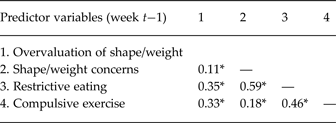
At week t − 1 and week t, feelings of fatness and fat phobia were strongly correlated (polychoric r s = 0.97, p < 0.01). As such, we combined feelings of fatness and fat phobia into a single measure of shape/weight concerns. Associations between predictor variables in the cross-lagged path model are reported in Table 1.
Correlations between predictor variables in the cross-lagged model

All variables were either dichotomous or ordered categorical. As such, associations between ordinal variables were examined using polychoric correlations and associations between binary variables were examined using tetrachoric correlations.
* p < 0.01.
Overvaluation of body shape/weight
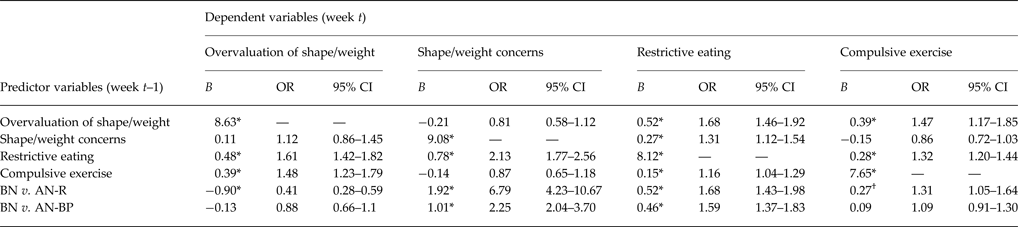
Results from the cross-lagged model are reported in Table 2. Participants who overvalued their shape/weight in a given week were more likely to engage in restrictive eating (OR 1.68, p < 0.01) and compulsive exercise (OR 1.47, p < 0.01) during the following week, regardless of their shape/weight concerns, restrictive eating, and compulsive exercise during the prior week, and their intake diagnosis. Further, participants who engaged in restrictive eating (OR 1.61, p < 0.01) or compulsive exercise (OR 1.48 p < 0.01) in a given week were more likely to overvalue their shape/weight during the following week, regardless of their overvaluation of shape/weight, and shape/weight concerns during the prior week, and their intake diagnosis.
Regression estimates and odds ratios from the cross-lagged path model

OR, Odds ratio; CI, confidence interval; BN, bulimia nervosa; AN-R, anorexia nervosa – restricting type; AN-BP, anorexia nervosa – binge eating/purging type.
† p = 0.05, * p < 0.05.
Importantly, two alternative unidirectional models did not provide a better fit to the data. Specifically, compared to the cross-lagged model, the unidirectional model in which overvaluation in a given week predicted restrictive eating and compulsive exercise during the following week provided a poor fit to the data (∆χ 2 2 = 59.02, p < 0.001). Likewise, compared to the cross-lagged model, the unidirectional model in which restrictive eating and compulsive exercise in a given week predicted overvaluation during the following week provided a poor fit to the data (∆χ 2 2 = 33.18, p < 0.001). In sum, overvaluation and non-compensatory weight-control behaviors were reciprocally related.
Shape/weight concerns
Results from the cross-lagged model indicated that participants’ shape/weight concerns and compulsive exercise were unrelated (see Table 2). However, there was evidence for a reciprocal relationship between shape/weight concerns and restrictive eating. Specifically participants who were concerned with their shape/weight in a given week were more likely to engage in restrictive eating during the following week (OR 1.31, p < 0.01), regardless of their overvaluation of shape/weight, restrictive eating, and compulsive exercise during the prior week, and intake diagnosis. Moreover, participants who engaged in restrictive eating in a given week were more likely to be concerned with their shape/weight during the following week (OR 2.13, p < 0.01), regardless of their shape/weight concerns, overvaluation of shape/weight, and compulsive exercise during the prior week, and intake diagnosis. In sum, there was evidence for a reciprocal relationship between shape/weight concerns and restrictive eating.
Discussion
To evaluate the predictions emanating from one aspect of Fairburn and colleagues’ transdiagnostic cognitive-behavioral model of eating disorders, we examined whether a reciprocal relationship existed between overvaluation of shape/weight and non-compensatory weight-control behaviors, which were defined as restrictive eating and compulsive exercise. We drew inferences from a large sample of women diagnosed with AN or BN using 2 years of weekly data based on clinical interviews. Consistent with this aspect of the transdiagnostic cognitive-behavioral model of eating disorders, we found that engagement in non-compensatory weight-control behaviors during a given week was positively associated with overvaluation during the following week. According to this model, engagement in non-compensatory weight-control behaviors reinforces overvaluation of shape/weight via the mediation of increased binge eating and/or maintenance of low weight. Although one previous study found that greater time spent engaging in compulsive exercise prior to treatment was associated with increasing scores during treatment on a composite measure of overvaluation and shape/weight concerns (Dalle Grave et al. Reference Dalle Grave, Calugi and Marchesini2008a ), no prior research has examined whether engagement in non-compensatory weight-control behaviors intensifies overvaluation directly or indirectly via mediating factors. As such, our research is the first to demonstrate that engagement in non-compensatory weight-control behaviors may reinforce overvaluation over time, which is a critical first step for examining the mediating roles of binge eating and maintenance of low weight.
We also found that overvaluation on a given week was positively associated with engagement in non-compensatory weight-control behaviors during the following week, which is consistent with prior research with women diagnosed with BN (Fairburn et al. Reference Fairburn, Cooper and Shafran2003 Reference Fairburn, Stice, Cooper, Doll, Norman and O'Connor b ) as well as non-clinical samples of children and adolescents (Allen et al. Reference Allen, Byrne, McLean and Davis2008; Wilksch & Wade, Reference Wilksch and Wade2010). Fairburn et al. (Reference Fairburn, Cooper and Shafran2003 Reference Fairburn, Stice, Cooper, Doll, Norman and O'Connor b ) found that greater overvaluation at baseline was associated with increased restrictive eating over a 15-month interval. Wilksch & Wade (Reference Wilksch and Wade2010) reported a similar finding; however, non-compensatory and compensatory weight-control behaviors were conflated in their study. Allen et al. (Reference Allen, Byrne, McLean and Davis2008) found that pre-adolescent girls who had greater overvaluation at baseline also had greater engagement in restrictive eating 1 year later.
Taken together, these findings suggest that overvaluation of shape/weight and engagement in non-compensatory weight-control behaviors mutually reinforce each other over time in a reciprocal manner. These relationships emerged while controlling for shared variance between overvaluation, shape/weight concerns, and intake diagnosis. Note that participants diagnosed with AN had more shape/weight concerns and engaged in more restrictive eating relative to participants diagnosed with BN. In addition, participants diagnosed with AN – restricting type had less overvaluation and engaged in more compulsive exercise relative to participants diagnosed with BN.
Our study also contributes to the literature examining the distinction between overvaluation and shape/weight concerns. In cross-sectional research on individuals with eating disorders, empirical evidence for the conceptual distinction between overvaluation and shape/weight concerns is equivocal. Nevertheless, our adoption of a longitudinal perspective enabled us to disentangle the relationship between overvaluation and non-compensatory weight-control behaviors from shape/weight concerns. Although overvaluation and shape/weight concerns were only modestly correlated in our sample, the findings suggest that they cannot be equated in relation to engagement in non-compensatory weight-control behaviors.
Nevertheless, shape/weight concerns had a distinct relationship with restrictive eating only. There was evidence that shape/weight concerns had a reciprocal relationship with restrictive eating, which was independent of overvaluation and intake diagnosis. Although the findings for shape/weight concerns were unexpected, they are intriguing because they suggest that shape/weight concerns may independently contribute to the maintenance of restrictive eating above and beyond the maintaining influence of overvaluation among women with AN or BN. As such, targeting shape/weight concerns in treatment may be particularly important to address restrictive eating.
Furthermore, engagement in restrictive eating over a given week was independently associated with overvaluation of shape/weight and shape/weight concerns during the following week. These findings fit with prior research on the consequences of restrictive eating. For example, in the classic work of Ancel Keys, normal-weight men who were starved down to 75% of their original body weight exhibited heightened preoccupations with food and eating (Franklin et al. Reference Franklin, Schiele, Brozek and Keys1948). Similarly, individuals classified as restrained eaters are generally more preoccupied with their food, shape, and weight compared to unrestrained controls (Polivy, Reference Polivy1996). Moreover, individuals with eating disorders who engage in severe restrictive eating interpret their symptoms of starvation (e.g. hunger and dizziness) in terms of their control over their eating, shape, or weight (e.g. ‘I am going to lose control and get fat’, see Shafran et al. Reference Shafran, Fairburn, Nelson and Robinson2003, p. 893; also see Dalle Grave et al. Reference Dalle Grave, Pauli, Sartirana, Calugi and Shafran2007).
Clinically, the findings for restrictive eating suggest that, perhaps counter-intuitively, targeting patients’ restrictive eating behaviors in treatment could be instrumental in helping to address their overvaluation and their shape/weight concerns. Indeed, greater weight gain over the course of cognitive-behavioral therapy was found to be associated with greater decreases in scores on a composite measure of overvaluation and shape/weight concerns among AN patients (Dalle Grave et al. Reference Dalle Grave, Calugi, El-Ghoch, Conti and Fairburn2014) and a mixed eating disorder sample (Dalle Grave et al. Reference Dalle Grave, Calugi and Marchesini2008a ) in an inpatient setting. In an adolescent sample, AN patients who received family-based treatment gained more weight and had lower scores on a composite measure of overvaluation and shape/weight concerns at the end of treatment compared to AN patients who received adolescent-focused therapy (Lock et al. Reference Lock, Le Grange, Agras, Moye, Bryson and Jo2010). The lower overvaluation and shape/weight concerns observed in family-based treatment are especially notable given that the approach specifically addresses restrictive eating rather than overvaluation and shape/weight concerns, which suggests that targeting patients’ restrictive eating may lead to decreases in their overvaluation and shape/weight concerns.
Accordingly, future research might examine whether overvaluation of shape/weight maintains disordered eating above and beyond the influence of shape/weight concerns. Such an investigation would assist in further unpacking the complex psychopathology of eating disorders. This is important for enhancing our understanding of the maintaining role of overvaluation in eating disorder populations, and for identifying developmental risk factors for eating disorders. Indeed, overvaluation and shape/weight concerns – including feelings of fatness and fat phobia – have each been identified as risk factors for eating disorder onset in children and adolescents (Gowers & Shore, Reference Gowers and Shore2001), and were conflated in prior research on adolescents (Killen et al. Reference Killen, Taylor, Hayward, Wilson, Haydel, Hammer, Simmonds, Robinson, Litt, Varady and Kraemer1994, Reference Killen, Taylor, Hayward, Haydel, Wilson, Hammer, Kraener, Blair-Greiner and Strachowski1996). Future research that aims to tease apart the unique contributions of these risk factors for the development of eating disorders may assist in the design of targeted treatment interventions.
The present study has several strengths which include the length of follow-up, large sample size, inclusion of AN and BN, and reliance on interview-based reports. One limitation of the present study is that our findings were based on a sample of treatment-seeking women, which may not generalize to women who never seek treatment. Another potential limitation is that participants recalled their eating disorder symptoms and behaviors (i.e. recall bias). However, participants’ recollections were vetted by a trained assessor using a semi-structured interview (the LIFE-EAT II) that has been shown to have high inter-rater reliability (Franko et al. Reference Franko, Keel, Dorer, Blais, Delinsky, Eddy, Charat, Renn and Herzog2004) like prior research on other psychiatric disorders using the LIFE methodology (Keller et al. Reference Keller, Lavori, Friedman, Nielsen, Endicott, McDonald-Scott and Andreason1987; Warshaw et al. Reference Warshaw, Keller and Stout1994, Reference Warshaw, Dyck, Allsworth, Stout and Keller2001). A third limitation is that we did not examine the role of compensatory weight-control behaviors (e.g. purging in response to consuming a large amount of food). Indeed, to fully test the transdiagnostic cognitive-behavioral model of eating disorders, future research would need to investigate the role of compensatory weight-control behaviors in relation to overvaluation and non-compensatory weight-control behaviors. A fourth possible limitation is that we used single-item measures from the LIFE-EAT II to assess each construct. As such, we were not able to use latent variables to examine the construct validity of our measures. Nevertheless, we found that overvaluation and shape/weight concerns were only modestly correlated (see Table 1), which suggests that they are related but distinct constructs. Also, our adoption of a longitudinal design enabled us to examine the unique associations between overvaluation and non-compensatory weight-control behaviors while statistically controlling for shared variance with shape/weight concerns.
Closing comments
We found that overvaluation of shape/weight and engagement in restrictive eating and compulsive exercise were reciprocally related over time. Further, above and beyond the influence of overvaluation, we found that shape/weight concerns had a reciprocal relationship with restrictive eating but not compulsive exercise. Together, the findings suggest that targeting non-compensatory weight-control behaviors in treatment may be instrumental in helping to alleviate overvaluation as well as shape/weight concerns.
Acknowledgements
The research was supported by an NIMH grant MH-38333 (PI D.B.H).
Declaration of Interest
None.