Cyberbullying (CB) has become a key concern for teachers, parents and educational policy makers worldwide (O’Moore, Reference O’Moore2012). As it is constantly evolving, there is no universally accepted definition of CB, making it difficult to capture across studies (Kwan et al. Reference Kwan, Dickson, Richardson, MacDowall, Burchett, Stansfield and Thomas2020). Generally, CB has been defined as intentional and repeated harm inflicted on an individual via electronic devices that can have a significant impact on mental health (Tokunaga, Reference Tokunaga2010; Le et al. Reference Le, Nguyen, Campbell, Gatton, Tran and Dunne2017). The internet has become a central part of daily life for young people and adults. It brings many benefits such as access to; educational information, resources, the development/maintenance of friendships with peers and an outlet for creativity (Dowdell, Reference Dowdell2013; Hartanto et al. Reference Hartanto, Yong, Toh, Lee, Tng and Tov2020). With the evolvement of the internet, bullying and risk taking behaviours are now moving online including, contact with strangers, sexual messaging (‘sexting’) and pornography (Livingstone & Smith, Reference Livingstone and Smith2014). Technology has removed the schoolyard boundaries from traditional bullying (TB) and expanded the problem to the borderless cyber world (Diamanduros et al. Reference Diamanduros, Downs and Jenkins2008).
There is a wide range of CB prevalence rates reported in the literature, partly contributed to by variations in CB definitions. With this understanding, Zhu et al. (Reference Zhu, Huang, Evans and Zhang2021) conducted a systematic review of global research and found that rates of CB ranged from 13.99–57.5% across 63 studies of children and adolescents. Reporting on 994 Irish children aged 9–16 years, O’Neill et al. (Reference O’Neill, Grehan and Olafson2011) found that a small proportion (4%) were bullied online, or by mobile phone with teenagers experiencing the greatest levels of CB (9%). In their meta-analysis of 39 TB and CB studies in Irish primary and secondary schools, Foody et al. (Reference Foody, Samara and O’Higgins Norman2017) found that TB (26.1%; nine studies) was twice as high as CB (13.7%; three studies) in primary schools. Rates of CB (9.6%; seven studies) were also less than TB (12.4%; 16 studies) in secondary schools, but the difference was non-significant. The majority of studies in Foody et al’s. (Reference Foody, Samara and O’Higgins Norman2017) meta-analysis focused on non-clinical samples with the exception of Dyer & Teggart (Reference Dyer and Teggart2007) who examined Child and Adolescent Mental Health Service (CAMHS) clients in Northern Ireland. Dyer and Teggart (Reference Dyer and Teggart2007) found that 62.5% of participants said that bullying experiences played a moderate-very important role in their CAMHS attendance. However, this study was not specific to CB.
Research has identified several possible negative effects stemming from CB victimisation, such as depression, poor self-esteem, anxiety, suicidal ideation, psychosomatic problems and school absenteeism (Patchin & Hunduja, Reference Patchin and Hinduja2010; Tokunga, Reference Tokunaga2010; Agatson et al. Reference Agatson, Kowalski, Limber, Patchin and Hinduja2012; Menesini & Nocentini, Reference Menesini, Nocentini, Costabile and Spears2012; Olweus, Reference Olweus2012; Kowalski et al. Reference Kowalski, Morgan and Limber2012; Smith, Reference Smith, Jimerson, Nickerson, Mayer and Furlong2012). In assessing how young people cope with CB, McLoughlin (Reference McLoughlin2019) surveyed 229 adolescents in an Australian community sample. Findings indicated that the greater the level of CB experienced the less active coping intentions and higher symptoms of depression, anxiety and stress were present (McLoughlin, Reference McLoughlin2019). In this way CAMHS staff may have a key role in identifying and promoting effective coping skills in response to CB.
In their systematic review, Bottino et al. (Reference Bottino, Bottino, Regina, Correia and Ribeiro2015) found that CB was associated with depressive symptoms, substance use and suicidal ideation/behaviour in adolescents, making it important for CAMHS. Biddle et al. (Reference Biddle, Derges, Goldsmith, Donovan and Gunnell2018) explored the suicide-related online behaviour of young adults in a community sample or attending hospital emergency departments with self-harming behaviour. Patients who self-harmed demonstrated internet use centred on researching suicidal methods with avoidance of online help (Biddle et al. Reference Biddle, Derges, Goldsmith, Donovan and Gunnell2018). The authors argued that understanding suicide-related internet use may benefit clinicians in assessing risky online behaviour and promoting internet safety (IS) (Biddle et al. Reference Biddle, Derges, Goldsmith, Donovan and Gunnell2018). In addition, John et al. (Reference John, Glendenning, Marchant, Montgomery, Stewart, Wood and Hawton2018) reviewed 33 CB studies with children and adolescents and identified a correlation between experiencing CB and self-harm/suicidal behaviours. However, it is possible that CB may worsen difficulties already present in vulnerable populations rather than directly leading to self-harm/suicidal behaviours (Hinduja & Patchin, Reference Hinduja and Patchin2009).
Internet risk behaviours found to cluster together in an adolescent population include the posting of personal information, corresponding online with an unknown person, meeting the person(s) offline, online harassment, accessing online sex sites and overriding internet blocks (Lenhart et al. Reference Lenhart, Madden, Macgill and Smith2007; Mitchell et al. Reference Mitchell, Wolak and Finkelhor2008; Dowdell et al. Reference Dowdell, Burgess and Cavanaugh2009). Juvonen and Gross (Reference Juvonen and Gross2008) found that 90% of 1454 12–17 year olds would not tell adults about their online experiences while O’Moore (Reference O’Moore2012) found that only 1% of witnesses to CB would tell an adult. This is in contrast to O’Brien & Moules (Reference O’Brien and Moules2013) who found that 78% of 473 young people surveyed sought support by talking to their parents. These findings highlight the importance of equipping parents with the knowledge to support their children to manage risks online. CAMHS staff may be well placed to support parents in this regard.
Mieczynski (Reference Mieczynski2011) surveyed the experiences of mental health professionals in the United States of America with CB and problematic internet experiences of child and adolescent clients. Over half of respondents had at least one client who experienced online harassment/CB (n = 45, 54.8%). However, only 10% of respondents assessed problematic internet experiences during the intake assessment (Mieczynski, Reference Mieczynski2011). Therefore, the reported frequency of CB may represent an underestimate. This may reflect lack of clinician confidence reducing inquiry at intake assessment. This is supported by Mieczynski’s (Reference Mieczynski2011) finding that more than half of mental health professionals surveyed did not feel adequately prepared to address client problematic internet experiences.
As technology evolves, so to must mental health practitioner’s knowledge. Clarke et al. (Reference Clarke, Chambers and Barry2017) surveyed an Irish population of 900 professionals across education, mental health and health disciplines. The authors found that 98% of respondents demonstrated a readiness/willingness to use online resources to support youth mental health. Efforts to address CB may benefit from involving young people in its exploration (Dennehy et al. Reference Dennehy, Cronin and Arensman2019). This may help reduce the possible barriers of different intergenerational dynamics regarding online use and communication regarding CB.
CAMHS professionals occupy a vital role in helping to educate young people and their families on these issues. However, little is known in Irish services about their perceptions and understanding of CB or about whether internet behaviour is assessed in mental health consultations. Most importantly, there is insufficient knowledge about the training needs of CAMHS practitioners in relation to safeguarding young people’s internet activity. This study aims to examine CAMHS staff perceived knowledge, practice and attitudes towards CB and IS, and their training needs within a CAMHS context.
Methodology
Design
This study employed a quantitative, descriptive, survey design. CAMHS clinical staff completed an anonymous online survey at one time point. Surveys assessed respondents’ perceived knowledge, practice and attitudes towards CB and IS and their training needs within a CAMHS context. Frequency and descriptive tests were conducted on all survey questions to identify trends in CAMHS staff responses.
Participants
All 70 clinical staff members from five CAMHS clinics were invited to complete the online survey. A total of 59 clinicians (male N = 9; female N = 47) completed the survey, yielding an 84% response rate. Three respondents did not disclose their gender. Participants represented a variety of disciplines with years’ experience working in CAMHS ranging from less than one year to over ten years. All participants worked with clients up to 18 years of age (N = 43). Participant professional backgrounds are summarised in Table 1.
Professional background of participants

Measures
Cyberbullying and IS questionnaire
A 36-item online study specific survey was administered to all clinical staff. The questionnaire was designed to quantitatively measure clinician’s experience and perceived knowledge of CB and IS issues for children and adolescents they see in clinical practice. Survey questions were designed based on previous research studies exploring CB (Mieczynski, Reference Mieczynski2011), and by researchers in the current study to meet the needs of the study aims. The questionnaire was divided into three domains utilising Likert scale, categorical and open questions. Items examined respondents: (a) knowledge; perceived internet competencies, frequency and nature of internet use; (b) routine clinical practice; in the assessment of young people’s internet use and experiences of bullying, parental concerns regarding same and participants responses to concerns about clients’ internet activity; and (c) attitudes; participants views on how well equipped they feel in advising children and caregivers on IS, the role CAMHS clinicians have in promoting IS and their preferences for training, information and resources on CB and IS.
For a series of questions participants were asked to endorse, from provided responses, what they felt the psychological consequences of CB were, the nature of child internet and mobile phone use and staff support and training needs. These variables were not mutually exclusive to allow for the complex and varied nature of online behaviour. To ensure all respondents views were represented, comments and qualitative responses were encouraged. Qualitative responses are beyond the scope of this study and will be analysed in another research paper.
Procedure
Ethical approval for this study was granted by the St. John of God provincial ethics committee. Participants were emailed a link to the study information, consent form and questionnaire and invited to complete a brief (10 minute), anonymous, online questionnaire using Survey monkey. Survey monkey is a self-serve survey platform on which users can securely compose, collect and analyse survey responses. The survey remained open for two weeks, including weekends, with staff members sent regular reminder emails within this time. Survey responses were analysed using the Statistical Package for Social Sciences (SPSS, V20).
Results
Data were exported from survey monkey to SPSS; four blank and two administrative staff respondents were removed, leaving a sample of N = 59. Small sample size precluded inferential statistical analysis. Results will be presented according to the primary domains of interest: perceived knowledge, practice and attitudes of CAMHS staff. The general topic of questions in the survey and the corresponding results are shown in each table.
Perceived knowledge
On a four point Likert scale ranging from 0 (not at all) to 4 (extremely), participants mean level of perceived knowledge was 1.72 (SD = 0.66) with the highest frequency of participants (55%) feeling moderately knowledgeable about CB. A similar percentage (52%) reported feeling moderately equipped to advise carers on internet use and CB. Although 55% of respondents felt moderately knowledgeable about CB, more than one-third felt lacking in knowledge and 35% felt ill equipped to advise parents on IS. Findings are summarised in Table 2.
CAMHS staff competence discussing the internet with clients and families

CAMHS, Child and Adolescent Mental Health Service; SD, standard deviation; IS, internet safety; CB, cyberbullying.
Clinicians were generally aware of possible adverse effects of CB. The highest proportion of respondents perceived social withdrawal (93%), low self-esteem (92%) and anxiety (92%) as potential adverse effects. Self-injurious behaviour (81%) and suicidal thoughts (68%) were also strongly endorsed effects with potentially serious consequences. Findings are summarised in Fig. 1.
Child and Adolescent Mental Health Service (CAMHS) staff reported perceived psychological effects of cyberbullying.

Routine clinical practice
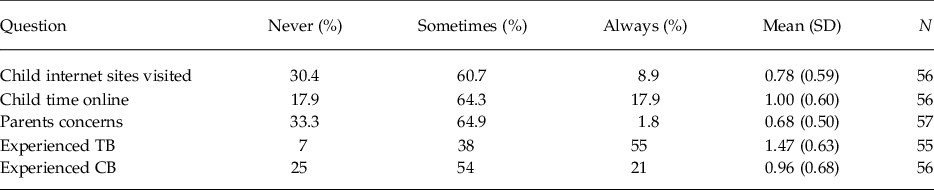
TB was much more frequently inquired about than CB as part of standard assessment, with 93% of clinicians always or sometimes asking about it. A lower proportion of participants reported that they always asked clients about CB (21%) than TB (55%) as part of their routine assessment practice. A higher rate of respondents (25%) stated they never ask about CB than TB (7%). A similar proportion of respondents indicated that they sometimes or always asked about internet sites visited by clients (69.6%) and parental concerns about their child’s internet use (66.7%). A larger proportion of respondents sometimes or always asked about the amount of time children spent online (82.2%). 30.4% of respondents stated they never asked about internet sites visited by clients and 33.3% never ask about parental concerns regarding internet use (33.3%). See Table 3.
Participants routine assessment queries in relation to child and parent internet use

Attitudes
The overwhelming majority of respondents (N = 59) felt CAMHS staff have a role in managing CB (95%) and promoting IS (97%) and stated they wanted training in both managing CB (97%) and promoting IS (93%).
Staff support and training needs
Cyberbullying
In exploring what would help CAMHS staff to support clients who have experienced CB, the highest percentage of participants indicated their preference was for information/resource packs about CB to give clients and their caregivers about CB (90%). A high proportion of participants reported their preference for training on ways to help respond effectively to CB for themselves as clinicians (81%). Training for children and adolescents on positive online behaviour and good digital citizenship skills in managing CB (70%) was also a highly endorsed preference. A similarly high percentage of participants reported they would find the following helpful in managing CB; education/information on the findings of international research on CB (83%), school anti-bullying policies that address CB and social media use (75%) and guidelines on issues related to CB incorporated into child protection guidelines (78%). Findings are summarised in Fig. 2a.
Participant support for helping clients who have experienced cyberbullying.

Internet safety
In exploring what would help CAMHS staff support clients who engage in risky internet behaviours, the highest percentage (86%) indicated their preference for information/resource packs to give clients and their caregivers about IS. A similarly high frequency of respondents endorsed training in practical strategies for dealing with concerns about internet activity (78%) and collaborative approaches to managing risky internet behaviour, involving the school, family, community and mental health service (73%) as helpful. A slightly lower frequency (63%) reported that training for young people on positive online behaviour and digital citizenship skills might be helpful for dealing with risky internet behaviours. This was also slightly lower than when asked the same question in relation to managing CB. Findings are summarised in Fig. 2b.
CAMHS staff support for helping clients who have engaged in risky internet behaviours.

Discussion
The aim of this study was to examine CAMHS staff perceived knowledge, practice and attitudes towards CB and IS and their training needs, within a CAMHS context. This study found that clinicians perceived a high degree of risky internet behaviour and CB among youth they see in CAMHS. This study identified a wide range of strongly endorsed perceived adverse psychological effects of CB, including social withdrawal, low self-esteem, anxiety, self-injurious behaviour and suicidal thoughts. This is in line with previous research identifying negative effects of CB victimisation on mood, anxiety and suicidal ideation (Bottino et al. Reference Bottino, Bottino, Regina, Correia and Ribeiro2015; John et al. Reference John, Glendenning, Marchant, Montgomery, Stewart, Wood and Hawton2018; Biddle et al. Reference Biddle, Derges, Goldsmith, Donovan and Gunnell2018; Patchin & Hunduja, Reference Patchin and Hinduja2010). However, the results of this study must be interpreted with caution given they are speculative findings based on clinician perception and a small sample.
The overwhelming majority of participants felt CAMHS staff have a role in managing CB and promoting IS and wanted training in both. This willingness to access available training and supports to facilitate their work with young children is reflective of the findings of Clarke et al. (Reference Clarke, Chambers and Barry2017). Although 55% of participants in this study felt moderately knowledgeable about CB, more than one-third felt lacking in knowledge and 35% felt ill equipped to advise parents on IS. This is somewhat better than previous findings that over 50% of mental health professionals did not feel adequately equipped to manage clients’ problematic internet experiences (Mieczynski, Reference Mieczynski2011). Although it is a positive finding in this study that over half of participants felt moderately knowledgeable about CB this leaves a significant proportion who do not. It is important that adequate training is provided so that insufficient knowledge of information and communication technology does not prevent parents, or clinicians from providing guidance to young people to safely navigate cyberspace. This may help address different intergenerational dynamics regarding internet use to reduce barriers to effective communication between young people and clinicians about CB and IS (Dennehy et al. Reference Dennehy, Cronin and Arensman2019).
In terms of resources and training needs, the majority of participants indicated their preference for information/resource packs to give clients and caregivers training in responding effectively to CB and risky internet behaviour. Training for children and adolescents on positive online behaviour and good digital citizenship skills was also a highly endorsed preference for both CB and IS. A high frequency of respondents endorsed training in practical strategies for dealing with concerns about internet activity and collaborative approaches to managing risky internet behaviour, involving the school, family, community and mental health service as helpful. This is similar to previous research identifying school principal’s desire for assistance in relation to CB; training, resources, guidance and information (Corcoran et al. Reference Corcoran, McGuckin and O’Moore2011). Two-thirds of participants reported sometimes or always asking about CB as part of their routine assessment practice. This is a positive result in terms of gathering information as part of assessment as well as modelling open communication about CB with parents and young people. Directing parents to online resources and educational materials about CB/IS may be beneficial. A dynamic interactive approach involving young people and their parents in discussion and research surrounding CB is more likely to underpin training and practice that is in keeping with the lived experience of young people. CAMHS clinicians are well placed to present evidence based information to parents and their children regarding safe online behaviours. McGuckin et al. (Reference McGuckin, Cummins and Lewis2010) caution that if you do not understand cyber safety you cannot teach it. In light of the current findings, CAMHS staff may benefit from training in CB and IS to ensure they have the necessary competencies to support clients online behaviour.
This is the first study examining the perceptions of CAMHS clinicians in Ireland on CB and IS. The small sample, despite a high-response rate, limits generalisability to other services and precluded the use of inferential statistics. A further limitation is that there is no unified definition of CB across studies reviewed; each paper may code this differently. The study is also limited by the reliance on subjective responses by staff. However, it has identified some modifiable factors that may support youth and families to address the unintended consequence of internet availability. Findings indicate the need to upskill CAMHS in this area and develop a standardised approach to assessment in relation to CB and IS. However, CAMHS have a limited role in addressing CB which must also be addressed in schools, for example, anti-bullying policies.
Professionals who work in CAMHS occupy a vital role in providing comprehensive care to children and families by identifying needs, areas of knowledge deficit and providing education. However, CAMHS staff exploring and advising on IS may be venturing into an area of limited experience and knowledge. This study identified a need and a willingness to develop the competencies of CAMHS teams in addressing CB and IS as part of their routine practice. Findings have implications for developing resources and training in CB and IS for clinicians, young people and caregivers in CAMHS services. Further research, both quantitative and qualitative is needed which may benefit from self-report data from children and adolescents. Future research may also benefit from exploring the reasons young people may have for not disclosing CB or risky internet behaviour to adults in their lives so that these barriers can be addressed.
Conflicts of interest
The authors have declared that they have no competing or potential conflicts of interest.
Ethical standards
The authors assert that all procedures contributing to this work comply with the ethical standards of the relevant national and institutional committee on human experimentation with the Helsinki Declaration of 1975, as revised in 2008. Ethical approval for this study was granted by the St. John of God provincial ethics committee.
Financial support
This research received no specific grant from any funding agency, commercial or not-for-profit sectors.
Acknowledgements
The authors would like to thank all the Child and Adolescent Mental Health Service clinicians who took part in this study.