INTRODUCTION
One afternoon at my field site, a public arts high school in the San Francisco Bay Area, I was hanging out with a few students by their lockers, where they often met to kick hacky-sack, play music, and decide on after-school plans. Trevor,Footnote 1 a guitar student who spent much of his free time producing hip hop music, got word that his ride was there to pick him up. He picked up his backpack, exchanged handshakes with a few of us, and slowly made his way down the hallway to the double doors. A friend of his, jokingly offended that she didn't receive a personal goodbye, shouted loudly after him, “How you gonna do that, bro? Just leave without a goodbye?!”. Trevor maintained his slow pace toward the doors, not stopping until he had reached the end of the hallway, where he stood still for a beat, then turned slowly and deliberately and gave her a subtle upward head nod. Without a word, he turned back towards the doors and left. Their interaction was playful, and knowingly performative on Trevor's part. But it was also an instance of Trevor enacting ‘chill’, a locally relevant affect that students displayed through both linguistic and bodily practice at the high school.
This article examines the entanglement of such linguistic and bodily practices as they relate to the circulation of affect. This is in part because ‘it is impossible to utter a sentence without coloring the utterance with some kind of perceivable affect’ (Goffman Reference Goffman1978:813). Manifestations of affect are not simply ephemeral displays of emotional states, but rather indexical cues in a broader stylistic landscape that includes attitudes, moods, and emotions (Ochs & Schieffelin Reference Ochs and Schieffelin1989; Eckert Reference Eckert2010, Reference Eckert2019). Nor are emotions individualized experiences detached from social meaning-making. Affect courses through the interactional moments wherein we produce and interpret stylistic variation, and in doing so it constitutes and reflects both conventionalized displays of emotion as well as the ideological rendering of styles and personae; Trevor's departure in the vignette above is not simply a reflection of his mood in the moment but part of a broader performance of his style, through which chill affect circulates and is made meaningful. Moreover, as I demonstrate here, affect is interwoven with students’ ideological positioning within the political economy of the school.
AFFECT, PERSONAE, AND THE BODY
That affect is central to sociolinguistic style is particularly evident when considering how personae constitute the semiotic landscape (Agha Reference Agha2005; Coupland Reference Coupland2007; Moore & Podesva Reference Moore and Podesva2009; D'Onofrio Reference D'Onofrio2018). As abstract, conventionalized, and ideological representations of social types, personae invoke particular attitudes and emotions. The affective qualities of a given persona are reflected and enacted via sociolinguistic and non-linguistic signs, as when mock white girl is performed using creaky voice and uptalk, alongside her Starbucks cup, blonde hair, and vapid and superficial affect (Slobe Reference Slobe2018). Likewise, the prototypical surfer (bro/dude) is not simply defined by his youthfulness, gender, coastal residence, and the social-athletic practice of surfing, but by the affective qualities of being laidback and easygoing (Pratt & D'Onofrio Reference Pratt and D'Onofrio2017). Even beyond abstract representations of personae, Starr, Wang, & Go (Reference Starr, Wang; and Go2020) contrast the calm and professional personae enacted in Chinese ASMR (Autonomous Sensory Meridian Response) videos with the ‘amateur camgirl’ eroticized personae in explicitly sexual ASMR videos. Notably, ASMR performers use breathy voice and limited pitch range, dress conservatively, focus on hand gestures like tapping, and are associated with a calm and relaxed affect, while the sexualized ASMR videos are consistent with Chinese sajiao style, characterized by high pitch, fluctuations between voiced and whisper phonation, sexualized clothing and posture, video framing of the mouth, and petulant, aroused affect.
Other scholars have explored the affective meaning-potential of sociolinguistic signs in situated contexts, albeit without explicit focus on the body. In an ethnography of Latina gang girls in Northern California, Mendoza-Denton (Reference Mendoza-Denton2011) emphasizes that one speaker, Babygirl, uses creaky voice quality to display her tough, hardcore persona. And in her ethnography of pre-adolescents, also in Northern California, Eckert (Reference Eckert2010) shows how a young girl named Collette uses auditorily backer variants of GOAT and PRICE to perform ‘attitude’. Kiesling (Reference Kiesling2018) demonstrates that an affect of ‘masculine ease’ emerges among white, cis, hetero fraternity brothers through interactional moments of stancetaking, where exhibiting low-investment is associated with masculinity. In each of these cases, affect circulates via linguistic performance, and simultaneously reflects and reproduces the ideological orientation of the communities of practice.
What's more, affect underlies insights on sociolinguistic practice even when not explicitly analyzed as such. Eckert's (Reference Eckert1989, Reference Eckert2000) jocks and burnouts are characterized by generally positive and negative affect, respectively, which correspond to social practices like smiling (the jocks do more of it) and the conventionalized meanings of sartorial tendencies (pastels on jocks, black and leather on burnouts). The goofy affect of Bucholtz's (Reference Bucholtz1999) nerd girls aligns with their commitment to ‘randomness’, used to deliberately situate themselves against the dominant affective prescription that student groups take themselves ‘seriously’. More recently, Calder (Reference Calder2019a,Reference Calderb) describes SoMa drag queens’ variation in the frontness of /s/ to index either fierceness in their drag persona or ‘sissy’ in non-drag persona. Though not explicitly stated, I see these analyses as reflecting the ever-present circulation of affect in the social landscape.
Recent work in sociolinguistics and linguistic anthropology demonstrates that linguistic and bodily practices are indexically intertwinedFootnote 2 (Hall, Goldstein, & Ingram Reference Hall, Goldstein and Ingram2016; Bucholtz & Hall Reference Bucholtz, Hall and Coupland2016; Reyes Reference Reyes2017; Pratt & D'Onofrio Reference Pratt and D'Onofrio2017; Calder Reference Calder2019a,Reference Calderb; Pratt Reference Pratt2020; Smalls Reference Smalls, Alim, Reyes and Kroskrity2020; Starr et al. Reference Starr, Wang; and Go2020). And the expression of affect is popularly imagined to be an embodied phenomenon; posture, gait, and facial expressions are taken to display emotions, moods, and attitudes. Such an integrated view of language and body is compatible with Bourdieu's (Reference Bourdieu1977, Reference Bourdieu1978) notion of the habitus: the socialized, embodied dispositions that shape perception and action, and which reproduce social structure. Though Bourdieu's conception of the habitus leaves little room for agency, de Certeau (Reference de Certeau1984) and Giddens (Reference Giddens1984) emphasize that social practice always involves agentive appropriations of existing signs. This ongoing practice invites modification—and thus novel semiotic interpretations—in each instance of reproduction. Thus social actors not only reproduce but also subvert and modify the social order as they appropriate it in everyday interaction. Merleau-Ponty's (Reference Merleau-Ponty, Dreyfus and Dreyfus1964) account likewise includes affect as habitual, arguing that emotions are not abstract internal states but rather ‘types of behavior or styles of conduct which… exist on this face or in those gestures, not hidden behind them’ (Reference Merleau-Ponty, Dreyfus and Dreyfus1964:52). I draw on such perspectives here, emphasizing the entanglement of language, body, and affect in social practice.
THEORIES OF AFFECT
Though the ‘affective turn’ in social theory was not named as such until quite recently (e.g. Clough & Halley Reference Clough and Halley2007), scholarly work on affect goes back centuries. Writing in the seventeenth century, Spinoza (Reference Spinoza and Curley1985) described affect as something produced by a body in interaction with another body. Deleuze and Guattari define it similarly as the capacity to affect and be affected (see Massumi Reference Massumi, Deleuze, Guattari and Massumi1987), and more recent work draws on this tradition in describing affect as a pre-social bodily phenomenon (e.g. Massumi Reference Massumi2002; Thrift Reference Thrift2004, Reference Thrift2008). Such approaches have been critiqued on the grounds that the experience of the body is itself mediated by the social, and thus cannot be relegated to a pre-social realm. Similarly controversial is Tomkins’ (Reference Tomkins1962) psychological exploration of affect, in which he classifies emotional states into positive or negative affect (e.g. enjoyment, excitement vs. anger, disgust), ultimately advocating that ‘optimal’ mental health involves maximizing positive affect and minimizing negative affect. Tomkins’ ‘affect programs’ (later popularized by Paul Ekman as ‘basic emotions’) describes a small set of innate emotions, a perspective that remained prominent in the study of emotion in psychology well into the 1990s. Though this work has been widely critiqued for trivializing the social and environmental factors that shape the experience of emotion,Footnote 3 the basic emotions paradigm has persisted in mainstream notions of human emotional experience.
Social psychologist Margaret Wetherell (Reference Wetherell2015) advocates that practice theory be extended to ‘affective practice’, and critical theorist Sarah Ahmed (Reference Ahmed2004b) emphasizes that affective value circulates through social relations in ‘affective economies’. I join others (e.g. Leap Reference Leap2018; Kiesling Reference Kiesling2018; Milani & Richardson Reference Milani and Richardson2020) in suggesting that such scholarship speaks directly to sociolinguistic theory. Both take as a starting point that emotions and the body are mediated by the social, arguing against the idea of any biologically innate or pre-social experience of affect. Surveying recent work in psychology, Wetherell reports that affective responses (i.e. emotional cognition) are characterized by plasticity and flexibility, and shaped by cultural and developmental contexts. Further, there is little support for any kind of ‘lower’ or ‘basic’ emotions (e.g. Lewis & Liu Reference Lewis and Liu2011). Wetherell (Reference Wetherell2015:152) insists:
social actors engaged in affective practice are embodied beings for sure, but are also usually sentient, bathed in cultural practice like fish in water, usually reflexive, engaged with others in negotiating their worlds… The unit of analysis for social and cultural research on affect is… the conduct of activities we conventionally recognize as making psychological and emotional sense.
In this view, affect is (re)produced and recognized within social and historical contexts; this allows us to account for both the semi-routinization and also the constant reconfiguration of affective activity, and further, the fact that both representation and perception are shaped by context. Affective practice is thus an assemblage which, like language, derives from past and existing practice and also changes through time.
Sarah Ahmed's The cultural politics of emotion (Reference Ahmed2004a), and subsequent work (Reference Ahmed2004b, Reference Ahmed, Gregg and Siegworth2010), addresses the social life of affect. Similarly rejecting the idea of emotions as inner experiences that move outward, she argues that affect moves among signs, subjects, and objects, and in doing so mediates between the psychic and the social, and between the individual and collective (Reference Ahmed2004a:119). In examining the idealized object of the ‘happy family’, she emphasizes how normative societal orientations are tied up with shared affective evaluations:
Groups cohere around a shared orientation toward some things as being good, treating some things and not others as the cause of delight. If the same objects make us happy—or if we invest in the same objects as being what should make us happy—then we would be oriented or directed in the same way. (Ahmed Reference Ahmed, Gregg and Siegworth2010:35)
Ahmed's concept of affective economies emphasizes that affect is both relational and dynamic, circulating between signifiers, and gaining value in the process of circulation (i.e. drawing on Marxist theories of capital, where commodities gain value only through their circulation). A happy object—like the ‘happy family’—gains affective value by virtue of shared orientation to it as something that produces social good. For Ahmed, the movement of affect (here, happiness) between signs and subjects is not only social, but a historical and ideological process. It is this emphasis on the circulation of affect, rooted in ideology, that pertains to a practice-based account of affect as offered by Wetherell.
A growing body of scholarship in sociolinguistics engages with affect on these terms, in analyses of discourse, interaction, and performance. Kiesling (Reference Kiesling2018) incorporates Wetherell and Ahmed's scholarship in his examination of the interlocking practices of affect and stancetaking, establishing first that language is embodied and affective rather than purely denotational. In analyzing an interaction among fraternity men at a Pittsburgh university, he argues that moments of low-investment stance are enacted to produce a broader affect of ‘masculine ease’. Though my focus here is on the ideological circulation of affect rather than stancetaking, these two approaches are not unrelated, and both Kiesling (Reference Kiesling2018) and Starr et al. (Reference Starr, Wang; and Go2020) substantively theorize affective stance in interaction and performance, respectively. However, Kiesling (Reference Kiesling2018) describes stancetaking as a social practice that produces affect—‘stancetaking is a practice of talk and text in interaction, while affect is an effect of such stancetaking’ (Reference Kiesling2018:192)—and suggests that stancetaking ‘changes the affects of both the speakers and the conversations they engage in’ (Reference Kiesling2018:192). Rather than viewing stancetaking as fundamental to affect, or viewing affect as something a speaker or conversation possesses, I follow Ahmed's conceptualization of affect as circulating within social practice and discourse, as it both reflects and reproduces the ideological landscape (on affect and performativity, see e.g. Ahmed Reference Ahmed2004a:113).
Milani (Reference Milani2015) examines the latent political tensions between middle-class, liberal activists focused on appealing to the state for LGBTI rights, and primarily Black queer and trans women who staged a die-in at Johannesburg Pride in 2012 to assert that the state has never protected them, and to counter the depoliticization of Pride more generally. In addition to analyzing the embodied affective performance of the die-in, Milani demonstrates how liberal event organizers’ responses layer discursive frames of rationality, morality, and affect to enforce ‘orderly’ activism, thus reproducing bourgeois logics of social order and ‘decency’ in their attempts to delegitimize the protest-within-a-protest. Ferrada, Bucholtz, & Corella (Reference Ferrada, Bucholtz; and Corella2019) are likewise interested in the ideological manifestation of affect, and focus on affective agency, defined as the ‘micropolitical, quotidian bodily encounters’ of affect which constitute social formations (McManus Reference McManus, Maiguashca and Marchetti2013:137). Through situated ethnographic analysis of an after-school program primarily serving Latinx students, they demonstrate how one student's reaction to linguistic racism is saturated with affect—including physiological displays of upset (crying, anxious laughter), embodied interactions with friends, and the audible emotion in one's voice. The latter manifests during a student's impassioned presentation of a public campaign against linguistic racism, and the authors describe this moment in the narrative trajectory as the student having ‘mobilized affect’ to deliver their ideological argument. Like Ferrada and colleagues (Reference Ferrada, Bucholtz; and Corella2019), here I focus on the semiotics of affect in everyday linguistic and bodily practice among adolescents, building on their assertion that ‘young people are affective experts, particularly racialized and other sociopolitically subordinated youth, whose affective experiences are daily negated in hegemonic spaces such as schools’ (Reference Ferrada, Bucholtz; and Corella2019:2). I focus on the circulation of affect, bodily, and sociolinguistic signs within the ideological landscape and affective economy of the high school.
THE SEMIOTICS OF AFFECT AT CAPA HIGH SCHOOL
My analysis centers on a public, arts-focused high school in the San Francisco Bay Area, which I call Creative and Performing Arts (CAPA), where I conducted ethnographic fieldwork during the 2015–2016 academic year. Students at the high school split their time between academic classes and one of twelve arts disciplines, such as orchestra, dance, or visual art. Unlike traditional high schools, ‘the arts’ (i.e. high-brow artistic pursuits) figure prominently in the institution's distribution of material resources and its system of cultural value. CAPA students are encouraged to orient either to college or to a professional career in the arts, and are positioned (and position themselves) with respect to this. I spent my time primarily with juniors and seniors (aged fifteen to eighteen years old), and my description of the social landscape draws broadly on my interactions and observations as recorded in daily fieldnotes.
My positionality at the school was informed by my positionality in society more generally: as a cisgender white woman, at the time affiliated with a nearby elite institution (Stanford University). Several of the students jokingly called me ‘Stanford’ instead of my name, and this affiliation set particular expectations about my material conditions (e.g. students were surprised that I did not own a car and instead took the bus or rode a bike to get to school). And though I was in my late twenties at the time of fieldwork, when I first arrived many students assumed I was a fellow high schooler. In addition to whatever physiological features they drew on to make that assessment, this likely resulted from my intentionally informal clothing style (cf. Bucholtz Reference Bucholtz2010).
Throughout my fieldwork, affect emerged as locally salient, specifically with respect to energy level. Students commented on their peers’ behaviors as high-energy, loud, or excitable on the one hand, or chill or low-energy on the other. This discourse was particularly salient among young men in the partying scene, and as such the present analysis focuses on those twelve cisgender male high school juniors. These discussions surfaced with relation to artistic and academic stereotypes, as well as orientations to the high school as an institution. Being chill had cultural value for everyone, which is perhaps unsurprising given the positive evaluation of chill affect among young people more generally (e.g. saying someone ‘has no chill’ is typically a negative or teasing evaluation). Being too high-energy was routinely critiqued; as one senior describes in (1).Footnote 4
(1) There's people who – are annoying, when they talk to each other… u- voices, the stuff they talk about, uh inappropriate volume control, uh inappropriate places to talk about things, just all around like th- being a pain in my ears (hhh).
But the same analysis was applied to academic orientation as well; taking school seriously was described as not chill, and was even linked with a perceived performative happiness or group harmony.
(2) And the people that are in like APFootnote 5 classes… it's just like d- elevated, you know? It's like “Hi, I'm great, all the time. I swear to God. This is awesome. We love each other.” And I'm just like “Wait, what?” Like it's fine. It's gonna be okay. (hh) Everyone chill (hhh) you know? Like, it's just like the energy level's different. Like I think you're just like a lot more chill.
In addition to negative evaluations of high-energy style, many students labeled themselves as low-energy.
(3) Eddy: Um there are a lot of people who have a lot of energy and they just… they're just loud.
Teresa: How do you feel about that, where do you fit into that?
Eddy: Um I'm pretty low energy, I'm pretty tired. Just like all the time.
Trevor, introduced in the opening anecdote above, self-describes as low-energy and connects it explicitly to his musical style. In our discussion of one of his new bands he explained to me:
(4) I don't know we're kinda trying to be more of a grungy math rock cuz you know we're not like, high-energy kinda people. So I don't know you gotta express yourself in the music.
In contrast, other young men in the partying scene adopted the qualities of being high-energy or loud as a positive asset. Brad explained:
(5) You meet me, I'm loud, I'm in your face… So when I go to parties and someone is e- you know a little – little gone they'll be like “[Brad]!” and I'll be like “Yo, yo, yo, yo, yo” I'll be like super like internet-y, like super like loud and, bring like some energy into the party.Footnote 6
But perhaps the most explicit discussion of the contrast came when I asked Reuben what he thought.
(6) I'm definitely a loud (hhhhh) like I'm definitely a loud one. […] I guess there's like ‘loud’ which is our group, we're really loud, then there's ‘chill’ which is like the – like [Trevor] and [Ranch], they're like – and [Michael] – they're just kinda like just chilling around and, uh.
Notably, though Reuben describes his group as loud and distinguishes a chill group including Trevor, Ranch, and Michael (all of whom are in the current sample), they all went to the same parties and hung out together at school. Later in the interview Reuben discusses marijuana, the label ‘stoner’, and their connection to chill affect.
(7) Reuben: like we smoke weed a lot I guess, but like I don't think s- we're stoners. Like stoners is like a way of talking and a way of acting […] like [Ranch], I think he's just like a stoner like [Probe] is like a stoner […]
Teresa: When you say [stoners] like walk a certain way what does that mean?
Reuben: I mean just like, you know like you float around like you kinda like you're always in the clouds.
In conjuring the stoner as a way of talking, acting, and moving, Rueben reflects the entanglement of linguistic, bodily, and consumption practices in everyday persona construction.
These energetic styles were apparent in everyday practice as well, as when I attended a concert of a psychedelic rock band that a few of the students were in. Roughly thirty students filled up the small community space. Once the band began, three young men were central in instigating and maintaining mosh activity for the duration of the show, dancing erratically and deliberately colliding with each other. In contrast, several other young men stood at the back of the small room for the entirety of the show, hardly moving despite the fast pace of the music. Particularly in the small space, this stark difference between bodily stillness and performatively uncontrolled movements reinforced the distinction between energetic orientations that I observed in the school.
SUPRASEGMENTAL VARIATION, HEXIS, AND ICONIZATION
Across levels of language, suprasegmental features are perhaps most strongly ideologically linked with emotional and affective states (see Eckert Reference Eckert2019). The present analysis looks at the occurrence of two suprasegmental features: creaky voice quality and speech tempo. Creak's affective utility has been widely discussed: speakers use it to display orientations like disengagement (D'Onofrio, Hilton, & Pratt Reference D'Onofrio, Hilton and Pratt2013; Zimman Reference Zimman2015), intimacy (Shaw & Crocker Reference Shaw and Crocker2015; Goodwin Reference Goodwin, Meyer, Streeck and Scott Jordan2017), or toughness (Mendoza-Denton Reference Mendoza-Denton2011), and it occurs in discussions of obligation (Levon Reference Levon, Levon and Mendes2016) and in moments of commiserating (Brown & Levinson Reference Brown and Levinson1987). The indexical indeterminacy of creak likely contributes to its discourse utility (Chun & Podesva Reference Chun and Podesva2010). Speech rate is arguably more straightforwardly enregistered, in the sense that slow speech is often associated with low energy and fast speech with high energy—an interpretation as prevalent in the popular imaginary as it is in academic work. Jacewicz, Fox, O'Neill, & Salmons’ (Reference Jacewicz, Fox, O'Neill and Salmons2009) link speech tempo to social, psychological, and even physical states of the speaker, and their findings reflect stereotyped notions that (US) ‘Northerners’ speak faster than ‘Southerners’ (see also Robb, Maclagan, & Chen Reference Robb, Maclagan; and Chen2004; Clopper & Smiljanic Reference Clopper and Smiljanic2011). This is in turn tied up with language ideologies linked to the imagined slower pace of life in the US South (e.g. Lippi-Green Reference Lippi-Green2012). And in Irvine's (Reference Irvine, Lutz and Abu-Lughod1990) ethnography of Senegalese Wolof speakers, fast and loud speech are iconized as reflective of the lower-status griots’ excitability, in contrast with iconization of the nobles’ calm composure in the form of their slow, quiet speech. Thus the use of speech rate in the performative construction of energetic affect may in fact rely on speakers’ exploitation of corresponding language ideologies.
Likewise, linguistic and bodily forms correlate in ways that align with normative ideas about what high- or low-energy looks and sounds like. Social meanings related to bodily stillness or movement have been linked to speech rate, and also show up in regional stereotypes and conventionalized personae. The Stoner's altered cognitive state (i.e. being high) and the Surfer's laid-back or relaxed attitude conjure a slow speech rate, whereas fast speech rate has place-based associations with a fast-paced urban lifestyle (e.g. New York City) and demeanor-based associations of being anxious or excitable. Though they describe a slightly different axis of energy, namely relaxation versus arousal, Starr et al. (Reference Starr, Wang; and Go2020)'s examination of sensual and sexual affect shows productively how sociolinguistic and bodily practice are integrated in meaning-making. Interestingly, the social meanings associated with creak—among them disengagement, intimacy, toughness, or emotional distance—could correspond with a slew of enregistered bodily cues involving eye contact, posture, and facial expression.
These correspondences across creaky voice quality, speech rate, and imagined bodily practices are at least in part a result of iconization, the process by which a sign comes to appear emblematic of an inherent essence or quality (Irvine & Gal Reference Irvine and Gal2000:37). Because the popular understanding of affect imagines the locus of emotions within the body (e.g. Tomkins Reference Tomkins1962), linguistic and bodily signs like voice quality, speech rate, or body movement can be iconized as indicative of internal energy level, among other things. Linguistic features and bodily tendencies are seen as externalizing that which arises internally, such that creaky voice quality—with its audibly slow, irregular vocal fold vibrations—or slow speech rate, or posture or relative bodily stillness, can be iconized as manifestations of an otherwise internal energy level. Thus a more holistic semiotics of affect can circulate via assemblages of iconized signs.
SPEAKERS AND METHODS
The present analysis includes twelve cisgender young men. This group of young men, like the student body more generally, is heterogenous in terms of racialized identity. My focus on these particular speakers stems from their discursive focus on energy level throughout my fieldwork. And though affect is absolutely tied up with formations of race, and its intersections with gender and sexuality, neither racialized identity nor gender or sexuality was explicitly or implicitly tied to affect by the students, and as such is not specifically addressed here.
Data come from audio and video recordings of ethnographic interviews with students from across artistic disciplines: tech (two), world music (three), band (four), vocal (two), and guitar (one). Interviews average eighty-nine minutes in length, but range from forty-two minutes to two hours and twenty-five minutes. Each interview was recorded using a Sony PCM M-10 digital recorder, at a 44.1 kHz sampling frequency with a bit rate of sixteen. Interviewees wore either an Audio-Technica ATR3350 omnidirectional condenser lavalier microphone, or an Audio-Technica AT831b cardioid (i.e. directional) condenser lavalier microphone. Interviews were transcribed in ELAN (2019) and then phonemically aligned using FAVE align (Rosenfelder, Fruehwald, Evanini, & Yuan Reference Rosenfelder, Fruehwald, Evanini and Yuan2011).
Acoustic analysis of voice quality
To determine the occurrence of creaky voice quality, I conducted an acoustic-auditory analysis of phonation type. Despite the prevalence of acoustic measures of periodicity, hand-coding remains a reliable measure for classifying phonation type more broadly and creak more specifically (see Keating, Garellek, & Kreiman Reference Keating, Garellek and Kreiman2015; Davidson Reference Davidson2020). Creak is an impressionistic label describing a voice quality, while phonation type refers specifically to the nature of the vibration of the vocal folds. Although creak is described as irregular vibration of the vocal folds, any measure of this necessarily conflates multiple outcomes of periodicity: pitch, loudness, and phonation. For these reasons I rely primarily on the hand-coding of creak based on a visual translation (spectrogram) of the acoustic signal (the waveform) using two acoustic correlates of creak: irregular pulses in the waveform (Ladefoged & Maddieson Reference Ladefoged and Maddieson1996) and widely-spaced vertical striations in the spectrogram (Henton & Bladon Reference Henton, Bladon, Hyman and Li1988), indicating low-frequency vibrations.
Based on the force-aligned phone segment boundaries, I hand-segmented the first ten minutes of each interview into syllables, correcting phone boundaries as necessary (n = 22,297 syllables, approximately 1,858 syllables/speaker). Though I initially coded each syllable as exemplifying one of seven voice qualities (creaky, modal, falsetto, breathy, whisper, harsh, or laughing), classifications were subsequently converted to a binary schema of creaky or not creaky, because creak was by far the most prevalent of non-modal voice qualities. All coding was done in Praat (Boersma & Weenink Reference Boersma and Weenink2019).
Acoustic analysis of speech tempo
Speaking rate, pause frequency, and pause duration were measured for each speaker, via an automated Praat script, across intonational phrases (IPs) for the first twenty minutes of each interview (n = 2,672 IPs, approximately 223 IPs/speaker). Speaking rate captures the number of syllables in an IP per duration of the IP in seconds, meaning this measure reflects the ‘frequency of pausing, use of laughter or fillers… [that] define a speaker-specific communication style’ (Jacewicz et al. Reference Jacewicz, Fox, O'Neill and Salmons2009:235). This is in contrast to articulation rate, which aims to isolate articulated speech only by excluding pauses and other paralinguistic activity such as laughter. In addition, following assertions by Goldman-Eisler (Reference Goldman-Eisler1968) that perceived changes in the speech tempo results mainly from frequency and length of pausing, I measure the number of pauses and the duration of pausing for each speaker. Following Kendall (Reference Kendall2009), I measure only turn-internal pauses as opposed to turn-boundary pauses (cf. Mendoza-Denton Reference Mendoza-Denton, Hall and Bucholtz1995). I treat any pause of at least 100 milliseconds as a so-called silent pause (e.g. Kendall Reference Kendall2009). Using measurements obtained by the same automated Praat script, I calculate proportion pause, which captures the ratio of the duration of all pauses greater than 100 ms (within a single IP) per total duration of the IP (in milliseconds).
Video analysis of body hexis
To incorporate hexis, I focused on the (seated) body configuration that individuals return to between gestures or other movement throughout the interview. For each speaker, I coded posture for the first thirty minutes of each interview, using a modified version of the Body Action and Posture (BAP) coding system, developed for the study of emotional expression (Dael, Mortillaro, & Scherer Reference Dael, Mortillaro and Scherer2012). Using a subset of their coding schema that focuses on posture rather than movement, I coded for trunk posture, arm/hand position, and leg arrangement (see Appendix B for further detail). Video coding was completed in ELAN (2019) without audio to avoid any auditory influence on the coding. I then counted the total number of transitions across the coded portion of the interview. I count transitions temporally, such that if a speaker simultaneously rearranged any of the three categories (torso, arms, or legs) in the same moment, the transition count increases by just one. Though the correlation of bodily movement and linguistic features at specific moments in discourse is an interesting facet of bodily style and deserving of sociolinguists’ attention, here I am interested in the ways that relative seated stillness might correspond with the performance of energy level.
Statistical analysis
A mixed-effects logistic (binomial) regression was constructed using the lme4 package (Bates, Maechler, Bolker, & Walker Reference Bates, Maechler, Bolker and Walker2014) in R (R Core Team 2017), using creaky/not creaky as the dependent variable. Two suprasegmental factors were included as controls for both voice quality and speech tempo measures: phrase position (measured as temporal percent into phrase), and logarithmic phrase duration. The latter measure reflects the tendency for creak to occur phrase-finally for physiological (i.e. airflow) reasons (e.g. Henton & Bladon Reference Henton, Bladon, Hyman and Li1988). Log-transformed measures of speech rate, proportion pausing, and the number of posture transitions were included as fixed effects. Each of these factor groups was tested for model fit through a comparison of the residual sum of squares via the anova function in R. Logarithmic measures of posture transition and proportion pausing were found to significantly improve model fit (both p < .01 or less), but not speech rate; the final model reflects this. Random effects (all intercepts) were included for speaker and lexical item.
QUANTITATIVE RESULTS
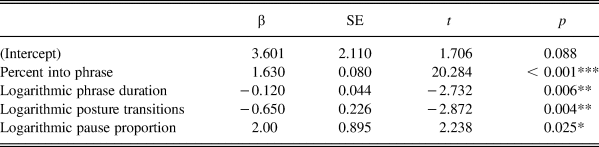
The logistic regression summarized in Table 1 shows that linguistic factors condition the creakiness of a given syllable. Notably, number of posture transitions and pause rate are both significant predictors of voice quality. The log-transformed count of posture transitions correlates negatively with creaky voice quality, such that a speaker with a low number of posture transitions throughout the interview is more likely to produce creaky syllables. Additionally, pause proportion is correlated positively with creaky voice quality, meaning that speakers who do more phrase-internal pausing are more likely to produce creaky syllables.
Summary of regression model predicting voice quality (creaky or non-creaky).

Percent into phrase is a significant predictor of voice quality such that higher-percentage syllables (i.e. closer to the end of the IP) are more likely to be creaky (Henton & Bladen Reference Henton, Bladon, Hyman and Li1988; Ogden Reference Ogden2001). Phrase duration is also a significant predictor of voice quality, such that longer IPs correlate negatively with creak (i.e. shorter phrases are more likely to contain creaky syllables). Given the expectation that creak occurs more often phrase-finally because the airstream weakens throughout an intonational phrase, we might expect longer phrases to be more creaky. This suggests that the speakers here may be using creak outside of physiologically conditioned contexts, though it could also result from a high number of very short phrases being entirely creaky.
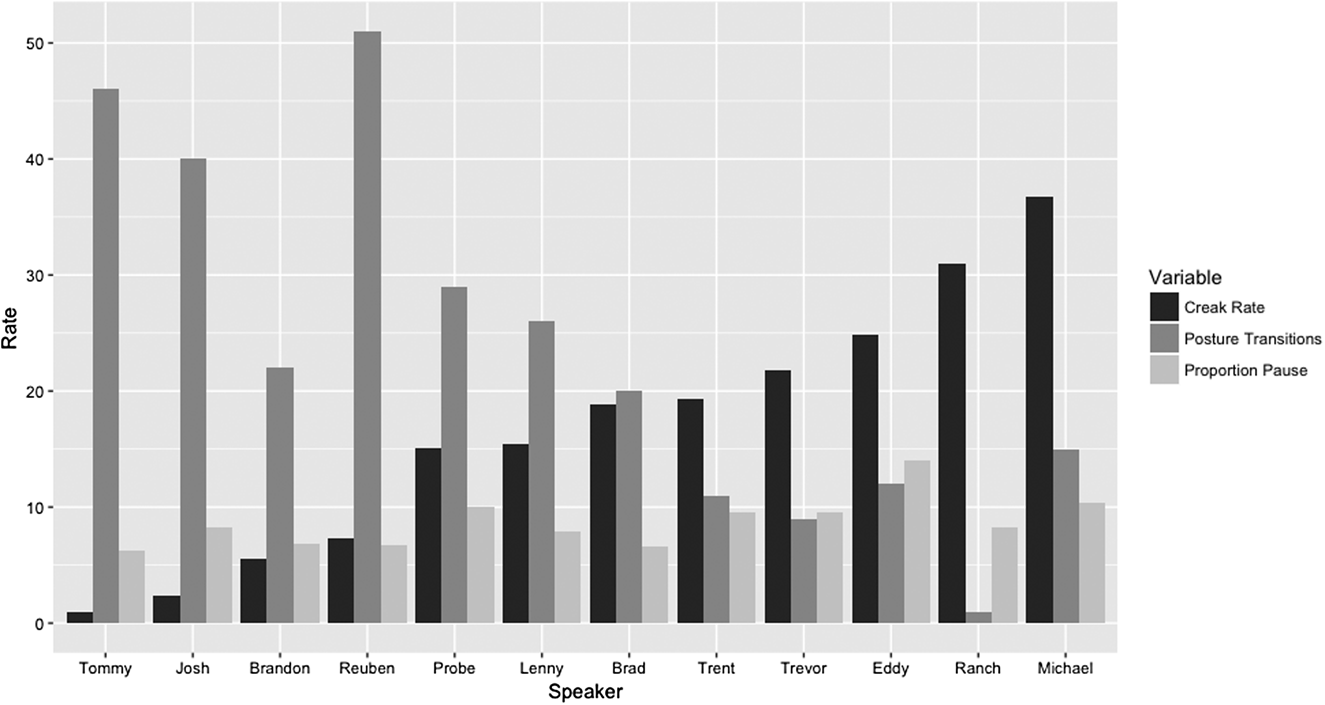
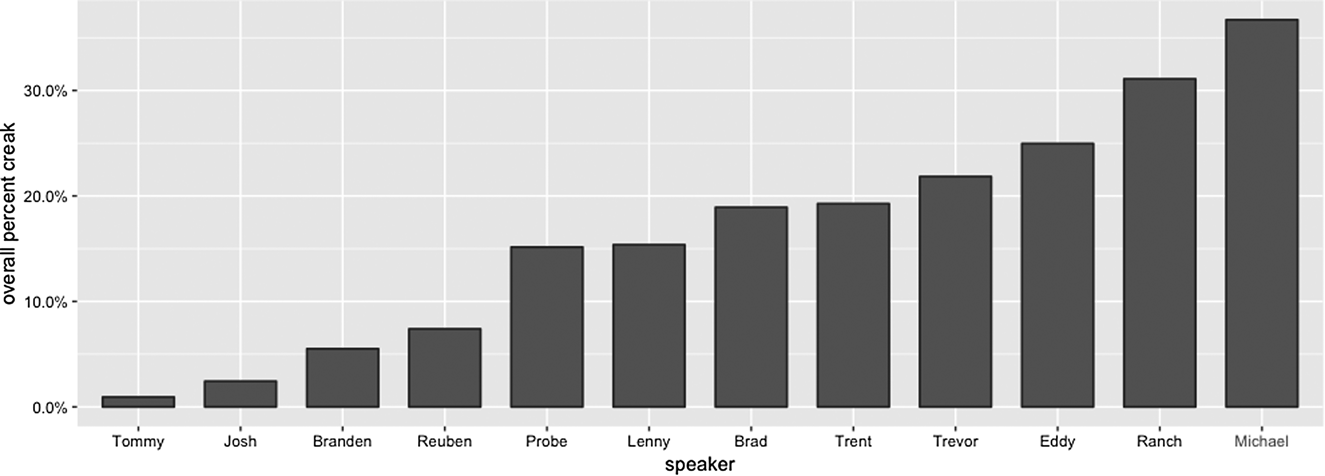
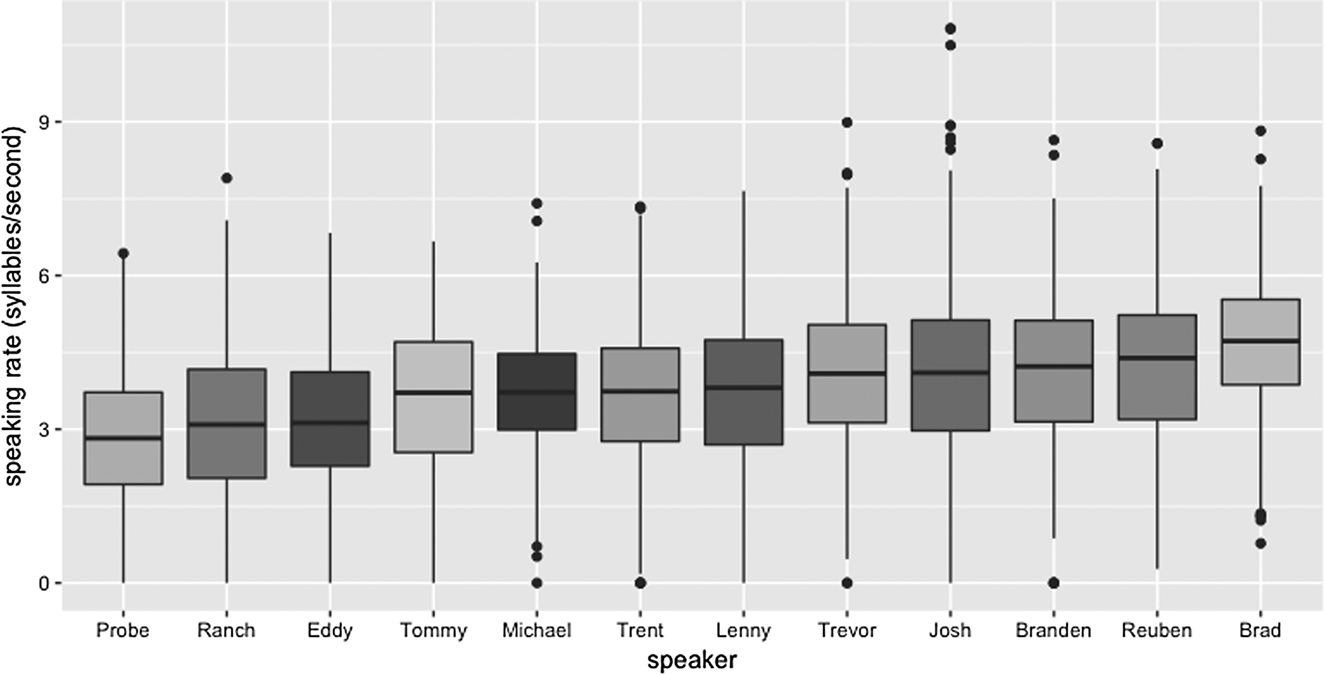
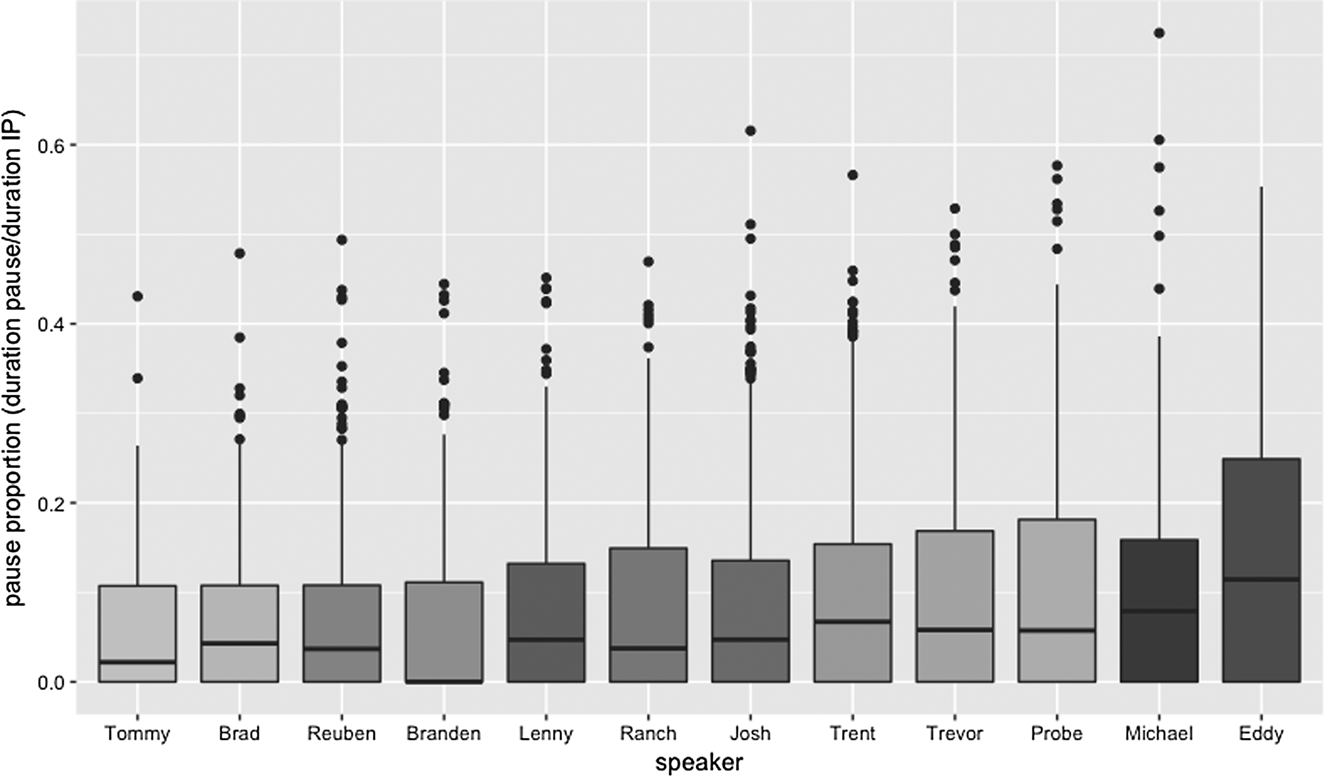
Figure 1 interprets these results holistically, using overall percentage of creaky syllables as a measure of voice quality. As overall percent creak (black bars) increases from left to right, posture transitions generally decrease (dark gray bars). Though slightly more difficult to discern given the proportional representation, proportion pausing (light gray bars) also increases as posture transitions decrease. Stand-alone plots of creak, phrasal speech rate, and phrasal pause proportion are included in Appendix C.
By-speaker plot of creak rate, posture transitions, and pause rate, ordered by increasing creak rate.

AFFECT, BRICOLAGE, AND POLITICAL ECONOMY AT CAPA
Figure 1 demonstrates general trends born out in the regression model. But in everyday practice, styles are not fixed sets of sociolinguistic features occurring at given rates. Social actors (re)combine sociolinguistic and bodily signs in the ongoing process of bricolage (Hebdige Reference Hebdige1979), using semiotic resources to construct and interpret styles that reflect and reproduce their positioning in the political economy.Footnote 7 Hebdige maintains that bricolage is always ideological, a process through which ‘mundane’ objects like clothing (or linguistic forms or bodily posture) take on symbolic meaning. Like Ahmed's notion of affective economies, whereby the circulation of affect creates its value, Hebdige argues that the sources of value for stylistic signs are simply their use by a particular group. Thus styles, the affective value of their constitutive signs, and the social actors who construct the style are all emergent in a co-constructive process. No single component is fundamental; rather, through its circulation a semiotic assemblage becomes legible as a style. In Ahmed's (Reference Ahmed2004a) terms, it is through such circulation that affect ‘sticks’ to signs, subjects, and objects (despite our semantic conventions that represent emotions as taking residence in/on subjects or objects, e.g. ‘a happy person’, ‘a sad book’). Affect, like style more generally, is not the property of a subject or object but rather emergent through ongoing signification. In this section I aim to complicate the quantitative patterns above by tracing affect along students’ orientations to the political economy of the school, their future career trajectories, and class writ large.
One of the most salient manifestations of class at CAPA concerned students’ post-secondary plans. Some students planned to attend a four-year college or university, and saw their art as a hobby that they may or may not continue practicing after high school. Others hoped to pursue their art more fully after high school, either through post-secondary study or an attempt at professional work in their respective industry. Many more were unsure but intended to at least ‘try’ college, taking classes part-time at one of several community colleges in the area and working gigs related to their artistic training. The appeal of either of these options was as intricately wrapped up with students’ academic subjectivity (i.e. how they and the institution saw their academic potential) and class-based understandings of these life paths, as it was their relative interest in pursuing their art. The students who planned to attend college were generally academically and institutionally engaged, taking multiple AP classes and holding student office. They saw college as the attractive choice for both financial and cultural reasons: the normative college experience sounded fun, would be within their perceived academic reach, and was feasible given their family's finances. And like all of the students I spoke with, they recognized that it would be nearly impossible to support themselves solely with their art, and were well aware of the dangers of student debt if they chose a field of study that left them without job prospects. It is perhaps not surprising that the students who did not see college as an option were the same students who had never seen themselves as ‘good at school’, and that these students were driven to pursue non-academic careers in the arts on their own terms.
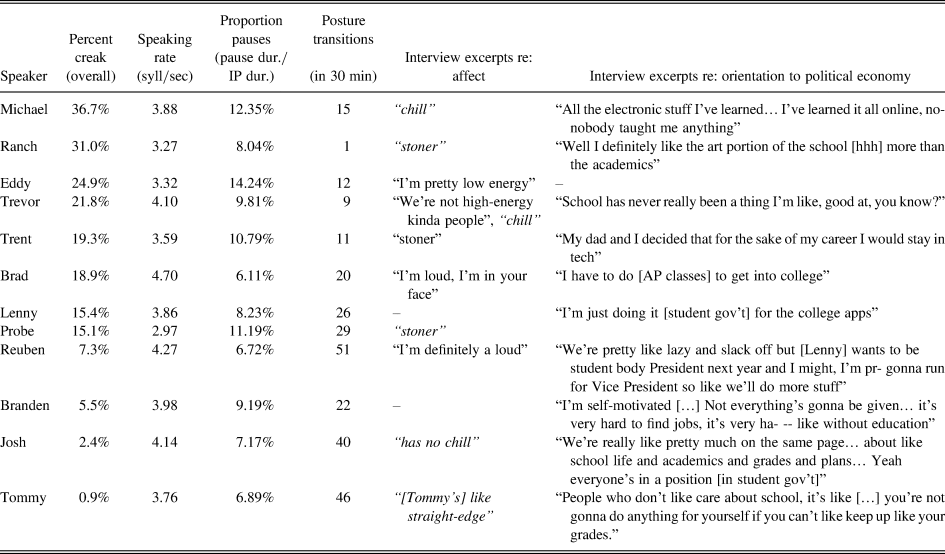
Table 2 lists by-speaker measures for each of the stylistic features analyzed, ordered by decreasing creak rate, along with representative interview excerpts regarding affect and political economy (I treat the label ‘stoner’ as connoting chill affect, per interview data). Michael, for example, produces the highest rates of creak and has the second-highest pause rate. He is one of the speakers Reuben labels chill, and much of my interview with him concerned his general disalignment with the school. Definitively not interested in college, Michael spent free time teaching himself electronic music production and critiqued the school's inability to train students in marketable skills.
(7) It's like it's like all music it's just, it's very hard to get a job, you know? Especially like right out of high school if you don't wanna go to college, you know? […] I'm not that academically like interested… I just go home and like try to do – try to get good at this craft.
By-speaker rates of creak, speech tempo, and hexis (ordered by decreasing creak rate). Excerpts in italics were uttered by others in the sample about that speaker; otherwise, excerpts are uttered by the speaker.

Like Michael, many students spent hours practicing their ‘craft’ outside of school. These students saw college in much the same way they saw high school academics—boring and irrelevant to future work prospects. The artistic projects they pursued outside of school were truly independent; they received no academic credit for this work. They wanted to develop skills, largely absent from CAPA's curriculum, that might help them launch careers in music production, tattoo art, or photography.
Trevor and Trent in the current sample were independently oriented like Michael and share a similar stylistic pattern. Both have relatively high rates of creak and low rates of movement throughout the interview (nine and eleven transitions, respectively). Trevor, introduced in the opening anecdote and in excerpt (4), describes himself as ‘not high energy’, and Trent self-describes as a stoner. Neither see themselves as ‘good at school’. Trevor plays in at least three bands in addition to his independent music production work.
(8) I'm much better at performing and playing shows […] The rehearsals are very, uh just ve- very – like, on point. […] We're pretty serious about you know, the craft and everything, you know, writing stuff.
Trent was interested in artistic pursuits outside the school's curriculum, but did have financial support for college. Though not academically engaged, Trent saw the skills practiced in technical theater (‘tech’) as useful because of his interest in cinematography. He spent time outside of school practicing photography, and operated at least two Instagram accounts to showcase different styles of his photography. The sophistication of his two semi-professional Instagram accounts was in stark contrast to the Instagram accounts of his peers, or even his own (third) socially focused account. Trent often proudly showed me the new work he had posted and the positive feedback he received from followers. These independent artistic products are implicated in the circulation of affect, then. In addition to the linguistic and bodily signs analyzed here, chill affect circulated at CAPA between (student-)subjects, their orientation to the school, and artistic products (objects) in the form of independent work.
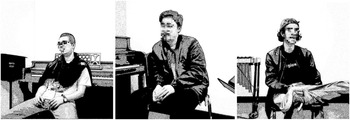
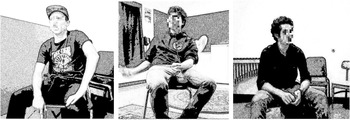
Images of Michael, Trevor, and Trent's most frequently held seated positions are shown in Figure 2 from left to right. Each of them maintains postural stillness compared to their peers, but these sketched video stills highlight the heterogeneity that bricolage permits: various postures co-occur with other features (creak, slow speech rate, relative bodily stillness) alongside students’ discussions of their ideological orientations to school and art. Through its circulation, chill affect sticks to the constitutive signs. In these moments, chill emerges not through formulaic stylistic combinations but rather by virtue of the holistic co-construction of affect and style.
Sketch-converted video stills of Trevor, Michael, and Trent (left to right) in their most frequent seated position during interviews.

Probe and Brad have mid-range rates of creak among the sample. Probe was described by others as a stoner and frequently discussed his daily marijuana use with me; he also has the slowest speech rate and the third-highest rate of pausing. In addition, Probe's pitch range was impressionistically narrow and low, as was his intensity range. The low rate of creak reflects the non-formulaic assemblage of affect and style through bricolage. Though creak is used by students who orient away from school and self-describe as low energy, it is not essential. Likewise, though Brad (‘loud and in your face’) has a similar rate of creak to Probe, he has both the fastest speech rate in the group and the lowest rate of pausing. His posture transition rate is mid-range, but his most common hexis is leaning forward, hands on his knees. Impressionistically, he gestures more than any other speaker in the sample. Brad and Probe also differ in their orientations to school. Probe does not orient strongly to academics; he's more interested in drumming and drawing, and always planned to be a mechanic. He did express interest in studying drugs and psychology in college, though—an interest situated in a critical class analysis of his peers, whom he labels ‘yuppies’, and their orientation to drugs.
(9) Just all the rich people and the ones that think that like they're better than u- like the other people. […] And they don't do drugs cuz they're -- the only thing they think about is like ‘that's not good for you’.
Brad, by contrast, declares himself lazy but in the same stretch both asserts that he loves his AP history class and implies that he'll go to college.
(10) I'm just lazy. I th- find that if I have to take a class that I don't care about, like marine biology, but I have to do it to get into college […] like I'll be on my phone the entire time in that class. But if it's a class like AP US History, which I love, I'll be – fully attentive.
Chill affect circulates and sticks to Probe's slow speech rate, stoner persona, and disalignment with school and class-based drug elitism. Though Brad's rate of creak is similar to Probe's, his hexis, fast speech rate, and upper middle-class alignment with academics and college are the basis for his contrasting (and self-described) loud, high-energy affect.
Images of Brad, Reuben, and Josh's most frequently held seated positions are shown in Figures 3 from left to right. Like Brad, Reuben (‘definitely a loud’) is school-oriented, as is Josh (see Table 2). Neither Josh nor Reuben make great use of creak, both move more than their peers throughout the interview, and in combination with Brad these three have the fastest speech rates of the sample. As discussed earlier, speech rate, creak, and bodily stillness (or movement) are iconized in the popular imagination: with creak, slower speech rate, and less frequent movement as low-energy, and absence of creak, faster speech rate, and more frequency movement as high-energy. However, it is only in the situated political economy of the high school that high- or low-energy affect cohere into styles that reflect and reproduce students’ ideological orientations to academics, art, and future plans.
Sketch-converted video stills of Brad, Rueben, and Josh (left to right) in their most frequent seated position during interviews.

DISCUSSION AND CONCLUSION
The young people discussed here are agentive stylistic actors, positioning themselves—and responding to the ways that they are positioned—as either college-bound or not, artistically motivated or not, chill or not. I argue that affect and style are co-constructed in this context. Affect circulates in interaction as these sociolinguistic signs and bodily forms are enacted, and by sticking to these signs and their subjects, affect contributes to the coherence of styles. Creak, speech rate, and movement gain value in the affective economy at CAPA, as forms constitutive of chill, through their daily interactive use. The meaning-making practice of bricolage depends not only on the local context, but draws on iconized interpretations present in popular imaginaries of emotion and energy. In this case, the same students who self-identify or are identified as chill or low-energy position themselves outside the academic and artistic endeavors of the school and develop their artistic craft independently, and make great use of creak, a slower speech rate, and postural stillness. Their definitively college-bound peers orient to academics and extracurricular endeavors and call themselves ‘loud’ or are labeled as having no chill. In the interview context, these students make less use of creak, use faster speech rates, and are less still in their seated posture. And though friendship groups loosely form around these ideological and class-based differences, all of these students do hang out together within and outside of school. Thus groups need not be socially opposed for stylistic (i.e. ideological) distinctions to be relevant.
It is worth returning to Kiesling's (Reference Kiesling2018) exploration of affect and masculinity, in particular the ‘masculine ease’ and ‘verbal swagger’ he observes in an interaction between college fraternity men. On the surface, it might seem that chill has some relation to ‘ease’ via the low-investment stance that Kiesling describes. While the chill affect that circulates at CAPA is performatively low-investment, the semiotic landscape at CAPA is notably different. In the first place, although the young men at CAPA discuss energy level most explicitly, the cultural value of chill is not associated discursively with masculinity; excerpt (2) above is from my interview with a young woman, and chill affect was widely valued by all CAPA students. Perhaps more notably, the axis of differentiation between chill and loud presented here differ significantly from the axis Kiesling suggests between masculine ease and dis-ease (or even anger) (Reference Kiesling2018:18). Further, the additional qualities of (performative) ‘unconcern’ and ‘comfort’ that Kiesling uses to characterize masculine ease are in fact ideologically distinct at CAPA. If there is anything like verbal swagger at CAPA, it emerges in interactional moments of doing ‘loud’ rather than chill; the students who are most ‘at ease’ in the institutional setting are those who see themselves within (and explicitly align themselves with) the institutional goals of the school. In contrast, chill—and its relation to ‘unconcern' — emerges as an ideological stance and corresponding semiotic practice as a way of expressing an anti-institutional stance. Performing low-investment is CAPA students’ response to a perceived low investment by the school and the broader political economy, where their artistic talents have significant cultural capital but would provide little to no material stability. Thus the axes of differentiation are quite different across these settings. This is not surprising; it substantiates the need for situated, contextualized analyses of affect which foreground the ideological landscape of meaning-making.
As this and other recent work shows, affect is central to how speakers construct and interpret sociolinguistic and bodily signs (Milani, Levon, & Glocer Reference Milani, Levon; and Glocer2019; Ferrada et al. Reference Ferrada, Bucholtz; and Corella2019; Starr et al. Reference Starr, Wang; and Go2020). When Wetherell (Reference Wetherell2015) describes affective practice as social actors ‘making psychological and emotional sense’, this is what she means: the students here co-construct language, the body, and affect in ways that make sense to them. Affective practice is their response to the political economy. These linguistic and bodily signs circulate in CAPA's affective economy; as chill (or ‘not chill’) is enacted, the affect itself gains value. It is worth returning to Hebdige's (Reference Hebdige1979) assertion that style is fundamentally a subversive practice, a form of refusal. The circulation of chill at CAPA is in part about subverting the school's academic and artistic provisions. Crucially, chill has cultural value even for the students who generally align with the institutional values, arguably because an anti-institutional stance is always ‘cool’, and also via the broader societal circulation of chill. Through their use of stylistic resources, a range of ideological stances then cohere—institutionally detached, artistically committed, not college-bound—and reflect their experiences across interactional and institutional settings. In this way, Ahmed's notion of affect ‘sticking’ to signs, subjects and objects can be thought of as part of what makes styles and ideologies cohere. Like the ‘happy family’, chill gains affective value by virtue of the students’ shared orientation to it. And as with Ahmed's happy objects, the movement of affect (chill) between signs and subjects is not only social, but a historical and ideological process that reproduces class dynamics in the day to day at CAPA.
Though my discussion here is limited to the circulation of chill at CAPA, this is arguably part of a broader discourse of chill in popular culture. CAPA is not isolated from the social semiotics of chill beyond the school, particularly among Gen Z and younger millennials in North America with its associated practices of declaring that someone ‘has no chill’. Though beyond the scope of this article, the affective economy of chill in broader society merits analytical attention. As a feature of the semiotic landscape, affect is embedded in the human social processes of meaning-making. I advocate for continued exploration of the ways that affect shows up in embodied linguistic practice, alongside broader conventionalized affective meanings. Such explorations represent an approach to sociolinguistic style that sees affect as social and relational, and as a crucial piece of how speakers position themselves in their worlds.
APPENDIX A: TRANSCRIPTION CONVENTIONS
- h
laughter (each token marks one pulse)
- …
speaker pause > 0.5 seconds
- –
speaker restart/pause < 0.5 seconds
- […]
my omission of a portion of the excerpt
- [name]
real name replaced by pseudonym
APPENDIX B: MODIFIED BAP POSTURE CODING USED IN VIDEO ANALYSIS

APPENDIX C: STAND-ALONE PLOTS OF CREAK, PHRASAL SPEECH RATE, AND PHRASAL PAUSE PROPORTION
Percent creak across all phrases by speaker.

Range of phrasal speech rate for young men, ordered by increasing mean percent speech rate across all phrases.

Range of phrasal pause proportion for young men, ordered by increasing mean pause proportion across all phrases.