Based on the multilevel governance approach, a central debate in environmental politics literature revolves around which type of governing system – centralization or decentralization – produces better environmental performance.Footnote 1 The proponents of decentralized environmental governance theory argue that lower-level governments produce better environmental performance because they are closer to the people and the “environment” than the national government.Footnote 2 They point to the many advantages of decentralized environmental governance, including the fact that lower-level governments have better access to information and local knowledge; are more representative and responsive to local needs; and are more effective and innovative than the national government.Footnote 3 Their critics hold that environmental decentralization may lead to a “race to the bottom” and local spill-over effects, but a significant body of empirical study shows environmental decentralization is more efficient than centralization in the area of forestry management, water and air pollution control.Footnote 4
In the past few decades, policymakers from developed democratic systems as well as developing and authoritarian states have turned to a decentralized form of environmental governance. The dynamics of environmental politics were dramatically changed by reforms in pollution control, natural resource management and other environmental policy domains in approximately sixty developing countries. But the actual environmental outcomes of decentralized environmental governance in different countries are mixed.Footnote 5
China has developed one of the most decentralized systems of environmental governance in the world, but has been experiencing the most serious environmental degradation ever seen in human history.Footnote 6 Despite the expectations of decentralized environmental governance theorists, decentralization is widely regarded as one of the most significant reasons for China's environmental governance crisis, and local governments and officials are often the targets of criticism and blame.Footnote 7 Both China's previous Environmental Law and its recent revision make it very clear that “it is the local government's responsibility to improve the environmental quality in their jurisdiction.”Footnote 8 However, it has been widely noted that many local governments have largely failed to fulfil their responsibility for environmental governance due to a lack of interest, commitment or capacity.Footnote 9 Many blame poor environmental performance on the coexistence of China's highly decentralized environmental governing structure with the large policy implementation gap on the ground.Footnote 10
Current literature focuses on the local policy implementation perspective to explain why China's decentralized system of environmental governance has failed to produce better environmental performance. The school of policy implementation understands the wide gap between the central state's policy and the implementation outcome at local levels by assuming the interactions between policymakers and implementers are fundamentally shaped by institutional design and incentives. A substantial body of work has viewed the environmental policy implementation gap as a result of China's “fragmented authoritarianism” governing structure.Footnote 11 Other scholars argue that the conflict of interest between central and local governments and the perverse incentive structure set by the central government might discourage local implementers from the fulfilment of their environmental responsibilities.Footnote 12 Recentralization is often prescribed as an effective policy recommendation to overcome the institutional fragmentation and weak incentive in China's decentralized system of environmental governance. Nevertheless, the question needing to be more carefully explored is: despite central government leaders’ recentralization tendency in other policy domains and their seemingly stronger resolve to “fight” pollution,Footnote 13 why does environmental protection responsibility remain decentralized to local governments?
Existing studies tend to assume that policymakers select a decentralized system of environmental governance simply because they believe it will translate into better environmental performance. However, this assumption overlooks the phenomenon of political elites shielding themselves from blame for policy failures by instituting mechanisms to deflect blame. According to the theory of Blame Avoidance Behaviour (BAB), government officials are motivated primarily by their desire to avoid blame for unpopular actions; as such, blame avoidance is a central feature of political and institutional life.Footnote 14 While government officials may not always act solely in the interest of avoiding blame, the imperatives of blame avoidance may still wield a powerful force in shaping the “architecture of organizations and behaviour that seem to run entirely counter to commonly advanced precepts of good public service management,” and even sometimes against the public interest in producing greater effectiveness and efficiency.Footnote 15
Some researchers have demonstrated the connection between the political elites’ blame avoidance behaviour and the institutional design of decentralization. Weaver found the degree of centralization in the political system has a significant impact on the opportunity for delegating or diffusing blame. More opportunities for assigning blame exist in decentralized systems with a wide variety of actors involved in the political process than exist in a centralized system.Footnote 16 Mortensen argued that the question of centralization or decentralization offers a trade-off for higher-level political elites: they can win credit for positive outcomes in a more centralized system, but they in fact practice blame avoidance through decentralization.Footnote 17 His research on health care issues in Denmark indicated that decentralization of formal authority does lead to a blame deflection effect in media coverage of health care issues.Footnote 18
Conventional wisdom holds that an authoritarian state has more difficulty in avoiding blame because of the high concentration of power and responsibilities in the government.Footnote 19 However, in the Chinese context, Yongshun Cai's research on contentious politics found that “the decentralized power structure allows central government to distance themselves from blame-generating situations when local governments use repression,” and it therefore allows the authoritarian Party-state to maintain social stability and political legitimacy.Footnote 20 Xiaobo Lü’s research on the effects of education reform in China indicates that decentralization of education decision-making in a controlled media environment allowed the central government to benefit from social policy initiatives regardless of their success or failure. His quantitative study showed that citizens experiencing positive education outcomes give more credit to the central government than to local governments. Meanwhile, people tend to blame local, not central, government officials for poor education outcomes. Hence, “an asymmetry in the assignment of credit and blame produces different policy effects for trust in the central and local governments in China.”Footnote 21 O'Brien and Li's research in rural China reveals that villagers still trust the good intentions and policies of central leaders, despite doubt about the central government's capacity to monitor and control local officials’ mis-implementation of policies. O'Brien and Li further point out that “Chinese villagers trust the Center and distrust the lower level in a pattern that encourages the transformation of policy violation into opportunities for rightful resistance.”Footnote 22
The general BAB theory and its applied studies in a comparative political context provide an intriguing foundation for further understanding the puzzle of China's decentralized system of environmental governance and its poor environmental performance. Through the lens of blame politics, political elites may be more concerned with who is blamed when environmental policies fail. This article explores how blame avoidance behaviour shapes China's decentralized system of environmental governance by examining three aspects in each of the following three sections: the actors, the strategies and the context of the blame game between central and local governments.
The methodology of this article relies on semi-structured interviews and documentary discourse analysis. Data and material were collected from primary and secondary sources in my extensive fieldwork from 2007 to 2015 in Xiamen, which sits in Fujian province in southeastern China; Nantong, in Jiangsu province in eastern China; Hebei province in northern China; and Beijing. Ninety-one interviews were conducted in formal and informal settings. The interviewees were selected via a snowballing method, which aims to cover those participating in the blame game within the environmental governance process, including high-level, mid-level and street-level bureaucrats assigned environmental responsibilities. Interviews were also conducted with environmental NGO organizers, university students, environmental journalists, scholars and activists. Since I was unable to interview top-level officials, I have used their speeches and publications in addition to related media coverage as secondary resources.
Drawing on documentary discursive analysis and extensive fieldwork, this article suggests that the role of different actors and the shifting of blame are shaped by the hierarchical power structure among environmental policymakers and implementers. This work also finds that discursive domination and decentralization are the two prominent strategies that shift blame from the central government to the local government. Finally, “Hierarchical Governmental Trust” is a contextual factor as well as a partial outcome of the blame-shifting game between the central and local governments. As a result, the dysfunction of China's decentralized environmental governance structure appears to be an outcome of a blame-shifting game between central and local governments.
Actors and the Chain of Blame in China's Environmental Politics
Taking credit and managing blame are everyday aspects of political and social life.Footnote 23 However, BAB theory was not developed until Kent Weaver published his influential article in 1986 on “The Politics of Blame Avoidance” about the rational behaviour of politicians.Footnote 24 Weaver argued that political elites are not credit-claiming maximizers, but rather blame minimizers.Footnote 25 BAB is generally regarded as any type of integrity-protecting activity by politicians and bureaucrats in the face of future (perceived or real) accusations.Footnote 26 Those who fail to avoid blame are likely to find themselves unemployed.Footnote 27 As such, there exist strong incentives to minimize potential blame. For example, elected politicians will manage blame if they think it will reduce their chances of re-election; or, bureaucrats will manage blame if they believe it will reduce their prospects for promotion, bonuses or other forms of career advancement.Footnote 28
Not only is the blame game played within the state, but it also often extends to larger society. Public officeholders try to place the blame on civil society actors and international or outside forces. Hood classified the actors/players in the blame game into “four worlds.” The “first world” are the “generals” – those in top leadership positions; the “second world” are the “infantry” – street-level bureaucrats; the “third world” are public officials whose positions lie between the “generals” and “infantry”; and finally, the “fourth world” comprises all actors outside the government.Footnote 29
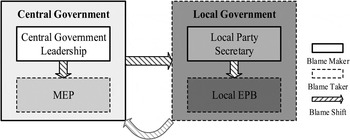
Inspired by Hood's classification, this section examines two major actors in the blame game within the government: one is the environmental policymaker in the central Party-state; the other is the environmental policy implementer in the local Party-state. BAB theory suggests that each type of actor can either be a blame taker or a blame maker.Footnote 30 My fieldwork revealed that the role of blame maker and blame taker is interchangeable in a way that is significantly shaped by the hierarchical power structure embedded in China's decentralized system of environmental governance (Figure 1). As seen in Figure 1, the chain of blame goes from the highest-ranking policymakers to the middle-ranking policymakers down to the policy implementers at the local level. This chain of blame repeats at the local level, which tends to shift the blame from the more powerful Party secretary to the less powerful Environmental Protection Bureau (EPB) officials. Despite fewer opportunities and capabilities for avoiding blame, local EPBs can also deflect blame on policy defects, other institutions and social factors, among other targets.
The Chain of Blame-shifting between Central and Local Actors

Actors at the central level: policymaker equals blame maker?
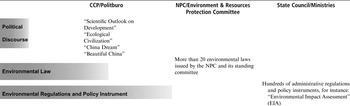
Despite the establishment of a decentralized system of environmental governance in China, the power to make environmental policy is still highly centralized within the central Party-state in Beijing, including the Party's Politburo Standing Committee (PSC), National People's Congress (NPC), State Council and its more than ten ministries. PSC produces abstract political ideas and discourse, and the NPC and State Council are responsible for translating them into specific environmental laws and policies. Meanwhile, under the supervision of the NPC, at least in theory, different ministries of the State Council make the most of concrete environmental policies (see Table 1).
Architecture of China's Environmental Policies Making System

Source:
the author.
Paradoxically, while the Party's top leadership dominates the discourse in an authoritarian manner, almost all of the environmental laws, regulations, policies and policy instruments are formulated by more than ten administrative ministries (agencies) in a highly disjointed and fragmented way. Some research has revealed that one of the outcomes of this “fragmented authoritarianism” (“FA” model) is that environmental policies are often framed in non-specific and unclear language, and conflicts between different environmental policies sometimes lead to a system lacking internal consistency.Footnote 31 The classic “FA” model explained much about the relations among various state agencies, and their blame game horizontally at the central level.Footnote 32 In the context of the “FA” model, decentralization reforms created even more spaces for intergovernmental blame in the vertical hierarchy, which might lead to further obstacles for environmental policy implementation. The chain of blame moves from the most powerful and highest-ranking policymakers to less powerful and middle-ranking policymakers, and finally drops all the way down to various agencies and policy implementers. Not many citizens have sufficient knowledge and information to understand this system accurately enough to identify these institutional defects. It is common to believe that China has already developed a comprehensive and modern set of laws and policies to address environmental issues, and that the difficulty in implementing such laws lies at the level of local implementation.Footnote 33
In comparison to local implementers, environmental policymakers as a whole have obtained credit by outwardly appealing discourse and policies. However, not every policymaker can act as a blame maker. It is evident that the PSC and its top leaders gain the most protection from shifting blame. The hierarchical power structure among various environmental policymakers allows central Party leaders, among all environmental policymakers, to maximize their own credit by showing off their “green” image and ideology to the general public and international community. Meanwhile, they have lowered the risk of being blamed when certain concrete environmental policies fail. This institutional arrangement also allows the blame for unpopular policies to shift from more powerful to less powerful players.
Central Party leaders, in fact, have successfully avoided blame for air pollution with such popular symbolic gestures, and have partly transferred it to the Ministry of Environmental Protection, which many believe should be explicitly responsible for air pollution control. With much of the population of northern China suffering toxic levels of air pollution as measured by the World Health Organization during the last week of February 2014, Xi Jinping, without wearing a facemask, made an unannounced visit to a hutong neighbourhood in Beijing. “Breathing together, sharing the fate” (tong huxi, gong mingyun 同呼吸,共命运) – a revolutionary political discourse carefully selected by the Xinhua News Agency as the headline to promote Xi's impromptu public outings.Footnote 34 This headline was also widely tweeted online. Many people hailed Xi for his “bravery for not wearing a facemask and breathing bad air with the masses” and gave the thumbs-up (“dianzan” 点赞) for that reason.Footnote 35 Meanwhile, some microbloggers wrote about it on the microblog sina weibo and used the @ symbol, to link to then-minister of environmental protection Zhou Shengxian 周生贤 and encourage him to “follow the spirit of ‘Papa Xi’ 习大大.”Footnote 36
Zhou Shengxian was removed from his environmental minister position in early 2015.Footnote 37 The official announcement did not provide detailed reasons for this change, but it was widely reported that Zhou had been harshly criticized after the “haze” (wumai 雾霾) issue became a national hot topic in 2011. Zhou received the most votes opposing his reappointment as environmental minister (171 opposed and 47 abstentions) in a NPC voting in 2013. According to media reports, NPC members even clapped when the number of opposing votes was announced. That level of opposition had not been seen in the NPC since the vote against the construction of the Three Gorges Dam in 1992.
It seems that the blame-shifting did not stop with him. Zhou called himself a minister of “embarrassment” in the media, saying, “I have heard that there are four major embarrassing departments in the world and that China's Ministry of Environmental Protection is one of them.” He blamed his ministry's dysfunction on “overlapping” remits, which confused the agency's role in handling issues such as carbon emissions and water monitoring. Meanwhile, Zhou also argued “our work needs the support and cooperation of local governments.” It came as no surprise to watch him shift blame to the environmental policy implementers at the local level.Footnote 38
Actors at the local level: policy implementer equals blame taker?
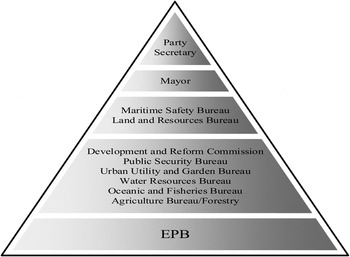
Environmental policy implementation is assigned to local governments and their agencies.Footnote 39 Generally, those environmental policy implementers must accept blame while playing the blame game with policymakers in Beijing. As illustrated in the next section, some dominant discourse used to blame local governments for environmental policy failure includes “blind pursuit of GDP,” “GDP idolatry” and “protectionism.” Are the blame game and its impacts the same with different individuals, actors or institutions in local government? In my fieldwork, I observed that the Party secretary, among several actors in the blame chain, is least likely to be blamed while local EPBs and their officials are most likely to be blamed for environmental issues. This chain of blame reflects the hierarchical power structure of the local Party-state system (Figure 2).
The Hierarchical Power Structure of Local Actors

The Party secretary will receive direct pressure if the blame originates from the central government, especially from top leaders. But this blame can be easily transferred to actors or institutions in less powerful positions. As the most powerful person in the local political system, the Party secretary is well protected from being blamed for local environmental issues. Under current environmental law, the Party secretary is assigned zero concrete legal responsibilities for environmental policy implementation, but the Party secretary's vision, interests and preferences dominate which policy areas are prioritized under “selective implementation.”Footnote 40
More crucially, the Party secretary controls local cadres’ performance evaluations, promotions and demotions, including that of the head of the local EPB, DRC and other relevant agencies. A large body of research has noted that the CCP's cadre performance evaluation system has upgraded environmental targets to “hard” targets with veto power. In reality, the number of Party secretaries who actually set environmental targets as top priorities when they evaluate local cadre performance is still under debate.Footnote 41 It is rare to find a case where the Party secretary was blamed and punished for a problem related to environmental protection. One such case seemingly occurred after an environmental protest in Qidong启东, Nantong 南通, in 2012, when the then-Party secretary was quickly moved to another position.Footnote 42 But this happened not on account of environmental protection, but rather because the then-Party secretary was held accountable for social unrest.Footnote 43 According to an official news report in 2015, several cities in Shandong province are beginning a new experiment to hold local Party secretaries responsible for failing to meet environmental targets in their jurisdiction, which would be the first time such a policy was attempted in China.Footnote 44 However, whether the Party secretary would really be held accountable for environmental governance might depend on how easy it is to shift blame for any failings to other actors or institutions.
The local EPBs are most likely to be blamed for an environmental issue. The weak position of EPBs in the local power structure often means that they are assumed to have the highest responsibility for environmental policy implementation. However, they only maintain limited authority and resources, which turn the local EPBs and their officials into prominent targets of blame.Footnote 45 I was told by a county-level Party secretary that environmental protection is the duty of the EPB and the “government,” not the local Party committee.Footnote 46 This perception is also usually held among local residents. Most of the local residents I interviewed did not know that there are more than ten actors and institutions in addition to the EPB that are also responsible for local environmental governance. A student majoring in environmental economics at one of the best universities in Beijing answered, “Who else should be responsible for dealing with the haze if the EPB isn't responsible?” She added that, “I won't work for a local EPB after graduation.… It's too weak, and its reputation is not good.”Footnote 47 One Hebei resident I interviewed criticized the local EPB's lack of responsiveness when she called a “green 911”Footnote 48 hotline about illegal garbage burning.Footnote 49 By contrast, a Hebei EPB official said that about 20 to 30 per cent of the complaints and petitions his department received through the “green 911” each year addressed environmental issues that the EPB was not able to respond to since departments other than the EPB were responsible for them.Footnote 50
In recent years, the media has consistently portrayed EPBs in a negative light.Footnote 51 It seems the heads of EPBs have become targets for blame as people's dissatisfaction with environmental problems has grown progressively worse. “Inviting the head of the EPB to swim in the local river” (qing huanbao juzhang xiahe youyong 请环保局长下河游泳) became a media event in 2013 when a businessman from Wenzhou posted a message on Weibo saying that “the river here is seriously polluted; if the head of the EPB dares to swim in this river for twenty minutes, I will give him two hundred thousand yuan.” This message was quickly reported by several national media outlets, and later was selected as one of China's most influential environmental news stories in 2013.Footnote 52
As another example of blaming EPBs, corruption cases involving EPB officials are being widely reported.Footnote 53 It was recently announced that the then-head of the EPB in Xiamen was placed under investigation due to a “serious violation of Party discipline and state law.” This case was publicized as an “anti-corruption model case” by the Commission for Discipline Inspection (CDI) in Fujian province in 2014.Footnote 54 In discussion on social media, people connected the corruption case to the official's “notorious” opinion on the “PX” project in 2007,Footnote 55 and said that to send him to prison showed the strength of the government's determination to improve environmental governance. As one angry “netizen” put it, “He asked for it! This is the guy who said PX is as toxic as coffee!” Another commenter expressed, “An investigation on him is a kind of answer for Xiamen people.” But some doubted whether he was merely a “scapegoat” targeted by the government. One commented, “I totally believe that this guy is corrupt, but I also totally believe that there are other officials who are in a higher position than him who still act unfettered and beyond the law.”Footnote 56
One way in which the government could be responding to the general public's growing concern about environmental pollution is through its anti-corruption campaign targeting EPB officials. Launched since he took power in 2012, Xi Jinping's anti-corruption movement is regarded as an appeal for people's hearts that aims to strengthen his power and the CCP's legitimacy.Footnote 57 Investigations into and reports on EPB officials’ corruption may send a message to the public that the government's resolve to fight pollution is as strong as its resolve to fight corruption. Under such circumstances, the possibility of local EPB officials avoiding blame is even slimmer.
Despite less opportunity and capability for avoidance of blame, local EPBs are not simply blame takers. My fieldwork reveals that they also behave as blame makers through three approaches: 1) shifting blame to policy defects; 2) blaming other actors or agencies; 3) blaming local residents and society. Nevertheless, whether those strategies are successful or not may largely be restricted by EPBs’ bargaining power within local Party-state systems and their power of persuasion with local residents.
While the central government and citizens usually cite “outwardly appealing” environmental policies while blaming local EPB's poor implementation of those policies, local EPB officials might try to divert that blame by pointing out the defects of the policies per se. Actually, I found in my fieldwork that most of the criticism of environmental policies came not from local residents who suffer from pollution and other environmental problems; instead, it came from local EPB officials.Footnote 58 When the then-head of the EPB in Xiamen (currently under investigation for corruption) gained national attention for his interview titled “Heartfelt wishes from the head of a local EPB,” he complained about the difficulty of his job, stating that “local EPBs do not implement environmental policy because we CANNOT do so.” He listed the four problems that most impede local EPBs: difficulty balancing local economic needs with environmental needs; difficulty balancing relations between political leaders and local citizens; difficulty balancing relations between polluters and victims of pollution; and implementation of environmental policies passed by the central government that are in opposition to local interests. In his interview, he criticized the environmental law as a “soft law” that made it difficult to punish polluters; and he said he hoped that the EPB could obtain additional financial resources from the local government to pay its staff.Footnote 59 It is true that China's environmental policies have defects that might make implementation difficult. It is also true that local EPB officials often justify their under-performance by criticizing policies.
Strategies of Blaming Local: Discursive Domination and Decentralization
Weaver pointed out eight specific blame avoidance strategies policymakers might employ, including: 1) Limiting the Agenda; 2) Redefining the Issue; 3) Throwing Good Money after Bad; 4) Passing the Buck; 5) Finding a Scapegoat; 6) Jumping on the Bandwagon; 7) Circling the Wagons; and 8) “Stopping Me before I Kill Again.”Footnote 60 Hood further identified three types of strategies for deflecting or avoiding blame, which are presentational strategies, agency strategies and policy strategies.Footnote 61 Presentational strategies are crucial in the information phase and are usually the first to be deployed when conflicts over how to assign blame begin. Agency strategies work on the perception of who is responsible for the harm, and attempt to carefully distribute responsibility across the organizational chart. They can range from “finding a scapegoat” to “delegation” strategies. Policy strategies also work on the perception of who is responsible for the harm. But instead of pointing to a scapegoat, they achieve their effect by appealing to formal rules or by herding together potential blamers.Footnote 62
Both presentational strategies and agency strategies are obvious in China's environmental politics. My fieldwork identified two prominent strategies for blaming the local government, namely discursive domination and decentralization. I argue that discursive domination through manipulation of China's propaganda machine constructs positive images of the central government's environmental policy efforts, which are framed in stark contrast with the negative image of local implementation efforts. On top of that, without decentralizing implementation responsibilities to local governments, blaming local governments’ poor implementation would not be justifiable. In that sense, decentralization provides a necessary prerequisite that enables blame to be funnelled towards local governments. The above findings also support Xiaobo Lü’s argument that decentralization in a controlled-media environment allows the central government to benefit from social policy initiatives regardless of their success or failure.Footnote 63
BAB theory predicts that the success of presentational strategies is highly dependent on their persuasive and discursive power.Footnote 64 The discursive approach towards environmental political studies finds that such discourse has been widely used by the state and political leaders to demonstrate their concerns over environmental issues.Footnote 65 As previously discussed, the Party and its top leadership dominate the construction of political discourse, which reflects the power structure in China's decentralized system of environmental governance.Footnote 66 My fieldwork found that the central government's blaming of local strategy through the discursive domination of its propaganda machine sends a strong signal to the public that local government should be blamed for environmental policy implementation failures and take responsibility for cleaning up pollution.
Yuezhi Zhao and Sun Wusan's research on media and communication in China shows that the role of the media and its “public opinion supervision” in legitimating “monopolistic party power through displays of the central leadership's paternalistic commitment to the people is more significant than the actual ability of the media to restrain local officials’ behavior.” They found that the Chinese official media, viewed as the “mouth and tongue” of the central Party-state, is a major tool of the central government to “promote the viewpoint among peasants that errant local cadres are to blame for their plight, painting itself as a good, caring government.”Footnote 67 Tianjian Shi further pointed out that the fall-off in trust moving down the spectrum from central to local authorities reflects the fact that “official media are allowed to criticize local officials, within certain limitations, but can only praise national institutions.”Footnote 68 Other research has found that access to government-controlled media could significantly dilute the negative impact of grapevine news on popular perceptions of corruption and that Chinese media contribute to regime legitimacy and effective rule by propagandizing citizens’ experiences of the legal system.Footnote 69 Their findings are helpful for understanding the mechanism by which the propaganda machine has played a significant role in shifting the blame to local governments.
The discursive domination by the central government constructed a positive image of its environmental policymaking as opposed to the negative image of local implementation. In the past decade, the “Scientific Outlook on Development” (kexue fazhanguan 科学发展观) and “Ecological Civilization” (shengtai wenming 生态文明) adopted by Hu Jintao in the 2000s, and the most recent “China Dream” and “Beautiful China” promoted by Xi Jinping since 2012 have been the major political discourses that have dominated environmental policymaking and implementation in China. The central government leadership conveyed the above political discourse largely through its propaganda machine.Footnote 70 After the leadership transition in 2012, the most prominent political discourse has been the “China Dream” that was promoted by Xi. According to the official interpretation, the “China Dream” is about the glorious revival of the Chinese nation. In Xi's speeches, he explains how the China dream should be connected to people's demands for a clean environment. As he put it, “moving toward a new era of ecological civilization and the construction of a beautiful China are the most important elements to realizing the China Dream of a glorious revival of the Chinese nation.”Footnote 71
In coverage of environmental news, it is rare to find criticism of the central government leadership and its policies. It was widely reported that seven PSC members were given, in total, 560 instructions with regard to environmental protection, 17 of which were “especially given by Xi Jinping, which shows his great attention to protecting the environment.”Footnote 72 One article published by the Party mouthpiece People's Daily argued that “the central committee and leaders care very much about environmental protection problems, have clearly instituted all kinds of environmental targets within central policies, and have invested a huge amount of effort and resources to resolve ordinary people's environmental demands.”Footnote 73 The People's Daily website specifically published “Xi Jinping's View on ‘Ecological Civilization’ since the 18th National Congress of the CCP.”Footnote 74 The propaganda department and the official media directly under its control organized a propaganda event to promote Xi's green image. One of the most cited discourses is Xi's statement that “clean water and green mountains are also golden mountains and silver mountains” (lüshui qingshan jiushi jinshan yinshan 绿水青山就是金山银山).Footnote 75
The central government leadership's outwardly attractive political discourse on environmental protection often does not lead to tangible progress for environmental issues. When environmental policies fail, local governments and their officials are often blamed for “local protectionism” and unfaithful implementation. Such dominant media discourse that blames local governments includes, for example, the “blind pursuit of GDP,” “GDP idolatry” and “protectionism.” While Xi talks about clean water and green mountains, local officials are commonly criticized for their “false cognition of political performance,” which is to say that they “only want golden and silver mountains; they don't want clean water and green mountains”Footnote 76 (zhiyao jinshan yinshan, buyao lüshui qingshan 只要金山银山,不要绿水青山). One article asserted that “some local governments have paid little attention to environmental protection due to ‘local protectionism’; local officials are only interested in GDP growth, and have benefited from that growth at the cost of the environment.”Footnote 77 Some articles argue that the environmental awareness of local government officials is very low because they are lost in “GDP worship.” As one article claimed, “some local governments blindly developed their economy without any attention to environmental protection, which is a mistake caused by local protectionism.”Footnote 78
In another article, the author discussed the three ways local environmental protectionism resulted in environmental problems: “soft law enforcement that cheats the central government and ordinary people”; “collusion and corruption of local business people and cadres as pollutant enterprises are protected by the cadres’ political umbrella”; and “local governments blogging about local pollution issues to local people as well as to the central government.”Footnote 79 Several articles call on local governments to “wake up and take seriously the fact that environmental protection is the legal responsibility of the local government, not the central government,”Footnote 80 adding that “punishment of local governments for protectionism will lead to strict implementation of central policies at the local level and the resolution of environmental problems.”Footnote 81
The strategy of discursive domination alone will not be effective in blaming local governments if the institutional arrangement of decentralization does not provide the necessary prerequisites. It is important to stress that without delegating all the implementation responsibilities to local governments, blaming their poor implementation could hardly be justified. Delegation of responsibility down the line or out from the centre is often the favourite agency strategy of higher-level policymakers for blame avoidance.Footnote 82 Further blaming opportunities exist in decentralized systems with a wider variety of actors involved in the political process than in a centralized system.Footnote 83 As Cai points out, decentralization in China helps to protect the legitimacy of the central government and the regime in two ways. First, “the decentralized power structure allows central governments to distance themselves from blame-generating situations when local governments use repression.” The central government's intervention in some large-scale incidents shifts the responsibility and blame to local governments. This arrangement also allows the central government to deny knowledge of the repression when it does not want to intervene. Second, local governments’ attitudes towards citizen resistance may focus citizens’ blame, so that instead of faulting the entire political system, they attribute the problems to their local governments.Footnote 84
The decentralized system of environmental governance may prevent the central government from being blamed for environmental policy failures, and therefore reduce the risk that the legitimacy of the central state will be questioned. The decentralized system of environmental governance in China is not very effective at cleaning up pollution, but recentralization might be risky for the central government since it will not provide the same opportunities for blame avoidance as decentralization. From this perspective, it is helpful to understand why China's central policymakers allow environmental responsibility to be decentralized and delegated to local governments and officials who are often blamed for their poor implementation. As one local official insisted, some central government environmental policies are a “big meal” for citizens, but they have to be paid for by local governments. If local governments cannot afford them, then nobody would be able to enjoy this “big meal.” This situation was vividly encapsulated by a popular saying: “The central government invites guests, but the local government has to pay the bill” (zhongyang qingke defang maidan 中央请客,地方买单).Footnote 85
In summary, the blame game in China's environmental politics is shaped by the discursive domination of the more powerful central government. Despite obvious “central protectionism” in environmental governance, local governments are often criticized and blamed for their “local protectionism” through the central propaganda machine's dominant media discourse.Footnote 86 Decentralizing environmental responsibilities to local governments created a necessary prerequisite and allows more space for blaming local officials. However, can that automatically be translated into the general public blaming local government as well? The answer may depend on to what degree the public's perception of environmental governance has been shaped by the central state's propaganda machine. In my fieldwork, I did observe that people overwhelmingly blame local governments more than they blame the central government for environmental problems, but it is still not clear whether that reflects residents’ genuine belief in the central government's dominant discourse or whether it reflects their strategic, locally focused tools for “rightful resistance.”Footnote 87
“Hierarchical Government Trust”: Contextual Factor of the Blame Game
Why do certain blame strategies work better than others? Researchers have found that the choice among various strategy options depends on contextual factors that stimulate or restrict BAB.Footnote 88 McGraw found that a government that enjoys greater trust from the general public is more successful in advancing its own interpretation of the facts in a particular blame-avoidance situation. Citizens with a high level of trust in their government are more likely to accept the government's excuses or justifications than their more cynical counterparts.Footnote 89 My fieldwork reveals that in China's decentralized system of environmental governance, trust in local governments is generally much lower than in the central authorities. “Hierarchical Governmental Trust” (HGT)Footnote 90 makes it easier to blame local government when environmental policies fail. I argue that “Hierarchical Governmental Trust” is a contextual factor as well as a partial outcome of the blame-shifting game between the central and local governments.
Environmental politics theory suggests that environmental responsibility should be assigned to the levels of government that are more legitimized. Lower-level governments generally gain more trust than higher-level governments in liberal democracies, which provides the context for decentralized environmental governance in those political systems.Footnote 91 However, despite conventional wisdom, China's decentralization of its environmental policy domain was undertaken within a macro-political context that local governments are generally less legitimized than the central government. Much research has noted that the lower the level of a particular government, the less political trust there is.Footnote 92 Lianjiang Li conceptualized it as “Hierarchical Governmental Trust.”Footnote 93
China's “HGT” is structured in a reverse pattern with that of most countries where trust is highest for the level of government that people live closest to.Footnote 94 In theory, an authoritarian regime inherently suffers from a legitimacy crisis among its people due not only to the absence of elections, human rights, rule of law and other universal norms that are widely exercised in democratic systems, but also because of the use of repression in the face of popular resistance.Footnote 95 However, as Nathan noted, one of the puzzles of the Post-Tiananmen Era is the regime's ability to rehabilitate its legitimacy.Footnote 96 Research has found that the high level of trust in the central government under the CCP's authoritarian rule mainly stems from a combination of the following sources of legitimacy: 1) economic growth and development; 2) social stability and governance; 3) political reform and institutional trust; 4) international prestige and nationalism; 5) traditional value and ideology; 6) media propaganda; 7) culture and social rights.Footnote 97
Li pointed out that popular trust in government varies considerably across policy domain. The question is whether, and how, “Hierarchical Governmental Trust” also appears in China's environmental politics? Both the poll results and my own fieldwork found that people generally trust the central government's concern about environmental problems and its efforts to fix them, but are not satisfied with the efficacy of local governments’ environmental protection work. Poll results indicate that 64.4 per cent of Chinese people think the central government has paid a great deal of attention to environmental protection, while only 4.1 per cent think the central government has not paid enough attention.Footnote 98 On the other hand, 75.4 per cent of survey respondents said local governments did not pay adequate attention to environmental protection, and 60.6 per cent were not satisfied with their local governments’ efforts to protect the environment.Footnote 99 As one of the interviewees vividly stated, quoting a popular saying, “the central government is a relative, the provincial government is a good man, the township government is a bad man, and the village cadre is our enemy” (zhongyang shi qinren, shengli shi haoren, xiangli shi eren, cunli shi chouren 中央是亲人,省里是好人,乡里是恶人,村里是仇人).Footnote 100
According to official data, the number of “collective incidents” (qunti xing shijian 群体性事件) related to environmental issues has grown by 29 per cent each year in the past decade, which has been a critical threat to social stability.Footnote 101 A report from the governmental think tank CASS estimated that around 30 per cent of the 100,000 “collective incidents” that happened in 2012 were sparked by conflict related to environmental issues.Footnote 102 However, almost all of these environmental protests happened at local levels where local governments and officials are targeted and blamed.Footnote 103 Survey respondents stated that local governments should be the entities held most responsible for cleaning up pollution through strict implementation of environmental policy.Footnote 104
Does blaming local governments for poor implementation help the construction of “Hierarchical Governmental Trust”? Some research has found that decentralization in the authoritarian state constitutes a driving force that makes the public more likely to distrust local governments partly because central governments have more opportunity to avoid blame.Footnote 105 As mentioned earlier, the central government's discursive domination sent a strong signal to the public that the environmental issues that affect them are caused by local governments’ “bad” implementation of “good” environmental policies. I found that some participants in environmental protest did believe that central government was too removed from local governments to be able to control local officials’ “bad” implementation, but they didn't think the central government's policies were “bad” per se. As one protester at the Qidong protest in Nantong said, “I don't believe all crows under the sun are black. Maybe they are not very capable … but I still have hope that they (the centre) will act. … This is the only thing I can do.”Footnote 106
Two environmental activists who strongly opposed the construction of a chemical plant (“PX” project) in Xiamen told me that they were looking for central government officials whom they could complain to about the pollution caused by the local government-proposed chemical industry. They also hoped the central government would investigate the environmental issues in Xiamen, insisting the then-local Party secretary's “great leap forward style” of developing the petro-chemical industry betrayed Hu Jintao's “Scientific Outlook on Development” (kexue fazhan guan 科学发展观), which led to the environmental problem caused by the “PX” development.Footnote 107 The organizer of a grassroots environmental NGO called Xiamen Green Cross Association (Xiamen lü shizi 厦门绿十字) said the construction of polluting industries in Xiamen was not in the interest of the leadership in Beijing. She encouraged local activists to take their concerns to Beijing instead of organizing street protests in Xiamen.Footnote 108 Interestingly, two of the most popular protest signs in Xiamen's “Anti-PX” protest were “Anti-PX – for the Full Implementation of the Central Level's ‘Scientific Outlook on Development’” as well as “Party Secretary Step Down.”Footnote 109
O'Brien and Li pointed out that “Chinese villagers trust the Center and distrust the lower level in a pattern that encourages the transformation of policy violation into opportunities for rightful resistance.”Footnote 110 Li further pointed out how distrust in local governments may reflect partial distrust in the central government, or at least doubts about its capabilities to choose, monitor and control local authorities.Footnote 111 It is indeed doubtful that people's trust in central government is real, or merely for strategic reasons. However, it is very clear to local residents (especially those who engaged in “rightful resistance”) that blaming their local government bears a relatively lower political risk than blaming central government. Central government's design – that few formal institutional channels permit people to criticize central government (especially the top level of leadership) – diffuses possible aggression against the central Party-state as a whole.Footnote 112
While trust in central government might not be genuine, it can help shift the blame from central to local officials. Cheng Li pointed out that central government's strategy under Hu-Wen's leadership is to localize social unrest and blame local leaders; in other words, central leadership's “blame game” has generated or reinforced the public assumption that social protests occurred because local leaders did not comply with the policies of the central government.Footnote 113 Moore argued that “Beijing is pursuing a deliberate and largely successful strategy of protecting the central government from environmental fallout by skilfully deflecting blame toward protectionist local officials and state-owned enterprises. In the process, the central government is enhancing its own power.”Footnote 114
Studies of the environmental movement in former Eastern European communist countries found that environmental crises led to national social movements that presented a significant challenge to the Party-state's political legitimacy.Footnote 115 It seems that China's central Party-state still shows a certain degree of “authoritarian resilience” despite the serious environmental crises nationwide. The decentralized governance structure and “Hierarchical Governmental Trust” in China's environmental governance might mutually reinforce themselves so that central government avoids being blamed for environmental policy failures, and therefore reduces the legitimacy risk felt by a central state challenged by China's continuing environmental crises.
Conclusion
The supporters of decentralized environmental governance theory believe that decentralization can produce better environmental performance mainly because lower-level governments are closer to the people and environmental issues, and therefore more legitimate than the national government. China's central government has decentralized environmental protection responsibilities to local governments and constructed a sophisticated decentralized system of environmental governance. However, the performance of China's decentralized environmental governance structure is poor. Decentralization is widely regarded as one of the most significant reasons for China's environmental governance crisis, and local governments and officials are often blamed for creating the huge gap between China's environmental policies and implementation outcomes.
Current literature on China's environmental politics and policy implementation has assumed that policymakers tend to select a decentralized environmental governing system because they believe it will translate into better environmental performance. However, as BAB theory highlights, in reality, policymakers may choose such a system based on concerns over who is blamed when environmental policies fail and who receives credit when environmental policies succeed. BAB theory and its applied studies in comparative politics further suggest that a greater number of blaming opportunities exist in decentralized systems with a wide variety of actors involved in the political process than in a centralized system. China studies found that decentralization in a controlled media context allowed central government to distance itself from any situations it might be blamed for.
This article tries to understand the puzzle of China's decentralized system of environmental governance and its poor environmental performance through the perspective of BAB theory. I examined how the actors, strategies and context of blaming politics shaped China's decentralized system of environmental governance. Drawing on documentary discursive analysis and extensive fieldwork, this article suggests that the dysfunction of China's decentralized environmental governance structure might be an outcome of the blame-shifting game between central and local governments.
First, I found that, generally, the environmental policymaker in the central Party-state and the environmental policy implementer in the local Party-state played the role of blame maker and blame taker, respectively. Not every policymaker and implementer has the same opportunity to make or take blame. The chain of blame shifts from more powerful to less powerful actors. The hierarchical power structure among various environmental policymakers and implementers has allowed central Party leaders, among all environmental policymakers, to minimize the risk of being blamed when certain concrete environmental policies have failed; on the contrary, local EPBs are most likely to be blamed over environmental issues.
Second, this article suggests that discursive domination and decentralization are the two prominent strategies that shift blame from the central to the local government. Discursive domination through manipulation of the government's propaganda machine constructs a positive image of central government's environmental policymaking, which contrasts with the negative light in which local implementation is portrayed. Meanwhile, decentralization provides a necessary prerequisite that enables blame to be funnelled towards local government.
Finally, this article reveals that China's decentralized system of environmental governance is embedded in a broader political context in which trust in local governments is generally much lower than the trust in central government. “Hierarchical Governmental Trust” functioned as a contextual factor as well as partial outcome of the blame-shifting game between central and local governments. “HGT” and a decentralized environmental structure might mutually reinforce the way in which central government is protected from being blamed for environmental policy failures and reduce the legitimacy risk of the central state when challenged by China's continuing environmental problems.
Many observers believe that over the last decades, and especially during Xi's rule, China's environmental governance has witnessed a new trend of recentralization.Footnote 116 According to the 13th Five-Year Plan proposal, China plans to centralize environmental supervision and monitoring agencies to the provincial level.Footnote 117 Nevertheless, environmental protection responsibilities remain decentralized, with local governments continuing to take more blame for pollution and other environmental problems. Recentralization or decentralization of China's environmental governance system may not depend principally on which system is more efficient in cleaning up pollution, but rather on political elites’ manoeuvring in blame politics.
Acknowledgement
This research is supported by the Research Funds of Renmin University of China, US-China Institute at University of Southern California and Haniel Foundation. An earlier version of this article was presented at Brown-Hertie School Workshop “China Environmental Governance” and the 2014 Annual Conference of the Association for Asian Studies. The author thanks all the panellists, Jack Chang and the anonymous reviewers for their helpful comments on earlier drafts.
Biographical note
Ran Ran is an associate professor of political science at the School of International Studies, Renmin University of China. Her research interests are Comparative Environmental Politics, Decentralization and Local Governance in China.